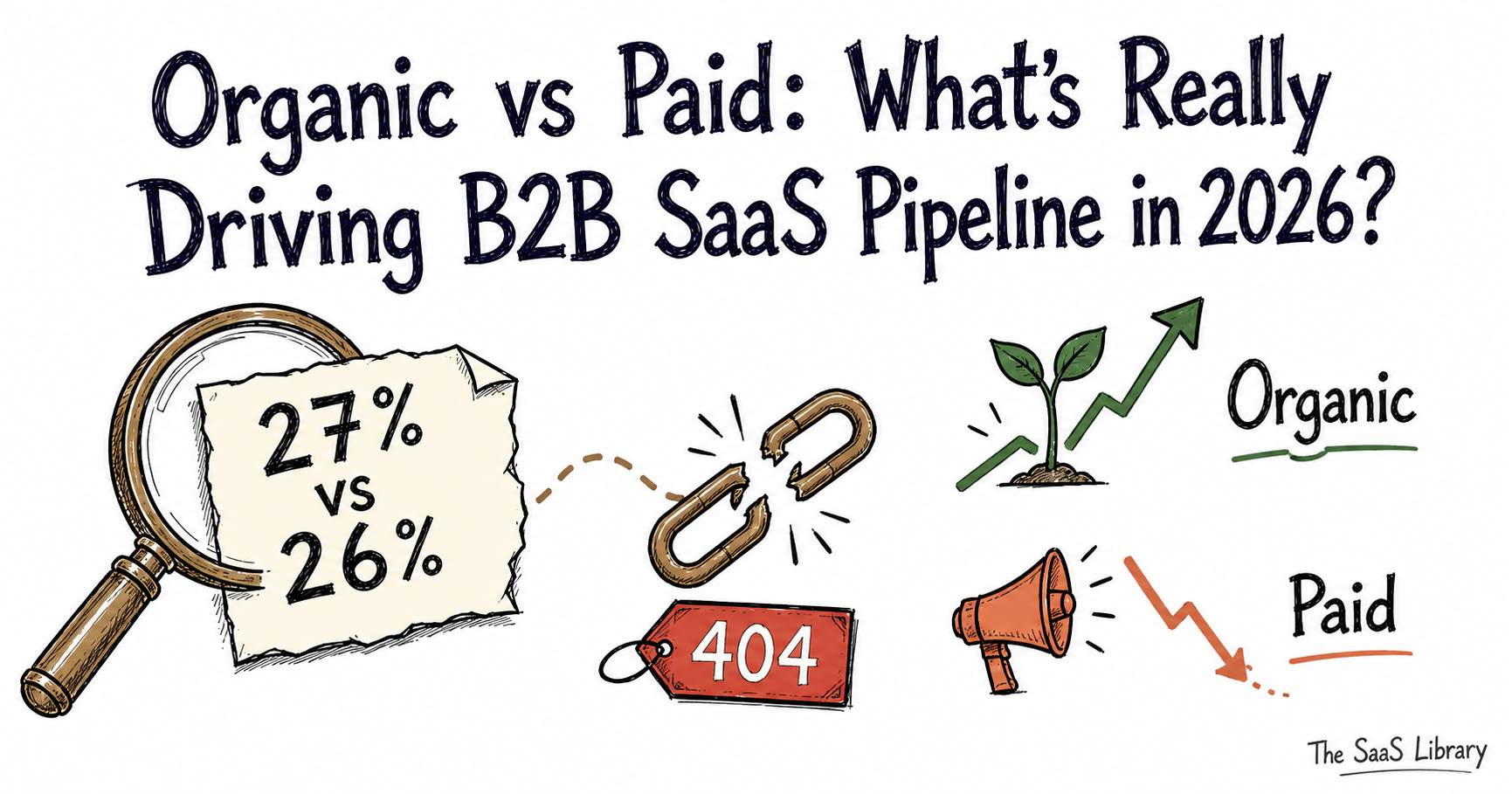
The organic vs paid B2B SaaS pipeline 2026 debate keeps citing a stat that doesn’t lead to a real report — it leads to a 404. Organic is still probably winning; this particular proof of it isn’t real.
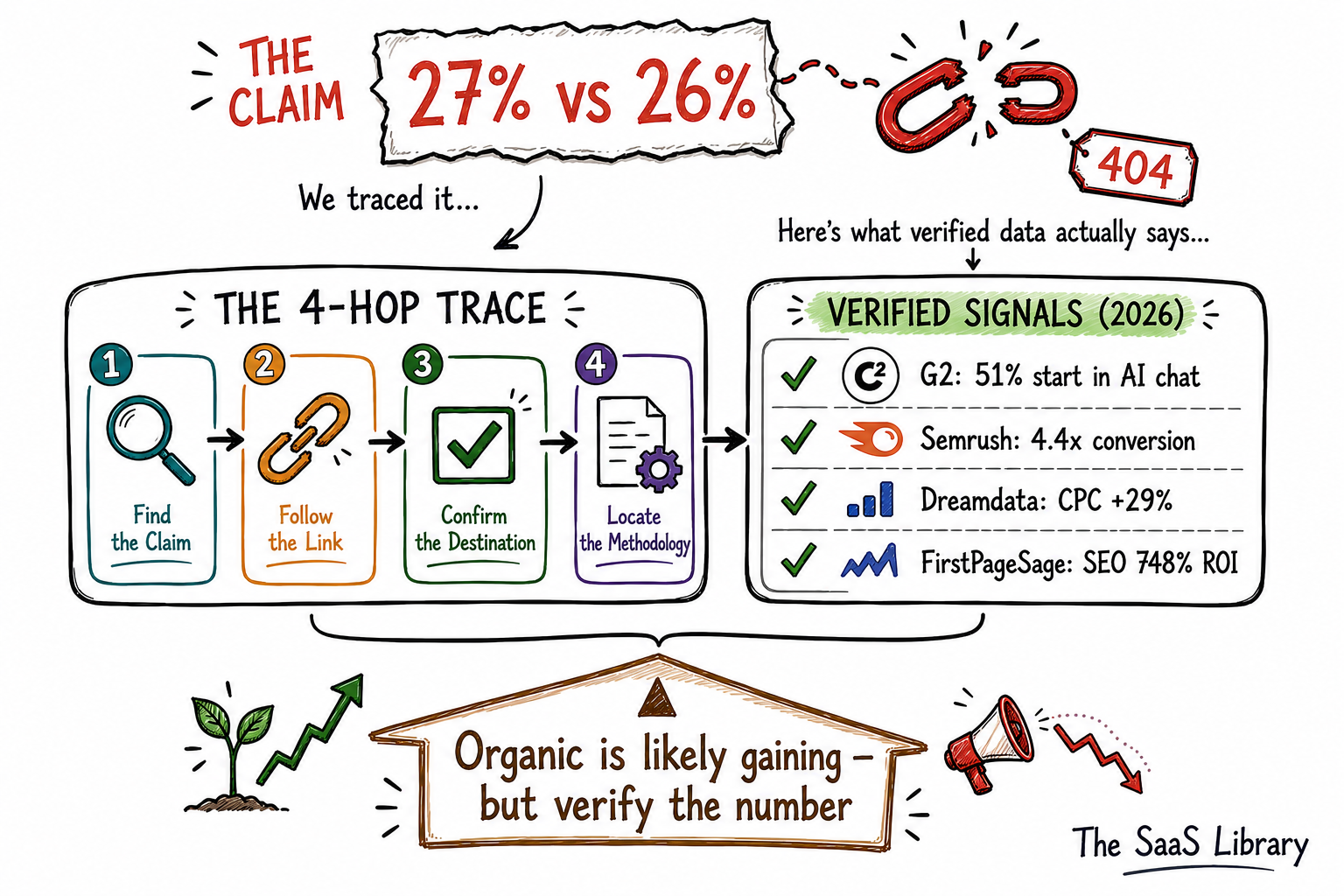
Organic is likely gaining pipeline share on paid in 2026, based on verified data from G2 and Semrush — but the specific “27% vs 26%” statistic driving this narrative traces to a source that returns a 404 error, meaning that exact figure cannot currently be verified.
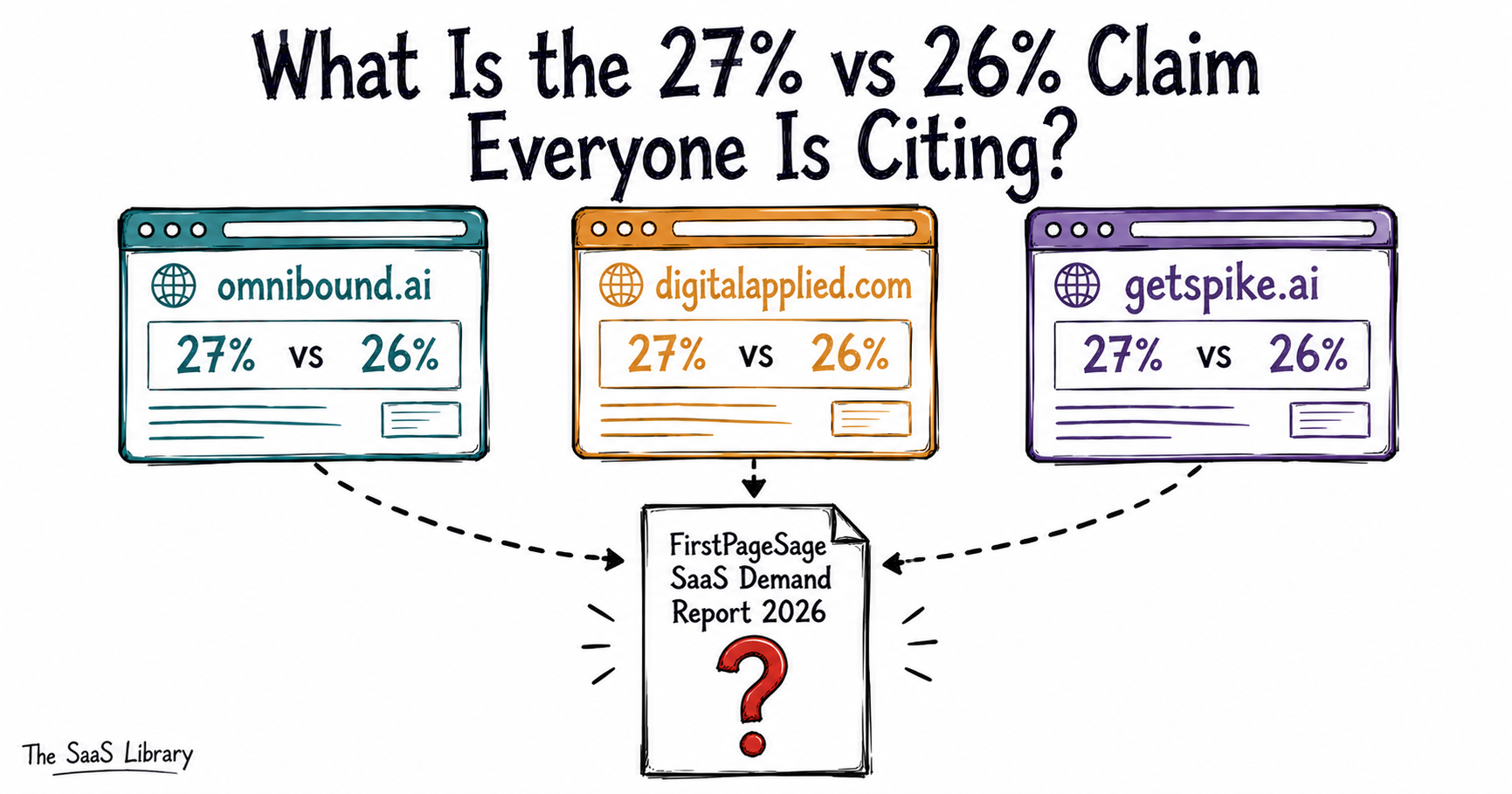
What Is the 27% vs 26% Claim Everyone Is Citing?
The organic vs paid B2B SaaS pipeline 2026 debate keeps circling one specific pipeline-attribution statistic: organic search, SEO, and AEO combined now source 27% of median B2B SaaS pipeline (41% at top-quartile companies), up from 22% in 2023, while paid acquisition has fallen from 34% to 26%, according to a widely repeated figure. Every version of the stat is attributed to the same source: a “FirstPageSage SaaS Demand Report 2026.” This sits inside a broader set of 2026 B2B SaaS trends reshaping how pipeline gets built — but this specific proof point deserves its own scrutiny.
The number shows up everywhere. It’s the anchor stat in at least four separate stat-aggregator articles published between April and June 2026, each repeating it nearly word-for-word.
| Site | Published | Attribution given |
|---|---|---|
| omnibound.ai | June 30, 2026 | “FirstPageSage SaaS Demand Report 2026” — hyperlinked |
| digitalapplied.com | April 29, 2026 | “FirstPageSage SaaS Demand 2026” — named, no link |
| getspike.ai | ~July 2026 | “recent B2B SaaS benchmarks” — unattributed, then names First Page Sage |
A statistic this specific — three decimal-free percentages, a named 2023 baseline, a top-quartile breakout — should be traceable to one primary document. Instead, it only exists inside other people’s summaries of it.
The claim is also doing real argumentative work. It’s cited as evidence that organic has become “the single largest pipeline contributor” for the first time — a much stronger claim than “organic is growing.” That distinction matters for the next section, because it’s exactly the kind of claim that needs a primary source, not a chain of paraphrases.
What Happened When We Traced the Stat to Its Source?
What happened is four hops of citation that moved further from a primary source at every step. Each hop should have gotten closer to verification. Instead, it got further away.
Hop 1 — The Aggregator
Omnibound’s B2B SaaS marketing statistics page states the 27% vs 26% figure as fact and links it directly to a page on firstpagesage.com. The same article makes an explicit methodology claim: “Every statistic was traced to its originating study before inclusion.”
Hop 2 — The Link
We opened that exact URL. It returns a 404 error. The page does not exist.
The FirstPageSage URL cited as the stat’s origin (firstpagesage.com/seo-blog/roi-of-seo/) returns a 404 error. No report by that name exists anywhere on the domain.
Hop 3 — The Real Site
We searched firstpagesage.com directly for a “SaaS Demand Report.” It doesn’t exist under that name anywhere on the domain. What does exist is a real, dated report — B2B SaaS Marketing Channels: 2026 Comparison, published May 5, 2026 — and it contains genuine data. None of it is a pipeline-share percentage.
| Channel | Real FirstPageSage data (2026) |
|---|---|
| SEO | 748% 3-year ROI |
| GEO | 520% 3-year ROI |
| PPC / SEM | 36% 3-year ROI |
| LinkedIn Ads | 192% 3-year ROI |
This is FirstPageSage’s actual published position on channel performance. It’s a ROI comparison, not a pipeline-attribution split. The 27/26/41 figures aren’t a mangled version of this table — they’re not in it at all.
Hop 4 — The Mutation
A fourth site, getspike.ai, repeats the same 27/26 claim but changes one detail without flagging it: “LinkedIn ad CPMs have risen ~24% year-over-year, with Google Ads not far behind at ~19%.” Every other version of this claim — including omnibound’s — describes the same 24%/19% figures as CPL (cost per lead), not CPM (cost per thousand impressions). Somewhere in the retelling, the unit changed, and nobody flagged it.
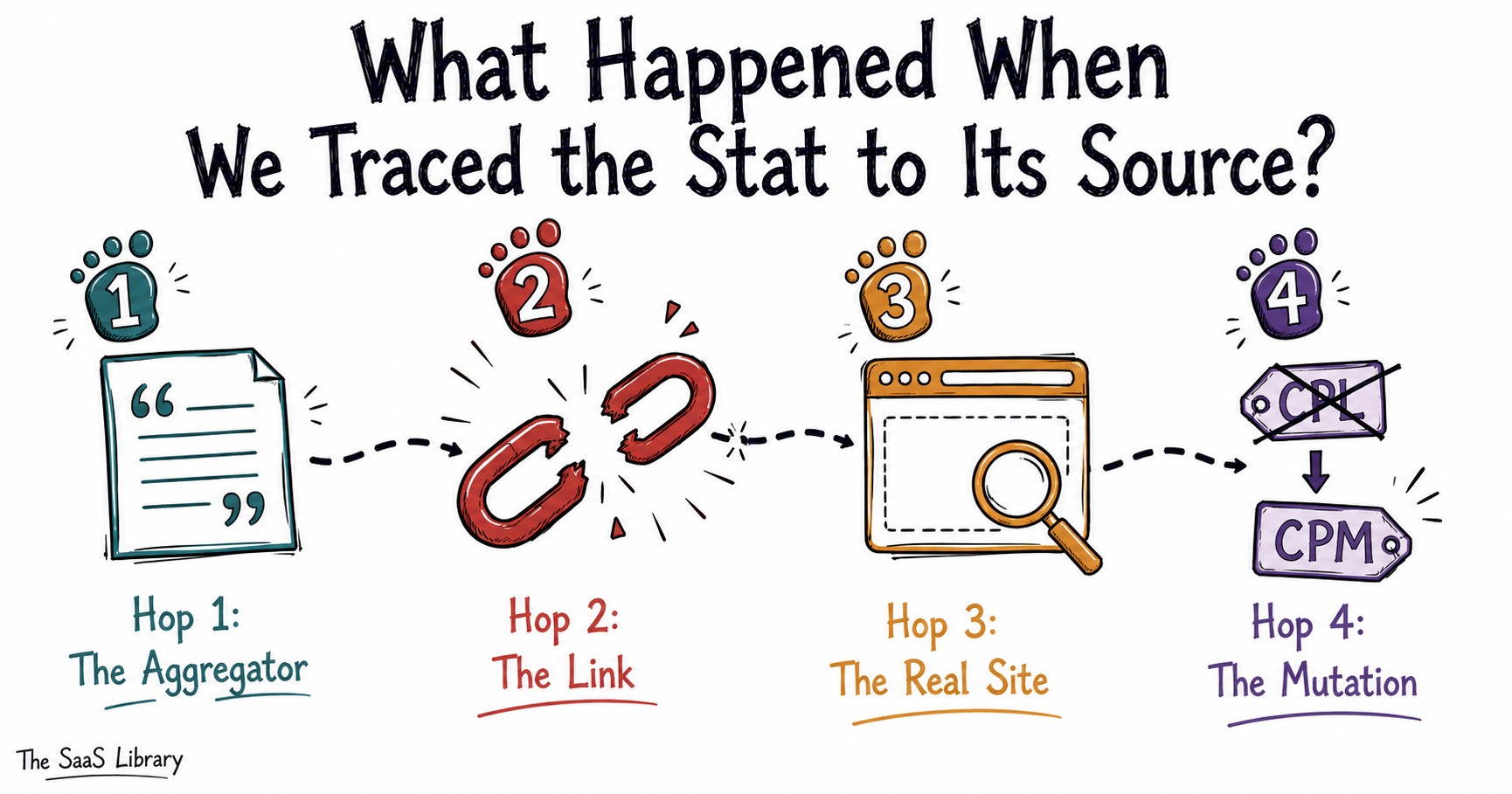
So what actually happened here isn’t one error. It’s four: a claim invented or badly sourced at the origin, an aggregator that states a false verification process, a dead link standing in for a citation, and a metric that silently changed meaning in transit. And this is happening in content explicitly built to be summarized by ChatGPT and Claude — the page itself has “Summarize with ChatGPT” and “Summarize with Claude” buttons built in. The unverifiable number isn’t just sitting in a blog post. It’s being actively fed into the exact systems this whole article is about.
See how AEO and GEO tools are actually pulling their data — useful context before you trust any AI-citation stat.
How SEO, AEO & GEO Tools Collect Data →What Does Verified Data Actually Say About Organic vs Paid in 2026?
Verified data shows organic is very likely gaining pipeline share on paid in 2026 — the direction of the phantom stat is probably still correct, even though its exact numbers aren’t. Four independently confirmed data points support this, and none of them originated from the broken chain in Section 2.
The buyer’s starting point has moved
G2’s own research, published April 15, 2026, found that 51% of B2B software buyers now begin research inside an AI chatbot more often than a search engine, up from 29% just twelve months earlier. That’s not a niche behavior shift — it’s the majority starting point flipping in under a year.
If half your buyers form a first impression of your brand inside an AI answer before they ever see your homepage, your website’s ranking matters less than what the answer engine says about you.
Sanders explains that buyers no longer gather sources themselves — they trust a chatbot to synthesize the research and hand back a shortlist in a single prompt, which changes what it takes for a vendor to even be considered.
AI-referred traffic is worth more per visitor
Semrush’s June 2025 study of 500+ marketing and SEO topics found that visitors arriving from AI search convert at 4.4 times the rate of standard organic visitors. This number comes from marketing-topic content, not B2B SaaS specifically, so it’s directional evidence of a pattern rather than a SaaS-specific benchmark. The mechanism still applies to SaaS buyers: an AI answer pre-qualifies intent before the click ever happens, so the person who does click has already done most of their evaluating.
Paid acquisition is getting measurably more expensive
Dreamdata’s 2026 benchmark — built from aggregated Google Ads data across its B2B customer base, Aug 2024 to Jul 2025 — found non-branded Google Search CPC rose 29% to $5.34, while click-through rate fell 26% over the same period. That’s real cost inflation, verified with disclosed methodology, not a citation-chain artifact.
Organic’s own ROI case doesn’t need the disputed stat
FirstPageSage’s real, dated 2026 channel comparison — the one Section 2 traced the phantom stat back to and didn’t find — still makes a strong case on its own: SEO returns 748% ROI over three years against PPC’s 36%, with GEO at 520%. Organic doesn’t need an unverifiable pipeline-share figure to look like the better long-term bet. It already has one, sitting in the same report the phantom stat was falsely attached to.
| Verified data point | Source | What it shows |
|---|---|---|
| 51% start research in AI chatbot (up from 29%) | G2, Apr 2026 | Buyer behavior has shifted starting points |
| 4.4x conversion rate for AI-referred visitors | Semrush, Jun 2025 | AI traffic pre-qualifies intent |
| CPC +29%, CTR −26% (non-branded Search) | Dreamdata, 2026 | Paid is getting more expensive, independently of organic |
| SEO 748% ROI vs. PPC 36% ROI | FirstPageSage, May 2026 | Organic’s real ROI case doesn’t need a disputed stat |
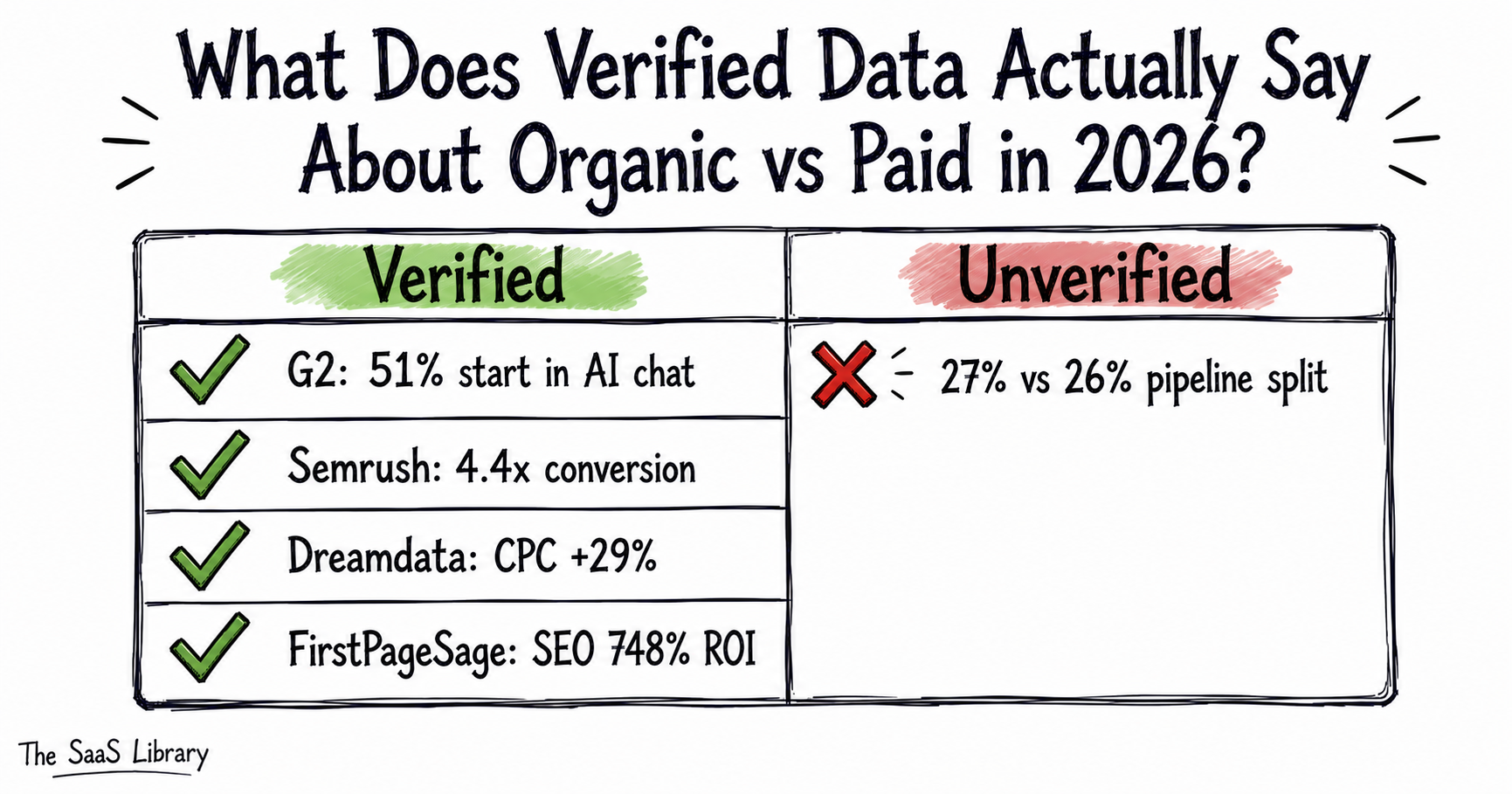
None of this proves organic has overtaken paid as the single largest pipeline contributor — that specific claim still has no verified source. It does show that every plank of the broader argument holds up without it.
Why Do AI Answer Engines Keep Repeating Unverifiable Stats?
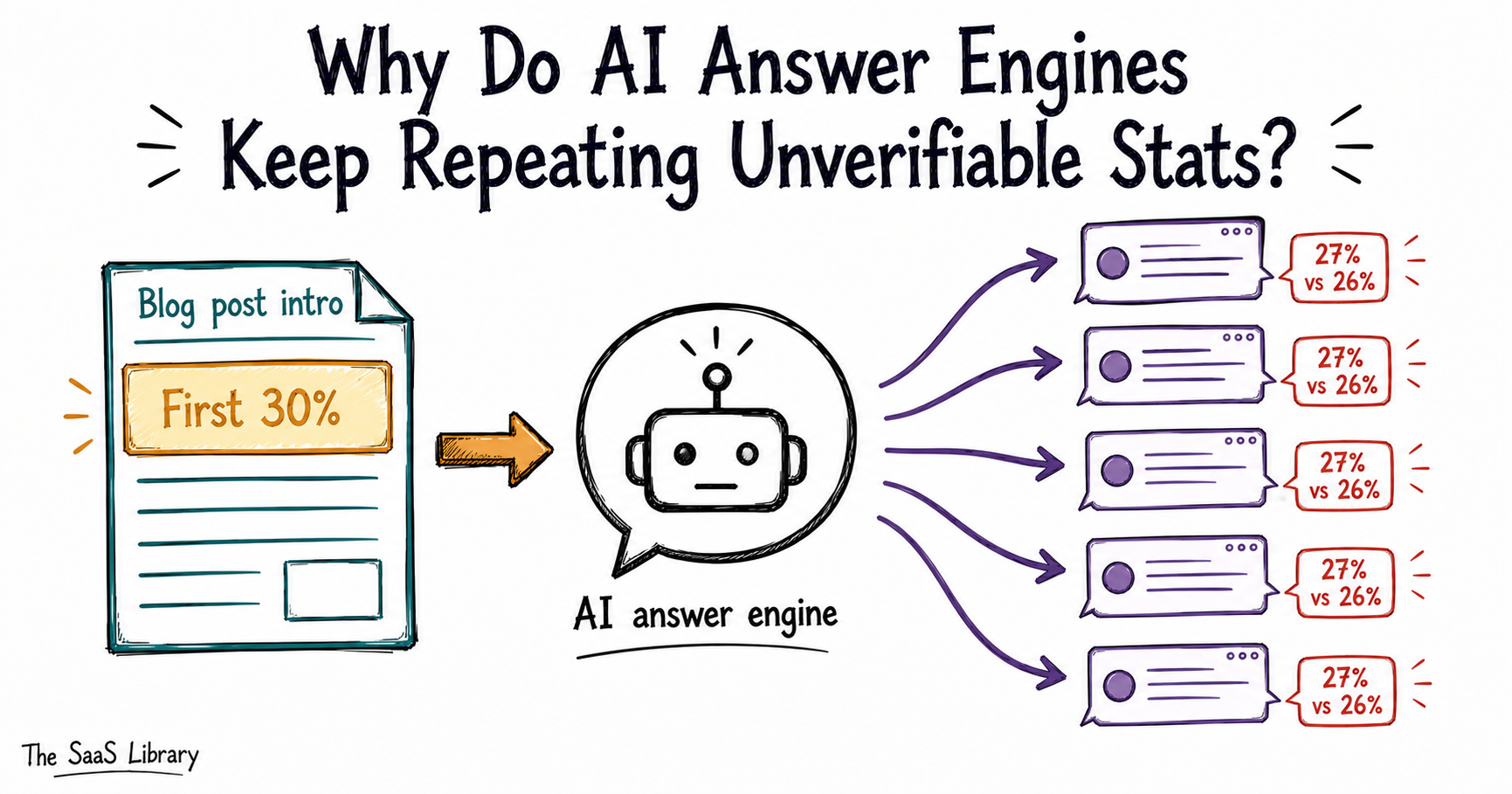
AI answer engines repeat unverifiable stats because they’re built to extract and synthesize, not to fact-check, and the citation-trail failure from Section 2 is exactly the kind of error that structure rewards.
Extraction favors repetition, not verification
Research tracking LLM citation patterns found that a large share of citations are pulled from the first 30% of a page’s content — the introduction, where a stat like “27% vs 26%” gets stated plainly and confidently. Attribution for this specific figure is contested; it circulates under at least three different named sources depending on which secondary site you read, which is itself a small version of the same problem this whole article is about. Whichever the origin, the pattern holds: a confidently stated number near the top of a page is more likely to get pulled into an AI answer than a hedged one buried in a caveat-heavy paragraph. That’s consistent with Google’s own guidance that GEO and AEO are still fundamentally SEO — the extraction layer changed, not the underlying incentive to rank confidently stated claims.
The aggregators are already feeding the machine
Omnibound’s article — the same one whose 404-linked stat anchors this whole piece — has “Summarize with ChatGPT,” “Summarize with Claude,” and “Summarize with Perplexity” buttons built directly into the page. Readers who click any of them are asking an AI system to synthesize an article that states a false verification claim and links to a dead page.
The unverifiable stat isn’t sitting quietly in one blog post. It has an active on-ramp into the same answer engines that 51% of B2B buyers now start their research in.
Why this compounds faster than it corrects
Once three or four aggregator sites repeat a stat with enough confidence and volume, it starts to look independently confirmed — even though every instance traces to the same broken chain. It’s also a technical crawlability issue as much as an editorial one, which is where technical SEO in the AI era comes in: the pages an AI system can crawl and extract from are the pages that shape its answers, regardless of whether those pages did the verification work they claim to have done.
None of this is unique to this one stat. It’s a preview of what happens to any number that’s stated with confidence, links convincingly, and never gets checked at the destination.
How Can You Verify a Marketing Stat Before You Cite It?
You can verify a marketing stat before citing it by running it through four checks: find the claim, follow the link, confirm the number exists at the destination, and locate the methodology behind it. We call this the 4-Hop Trace — the same method applied to the 27% vs 26% stat in Section 2.
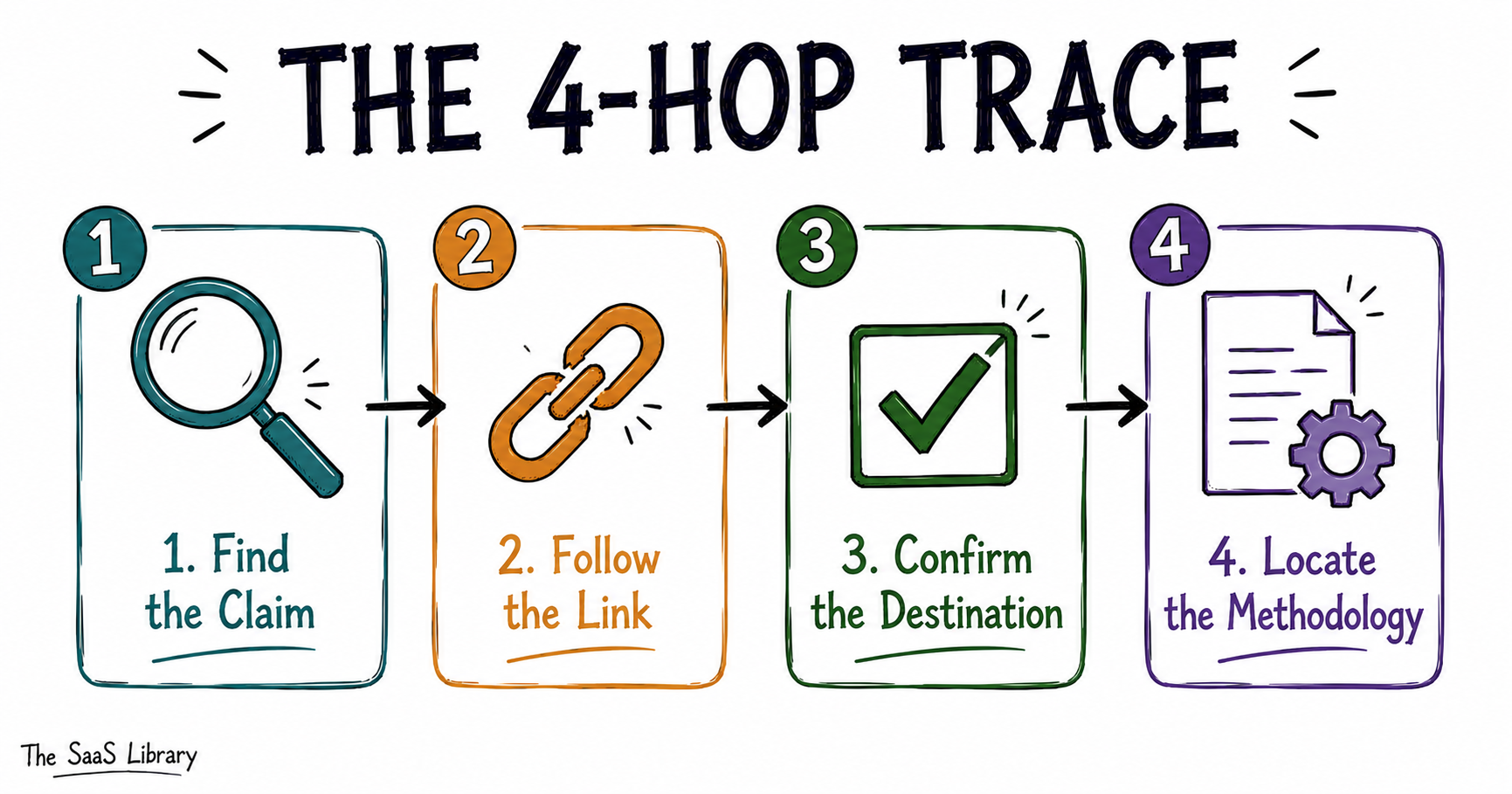
A stat only earns the right to be cited once it clears all four hops. This one failed at Hop 2 and never had a chance to clear Hop 4.
Applying the trace beyond this article
The 4-Hop Trace isn’t specific to pipeline-attribution stats — it works on any number that circulates in marketing content: conversion-rate claims, ROI percentages, adoption-rate figures. Before you put a stat in a deck, an article, or an investor update, run it through these four questions. If it fails at Hop 2 or Hop 3, treat it the way this article treats the 27/26 figure — usable as an example of what’s being claimed, not usable as a fact.
Frequently Asked Questions
Is organic really beating paid in B2B SaaS pipeline in 2026?
Organic is likely gaining pipeline share on paid in 2026, based on verified data from G2 and Semrush showing buyer behavior and traffic value shifting toward AI-mediated and organic search. The specific claim that organic has become the single largest pipeline contributor — the “27% vs 26%” figure — is not currently verifiable from any locatable primary source.
What is the 27% vs 26% B2B SaaS stat?
The 27% vs 26% stat is a claimed pipeline-attribution figure stating that organic, SEO, and AEO combined source 27% of B2B SaaS pipeline while paid sources 26%, down from 34% in 2023. It is attributed across multiple sites to a “FirstPageSage SaaS Demand Report 2026,” which could not be located.
Is the FirstPageSage SaaS Demand Report real?
The FirstPageSage SaaS Demand Report, as named and linked by the sites citing it, could not be confirmed to exist. The linked URL returns a 404 error, and no report by that name appears anywhere on FirstPageSage’s own site.
Why do so many sites cite the same unverified stat?
Sites cite the same unverified stat because once a few aggregators repeat a number with confidence, it starts to look independently confirmed even though every instance traces back to the same broken source. AI answer engines compound this by extracting confidently stated figures without verifying the destination link.
What is the 4-Hop Trace?
The 4-Hop Trace is a four-step method for verifying a marketing statistic before citing it: find the claim, follow the citation link, confirm the number exists at the destination, and locate the methodology behind it. A stat that fails any of these four steps shouldn’t be cited as fact.
How much more do AI-referred visitors convert compared to organic?
AI-referred visitors convert at 4.4 times the rate of standard organic visitors, according to Semrush’s June 2025 study of 500+ marketing and SEO topics. This figure comes from marketing-topic content specifically, so it should be treated as directional evidence for B2B SaaS rather than a SaaS-specific benchmark.
What percentage of B2B buyers start research with AI chatbots?
51% of B2B software buyers now begin their research inside an AI chatbot more often than a traditional search engine, according to G2’s April 2026 report, up from 29% in April 2025.
Why are paid acquisition costs rising in B2B SaaS?
Paid acquisition costs are rising in B2B SaaS because click-through rates are falling as AI Overviews absorb search queries, which drags down Quality Scores and pushes CPCs higher. Dreamdata’s 2026 benchmark found non-branded Google Search CPC rose 29% to $5.34 while CTR fell 26% over the same period.
Is SEO still worth the investment for B2B SaaS in 2026?
SEO is still worth the investment for B2B SaaS in 2026 based on FirstPageSage’s verified 2026 data, which shows SEO delivering 748% ROI over three years compared to 36% for PPC. This case holds independently of any disputed pipeline-share statistic. For the complete ROI breakdown, see Is SEO Still Worth It for B2B SaaS in 2026?
How can I verify a marketing statistic before citing it?
You can verify a marketing statistic before citing it by running the 4-Hop Trace: locate where the claim is stated, follow its citation link, confirm the number actually appears at that destination, and check whether a disclosed methodology exists behind it. If the trail breaks at any step, treat the number as unverified.
Conclusion
The channel rebalance toward organic and AEO is real — G2, Semrush, and Dreamdata all independently confirm pieces of it. But the specific number most often used to prove it, 27% vs 26%, traces to a dead link, not a report. Run any stat like it through the 4-Hop Trace before it goes in your next deck or article.
If you want the case for organic without a disputed number attached, FirstPageSage’s own verified ROI data already makes it. This kind of unverified-stat problem isn’t isolated to this one claim — see Optimization Without Understanding: The Hidden Cost of AI-Assisted SEO for how it shows up elsewhere in AI-assisted content work.
- G2 — The Answer Economy: How AI Search Is Rewiring B2B Software Buying, 2026
- Semrush — We Studied the Impact of AI Search on SEO Traffic, 2025
- Dreamdata — B2B Google Search Ads Benchmark, 2026
- FirstPageSage — B2B SaaS Marketing Channels: 2026 Comparison
- Omnibound — B2B SaaS Marketing Statistics (2026) — cited as audit specimen
- Spike AI — B2B SaaS Marketing News: 5 Structural Shifts Reshaping 2026 Strategy — cited as audit specimen
- FirstPageSage — cited destination URL (returns 404, evidence of broken citation)