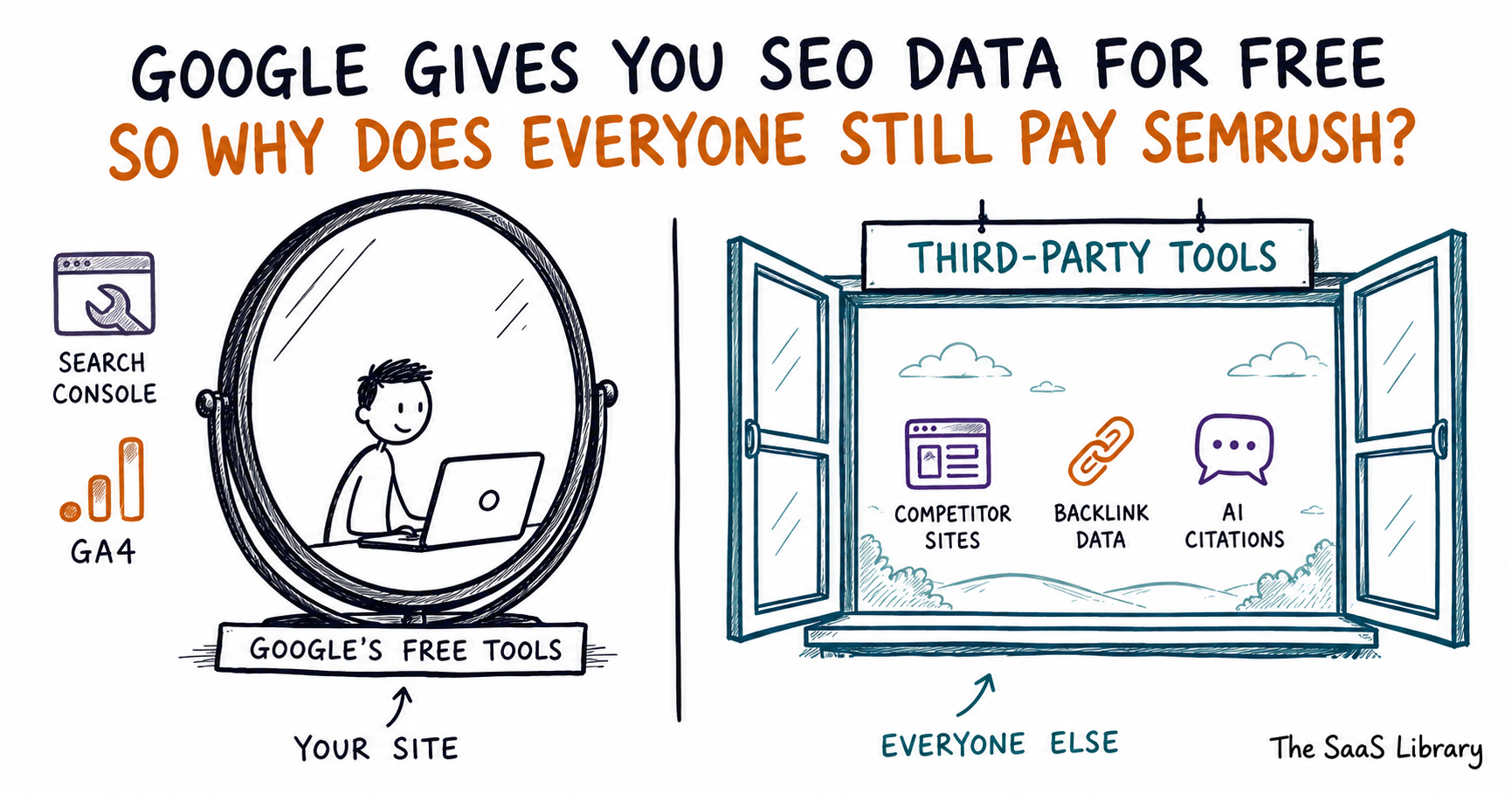
Google Search Console hides close to half of your search data from you, on purpose. That’s the whole reason SEMrush still makes money next to a free tool.
People still pay for SEMrush because Google’s free tools only show you your own site, on Google, with pieces hidden by design. SEMrush and tools like it show you your competitors, other search engines, and AI citations. These are the exact things Google will never hand you for free.
How Much of Your Google Search Console Data Is Actually Hidden?
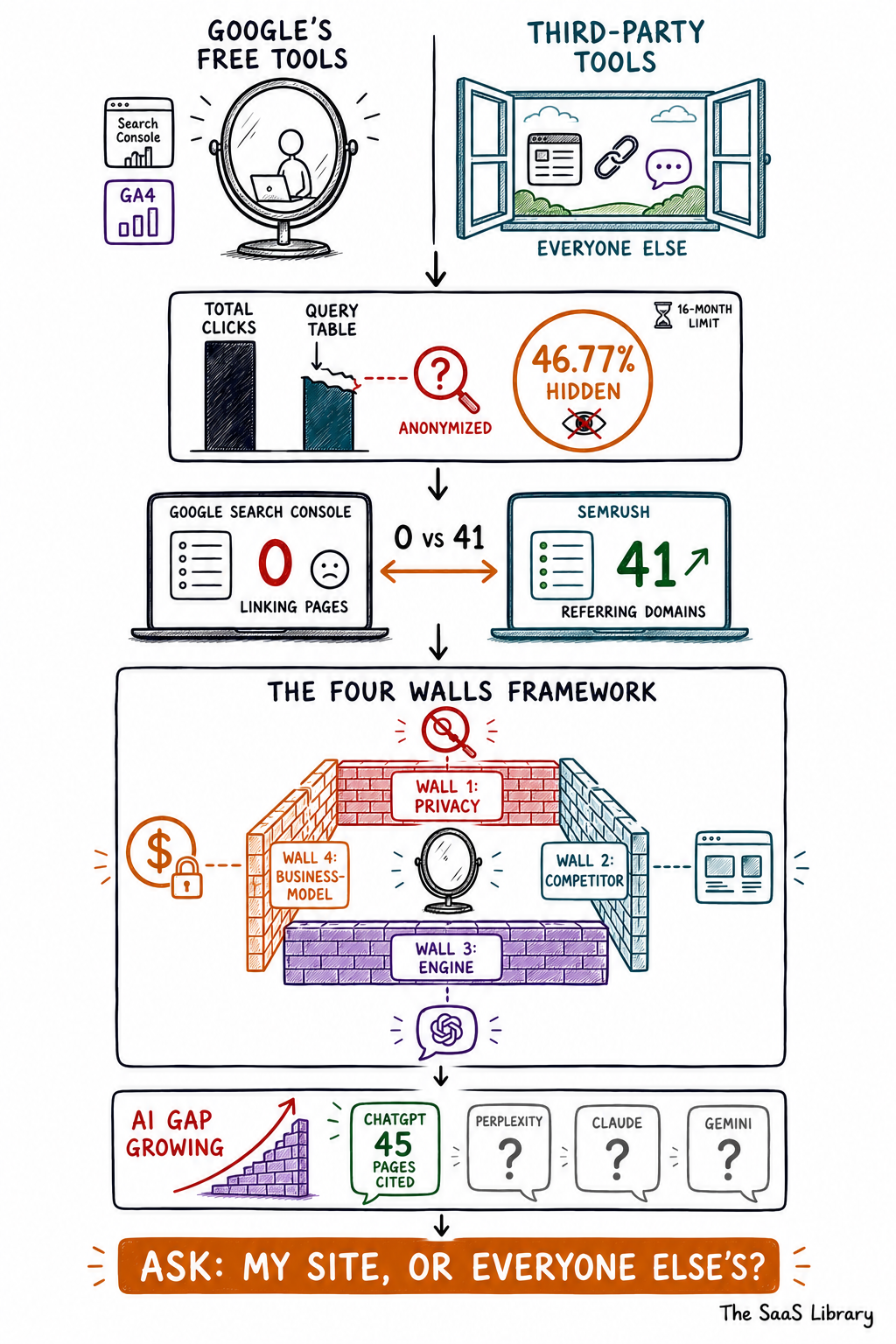
A huge amount of your Google Search Console data is hidden, and Google says so itself if you know where to look.
Here’s the part that trips up almost every beginner. You open Search Console. You check your top queries. The number at the top of the chart never quite matches the numbers in the table underneath it. That’s not a bug. That’s Google removing data on purpose.
Google calls this an “anonymized query.” Its own Search Central documentation explains the rule in plain terms:
- Queries typed by only a small number of people over a two to three month window get pulled from your report
- This happens to protect the privacy of the person who searched, not to punish your site
- The clicks still count in your total chart, but the actual words people typed disappear from the table
So what does that mean for you, practically? It means real traffic is landing on your page right now, and you are not allowed to know what words brought it there.
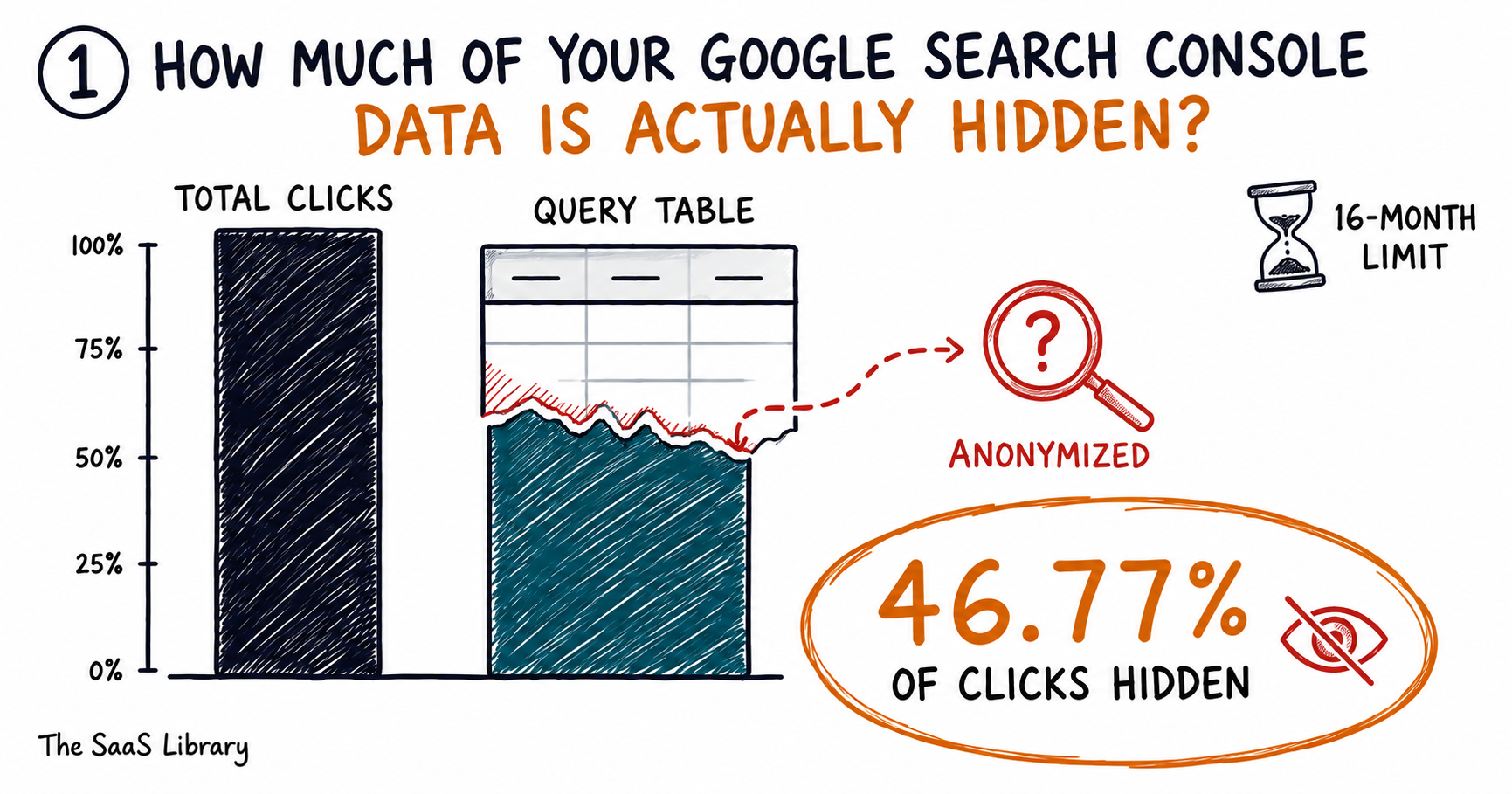
Patrick Stox, the researcher at Ahrefs who ran that study, found this wasn’t a one-time glitch. He noted the 2025 number was “only slightly worse than the 46.08% anonymous we saw in 2022.”
In other words, this has been the normal state of Search Console for years. Most people just never checked. And it gets worse once you leave Google’s home turf.
Under the European Union’s Digital Markets Act, Google was forced to define exactly what counts as an anonymized query for regulatory purposes. DuckDuckGo looked at that definition and estimated it strips out close to 99% of long-tail queries, the longer, more specific searches that make up a huge share of real search behavior.
Search Console only keeps 16 months of your performance history. After that, it’s gone. No export, no recovery, no second chance.
So here’s where that leaves you. Google Search Console gives you a real, accurate picture of your own site. But it’s a picture with almost half the frame cut out, a hard expiry date, and zero information about anyone but you. Which raises the next obvious question. If Google won’t even show you all of your own data, what happens when you want to see someone else’s?
Why Doesn’t Google Show You What Your Competitors Are Doing?
Google doesn’t show you what your competitors are doing because Search Console and GA4 are built to report on exactly one property: yours.
Not the site ranking above you. Not the site stealing your featured snippet. Just you. That sounds obvious once you say it out loud. But it has a bigger consequence than most beginners realize. If Google won’t even show you all of your own data, as we just saw, it will show you absolutely none of anyone else’s.
Here’s what that looked like when we checked it on The SaaS Library itself. TSL launched on April 15, 2026. As of this audit, the site is a little under 90 days old. So none of these numbers are meant to look big. They’re meant to show you where each dashboard’s blind spots sit, even on a small, brand new site.
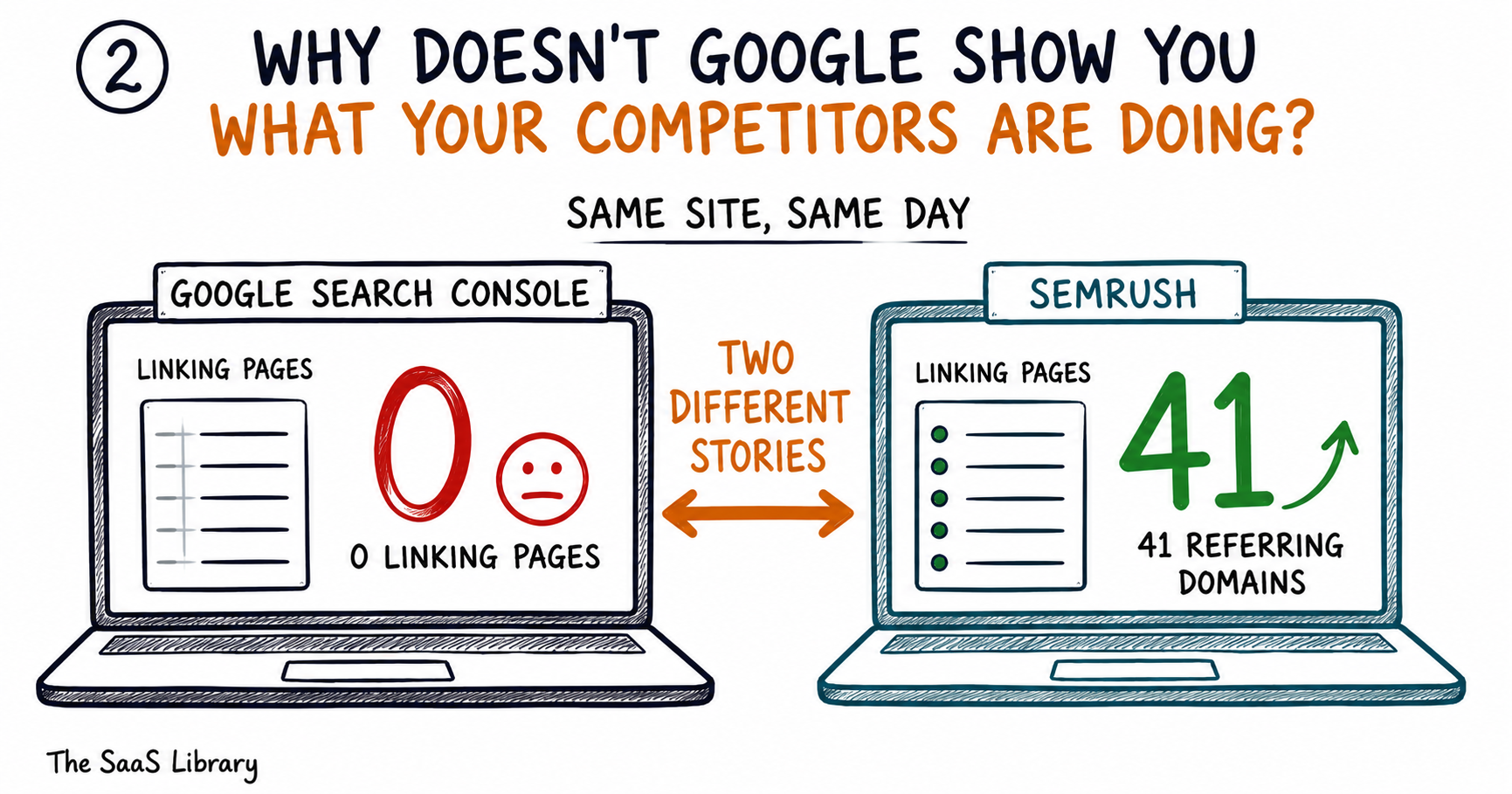
Google Search Console, pulled directly from TSL’s own account:
- Total clicks in the last 28 days: 69
- Total impressions in the last 28 days: 15,370
- Individually named queries visible in the report: 606
- External linking pages shown in the Links report: 0
That last line is the one worth pausing on. GSC’s own Links report came back completely empty. Not a small number. Zero rows.
Semrush, pulled the same day, same site:
- Authority Score: 12
- Organic keywords tracked: 78
- Referring domains: 41
- Backlinks: 50
- Pages cited by ChatGPT: 45
Same website. Same day. Two completely different stories. GSC says TSL has no visible external links. Semrush says 41 separate domains are linking to it. Neither dashboard is lying. They’re just built to answer different questions.
Open Search Console, go to Performance, and note the total clicks number at the top. Scroll to the Queries table and add up the clicks next to every query you can see. If the second number is smaller, the difference is traffic Google won’t name for you. On TSL, that gap was 72.5% of all clicks.
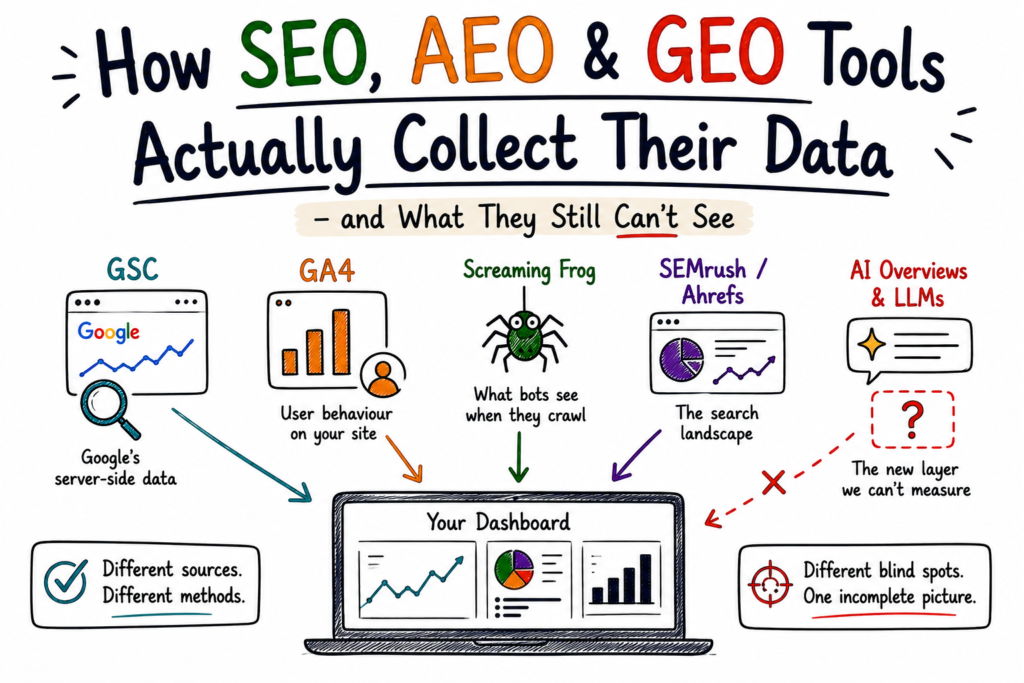
Want the deeper mechanics of how these tools actually collect their data?
Read the SIGNAL Stack →And the backlink gap isn’t the only place third-party tools separate the picture. That 45 figure for ChatGPT-cited pages exists nowhere inside GSC at all. Not hidden, not partial. Google Search Console has no field for it, because ChatGPT isn’t Google. Which means the question isn’t really “why doesn’t Google show competitor data.” It’s bigger than that. Google’s tools were never built to look outside Google in the first place. So why is that? Why build a tool this limited and hand it out for free?
Why Are Google’s Tools Free in the First Place?
Google’s tools are free because you’re not actually the customer. You’re the unpaid labor that makes Google’s other products better.
That sounds harsh. It’s also exactly what Google’s own materials describe, once you read past the marketing language. Start with Search Console. Every time you fix a crawl error, submit a sitemap, or clean up a broken page because Search Console flagged it, you’re not just helping your own site. You’re making Google’s index of the entire web slightly more accurate.
Millions of site owners doing that same small cleanup, every single day, adds up to a search engine that costs Google less to run and returns better results. That’s the whole point of handing the tool out free.
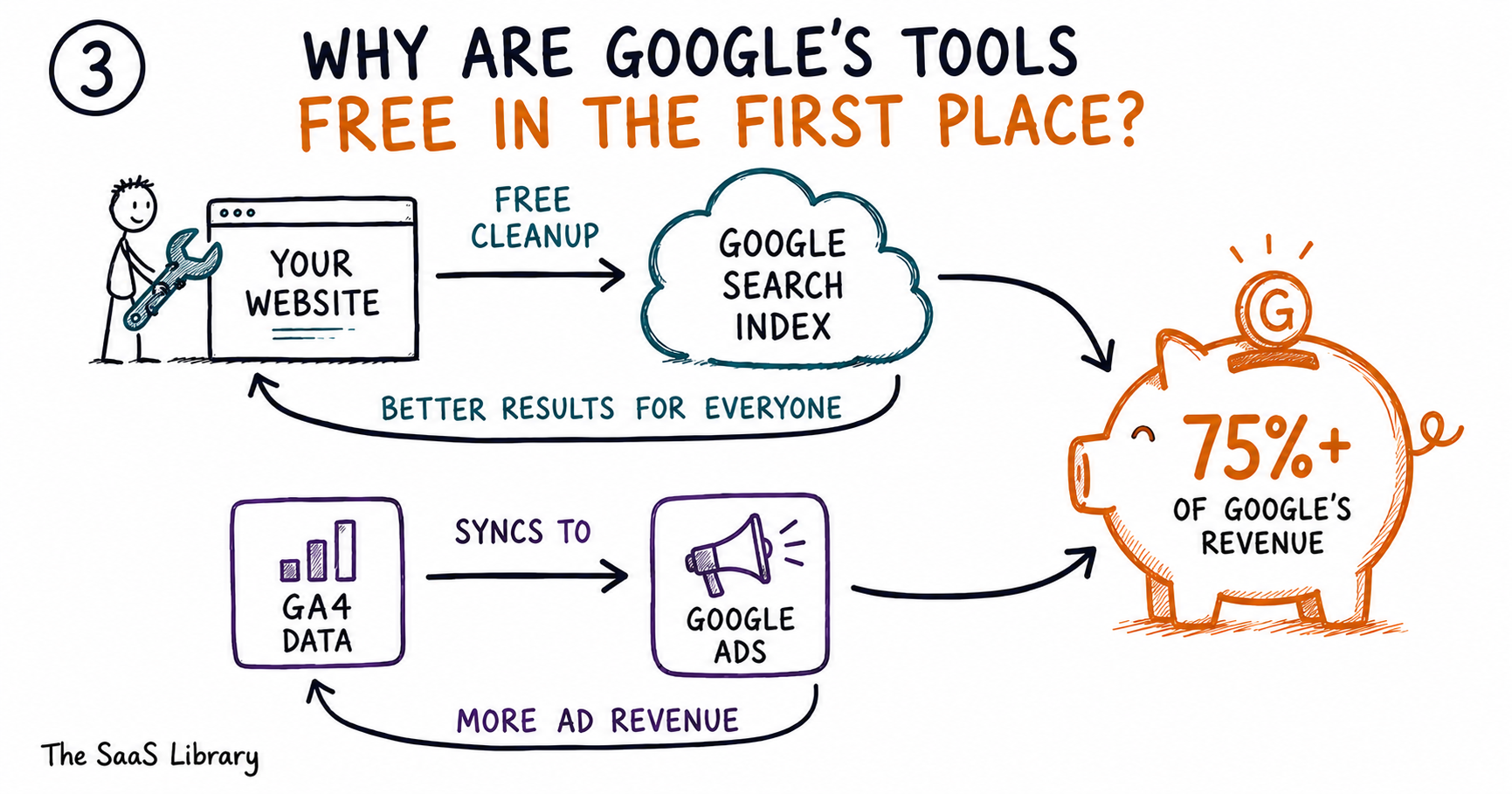
Now look at GA4. GA4 isn’t just a reporting dashboard sitting off to the side. It’s wired directly into Google Ads.
- Audiences you build in GA4 sync straight into Ads for remarketing
- “Key events” in GA4 become “conversions” inside Ads
- Google’s own machine learning uses this data to model ad performance, especially now that cookies are disappearing
Here’s why that line matters more than it sounds like it does. Advertising isn’t a side project for Google. It’s almost the entire business. Advertising isn’t a side project for Google. It’s almost the entire business. Alphabet’s own 2024 Form 10-K states the company generated more than 75% of total revenue from online advertising that year.
Google rebuilt GA4 specifically to stay useful for advertisers in a cookie-less world, using machine-learning modeling to recover ad-click-to-conversion journeys, as TechCrunch reported when the product launched.
So when you put GSC and GA4 next to each other, the pattern is the same tool wearing two different hats.
- GSC exists to make Google Search better, for free, using your effort
- GA4 exists to make Google Ads better, for free, using your data
Neither tool was ever designed to hand you a complete picture of the internet. They were designed to make you a better, more cooperative input into Google’s two biggest products. That single fact explains everything we found in the last two sections. The anonymized queries, the missing competitor data, the empty Links report. None of that is an accident or an oversight Google forgot to fix. It’s the tool doing exactly the job it was built for. Just not the job most people assume it’s doing. Which brings up the obvious next question. If this is really about business model and not generosity, what happens the moment Google decides to charge for it?
What Happens If Google Starts Charging for Its Data?
Nothing changes if Google starts charging for its data, because Google already has, and the market barely noticed.
That’s not a hypothetical. It’s called GA4 360, and it already exists today. Standard GA4 is free for everyone. GA4 360 is the paid version, built for large companies that need more room and faster data.
What GA4 360 actually costs and adds:
- Entry pricing starts near $50,000 per year, scaling toward roughly $150,000 per year for high traffic accounts, per Cardinal Path
- Data retention stretches to 50 months, instead of the 14 months free users get
- Reports update in under an hour, instead of the 24 plus hour delay on the free tier
- Enterprise support and formal service agreements are included
So the experiment we’re asking about in this section already ran. Google already charges serious money for a more complete version of its own free tool.
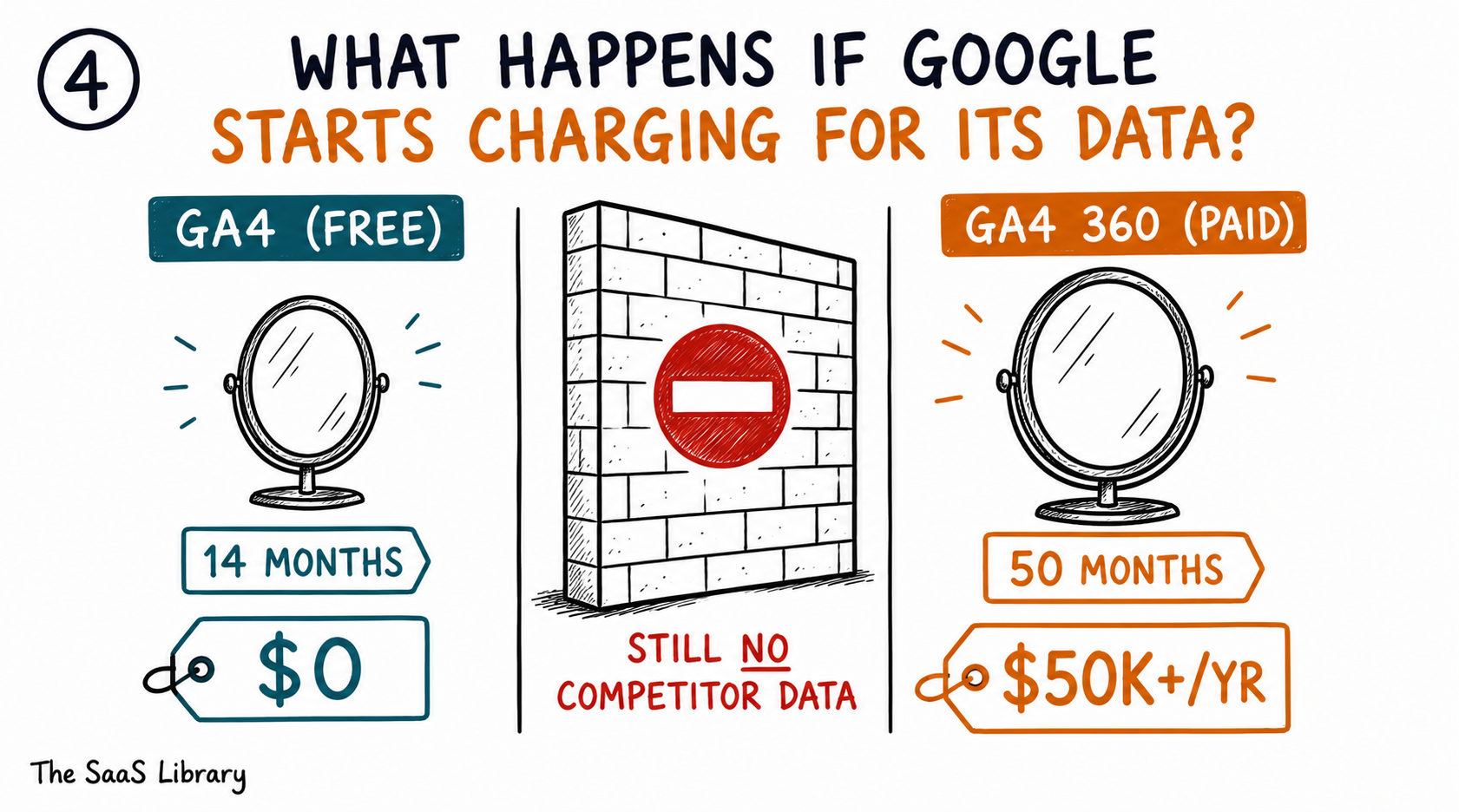
Here’s the part that actually answers our question, though. GA4 360 still doesn’t show you your competitors. It still won’t tell you what’s happening on Bing, or inside ChatGPT. It’s a bigger, faster mirror of your own site. Not a window into anyone else’s. Paying Google more money doesn’t buy you a different kind of tool. It buys you more of the exact same kind of tool.
That’s the detail most people miss when they imagine “what if Google charged for Search Console too.” The fear usually sounds like this: if Google starts charging, third party tools finally get their opening. People will feel free to switch.
But look at what we already established about why these tools are free. Google’s tools were never free because Google was being generous. They were free because your effort and your data were already paying for them, just in a different currency. Charging you money on top of that doesn’t hand SEMrush or Ahrefs anything new to sell. It doesn’t add competitor visibility to Google’s report. It doesn’t add Bing. It doesn’t add ChatGPT citations.
Price was never the variable holding the two categories of tool apart. Which means the real test isn’t “what if Google charges the same amount.” It’s a harder version of that question. What if Google didn’t just charge the same amount, but actually tried to sell you everything SEMrush sells too?
Would You Still Pay for Third-Party Tools If Google Sold the Exact Same Data?
Yes, you’d probably still pay for third-party tools even if Google matched them exactly, because Google legally and structurally can’t sell you the same thing they sell.
This is the hardest version of the question, so let’s slow down and take it apart piece by piece.
Reason One: The Legal Problem
Imagine Google decided to show you your competitor’s exact search queries, their exact traffic numbers, the same way it shows you your own. That’s not just a bold product decision. It’s a privacy and antitrust problem, especially for a company that has already been through a major antitrust case.
In August 2024, a U.S. federal judge ruled that Google had illegally maintained a monopoly in search. In September 2025, that same judge issued the remedies, as NPR reported.
- Google was not forced to sell off Chrome or Android
- Google was ordered to stop signing exclusive default deals for Search, Chrome, and its AI assistant
- Google was ordered to share certain search index data with qualified competitors, but specifically not its advertising data
Read that last point again. Even in a ruling built to open up Google’s data, the sharing that got ordered was index data going to rival search engines. Not competitor traffic data going to individual site owners like you. A referee that’s already under legal scrutiny for how it handles data has every reason to stay far away from selling one site’s private numbers to another.
Reason Two: The Trust Problem
Even if the law allowed it, would you actually believe Google’s version of “here’s how your competitor is doing”? SEOs have spent years catching gaps between what Google says matters for ranking and what actually seems to move the needle. A tool graded by the company running the exam has an obvious incentive problem.
Third-party tools work because they’re outsiders. Ahrefs runs its own crawler. SEMrush runs its own crawler. Neither one needs Google’s permission or Google’s blessing to tell you what they found.
Reason Three: The Money Is Already Betting Against Google Closing This Gap
Look at what’s happening in AI visibility tracking right now, a space Google has the most obvious motive to own itself.
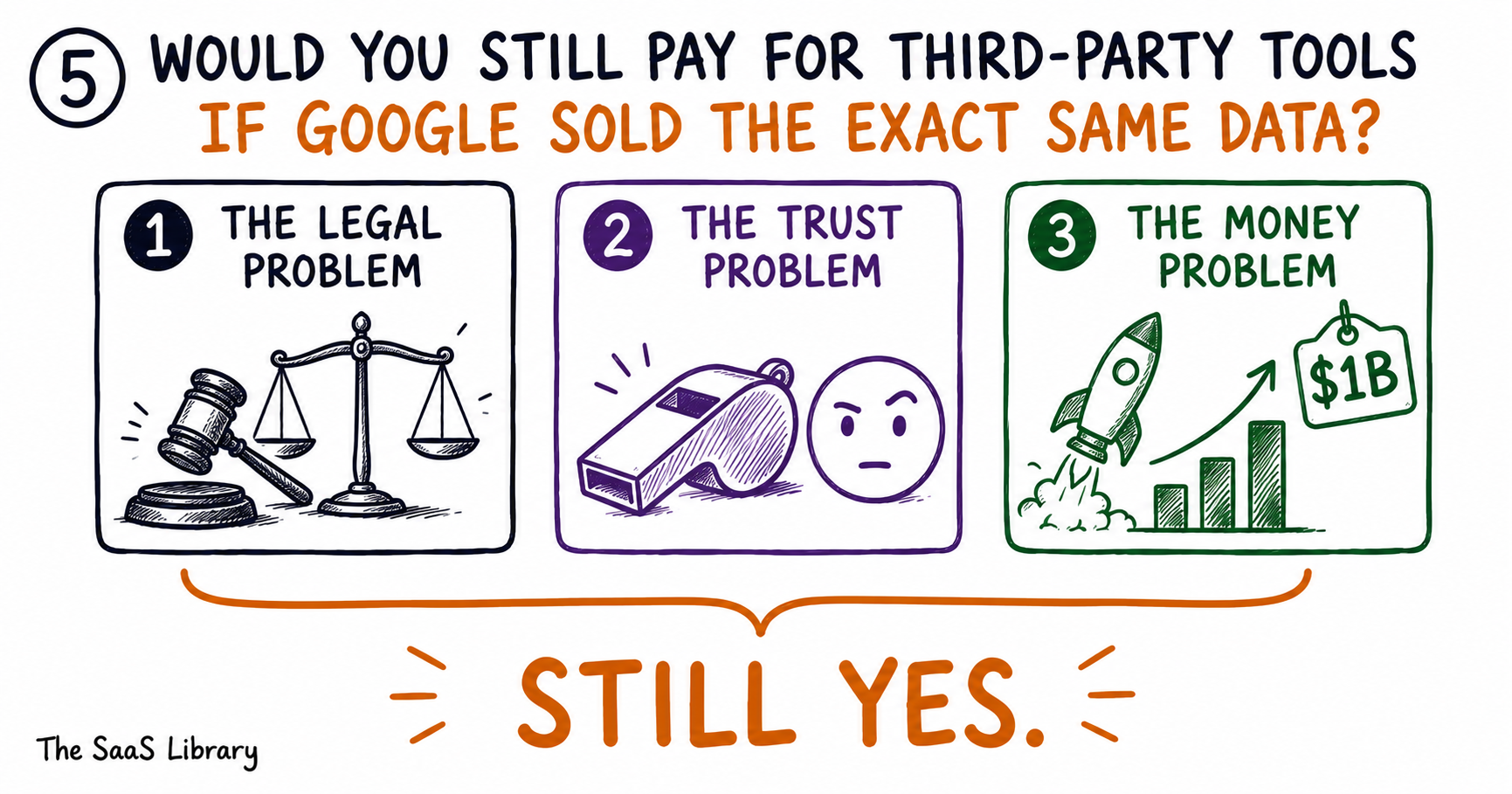
Investors aren’t putting real money into that kind of company because they think Google is about to make it irrelevant. They’re betting on the opposite. They’re betting Google structurally cannot, or will not, ever hand you that data itself.
Even in the world where Google offers everything SEMrush offers, at the same price, you’d likely still end up paying for the outside view. Not because Google’s version would be worse quality. Because Google legally can’t be the one selling it, and even if it could, nobody would fully trust the referee grading its own game.
That’s three separate answers pointing at the same conclusion. Which means it’s time to name what’s actually holding this gap in place, permanently, on both sides of the price tag.
What Are the Four Walls Google’s Tools Can Never Cross?
Google’s tools can never cross four specific walls, and understanding them explains everything we’ve covered so far in one place.
Call it the Four Walls Framework. Four separate reasons, stacked on top of each other, that keep Google’s free tools and third-party paid tools doing permanently different jobs.
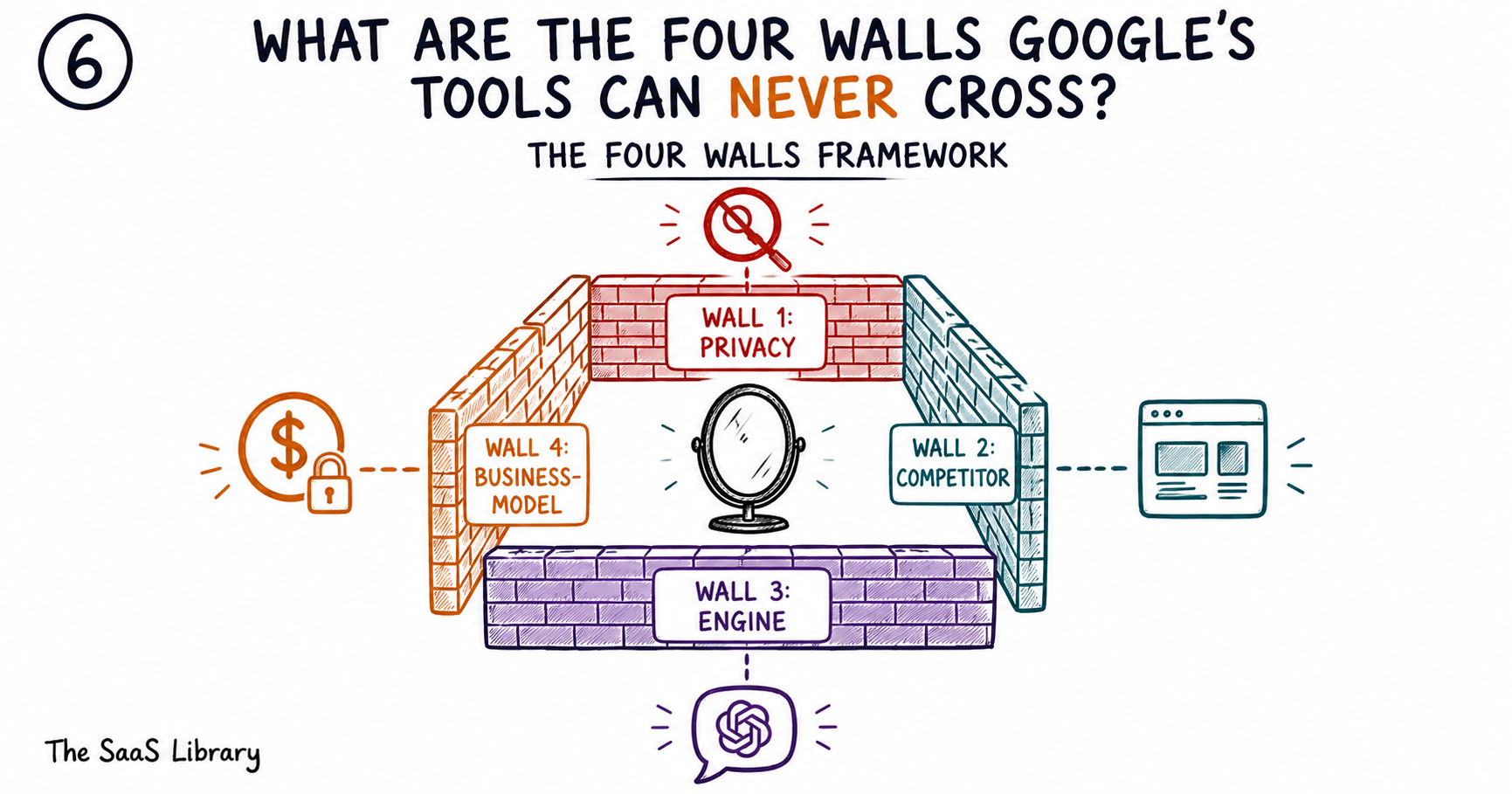
Put together, the Four Walls explain why charging more, as we saw with GA4 360, never closes the gap. Money buys you a bigger version of the same walled-in view. It never buys you a door through the wall.
Bing Webmaster Tools is proof the Engine Wall is a design choice, not a law of nature. It’s also free, and it’s actually more generous than GSC: it doesn’t anonymize queries the same way, and shows roughly six months of exact keyword data, per Microsoft’s own comparison. It just only covers Bing and Yahoo, a much smaller slice of search traffic.
None of this changes the fundamentals of ranking well in the first place, which is exactly why optimizing for AEO remains the starting point regardless of which wall you’re staring at. Google’s own guidance has been consistent on this, confirmed in Google’s AI search guide: the fundamentals of AEO and GEO are still SEO fundamentals, just applied to a new surface.
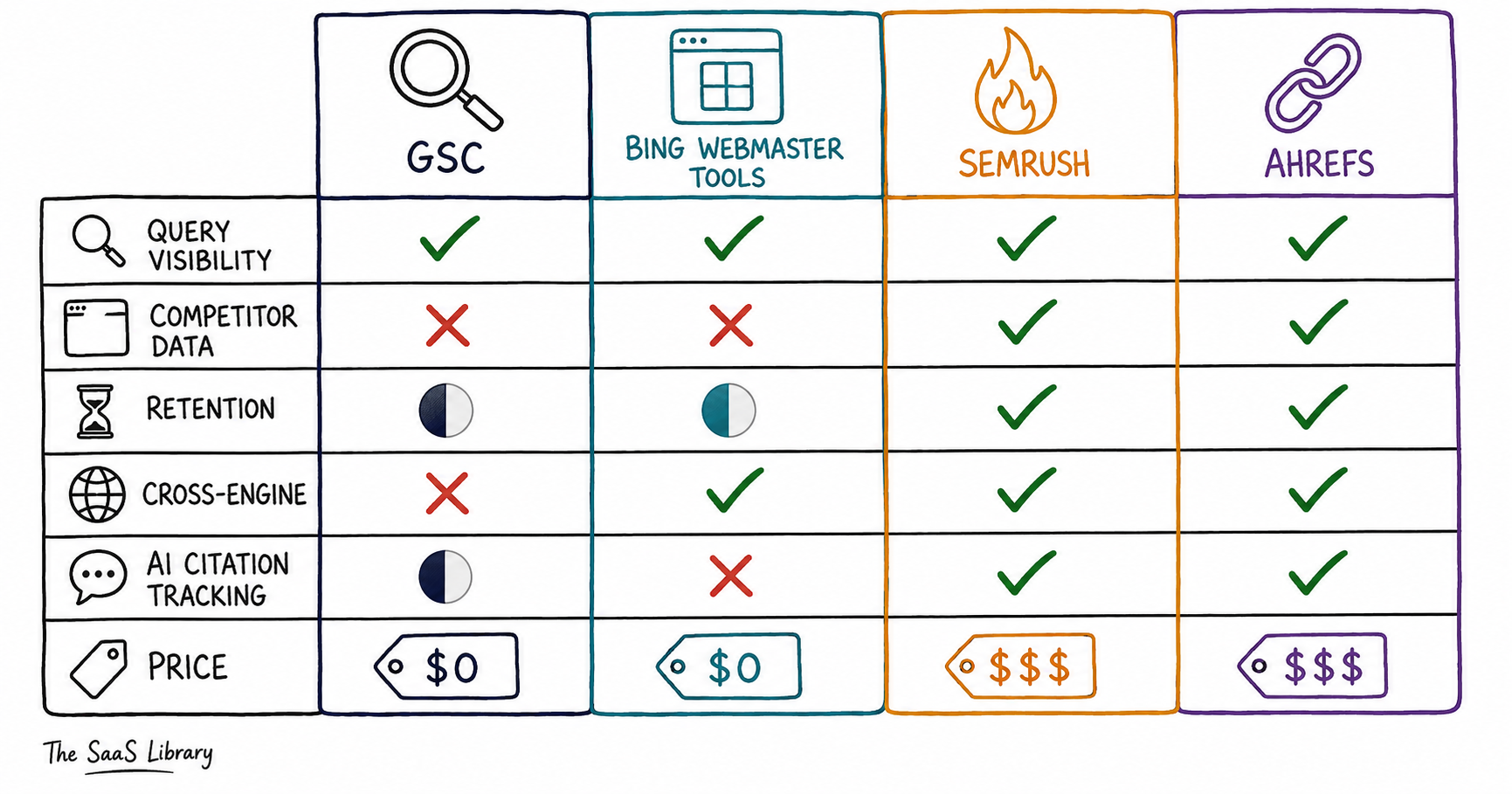
Here’s the same idea laid out side by side.
| GSC | Bing Webmaster Tools | SEMrush | Ahrefs | |
|---|---|---|---|---|
| Query-level visibility | Partial, anonymized | Fuller, less anonymized | Estimated, full | Estimated, full |
| Competitor data | None | None | Yes | Yes |
| Data retention | 16 months | ~6 months of keyword data | Ongoing subscription | Ongoing subscription |
| Cross-engine coverage | Google only | Bing and Yahoo only | Multi-engine estimates | Multi-engine estimates |
| AI citation tracking | None | None | Available via add-on | Available via Brand Radar |
| Price | Free | Free | From $139.95/mo | From $29/mo |
Screaming Frog’s paid license runs $279/year per user, far below SEMrush or Ahrefs, but it only crawls, it doesn’t track competitors’ keywords or backlinks the way the others do.
Four walls. One free mirror on one side. A paid window on the other. Neither one was ever going to replace the other, no matter what either company charges. Which leaves one thing still worth checking. Are these four walls holding steady, or is one of them growing taller right now, in real time?
Where Is This Gap Widening Fastest Right Now?
This gap is widening fastest inside AI search, and it’s happening in real time, not as a future prediction.
On June 3, 2026, Google added something new to Search Console. A dedicated report for generative AI performance, covering AI Overviews, AI Mode, and AI features inside Discover.
Here’s what that report shows you.
- Impressions
- Which pages appeared
- Country and device breakdowns
Here’s what it doesn’t show you.
- Clicks
- Click-through rate
- The actual query that triggered the AI feature
And that front door is only half the building. Search Console’s new report only covers what happens inside Google’s own AI features. It has zero visibility into whether ChatGPT, Perplexity, Claude, or Gemini mention your site at all.
Look at what that means for TSL specifically. The same Semrush pull we ran on TSL’s own site earlier showed 45 TSL pages cited by ChatGPT. Zero cited inside Google’s AI Overview. Zero inside Gemini. One single mention inside AI Mode. Search Console cannot show a single one of those numbers. Not the 45. Not the zero. None of it. That data doesn’t have a home inside Google’s own tools, because ChatGPT isn’t Google’s product.
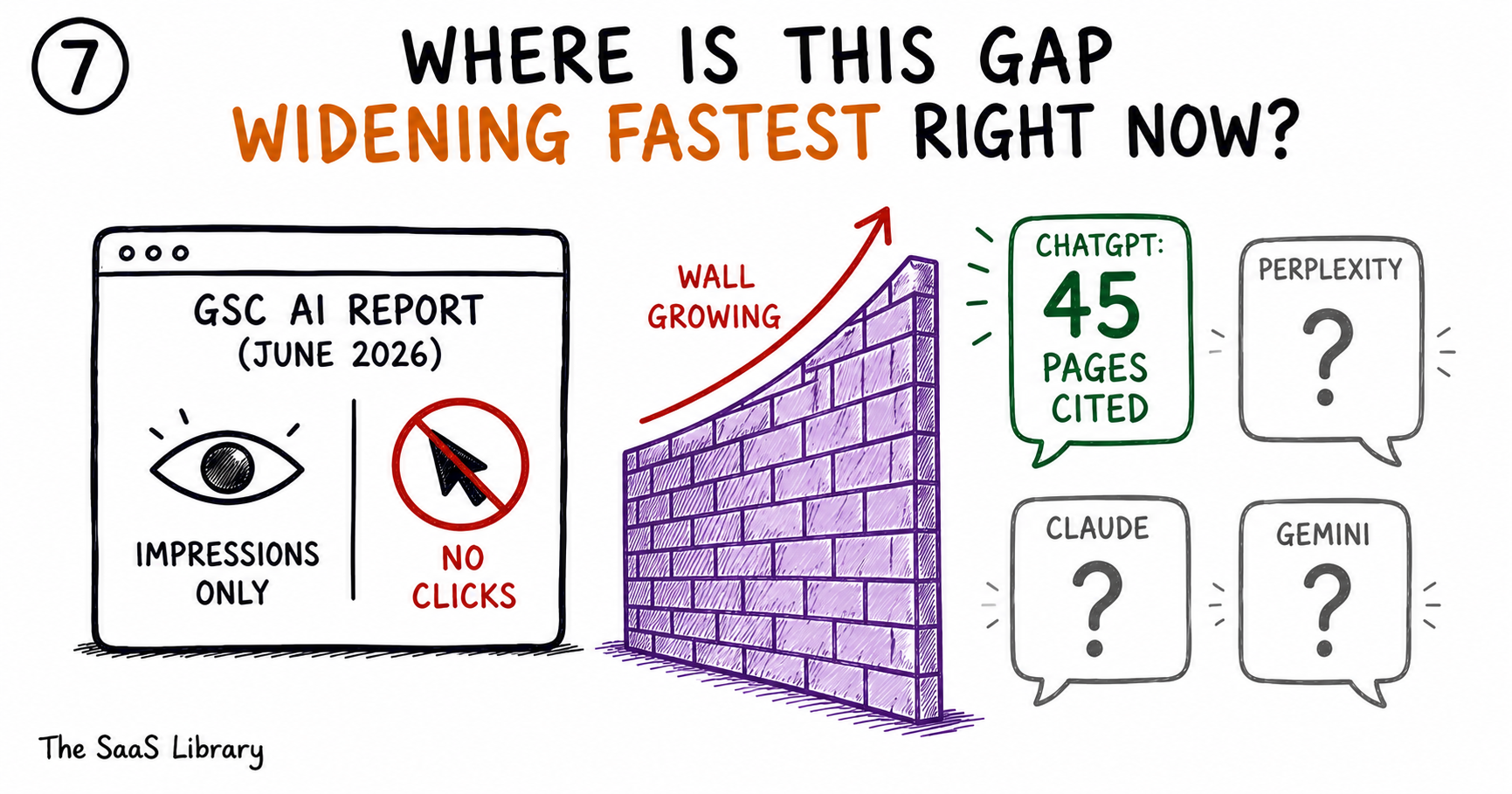
This is the Engine Wall from the last section, except it’s getting taller, not staying still. A small, fast-growing category of tools exists purely to stand in that gap.
- Profound, Peec AI, and Otterly.AI track how often assistants like ChatGPT and Perplexity mention a brand
- Semrush’s own AI Visibility Toolkit, the exact source behind TSL’s numbers in this article, does the same thing bundled into a familiar dashboard
One honest caution belongs here too. Research tracking 240 million ChatGPT citations found cited domains change 40 to 60% month over month, so treat any single AI-visibility number as a snapshot, not a fixed score.
That volatility is actually the point. It’s exactly the kind of fast-moving, cross-platform signal Google’s own tools were never built to track, going all the way back to how these AI systems and search engines actually collect their data in the first place.
It also connects to a deeper question about why AI assistants disagree with each other in the first place, something we broke down in detail in why ChatGPT gives different answers to the same question.
And if the real goal now is earning that citation rather than just measuring it, that’s a search experience problem as much as a tracking problem, which is exactly what we mapped out in what SXO actually means.
So here’s where all four walls stand right now, in mid-2026. Three of them have held steady for over a decade. The fourth, the Engine Wall, just got a new floor added on top of it in the form of AI assistants Google doesn’t own and can’t see inside. Charging more money never opens a door in that wall. Neither does time. The wall is the design, not a bug waiting to be patched.
Frequently Asked Questions
What is Google Search Console?
Google Search Console is a free tool from Google that shows site owners how their own website performs in Google Search, including clicks, impressions, and indexing status.
What is GA4?
GA4, or Google Analytics 4, is Google’s free analytics platform that tracks visitor behavior on a website, including traffic sources, events, and conversions.
What are anonymized queries in Google Search Console?
Anonymized queries are search terms Google Search Console hides from a site owner’s report because too few people typed that exact phrase over a two to three month period, protecting the privacy of the searcher.
Why does Google hide search query data?
Google hides search query data to protect the identity of individual searchers, since a rare enough phrase could reveal who searched for it.
What is GA4 data thresholding?
GA4 data thresholding is a privacy feature that hides report rows once the number of users or events in that row drops too low, usually somewhere near 50, to prevent identifying individual visitors.
What is GA4 360?
GA4 360 is Google’s paid, enterprise version of Google Analytics 4, offering longer data retention, faster reporting, and higher processing limits for a starting price near $50,000 per year.
Why do people still use SEMrush if Google Search Console is free?
People still use SEMrush because it shows competitor data, backlink profiles, and cross-engine visibility that Google Search Console was never built to provide, regardless of price.
What is the Four Walls Framework?
The Four Walls Framework is a model describing the four structural limits, the Privacy Wall, the Competitor Wall, the Engine Wall, and the Business-Model Wall, that keep Google’s free tools and third-party paid tools permanently different products.
Which tool shows competitor data, Google Search Console or SEMrush?
SEMrush shows competitor data, while Google Search Console only reports on the single property a person has verified ownership of.
Does Google Search Console show AI Overview data?
Google Search Console does show AI Overview data as of June 2026, but only impressions, pages, countries, and devices, without any click or query-level detail.
Can Google Search Console track ChatGPT citations?
Google Search Console cannot track ChatGPT citations, since that data belongs to a separate company’s product and has no reporting field inside Google’s own tools.
Which is better, Google’s free tools or third-party SEO tools?
Neither Google’s free tools nor third-party SEO tools are individually better, since each one answers a different question, your own site’s Google performance versus the competitive and cross-platform landscape around it.
Conclusion
Four walls explain the entire gap. Privacy, Competitor, Engine, and Business-Model. Google’s tools were built to protect searchers and grow Google’s own products. Not to hand you the outside view.
That’s why charging more, as GA4 360 already proved, never closes it. It’s also why SEMrush, Ahrefs, and newer AI-visibility tools keep growing anyway.
Before you open either dashboard again, ask one question first. Am I checking my own site, or everyone else’s? That single line tells you exactly which tool has your answer.
- Google Search Central Blog — A deep dive into Search Console performance data filtering and limits, 2022
- Ahrefs — Anonymized Queries Make Up Nearly Half of Google Search Console Traffic, 2025
- DuckDuckGo — Roadblocks to Competition: Investigate Google’s Non-Compliance with DMA, 2024
- Google Analytics Help — About data thresholds
- Analytics Mania — Thresholding applied in Google Analytics 4, 2026
- Cardinal Path — The GA4 360 Pricing Model, Explained, 2026
- Brian Clifton — Why is Google Analytics free?, 2007
- TechCrunch — Google Analytics prepares for life after cookies, 2021
- Alphabet Inc. — 2024 Form 10-K
- NPR — In a major antitrust ruling, a judge lets Google keep Chrome but levies other penalties, 2025
- GlobeNewswire — Profound Raises Series C at $1B Valuation, 2026
- Bing Blogs — Bing Webmaster Tools or Google Search Console: A Comparison, 2024
- Google Search Central Blog — Introducing Search Generative AI performance reports in Search Console, 2026
- Semrush — Pricing, 2026
- Ahrefs — Pricing, 2026
- Screaming Frog — Pricing, 2026
- AI Rank Checker — AI Citation Tracking Tools in 2026: A Complete Comparison
- The SaaS Library — Google Search Console Performance export, own data, pulled July 9, 2026
- The SaaS Library — Google Search Console Links export, own data, pulled July 9, 2026
- The SaaS Library — Semrush Domain Overview, own data, pulled July 8, 2026