Your content ranks on Google. ChatGPT has never heard of it. That gap has a name, and a fix.
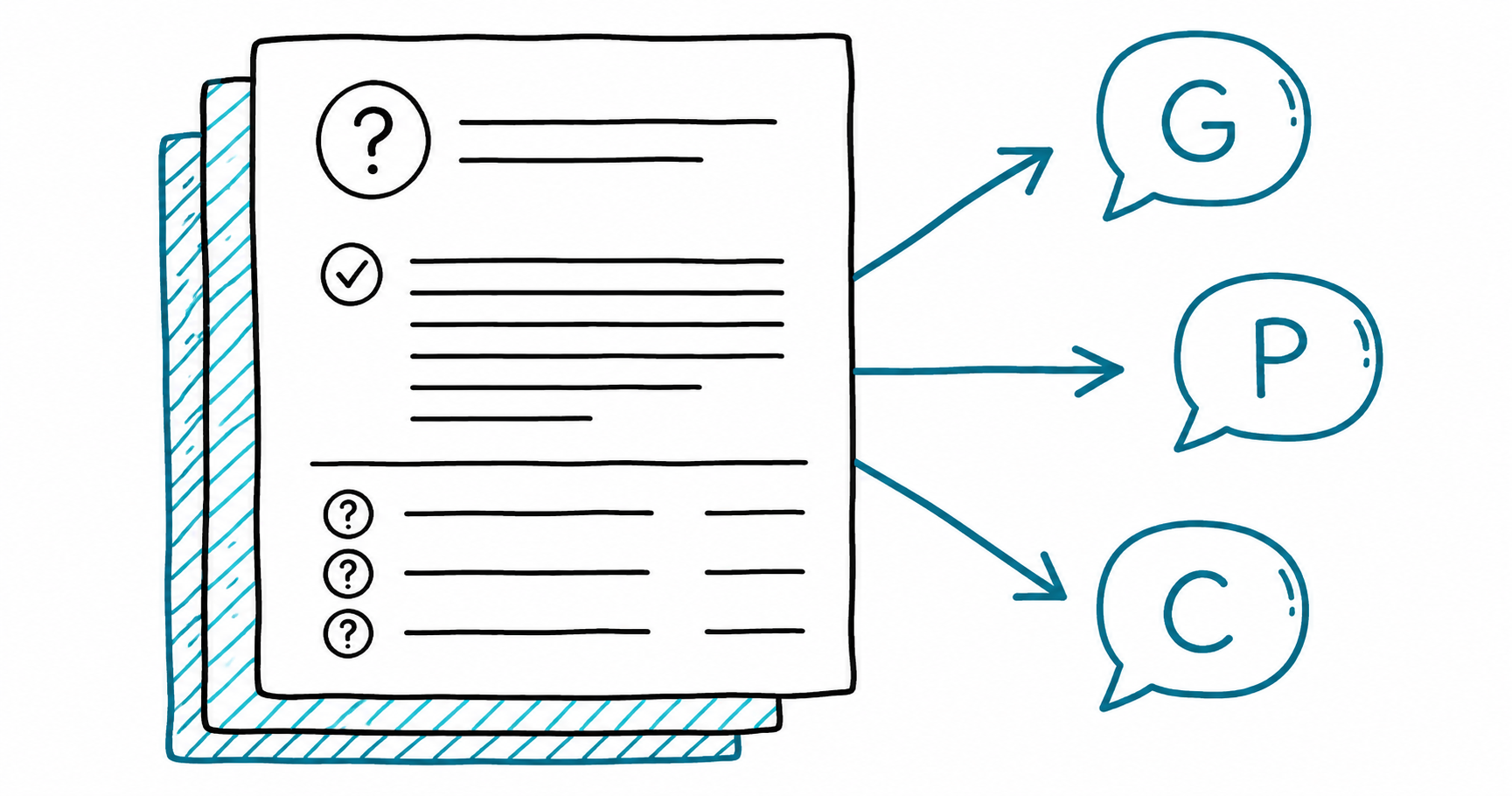
Answer Engine Optimization (AEO) is the practice of structuring content so AI engines extract and cite it as a direct answer, not merely rank it as a search result. Gartner predicted traditional search volume would drop 25% by 2026 as AI chatbots replace conventional queries (Gartner, February 2024). That shift is not theoretical: ChatGPT alone reached 900 million weekly active users by February 2026 (OpenAI). The question is not whether your buyers are using AI search. It is whether your content appears when they do. Understanding how AI systems evaluate and trust content is the first step toward making yours citation-ready.
This post walks through the AEO Signal Stack, a six-layer framework developed by The SaaS Library for structuring content so AI engines can find it, trust it, and quote it. Each layer builds on the one below it. Apply them in order, starting with structure, and the gains are measurable within weeks on Google AI Overviews.
The AEO Signal Stack is a six-layer optimization framework developed by The SaaS Library that structures content for AI engine extraction across content structure, section extraction, FAQ architecture, schema markup, entity signals, and performance measurement, enabling content to be cited as a direct answer rather than merely ranked as a search result.
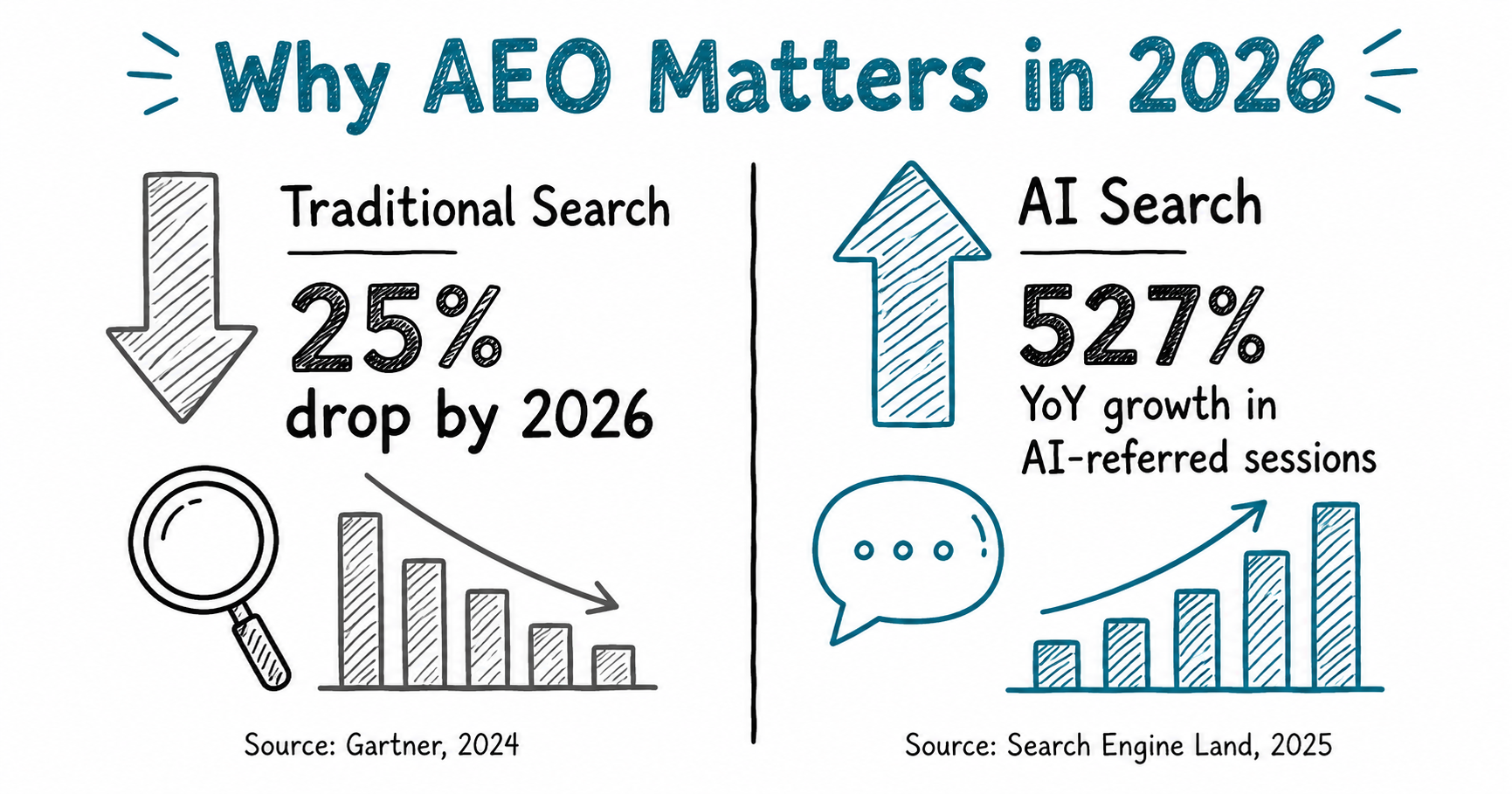
AEO is the practice of structuring content so AI engines cite it directly. It sits alongside SEO and GEO, not in place of them. The AEO Signal Stack covers six layers: content structure, section extraction, FAQ architecture, schema markup, entity signals, and measurement. Apply the layers in order. Start with your ten highest-traffic posts. The gains are fastest on existing content.
Each layer builds on the one below it. Start at Layer 1 before touching Layer 6.
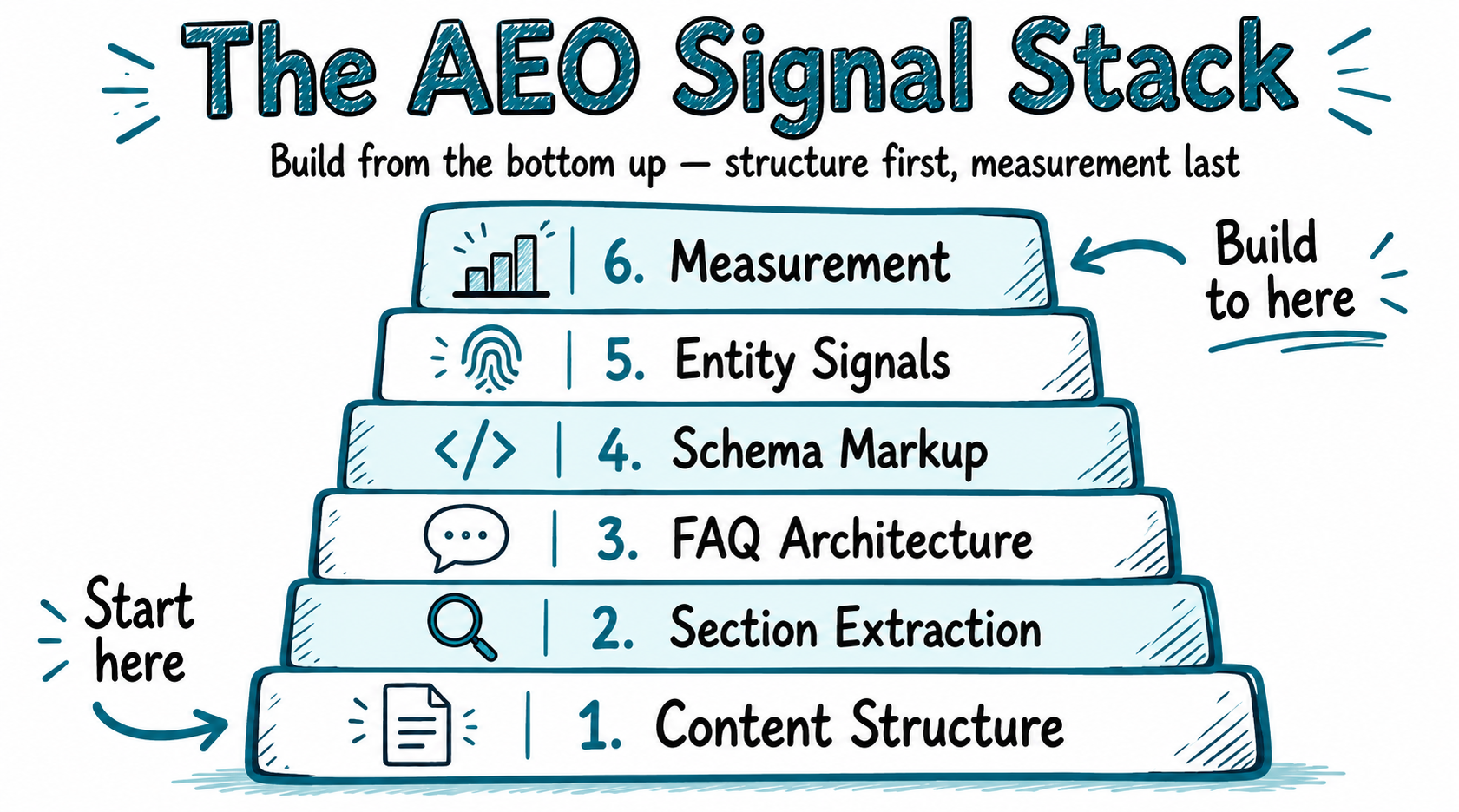
Start at structure. Schema, entity signals, and measurement compound the work you do at layers 1 and 2.
What Do AI Engines Actually Extract From Your Content?
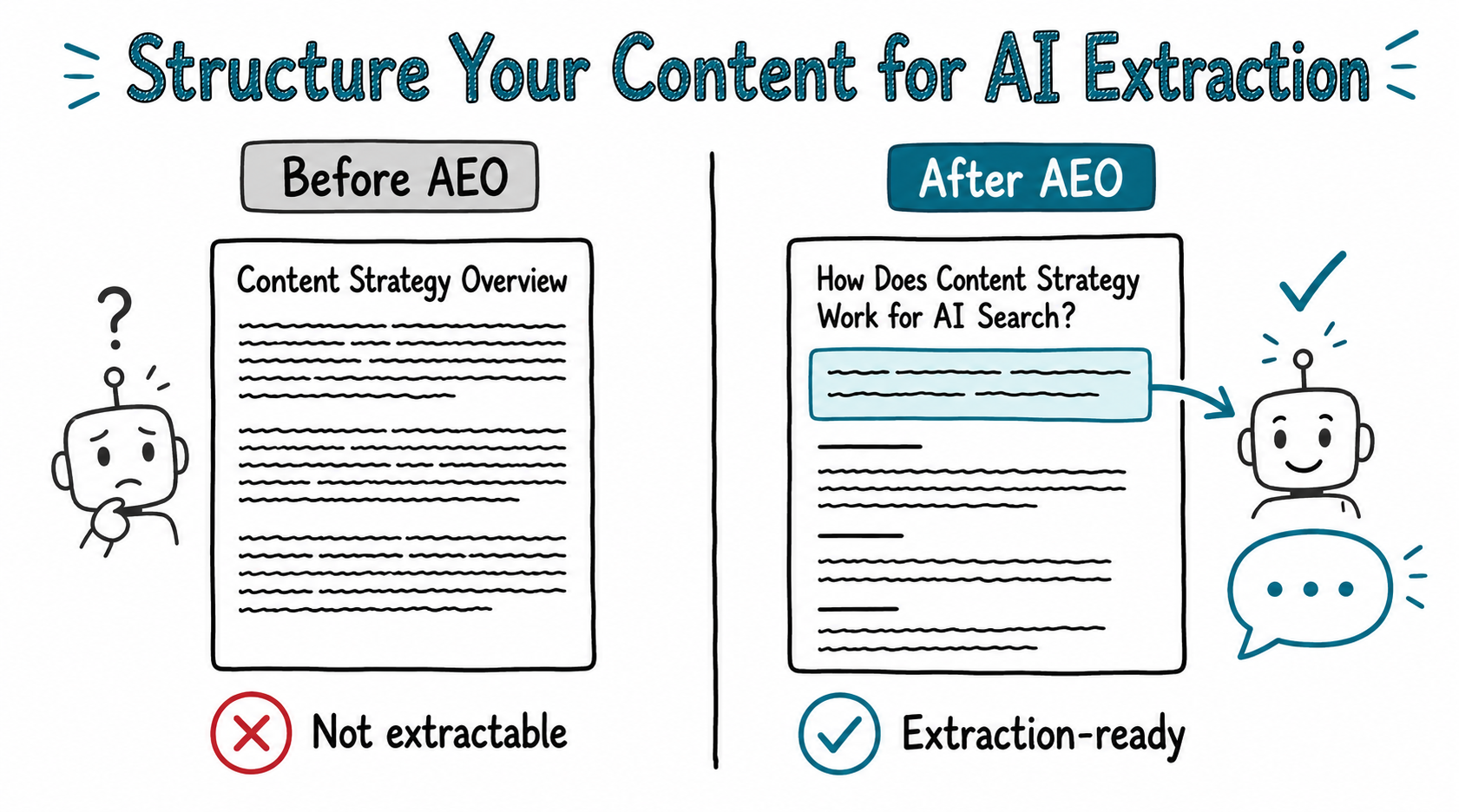
AI engines do not read your post. They extract discrete passages, and they prioritise the first complete, self-contained answer they find in each section. The pipeline behind ChatGPT, Perplexity, and Google AI Overviews is called Retrieval-Augmented Generation (RAG): it scores candidate passages on relevance, authority, and structural clarity before any ranking signal is applied (Frase.io, 2026). Content that buries its answer in paragraph three fails the extraction test at Stage 2 of that pipeline, before authority or freshness are even evaluated.
Ahrefs found that AI search visitors convert at 23 times the rate of traditional organic visitors, with 0.5% of total traffic from AI platforms driving 12.1% of all signups (Ahrefs, June 2025). That conversion premium exists because users arriving from AI citations have already been pre-qualified by the AI’s answer. The implication is direct: a page that earns citations gets disproportionate business impact, not just traffic.
How Do You Structure a Section So AI Engines Extract It?
Every section needs three elements in sequence: a direct answer in the first sentence, supporting evidence in sentences two and three, and an H2 that mirrors the exact question a user would type. Research from LLM Pulse (2025) found that 44% of AI citations come from the first 30% of a page, meaning AI retrieval systems weight early, direct content significantly higher than content buried deeper in a post. A section that opens with context, hedging, or background before reaching the answer will be skipped at the retrieval stage regardless of how accurate or well-written the eventual answer is.
Google’s own guidance, confirmed in its May 2025 Search Central Blog update, states that structured data and answer-first content organisation makes pages eligible for AI-generated rich results. Semrush’s July 2025 analysis of 500+ high-value topics found that AI-driven visitors convert at 4.4 times the rate of standard organic search visitors (Semrush, July 2025), a conversion quality that is only available to content that actually earns citations. Apply the answer-first structure to your ten highest-traffic posts first, then work outward.
For Google’s own position on how AEO, GEO, and SEO relate to each other, see Google’s AI search guide on the overlap between these disciplines.
How Should You Write FAQs for AI Engines?
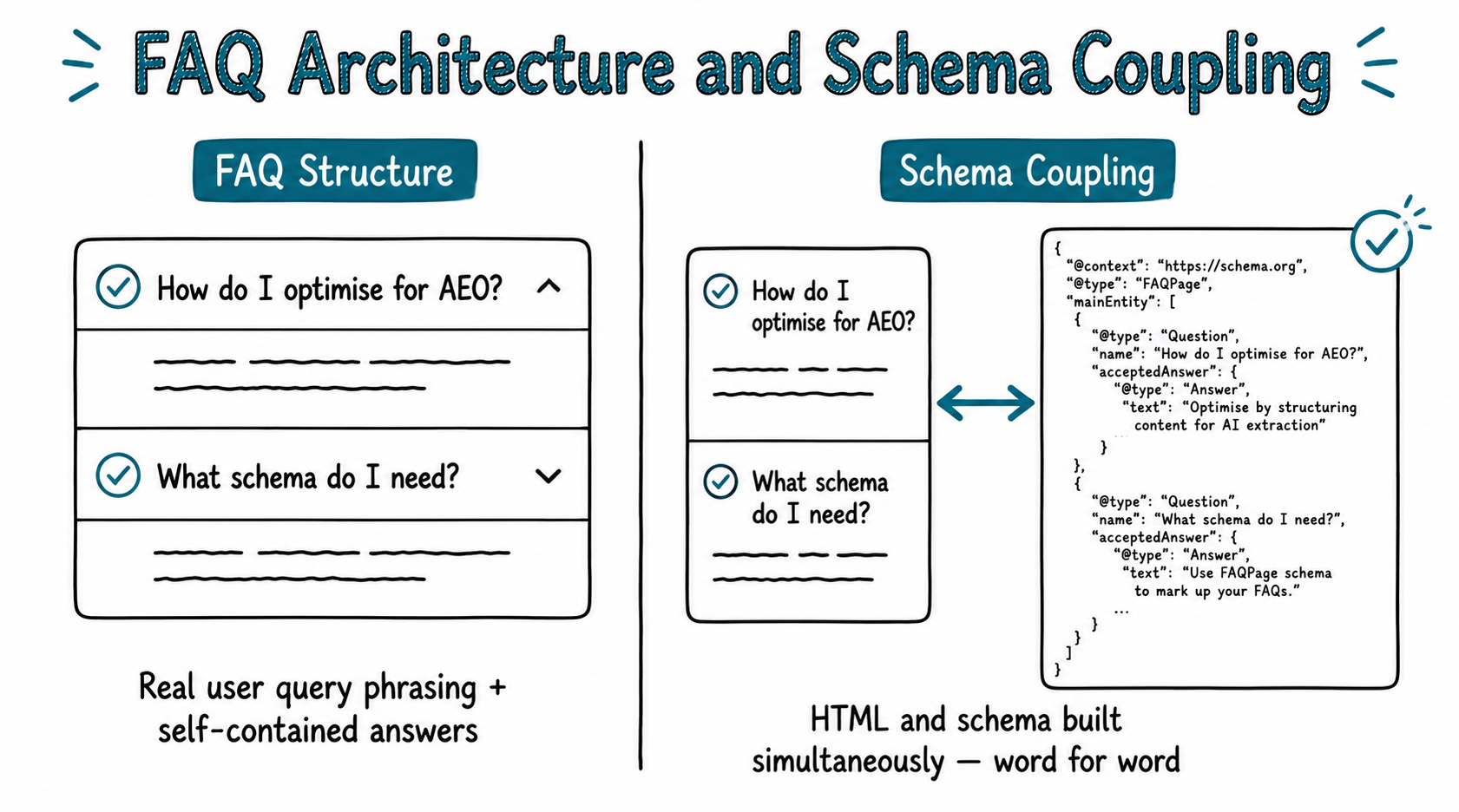
Every FAQ question must be phrased exactly as a user would type it into ChatGPT or Perplexity, and every answer must be fully self-contained in 40-60 words without referencing other sections of the post. Google confirmed in May 2025 that FAQ-structured content with FAQPage schema remains eligible for AI-generated rich results even after traditional FAQ rich snippets were deprecated from standard search results. The implication, covered in detail in why Google deprecating FAQ rich results makes FAQs more important for AI search, is that FAQ architecture now matters more for AI citation than it ever did for traditional SERP features.
The most common failure mode is schema drift: the FAQPage schema is built once and the HTML accordion is edited later, creating mismatches between visible content and structured data. AI systems use schema to verify and cross-reference page claims. A mismatch signals a credibility failure and reduces citation probability. Build the FAQPage schema simultaneously with the HTML, word for word, and treat any edit to an answer as requiring a simultaneous edit to the schema. This is not a technical nice-to-have. It is the difference between schema that helps extraction and schema that actively harms it.
AEO comes from Google’s evolution from keyword-driven search to one that uses machine learning and NLP to parse queries and serve content to match intent. Authority, user intent, and topical relevance are key ranking factors.
Which Schema Types Does AEO Actually Require?
Every AEO-optimised post requires four schema types as a minimum: Article, FAQPage, BreadcrumbList, and Author (Person), with HowTo added for any step-by-step instructional content. Princeton’s GEO research found that adding structured data increases AI citation probability by 30-40% compared to unstructured content of equivalent quality. Schema gives AI engines a machine-readable map of what your content is, who produced it, when it was published, and what questions it answers, reducing the inference burden that causes retrieval systems to skip ambiguous pages.
The Author (Person) schema carries the EEAT signal that AI engines use to assess credibility: name, job title, and a consistent URL that appears across multiple pages. Without it, a page may have strong factual content but no verifiable authorship. Princeton’s research identifies missing authorship as one of the primary reasons high-quality pages fail to earn citations. Validate every schema implementation with Google’s Rich Results Test immediately after adding it. Schema values that do not match visible page content create conflicting signals that actively suppress citation probability. See also: why ungoverned AI deployment creates the same trust gap as unverified content signals.
Why Does Entity Consistency Determine Who Gets Cited?
AI engines build knowledge graphs from consistent entity signals. Your author name, publication name, and ownable concepts must appear identically across your article HTML, schema, credibility markers, and any third-party mentions. SE Ranking’s study of 2.3 million pages found that domain traffic is the strongest predictor of AI citations, with high-traffic sites earning 3 times more citations than low-traffic ones (SE Ranking, 2025). A secondary driver is brand entity consistency: when the same named entity appears with identical phrasing across multiple sources, AI systems treat it as verified and weight it higher in citation selection.
The failure mode is fragmentation. An author named “Sara O.” in a byline, “Sara Okafor” in the Article schema, and “S. Okafor” in a LinkedIn bio are treated by LLMs as three separate entities. The authority signal that should compound across sources instead disappears entirely. The same applies to publication names and ownable concepts: if the AEO Signal Stack appears as “AEO Stack,” “the signal framework,” and “TSL’s AEO model” across three sections of the same post, no LLM builds a coherent entity around it. Name things once, name them consistently, and name them in the positions AI systems scan: DefinedTerm block, Takeaway Card, FAQ, and schema. For deeper context on how agentic AI systems handle entity resolution, see agentic AI optimization and what it means for content strategy.
The brands that win AI citations in 2026 are not the ones publishing the most content. They are the ones publishing the most extractable content.
How Do You Measure Whether Your AEO Optimisation Is Working?
AEO performance is measured through three systems: a GA4 AI channel group segmenting referral traffic from chatgpt.com, perplexity.ai, and claude.ai; monthly manual citation audits testing 10-15 target queries across ChatGPT, Perplexity, and Google AI Overviews; and a Share of Model metric tracking the percentage of relevant queries where your brand appears as a cited source. Only 16% of Fortune 500 companies currently track AI search performance (AirOps, 2025), which means the measurement gap is the clearest first-mover opportunity still available to most operators. Standard SEO dashboards do not surface AI citation performance: a post ranking first on Google can have zero AI citation presence, and without a separate measurement layer there is no way to identify which optimisation actions are producing gains.
Set up the GA4 AI channel group this week. It takes under 20 minutes and immediately starts surfacing referral data that most teams are currently attributing to direct or untracked traffic. Run the first manual citation audit in the same week: test your five highest-traffic posts across all three platforms and log which appear as cited sources. After three months of monthly audits, the data will show clearly which layers of the AEO Signal Stack are producing citation gains and which gaps remain. For a full platform-by-platform execution guide covering ChatGPT, Perplexity, and Google AI Overviews individually, the AI search optimisation guide is the next read after this post.
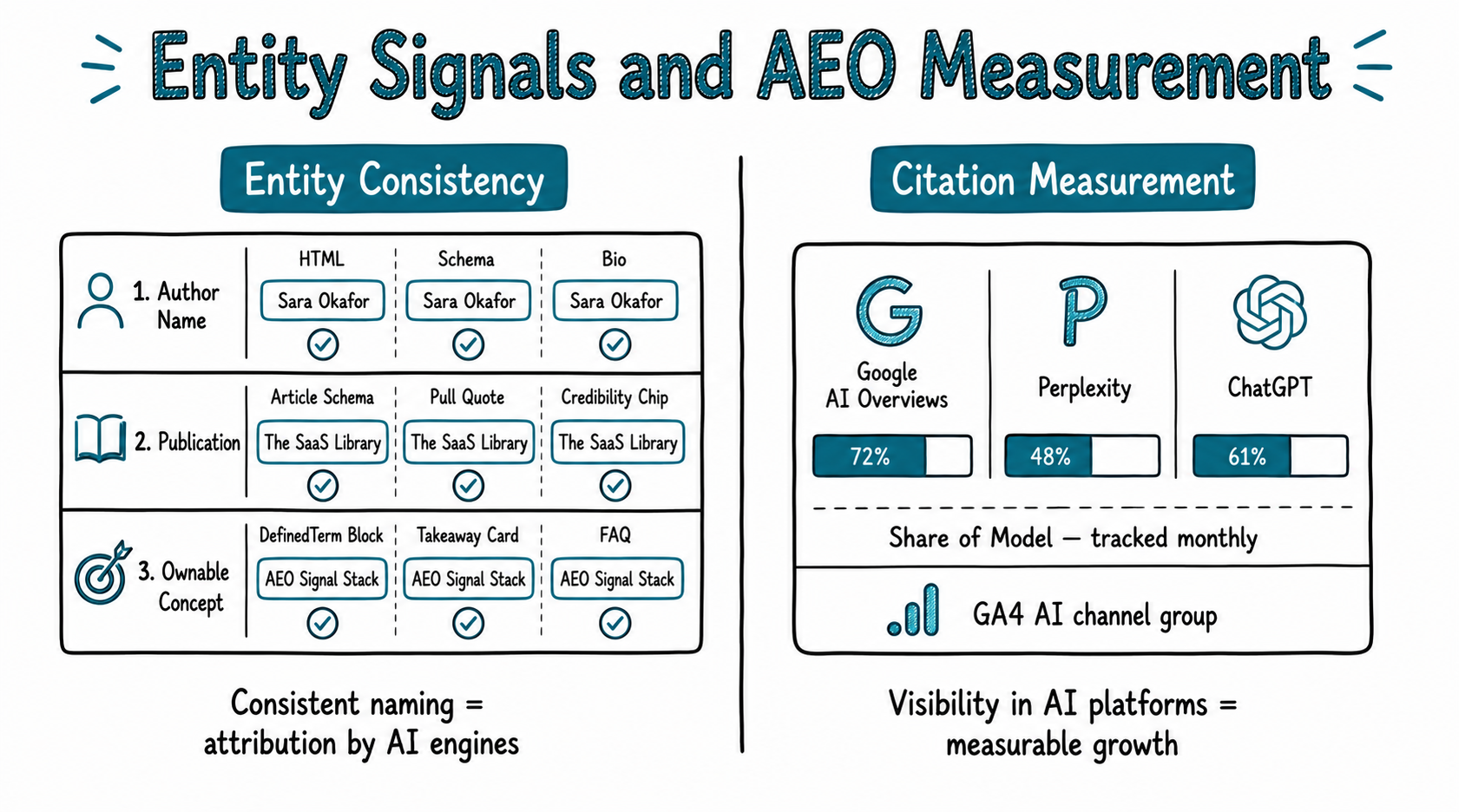
Note: percentage values in the Citation Measurement panel are illustrative examples only, not verified data.
This post is the framework. It explains what AEO is, how it differs from SEO and GEO, and gives you the six-layer AEO Signal Stack to build from. If you are ready to go deeper on platform-specific execution across ChatGPT, Perplexity, and Google AI Overviews, How to Optimise Your Blog for AI Search in 2026 is the direct continuation of this post. Start here. Go there after.
AEO does not replace SEO or GEO. SEO gets your content into the candidate set that AI engines search. AEO gets you extracted from it. GEO builds the off-site signals that make AI engines trust you enough to cite you. All three operate on different layers. None replaces the others.
For Google’s own take on where these disciplines overlap and where they diverge, see Google’s AI search guide and what it says about GEO, AEO, and SEO.
The AEO Signal Stack is the six-layer framework for getting content cited by AI engines: extraction-ready structure, question-phrased H2s, self-contained FAQs, validated schema, consistent entity signals, and a measurement system that tracks citations rather than rankings. Apply the layers in order. Structure first. Measurement last.
Once the stack is in place, the next step is distribution. See how the DIRHAM Framework reframes content distribution for the AI era.
Where Do You Go From Here?
The brands that own AI citation share in 2027 are building their AEO foundations in 2026. Once the stack is in place, distribution is the next lever. See how the DIRHAM Framework approaches content distribution for AI-first audiences.
Frequently Asked Questions
AEO (Answer Engine Optimization) is the practice of structuring content so AI engines extract and cite it as a direct answer. SEO optimises for ranked link results in Google. AEO optimises for citation inside AI-generated responses from ChatGPT, Perplexity, and Google AI Overviews. Both are required in 2026. SEO gets content into the candidate set; AEO gets it extracted from it.
AEO and GEO are different disciplines. AEO is on-site structural work: extraction-ready content, FAQ architecture, and validated schema. GEO is off-site brand signal work: consistent entity data across third-party publications, directories, and platforms. AEO without GEO produces citations only where you are already trusted. GEO without AEO builds trust signals that point to content AI engines cannot extract. Both are required.
Test your five highest-traffic posts manually: ask ChatGPT, Perplexity, and Google AI Overviews your target query and check whether your content appears as a cited source. If it ranks on Google but does not appear in any AI answer, your content has strong SEO signals but is not extraction-ready. That gap is where AEO work begins.
Every AEO-optimised post requires Article, FAQPage, BreadcrumbList, and Author (Person) schema as a minimum. Step-by-step instructional content should also include HowTo schema. Validate every implementation with Google’s Rich Results Test and ensure schema values match visible page content exactly. Schema that mismatches visible content creates conflicting signals and actively reduces AI citation probability.
The AEO Signal Stack is a six-layer optimization framework developed by The SaaS Library that structures content for AI engine extraction across content structure, section extraction, FAQ architecture, schema markup, entity signals, and performance measurement, enabling content to be cited as a direct answer rather than merely ranked as a search result.