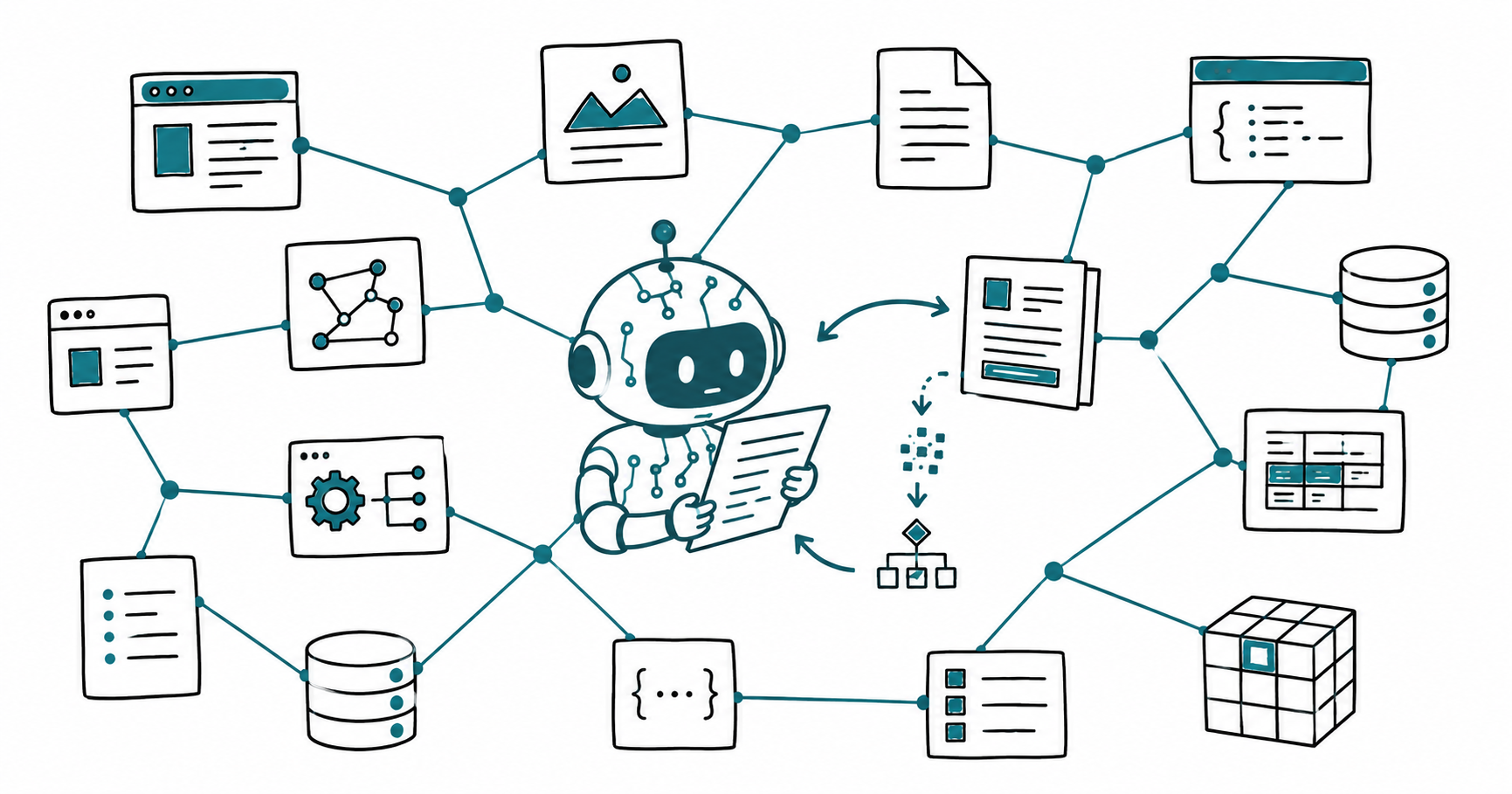
The web was built for humans who click. AI agents don’t click — they fetch, parse, and decide in milliseconds, then move on. Most of your content was never built for them, and most of the time, they’re already ignoring it.
Agentic AI Optimization — often called AEO — is the practice of structuring your digital content so that autonomous AI agents can find it, read it, and act on it. Unlike traditional SEO, which targets human users via search engines, AEO targets a new class of visitor: software systems that browse, compare, and make decisions on behalf of the humans who deployed them. As our analysis of the AI agent governance gap showed, AI agents are now embedded in enterprise workflows at scale — and the gap between companies that are visible to them and those that aren’t is widening fast.
This article covers what Agentic AI Optimization actually is, why it exists now, how AI agents consume content differently from humans, and what the five-layer Agent Readiness Stack tells you about where your content currently stands. You’ll leave with a clear picture of the landscape — and a framework you can apply immediately.
The Agent Readiness Stack is a five-layer prioritization framework developed by The SaaS Library that scores any page or content asset across discoverability, parsability, token efficiency, capability signaling, and access control — giving SaaS operators a structured way to identify and fix the gaps that prevent AI agents from reading, using, and acting on their content.
Agentic AI Optimization is the emerging discipline of making your content readable and actionable for AI agents — not just search engines or human visitors. The Agent Readiness Stack breaks this down into five layers: discoverability, parsability, token efficiency, capability signaling, and access control. Miss any one of them and AI agents will skip your content entirely, regardless of how well it ranks.
Each layer must be solid before the next one matters. Start at Layer 1 and work up.
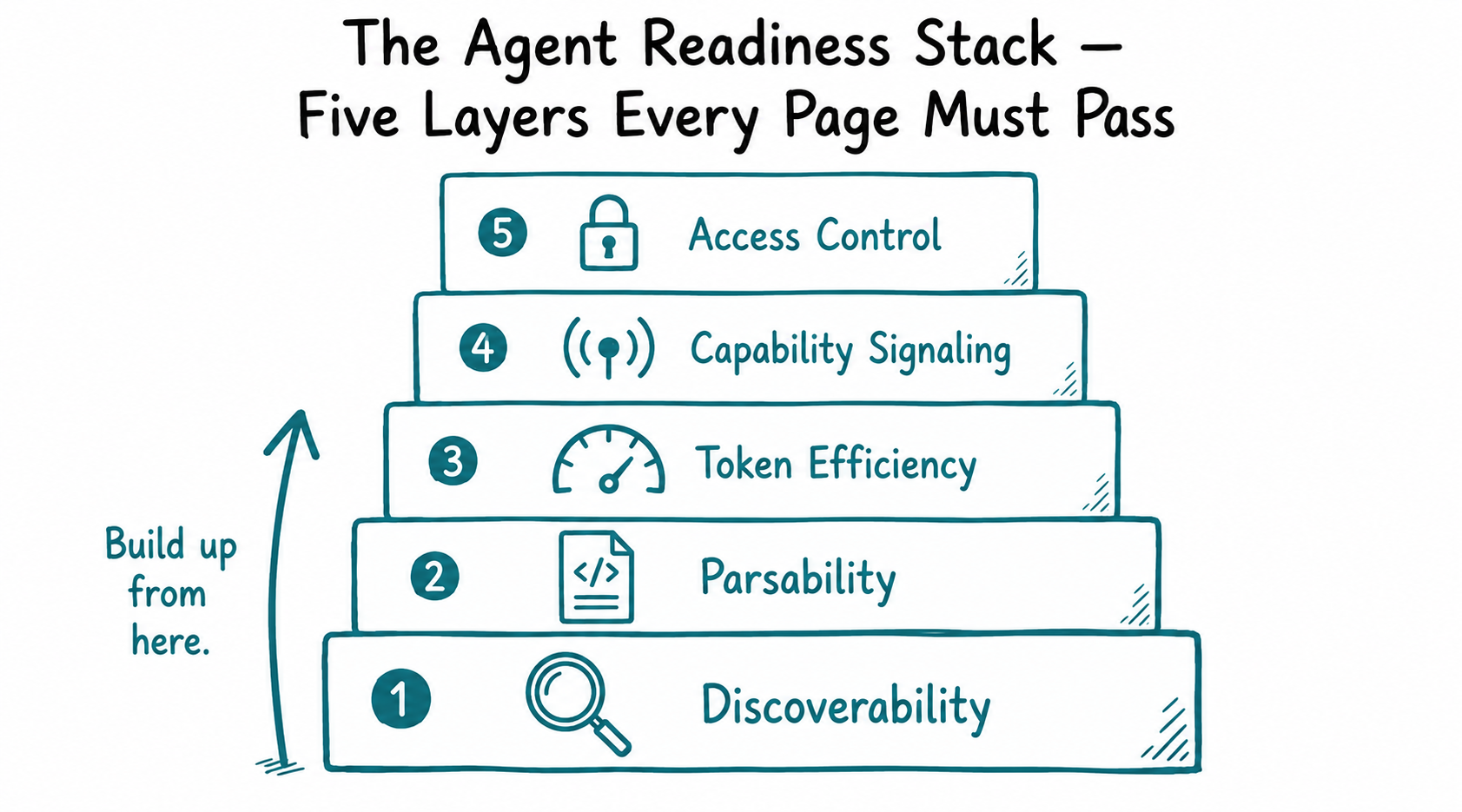
Content that fails Layer 1 (Discoverability) never reaches Layer 5. Agents stop where the stack breaks.
What AEO Actually Is — and What It Isn’t
Most operators have heard “AEO” in three different contexts this year — answer engine optimization, AI search optimization, and now agentic engine optimization. These are not the same thing, and conflating them leads to the wrong fixes.
Agentic AI Optimization specifically addresses autonomous AI agents — systems that act on behalf of users, not just retrieve answers. A ChatGPT agent comparing SaaS vendors, a coding agent pulling documentation, a procurement agent assembling a research brief — these systems fetch your content once, parse what they can, and discard the rest. Optimizing for them means structuring content they can actually use, not just content that ranks. What separates an AI agent from a chatbot is precisely this capacity to act — and that distinction changes everything about how your content needs to be built.
The Traffic Shift That Made This Necessary
Most teams are optimizing for a version of the web that no longer describes the majority of traffic. The assumption that internet visitors are primarily human became false in 2025.
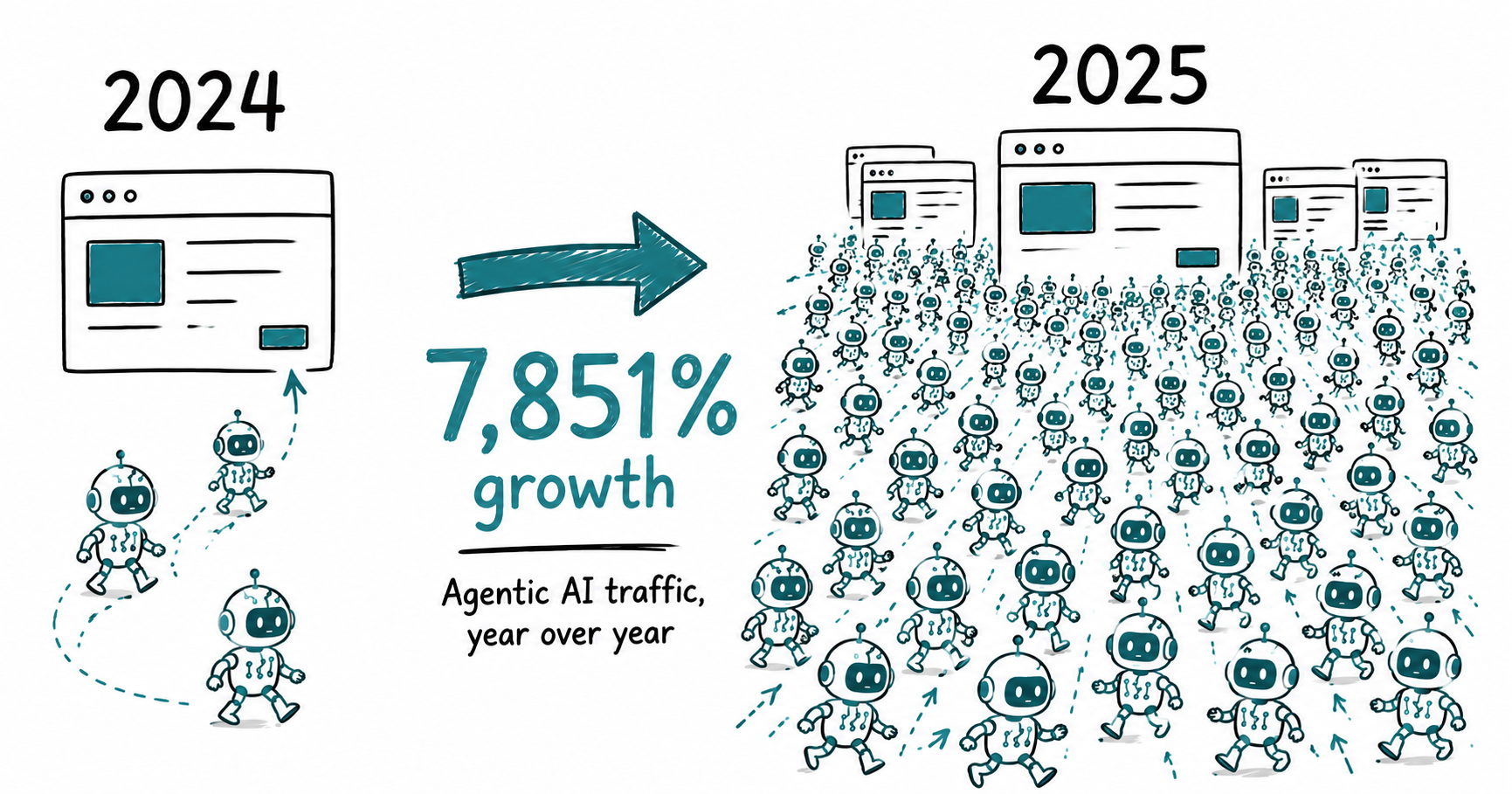
HUMAN Security’s analysis of over one quadrillion digital interactions found that automated traffic grew eight times faster than human traffic in 2025. Agentic AI traffic specifically — autonomous systems navigating and transacting on the web — grew 7,851% year over year. Monthly AI-driven traffic volumes nearly tripled across the calendar year. These aren’t crawlers indexing pages. They are agents completing tasks: comparing products, retrieving specifications, assembling research briefs, initiating purchases. The web your content was built for and the web it now operates in are not the same web.
How AI Agents Actually Read Your Content
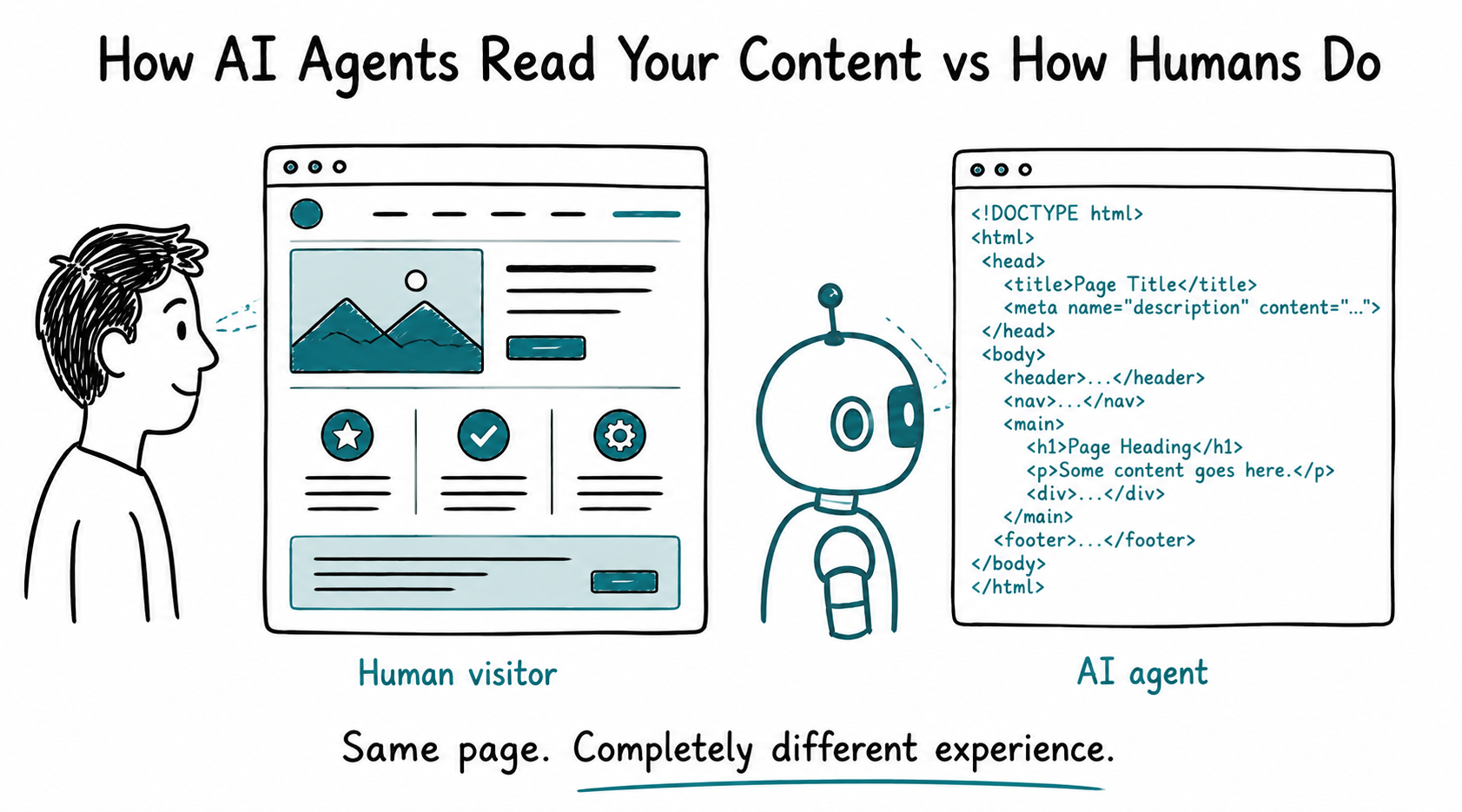
You cannot optimize for AI agents without understanding what they actually do when they land on your page. It is fundamentally different from what a human does — and from what a traditional search crawler does.
An AI agent issues a single HTTP request, strips the HTML, counts tokens, and makes a binary decision: use this content as context, or discard it. It doesn’t scroll. It doesn’t click. It doesn’t wait for JavaScript to load. Research from Search Engine Land’s analysis of 100 ChatGPT agent sessions found that 46% of visits began in reading mode — a plain-text version of your page with no CSS, no images, and no schema markup visible. After landing, 63% of agent visits bounced immediately, most often due to HTTP errors, slow load times, CAPTCHAs, or bot-blocking rules. The agent didn’t “leave” in the human sense. It simply moved to the next source.
The teams that move early here will probably have a real advantage: their APIs will be the ones agents recommend.
The Five Pillars of Agentic AI Optimization
AEO isn’t one setting to toggle or one file to add. It’s five distinct technical and structural requirements that determine whether an AI agent can use your content at all.
These five pillars map directly to the layers of the Agent Readiness Stack. Discoverability: can agents find your content without rendering JavaScript — do you have an llms.txt file, is your robots.txt configured to allow legitimate AI crawlers? Parsability: is your content in clean semantic HTML or Markdown that agents can read without interpreting visual layout? Token efficiency: does your content fit within typical agent context windows — Addy Osmani’s framework targets under 100K tokens per page, with critical content front-loaded? Capability signaling: do you expose what your content can do via AGENTS.md files, schema markup, or API documentation? Access control: have you made deliberate decisions about which agents can access which content, rather than applying blanket bot-blocking? Each layer builds on the one below. Content that fails Layer 1 never reaches Layer 5.
AEO vs GEO vs SEO — Where Each One Ends
The three disciplines share a name structure and some underlying signals, which leads most teams to treat them as variations of the same thing. They aren’t — and investing in one while neglecting the others creates specific, measurable blind spots.
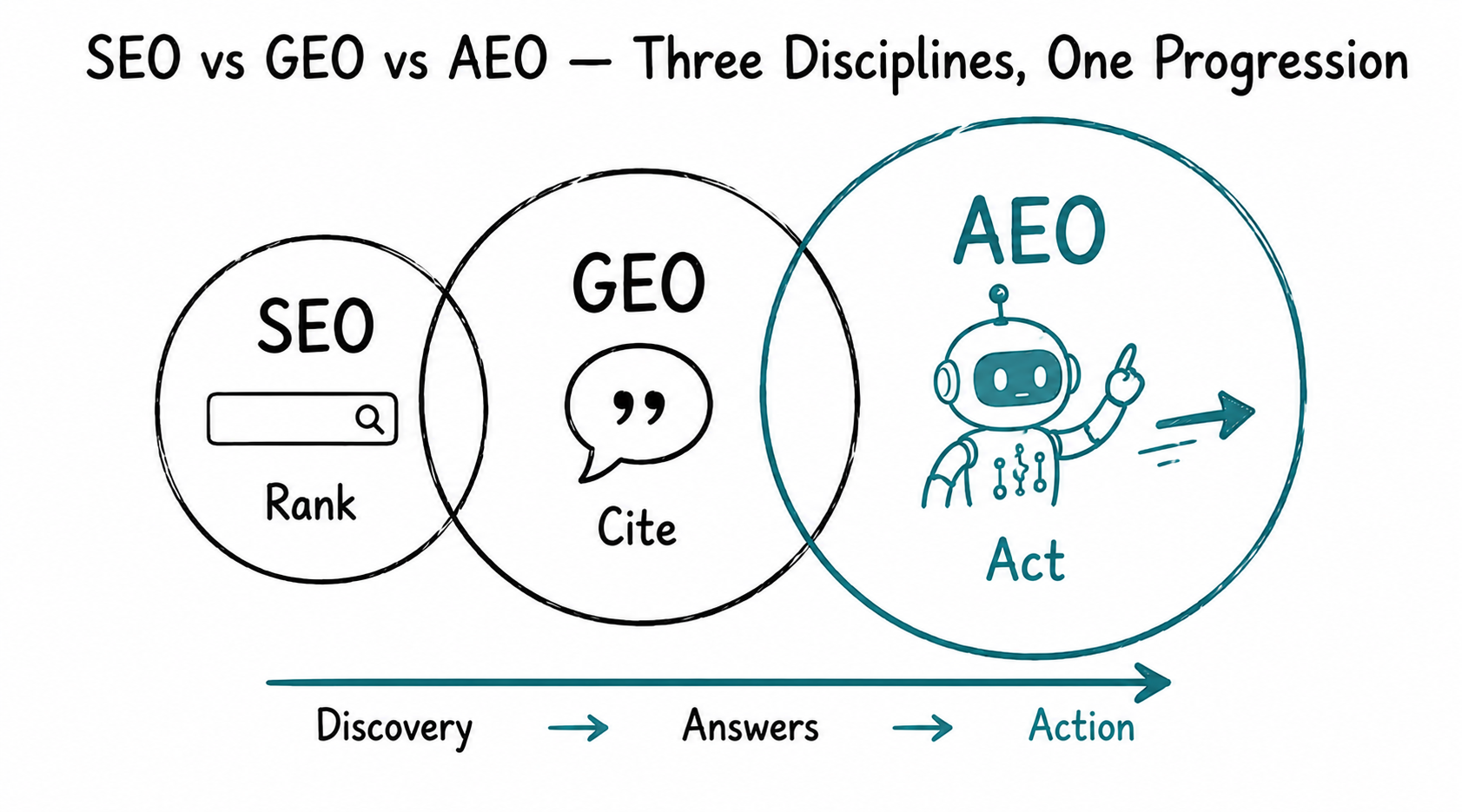
SEO targets human users via search engine ranking — success is a click. GEO (Generative Engine Optimization) targets AI systems that generate answers — success is being cited in a ChatGPT, Perplexity, or Gemini response. Agentic AI Optimization targets autonomous agents that execute tasks — success is being selected, fetched, and used as the source the agent acts on. The distinction that matters operationally: GEO gets you mentioned; AEO gets you used. A brand optimized for GEO might appear in an AI-generated summary. A brand optimized for AEO is the one whose pricing page an agent fetches when it’s comparing vendors for a procurement decision. Our piece on how to optimize your blog for AI search covers the GEO layer in depth — and Google’s own position makes clear these disciplines are converging, not diverging.
Every content decision you make is now also an access decision. The question isn’t whether your copy converts humans. It’s whether an AI agent can find it, read it, and act on it — without a human in the room.
How to Optimize for Agentic AI
Most AEO advice is either too technical for content teams or too vague to act on. The practical starting point is narrower than most guides suggest.
Start with the Agent Readiness Stack in order. Layer 1 — Discoverability: add an llms.txt file to your root directory; check your robots.txt isn’t blocking legitimate AI crawlers; ensure core content doesn’t require JavaScript to render. Layer 2 — Parsability: audit your highest-value pages with Screaming Frog or the agentic-seo CLI; convert critical content to clean semantic HTML; remove or defer non-essential scripts that delay content delivery. Layer 3 — Token efficiency: front-load key information on every page; avoid nav, footer, and modal content that forces agents to parse irrelevant material before reaching your core message. Layer 4 — Capability signaling: implement FAQPage, HowTo, and Article schema on relevant pages; add an AGENTS.md file documenting what your site can do. Layer 5 — Access control: review bot-blocking rules to distinguish malicious scrapers from legitimate AI agents. Adobe’s April 2026 data showed AI-referred traffic now converts 42% better than non-AI traffic — the commercial case for getting this right is no longer theoretical. The next step after your audit: see how AI agents are being deployed in SaaS workflows right now.
What Breaks AEO — and Why Good Content Isn’t Enough
The most common mistake operators make when they first encounter AEO is assuming their existing content is already agent-ready because it ranks well and reads well. These are unrelated qualities.
Adobe’s April 2026 retail data found that approximately 25% of homepage and category content remains inaccessible to large language models, with product pages performing worse at 34% unoptimized. The failure modes are specific: JavaScript-dependent content that agents strip before reading; bot-blocking rules applied without agent-type discrimination; pages with massive token loads that force agents to truncate or abandon; missing schema that prevents agents from understanding what a page is or does. AI compliance compounds this further — as we covered in AI compliance for enterprise SaaS, the governance questions enterprise buyers now ask about your AI apply inversely to how your content handles theirs. Access control decisions made years ago are now blocking legitimate AI traffic alongside malicious bots.
Where Agentic AI Optimization Is Heading
AEO as a discipline is less than six months old in any formal sense. The frameworks that exist today — Osmani’s five pillars, llms.txt, AGENTS.md — are first-generation tools for a problem that will compound quickly.
The execution layer is what comes next. Today’s AEO focuses on making content readable by agents. Tomorrow’s AEO will focus on making content actionable — structured for agents that don’t just retrieve information but complete transactions, initiate workflows, and make selections. When those agents are shopping, comparing, and purchasing on behalf of enterprise buyers, the brands whose content can be acted on — not just read — will have a structural advantage that compounds over time. This is not a traffic story. It’s a revenue story. The same shift in content distribution that the DIRHAM Framework describes at the channel level is playing out at the content infrastructure level right now.
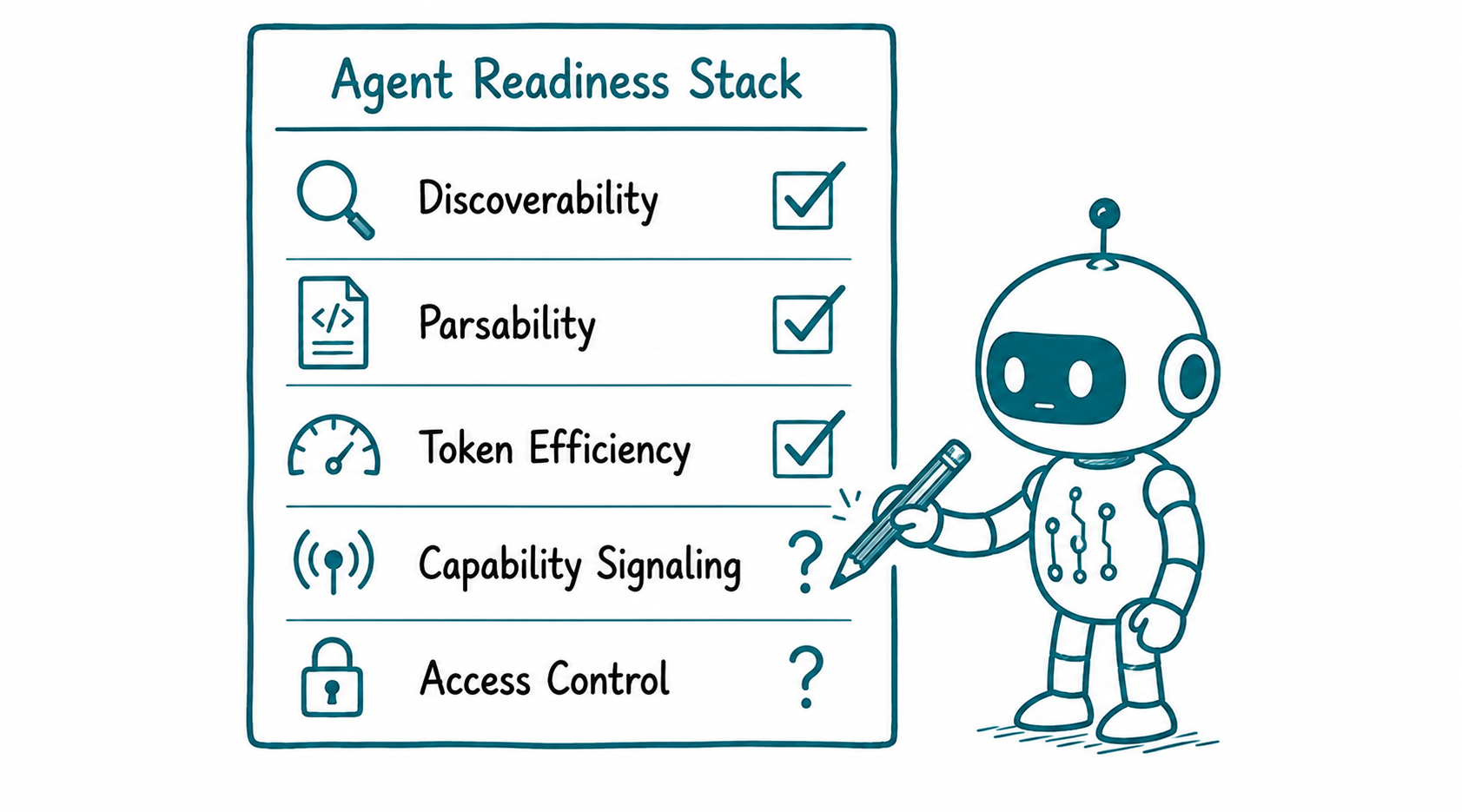
Agentic AI Optimization is not a content quality problem — it’s a structure and access problem. An AI agent doesn’t care how well your copy is written. It cares whether it can find your page without JavaScript, read it within its token budget, understand what it is via schema, and access it without hitting a bot blocker.
Fix the structure first. The content already exists.
The Agent Readiness Stack is the five-layer framework The SaaS Library uses to audit any page for agentic AI readiness: Discoverability, Parsability, Token Efficiency, Capability Signaling, and Access Control. Each layer must be solid before the next one matters.
Use the Readiness Checker below to assess where your content currently stands — and which layer to fix first. For the deployment context behind these agents, see AI Agents in SaaS: 8 Use Cases You Can Deploy Right Now.
So, What Do You Actually Do With This?
The teams optimizing for AI agents today are building the same kind of early-mover advantage that early SEO practitioners built in 2005. The difference is the window is shorter — and the stakes, given what AI-driven content distribution is doing to reach, are higher.
Frequently Asked Questions
Agentic AI Optimization is the practice of structuring digital content so that autonomous AI agents — systems that browse, compare, and act on behalf of human users — can find it, read it, and use it. Unlike SEO, which targets human users via search engines, AEO targets AI systems that fetch and process content programmatically to complete tasks on behalf of users.
SEO helps your content rank in search results for human users. GEO (Generative Engine Optimization) helps AI systems cite your content in generated answers. Agentic AI Optimization goes further — it ensures AI agents can not just find or cite your content, but fetch, parse, and act on it when completing tasks on behalf of users. GEO gets you mentioned; AEO gets you used.
AI agents issue a single HTTP request, strip the HTML, count tokens, and decide whether to use the content — all without rendering visuals, executing JavaScript, or clicking. Research shows 46% of ChatGPT agent visits begin in plain-text reading mode, stripping all CSS and images, and 63% bounce immediately due to technical barriers rather than content quality.
Use the Agent Readiness Stack Checker in this article to get a qualitative assessment across all five layers, or run the open-source agentic-seo CLI tool (npx agentic-seo –url your-url) for a scored technical audit covering discoverability, parsability, token efficiency, capability signaling, and access control signals.
The Agent Readiness Stack is a five-layer prioritization framework developed by The SaaS Library that scores any page or content asset across discoverability, parsability, token efficiency, capability signaling, and access control — giving SaaS operators a structured way to identify and fix the gaps that prevent AI agents from reading, using, and acting on their content.