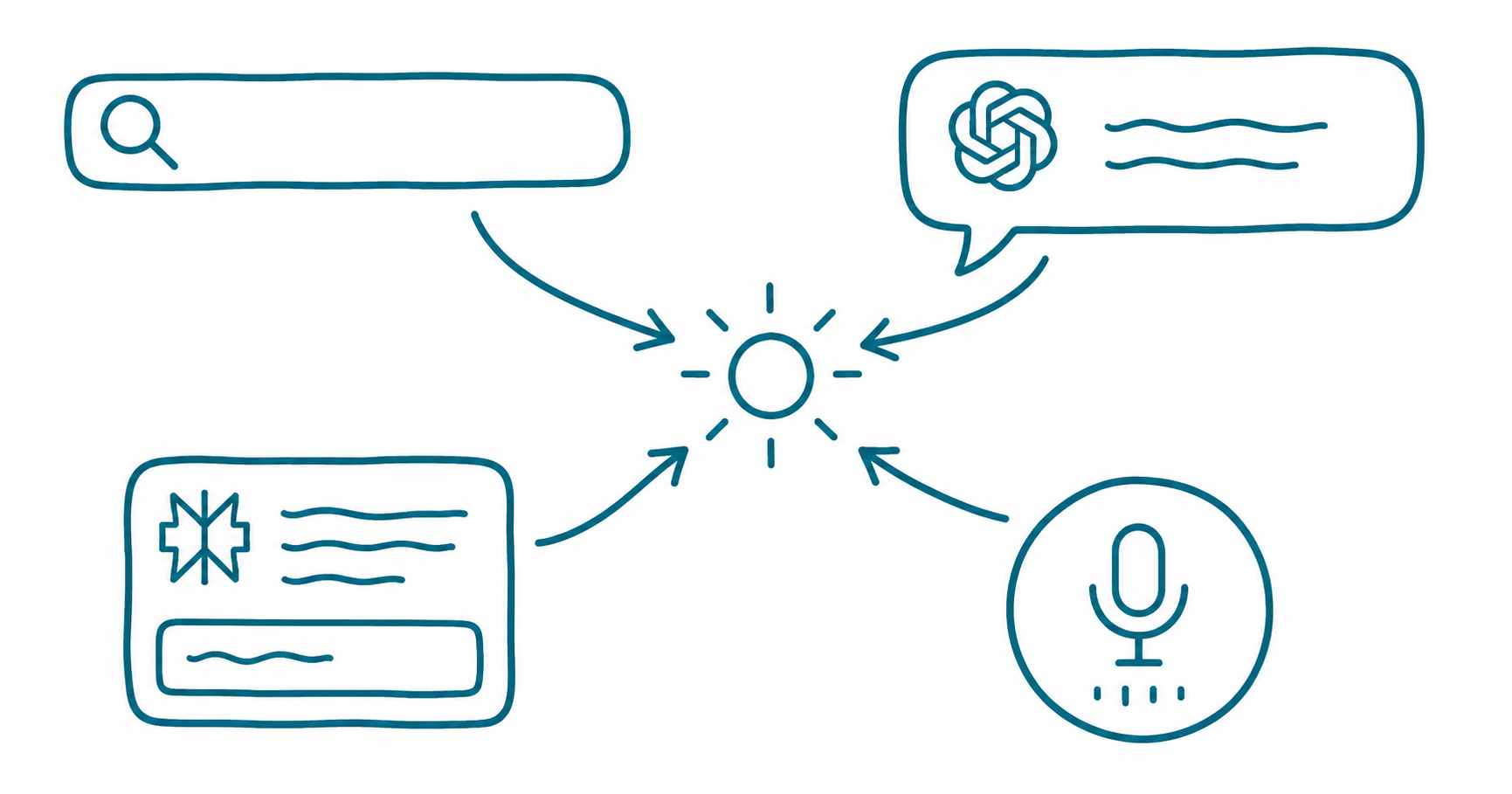
Hybrid Engine Optimisation (HEO) is the practice of optimising your content to rank on traditional search engines like Google while simultaneously getting cited by AI-powered platforms like ChatGPT, Perplexity, and Google AI Overviews. It unifies SEO, AEO, and GEO into one workflow so your brand stays visible wherever your audience is searching — whether that is a blue-link result, a featured snippet, or an AI-generated answer. For B2B SaaS brands, this shift is already reshaping how buyers discover and evaluate tools in 2026.
The term was coined by Jori Ford at SEO Week 2025. But to understand why it matters and what it actually changes about your strategy, you need to understand how we got here — and how the four optimisation disciplines relate to each other. That is what this guide covers, start to finish.
The Search Visibility Stack is a four-layer optimisation framework developed by The SaaS Library that maps the dependency chain between SEO, AEO, GEO, and HEO — showing how each layer builds on the previous one to deliver complete brand visibility across traditional search engines, answer engines, and generative AI platforms simultaneously.
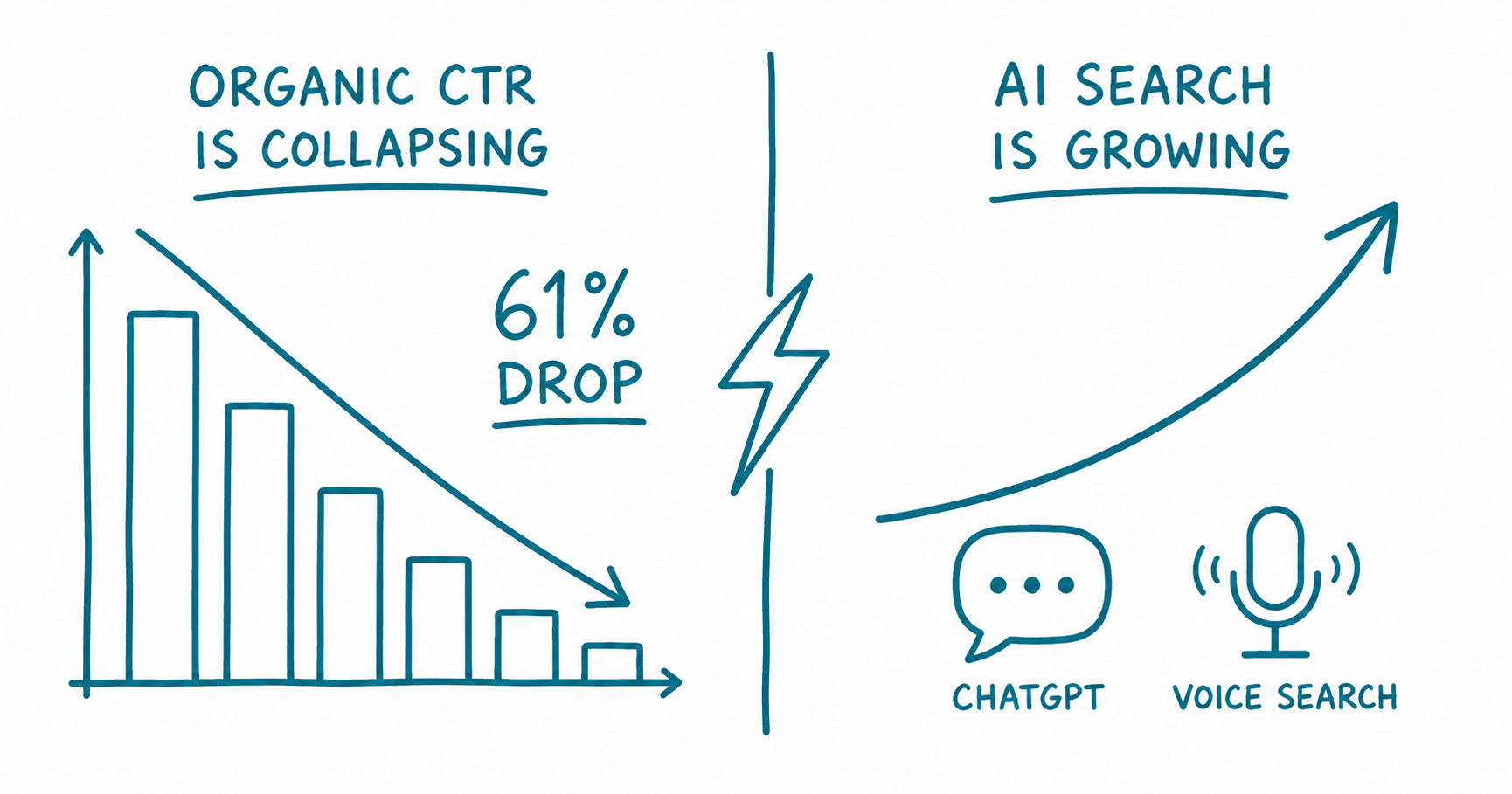
Source: Seer Interactive, November 2025 — analysis of 3,119 informational queries across 42 organisations, June 2024–September 2025.
HEO unifies SEO, AEO, and GEO into one strategy for a search landscape where AI tools handle hundreds of millions of queries daily. Organic CTR is collapsing on traditional search while AI-cited brands earn more clicks and dramatically higher conversion rates. The brands building for both surfaces now will own visibility in 2026 and beyond.
What is Hybrid Engine Optimisation (HEO)?
Hybrid Engine Optimisation is a unified search strategy that optimises your content for both traditional search engines and AI-powered answer platforms at the same time. The “hybrid” in the name refers to the dual nature of modern search — part algorithm-ranked blue links, part AI-generated answers — and the need to be visible across both simultaneously.
HEO does not replace SEO. It absorbs it. Your technical SEO foundation, keyword strategy, and backlink profile are prerequisites. HEO adds the AEO and GEO layers on top, so your content can also be extracted as a featured snippet, cited by ChatGPT, or surfaced in a Google AI Overview.
For B2B SaaS brands specifically, this matters because your buyers are researching tools across multiple surfaces. They might Google a category, ask ChatGPT for a comparison, and check Perplexity for real user context — all before they visit your website. If you only show up in one of those moments, you are missing the others entirely.
Why Did SEO Alone Stop Being Enough?
The short answer: ranking is no longer the same as being seen. Three converging shifts made traditional SEO insufficient on its own.
CTR collapsed. Organic click-through rates for informational queries with AI Overviews dropped 61% between June 2024 and September 2025, according to Seer Interactive’s analysis of 25.1 million impressions across 42 organisations. Even queries without AI Overviews saw a 41% CTR decline. Ranking number one delivers less traffic than it did 18 months ago. That trend is not reversing.
AI tools became primary research destinations. ChatGPT reached 900 million weekly active users as of February 2026 — more than double its February 2025 figure. Perplexity processed 780 million queries in May 2025 alone. These are not niche tools. They are where a growing share of your audience is spending research time.
The conversion opportunity shifted. AI search visitors convert at 23 times the rate of traditional organic visitors, according to Ahrefs’ internal traffic analysis — 0.5% of visitors from AI platforms drove 12.1% of signups. The traffic volume is still small, but the intent quality is exceptional. Brands cited in AI Overviews also earn 35% more organic clicks than those that are not, per the same Seer Interactive research.
These three shifts together make the case for HEO. Optimising for AI search is no longer optional for B2B SaaS brands that depend on organic discovery.
The History: How SEO Evolved Into HEO
HEO did not appear from nowhere. It is the product of four distinct phases in the history of search optimisation, each one born from a major shift in how people search.
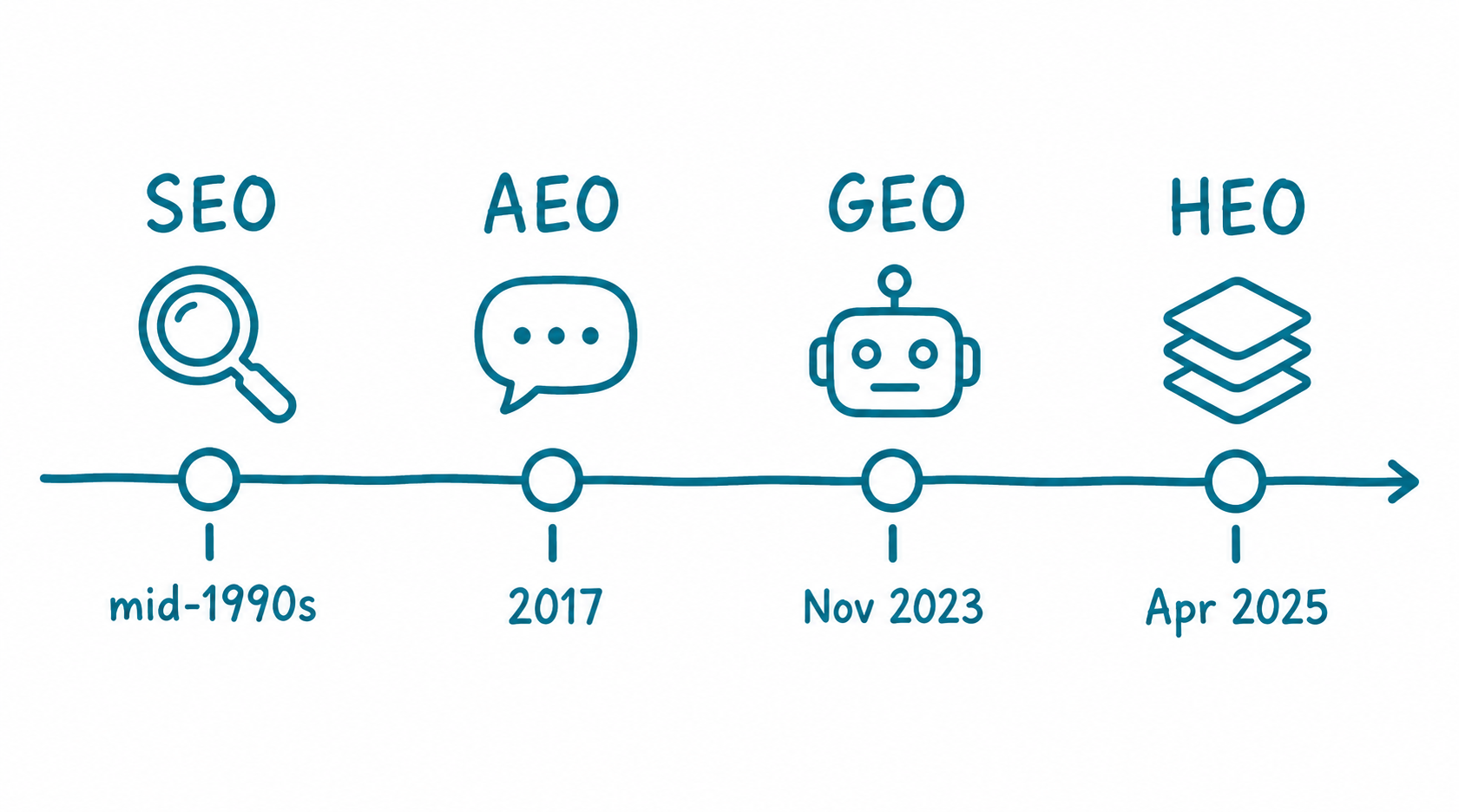
SEO — mid-1990s. Search Engine Optimisation emerged alongside the first web search engines in the mid-1990s. The first known printed reference to SEO appeared in 1997. For two decades, the goal was consistent: rank higher on Google and Bing through keywords, backlinks, and technical hygiene. SEO was the only game in town.
AEO — around 2017. Google’s featured snippets, People Also Ask boxes, and the rise of voice assistants changed the game. Ranking number one was no longer enough — you also had to be the chosen answer. Answer Engine Optimisation emerged as the practice of structuring content to win these direct answer slots, with short, extractable paragraphs, FAQ sections, and question-format headings.
GEO — November 2023. The term Generative Engine Optimisation was formally introduced in a research paper published on arXiv in November 2023, authored by researchers from Princeton University, Georgia Tech, the Allen Institute for AI, and IIT Delhi. The team built GEO-bench, a benchmark of 10,000 diverse queries, and tested nine optimisation strategies. Their finding: properly optimised content saw visibility improvements of up to 40% in AI-generated responses. A page sitting at position 5 in traditional search saw a 115% visibility jump in AI answers when proper citations were added. This paper gave the SEO industry its first academic foundation for optimising content specifically for generative AI search.
HEO — April–May 2025. Hybrid Engine Optimisation was coined by Jori Ford, Chief Marketing and Product Officer at FoodBoss, during her talk at SEO Week 2025 in New York City. The conference was hosted by Mike King’s agency iPullRank from April 28 to May 1, 2025. Ford’s talk was titled “Hybrid Engine Optimization: A Crawler Driven Approach to Maximizing Search and AI Visibility.” She deliberately chose “hybrid” rather than adding another acronym, because she wanted to signal that SEO professionals did not need to abandon their existing work — they needed to blend it with AI visibility. For further reading on her talk and the framework, see the iPullRank interview with Jori Ford.
SEO vs AEO vs GEO vs HEO — What Makes Them Similar and Different?
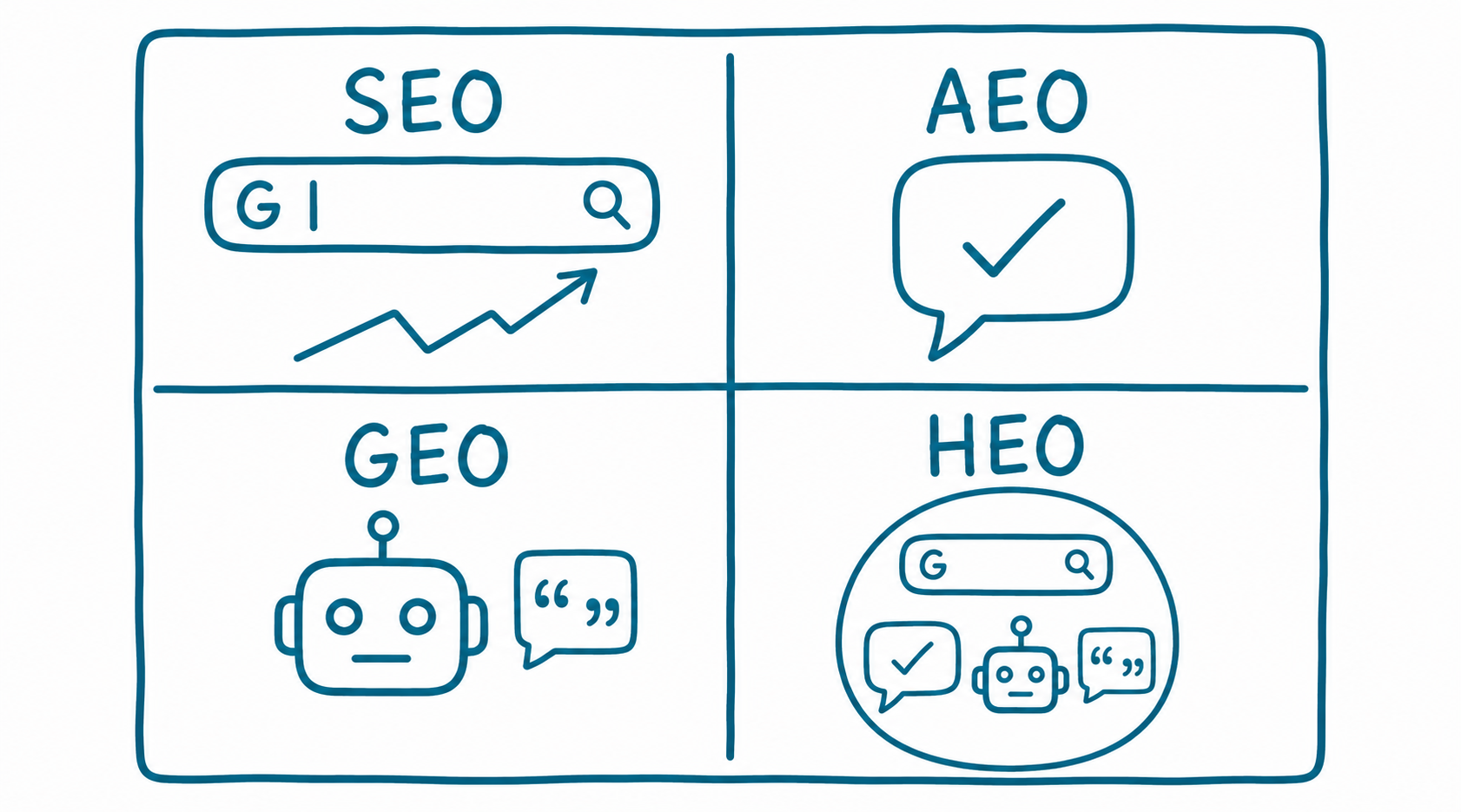
These four terms get used interchangeably, which creates real confusion. They are not the same thing. But they are also not competing strategies. Here is the clear distinction.
| Approach | Term Emerged | Primary Goal | Optimises For | Biggest Gap on Its Own |
|---|---|---|---|---|
| SEO | Mid-1990s | Rank in Google and Bing | Search engine results pages | Invisible to AI answer engines |
| AEO | ~2017 | Win featured snippets and voice answers | Featured snippets, PAA boxes, voice search | Does not address AI citation depth or rankings |
| GEO | November 2023 | Get cited by generative AI | ChatGPT, Perplexity, Gemini, AI Overviews | Does not guarantee traditional search rankings |
| HEO | April–May 2025 | Be visible everywhere people search | SERPs + AI tools + voice + snippets | Requires broader planning — but covers everything else |
What they share: All four start from the same foundation — high-quality, accurate, well-structured content. All four require technical accessibility — if search engines and AI bots cannot crawl your site, nothing works. All four reward E-E-A-T signals: real expertise, credible authorship, and verifiable sourcing. And all four ultimately serve the same goal — getting your brand in front of the right person at the right moment.
What separates them: The surface they target. SEO targets the SERP. AEO targets the direct answer slot within the SERP. GEO targets the AI-generated response outside the SERP. HEO targets all three simultaneously through one unified content and technical strategy. For a deep dive on AEO specifically, see our complete guide to Answer Engine Optimisation.
The important thing to understand: you are not choosing between them. SEO without AEO leaves featured snippets and voice search unclaimed. AEO without GEO leaves AI citations on the table. GEO without SEO is building on sand — AI tools use Google’s index as a starting point. HEO is what happens when you stop treating them as separate projects.
How Do SEO, AEO, GEO and HEO Interconnect and Complement Each Other?
This is the part most articles skip. They compare the four terms but never explain the actual dependency chain. Here it is.
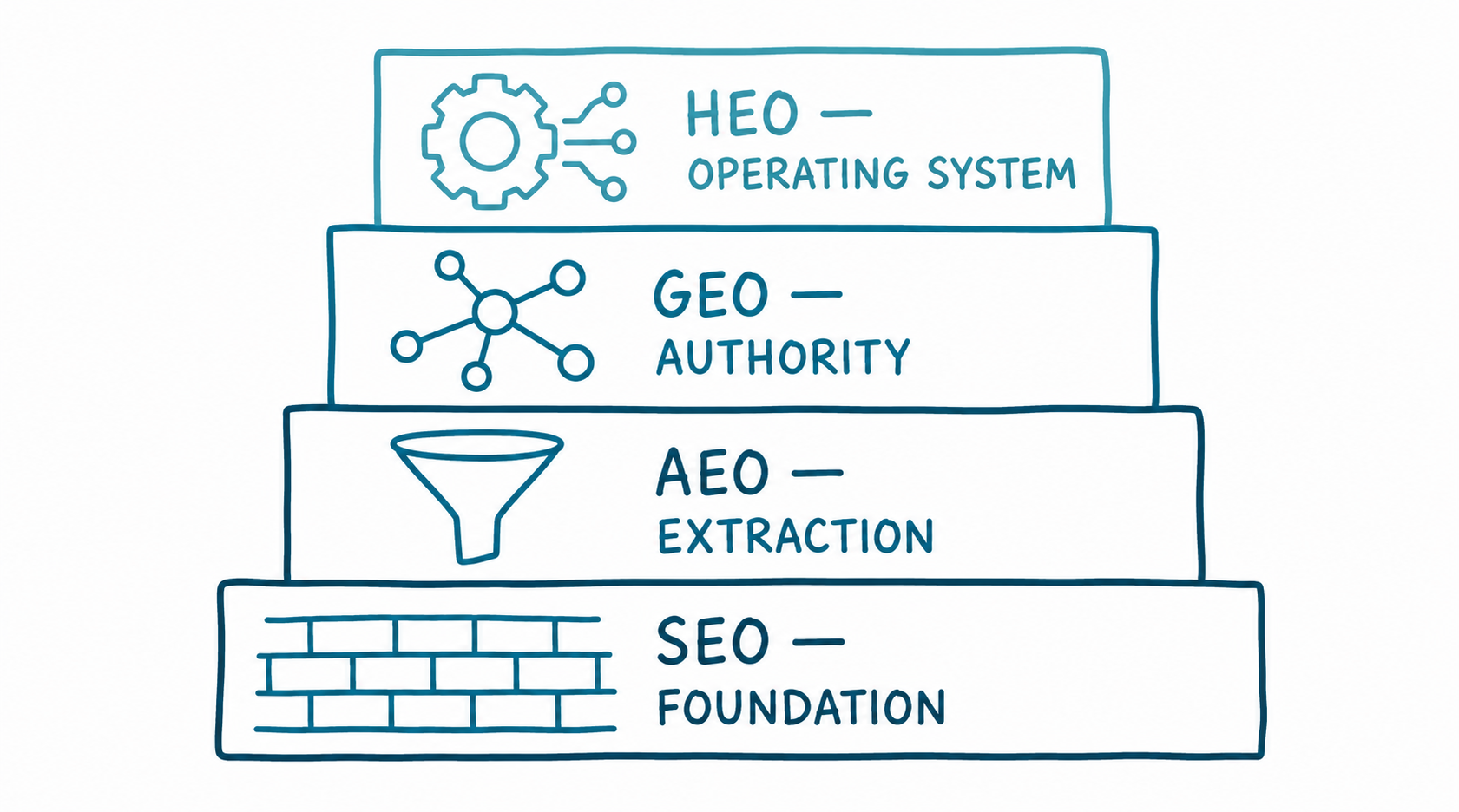
SEO is the foundation. Without it, nothing else functions. AI bots — GPTBot, ClaudeBot, PerplexityBot — use the same indexing infrastructure as Google’s crawlers. If your pages have crawl errors, slow load times, or broken indexing, AI tools will never see your content. Strong technical SEO is the prerequisite for everything above it. This is not optional even in an AI-first world.
AEO is the extraction layer. Once your content is indexed, AEO determines whether machines can pull a clean, direct answer from it. This means opening each section with a self-contained answer paragraph, using question-format headings, adding FAQ sections with FAQPage schema, and writing in language that can be read aloud by a voice assistant. AEO is what makes your content machine-readable at the answer level, not just the page level.
GEO is the authority layer. Good content that is well-structured will get indexed and extracted. But getting cited consistently by AI tools requires something more: brand authority signals across the broader web. GEO focuses on earning mentions in third-party publications, building entity presence through schema and consistent naming, and creating original data and insights that AI models cannot find elsewhere. Without GEO, your content may exist in the index but never get chosen as a citation.
HEO is the operating system. It does not replace any of the layers below — it runs them together as a single coordinated workflow. Every piece of content you create is evaluated against all three layers simultaneously: is it technically accessible (SEO), is it extractable as an answer (AEO), and does it carry the authority signals needed for AI citation (GEO)? HEO is the discipline of never letting these three separate into independent projects again.
Google itself has confirmed that GEO and AEO are extensions of SEO, not replacements for it — which validates the layered model above.
How Did HEO Become the Working Framework for AI Search?
Ford’s framework caught on quickly for three specific reasons — and none of them were hype.
First, it reframed the goal. Previous frameworks asked SEO professionals to add new tactics. HEO asked them to change what they were optimising for — from position to presence. That shift resonated with practitioners who were already watching their ranking traffic erode despite strong positions.
Second, it gave crawl logs a central role. Ford’s specific contribution was pushing SEO professionals to study their server logs to see exactly which AI bots were visiting their sites, how often, and which pages they prioritised. This was grounded, verifiable data in a space full of speculation. For more on the original talk and resources, see the SEO Week 2025 Day 1 recap.
Third, it gave practitioners a single name for something they were already doing in fragments. Most experienced SEO professionals were already running some combination of AEO and GEO tactics alongside traditional SEO. HEO gave them a framework — and a vocabulary — to describe what they were building.
By early 2026, HEO had moved from conference talk to industry standard. Agency decks, job descriptions, and client briefs started using the term. The reason is simple: it describes a real problem that every brand with an organic search strategy now faces.
What Are the Core Pillars of Hybrid Engine Optimisation?
HEO is built on seven pillars. Each one maps to a specific visibility problem. Together they cover every layer of the Search Visibility Stack.
1. Technical SEO foundation. Fast loading, clean crawling, mobile optimisation, proper indexing, and logical site structure. Both Googlebot and AI crawlers need to access your content without friction. Check your robots.txt file to confirm you are not accidentally blocking GPTBot, ClaudeBot, or PerplexityBot — this single oversight makes every other pillar irrelevant.
2. Topical authority and content depth. One blog post does not establish authority. Build content clusters — a pillar page covering the full topic at a high level, supported by multiple articles going deep on each subtopic. This signals to both Google and AI tools that your domain is a genuine authority, not just a page that covered something once.
3. Entity-based optimisation. AI engines understand the world through entities — brands, people, products, and concepts. Define your brand, your authors, and your services clearly as entities using Organisation schema and Person schema. Maintain consistent naming and contact information across your website, Google Business Profile, LinkedIn, and third-party mentions. FAQ schema remains a high-value entity signal even after Google’s changes to rich results display.
4. Schema and structured data. Schema markup gives machines a labelled, structured understanding of your content. At minimum: Article, FAQPage, Organisation, Person, and BreadcrumbList schema on every article. Without it, AI tools have to infer what your content is about rather than reading it directly. This is the fastest technical win available to most sites.
5. Brand mentions and citations. AI tools do not only read your website. They learn about your brand from across the web — press mentions, Reddit discussions, LinkedIn posts, podcast appearances, and industry publications. Brands cited in AI Overviews earn 35% more organic clicks than those that are not, per Seer Interactive. Off-site brand presence is not a nice-to-have in HEO — it is half the work.
6. Conversational content formatting. Write for how people actually ask questions. Use natural language, question-format H2s, short paragraphs, and direct answer sentences at the top of each section. Every section should be extractable as a standalone answer — readable and complete without surrounding context. This is the single biggest content change most sites need to make.
7. Crawl log analysis. Ford’s most distinctive contribution to HEO. Your server logs are the only place that shows you which AI bots are actually visiting your site, how often, and which pages they prioritise. Tools like Screaming Frog Log File Analyser or Botify can parse GPTBot, ClaudeBot, and PerplexityBot activity alongside Googlebot. This data tells you which pages are getting AI attention and which are being ignored — and it is more reliable than any third-party tool estimate.
How Do You Actually Optimise for HEO?
HEO implementation follows a logical sequence. Each step builds on the previous one. Skipping steps — particularly the technical foundation — is the most common mistake brands make when adopting AI search optimisation.
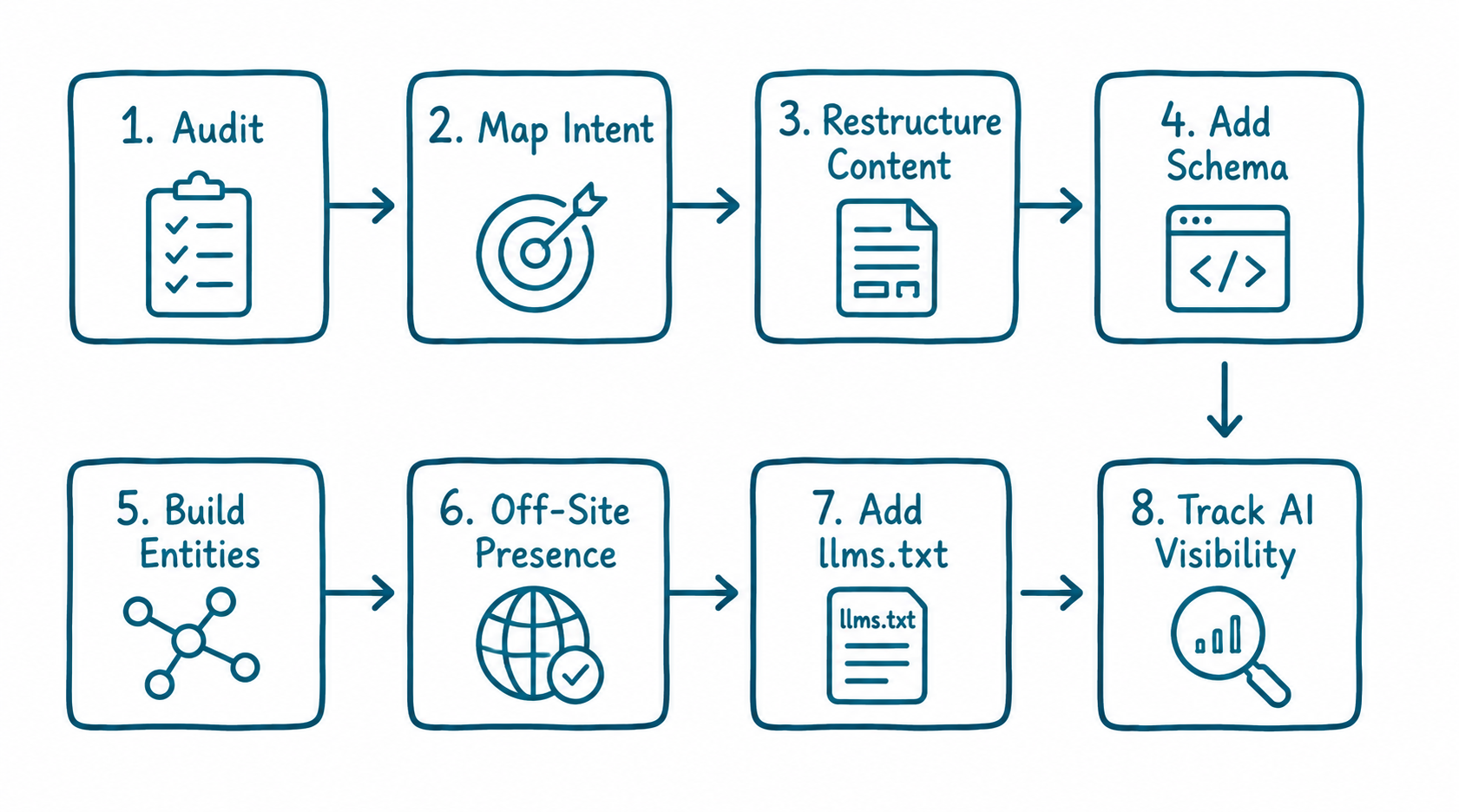
Step 1 — Audit your current foundation. Run a full technical SEO audit. Check for crawl errors, indexing gaps, page speed issues, and mobile problems. Critically: check your robots.txt file and confirm you are not blocking AI crawlers. This takes 30 minutes and has an outsized impact on everything else.
Step 2 — Map intent for both humans and AI. For each target keyword, ask two questions: what does a human reader want to learn, and what would an AI want to summarise? The human reader wants depth and context. The AI wants a clean, direct answer in the first paragraph of each section. Structure your content to serve both simultaneously.
Step 3 — Restructure content for direct answers. Go through your top pages and rewrite the opening of each major section. The first 2–4 sentences should fully answer the question implied by that heading — no preamble, no throat-clearing. This is what AI Overviews and featured snippets extract. Everything after that paragraph is for readers who want more depth.
Step 4 — Add schema markup. Deploy Article, FAQPage, Organisation, Person, and BreadcrumbList schema across your content. Validate everything using Google’s Rich Results Test before publishing. Schema is the machine-readable layer that makes your content categorisable and citable.
Step 5 — Build your entity presence. Write a detailed About page. Create author bio pages with real credentials and social profile links. Use Organisation and Person schema consistently. Ensure your brand name, description, and contact details are identical across every platform where your brand appears.
Step 6 — Build off-site brand presence. Contribute guest articles to respected publications. Get quoted in industry roundups. Answer questions on Reddit, Quora, and LinkedIn as a genuine subject matter expert. Appear on relevant podcasts. Get mentioned in comparison articles and tool lists. Each mention trains AI models to associate your brand with your topic.
Step 7 — Add an llms.txt file. Place a plain text file at yourdomain.com/llms.txt with a short description of your site and links to your most important pages. This acts as a welcome note for AI language model crawlers — similar to how robots.txt guides Googlebot. Adoption is still growing but adding one now positions you ahead of most competitors.
Step 8 — Track AI visibility. Set up a measurement system that covers both traditional search and AI surfaces. Manual weekly checks of ChatGPT and Perplexity for your core queries, combined with GA4 referral tracking for AI platform traffic, give you a clear picture of where you are gaining ground.
How Do You Measure HEO Performance?
Traditional SEO KPIs — position and CTR — are no longer the complete picture. HEO requires a blended measurement approach that covers both search and AI surfaces.
Track these alongside your existing SEO metrics:
AI Overview appearance rate. Tools like Semrush, Ahrefs, and SE Ranking now track whether your pages appear in Google AI Overview for specific keywords. Set up tracking for your top 50 keywords first. This tells you which content is being surfaced in AI-generated answers within Google search.
Brand mentions in LLM responses. Open ChatGPT and Perplexity weekly. Ask questions related to your industry, your product category, and your brand name. Note when you appear and when you do not. This is currently the most direct way to measure GEO performance and it costs nothing.
Branded search volume growth. As your HEO authority builds, more people will search your brand name directly. Track this in Google Search Console. Consistent growth in branded searches is one of the strongest signals that your AI visibility strategy is working — people have encountered your brand somewhere and are now seeking you out.
AI referral traffic. In GA4, check your referral sources for traffic from chat.openai.com, perplexity.ai, gemini.google.com, and similar platforms. This traffic is still a small percentage of total visits for most brands — but it converts at a dramatically higher rate. A 23x conversion multiplier on even 1% of your traffic materially changes your revenue picture.
Crawl log bot activity. Review your server logs monthly for GPTBot, ClaudeBot, and PerplexityBot activity. Which pages are they crawling most frequently? Which have they stopped visiting? This data tells you which content AI tools are treating as authoritative and which they are ignoring.
What Comes After HEO? The Next Phase of Search Optimisation
HEO is the framework for the current moment. But the search landscape is still moving, and two developments will shape what comes next.
Agentic AI will change content discovery entirely. AI agents that browse, compare, and make decisions on behalf of users are already in early deployment. When an AI agent researches a SaaS tool on someone’s behalf, the content it reads, the sources it trusts, and the brands it surfaces will be determined by the same signals HEO optimises for — but the stakes are higher. The agent, not the human, becomes the first audience for your content. Understanding how to optimise for agentic AI is the next step beyond HEO.
Hybrid search will become the default interface. The distinction between traditional search and AI search is already blurring. Google AI Overviews appear on millions of queries. ChatGPT has added web search. Perplexity cites sources inline. The user is not choosing between search and AI — they are using both simultaneously, often within the same session. HEO is the right framework for this hybrid reality, and its relevance will only grow as the two surfaces continue to converge.
The skills that matter going forward: technical SEO literacy, schema markup, content strategy focused on extractability, and brand-building beyond your own domain. These are not new skills — they are the existing SEO skill set, extended and reorientated toward presence rather than position.
The brands that will own visibility in the next 24 months are not the ones with the highest Google rankings — they are the ones whose content appears across every surface where a buyer makes a decision. HEO is not a trend to watch. It is the operational standard for B2B SaaS brands that depend on organic discovery. Start with your top 10 pages and ask: can an AI engine extract a clean answer from every section?
The Search Visibility Stack is a four-layer optimisation framework developed by The SaaS Library that maps the dependency chain between SEO, AEO, GEO, and HEO — showing how each layer builds on the previous one to deliver complete brand visibility across traditional search engines, answer engines, and generative AI platforms simultaneously. SEO is the foundation. AEO is the extraction layer. GEO is the authority layer. HEO is the operating system that runs all three. See how Google itself frames the relationship between these disciplines.
Where Do You Go From Here?
The brands that build for both surfaces today will not need to catch up when hybrid search becomes the universal default. That moment is not coming — it is already here.
Now that you know what HEO is and how the Search Visibility Stack works, the next step is implementation. Our step-by-step guide walks you through a full HEO content audit with real examples — so you know exactly what to fix, in what order, on which pages.
How to Optimise for HEO: A Step-by-Step Guide with ExamplesFrequently Asked Questions
HEO is a unified search strategy that combines SEO, AEO, and GEO into one workflow — optimising your content to rank on Google and Bing while also getting cited by AI platforms like ChatGPT, Perplexity, and Google AI Overviews simultaneously. It was coined by Jori Ford at SEO Week 2025.
Traditional SEO optimises for Google rankings through keywords, backlinks, and technical hygiene. HEO does all of that and adds AI visibility — structuring content so generative engines can extract, trust, and cite it. The goal shifts from ranking to presence across every surface where your audience searches.
No. HEO builds on top of your existing SEO foundation — it does not replace it. Strong technical SEO, backlinks, and on-page optimisation are prerequisites for HEO to work. You add AEO and GEO layers on top of what you already have.
Traditional SEO improvements from HEO appear within weeks to months. AI citation presence typically takes two to six months to build consistently, because AI models need repeated exposure to your content before associating your brand with a topic. Entity and brand authority signals compound over time.
The Search Visibility Stack is a four-layer optimisation framework developed by The SaaS Library that maps the dependency chain between SEO, AEO, GEO, and HEO — showing how each layer builds on the previous one to deliver complete brand visibility across traditional search engines, answer engines, and generative AI platforms simultaneously.