
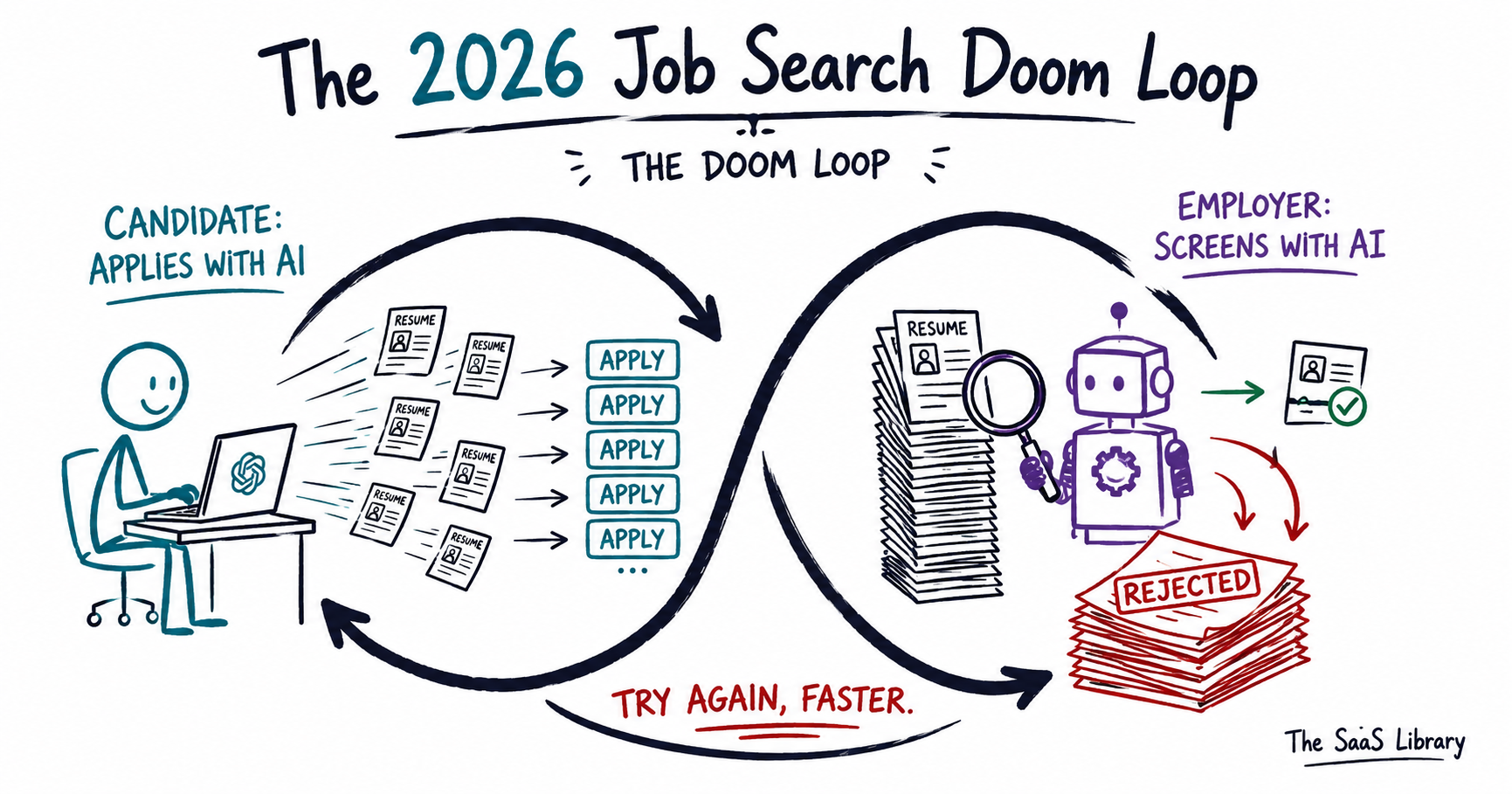
The average job posting in 2026 draws hundreds of applications, and LinkedIn alone has logged spikes of 11,000 submissions per minute platform-wide — hiring didn’t slow down, it became unreadable. Candidates turned to AI to apply faster, employers turned to AI to screen faster, and the result is the AI hiring doom loop: both sides act rationally while the whole system gets worse. This piece separates the real mechanics from the myths, and shows what’s actually working in the 2026 job search.
“75% of resumes are rejected by an algorithm before a human ever sees them” is one of the most repeated statistics in career advice. It traces back to a single defunct startup’s 2012 sales pitch — not a study, not a survey, not a single credible source.
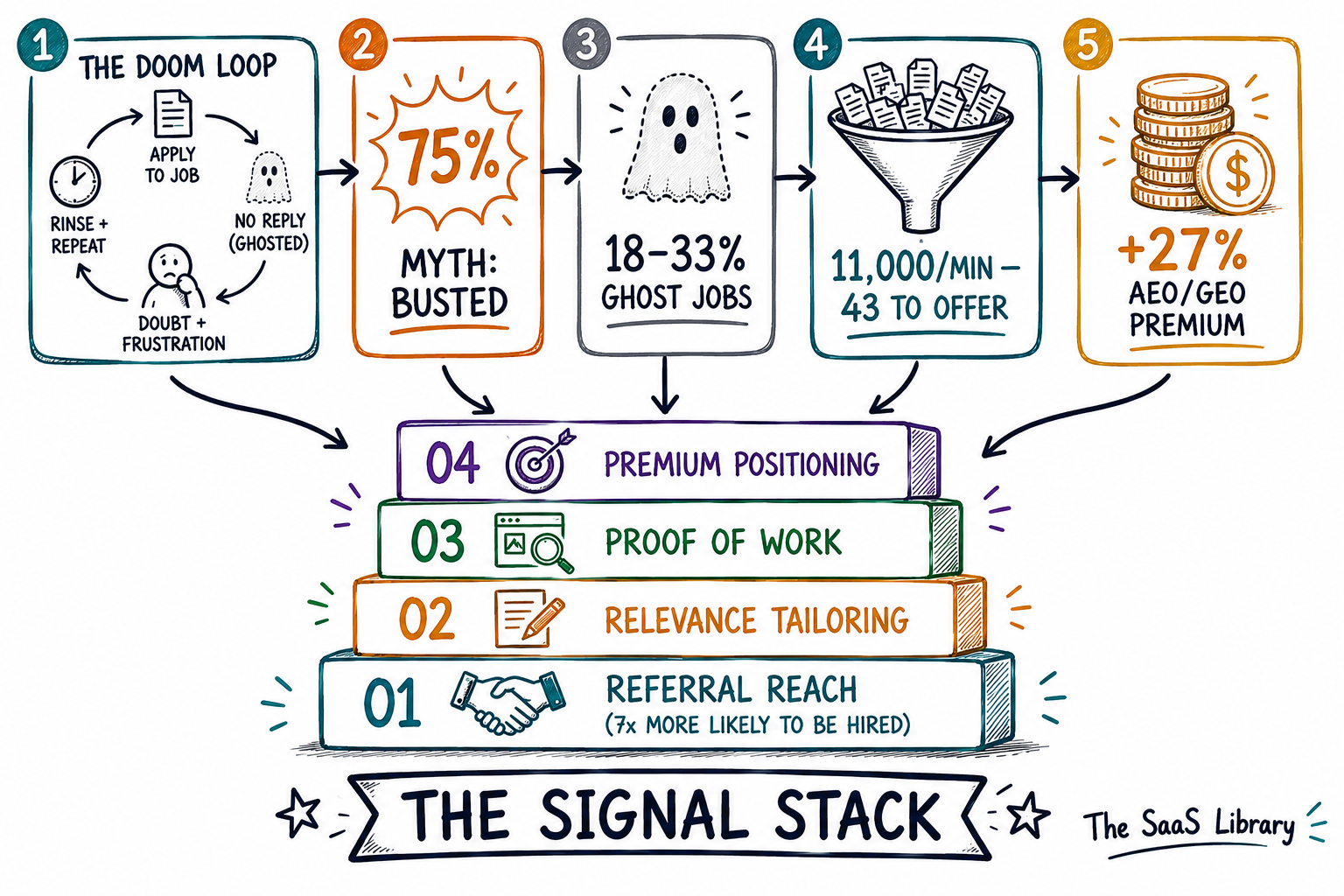
Start by recognizing that the obstacle isn’t a hidden algorithm rejecting your resume — it’s volume on both sides. Stop mass-applying, invest in referrals, tailor each application, build a verifiable proof-of-work artifact, and position explicitly around AI-search skills if you’re in marketing or SEO. That’s the Signal Stack, and it’s what actually converts in 2026.
Get the Signal Stack Toolkit — an Application Tracker, Ghost Job Scorecard, “Is This Real?” Diagnostic, and an AEO/GEO Positioning Swipe File, each with instructions and a worked example. Available after the framework section below.
Does AI Really Reject 75% of Resumes Before a Human Sees Them?
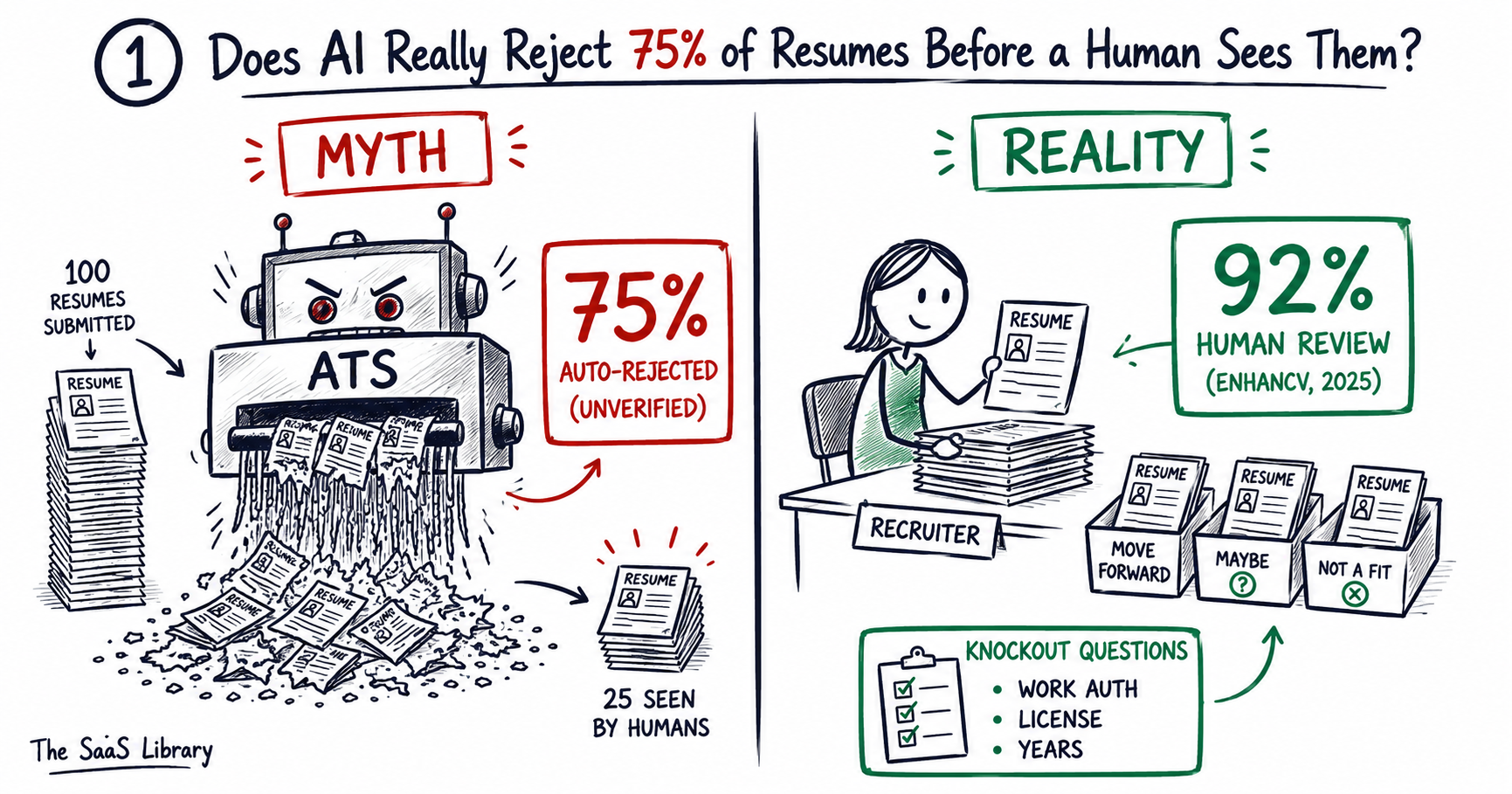
AI does not reject 75% of resumes before a human sees them — that figure has no verifiable source. It traces to a 2012 sales pitch from Preptel, a now-defunct resume-optimization startup with no published methodology, no sample size, and no peer review. Career-advice sites have repeated it for over a decade without anyone tracing it back to its origin.
The real research tells a different story. Enhancv’s 2025 study interviewed 25 US recruiters across tech, healthcare, finance, construction, and retail, using more than 10 different ATS platforms including Workday, Greenhouse, and Bullhorn.
The finding: 92% of recruiters confirmed their ATS does not auto-reject resumes based on content, formatting, or design. Only 2 of the 25 — 8% — configured any kind of content-based auto-rejection, and even then only for extreme thresholds like “match below 75%.”
What every recruiter in the study did use was knockout questions — blunt eligibility filters like work authorization, required licenses, or minimum years of experience. These aren’t algorithmic judgment calls. They’re yes/no gates a recruiter configured on purpose, and they catch far more applicants than keyword mismatches ever do.
| Claim | Reality |
|---|---|
| “ATS auto-rejects 75% of resumes” | No verifiable source; traces to a 2012 startup pitch |
| “Missing a keyword gets you instantly rejected” | Keywords affect search ranking, not rejection — recruiters query the database like a search engine |
| “ATS makes the rejection decision” | 92% of recruiters reject manually or via knockout questions, not content scoring (Enhancv, 2025) |
| “Most companies don’t use an ATS” | 99.7% of recruiters use keyword filters in their ATS or similar systems (Jobscan, 2025–2026) |
An ATS is a search-and-storage tool, not a rejection engine. The system parses your resume into a searchable database; a recruiter then searches that database the way they’d search Google. Ranking low in that search is functionally similar to rejection — but it’s not the same mechanism, and the fix is different.
Volume, not the algorithm, is the actual bottleneck. Workday’s mid-2024 platform data, gathered with Hanover Research, found job applications grew 31% year-over-year while job requisitions grew only 7% — applications outpacing openings roughly four to one.
In response, 72% of the more than 1,000 leaders surveyed said they were raising qualification requirements to cope with the flood, and 59% expected that trend to continue. Employers are responding to volume by raising the bar, not by automating rejection.
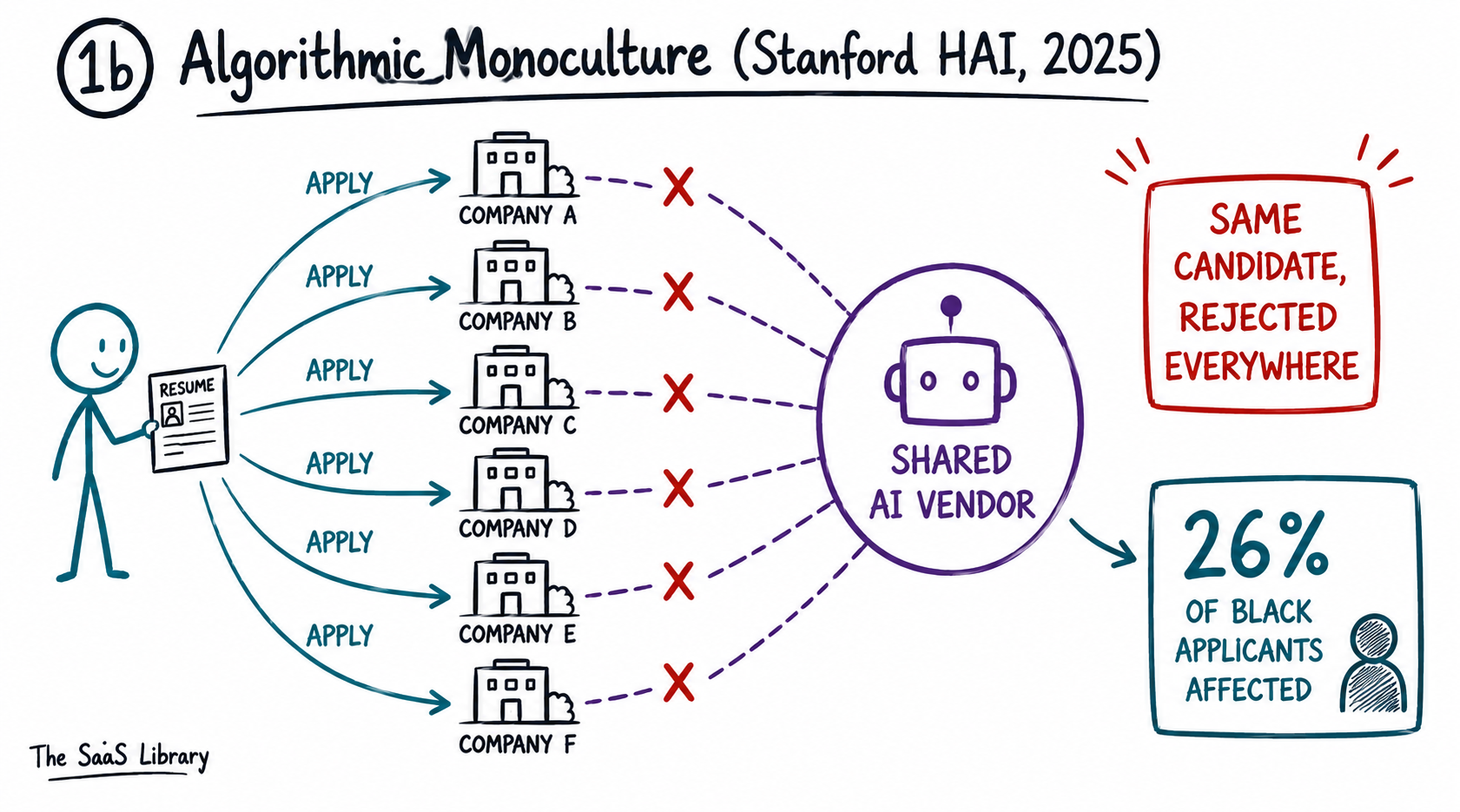
The “ATS doesn’t reject content” finding above applies to traditional keyword-matching systems — it doesn’t mean algorithmic hiring is risk-free. A separate, peer-reviewed Stanford HAI study analyzed 4.2 million real applications across 156 employers using the same AI assessment vendor and found a genuine “algorithmic monoculture” effect: candidates who apply to multiple companies screened by the same vendor are systemically rejected at higher rates than chance would predict, with the bias disproportionately affecting Black and Asian applicants — a pattern meeting the EEOC’s legal definition of adverse impact. The distinction matters: keyword mismatches aren’t quietly killing your applications, but a shared scoring vendor across employers genuinely can.
That’s the full picture on screening: the viral myth is false, but a narrower, real risk exists in shared-vendor bias. Next is the other half of the volume problem — postings that were never real to begin with.
How Common Are Ghost Jobs in 2026?
How Common Is It, By the Numbers
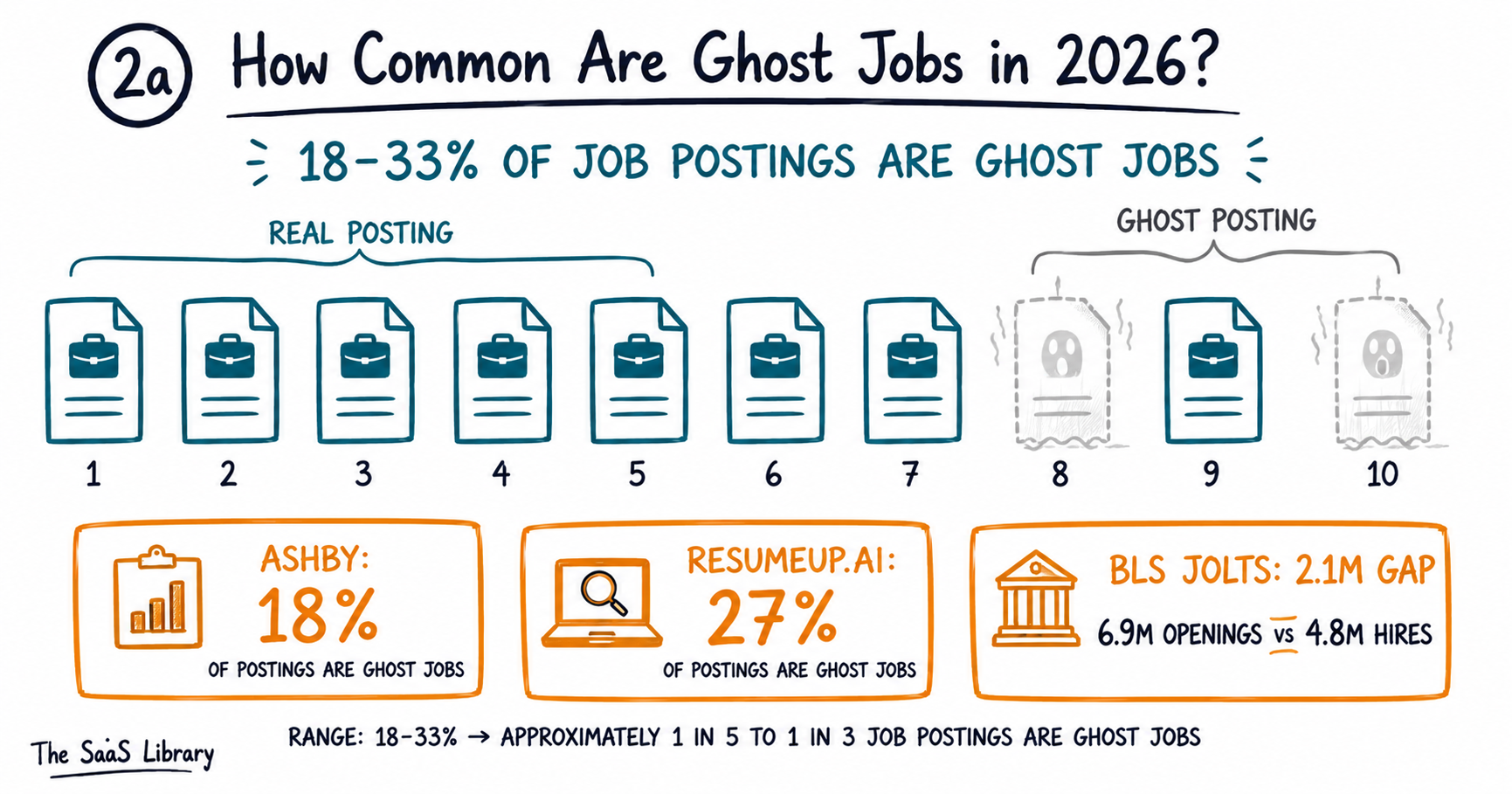
Ghost jobs make up somewhere between 1-in-5 and 1-in-3 of active job postings in 2026, with the exact figure depending on what’s being measured. Ashby’s analysis of its own platform data — the strongest estimate, since it’s based on actual hiring outcomes — found 18% of jobs posted in 2024 closed without a hire.
ResumeUp.AI’s listing-age analysis puts it higher, at roughly 27% of active US listings. Huntr’s Q1 2026 survey of 593 active job seekers found 93% have applied to a posting they believe was fake or never meant to be filled.
These numbers measure different things, which is why they don’t match. Ashby counts jobs that never resulted in a hire; ResumeUp.AI flags listings that stayed live well past a typical fill cycle; Huntr captures candidate perception rather than confirmed outcomes.
Read together, they triangulate on the same conclusion: a meaningful share of what you’re applying to was never a real opportunity. Government data adds a third, independent angle — the Bureau of Labor Statistics’ February 2026 JOLTS report recorded 6.9 million job openings against just 4.8 million actual hires that month, a 2.1 million gap consistent with the scale all three industry estimates describe.
Marketing and advertising are hit hardest of any sector. An Enhancv survey of 1,000 US professionals found 87.5% of marketing and advertising respondents reported encountering a ghost job — the highest rate of any industry surveyed, ahead of tech and finance.
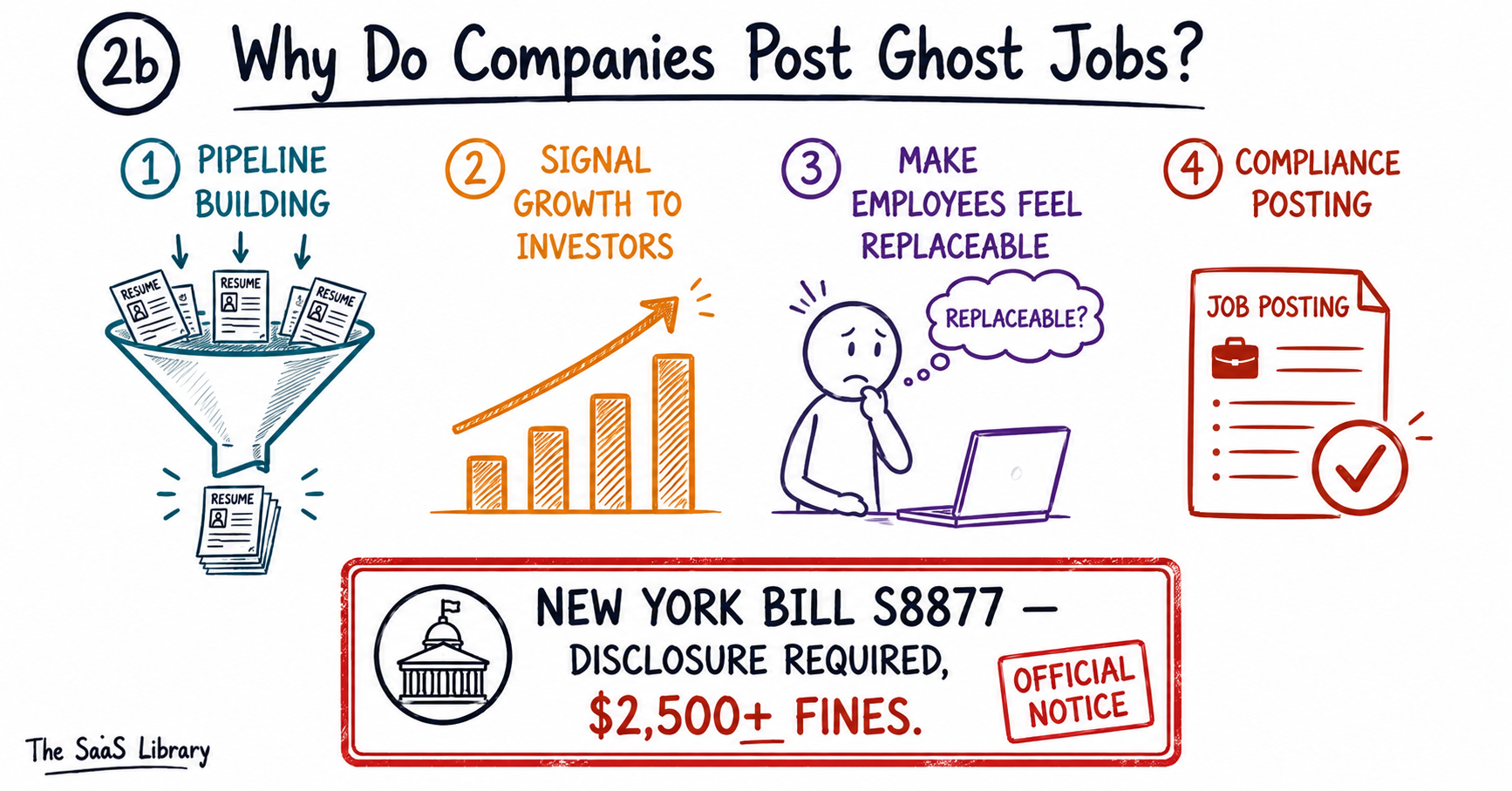
Why Companies Do It
- Pipeline-building — collecting resumes for a role that might open later
- Signaling growth to investors or the market, independent of actual headcount need
- Making current employees feel replaceable, or masking a hiring freeze
- Compliance posting — a role legally required to be advertised externally before confirming an internal candidate
The New York Crackdown
New York became the first US state to directly legislate against this practice. Bill S8877, passed by the State Senate and Assembly in June 2026 and awaiting Governor Hochul’s signature, requires employers with 100+ employees and third-party job platforms to disclose — in bold, capitalized text — whether a posting reflects a current vacancy, a future pipeline-building effort, or a role with no near-term fill date. Postings must come down within two weeks of the role being filled. Violations carry fines starting at $2,500 per posting.
Want to build the AI-search skills employers are now paying a premium for, instead of competing for a shrinking pool of generalist roles?
Read: Hybrid Engine Optimization →A ghost job costs a candidate real time — tailoring a resume, writing a cover letter, sometimes traveling for an interview — for a role that was never going to result in an offer.
Why Does the Job Search Feel Like Shouting Into a Void?
The job search feels like shouting into a void because candidates and employers are now using AI to overwhelm each other, and neither side’s defensive response fixes the underlying problem — it just escalates it. Two patterns are already driving this: ATS systems aren’t secretly killing applications, and ghost postings are wasting real time on both sides of the table. What’s left is the dynamic neither side fully controls — and it’s compounding.
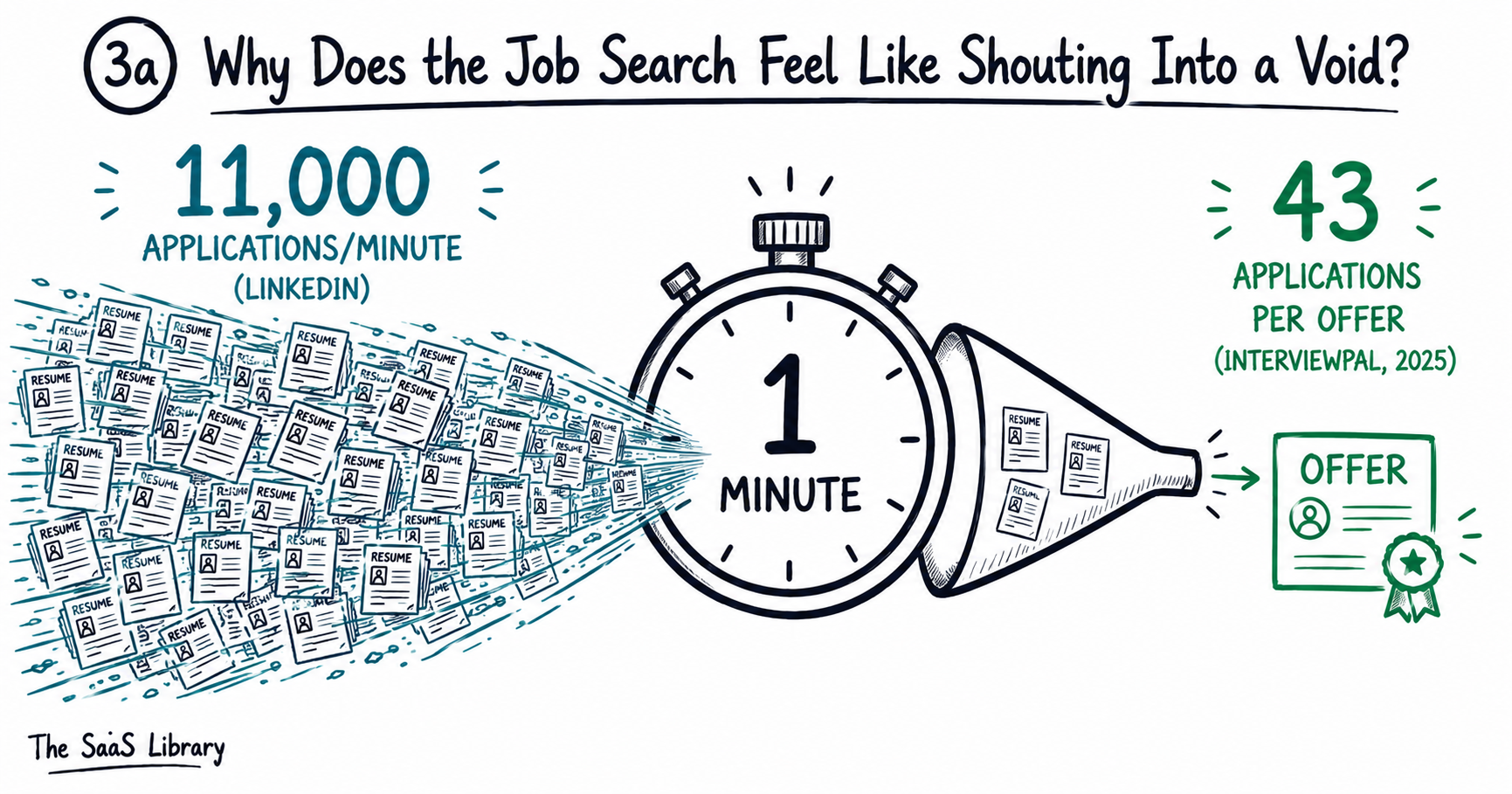
LinkedIn reported an average of 11,000 applications submitted per minute across its platform as of mid-2025, a 45% year-over-year increase the New York Times attributed directly to generative AI tools. The average job posting now draws 242 applications, giving an individual candidate roughly a 0.4% statistical chance of landing any given role.
Real funnel data confirms the math: InterviewPal’s 2025 hiring timelines study, tracking 2,247 real job searches, found candidates who eventually landed an offer submitted an average of 43 applications first — and that number climbs sharply for anyone relying solely on cold job-board applications instead of referrals or direct outreach.
Employers met the flood with their own automation, and the result is what amounts to a bot-versus-bot standoff. Recruiters now report applications that look polished on the surface but carry little genuine intent — auto-apply tools let candidates submit hundreds of applications a day without reading a single job description. In response, hiring teams are abandoning resume-first screening altogether: 41% of employers say they’re actively moving away from resumes as the primary signal, replacing them with skills assessments and behavioral interviews, and 39% of US hiring managers now conduct more in-person interviews specifically to verify that a candidate is who their AI-polished application claims they are.
Both sides are escalating in good faith and making the system worse for everyone. Candidates mass-apply because individual applications feel pointless in a 242-applicant pool. Employers screen harder because they can no longer distinguish a tailored application from a templated one. Each rational response degrades the signal the other side depends on.
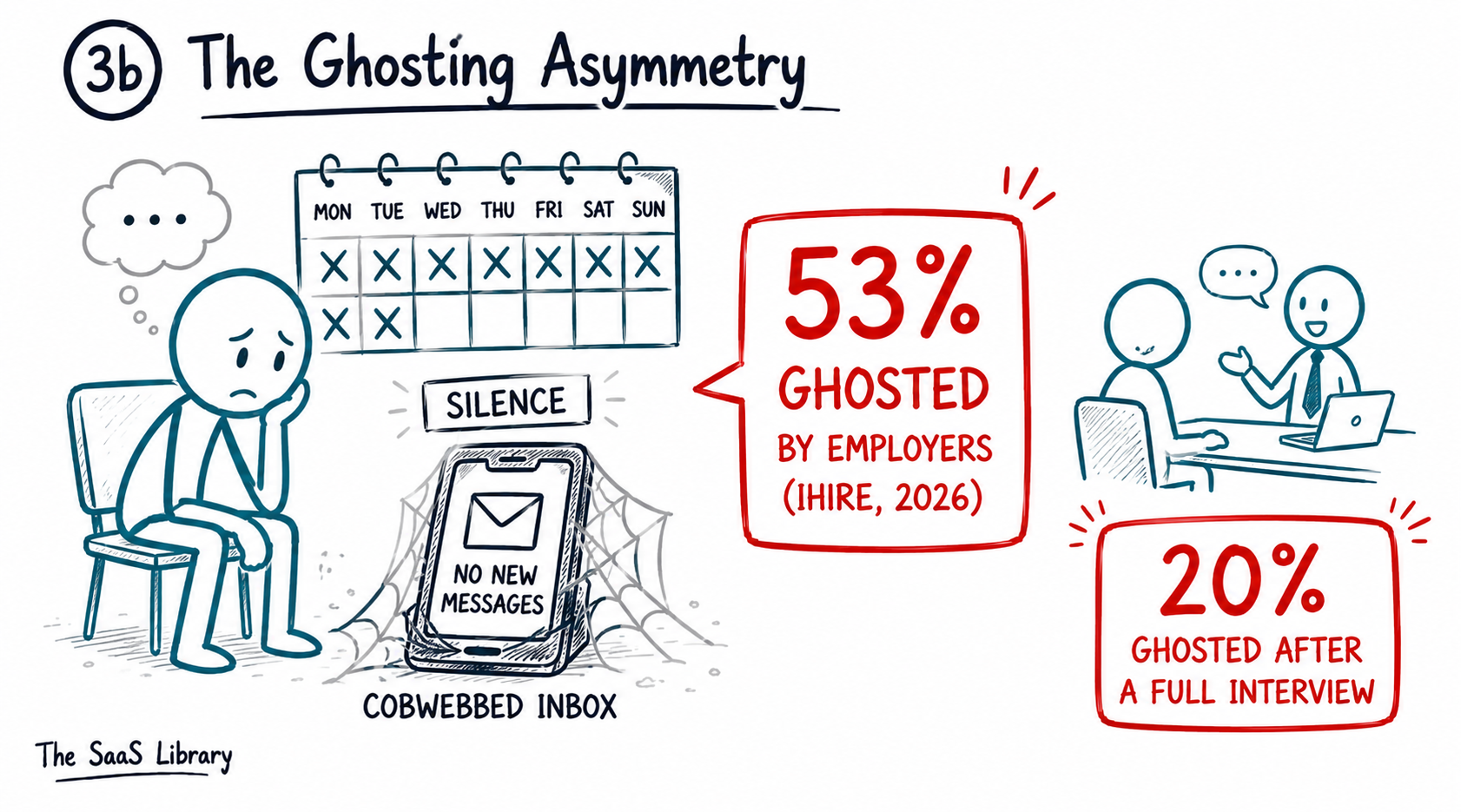
The fallout shows up in employer behavior too. iHire’s 2026 candidate experience survey found 53% of job seekers were ghosted by a potential employer in the past year — a three-year high, up from 48% in 2025 and 38% in 2024.
The silence increasingly happens deep in the process, not just at the application stage: 20% of candidates report being ghosted after completing a full interview. The doom loop isn’t a metaphor — it’s a measurable, worsening trend on both sides of the hiring table at once.
That volume-and-silence dynamic sets up a real divergence in who’s actually winning right now — and marketing and SEO talent sit at one of the sharpest edges of it. Employers are already paying a measurable premium for AI-search expertise, and the data behind that premium is worth examining in detail.
Do AI Skills Actually Pay More in Marketing and SEO?
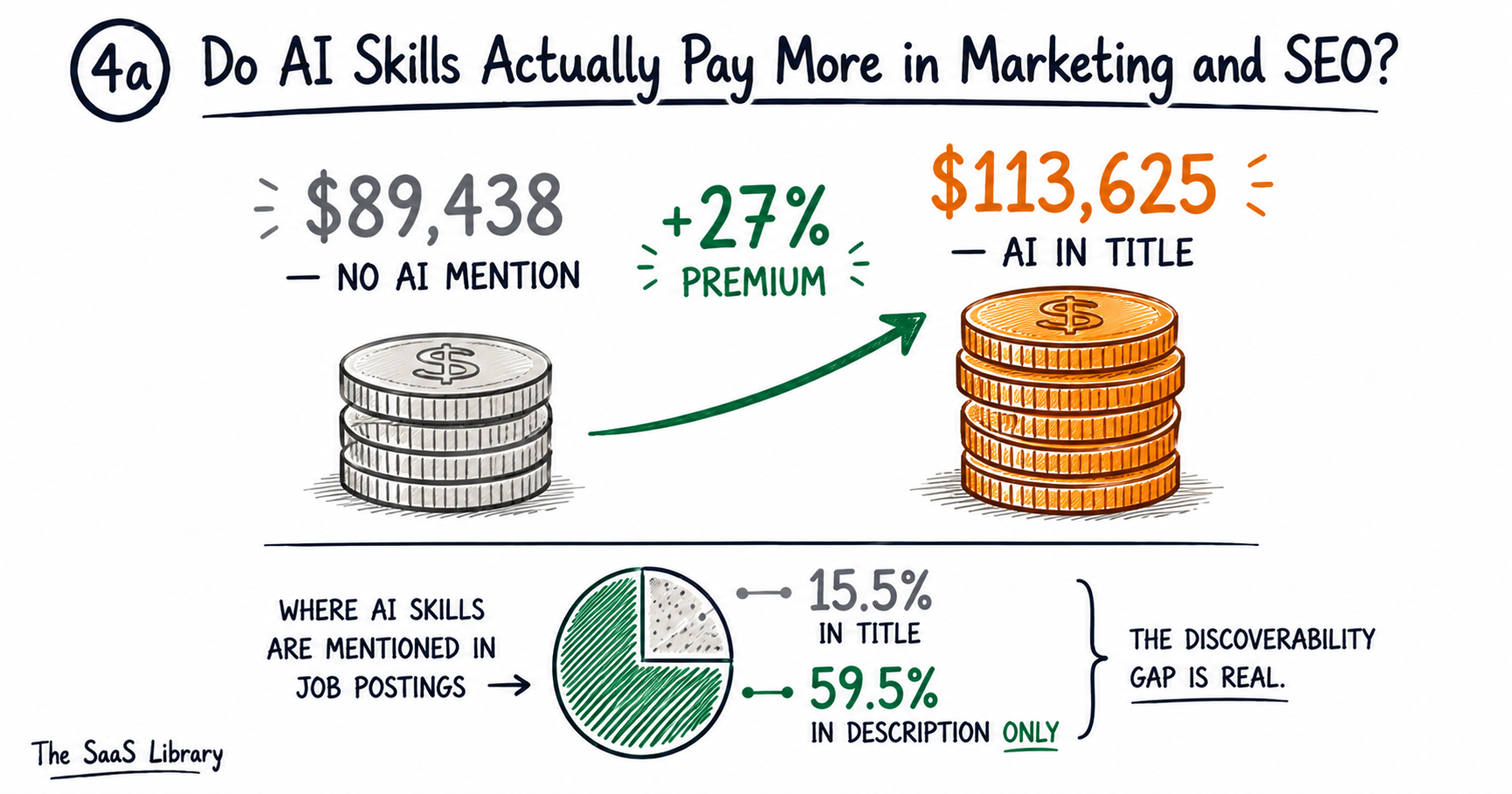
AI skills do pay more in marketing and SEO roles, and the premium isn’t a future projection — it’s already priced into 2026 hiring data. Growth Memo’s analysis of 946 full-time SEO postings from SalaryGuide.com (December 2025–March 2026) found roles with “AI” in the job title pay a median of $113,625, compared to $89,438 for roles without — a 27% gap.
The catch: only 15.5% of postings put AI in the title, while nearly four times as many — 59.5% — require it somewhere in the description instead.
Where the Premium Actually Lives
| Where AI appears | Share of postings | Median salary | Premium |
|---|---|---|---|
| In the job title | 15.5% | $113,625 | 27% (~$24,187) |
| In the description only | 59.5% | $100,000 | 25% (~$20,000) |
| At 9+ years experience | 92% | — | Baseline expectation, not a differentiator |
Title vs. Description: The Gap That Costs You
That gap matters operationally: a candidate who only searches job titles for “AI” or “AEO” or “GEO” misses roughly 80% of the roles that actually require — and pay for — those skills. Josh Peacock, founder of Search for Hire, put it directly in that same analysis:
Why the Market Is Tilting Senior
The market is also tilting senior. Semrush’s analysis of 3,900 Indeed listings found Director, VP, and Head-level roles account for 59% of all SEO postings, while mid-level Specialist and Manager roles make up a shrinking share — a sign that as AI tools absorb more execution work, companies are investing in strategic hires over individual contributors.
Growth Memo’s data confirms the same pattern from the salary side: at 9+ years of experience, 92% of postings mention AI — it’s no longer a differentiator at that level, it’s the baseline expectation.
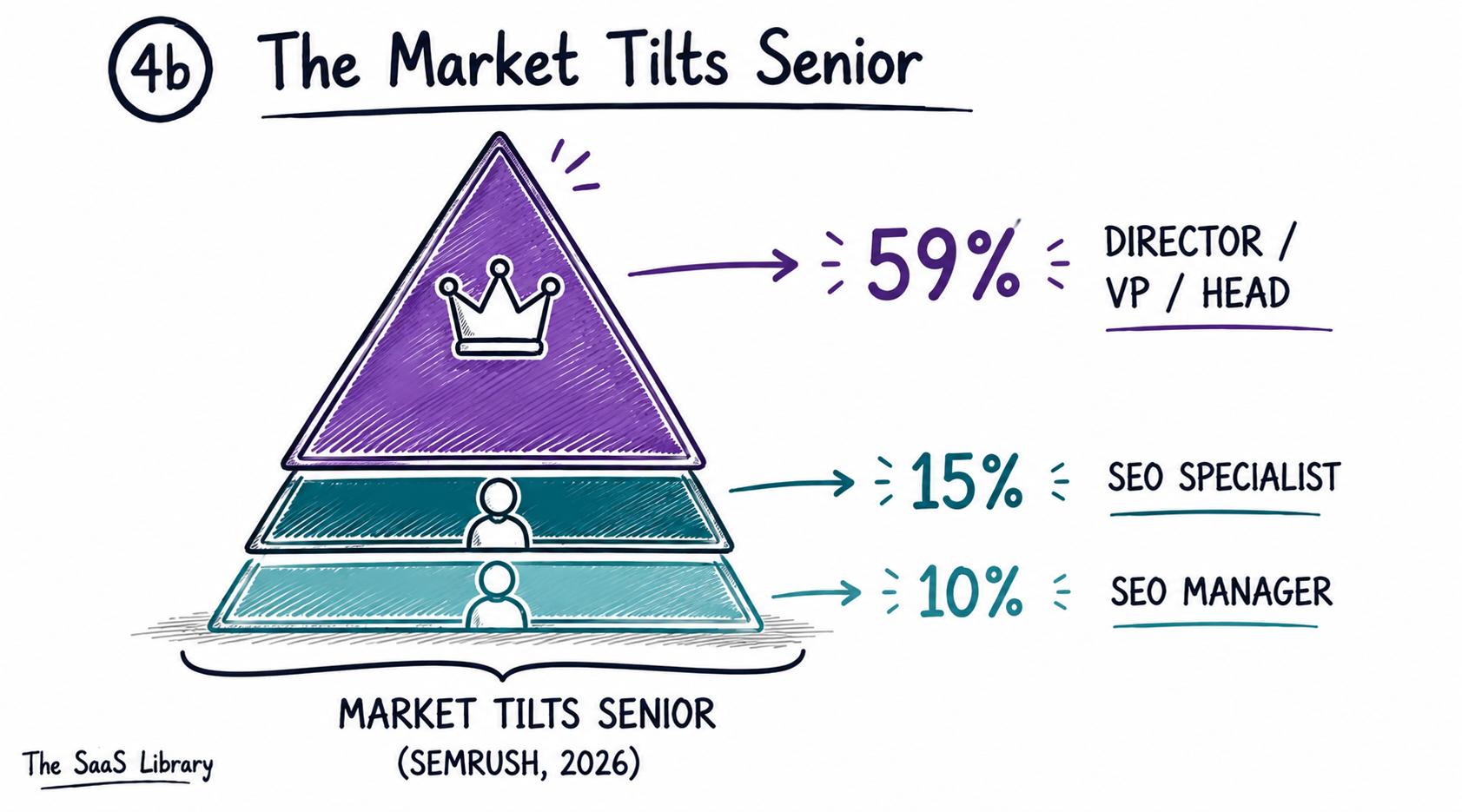
The premium isn’t paid for knowing about AI tools — it’s paid for specialization. A generalist “SEO Specialist” title competes in a shrinking, increasingly junior pool. A candidate who positions specifically around AEO, GEO, or AI-search strategy is pricing into the smaller, senior-leaning, higher-paying segment of the same market.
That distinction is the bridge into what actually works: tactics that signal real specialization instead of generic competence, regardless of which side of the doom loop is currently winning.
The Signal Stack: What Actually Cuts Through the Doom Loop
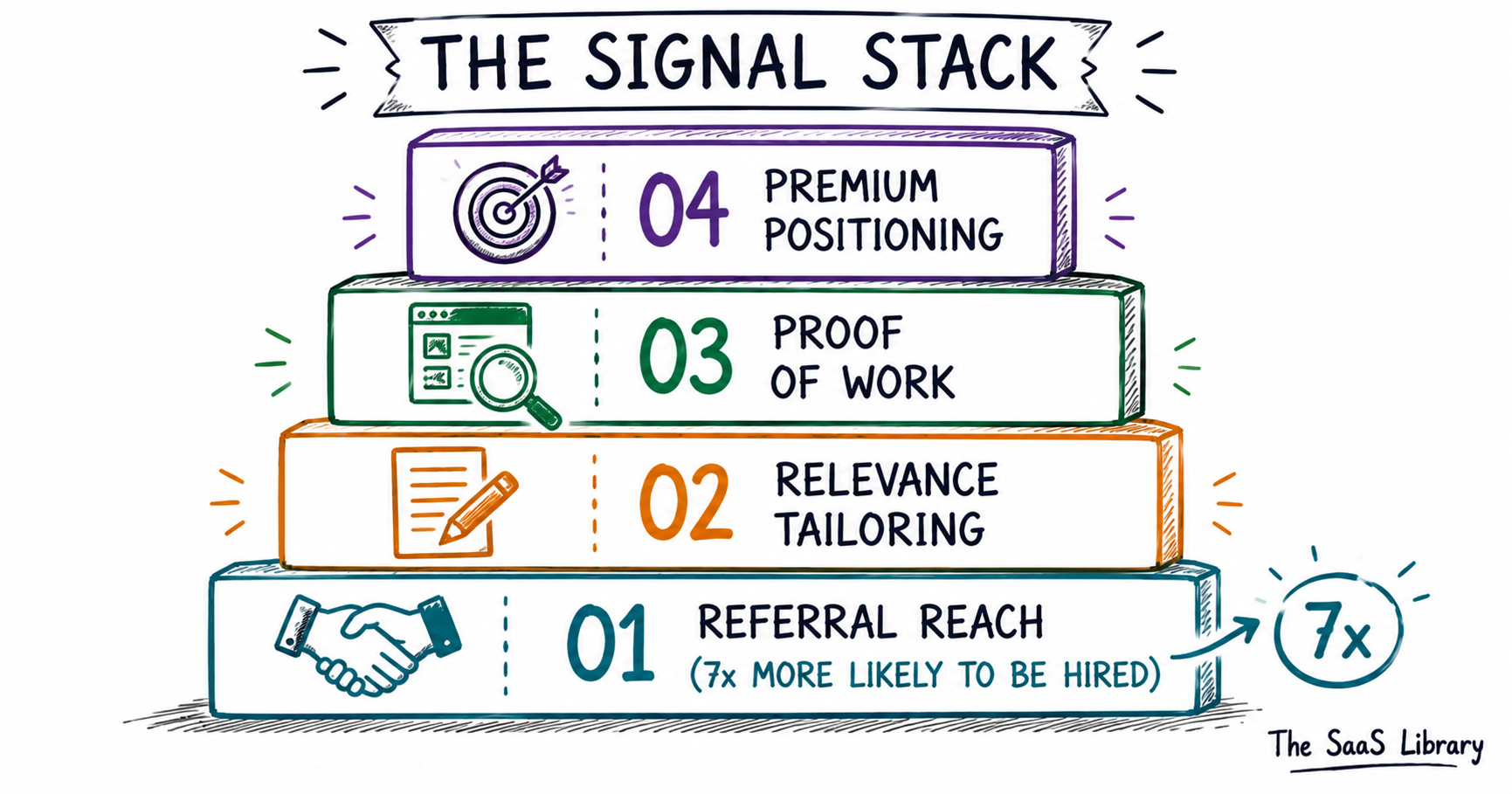
Original Data Point: One SEO/AEO specialist’s documented 2026 search makes the abstract case concrete: roughly 400 applications, only some tailored, returned 8–15 interviews — a 2–4% conversion rate that sits inside the broader benchmarks already cited. Four moves explain why the minority converted at all, and consistently outperform the high-volume, low-effort default — call it the Signal Stack.
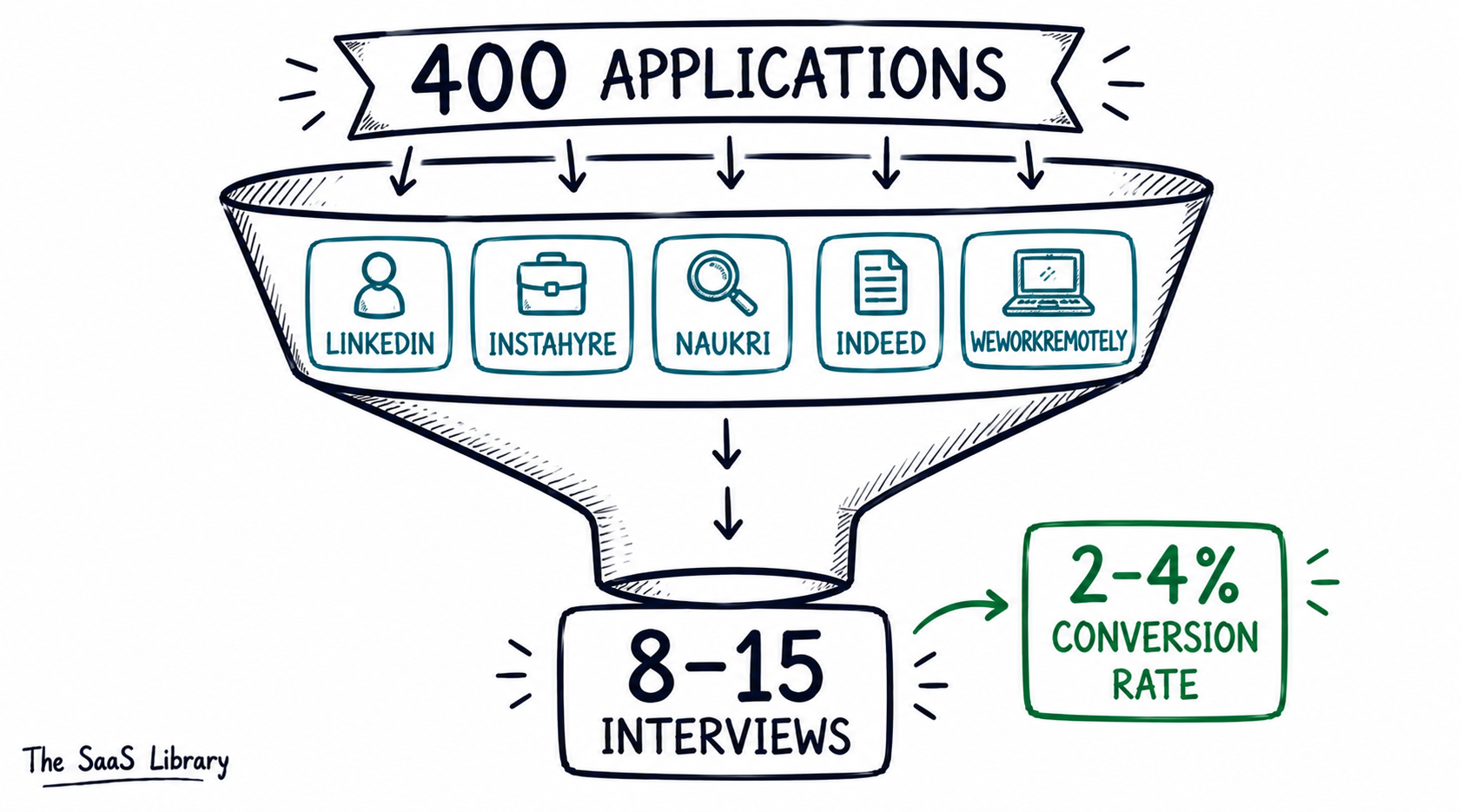
Referral access carries the most weight of the four layers, which is why it leads the stack — the scale of that advantage is worth isolating on its own.
That conversion rate lands squarely inside the 3.6–5.8% benchmark range cited earlier, which means volume wasn’t the limiting factor. What was applied, and how, was.
Referred candidates convert to hires at roughly 7x the rate of job-board applicants — the single highest-leverage move available in the Signal Stack (Pinpoint, 2026).
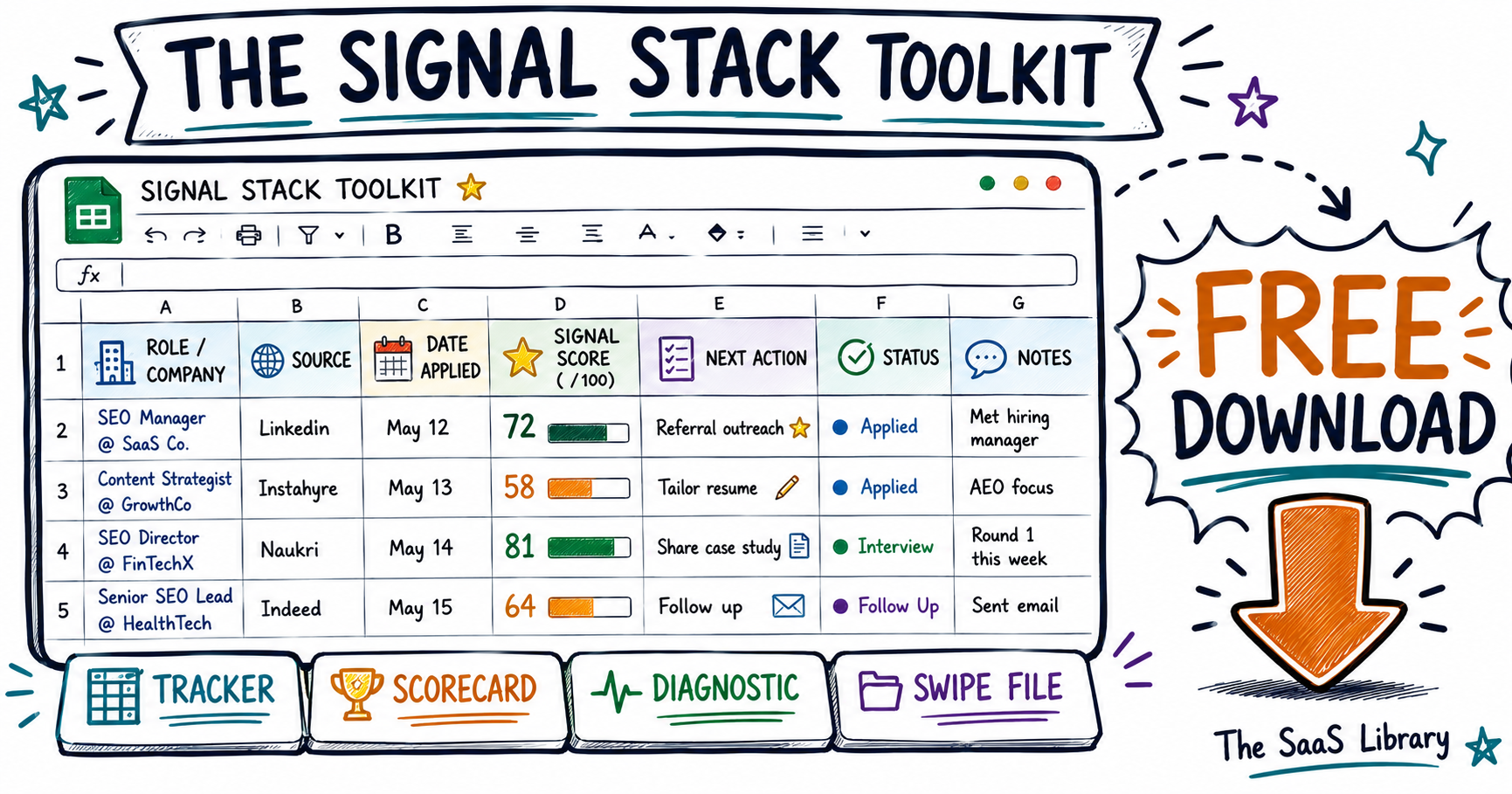
Four tabs — Application Tracker, Ghost Job Scorecard, Is This Real? Diagnostic, and an AEO/GEO Positioning Swipe File — each with instructions and a pre-filled example, so you’re never starting from a blank row.
Download the Toolkit (.xlsx) →Frequently Asked Questions
Do ATS systems really reject 75% of resumes automatically?
ATS systems do not reject 75% of resumes automatically — that figure traces to a 2012 sales pitch from a now-defunct startup with no published methodology, and a 2025 Enhancv study of 25 recruiters found 92% rely on manual review or knockout questions instead.
What percentage of job postings in 2026 are ghost jobs?
Ghost jobs make up roughly 18% to 33% of job postings in 2026, depending on the measurement method — Ashby’s outcome data puts it at 18%, while self-reported employer surveys run higher.
Why do companies post jobs they don’t intend to fill?
Companies post ghost jobs to build a future candidate pipeline, signal growth to investors, make current employees feel replaceable, or satisfy internal compliance requirements before confirming an internal hire.
Is New York banning ghost job postings?
New York is not banning ghost job postings outright, but Bill S8877 requires employers with 100+ employees and third-party job platforms to disclose hiring timelines or future-pipeline intent in bold, capitalized text, with fines starting at $2,500 per violation.
Why is it so hard to get a job interview in 2026?
Getting a job interview is hard in 2026 because application volume has overwhelmed the system — LinkedIn logs 11,000 applications per minute platform-wide, and the average posting draws 242 applicants.
Do AI-written resumes hurt your chances of getting hired?
AI-written resumes can hurt your chances when they read as generic — a substantial share of employers report rejecting AI resumes that lack personalization, while tailored, specific applications consistently outperform templated ones.
What is the AI skills salary premium in SEO and marketing jobs?
The AI skills salary premium in SEO is roughly 25-27% — roles requiring AI search skills in the job description pay a median of $100,000-$113,625 compared to $80,000-$89,438 for roles without, based on a 2026 analysis of SalaryGuide.com postings.
Should I only search for “AI” in job titles when job hunting?
You should not search only for “AI” in job titles, since only about 15.5% of SEO postings include AI in the title while 59.5% require it in the description — title-only searches miss roughly 80% of AI-required, higher-paying roles.
Do referrals really help you get hired faster?
Referrals do help you get hired faster — referred candidates are roughly 7x more likely to be hired than job-board applicants, based on an analysis of 4.5 million applications.
Does writing a cover letter actually improve your callback rate?
Writing a tailored cover letter does improve your callback rate — tailored letters get a 16.4% callback rate compared to 10.7% for applications with no letter at all, per a Resume Genius hiring manager survey.
What is GEO and AEO in the context of job hiring?
GEO (Generative Engine Optimization) and AEO (Answer Engine Optimization) are specializations within SEO focused on visibility in AI tools like ChatGPT, Perplexity, and Google AI Overviews, and they’re emerging as a premium-paying specialty within marketing hiring. Learn more about Answer Engine Optimization →
What is the AI hiring doom loop?
The AI hiring doom loop is the self-reinforcing cycle in which AI-assisted mass-applying by candidates and AI-driven screening by employers each respond to the other by further degrading trust and signal across the hiring process.
Conclusion
The Signal Stack works because it sidesteps the doom loop rather than trying to out-automate it — referrals, tailoring, proof of work, and premium positioning all rely on signal that algorithms on either side can’t fake.
The data is consistent: the people winning the 2026 job search aren’t applying more, they’re applying with more verifiable signal per application. For marketing, SEO, and B2B SaaS professionals specifically, that increasingly means positioning explicitly around AI search skills rather than a generic title.
Read: Optimization Without Understanding — the hidden cost of AI-assisted SEO →
- Enhancv — “Does the ATS Reject Your Resume?”, 2025
- Jobscan — “State of the Job Search”, 2025–2026
- Workday Global Workforce Report 1H24, with Hanover Research
- Stanford HAI / Digital Economy Lab — “Algorithmic Monoculture in Hiring”, 2026
- Ashby — Ghost Jobs Talent Trends Report, 2026
- ResumeUp.AI analysis, via Entrepreneur, 2025
- Huntr — Q1 2026 Job Search Trends Report
- U.S. Bureau of Labor Statistics — JOLTS, February 2026
- New York State Senate — Bill S8877, 2025/2026
- eWeek, citing New York Times reporting, 2025
- The Interview Guys — “The Average Job Opening Now Gets 242 Applications”, 2026
- InterviewPal — 2025 Hiring Timelines Study
- iHire — “53% of Job Seekers Have Been Ghosted”, 2026
- Growth Memo / Kevin Indig — “The AI Skills Salary Premium”, 2026
- Search for Hire — “SEO Hiring Trends 2026”
- Semrush — “SEO Job Market Study”, 2026
- Pinpoint — “Referrals Are 7x More Likely to Be Hired”, 2026
- Resume Genius — Cover Letter Statistics, Hiring Manager Survey
- Enhancv — Ghost Jobs Survey 2026