Google says nothing new is required to appear in AI Overviews. It also just built an entire crawler ecosystem that ignores half of what most sites were built to do.
What is technical SEO?
Technical SEO is the practice of optimizing a website’s infrastructure — crawlability, indexation, speed, structured data, rendering — so search engines and AI systems can access, interpret, and cite its content. It is distinct from content SEO and off-page SEO; technical SEO is what makes both possible.
What does a technical SEO audit check?
A technical SEO audit checks whether a site’s infrastructure lets search engines and AI systems do their job: crawl every important page, render it correctly, index the right version, and extract accurate information from it. That’s four separate failure points, and a site can pass three and still be invisible.
Crawlability determines whether a bot can reach a page at all — broken robots.txt rules, orphaned pages, and blocked resources stop everything downstream. Rendering determines whether what the bot sees matches what a user sees, which matters more now that AI crawlers like GPTBot and ClaudeBot don’t execute JavaScript the way Googlebot does. Indexation determines whether a crawled, rendered page actually gets stored and served — canonical conflicts and accidental noindex tags are the usual culprits.
Extraction is the newest addition to that list. Google’s own May 2026 guidance confirms why it matters: AI Overviews and AI Mode retrieve from the same core index as regular Search, using retrieval-augmented generation and query fan-out to pull supporting pages. A page that ranks on page one but buries its answer under three paragraphs of throat-clearing can still fail the extraction test.
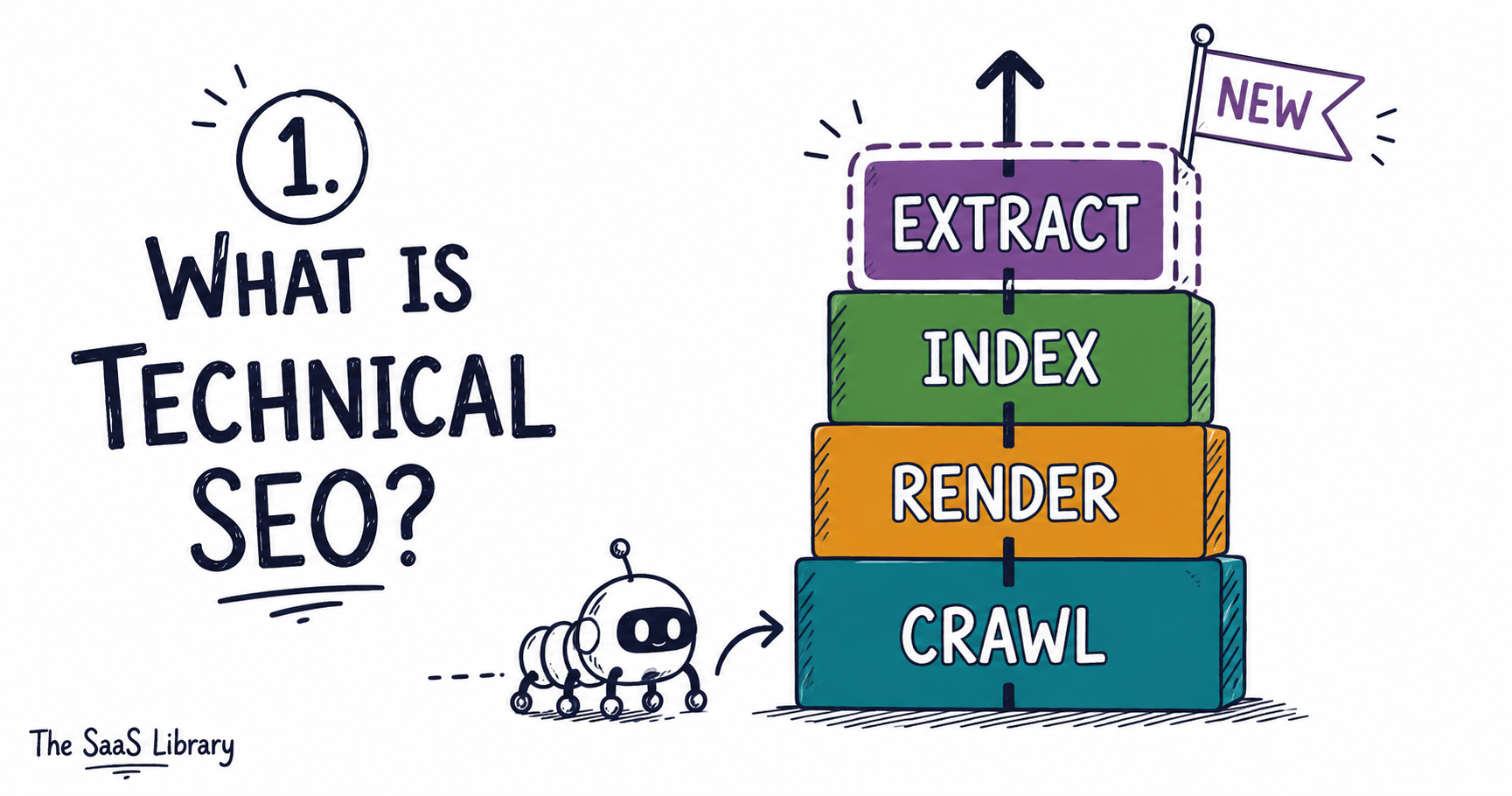
That fourth point — extraction — is exactly where the last two years of change concentrated, and it’s the subject of the next section.
How has AI changed technical SEO?
Roughly 80% of a technical SEO audit hasn’t moved in years. Crawlability, indexation, Core Web Vitals, canonical logic — Google’s own guidance confirms none of that changed for AI features, because AI Overviews and AI Mode retrieve from the same index Googlebot has always built. What changed is who else is reading that index, and that shift added a genuine second layer to the job without deleting the first.
Think of it like a building that suddenly gets a second class of visitor. The plumbing, wiring, and floor plan stay exactly the same. But now you’re also asked: can a wheelchair get through this doorway? Can someone who’s never seen the building before find the exit without asking? That’s the honest shape of what happened to technical SEO — same structure, new question layered on top.
What stayed the same?
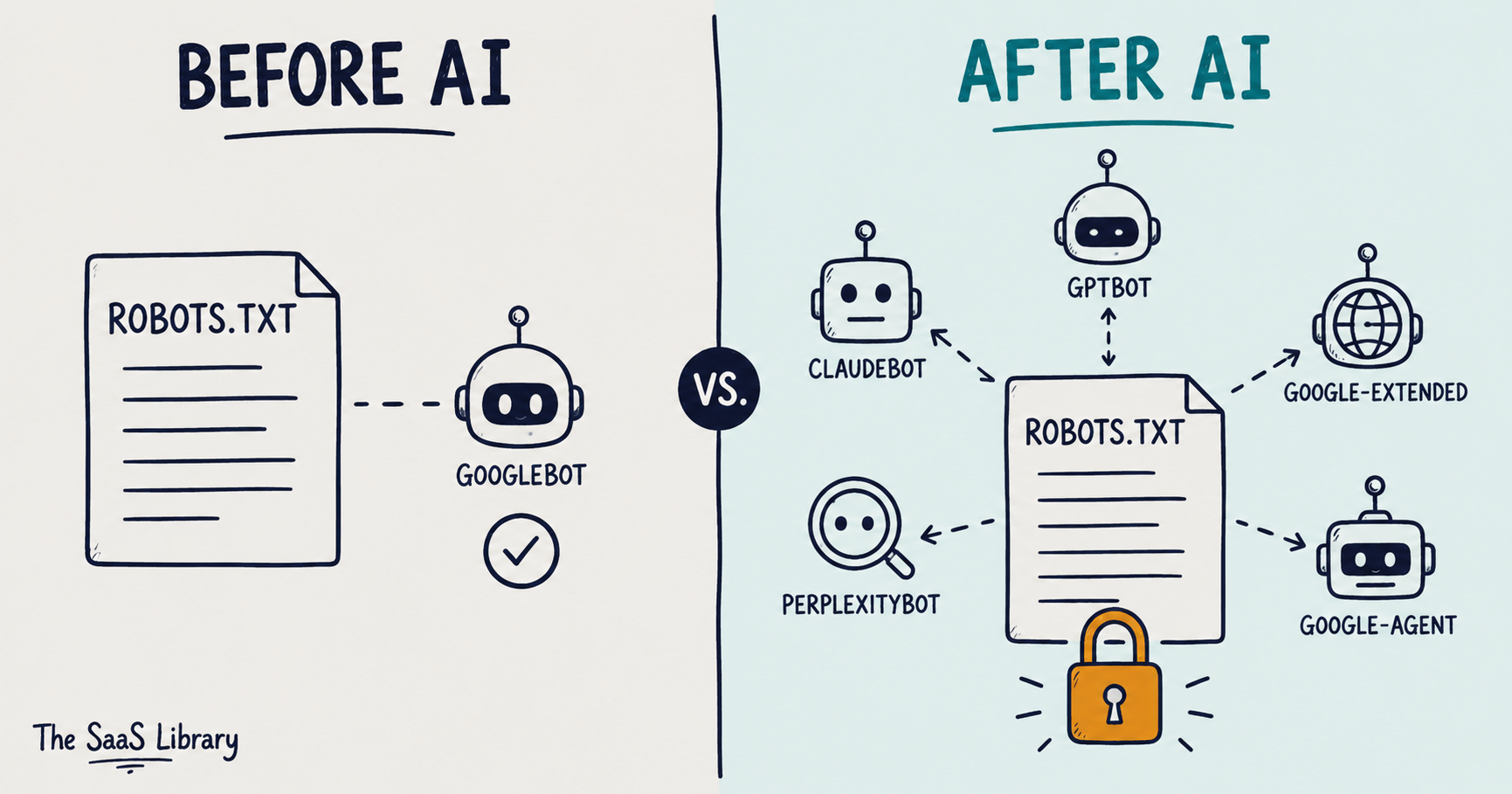
Crawlability, indexation, Core Web Vitals, canonical tags, XML sitemaps, HTTPS, and mobile-first rendering are unchanged in 2026. Google’s guidance states plainly that eligibility for AI Overviews and AI Mode requires nothing beyond being indexed and snippet-eligible in regular Search — no separate technical bar. If your site failed a 2022 crawl audit, it fails a 2026 one for the same reasons.
What got added?
Three things joined the checklist that didn’t exist as line items before. Bot policy management — deciding, deliberately, which AI crawlers get access via robots.txt, instead of leaving every rule unset and calling that neutral. Raw-HTML visibility — because most AI crawlers, including GPTBot and ClaudeBot, don’t render JavaScript, so content that only appears after a script runs is invisible to them even though Googlebot renders it fine. Extractability — key claims sitting early in the page, each section standing alone as a complete answer, because a model pulling one paragraph out of context needs that paragraph to make sense on its own.
What got removed?
Keyword-density checks, exact-match title obsession, and rank-position-only reporting are dead weight now. Google’s own guidance kills the speculative additions the industry tried to bolt on too — no llms.txt requirement, no content chunking, no special AI schema. The net effect: technical SEO didn’t get more complicated so much as it got pointed at two audiences instead of one.
Here’s the full shift, side by side:
| Audit Area | Before AI | After AI |
|---|---|---|
| robots.txt | 2-min check: is Googlebot blocked from anything important? | Strategic bot policy: deliberate allow/block per AI crawler (GPTBot, ClaudeBot, PerplexityBot, Google-Extended) |
| Crawlability | Crawl for 4xx/5xx, redirect chains, orphans | Unchanged — same crawl, same tools |
| Indexation | Index coverage, canonicals, noindex leaks | Same, plus snippet eligibility as the sole AI Overviews requirement |
| JS rendering | Does Googlebot render it eventually? | Does it exist in raw HTML? Most AI crawlers don’t execute JS |
| Log analysis | Googlebot crawl budget waste | Same, plus segmenting AI crawler hits |
| Structured data | Validate for rich results | Same tools, reframed: machine comprehension, not an AI hack |
| Content structure | Keyword placement, H1/title mechanics | Extractability: claims early, standalone answer units |
| Entity signals | NAP consistency, local SEO only | Cross-platform brand consistency, site-wide |
| Measurement | Rankings + organic sessions | + AI citation share, AI referral traffic |
| Keyword mechanics | Exact-match titles, density checks | Deprecated — intent and entity coverage replaced them |
So the honest verdict on “how much changed”: less than the industry’s marketing suggests, more than a skeptic wants to admit. The next question is what happens when someone takes that verdict too far in either direction.
Is technical SEO dead in the AI era?
No — if anything, technical SEO became more load-bearing, not less. That claim sounds like industry reassurance, so it’s worth stress-testing rather than asserting.
The argument for “dead” usually rests on one observation: AI Overviews and chat answers reduce clicks. That part is true. But fewer clicks isn’t the same as fewer requirements. AI Overviews and AI Mode still retrieve from the same core Search index Googlebot has always built — Google’s own May 2026 guidance is explicit that eligibility requires nothing beyond being indexed and snippet-eligible in regular Search. A page invisible to Googlebot was already invisible before AI Overviews existed; AI just added a second surface where that same invisibility now costs you twice.
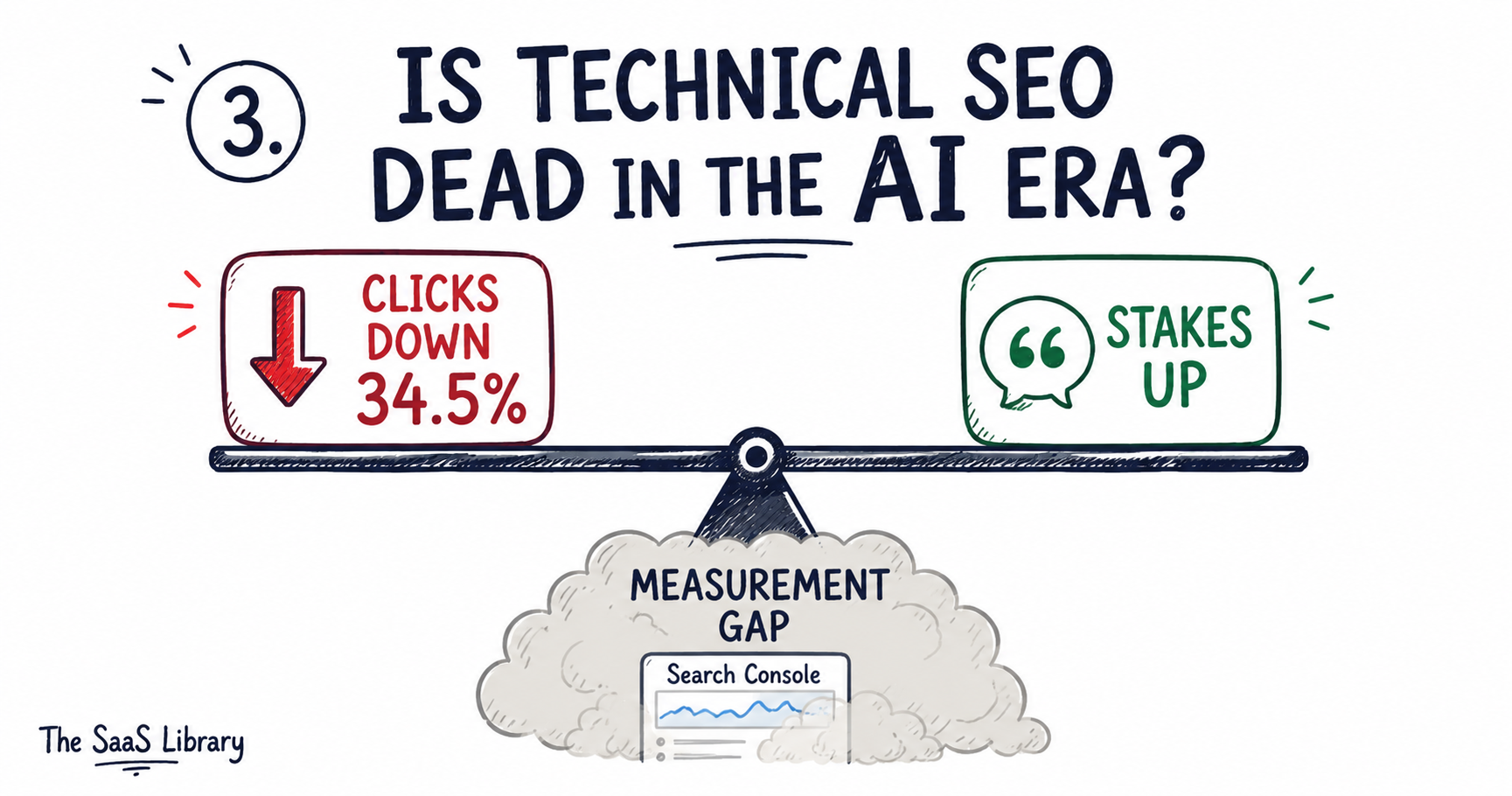
The counter-argument that actually holds up is different: technical SEO didn’t shrink, its failure mode got quieter. A crawl error used to cost you a ranking you could see drop in Search Console. Now it can also cost you a citation you never knew you were eligible for, in an AI answer you can’t fully audit yet — Search Console’s Generative AI performance report only started showing impression data from AI surfaces in June 2026, and even that omits clicks and queries. The stakes rose while the visibility into them lagged behind.
Not dead, not unchanged — technical SEO now operates with a wider blast radius and a narrower measurement window.
So the honest verdict: not dead, not unchanged, but operating with a wider blast radius and a narrower measurement window. That tension — Google saying “nothing new is required” while adding an entire crawler ecosystem that plays by different rules — is exactly where the next section needs to go.
What does Google officially say about technical SEO and AI?
Google says optimizing for its AI features is still SEO — full stop, no asterisk. On May 15, 2026, Google published “Optimizing your website for generative AI features on Google Search,” the first document to consolidate its AI-search guidance in one place, and the core claim is blunt: from Google Search’s perspective, optimizing for generative AI search is optimizing for the search experience, and is thus still SEO.
Google’s official position, published May 15, 2026, is that no additional technical requirements exist for AI Overviews or AI Mode eligibility beyond being indexed and snippet-eligible in regular Search. The guide explicitly rejects llms.txt, content chunking, AI-specific rewriting, and special schema as unnecessary.
The guide’s mechanics matter more than its reassurance. Google confirms that AI Overviews and AI Mode use retrieval-augmented generation — grounding model outputs in the existing Search index — combined with query fan-out, where the system generates a set of concurrent, related queries to gather supporting sources. Every one of those fan-out queries still runs through the same ranking systems that decide classic organic results. There is no separate AI ranking pipeline running in parallel; there’s one index, queried more ways than before.
That single fact resolves the industry’s most persistent myth: Google-Extended is not the switch that controls your AI Overview visibility. Google-Extended only governs whether your content trains or grounds Gemini models — blocking it has zero effect on whether Googlebot’s regular index surfaces your pages in AI Overviews or AI Mode. Sites that block Google-Extended expecting to opt out of AI features are opting out of nothing; they’re only affecting Gemini.
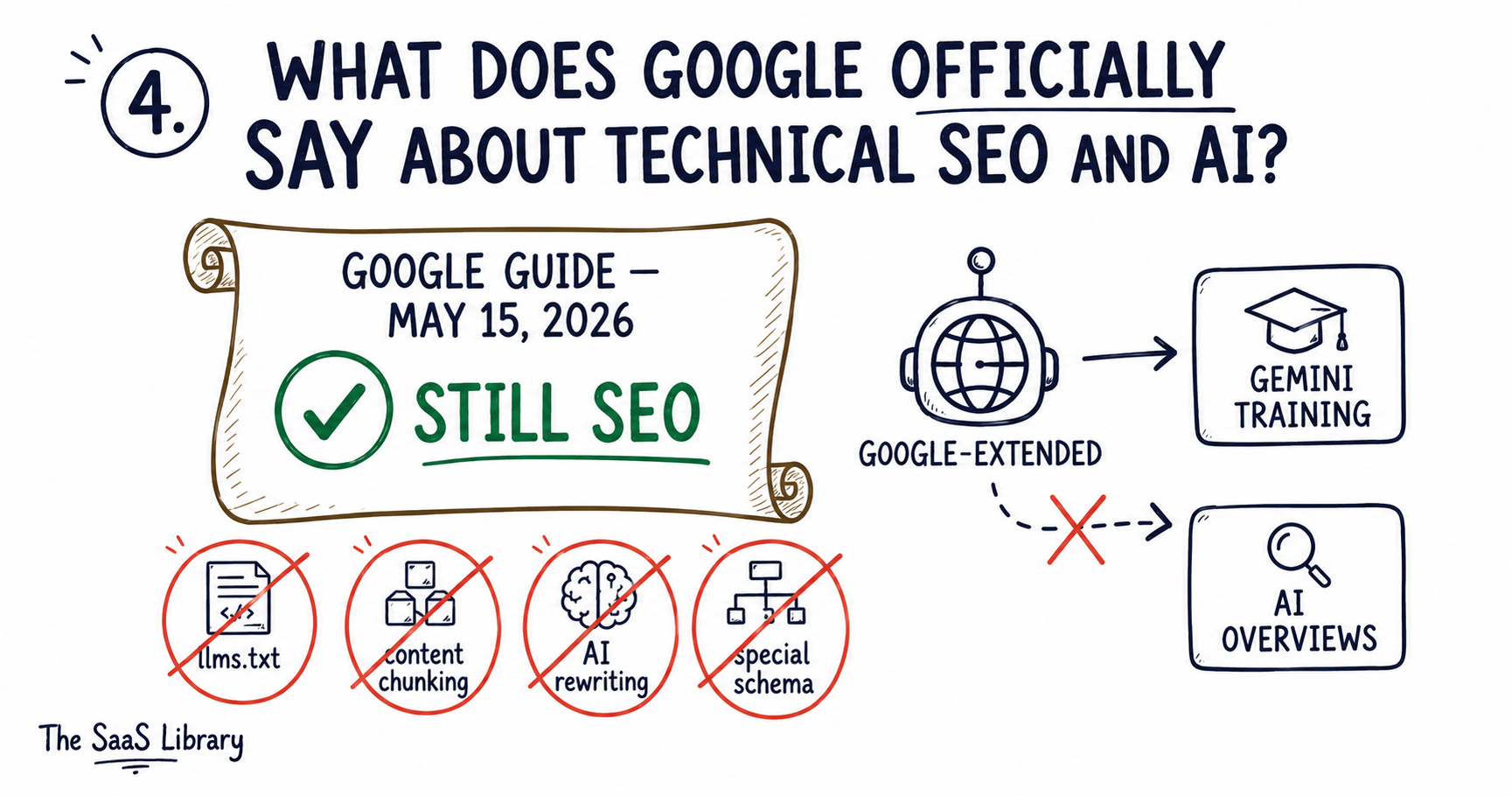
The guide’s mythbusting section is where Google spends its clearest language, and it reads like a direct rebuttal to two years of GEO-agency sales pitches: no need to create machine-readable files, AI text files, or markup; no requirement to break content into artificial chunks, because the systems understand language the way a person does; no benefit to rewriting content specifically for AI, and no special schema.org markup required for generative features at all. Structured data still helps for classic rich results — but that’s a separate, older justification, not a new AI-specific one.
Mike King, CEO of technical SEO agency iPullRank, publicly pushed back on Google’s guidance three days after it launched — arguing the company has a track record of steering the industry toward outcomes that serve Google first, leaving the open web’s benefit uncertain.
Google closed one more loophole the same day: its spam policies now explicitly cover generative AI responses. The updated language states that spam includes techniques used to manipulate Search systems into featuring content prominently, including attempts to manipulate generative AI responses in Google Search. Because AI features and organic rankings share the same enforcement system, a spam violation can suppress a site across both surfaces simultaneously — there’s no separate, laxer standard for gaming an AI answer.
Does Google require llms.txt?
No. Google’s May 2026 guidance explicitly states that no new machine-readable files, AI-specific text files, or markup are required for its generative AI search features. llms.txt remains an informal, contested proposal elsewhere in the industry — Google simply doesn’t factor it in. For the full picture on where llms.txt actually fits alongside sitemaps, see our breakdown of llms.txt and sitemaps.
See how Google’s guide reframes AEO and GEO as the same discipline as SEO.
How are AI crawlers different from Googlebot?
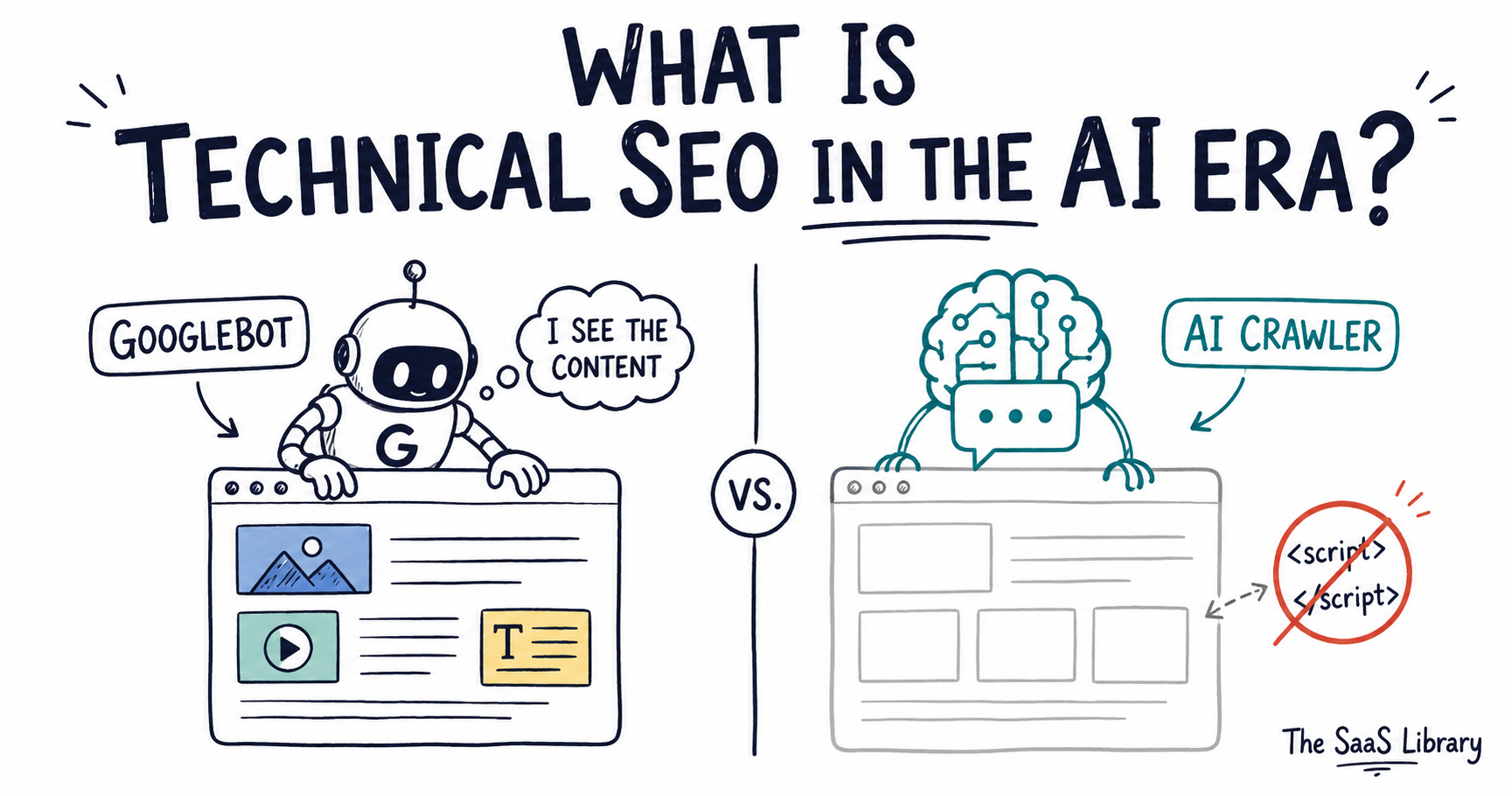
AI crawlers read raw HTML; Googlebot reads a rendered page. That single difference explains most of the confusion around AI visibility, and it’s worth establishing before anything else in this section.
AI crawlers like GPTBot, ClaudeBot, and PerplexityBot fetch static HTML and do not execute JavaScript, while Googlebot uses a full rendering pipeline that runs scripts and indexes the resulting DOM. A page that ranks on Google can be entirely invisible to ChatGPT, Claude, or Perplexity if its content only appears after JavaScript runs.
Independent analysis of over 500 million GPTBot fetches found zero evidence of JavaScript execution — the crawler downloads whatever HTML the server returns and moves on, even when it separately fetches the JavaScript files themselves as static text. ClaudeBot and PerplexityBot behave the same way. Googlebot’s rendering infrastructure took over a decade to build and still stands alone among crawlers touching your site regularly.
That gap creates three distinct crawler families with different jobs, and treating them as one undifferentiated “bot traffic” line item is where most robots.txt policies go wrong:
| Crawler family | Examples | Job | Renders JS? |
|---|---|---|---|
| Training crawlers | GPTBot, ClaudeBot, Google-Extended, CCBot | Feed future model training | No (except Google-Extended, via Googlebot) |
| Search/retrieval crawlers | OAI-SearchBot, Claude-SearchBot, PerplexityBot | Build the index used for live citations | No |
| User-triggered fetchers | ChatGPT-User, Claude-User, Google-Agent | Fire when a person asks an assistant to visit a page right now | No (except Google-Agent, via Google infrastructure) |
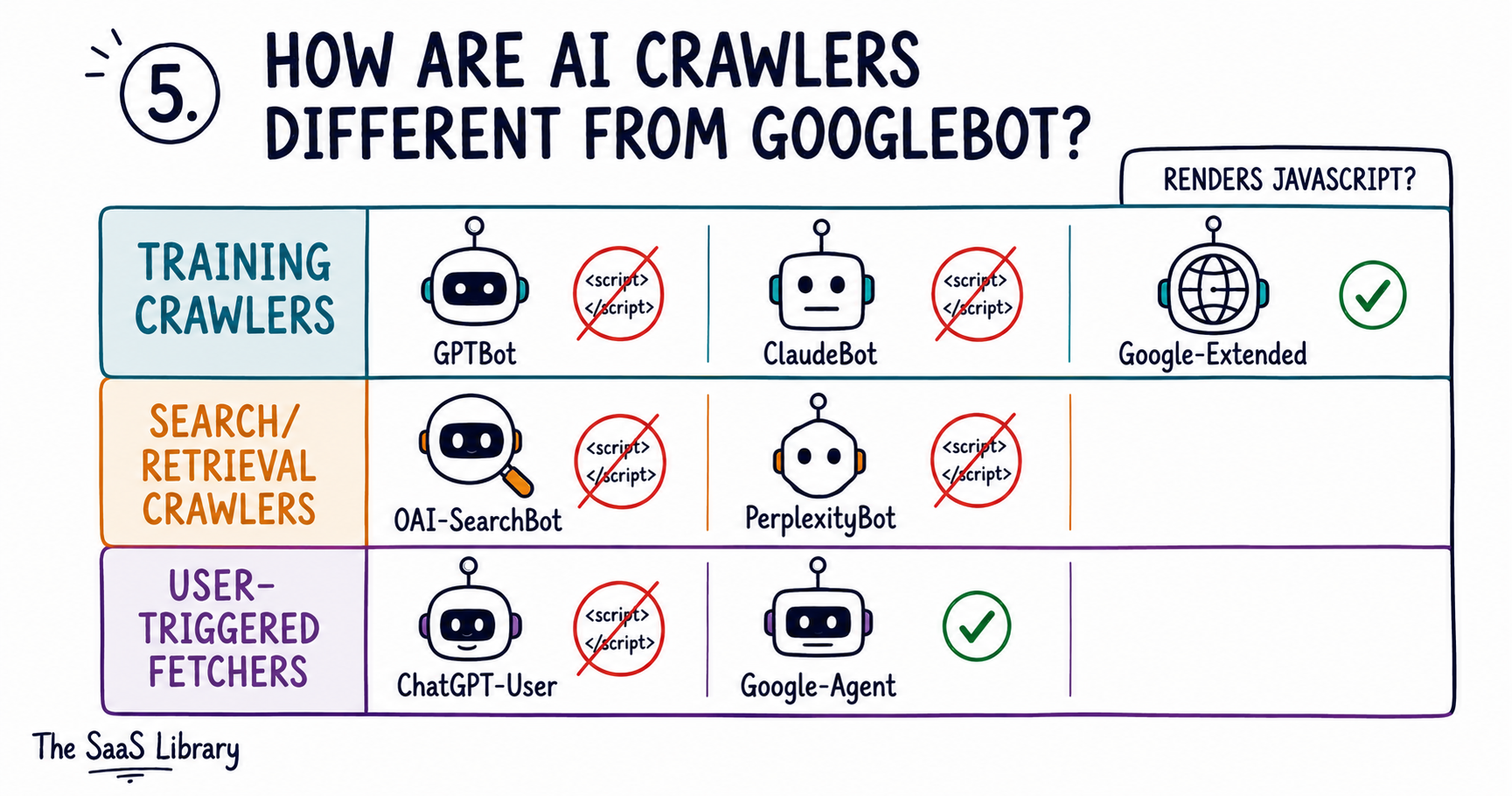
Google’s own stack is the outlier in every row. Google-Extended and Google-Agent both inherit Googlebot’s rendering pipeline because they run on Google’s infrastructure — the exception isn’t a special favor, it’s a byproduct of reusing the same rendering engine the search index already depends on. Every other major AI company built crawlers optimized for speed and scale, not rendering fidelity, because their priority was model training and retrieval, not replicating a browser.
The frequency pattern differs too. Googlebot recrawls high-value pages continuously based on freshness and authority signals. GPTBot’s crawl budget is comparatively low and selective — it may revisit a page only once every few weeks unless the page carries high authority. ChatGPT-User and Google-Agent don’t follow a schedule at all; they fire the moment a real person’s query triggers a live fetch, which means their traffic in your logs is a direct signal of actual user intent, not background indexing.
A redesign that moves your product pages to a client-side-rendered framework can quietly kill AI citation eligibility while your Google rankings stay untouched, because Googlebot won’t flag anything as broken.
One practical consequence follows directly from all of this: the two visibility problems are separate, and only one of them shows up in the tool you’re already watching.
Should you block AI crawlers from your website?
There’s no universal answer, but there is a wrong reason to decide either way: doing nothing and calling it neutral. An unset robots.txt rule isn’t a policy — it’s a default that allows access, and most sites are making that choice without realizing they’ve made it.
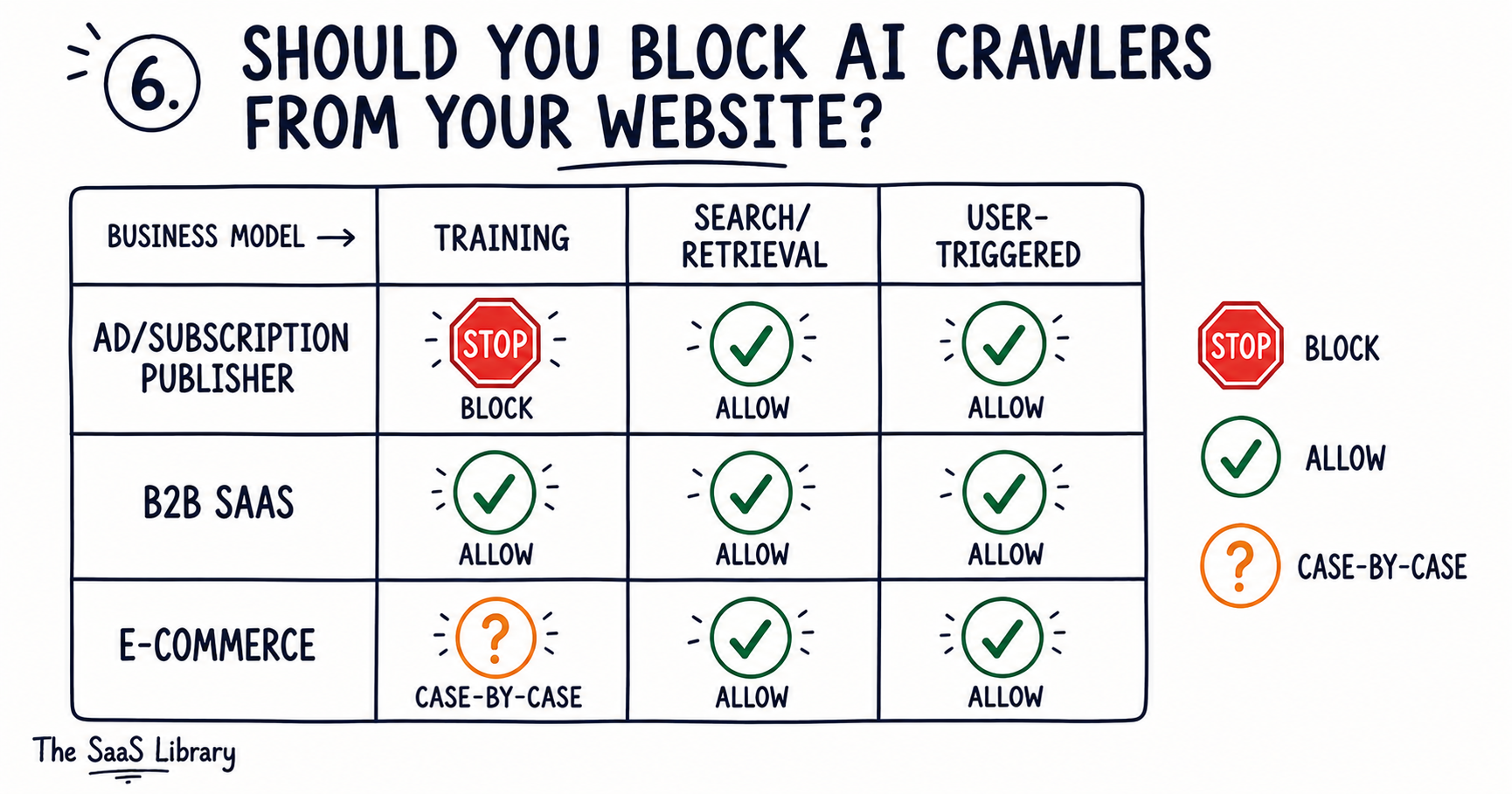
Whether to block AI crawlers depends on your content’s business model, not a fixed rule. Publishers monetized by traffic or licensing have a real case for blocking training crawlers like GPTBot and Google-Extended, while sites that rely on being cited or bought through AI answers generally benefit from allowing them.
The decision splits cleanly along one axis: does this content make money when a human clicks through, or does it make money when an AI system references it? A subscription news site loses revenue every time an AI answer satisfies a reader without a visit — for that business, blocking GPTBot and Google-Extended while allowing user-triggered fetchers like ChatGPT-User is a defensible middle ground, since it protects training value while still letting real user queries reach the page. A B2B SaaS blog like this one runs the opposite calculation: citation in an AI answer is often the entire point, since the reader was never going to convert from a blog post click anyway — the value is being named as the source a decision-maker trusts.
The crawl-to-referral math makes the publisher’s case starker than most site owners realize. GPTBot has been reported crawling far more pages than the referrals it sends back — a ratio that would be unthinkable for Googlebot, which sends far more traffic per crawl. That imbalance is the entire reason crawler compensation has become its own debate, separate from the visibility question.
Two decisions get conflated constantly and shouldn’t be: blocking Google-Extended does not remove you from AI Overviews or AI Mode, because those run on Googlebot’s regular index, not the training-and-grounding pipeline Google-Extended controls. If your actual goal is opting out of Google’s AI features specifically, the tools are nosnippet, data-nosnippet, or noindex — and all three also strip you from classic snippets, so there’s no way to opt out of Google’s AI surfaces while keeping full visibility in regular Search. You’re choosing between full participation and reduced participation everywhere, not picking an AI-only exit.
A simple framework for the decision:
| Your business model | Training crawlers | Search/retrieval | User-triggered |
|---|---|---|---|
| Ad/subscription-funded publisher | Consider blocking or licensing | Usually allow | Usually allow |
| B2B SaaS / thought leadership | Usually allow | Allow | Allow |
| E-commerce | Case-by-case | Usually allow | Allow — blocking breaks agent shopping |
This is also where the unresolved economics of the agentic web start to surface — a publisher blocking every training crawler today is making a bet that licensing deals or pay-per-crawl compensation will eventually make allowing access worth it. Read more in our piece on AI-assisted SEO’s hidden costs.
How do you know if AI crawlers are visiting your site?
Your server logs already have the answer — most site owners just never look. Every request to your site, human or bot, leaves a line in the raw access log with a timestamp, the requested URL, a status code, and a user-agent string that identifies the visitor. AI crawlers aren’t hidden in that data; they’re just ignored because nobody’s checking for them by name.
You know AI crawlers are visiting your site by pulling raw server access logs and filtering for their user-agent strings — GPTBot, ClaudeBot, PerplexityBot, OAI-SearchBot, ChatGPT-User, Google-Extended, Google-Agent — since none of these crawlers appear in standard analytics tools like Google Analytics, which only track JavaScript-executing visitors.
This is the one blind spot nearly every analytics setup shares: GA4 fires from a JavaScript tag, and AI crawlers, by definition, don’t execute JavaScript. A crawler can hit your page a hundred times in a week and your analytics dashboard will show nothing, because the tracking script never ran. Server logs sit underneath that layer and catch every request regardless of whether a script executes — which makes them the only reliable ground truth for AI crawler activity.
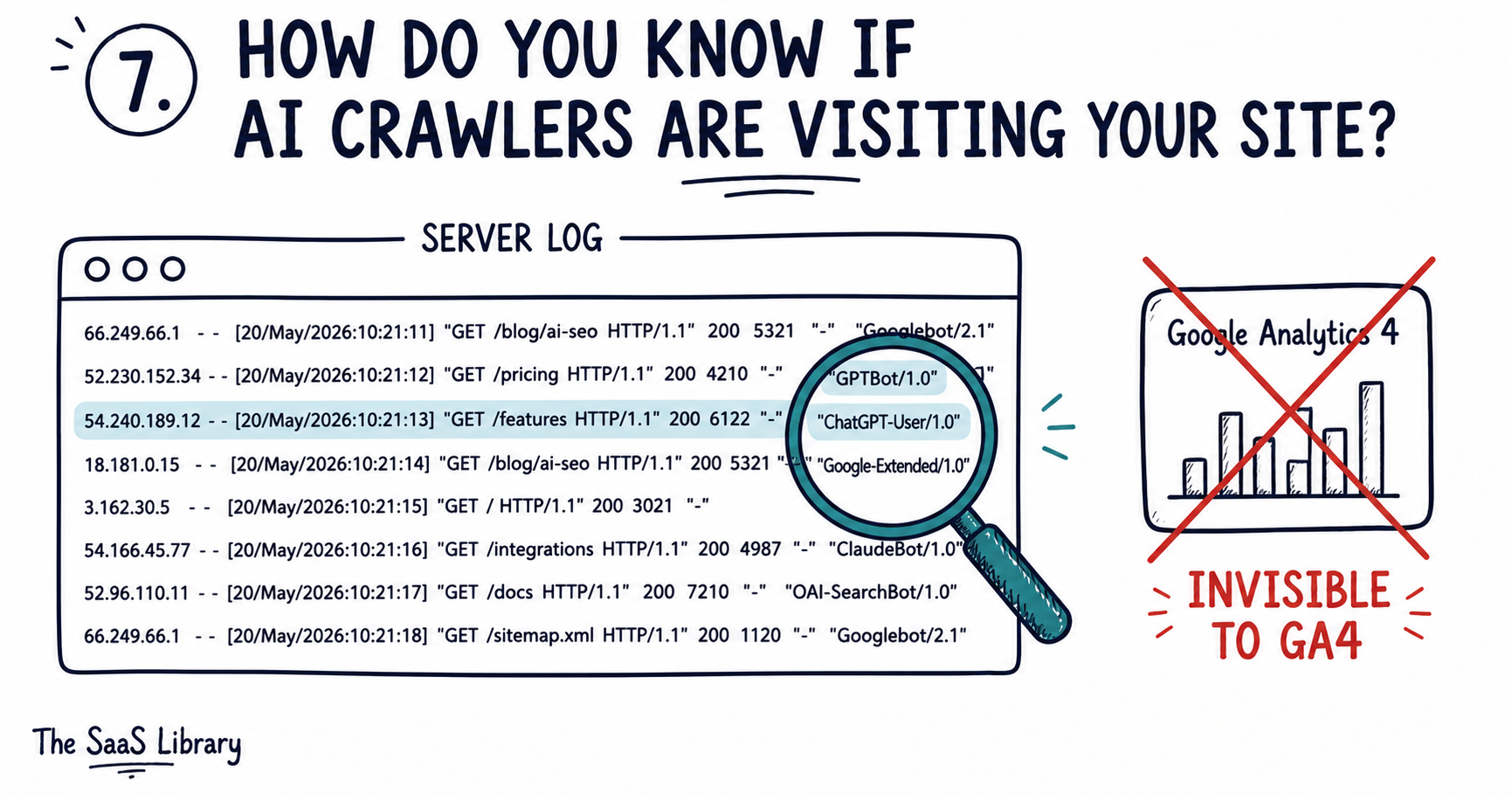
The practical workflow: pull the raw access logs from your hosting panel. Filter the log for the crawler names that matter — GPTBot and ClaudeBot for training access, OAI-SearchBot and PerplexityBot for retrieval, ChatGPT-User and Google-Agent for live user-triggered fetches. A single grep or Find command against those strings turns an unreadable text dump into a short list of exactly which bots visited, how often, and which URLs they hit.
Three things are worth checking once you have that list. First, frequency — training crawlers like GPTBot typically revisit on long, infrequent cycles, so a burst of hits usually means something changed rather than routine crawling. Second, which pages — a crawler hitting only your homepage and never your money pages suggests a crawl-depth or internal-linking problem, the same diagnosis you’d run for Googlebot. Third, verification — user-agent strings can be spoofed, so for any traffic pattern that matters commercially, cross-check the requesting IP against the crawler’s published IP ranges rather than trusting the user-agent header alone.
The absence of AI crawler hits is itself a finding. A site with zero GPTBot or ClaudeBot activity over several weeks isn’t being ignored by chance — it usually means the content isn’t being discovered through the links and citations that feed these crawlers’ queues in the first place, which points back to the same internal-linking and off-site-mention work that’s always driven discoverability.
Which tools do you need for a technical SEO audit?
You don’t need every tool on this list — you need one from each category, and most of the essential ones are free. That’s the part competitor guides tend to bury under vendor promotion.
A technical SEO audit needs a crawler (Screaming Frog), an indexing tool (Google Search Console), a performance tester (PageSpeed Insights), a schema validator (Rich Results Test), a log analyzer, and increasingly an AI-visibility tracker — covering crawlability, indexation, speed, structured data, AI crawler behavior, and citation share.
Which tools check crawlability and indexing?
Screaming Frog SEO Spider does the heavy lifting — a desktop crawler that maps every page, flags broken links and redirect chains, and catches noindex/canonical conflicts, free for up to 500 URLs. Google Search Console is non-negotiable and free regardless of site size: its Page Indexing report separates “Crawled – currently not indexed” from “Discovered – currently not indexed,” and its URL Inspection tool shows exactly what Googlebot rendered on a specific page. Bing Webmaster Tools is worth adding even for Google-focused sites, since Bing’s index feeds Microsoft Copilot and a large share of ChatGPT’s real-time search results.
Which tools test rendering and structured data?
Chrome DevTools answers the rendering question for free: disable JavaScript, reload the page, and anything that disappears is invisible to GPTBot, ClaudeBot, and PerplexityBot regardless of how well it ranks on Google. For schema, Google’s Rich Results Test validates against what Google actually displays as rich results, while the standalone Schema Markup Validator checks against the full schema.org vocabulary.
Which tools measure performance?
PageSpeed Insights is the starting point — read the field data before the lab data, because Google ranks on field data and the two frequently disagree. Prioritize Largest Contentful Paint, then Interaction to Next Paint, then Cumulative Layout Shift.
Which tools track AI visibility?
This category didn’t exist as a line item three years ago. Google Search Console‘s Generative AI performance report, announced June 3, 2026, shows impressions from AI Overviews and AI Mode by page, country, device, and date. Bing Webmaster Tools‘ AI Performance dashboard covers the equivalent view for Copilot. Beyond the free platform tools, dedicated AI-visibility trackers like Semrush‘s AI toolkit and Peec AI monitor citation share across a defined set of tracked queries.
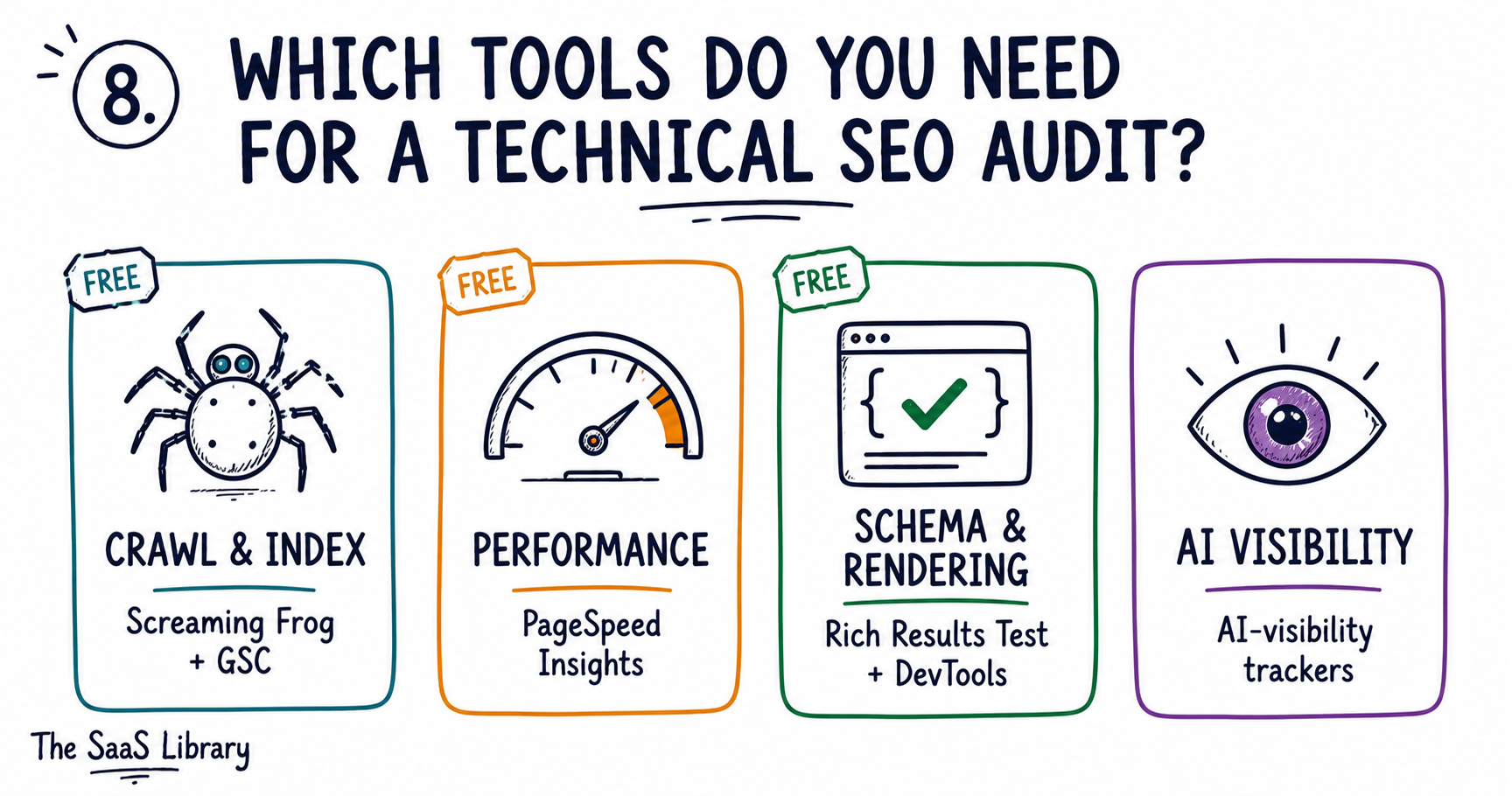
The honest pattern across all four categories: the tools that matter most — Search Console, DevTools, Rich Results Test, PageSpeed Insights — are free. Paid tools mostly buy scale, scheduling, and history, not access to data Google withholds elsewhere.
What does a complete technical SEO audit look like in 2026?
Every phase below builds on the last, and the sequence matters — running phase 3 before phase 1 wastes effort checking extractability on pages that Google can’t even index yet.
A complete 2026 technical SEO audit runs eight phases in sequence: baseline access, crawl and indexation, rendering and machine readability, performance, content extractability, log file analysis, trust signals, and measurement setup — covering both Googlebot and AI crawler visibility in one workflow.
Phase 1 — Baseline and access. Verify Google Search Console and Bing Webmaster Tools access, confirm server log access, and inventory every AI crawler rule in robots.txt.
Phase 2 — Crawl and indexation. Run a full Screaming Frog crawl for 4xx/5xx errors, redirect chains, and canonical conflicts, then cross-reference against Search Console’s Page Indexing report.
Phase 3 — Rendering and machine readability. Disable JavaScript in Chrome DevTools and reload key templates. Validate schema on live URLs with the Rich Results Test.
Phase 4 — Performance. Check PageSpeed Insights field data first, prioritizing LCP, then INP, then CLS.
Phase 5 — Content extractability. Confirm key claims sit in the first third of each page, each H2 section stands alone as a complete answer, and the page covers the natural follow-up questions a fan-out query would generate.
Phase 6 — Log file analysis. Segment AI crawler hits from the raw access logs — this is the only ground truth for whether GPTBot, ClaudeBot, or PerplexityBot are actually reaching your money pages.
Phase 7 — Trust and entity signals. Check cross-platform brand consistency across your site, social profiles, and business listings.
Phase 8 — Measurement setup. Baseline Search Console’s Generative AI performance report where available, and segment AI-referred sessions in GA4 by referral source.
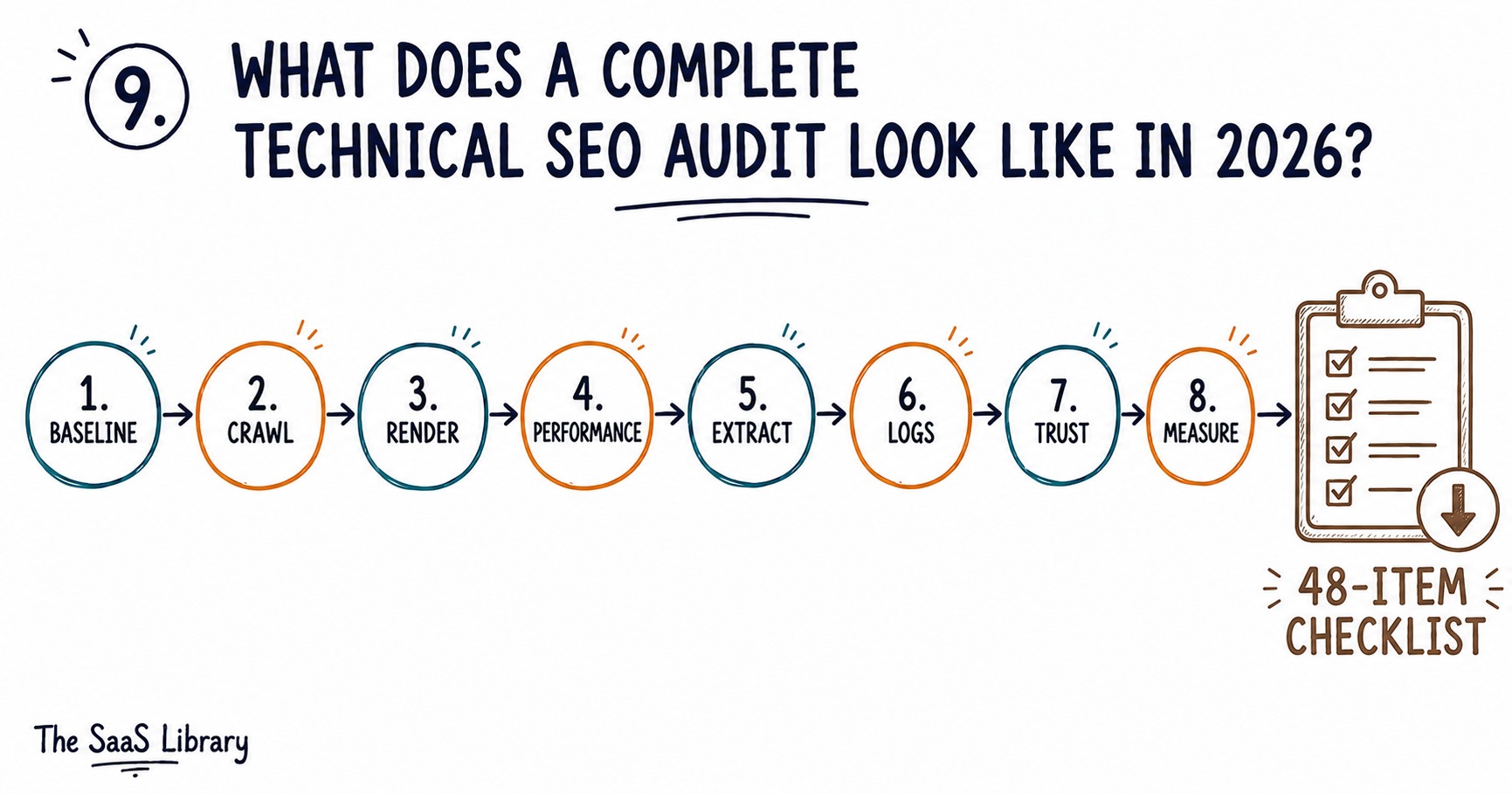
The full checklist below carries all eight phases into a working spreadsheet with a tool, an action, and a status field for every item — pull it, run through it top to bottom, and you’ve completed the audit this entire article has been building toward.
The complete 48-item technical SEO audit checklist for 2026 — every phase, every tool, ready to run.
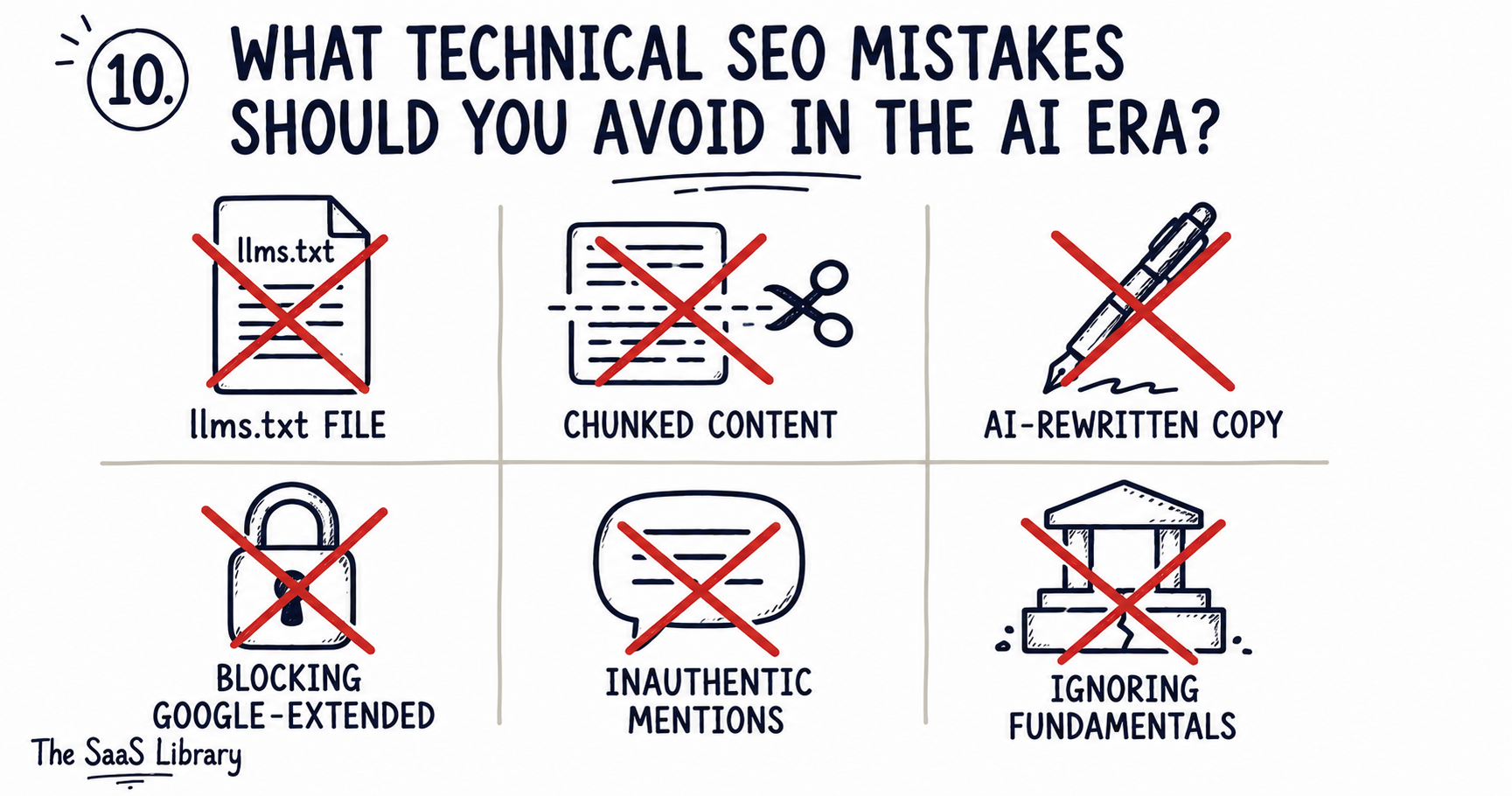
What technical SEO mistakes should you avoid in the AI era?
Most of the mistakes worth avoiding in 2026 aren’t new errors — they’re old instincts applied to a new set of anxieties. The pattern repeats across every item below: someone sees “AI changed everything” and reaches for a fix Google already said doesn’t exist.
The most common technical SEO mistakes in the AI era are building unnecessary llms.txt files, chunking content artificially, rewriting copy specifically for AI, blocking Google-Extended expecting to leave AI Overviews, and abandoning fundamentals to chase speculative AI-specific tactics.
Building an llms.txt file expecting a ranking benefit. Google’s May 2026 guidance states plainly that no new machine-readable files, AI text files, or markup are required. Treating it as a checklist item for Google Search specifically is solving a problem Google says doesn’t exist.
Chunking content into artificial fragments. Google’s guidance directly contradicts the instinct: there’s no requirement to break content into tiny pieces, because the systems that power AI Overviews and AI Mode understand language and general meaning the way a person reading the full page would.
Rewriting existing content specifically for AI. Google’s systems interpret synonyms and meaning without needing content restructured into robotic Q&A format. The better time investment is the extractability work from earlier in this article.
Blocking Google-Extended and assuming you’ve left AI Overviews. This is the single most common misunderstanding in this entire article’s subject matter. Google-Extended only controls Gemini training and grounding — AI Overviews and AI Mode run on Googlebot’s regular index.
Chasing inauthentic mentions or manipulated citations. Google’s spam policies now explicitly extend to generative AI responses, and the enforcement runs through the same system — SpamBrain — that already governs organic rankings.
Abandoning fundamentals because “AI changed everything.” Crawlability, indexation, Core Web Vitals, and clean structured data are unchanged requirements. Treating AI as a reason to deprioritize the boring, foundational 80% in favor of speculative 20% work is backwards.
What does the shift from ranking to extraction to action mean for your audit?
Every distinction this article has drawn — crawlers, extraction, agents — collapses into one underlying shift if you zoom out far enough. It’s worth naming, because a named shift is easier to audit against than a scattered list of changes.
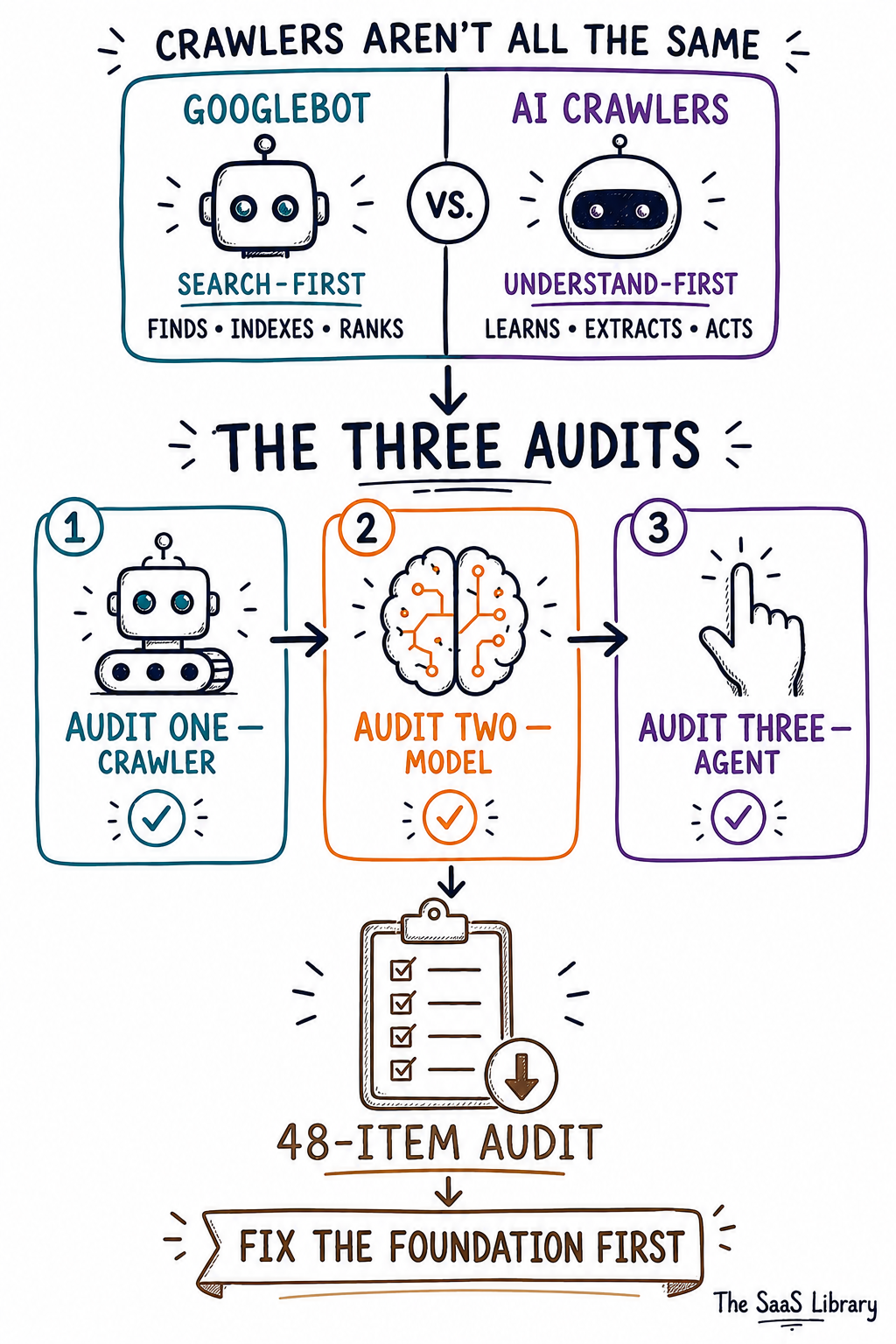
It means your audit now serves three different consumers in sequence: a crawler that ranks your page, a model that extracts an answer from it, and an agent that acts on it directly. Call this The Three Audits — each stage has its own pass/fail criteria, and passing one doesn’t guarantee passing the next.
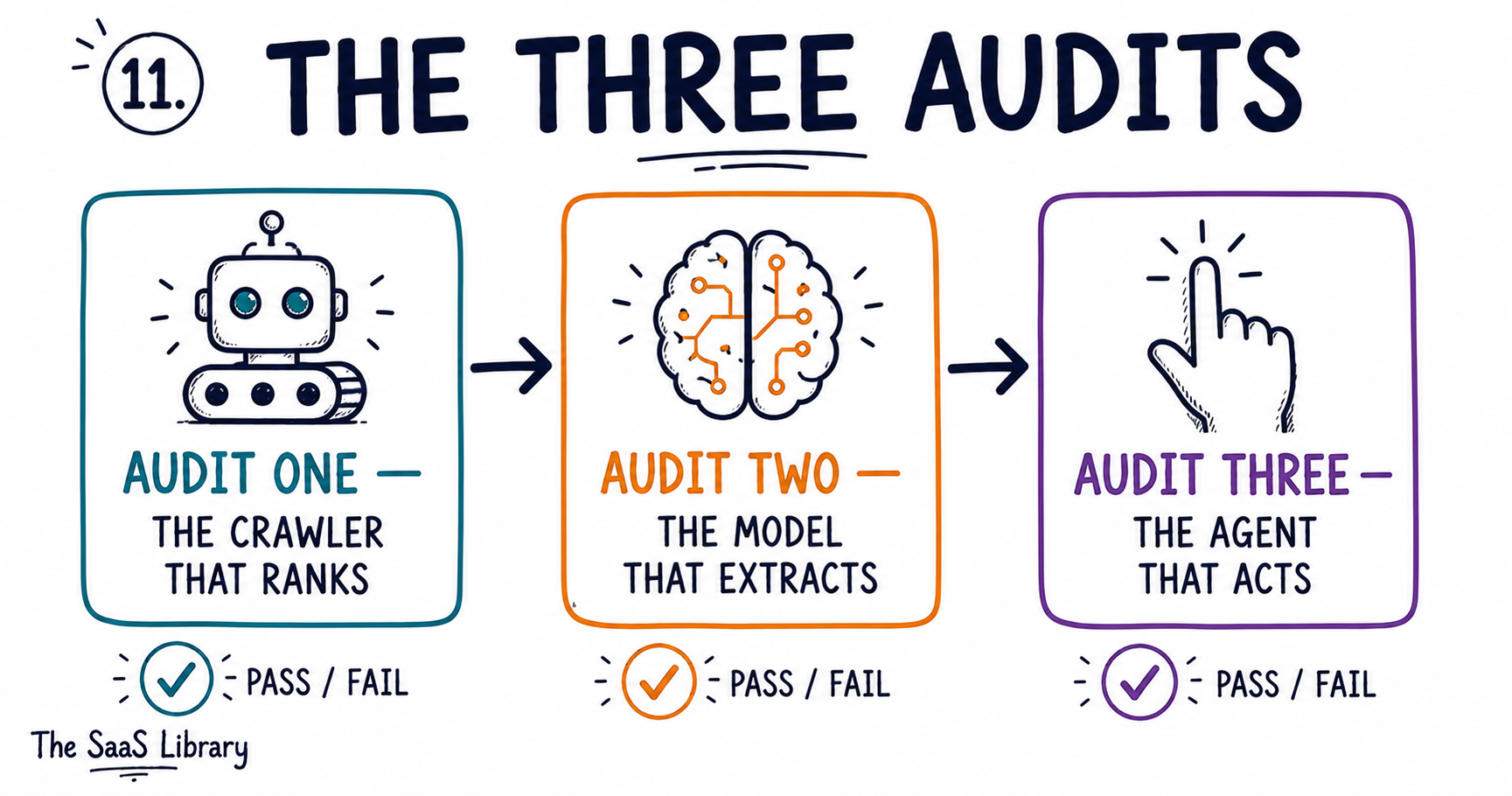
Why the sequence matters more than the list. Each audit builds on the one before it — a page invisible to Audit One’s crawler was never going to reach Audit Two’s extraction step, let alone Audit Three’s agent interaction. But passing an earlier audit creates no guarantee for the ones that follow, which is the exact trap the previous section’s mistakes fall into.
Audit Three is where the entire discipline is heading, and it’s also where the incentives are least worked out. The Three Audits framework doesn’t resolve that tension — it just makes clear that a technical SEO audit which stops at Audit One is now only auditing a third of what actually determines whether your content is found, understood, and used.
What comes next for technical SEO?
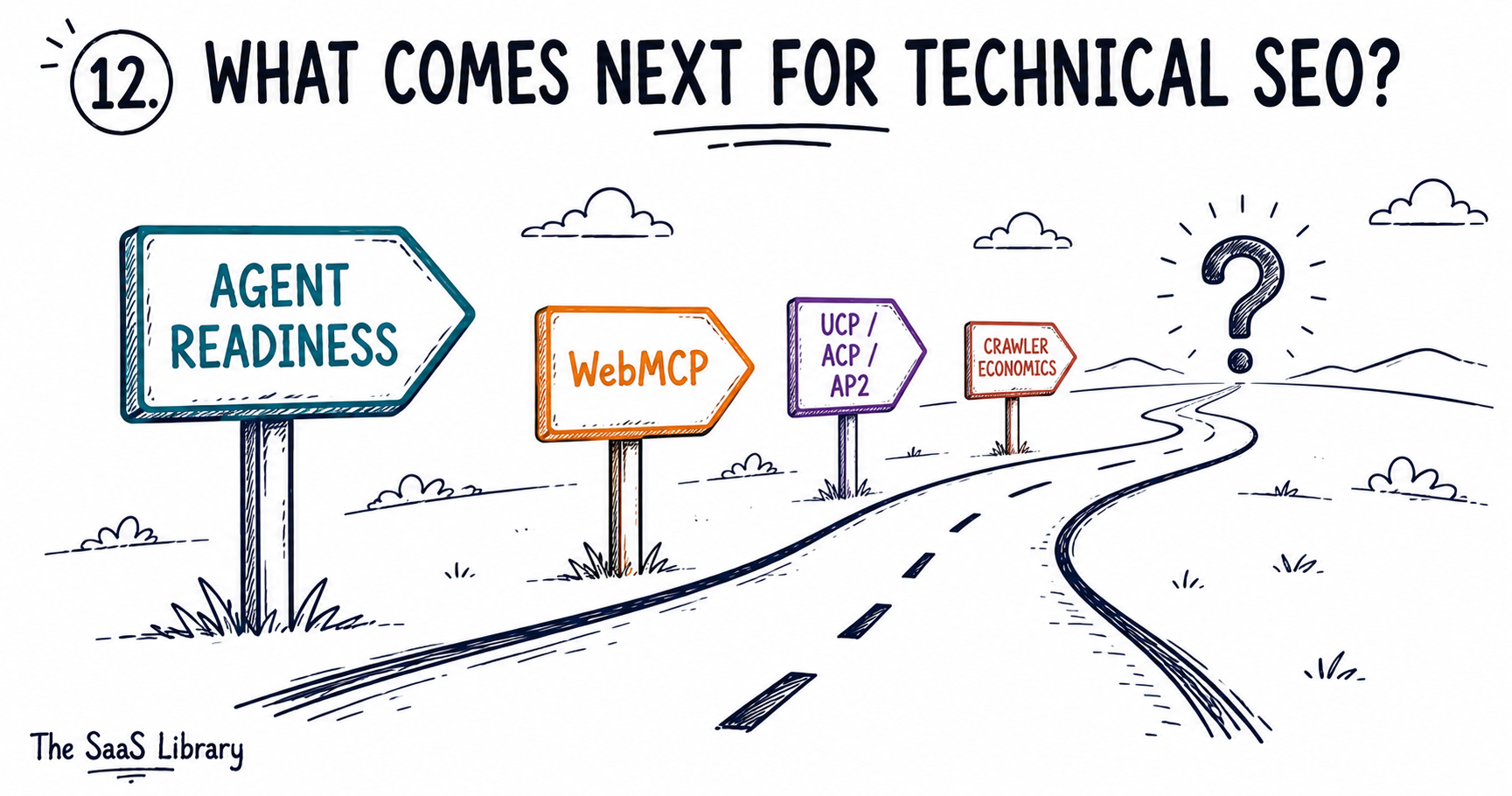
What comes next is Audit Three maturing into a standard practice — agent-readiness scoring, machine-readable action protocols like WebMCP and UCP, and a still-unresolved question of who pays whom when an agent extracts value from a page a human never visits.
Cloudflare’s agent-readiness scanner already scores sites against roughly sixteen signals most of the web currently fails. WebMCP is in early browser trials, letting sites expose actions directly to agents instead of being scraped for them. Commerce protocols — UCP, ACP, AP2 — are actively competing to define how agents transact, and OpenAI’s own Instant Checkout retreat earlier this year proved that standardization arrives faster than adoption does.
None of that changes what to do this month: pass Audit One, then Audit Two, in that order. Audit Three will still be there once you have.
Frequently Asked Questions
What is technical SEO?
Technical SEO is the practice of optimizing a website’s infrastructure — crawlability, indexation, speed, structured data, rendering — so search engines and AI systems can access, interpret, and cite its content.
Is technical SEO still important with AI search?
Technical SEO is still important with AI search because AI Overviews and AI Mode retrieve from the same core Search index that technical SEO has always served — a page invisible to Googlebot was already invisible before AI Overviews existed.
Does Google require llms.txt for AI Overviews?
Google does not require llms.txt for AI Overviews. Google’s May 2026 guidance explicitly states no new machine-readable files or AI-specific text files are needed for its generative AI search features.
Do AI crawlers like GPTBot execute JavaScript?
AI crawlers like GPTBot do not execute JavaScript. Independent analysis of over 500 million GPTBot fetches found zero evidence of script execution, unlike Googlebot’s rendering pipeline, which runs JavaScript before indexing a page.
Does blocking Google-Extended remove your site from AI Overviews?
Blocking Google-Extended does not remove your site from AI Overviews. Google-Extended only controls whether content is used for Gemini training and grounding — AI Overviews and AI Mode are served by regular Googlebot from the core Search index.
What is query fan-out in AI search?
Query fan-out is the process where an AI system generates a set of concurrent, related queries to gather supporting sources for a single answer, with every fan-out query running through the same ranking systems that determine classic organic results.
Does structured data help AI search visibility?
Structured data does not provide a special advantage for AI search visibility. Google’s guidance confirms there is no special schema.org markup required for generative AI features, though structured data still helps with classic rich results eligibility.
How often should you run a technical SEO audit?
You should run a technical SEO audit continuously across different cadences: weekly indexing checks, monthly full crawls and performance tests, and quarterly log file and bot policy reviews, rather than treating it as a single annual event.
Can spam violations affect your AI Overview citations?
Spam violations can affect your AI Overview citations. Google’s updated spam policies explicitly cover attempts to manipulate generative AI responses, and enforcement runs through the same system that governs organic rankings, so a violation can suppress a site across both surfaces at once.
What tools do you need for a technical SEO audit in 2026?
The tools you need for a technical SEO audit in 2026 are a crawler like Screaming Frog, an indexing tool like Google Search Console, a performance tester like PageSpeed Insights, a schema validator like Rich Results Test, a log analyzer, and an AI-visibility tracker.
Conclusion
The Three Audits framework won’t get simpler from here — if anything, a fourth consumer is only a matter of time. But the sequence holds regardless of what gets added: a page invisible to Googlebot was never going to reach an AI model, and a page an AI model can’t parse was never going to work for an agent either.
Fix the foundation first. The checklist above turns all three audits into forty-eight items you can run this week — start there, and the rest of this shift stops feeling like a moving target.
- Google Search Central — Optimizing your website for generative AI features on Google Search, May 15, 2026
- Google Search Central Blog — A new resource for optimizing for generative AI in Google Search, May 15, 2026
- Ahrefs — CTR analysis of 300,000 keywords, April 2025
- OpenAI Developer Platform — Overview of OpenAI Crawlers
- Google Crawling Infrastructure Changelog — Google-Agent, March 2026
- BrightEdge — AI Overview prevalence analysis, February 2026
- Search Engine Journal — Google’s New AI Search Guide Calls AEO and GEO ‘Still SEO’, May 2026
- Digital Applied — Mike King (iPullRank) response, May 18, 2026