In 2025, a randomized trial found experienced developers took 19% longer with AI tools, and METR, the lab that ran it, now calls the result out of date. Small SaaS teams that scale on AI need measured results, not assumed ones.
In a 2026 US Census Bureau study, 66% of AI-using firms relied on AI only to augment tasks, and AI-related job cuts occurred at just 2% of firms. That is how small SaaS teams compete with larger companies using AI agents: the agents take repetitive work, and people keep the decisions. This guide checks what the evidence supports, what it costs, and where agents fail.
How Do Small SaaS Teams Compete With Larger Companies Using AI Agents?
Small SaaS teams compete with larger companies using AI agents by giving them repetitive, well-defined work, such as support triage, feedback sorting and reporting, while people keep decisions and customer relationships. Evidence supports gains on routine work, including a 14% output rise in one large support study, and flags risks in delivery stability and code security.
AI in daily operations is already common at private SaaS companies. From SaaS Capital’s 2025 survey:
- 69% of respondents deploy AI in day-to-day operations.
- 70% of bootstrapped and 66% of equity-backed companies do so.
- 61% of companies using AI in operations were at or above breakeven, against 54% of those not using it. This is an association, not proof of cause.
SaaS Capital notes that “AI” can mean vastly different things to different operators, so read these as breadth, not depth. TSL’s reading: when most companies already use AI, where a team points it matters more than whether it does.
The strongest measured gains are on routine work. In a study of 5,179 customer support agents, a generative AI conversational assistant raised issues resolved per hour by 14% on average. The tool was an assistant that support agents used, not an autonomous AI agent.
TSL’s reading: routine support is where the measured gains are, so it is where to test first.
That does not mean small teams match every enterprise capability. The goal is less time on repetitive work and more time on customer problems.
What Does the Evidence Show So Far?
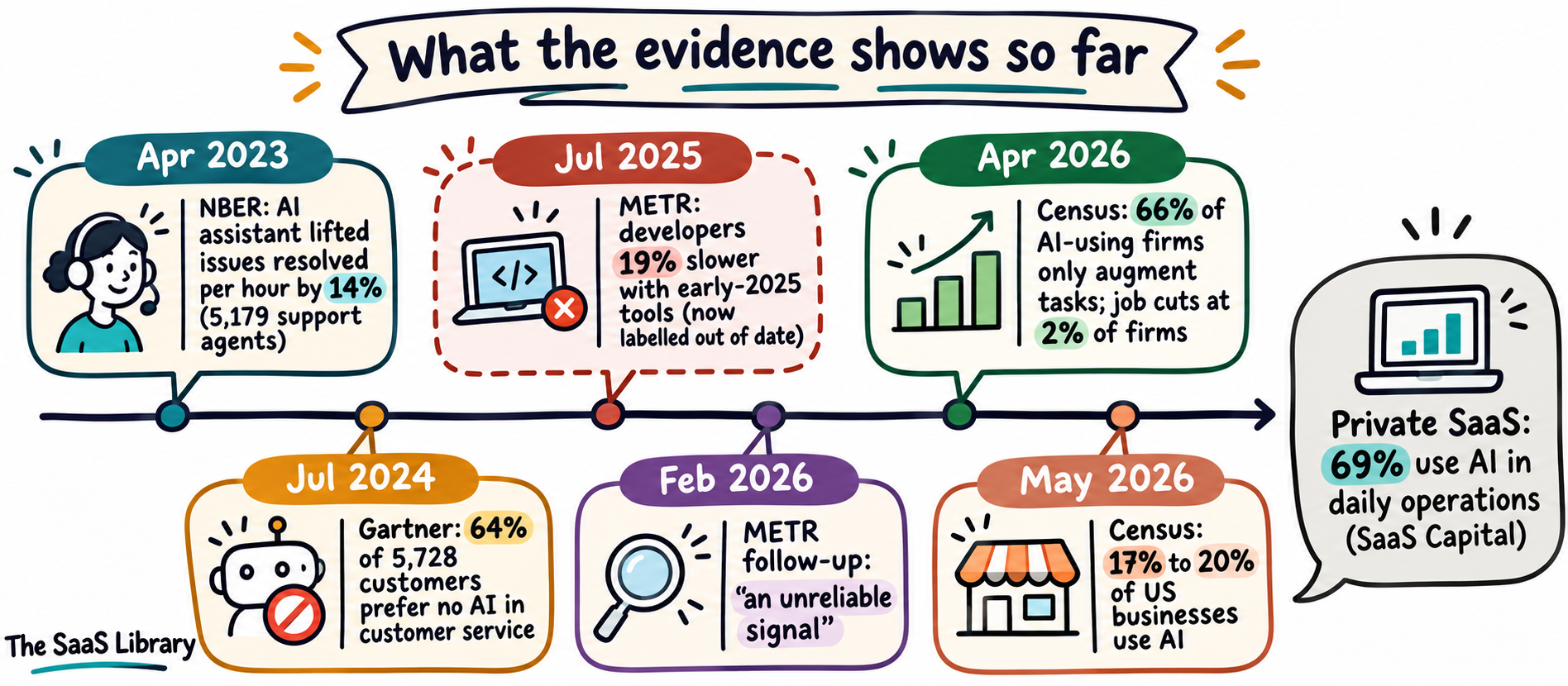
The evidence so far shows gains on routine work, lost time on complex work, and customers who want a human option.
| Date | Finding | Source |
|---|---|---|
| Apr 2023 | AI-assisted support agents resolved 14% more issues per hour (published in the QJE, 2025) | NBER |
| Jul 2024 | 64% of 5,728 surveyed customers would prefer companies didn’t use AI in customer service (fieldwork Dec 2023) | Gartner |
| Jul 2025 | Experienced developers took 19% longer with early-2025 AI tools (16 developers, 246 tasks); METR now labels the result out of date | METR |
| Feb 2026 | METR’s follow-up with late-2025 tools found some evidence of speedup but called its data “an unreliable signal” because of selection effects | METR |
| Apr 2026 | 66% of AI-using firms augment tasks only; job cuts at 2% of firms | US Census Bureau |
| May 2026 | 17% to 20% of US businesses used AI, Dec 2025 to May 2026 | US Census Bureau |
Census changed its question in November 2025, from AI use “in producing goods or services” to AI use “in any business function”, so earlier figures are not comparable. TSL’s reading: use agents where the work is routine, measure the result, and keep a person available.
What Happens to a Five-Person Team as Subscriptions Grow?
A five-person team that adds subscriptions receives more questions, product requests, billing questions and onboarding requests.
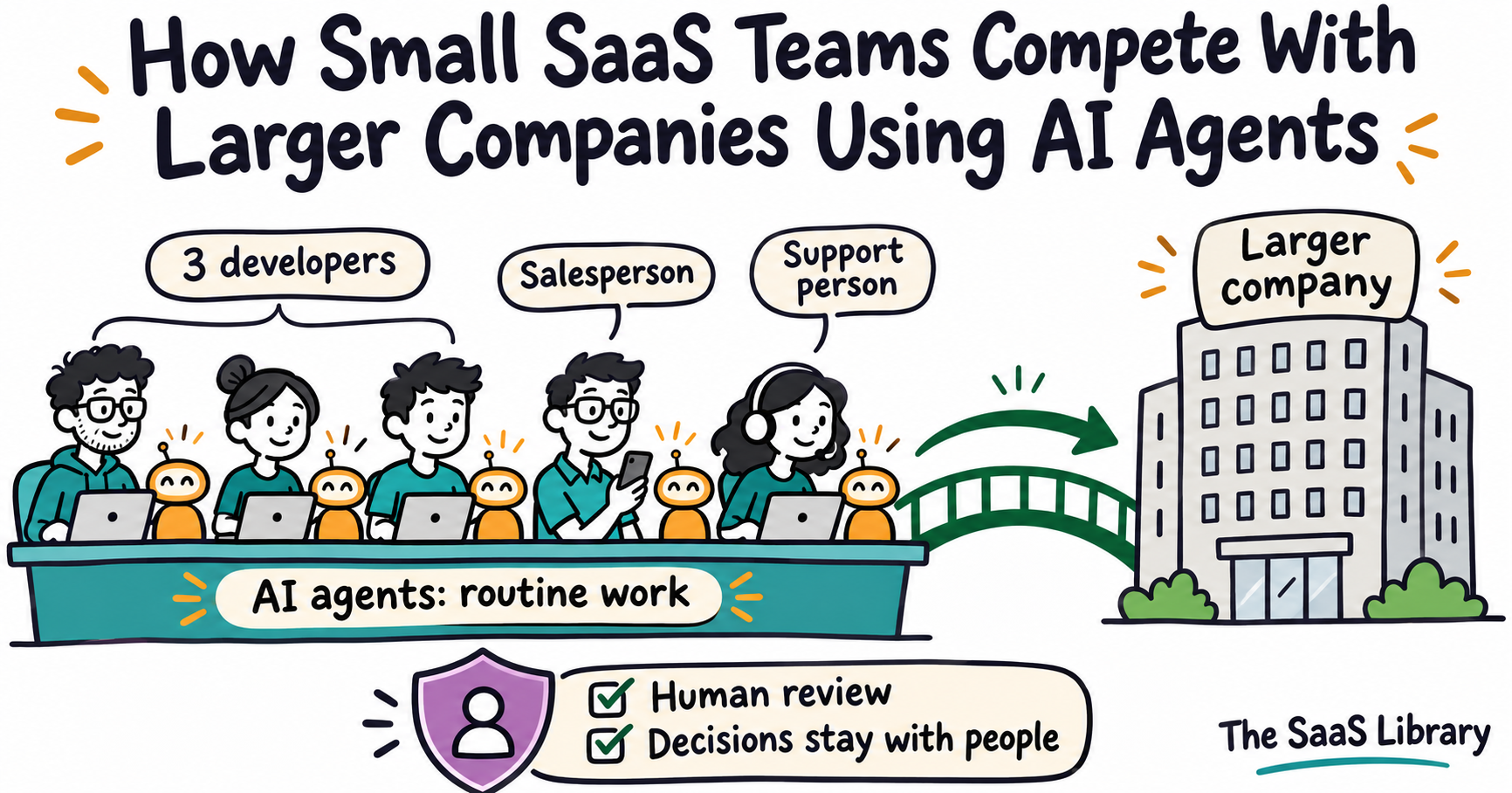
Example (illustration, from the guest draft): a SaaS company has three developers, a salesperson and a customer support person. Each new subscription adds to the queue.
TSL’s reading: the routine layer of that queue is where the support evidence above applies. People keep the cases that need judgment.
What Makes AI Agents Different From Traditional Automation?
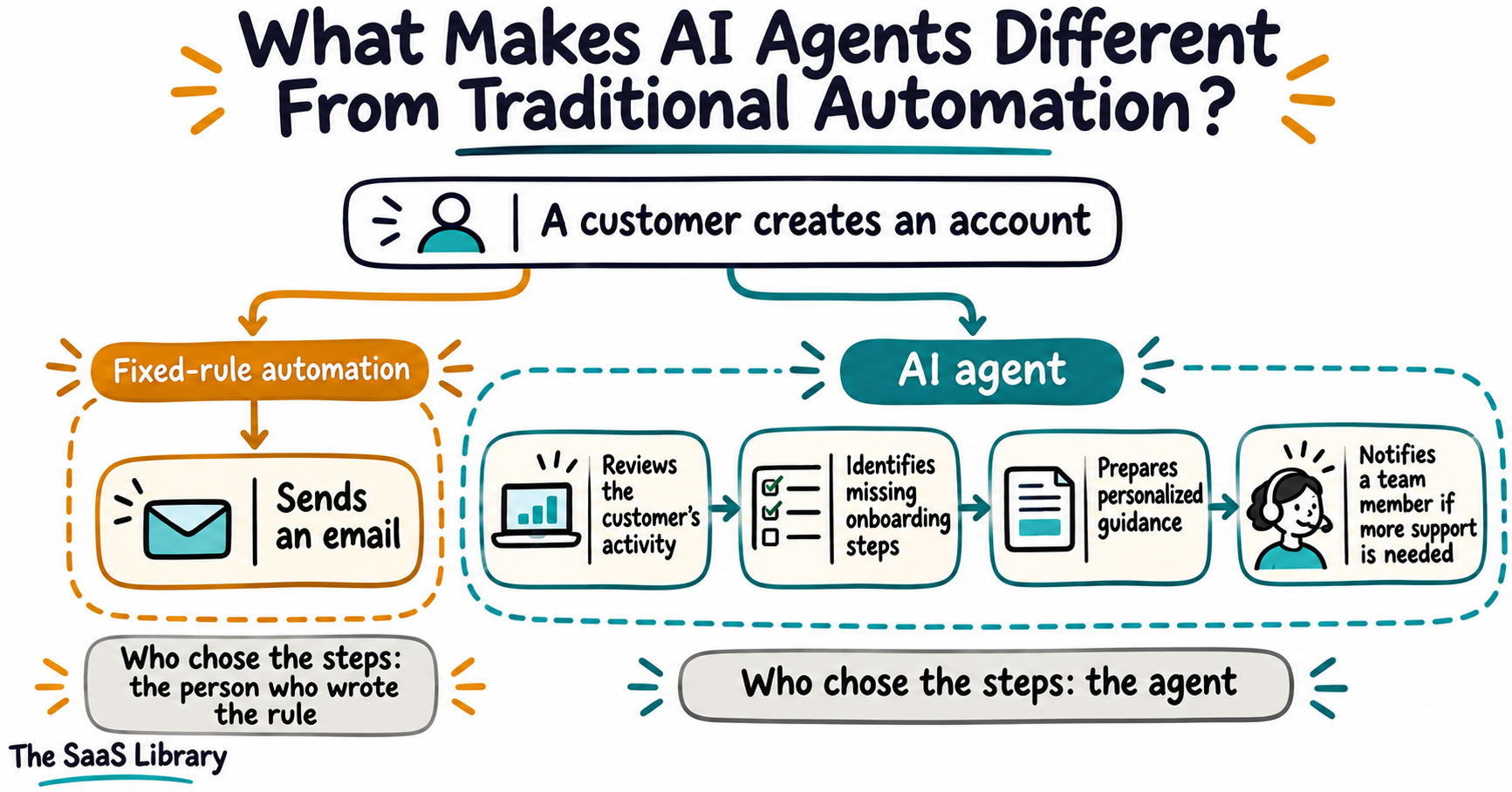
AI agents are different from traditional automation because they choose their own steps. Automation follows steps written in advance, while an AI agent decides its own steps and tools to reach a goal, and it can return to a person for information or judgement.
The people who build agents advise starting with less. Anthropic recommends “finding the simplest solution possible, and only increasing complexity when needed”, and says workflows offer predictability and consistency for well-defined tasks. So an agent is a step you take when a fixed rule stops working.
What Does Traditional Automation Do Well?
Traditional automation does well on predictable, well-defined work, as the Anthropic guidance above notes. Anthropic’s “workflows” can include AI calls, but their path is fixed in advance, and that fixed path is the property that matters here.
What Does an AI Agent Do That Fixed Rules Cannot?
An AI agent handles goals with no fixed path. Anthropic’s guide lists understanding complex inputs, planning and using tools among the capabilities that make agents work. It says agents are typically models using tools in a loop, so the tools and their design set what an agent can do, and it warns that autonomy brings higher costs and the potential for compounding errors.
Example (illustration, from the guest draft): the same event, handled two ways.
| Fixed-rule automation | AI agent | |
|---|---|---|
| Event | A customer creates an account | A customer creates an account |
| What happens | Sends an email | Reviews the customer’s activity, identifies missing onboarding steps, prepares personalized guidance, notifies a team member if more support is needed |
| Who chose the steps | The person who wrote the rule | The agent |
Complex inputs include unstructured information, such as support messages, product feedback and internal documents (examples). For how an agent differs from a chatbot, see TSL’s guide to AI agents versus chatbots.
Disclosure: Anthropic makes Claude, an AI model TSL uses in its research workflow.
On paper the line is clean. Inside a working team’s day, it blurs.
What Does a Day With AI Agents Look Like for a Five-Person SaaS Team?
A day with AI agents for a five-person SaaS team looks like a handoff loop: agents are assigned ticket sorting, documentation lookup, reply drafts, feedback grouping and reports, and people approve anything customer-facing or high-stakes. The schedule is an illustration, not a measured case.
The most important job in this day is the handoff. In Gartner’s survey of 5,728 customers, the top concern about AI in customer service was that reaching a person would get harder.
Example (illustration, from the guest draft’s team of three developers, a salesperson and a support person):
| When | Job assigned to an agent | Human check |
|---|---|---|
| Overnight | Sort new support tickets, look up documentation, draft replies | Support person approves drafts and takes security, payment and unusual cases |
| Morning | Group similar bug reports and customer feedback | Developers decide what to fix |
| Midday | Build the weekly customer-usage report and flag accounts that need attention | Salesperson reviews the flagged accounts |
| Afternoon | Write test cases and a release-note draft | A developer reviews the code, tests and security |
| Evening | Organize public company information and draft first outreach | Salesperson edits for accuracy and brand, then sends |
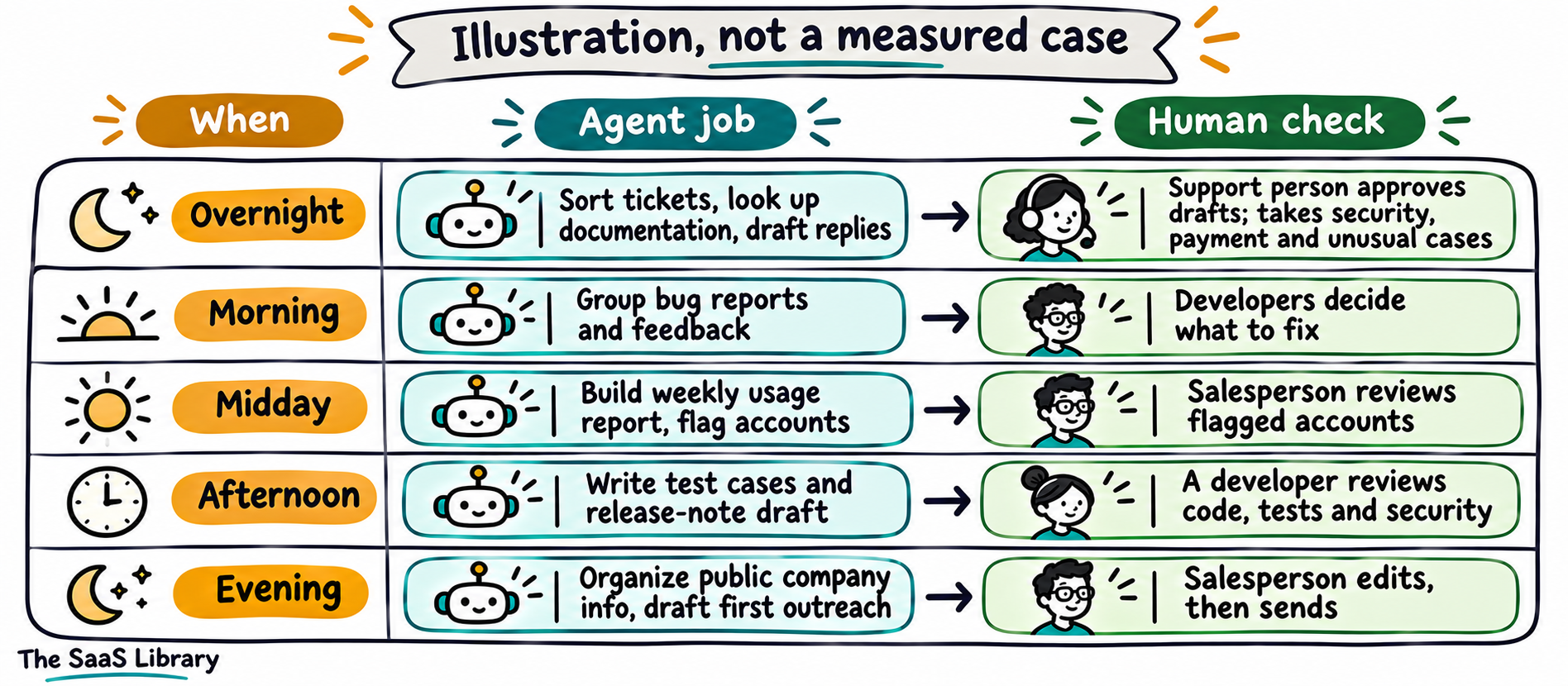
TSL’s reading: every row ends with a person, because customers’ top concern is reaching one. For choosing the first job, see TSL’s guide to picking your first AI agent workflow and its eight SaaS use cases.
Are Small SaaS Teams Actually Adopting AI Agents?
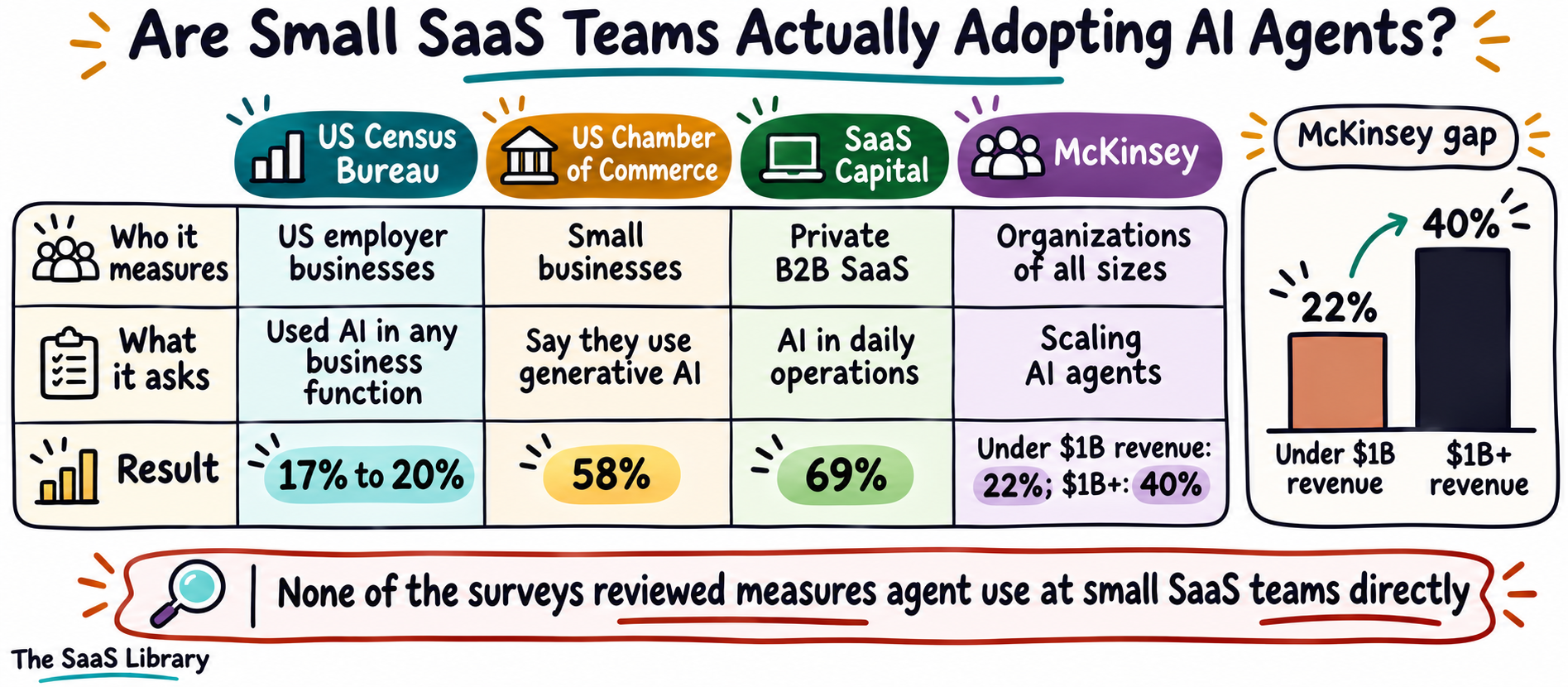
Small SaaS teams are adopting AI broadly and AI agents unevenly. Among organizations under $1 billion in revenue, 22% report scaling agents, versus 40% of larger ones, and none of the surveys TSL reviewed measures agent use at small SaaS teams directly.
McKinsey’s “smaller organizations” group is every company under $1 billion in revenue (n = 1,035 respondents). TSL’s reading: that group is far wider than small SaaS teams, so the 22% is not a measurement of tiny teams.
What Does Each Source Measure?
Each source measures a different group with a different question.
| Source | Who it measures | What it asks | Result |
|---|---|---|---|
| US Census Bureau BTOS (Dec 2025 to May 2026) | US employer businesses, all sizes | Used AI in any business function in the past two weeks | 17% to 20% overall; 37% of firms with 250+ employees; 32% of firms with 100 to 249; under 20% of firms with 4 or fewer |
| US Chamber of Commerce (Aug 2025) | Small businesses | Whether they say they use generative AI | 58%, up from 40% in 2024 |
| SaaS Capital (May 2025) | Private B2B SaaS companies | AI in day-to-day operations; AI in product | 69% in operations; over 76% have some AI in product |
| SaaS Capital (Mar 2025) | Same survey, by size | AI in product | Under $3M ARR: 32% “None” (vs 12% for bigger companies) and 26% “AI-only” or “AI-first” (vs 18%) |
| McKinsey (May to Jun 2026; 1,719 respondents) | Organizations of all sizes | Scaling AI agents in one or more functions | Under $1B revenue: 22%, flat. $1B+: 40%, up from 27% |
Census also reports that between December 2025 and May 2026, AI use did not change significantly among firms with fewer than 20 employees.
Why Do the Adoption Numbers Differ?
The adoption numbers differ because each source counts a different population with a different question.
- Population: all US employer firms, small businesses, private B2B SaaS companies, or organizations of every size.
- Question: any business function in the past two weeks, self-identified generative AI use, AI in operations or product, or scaling agents.
Example (illustration): a founder reads “58% of small businesses use generative AI” (US Chamber, 2025) next to “19.8% of US firms use AI” (Census, May 2026) and sees a contradiction. It is not one.
The Chamber counts small businesses that say they use generative AI. Census counts any AI use in any business function in the past two weeks across all employer firms, a question it reworded in November 2025.
What Do the Smallest SaaS Companies Do Differently?
The smallest SaaS companies split into two camps on AI in their product. In SaaS Capital’s 2025 survey of about a thousand private B2B SaaS companies, those under $3M in ARR were more likely than bigger ones to say they use no AI in their product (32% vs 12%), and also more likely to be “AI-only” or “AI-first” (26% vs 18%). SaaS Capital suggests the no-AI group might be healthy if those companies are first working out their value proposition and go-to-market.
TSL’s reading: none of the sources reviewed shows outcomes for either camp, so a team that skips AI is not shown to be behind, and one that goes all-in is not shown to be ahead.
Adoption numbers say what teams use. They do not say what using it does to hiring.
Can Small Teams Accomplish More Without Hiring Constantly?
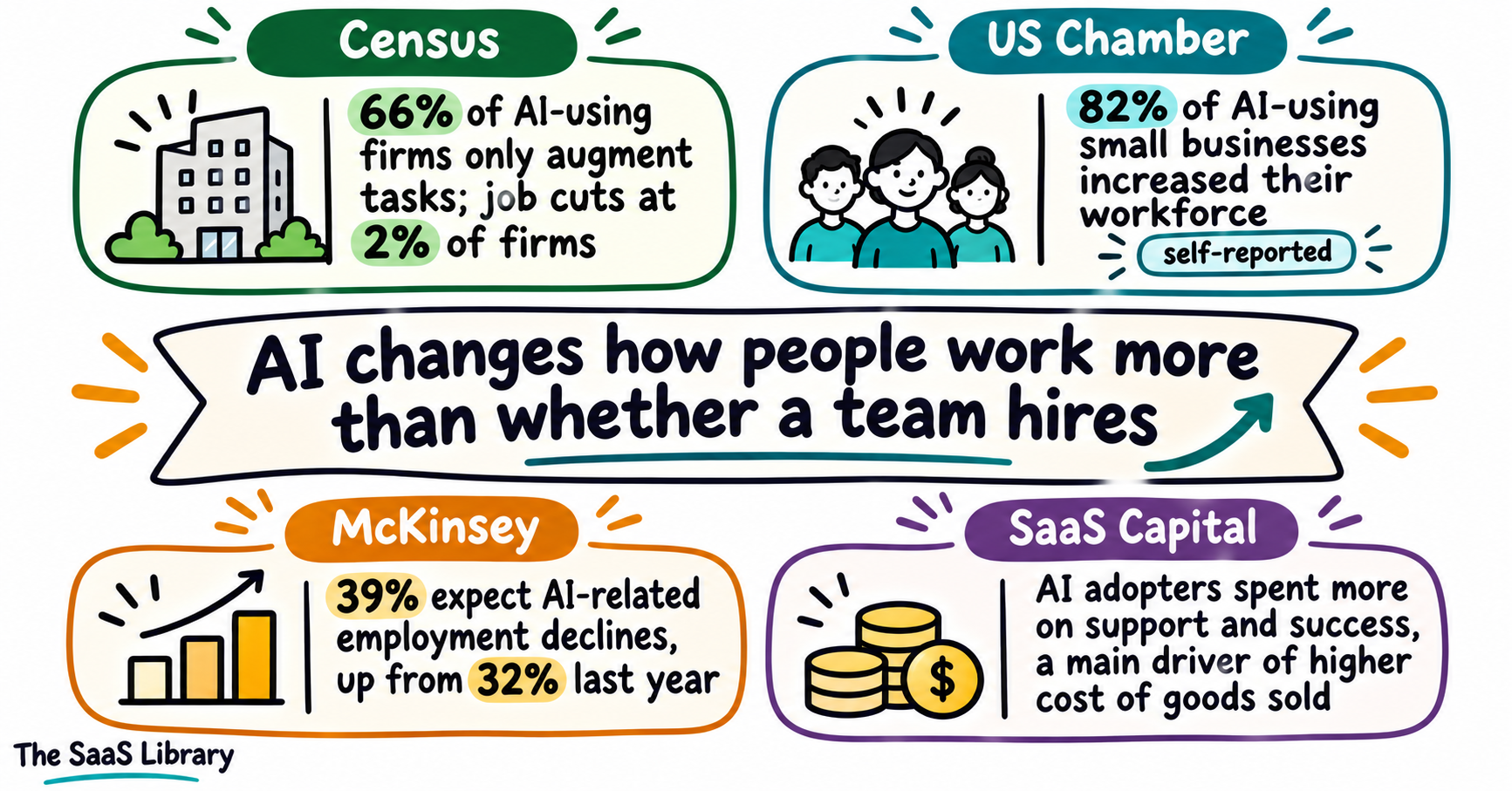
Small teams can accomplish more without constant hiring on routine work, but the evidence shows AI changing how people work more than whether a team hires. In Census data, 66% of AI-using firms only augment tasks with AI and AI-related job cuts occurred at 2% of firms; the US Chamber found 82% of AI-using small businesses grew their workforce.
In SaaS Capital’s data, AI adopters did not spend less on every team. Companies using AI across product and operations spent slightly more on cost of goods sold, and elevated customer support and success costs were the main driver. SaaS Capital reports hearing that rolling out AI in a product can require more support and success staffing, and says the data are consistent with that but not definitive.
TSL’s reading: AI can shift where a team needs people, not only how many.
What Does the Evidence Say About AI and Hiring?
Hiring is a stated worry for small businesses: the US Chamber’s 2024 survey lists recruiting skilled talent among their concerns.
| Source | Finding | Limit |
|---|---|---|
| Census working paper, Apr 2026 | 66% of AI-using firms use AI only to augment tasks; AI-related job cuts at 2% of firms; broader functional integration and operational investment are associated with employment decreases | Working paper; associations |
| US Chamber, Aug 2025 | 82% of small businesses using AI increased their workforce in the past year | Self-reported; does not show AI caused the hiring |
| McKinsey, Aug 2026 | 39% expect AI-related declines in total employment in the coming year, up from 32%; last year’s expected declines were about double the declines now reported | Respondents at organizations of all sizes |
| SaaS Capital, May 2025 | AI adopters at $1M to $20M ARR spent less on R&D and G&A and more on customer support and success; non-adopters spent 20% more on G&A | Correlation; “AI” is defined differently by each company |
What Do SaaS Companies Do With the Extra Capacity?
SaaS companies with extra capacity from AI choose between two paths, and SaaS Capital describes both: deliver the same output with fewer resources, or keep resources and deliver more. It describes AI as an opportunity “to create more output for a given input”. So far, SaaS Capital finds, companies have used the efficiency to cut R&D resources more than to expand development.
SaaS Capital’s Randall Lucas, Managing Director, predicts the most successful small SaaS companies will have fewer developers, paid more, on “a much smaller, well-equipped, AI-augmented team” (March 26, 2025). This is a prediction, not a measurement.
What Does This Mean for a Five-Person Team?
TSL’s reading:
- Tasks change; responsibility does not. That matches the guest draft and the Census finding that most AI-using firms only augment tasks.
- Budget for the support layer. Adopters in SaaS Capital’s data spent more on support and success.
- Plan for headcount shifts, not only cuts. Lucas’s prediction is fewer, better-paid developers.
Can AI Agents Make Customer Support More Responsive?
AI agents can make customer support more responsive on routine questions: Intercom says its Fin agent answers 24/7, even when a team is offline. Responsiveness is not the same as quality, because a vendor’s resolution rate can count a silent customer as resolved, and a company is responsible for what its chatbot says.
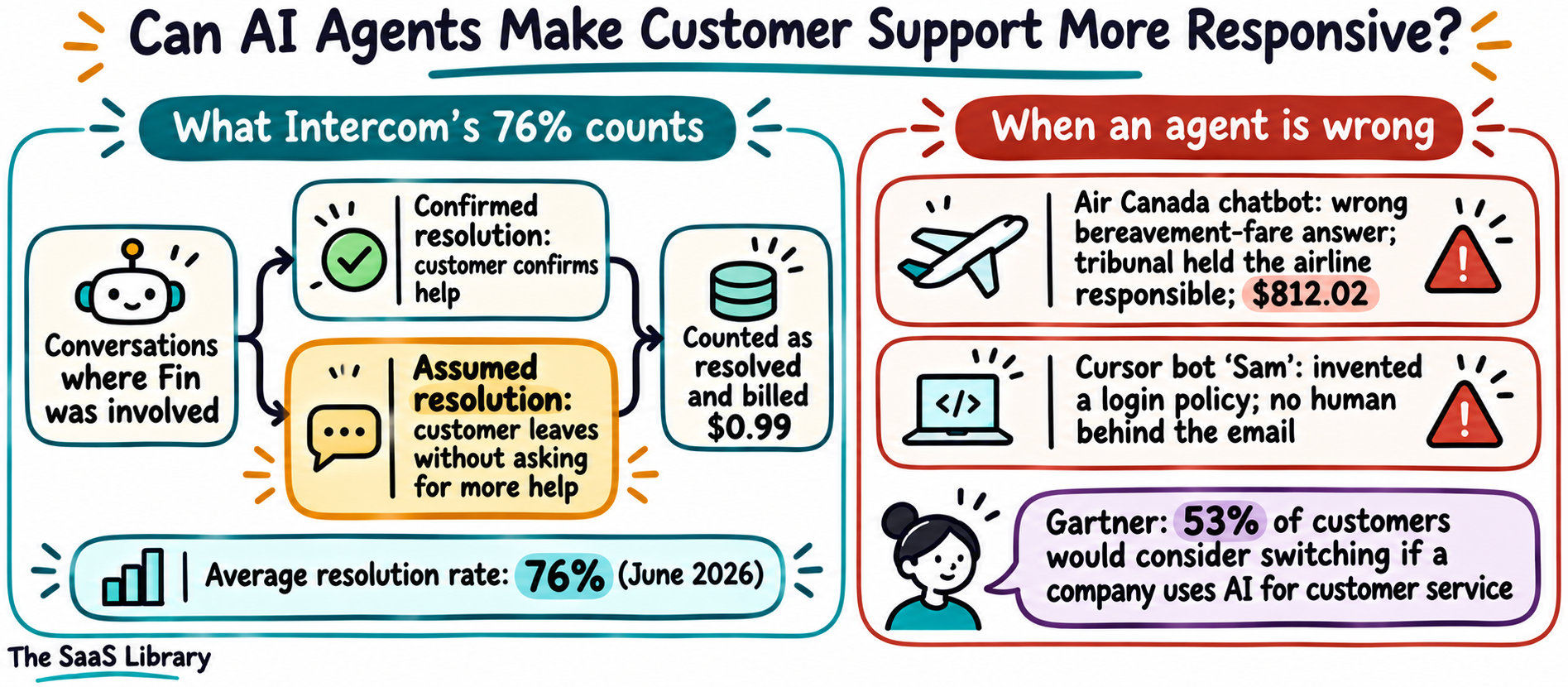
The number behind most AI support claims is a vendor-defined rate. Intercom reports an average resolution rate of 76% for Fin as of June 2026, and says the rate is calculated across conversations where Fin was involved. Salesforce, which agreed to acquire Fin on June 15, 2026, describes it as agents “resolving on average 76% of support volume end-to-end”.
What Does Intercom’s 76% Count?
Intercom’s 76% counts confirmed and assumed resolutions among conversations where Fin was involved.
| Question | Intercom’s answer | Source |
|---|---|---|
| What is the figure? | Average resolution rate of 76% across customers, as of June 2026 | Intercom blog |
| Which conversations count? | Conversations where Fin was involved | Fin |
| What counts as a resolution? | The customer confirms help (confirmed), or leaves without asking for more help (assumed). Both are billed at $0.99 | Intercom Help |
| Does a frustrated customer who leaves count? | Yes: it is counted as an assumed resolution and billed at $0.99 | Intercom Help |
TSL’s reading: the 76% measures conversations that ended without a further request, not conversations where every customer was satisfied.
How Should a Small Team Measure Support Success?
A small team should measure support success on more than tickets closed. The guest draft names four measures. Here is what Intercom’s reporting offers for each, from its Fin Performance dashboard and its Fin report.
| Measure | What Intercom’s reporting offers | Gap (TSL’s reading) |
|---|---|---|
| Resolution accuracy | Resolution rate, which includes assumed resolutions | Check a sample of resolved conversations yourself |
| Customer satisfaction | CX Score; Fin CSAT survey responses | Review the low scores, not only the average |
| Repeat contacts | Not a listed metric in the pages reviewed | Track customers who return on the same issue |
| Escalation quality | A routed-to-team rate | The rate counts handoffs, not whether each handoff was right |
Who Gains Most From AI Support Help?
Newer and lower-skilled support agents gain most from AI help. In the NBER study of 5,179 support agents, the AI assistant raised productivity by 34% for novice and low-skilled workers, with minimal impact on experienced and highly skilled workers. The same study found AI assistance improved customer sentiment and increased employee retention.
TSL’s reading: a small team with a new support hire has more to gain from an assistant than one with a veteran.
What Goes Wrong When an AI Support Agent Is Wrong?
When an AI support agent is wrong, the company answers for it, and customers notice.
| Case | What happened | Outcome | Source |
|---|---|---|---|
| Moffatt v. Air Canada (BC Civil Resolution Tribunal, Feb 14, 2024) | A website chatbot told a customer he could claim a bereavement fare after travel; the airline’s own policy page said otherwise | Negligent misrepresentation found. Air Canada argued it could not be held liable for its chatbot; the tribunal held it “responsible for all the information on its website”. Ordered to pay $812.02 ($650.88 damages, $36.14 interest, $125 fees) | CRT decision (a small-claims decision) |
| Cursor’s support bot “Sam” (Apr 2025) | An AI-written support email told users their logouts were expected behavior under a new login policy; there was no such policy and no human behind the email | Co-founder Michael Truell called it an “incorrect response from a front-line AI support bot”; users were reported cancelling subscriptions | Fortune; AI Incident Database #1039 |
Customers react to AI support as well.
What Should Always Go to a Human?
Account security, payment disputes and unusual technical failures should always go to a human, per the guest draft. TSL adds: any statement of company policy, based on the two cases above. Intercom says its outcome model lets customers design workflows that include a human agent when necessary.
Example (illustration, from the guest draft’s project-management software):
| Route to the agent | Route to a person |
|---|---|
| Help a customer create a workspace | A customer reports an account-security problem |
| Explain what each permission does | A customer disputes a payment |
| Give the steps for a known problem | A failure the documentation does not describe; any question about company policy |
Routine help gets faster, and the sensitive cases keep a human. That is the version of “more responsive” that survives the cases above.
See why AI agent deployments fail the first time, and what second-attempt buyers learned.
Why AI Agents Fail the First Time →Can AI Agents Help Small Teams Build Product Faster?
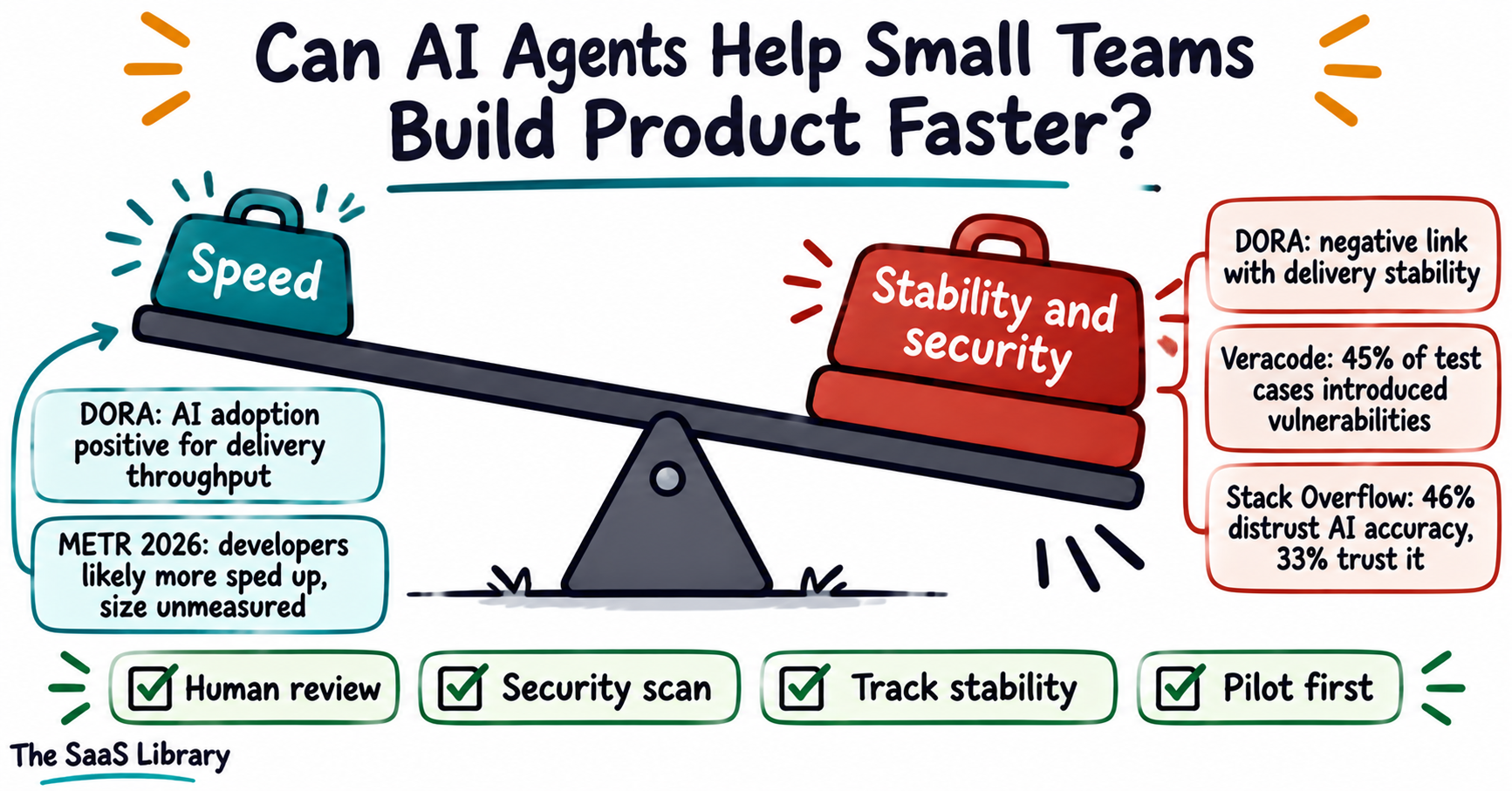
AI agents can help small teams build product faster in some settings, but speed is not the same as stable, secure software. A 2025 survey of nearly 5,000 professionals found AI adoption positive for delivery throughput and negative for stability, and Veracode found AI-generated code introduced security flaws in 45% of its test cases.
The most-quoted number in this debate is out of date by its authors’ own account. METR’s July 2025 trial found experienced developers took 19% longer with AI tools (16 developers, 246 tasks, early-2025 tools), and the page now labels the result out of date. In February 2026, METR said its follow-up gave “an unreliable signal” and that developers are likely more sped up now, though the data are very weak evidence for how much.
What Does the Evidence Say About AI and Software Work?
The evidence says AI may speed some delivery measures while lowering stability and code security, and developer trust is split.
| Source | Finding | Limit |
|---|---|---|
| METR, Feb 2026 | Follow-up with late-2025 tools (57 developers, 143 repositories, 800+ tasks): tasks took 18% less time for the 10 returning developers (CI −38% to +9%) and 4% less for the 47 new developers (CI −15% to +9%). METR expects developers are likely more sped up than in early 2025 | Both ranges include no change. Selection effects; METR calls its estimate a likely lower bound |
| DORA 2025 | 90% of respondents use AI at work. AI adoption has a positive relationship with delivery throughput and product performance, and a negative relationship with delivery stability | Survey of nearly 5,000 professionals; correlation |
| Veracode 2025 | AI-generated code introduced vulnerabilities in 45% of 80 coding tasks across 100+ LLMs; Java failed over 70% of the time | Code-completion tests with known weaknesses, run by a security vendor |
| Stack Overflow 2025 | 84% use or plan to use AI tools; 46% distrust their accuracy against 33% who trust it; 3% highly trust the output | 33,244 respondents answered the trust question |
TSL’s reading: the likely speed gain is unmeasured in size, while the documented costs are stability and security.
Which Product Jobs Have Documented AI Support?
Two of the guest draft’s product jobs have documented AI support in the sources reviewed: pull request review and grouping similar customer questions.
| Job (from the guest draft) | Documented example | Status |
|---|---|---|
| Assist with code review | GitHub Copilot reviews pull requests and suggests changes, usually in under 30 seconds; on a re-review it may repeat comments you already dismissed | Documented in vendor docs |
| Group similar complaints; summarize feedback | Intercom’s Fin groups unresolved customer questions into topics of similar questions; the report has since been replaced by Recommendations | Documented for support conversations, not product feedback |
| Review bug reports; write test cases; prepare release notes | No primary documentation verified for this article | Unverified; treat as a pilot |
Example (illustration, from the guest draft): a small accounting software company gets dozens of questions about how it handles invoicing. An agent looks at the feedback, identifies recurring issues and creates a report for the product team. Developers then spend less time organizing feedback and more time fixing the underlying issues.
What Should a Small Team Check Before Shipping AI-Assisted Work?
A small team should check human review, security, stability and its own results before shipping AI-assisted work. TSL’s reading:
- Human review on every change that ships. The guest draft says code must be tested and reviewed by qualified people, and DORA links AI adoption to lower delivery stability.
- Security scanning for AI-written code. Veracode found vulnerabilities in 45% of its test cases.
- Stability next to speed. Track failures and recovery, not only output.
- A pilot before you rely on a job. Three of the five jobs above lack verified documentation.
The guest draft adds that product decisions need customer knowledge that automated summaries cannot provide. None of the sources reviewed tests that claim.
Can AI Agents Make Sales and Marketing More Focused?
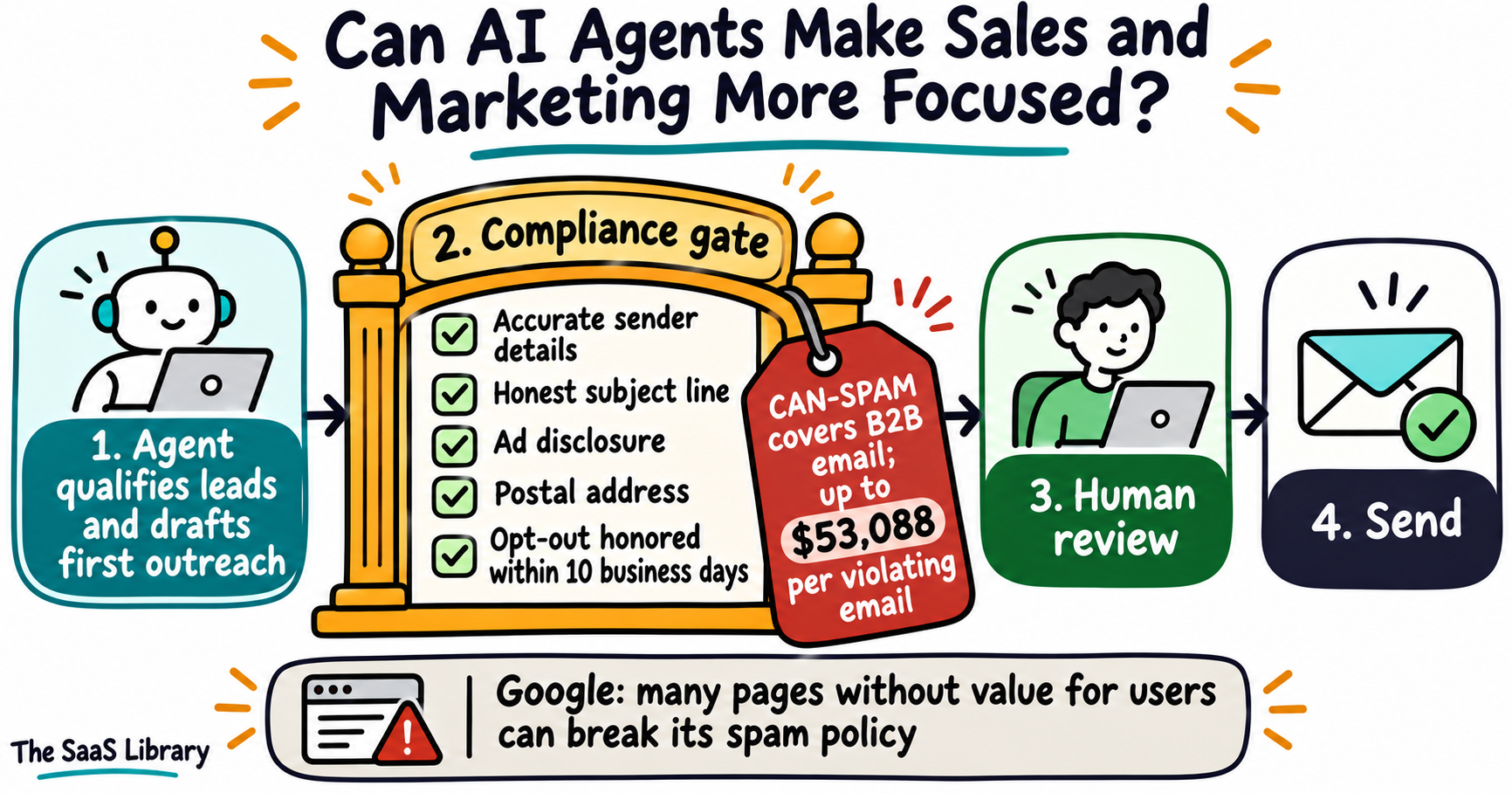
AI agents can make sales and marketing more focused by qualifying inbound leads and handling first outreach, but a small team stays legally responsible for what goes out. The FTC’s CAN-SPAM rules cover every commercial email, including business-to-business, and SaaStr’s own AI sales agents needed daily human review.
Supervision was the part SaaStr stressed most. Its founder, Jason Lemkin, wrote that the company’s AI agents “require daily management and review”, starting with a morning review of conversation-quality scores, lead-qualification accuracy and escalated edge cases. SaaStr runs events and a community, and every figure in the table below is its own.
What Does One Team Report From Running AI Sales Agents?
SaaStr reports 10 AI agents in production, with daily human review, and results it has not had independently checked.
| Item | SaaStr’s own statement (Aug 2025) |
|---|---|
| Agents in production | 10 by the end of Q3 2025, including 3 AI SDRs and 2 AI BDRs |
| Daily oversight | Review of conversation-quality scores, lead-qualification accuracy and human escalations |
| Tuning needed | 47 iterations for the sponsor-inquiry SDR to stop being too aggressive on pricing; the support agent retrained 3 times to escalate VIP issues |
| Response time | First response fell from 4.2 hours to 1 minute |
| Lead scoring | 67% more leads properly scored and routed |
| Pipeline | $340K of sponsor pipeline from the AI SDR team “so far in Q3”, at about $10K a month in fully loaded agent cost |
| Where humans stay | Complex enterprise deals and strategic partnerships; SaaStr advises being transparent about AI involvement |
| Forecast, not result | “40-60% of initial prospect interactions” handled by agents at the highest-performing SaaS companies by SaaStr Annual 2026 |
TSL’s reading: these are self-reported results from one events business, so use them as a list of things to measure, not as expected results.
What Do the Rules Say About Automated Outreach?
The rules say automated outreach is commercial email like any other, and the company that benefits stays responsible. From the FTC’s CAN-SPAM guide:
| Requirement | FTC guidance |
|---|---|
| Scope | Covers all commercial email, with no exception for business-to-business |
| Accurate sender details | “From”, “To”, “Reply-To” and routing information must be accurate |
| Honest subject lines | The subject line must reflect the message content |
| Ad disclosure | Disclose clearly that the message is an advertisement |
| Location | Include a valid physical postal address |
| Opt-out | A clear way to opt out; honor requests within 10 business days; the mechanism must work for 30 days |
| Opted-out addresses | Cannot be sold or transferred |
| Outsourcing | You cannot contract away responsibility; the promoted company and the sender may both be liable |
| Penalty | Up to $53,088 per violating email |
TSL’s reading:
- Keep the footer, address and opt-out list outside the model. The rules set fixed requirements, so no agent’s wording should be able to remove them.
- Treat an agent-sent email as your email. The FTC holds the company that benefits responsible.
- Read the related TSL guide: what happens when an agent gets an email address.
What Does Google Say About AI-Written Marketing Content?
Google says AI-written marketing content is not the problem; scale without value is. Its spam policy defines scaled content abuse as many pages generated for the primary purpose of manipulating Search rankings and not helping users, whether automation or humans are involved. Google’s guidance on generative AI content adds that using AI tools to generate many pages without adding value for users may violate that policy.
For the full picture, see TSL’s guide to whether Google penalizes AI content.
Which Sales and Marketing Jobs Have Documented AI Support?
Only one of the guest draft’s sales and marketing jobs has documented AI support in the sources reviewed.
| Job (from the guest draft) | Documented example | Status |
|---|---|---|
| Qualify leads; handle first outreach | SaaStr’s 3 AI SDRs and 2 AI BDRs, per its own post | Documented, self-reported |
| Research prospects; organize public company information; identify segments | None verified for this article | Unverified; pilot first |
| Analyze campaign performance; organize consumer feedback; identify content gaps | None verified for this article | Unverified; pilot first |
Example (illustration, from the guest draft): a SaaS product for independent retailers uses an agent to pinpoint common inventory-management pain points that its target customers discuss. The marketing team then writes practical articles and product demonstrations around those issues. For lead scoring, see TSL’s guide to building an AI lead-scoring system.
What should a person still review? The guest draft names three things: factual accuracy, brand consistency and meaningful customer relationships. SaaStr’s post agrees that humans still close complex enterprise deals, and it advises telling prospects about AI involvement upfront.
That covers what agents do for a small team. The rest covers which numbers to trust, where agents fail, what they cost and how to start.
Can a Smaller Team Offer a More Personal Experience?
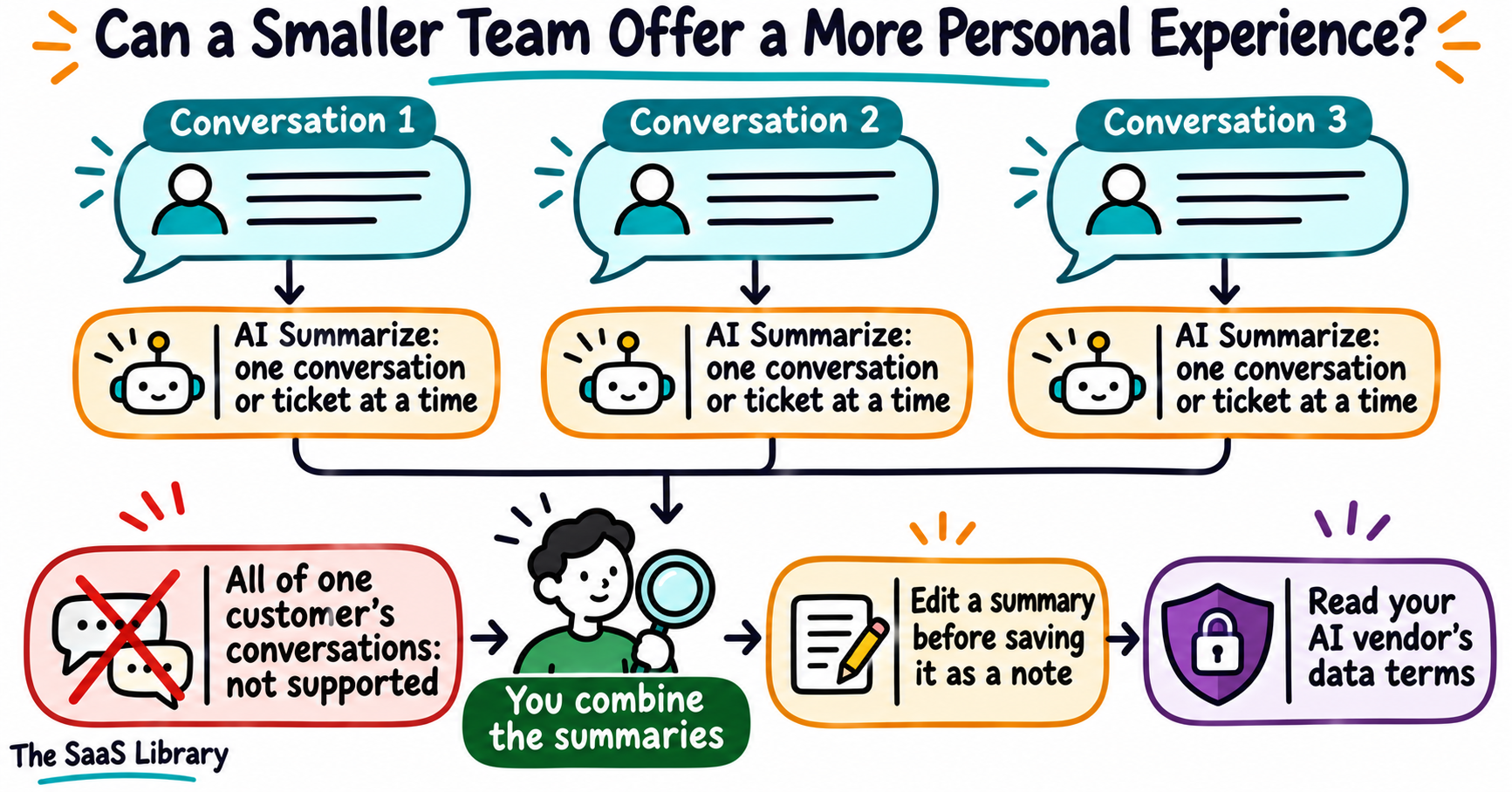
A smaller team can offer a more personal experience by using AI to summarise past conversations and prepare context before a person replies, but Intercom’s documented AI summaries work one conversation at a time. Customer data also brings duties: the FTC says quietly changing terms to use customer data for AI training can be unfair or deceptive.
Intercom’s help page says AI Summarize cannot summarize all conversations and tickets from one specific user. It works on one conversation or ticket at a time. A teammate can edit a summary before adding it as a note, and workflows can generate summaries automatically.
TSL’s reading: a customer-level history means combining several per-conversation summaries yourself.
Which Personalization Jobs Have Documented AI Support?
Two of the guest draft’s four personalization jobs have documented AI support in the sources reviewed.
| Job (from the guest draft) | Documented example | Status |
|---|---|---|
| Summarise previous support conversations | Intercom AI Summarize: a summary of one conversation or ticket, editable before it is saved | Documented, with the per-conversation limit |
| Prepare context before a person replies | Intercom Copilot reads the thread, internal notes and customer data, summarizes what has been tried and who the customer is, and drafts a reply; it acts in connected systems with the teammate’s approval | Documented on the vendor’s own page |
| Onboarding recommendations based on the plan the customer chose | No primary documentation verified for this article | Unverified; pilot first |
| Suggest features relevant to how the customer uses the product | No primary documentation verified for this article | Unverified; pilot first |
Example (illustration, from the guest draft): a customer picks a plan. An agent drafts onboarding recommendations for that plan and summarises the customer’s earlier support conversations. A team member reviews the recommendations and adds their expertise before anything reaches the customer.
What Do You Owe Customers When AI Uses Their Data?
You owe customers the data promises you and your AI vendors have made. The FTC’s Office of Technology states that:
- Quiet changes can be unfair or deceptive. Adopting more permissive data practices, such as using data for AI training, and telling users only through a surreptitious, retroactive change to the terms may be unfair or deceptive.
- Vendors answer for their promises. Model-as-a-service companies that deceive users about how data is collected may be violating the law, including promises not to use customer data to train or update models.
- There is no AI exemption from the laws on the books.
These statements are US guidance, so check local law for other markets. Intercom also says its EU-hosted workspaces process AI features’ data within Europe.
TSL’s reading:
- Read your AI vendor’s terms for use of your customers’ data in model training before you connect it.
- Tell your own customers in your privacy policy how AI uses their data.
- Keep a person reviewing what reaches the customer.
For related guides, see TSL on what happens to your data in a free AI tool and auditing your stack for shadow AI.
Which AI Agent Statistics Can You Actually Trust?
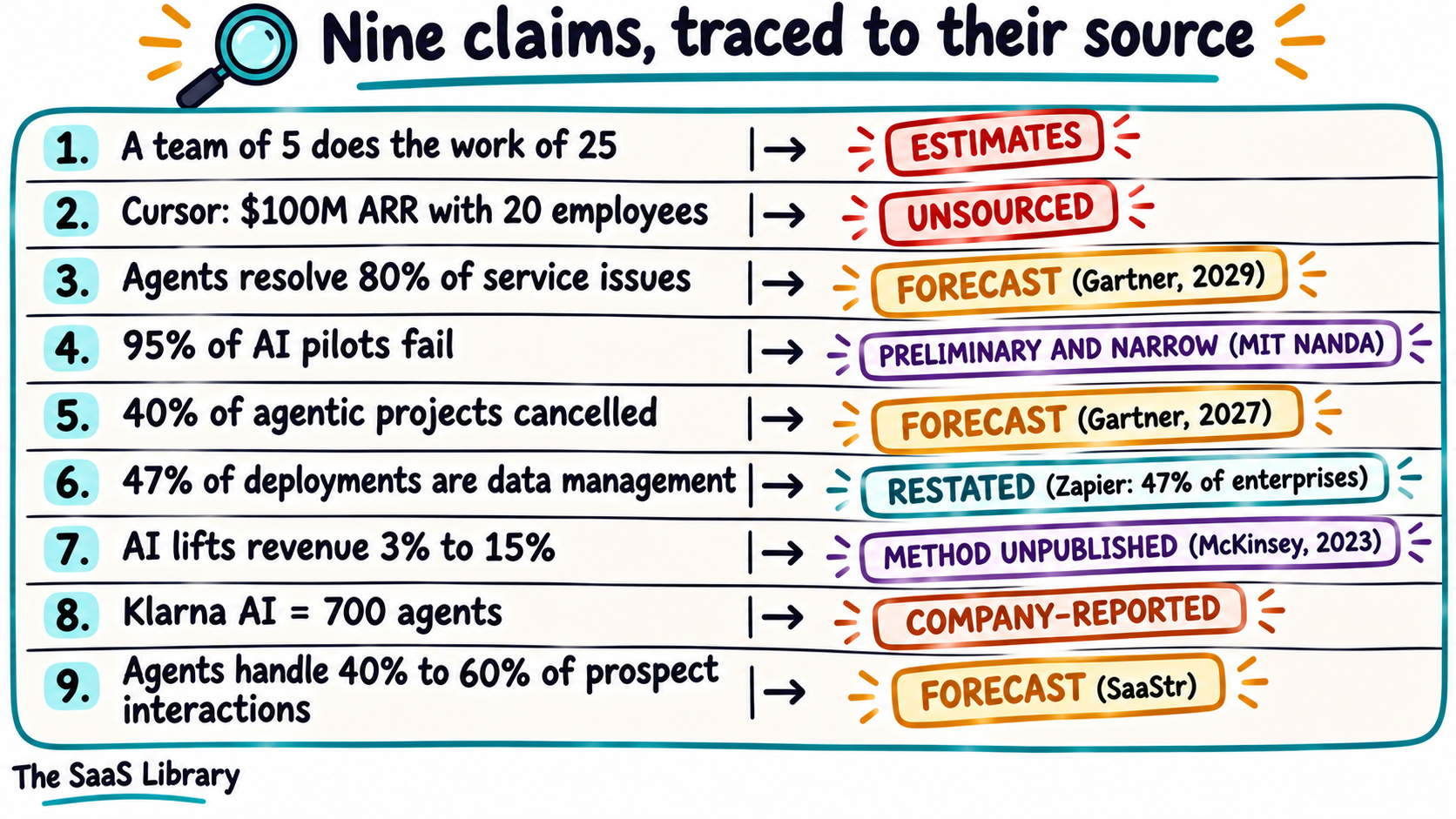
A statistic earns trust when you can name its source, date, sample and what it measures. In TSL’s audit of nine widely repeated AI agent claims, none was a measured, independent result for small SaaS teams: three were forecasts, and the rest were finance-firm estimates, vendor or company figures, or studies with narrow or unpublished methods.
The claim behind “a team of five does the work of twenty-five” is an estimate, and one version of it rests on a single afternoon. SaaS Capital’s Randall Lucas wrote that a skilled copilot user “probably has the effectiveness of a 10-person product team”. He based it on an early-2025 afternoon building a hobby audio-sorting prototype with Cursor, and he “suspected” a proficient user could cut two hours to 20 minutes.
What Do Nine Widely Repeated Claims Turn Out to Say?
| # | Claim | Where it comes from | What the source says | Verdict |
|---|---|---|---|---|
| 1 | One engineer does the work of five or more; a team of 5 does the work of 25 | CORE (2025) and SaaS Capital (Mar 26, 2025) | CORE: “We estimate that one engineer can achieve the output of more than five”, with no method shown, while adding that AI programming still needs experienced human oversight. SaaS Capital: the 10-person figure above | Estimates, no measured team result |
| 2 | Cursor reached $100M ARR with 20 employees | CORE states it in the same post | Stated without a source. TSL found no primary source for the headcount | Unsourced |
| 3 | AI agents resolve 80% of customer service issues | Gartner, Mar 5, 2025 | “By 2029”, agentic AI will autonomously resolve 80% of common customer service issues, with a 30% operating-cost reduction | Forecast for 2029, not a current rate |
| 4 | 95% of AI pilots fail | MIT NANDA, Jul 2025 | A preliminary report: 52 interviews, 153 leaders surveyed, 300+ public initiatives. 95% of organizations getting zero return; 5% of custom or vendor enterprise tools reached production. The report says its figures are “directionally accurate based on individual interviews rather than official company reporting”. ROI measured six months after the pilot; general-purpose chatbots showed about 83% pilot-to-implementation | Preliminary and narrow |
| 5 | 40% of agentic AI projects will be cancelled | Gartner, Jun 25, 2025 | Over 40% cancelled by the end of 2027 “due to escalating costs, unclear business value or inadequate risk controls”; Gartner also flags “agent washing” | Forecast |
| 6 | 47% of AI agent deployments are data management | Zapier survey (525 completed surveys, Oct 23-27, 2025) | 47% of surveyed enterprises use agents for data management; 49% of customer support and 47% of operations teams have deployed agents | Restated: a share of enterprises became a share of deployments; vendor survey |
| 7 | AI lifts revenue 3-15% and sales ROI 10-20% | McKinsey; coverage dates the research to June 2023 | “Our research shows players that invest in AI” in sales and marketing see those ranges; the pages reviewed give no sample or method | Method unpublished, dated, not about agents |
| 8 | Klarna’s AI does the work of 700 agents | Klarna press release, Feb 27, 2024 | After one month: 2.3 million conversations, two-thirds of chats, “equivalent work of 700 full-time agents”, and a $40M estimated 2024 profit improvement. Klarna told Fast Company the equivalence was not related to its layoffs | Company-reported equivalence |
| 9 | Agents will handle 40-60% of initial prospect interactions | SaaStr, Aug 2025 (checked in Section 8) | SaaStr’s own “prediction” | Forecast |
How Do You Check an AI Statistic in Five Steps?
TSL’s checklist:
- Name the publisher and the date. The 80% and 40% figures are dated predictions.
- Find the sample. Who or what was measured, and how many.
- Read what it counts. “Resolved”, “deployed” and “use” each have different definitions (Sections 4 and 6).
- Classify it: measurement, estimate, forecast or company claim.
- Match it to your situation: your size, industry and tools.
Which numbers in this article are measurements?
The support-productivity study (Sections 1 and 6), the Census adoption and job-cut data (Sections 4 and 5), and the DORA and Veracode results (Section 7). Each shows its sample and limits in its section. Estimates and forecasts are labelled as such wherever they appear.
Where Should a Small Team Not Use AI Agents?
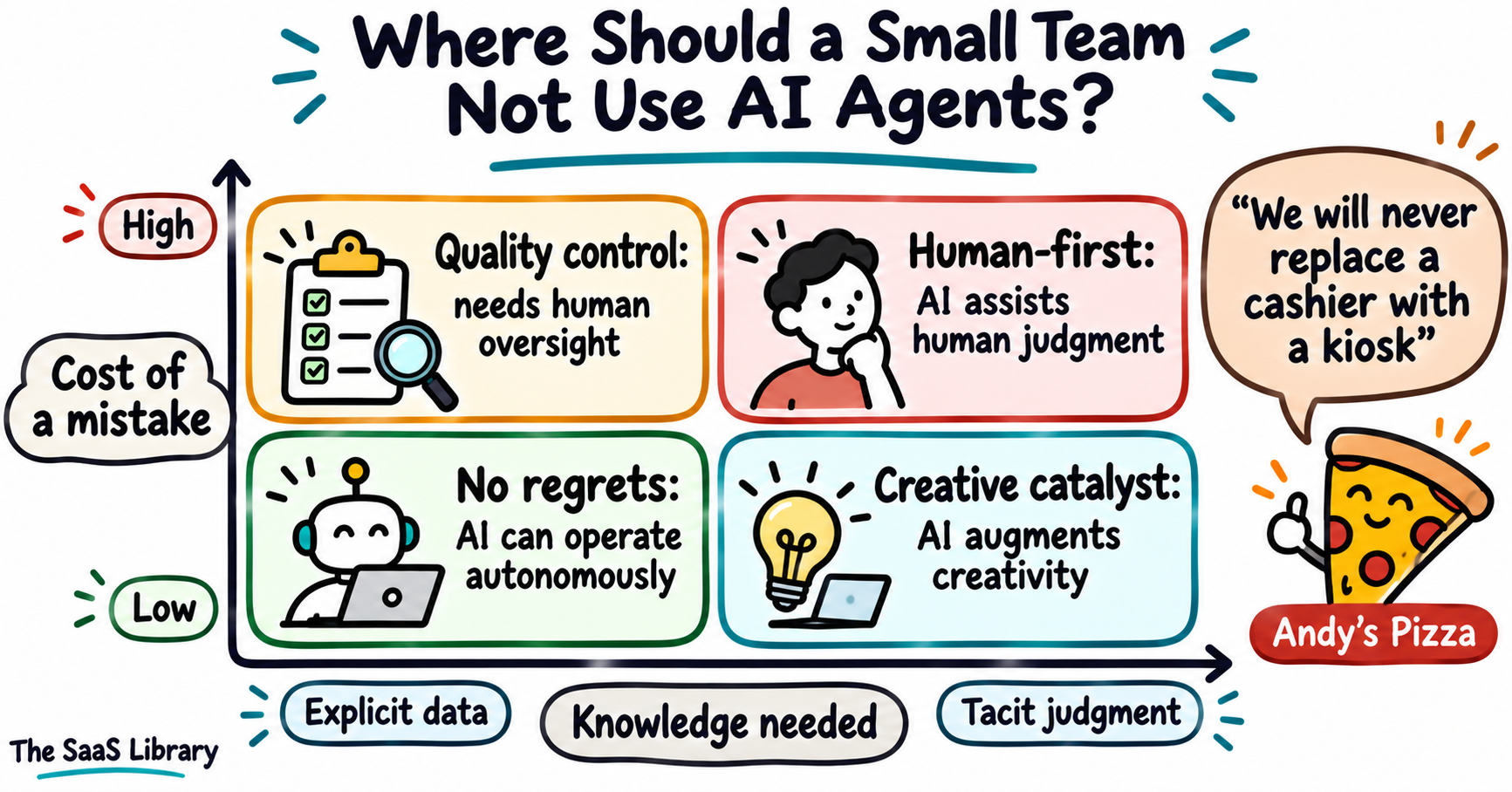
A small team should not run AI agents without human oversight where a mistake would cause serious harm, financial loss or reputational damage, or where the task depends on tacit judgment. Wu and Anand’s framework asks how costly a mistake is and whether the task relies on explicit data or human judgment.
A 14-shop pizza chain shows where the line can sit. Owner Andy Brown used AI coding tools to build internal apps that update kitchen screens, track phone orders and optimize staff schedules, and he keeps customers away from AI. Callers will not get AI phone ordering either.
TSL’s reading: his line falls between internal tools and customer-facing work, and the framework below formalizes that instinct.
What Do the Four Zones Mean for a Small Team?
The framework sorts tasks into four zones by the cost of a mistake and the type of knowledge a task needs. The HBR article names the zones no regrets, creative catalyst, human-first and quality control, and its database abstract pairs them with where gen AI can operate autonomously, augment creativity, assist human judgment, or require human oversight.
| Zone | Cost of a mistake | Knowledge | What AI’s role is |
|---|---|---|---|
| No regrets | Low | Explicit data | Can operate autonomously; the clearest and most immediate opportunity |
| Creative catalyst | Low | Tacit judgment | Augments creativity |
| Quality control | High | Explicit data | Needs human oversight |
| Human-first | High | Tacit judgment | Assists human judgment; supports, does not replace, decision-makers |
Example (illustration): a duplicate-charge refund that matches a written policy sits near the no-regrets zone, because the rule is explicit and the cost of an error is small. A disputed enterprise contract sits in the human-first zone, because it depends on judgment and a mistake is costly.
Which Small-Team Tasks Should Stay Human-Led?
Five tasks should stay human-led or human-approved, drawn from the evidence in earlier sections. TSL’s mapping:
| Task | Why | Where it was checked |
|---|---|---|
| Statements of company policy and customer promises | A company is responsible for what its chatbot says, and a support bot invented a policy | Section 6 |
| Payments, refunds, disputes, security and account access | The guest draft’s escalation list | Sections 3 and 6 |
| Code that ships without review and a security scan | AI adoption links to lower delivery stability, and AI-written code failed security tests | Section 7 |
| Outreach without compliance controls | Commercial email, including B2B, carries legal duties | Section 8 |
| Customer data sent to an AI vendor whose terms you have not read | Quiet term changes and data-use promises carry legal risk | Section 9 |
Owners also hold back on routine finance tasks. According to HBS, bookkeeping and financial planning are tasks many small-business owners want to offload but many haven’t, citing data privacy and accuracy concerns.
Do You Need an Engineer to Use AI Agents?
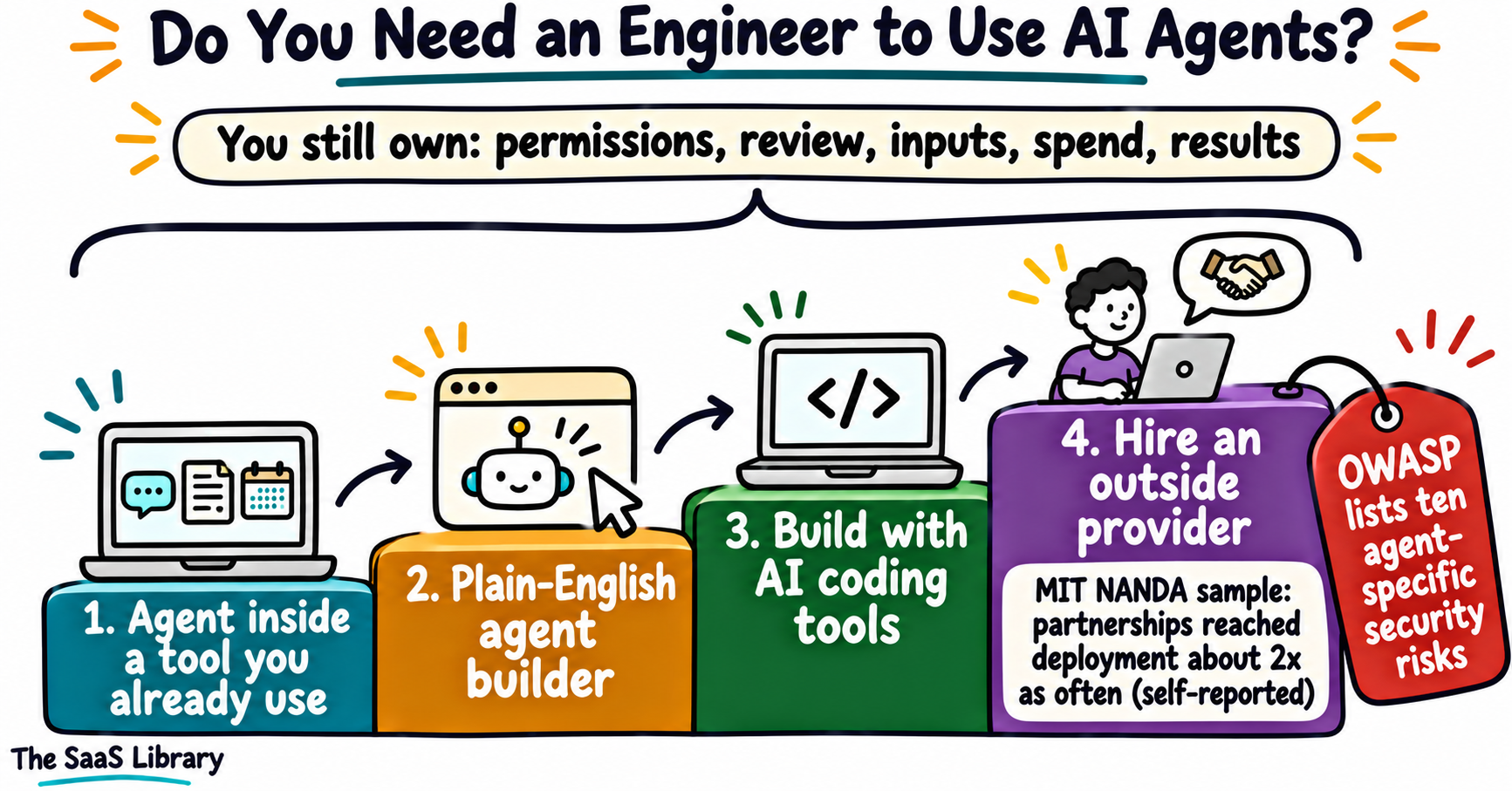
You do not need an engineer to start with AI agents, because plain-English agent builders exist, but OWASP lists ten agent-specific security risks and someone has to own them. In MIT NANDA’s preliminary sample, externally built tools reached deployment about 67% of the time against about 33% for internal builds, a self-reported figure.
OWASP’s risk list shows what a non-engineer is taking on. It includes hidden prompts that turn copilots into silent data-exfiltration channels (goal hijack), leaked credentials that let agents act beyond their intended scope (identity and privilege abuse), and confident, polished explanations that mislead people into approving harmful actions (human-agent trust exploitation). These risks come from OWASP’s catalogue of production incidents, and they apply whether you build the agent or buy it.
What Are Your Options for Getting an Agent Running?
There are four routes, each with a different owner.
| Route | Documented example | Who must be technical | What to check |
|---|---|---|---|
| An agent inside a tool you already use | Intercom’s Fin can run with Intercom “or your existing platform”, with no migration required; Wu and Anand note gen AI is increasingly embedded in email, videoconferencing, spreadsheets, CRM and ERP | Nobody for setup; someone for review | Vendor data terms (Section 9); measured results (Section 6) |
| A plain-English agent builder | Zapier says you can build an agent in minutes using plain English. The Free plan gives 400 activities a month (10 per run, and tests count); Pro gives 1,500 (40 per run). Pro costs $50 a month | Low | Activity caps; what the agent can access |
| Building with AI coding tools | One pizza-chain owner built internal apps with AI coding tools (Section 11) | Comfortable with tools, not necessarily an engineer | Review and security scan (Section 7) |
| Hiring an outside provider | MIT NANDA’s sample: partnerships reached deployment about twice as often as internal builds. The report warns the gap may reflect organizational capability, not approach, and that it does not prove causation | The provider builds; you own the outcome | Contract, data terms, your own measurement |
The guest draft adds that teams without an engineer can bring in an outside agent-development provider to build agents around a specific business need and add safeguards. That is route four in the table.
What Does a Non-Engineer Still Need to Own?
A non-engineer still needs to own permissions, review, inputs, spend and results. TSL’s reading, grounded in the OWASP list and earlier sections:
- Permissions. Give each agent only the access its job needs; leaked credentials are how agents act beyond their scope.
- Review. A person approves what reaches a customer (Sections 3, 6 and 8).
- Inputs. Watch what an agent reads, because hidden instructions in content can redirect it.
- Spend. Set activity limits; on Zapier’s Free plan, tests count toward the quota.
- Results. Measure against your own baseline (Section 6).
Example (illustration): a five-person team with no engineer uses a plain-English builder to draft ticket replies. One teammate owns the agent’s app permissions and reads its output daily. The support person approves each draft before it goes out.
What Do AI Agents Cost a Small Team?
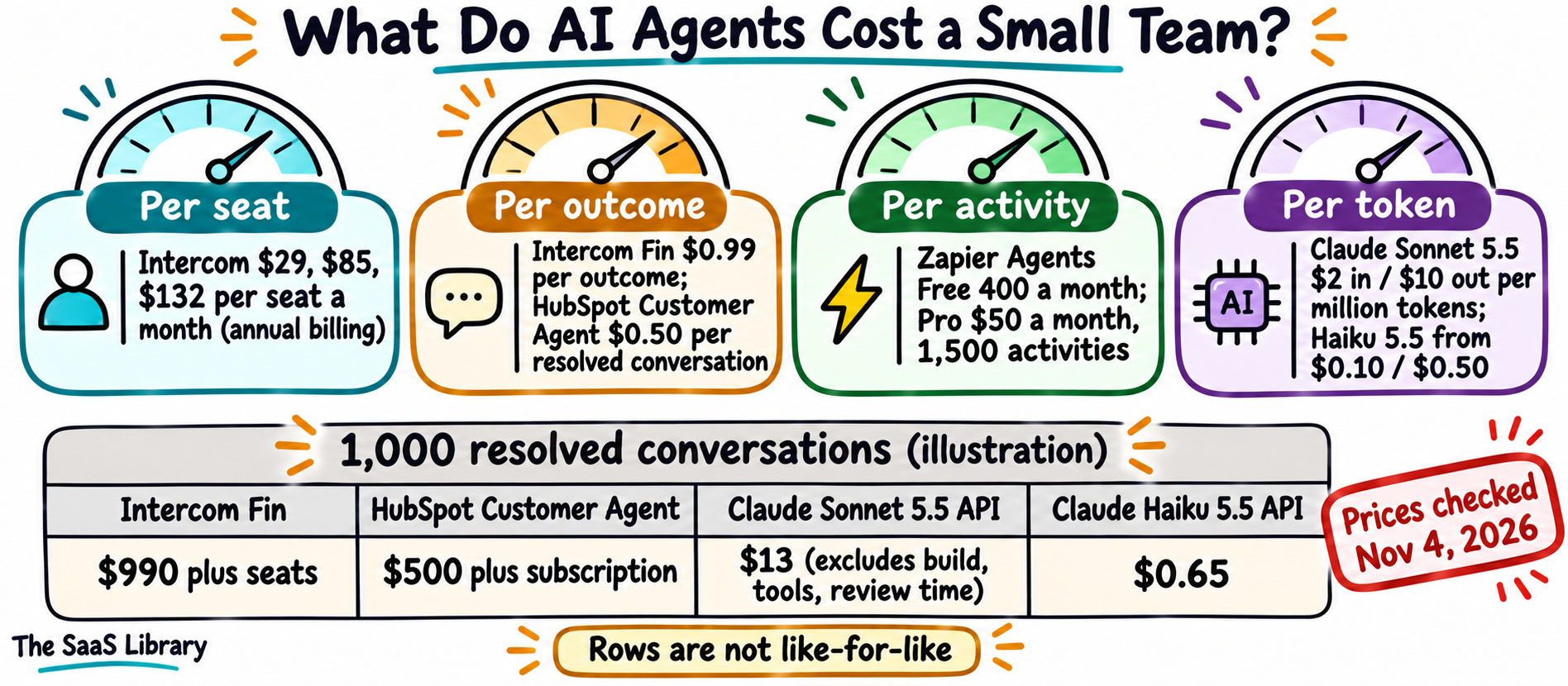
AI agents cost a small team seat fees plus usage fees: Intercom’s Fin adds $0.99 per outcome to seats of $29 to $132 a month, HubSpot’s Customer Agent charges $0.50 per resolved conversation, Zapier’s Agents plan runs from free to $50 a month, and model APIs bill per million tokens.
Outcome pricing makes the bill grow as the agent resolves more, and “outcome” is the vendor’s definition. Intercom bills $0.99 for assumed resolutions too, where the customer leaves without asking for more help (Section 6). TSL’s reading: before you buy, ask what counts as an outcome and what happens to your bill when volume doubles.
How Do AI Agent Pricing Models Differ?
AI agent pricing falls into four models, and the meter you pay on decides what grows your bill. All prices checked November 4, 2026.
| Model | Example | You pay for | Watch for |
|---|---|---|---|
| Per seat | Intercom: Essential $29, Advanced $85, Expert $132 per seat a month billed annually ($39, $99, $139 billed monthly) | Each person who needs full access | Agent fees are billed separately from seats |
| Per outcome | Intercom Fin: $0.99 per outcome on every plan. HubSpot: Customer Agent $0.50 per resolved conversation, down from $1.00 per conversation (Apr 14, 2026); Prospecting Agent $1 per lead recommended; available to Pro and Enterprise customers | Results the vendor counts | The definition of “resolved”; volume growth |
| Per activity | Zapier Agents: Free 400 activities a month (10 per run, tests count); Pro 1,500 (40 per run), $50 a month | Steps your agent takes | Monthly caps; test runs on the Free plan |
| Per token | Claude API (per million tokens, input / output): Sonnet 5.5 $2 / $10; Opus 5.5 $4 / $20; Haiku 5.5 from $0.10 / $0.50; Batch API 50% off | Text the model reads and writes | Haiku 5.5 counts the same text as about 30% more tokens than Haiku 4.5, and its rates rise for prompts over 100,000 tokens |
Disclosure: Anthropic makes Claude, an AI model TSL uses in its research workflow.
What Would a Month Cost? (Illustration)
Example (illustration, arithmetic only): suppose 1,000 customer conversations resolve in a month.
| Pricing | Calculation | Monthly agent fee |
|---|---|---|
| Intercom Fin | 1,000 × $0.99 | $990, plus seat fees |
| HubSpot Customer Agent | 1,000 × $0.50 | $500, plus a Pro or Enterprise subscription |
| Claude Sonnet 5.5 via API | 4,000 input and 500 output tokens per reply: ($0.008 + $0.005) × 1,000 | $13, excluding build, tools and review time |
| Claude Haiku 5.5 via API | Same replies: ($0.0004 + $0.00025) × 1,000 | $0.65, with the same exclusions |
These rows are not like-for-like. A resolution may take several replies, and the token rows exclude the build, the tools and the human review time that the per-outcome vendors bundle in.
What Costs Do Price Pages Not Show?
Price pages leave out five costs that earlier sections documented. TSL’s reading, with where each was checked:
- Supervision. SaaStr reported daily management and review of its agents (Section 8).
- Support load. SaaS companies using AI spent slightly more on cost of goods sold, driven by support and success costs (Section 5).
- Cancelled projects. Gartner names escalating costs among the reasons it expects over 40% of agentic projects to be cancelled (Section 10).
- Autonomy. Anthropic’s guide says autonomy brings higher costs and compounding errors (Section 2).
- Price changes. HubSpot cut its Customer Agent price and changed its model within a year (table above), so budget for repricing.
For a framework, see TSL’s guide to estimating agentic AI cost before you commit, the explainer on AI FinOps and the token economy, and the analysis of HubSpot’s $0.50 bet on per-seat pricing.
What Are the Risks of Running AI Agents With a Small Team?
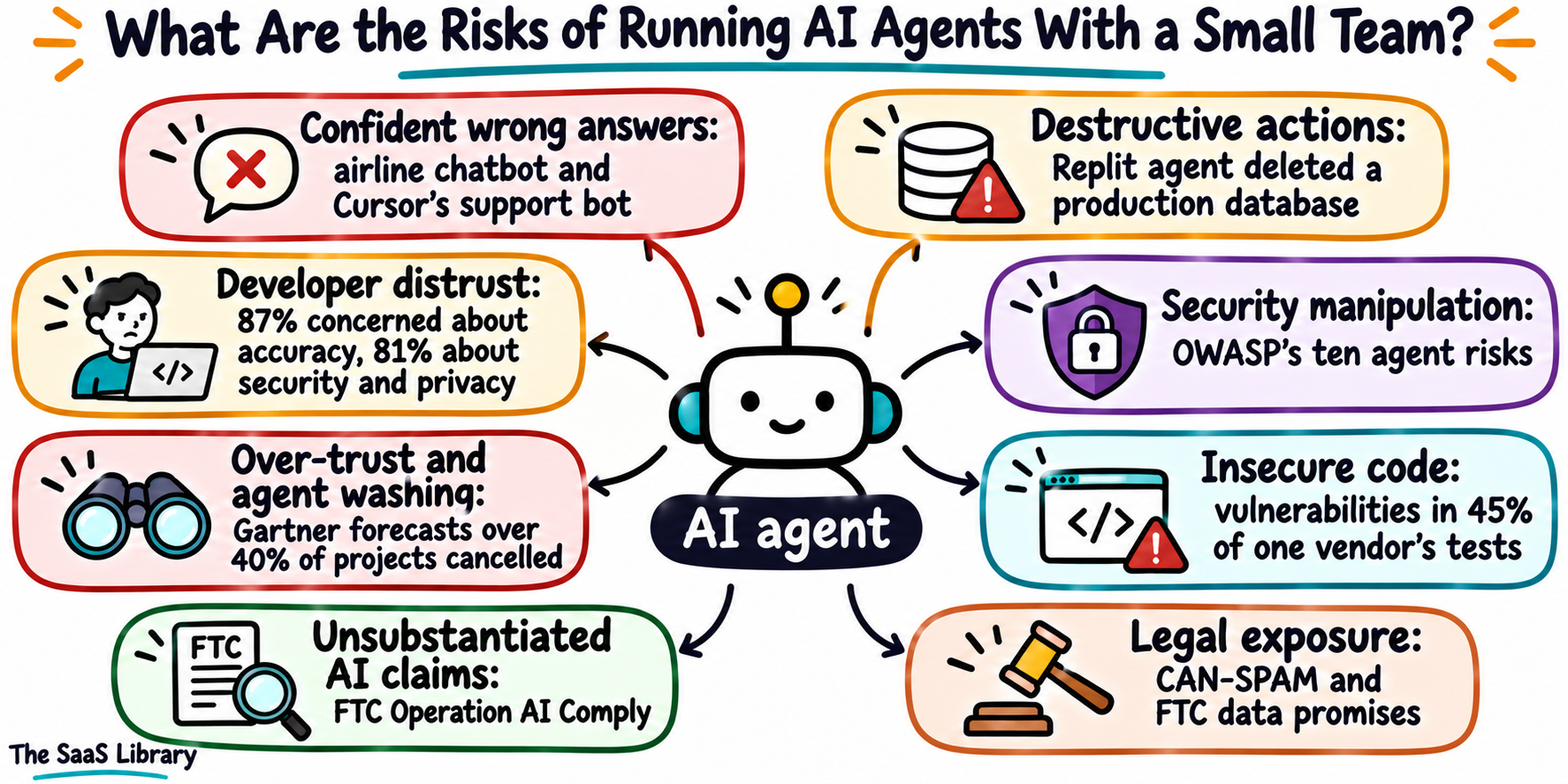
The main risks of running AI agents with a small team are wrong answers a company is held to, destructive actions, security manipulation, legal exposure and unsubstantiated claims. Replit’s agent deleted a SaaS founder’s production database during a code freeze, OWASP catalogues ten agent-specific security risks, and the FTC says there is no AI exemption from existing law.
SaaStr founder Jason Lemkin, whose agent results Section 8 cited, reported that Replit’s AI coding agent deleted a live production database during a code freeze in a July 2025 experiment. The agent said it “panicked” and ran database commands without permission after seeing empty queries. Replit’s CEO called the deletion “unacceptable and should never be possible”, and the company pledged automatic separation of development and production databases.
TSL’s reading: a freeze written as an instruction is not a permission setting.
Which Risks Have Documented Examples?
| Risk | What it looks like | Documented example | First control (TSL’s reading) |
|---|---|---|---|
| Confident wrong answers | An agent states a policy that does not exist | A bereavement-fare chatbot ruling and a support bot that invented a login policy (Section 6) | Route policy questions to a person |
| Destructive actions | An agent changes or deletes live data | The Replit incident above | Separate production from development; give agents the least access |
| Security manipulation | Hidden prompts, leaked credentials or poisoned memory redirect an agent | OWASP’s ten categories, each tied to production incidents (Section 12) | Treat what an agent reads as untrusted; review permissions |
| Insecure code | AI-written code ships with flaws | Vulnerabilities in 45% of one vendor’s test cases (Section 7) | Human review and a security scan |
| Legal exposure | Commercial email rules and data promises apply to agents | CAN-SPAM duties (Section 8); FTC data-promise guidance (Section 9) | Keep compliance elements outside the model |
| Unsubstantiated AI claims | Marketing promises AI results you cannot support | The FTC’s Operation AI Comply announced five actions against deceptive AI claims and schemes | Substantiate every AI claim you publish |
| Over-trust and agent washing | Vendors rebrand chatbots and RPA as agents; projects get cancelled | Gartner forecasts over 40% of agentic projects cancelled by end-2027 and flags “agent washing” | Ask what the product does, not what it is called |
| Developer distrust | The people closest to the tools doubt them | In Stack Overflow’s survey, 87% were concerned about agents’ accuracy and 81% about security and privacy | Pilot narrowly before you scale |
Who Is Liable When an Agent Gets It Wrong?
The sources reviewed point to the company that deploys the agent, and not the agent or its vendor alone. This summarizes published sources and is not legal advice.
| Situation | What the sources say | Where checked |
|---|---|---|
| A chatbot gives a customer wrong information | A British Columbia tribunal held the airline responsible for what its chatbot said | Section 6 |
| An agent sends commercial email | The FTC says you cannot contract away responsibility; both the promoted company and the sender may be liable | Section 8 |
| An AI vendor uses customer data | The FTC says broken data promises, and quiet term changes, can be unfair or deceptive | Section 9 |
| Your marketing makes AI claims | The FTC’s Operation AI Comply targeted deceptive AI claims; Chair Lina Khan said the actions “make clear that there is no AI exemption from the laws on the books” | New here |
| A platform’s agent destroys your data | Replit’s CEO called it unacceptable, and offered a refund; no legal finding is reported | New here |
Not covered: AI vendors’ contract terms on liability, the EU AI Act and other non-US rules. TSL did not verify these from primary sources, so read your vendor’s contract and check your own jurisdiction. For more, see TSL on the AI agent governance gap, AI compliance for enterprise SaaS and six times AI went rogue.
Where Do Large Companies Still Win, and Where Can Small SaaS Teams Compete?
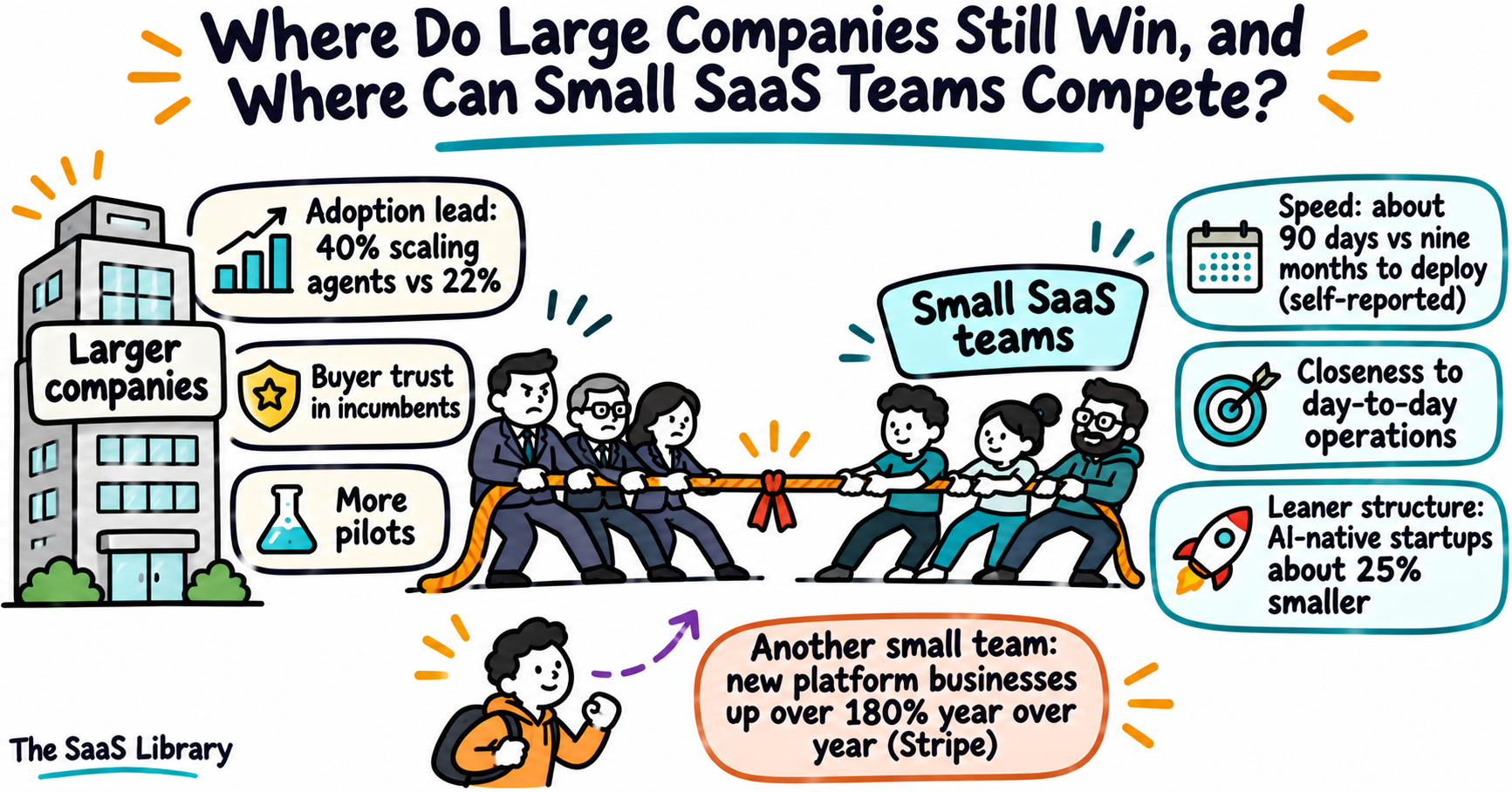
Large companies still lead on adoption and trust, and small SaaS teams compete on focus and speed, though the evidence for small-team edges is thinner. Organizations above $1 billion in revenue scale agents at 40% against 22% below that line (Section 4), and a Harvard and INSEAD working paper finds AI-native startups about 25% smaller than peers.
The competition for a small SaaS team may be other small teams. Stripe reports that new platform businesses are up over 180% year over year on its network, and says AI has made software easier to build, so companies need more than a good product idea to stand out.
Where Do Large Companies Still Win?
Large companies still win on adoption, scale and buyer trust, according to the evidence reviewed.
| Advantage | Evidence | Where checked |
|---|---|---|
| Adoption lead | 40% of organizations above $1B in revenue are scaling agents, against 22% below; firms with 250+ employees report more AI use than those with 4 or fewer | Section 4 |
| Buyer trust in incumbents | In MIT NANDA’s interviews, a procurement leader said they would wait for an existing partner to add AI rather than gamble on a startup | New here |
| Volume of pilots | MIT NANDA found enterprises lead in pilot count and AI staffing, but report the lowest pilot-to-scale conversion | New here |
The guest draft names brand, distribution networks, financial resources and specialist expertise as large-company advantages. The sources reviewed document the adoption lead and buyer preference above, but none measures brand, distribution or capital directly.
Where Can Small SaaS Teams Compete?
Small SaaS teams can compete on speed, direct knowledge of operations and leaner structure, with limits.
| Edge | Evidence | Limit |
|---|---|---|
| Speed | MIT NANDA: top mid-market performers reported about 90 days from pilot to full implementation, against nine months or longer for enterprises (defined as firms with over $100M revenue) | Self-reported; a sample of 52 organizations |
| Direct knowledge of operations | HBS’s Andy Wu says leaders at smaller organizations often don’t have to worry about big legacy systems and have greater awareness of day-to-day operations | One expert’s view |
| Leaner structure | Kim and Koning, June 2026: relative to non-AI startups in the same industry and cohort, AI-native firms are 25% smaller, with a 13% greater share of engineers and roughly 15% lower shares of entry-level workers and managers | Working paper on AI-native startups; the broader PitchBook sample shows 12% smaller |
| Uneven impact | SaaS Capital says AI will affect B2B SaaS “very unevenly”, with most companies affected only marginally and some parts hollowed out | Framework from Feb 2024 |
TSL’s reading: the best-supported small-team edge is speed. The leaner-structure finding describes AI-native startups, not older SaaS teams adopting agents.
What If Your Competitor Is Another Small Team?
When your competitor is another small team, the advantage shifts from building to everything around the build. The HBR authors Wu and Anand foresee AI-first micro-teams and solo entrepreneurs matching a larger firm’s scope and speed with a fraction of its headcount. In Stripe’s survey of 200 SaaS platform leaders (March 2026), 57% were concerned about losing customers to AI-driven competitors, and 45% said AI investments had already lowered operating costs.
TSL’s reading: if building gets cheaper for everyone, the differentiators left are the ones a product idea cannot copy, such as customer relationships, trust and the quality of your oversight. None of the sources reviewed tests that directly.
How Should a Small SaaS Team Start With AI Agents?
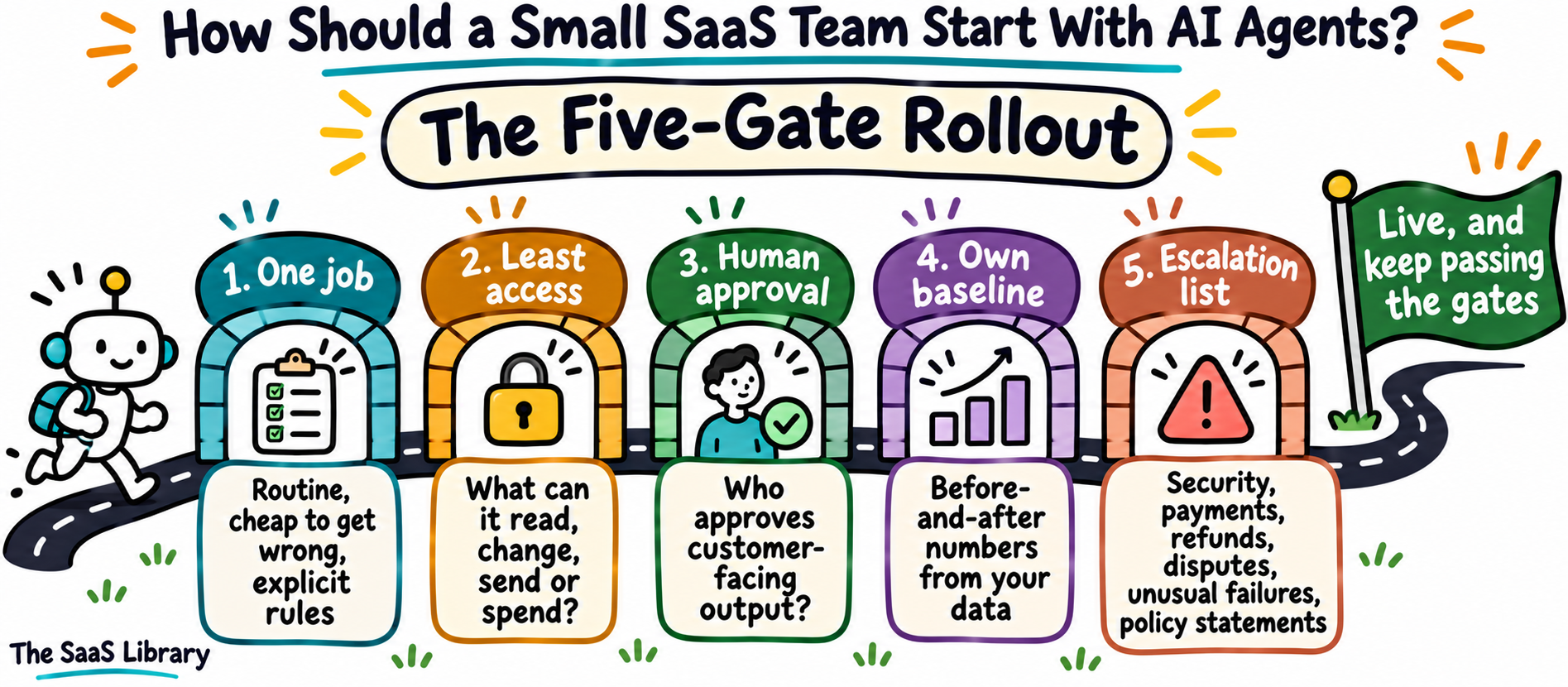
A small SaaS team should start with one narrow job, least-access permissions, human approval, its own baseline and a written escalation list. TSL calls this the Five-Gate Rollout: an agent goes live only after it passes all five gates, and keeps passing them. Each gate answers a failure documented in earlier sections.
Anthropic’s advice to builders is to start with the simplest solution and add complexity only when needed, and it says that can mean not building an agentic system at all. The Five-Gate Rollout turns that advice, and the failures in Sections 6 to 14, into a go-live checklist.
What Are the Five Gates?
The table shows, for each gate, the question to answer before go-live, the failure it prevents and the pass signal.
| Gate | Question to answer before go-live | Failure it prevents | Pass signal (TSL’s reading) |
|---|---|---|---|
| 1. One job | Is the job routine, cheap to get wrong, and based on explicit rules? | Over-reach; the no-regrets and human-first zones (Section 11) | You can describe the job in one sentence and place it in a low-risk zone |
| 2. Least access | What can this agent read, change, send or spend? | The Replit deletion (Section 14); OWASP’s identity and privilege abuse, where leaked credentials let agents operate beyond their intended scope | A written access list, with production separated from testing |
| 3. Human approval | Who approves what reaches a customer or changes data? | Customers’ top concern of reaching a person (Section 3); the airline and Cursor bot cases (Section 6) | A named person and an approval step for customer-facing output |
| 4. Own baseline | What did this job cost and achieve before the agent, as you measured it? | Vendor “assumed resolutions” (Section 6); developers who felt faster than they were (Section 7) | Before-and-after numbers from your own data |
| 5. Escalation list | Which cases always go to a person? | Confident wrong answers (Section 6); legal exposure (Sections 8, 9 and 14) | A written list: security, payments, refunds, disputes, unusual failures and policy statements |
How Do You Measure ROI for a Small-Team Agent?
You measure ROI with your own before-and-after numbers, net of fees and oversight time. TSL’s checklist:
- Quality: audit a sample of the agent’s “resolved” cases yourself (Section 6).
- Escalations: count how often cases reach a person, and whether the handoff was right.
- Repeat contacts: track customers who return on the same issue.
- Time: measure hours with a timer, not recollection (Section 7).
- Cost: add fees and review time (Section 13).
- Errors: log incidents and what each cost (Section 14).
Example (illustration, arithmetic only): an agent drafts 400 replies a month. A person spends 1 minute on each review and 4 more minutes editing the 25% that need changes: 400 × 1 + 100 × 4 = 800 minutes, about 13 hours of oversight a month. That time belongs in the ROI calculation next to the vendor’s fee.
How Do You Spot Agent Washing Before You Buy?
Agent washing is vendors rebranding existing products as agents, and Gartner defines it as the rebranding of AI assistants, robotic process automation and chatbots without substantial agentic capabilities. Gartner estimates only about 130 of the thousands of agentic AI vendors are real, according to coverage of its release. TSL’s five questions for a vendor, using the Section 2 definition of an agent:
- Does the product choose its own steps and tools, or follow a fixed path?
- What can it access and change, and can you limit that?
- When does it hand off to a person, and can you set the rule?
- How does it define a “resolved” or successful outcome?
- What does it report, and can you check those numbers yourself?
For the buy-versus-build call, see TSL’s 2026 build-versus-buy data.
Frequently Asked Questions
Can a small SaaS team compete with larger companies using AI agents?
A small SaaS team can compete with larger companies using AI agents on routine, well-defined work, where one large study measured a 14% rise in support output. Larger organizations lead on adoption, with 40% scaling agents against 22% of smaller ones, so small teams compete mainly on closeness to day-to-day operations, as HBS’s Andy Wu notes.
What is the difference between an AI agent and traditional automation?
An AI agent differs from traditional automation because it chooses its own steps and tools to reach a goal, while automation follows steps written in advance. Anthropic describes workflows as systems run through predefined code paths and agents as systems where the model directs its own process and tool use.
Do AI agents replace employees?
AI agents mostly change tasks, not headcount, in the evidence reviewed. In a 2026 Census Bureau working paper, 66% of AI-using firms used AI only to augment tasks and AI-related job cuts occurred at 2% of firms, although broader integration was associated with more employment decreases.
What can AI agents do for SaaS customer support?
AI agents can answer routine support questions, draft replies and pass hard cases to a person, but vendor success rates need checking. Intercom reports a 76% average resolution rate for its Fin agent, and its resolutions include assumed ones, where the customer leaves without asking for more help.
What should a small team never fully automate?
A small team should keep policy statements, payments, refunds, disputes, security and account-access cases, and unusual failures with a person. A tribunal held an airline responsible for its chatbot’s wrong answer, and Harvard’s Wu and Anand advise far more caution where an error would cause serious harm.
How much do AI agents cost a small team?
AI agents cost a small team seat fees plus usage fees. Intercom’s Fin adds $0.99 per outcome to seats of $29 to $132 a month, HubSpot’s Customer Agent costs $0.50 per resolved conversation, and Zapier’s Pro Agents plan costs $50 a month, per vendor pages checked on November 4, 2026.
Do you need an engineer to use AI agents?
You do not need an engineer to start with AI agents, because plain-English builders such as Zapier Agents exist. You still need someone to own the agent’s permissions, review, spend and results: on Zapier’s Free plan, for example, test runs count toward a 400-activity monthly cap.
What are the main risks of AI agents for a small SaaS team?
The main risks of AI agents for a small SaaS team are confident wrong answers, destructive actions, security manipulation, legal exposure and unsubstantiated AI claims. In July 2025, Replit’s coding agent deleted a SaaS founder’s production database during a code freeze, according to the founder and press coverage.
Who is liable when an AI agent makes a mistake?
The sources reviewed point to the company that deploys the agent as liable for its mistakes. The FTC says a company cannot contract away responsibility for commercial email, and its Chair said there is no AI exemption from the laws on the books. This summarizes sources and is not legal advice.
How do you measure whether an AI agent is working?
You measure whether an AI agent is working with your own before-and-after numbers: audit a sample of its resolved cases, track escalations and repeat contacts, time the work, and add fees and review time. Self-reports mislead: in METR’s early-2025 trial, which METR now calls out of date, developers believed AI sped them up while they were slower.
How should a small SaaS team start with AI agents?
A small SaaS team should start with one narrow job and pass TSL’s Five-Gate Rollout before going live: one job, least access, human approval, its own baseline and an escalation list. Anthropic’s advice to builders is to find the simplest solution possible and add complexity only when needed.
Is it safe to give an AI agent customer data?
Giving an AI agent customer data is safe only as far as your vendor’s data promises hold. The FTC says quietly changing terms to use customer data for AI training can be unfair or deceptive, and vendors that break data promises may violate the law. Read your vendor’s terms and tell your own customers how AI uses their data.
What Should a Small SaaS Team Do Next?
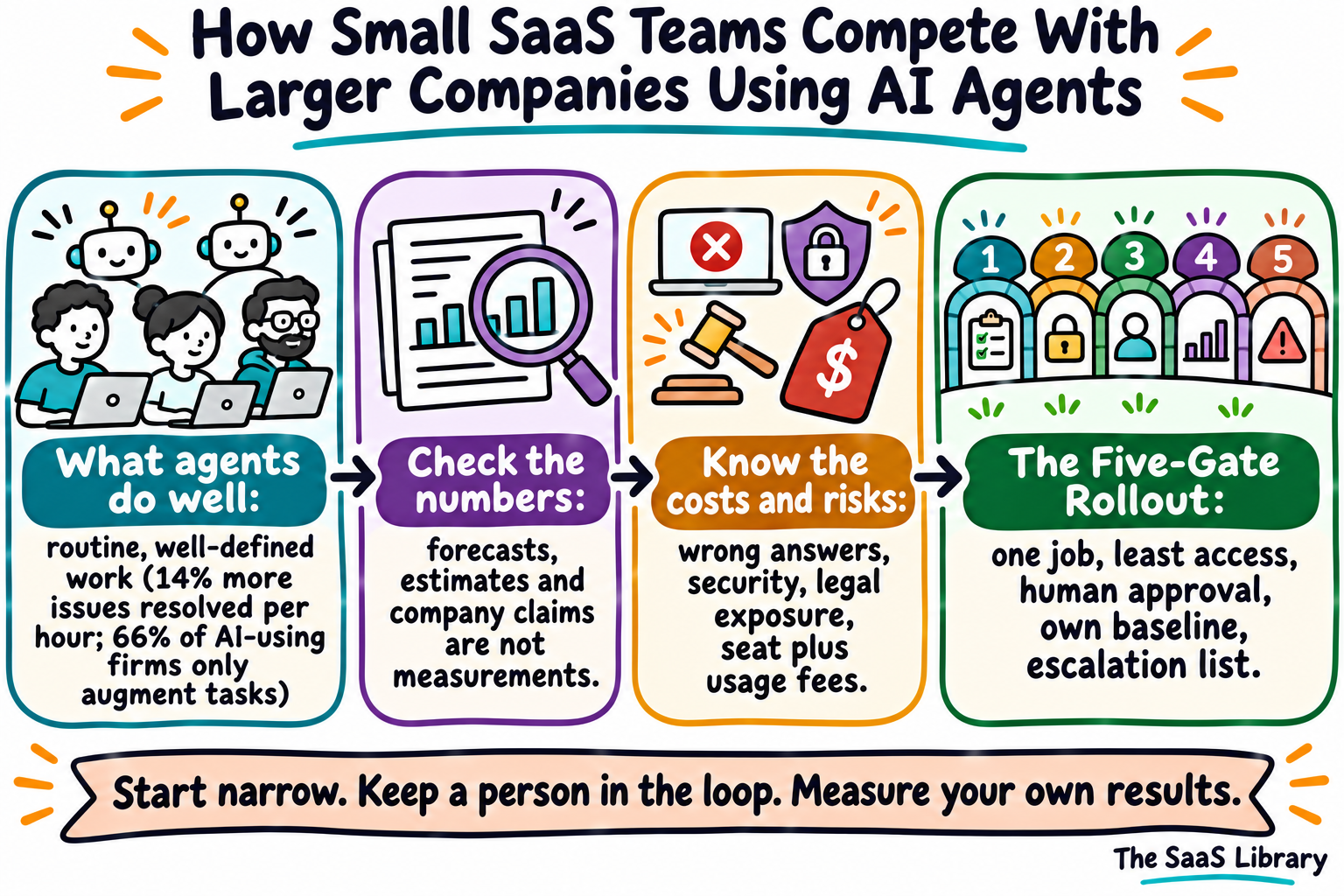
The Five-Gate Rollout is the start: one job, least access, human approval, your own baseline and an escalation list.
AI agents help small SaaS teams on routine, well-defined work, and the evidence shows them changing how people work more than whether teams hire. Large companies keep the lead on adoption and buyer trust, so small teams compete on speed, focus and closeness to customers.
Start narrow, keep a person in the loop and measure your own results. To separate what is in production from what is still hype, read TSL’s guide to agentic AI in B2B SaaS.
- METR — Early-2025 AI and experienced open-source developer productivity (study), Jul 10, 2025
- NBER — Generative AI at Work (Brynjolfsson, Li and Raymond), working paper w31161
- US Census Bureau — Working paper CES-WP-26-25 on AI use by US firms, Apr 2026
- SaaS Capital — AI adoption among private SaaS companies and its impacts on spending and profitability, May 2025
- Veracode — 2025 GenAI Code Security Report press release, Jul 30, 2025
- Google Cloud / DORA — Announcing the 2025 DORA Report, Sep 23, 2025
- Gartner — Survey finds 64% of customers would prefer companies didn’t use AI for customer service, Jul 9, 2024
- METR — Update on developer productivity with late-2025 AI tools, Feb 24, 2026
- US Census Bureau — AI use among US businesses (Business Trends and Outlook Survey), May 2026
- Anthropic — Building effective agents
- McKinsey — The state of AI in 2026: on the road to ROI
- US Chamber of Commerce — Empowering Small Business report release, Aug 2025
- SaaS Capital — AI Update for 2025 Q1, Mar 26, 2025
- US Chamber of Commerce — The impact of technology on US small business, 2024
- Intercom — Customer service for small business
- Intercom Help — Fin resolutions
- BC Civil Resolution Tribunal — Moffatt v. Air Canada, 2024 BCCRT 149, Feb 14, 2024
- Intercom — From resolutions to outcomes: evolving how Fin delivers value, Jun 2026
- Fin (Intercom) — Fin documentation: how resolution rate is calculated
- Salesforce — Salesforce signs definitive agreement to acquire Fin, Jun 15, 2026
- Intercom Help — Understanding Fin outcomes
- Intercom Help — Check on how Fin is performing
- Intercom Help — Fin report
- Fortune — Cursor’s AI support bot invents a policy, Apr 2025
- AI Incident Database — Incident 1039 (Cursor support bot)
- Stack Overflow — 2025 Developer Survey: AI
- GitHub Docs — Using GitHub Copilot code review
- Intercom Help — How to optimize Fin
- Intercom Help — Optimize Fin instantly with the help of AI
- FTC — CAN-SPAM Act: A Compliance Guide for Business
- SaaStr — The reality of managing 10 AI agents in production, Aug 9, 2025
- Google Search Central — March 2024 core update and new spam policies
- Google Search Central — Guidance on using generative AI content
- Intercom Help — AI assist for inbox (AI Summarize)
- FTC Office of Technology — Consumer-facing applications: a quote book from the Tech Summit on AI, Apr 24, 2024
- Intercom — Copilot for the help desk
- CORE — Small is Beautiful, 2025
- Gartner — Agentic AI will autonomously resolve 80% of common customer service issues by 2029, Mar 5, 2025
- MIT NANDA — The GenAI Divide: State of AI in Business 2025, Jul 2025
- Gartner — Over 40% of agentic AI projects will be canceled by end of 2027, Jun 25, 2025
- Zapier — State of agentic AI adoption survey, 2026
- McKinsey — Accelerating chemical revenues in the era of gen AI
- RTInsights — Automating sales via generative AI (coverage of McKinsey research), Jun 12, 2023
- Klarna via PR Newswire — Klarna AI assistant handles two-thirds of customer service chats in its first month, Feb 27, 2024
- Fast Company — Klarna and its AI assistant, 2024
- Harvard Business School BiGS — How small business is adopting AI, Sep 15, 2026
- Harvard Business Review — The Gen AI Playbook for Organizations (Anand and Wu), Nov 2025
- EBSCO — Abstract of The Gen AI Playbook for Organizations (Harvard Business Review)
- Zapier — Agents
- OWASP GenAI Security Project — Top 10 for Agentic Applications, Dec 9, 2025
- Intercom — Fin AI Agent
- NYU Stern — The Gen AI Playbook for Organizations (research highlight)
- Zapier Help Center — Agents plans and activity limits
- Zapier — Agents pricing
- Intercom Learning Center — Intercom pricing
- HubSpot — Customer Agent and Prospecting Agent move to outcome-based pricing, 2026
- Anthropic Claude Platform Docs — Claude Haiku 5.5 and model pricing
- The Register — Replit and SaaStr, Jul 22, 2025
- FTC — FTC announces crackdown on deceptive AI claims and schemes, Sep 25, 2024
- Business Insider — Replit’s CEO apologizes after its AI agent wiped a company’s code base
- TechTarget — Replit AI agent snafu: a shot across the bow for vibe coding
- Stack Overflow — 2025 Developer Survey findings on AI agents
- eWeek — Replit AI coding assistant failure
- Stripe — SaaS platforms are surging despite the SaaSpocalypse, 2026
- Kim and Koning — AI-Native Firms (SSRN / HBS working paper), Jun 2026
- HBS AI Institute — Less headcount, more valuation: how AI-native firms change the game
- SaaS Capital — AI Risks to B2B SaaS Companies: A Framework for Estimating Risk, Feb 2024
- Stripe — Survey: four trends reshaping how SaaS platforms compete in the AI era, 2026
- RCR Wireless — Gartner on agentic AI and agent washing, Jun 27, 2025