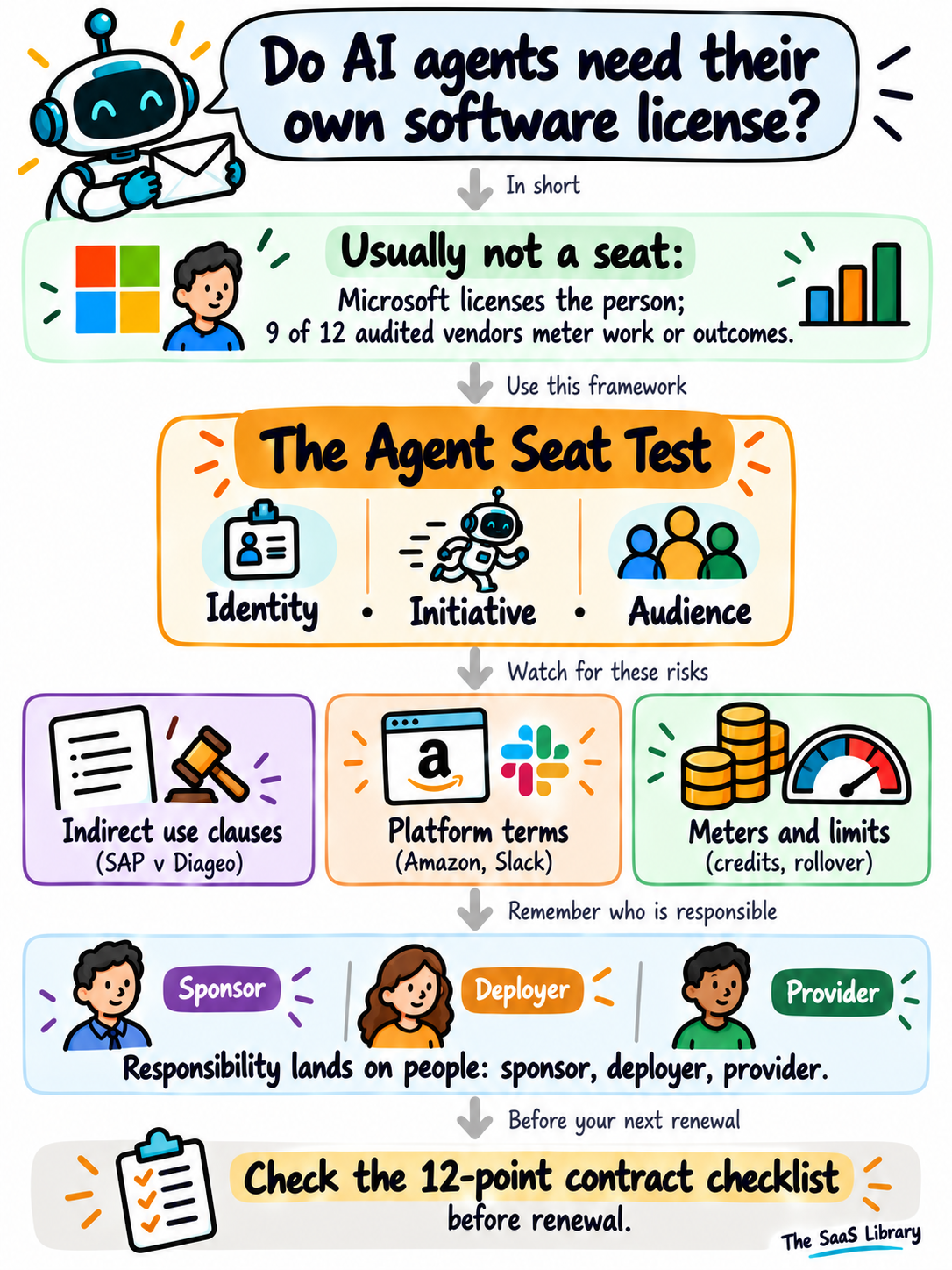
Microsoft’s licensing FAQ says AI agents do not require their own licenses, yet on October 8, 2026 Google announced coworker agents with their own email addresses. This guide shows who pays, who is liable, and what to check once an agent becomes a user.
On October 8, 2026, Google announced a Gemini agent that can create coworker agents with their own email address. Microsoft’s Agent 365 FAQ says agents do not require their own licenses. So an AI agent needs no Agent 365 license of its own: Microsoft licenses the person tied to it.
Several vendors bill the work agents do; contract clauses can still create compliance exposure. Next: who pays for an AI agent’s software license, who is liable, what to check.
Do AI agents need their own software license?
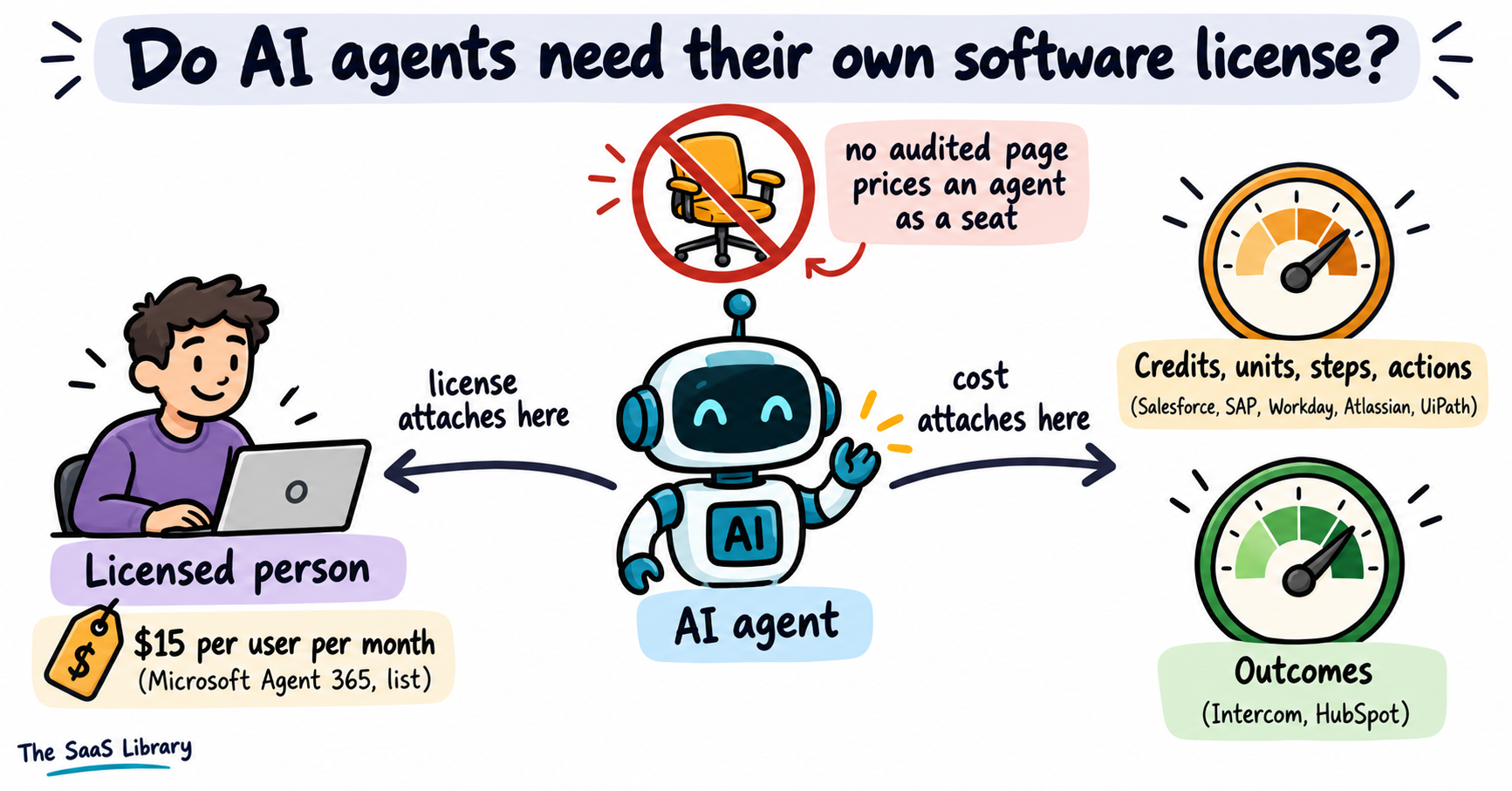
AI agents do not need their own Agent 365 license, and UiPath’s docs say an agent consumes no unattended-robot license; Microsoft licenses the person tied to the agent. UiPath, Atlassian, Intercom, SAP and Workday meter agent work in units, credits, outcomes, steps or actions. An agent with its own Microsoft mailbox needs the appropriate licenses for that account.
The bill did not disappear. It moved to a person, or to a meter: a counter that charges for agent work in credits, outcomes, steps or units.
| Vendor | Billing unit for agent activity | Verified detail | Source |
|---|---|---|---|
| Microsoft Agent 365 | Per human user | $15 per user per month standalone; $99 inside Microsoft 365 E7; agents not licensed separately; no consumption-based cost for Agent 365 yet | Microsoft Licensing FAQ |
| UiPath | Agent Units (Flex) or Platform Units (Unified Pricing) | Production agent runs consume units; a standard-model call costs 1 Agent Unit on Flex; the agent does not consume an unattended-robot license | UiPath Docs |
| Atlassian Rovo | Rovo credits | Basic Rovo agents use 10 credits per invocation; most meters bill from December 3, 2026 | Atlassian |
| Intercom Fin | Outcomes | $0.99 per Fin outcome; no seats required on an existing helpdesk | Intercom pricing |
| Workday | Flex Credits | Metered when an agent completes an action, not per query or token | Workday blog, Tim Garippa, July 30, 2026 |
| SAP Joule | AI Units per agent step, plus per-user packages | Basic 0.005, Standard 0.01, Advanced 0.025 AI Units per step in consumption scenarios | SAP Learning |
Microsoft anchors the cost to a human. The other five count what the agent does, and Intercom and SAP also charge per-user fees for their human users.
Example (illustrative arithmetic from Microsoft’s list prices, not a quote).
A team has 100 licensed users on standalone Agent 365. At list price that is 100 × $15 = $1,500 per month, whether those users sponsor 5 agents or 500. Microsoft says one license covers all agents tied to a user, with no fixed cap on how many agents one licensed user can oversee.
Two limits apply. Microsoft requires prerequisite licenses such as Microsoft 365 E5, and standard usage limits may apply. Runtime is separate: Windows 365 for Agents costs $0.40 per VM per hour.
License rules still apply. Microsoft’s FAQ states two consequences:
- An agent tied to an unlicensed user is out of compliance, and its activity gets no Agent 365 protections.
- Pooling services to reduce the number of required licenses is not permitted.
So the test shifts from whether an agent needs a license to which person the vendor counts.
What does “AI agent license” mean?
“AI agent license” means three different things, depending on who asks. This guide covers the first.
| Meaning | Question it answers | What governs it | Source |
|---|---|---|---|
| Seat or usage license | Who pays a vendor when an agent uses its software? | The customer’s agreement, which Microsoft’s FAQ says controls over the FAQ | Microsoft Licensing FAQ |
| Open-source license | What may you do with the code an agent is built from? | The license’s distribution terms, which must meet criteria such as free redistribution and permission for derived works | Open Source Definition |
| Output ownership | Who can claim copyright in what an agent produces? | Copyright law; outputs are protected only where a human author determined sufficient expressive elements | US Copyright Office, Jan 29, 2025 |
Google describes its agent as one that can work autonomously to complete objectives you assign it. For the difference between that kind of agent and a chatbot, see TSL’s guide to AI agents versus chatbots.
For how “open” AI models differ from open-source software, see TSL’s explainer on open weights versus open source.
That rule meets a harder case when an agent gets its own mailbox, which Google’s coworker agents are designed to have.
What happens the day your AI agent gets its own email address?
The day an AI agent gets its own email address, it becomes a separate identity that administrators can restrict, audit and, at Microsoft, license. Google’s coworker agent gets its own Workspace account and acts under its own identity. Microsoft’s agent user account can hold licenses and a mailbox, but only for tenants in the Frontier preview program.
The mailbox is where licensing enters. Microsoft’s documentation gives an agent two accounts, and only the second one holds a mailbox.
| Agent identity | Agent’s user account | |
|---|---|---|
| What it is | The account an individual agent runs as | An optional second account |
| What it holds | Own object ID, display name, sponsor, permissions | Mailbox, OneDrive storage, directory profile, Teams presence, with appropriate licenses |
| When to add it | Created for the agent | Only when the agent needs a mailbox, Teams presence or directory profile |
| License angle | Agent identity is a foundational Agent 365 capability at no additional cost | Can hold licenses; the page doesn’t name them |
| Availability | Not stated on the page | Frontier preview tenants only (page dated Aug 13, 2026) |
Microsoft also says agents that only emit telemetry and call tools usually do not need a user account. The page was updated August 13, 2026, so preview status may have changed since. For which agent features run in production today, see TSL’s guide to agentic AI in B2B SaaS.
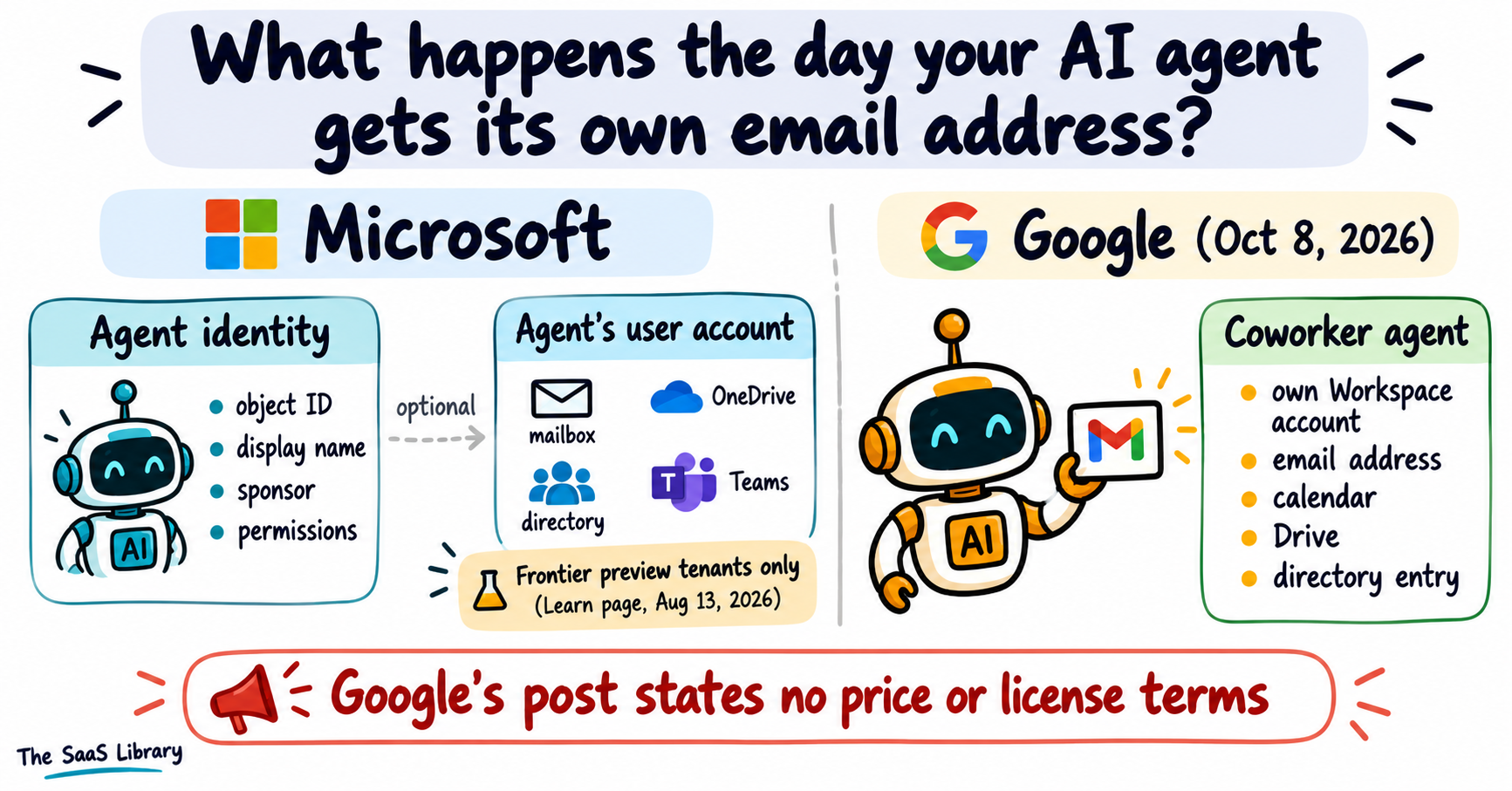
| What the agent gets | Google coworker agent | Microsoft agent user account |
|---|---|---|
| Own @agents.company.com address | Own mailbox, with the appropriate licenses | |
| Directory | Own listing in the company directory | Appears in directory and organizational metadata |
| How people reach it | Added to a Chat space, @mentioned, or tagged in a document comment | Teams, Outlook, Word comments and email |
| Who it acts as | Its own identity, not the user’s | Its own account (Agentic-User mode) |
| License terms stated | The Gemini at Work post gives no price or license terms | Account can hold licenses; Agent 365 is licensed per person tied to the agent |
| Availability stated | Not stated in the post | Frontier preview tenants only (page dated Aug 13, 2026) |
Example.
In Google’s own illustration, a user describes a role such as events coordinator and Gemini creates the agent. Colleagues add it to a Chat space or @mention it.
When it edits a Doc, it appears under its own name in version history. That is what an agent identity means in practice: the work shows up under the agent’s name, so a person can tell what the agent did.
Google frames governance as four checks: who the agent is, what it may do, what it did, and what it must never touch. It says each agent’s identity is cryptographically attested, carries least-privilege permissions, and every action goes to an audit trail attributed to the agent rather than a person. Spend caps work differently: Google sets them per project, not per agent identity.
Why does an agent’s identity matter for licensing?
An agent’s identity matters for licensing because it creates a sponsor, and Microsoft’s licensing attaches to the people tied to the agent.
- Identity: each agent identity requires at least one sponsor, the business representative accountable for the agent. A sponsor can be a user or a group.
- License: Microsoft’s FAQ says the owner, sponsor or manager of an agent with its own access needs an Agent 365 license. Users who delegate their access to agents need one too.
- Reason: Microsoft says Agent 365 is licensed per user because every agent is associated with a person in some capacity.
So the identity gives the vendor a person to count. The mailbox adds a second question: which licenses the agent’s own account needs, which Microsoft’s identity page does not name.
Microsoft had already described that scenario in public by December 2025.
Why did Microsoft call AI agents “seat opportunities”?
Microsoft, through then-EVP Rajesh Jha, called AI agents “seat opportunities” because he expects future organizations to have more agents than people, many with an identity, an address-book entry and a mailbox. He describes Microsoft 365 as a price-times-quantity business built around users, so an agent that acts like a user is a candidate seat.
The remark was a rebuttal. Karl Keirstead of UBS, who covers Microsoft, noted that investors in SaaS businesses worry about headcount cuts and asked Jha to comment on AI-induced seat pressure. Jha replied that he was not seeing AI drive Microsoft 365 seats down, and that AI was, if anything, an opportunity to drive seat growth.
What did Jha say AI agents would need?
Jha said AI agents would need seven things to work like users:
- an identity
- an entry in the address book
- a mailbox
- a computer to do their computation securely
- a way for colleagues to mention them
- a way to chat with colleagues
- a place in meetings
That list matches what Google’s coworker agent shipped on October 8: its own account and mailbox, a directory entry, and @mentions in Chat.
Jha also pointed to the far end of the agent range: digital workers that show up in the org chart, meeting rosters and channels. He called that the most immature end, and said 2026 would start to see it.
Why do seats matter to Microsoft 365?
Seats matter to Microsoft 365 because growth now comes mostly from revenue per user, not new enterprise seats.
| Metric | What Jha said (paraphrased) |
|---|---|
| Paid subscribers | Upwards of 400 million |
| Biggest driver of revenue-per-user growth | Microsoft 365 E5 |
| Second-biggest driver | Copilot |
| Where seat growth comes from | Small and medium-sized businesses and first-line workers, mostly at lower revenue per user |
| Enterprise seat growth | Jha calls Microsoft mature there |
So Microsoft 365 growth now leans mostly on revenue per user, and agents are the source of seat growth Jha pointed to.
Example (illustrative arithmetic, not a Microsoft price).
A company with 100 employees holds 100 seats. If it deploys 100 agents and each counted as a seat, its seat count would double without a single new hire. That is the logic of Jha’s remark.
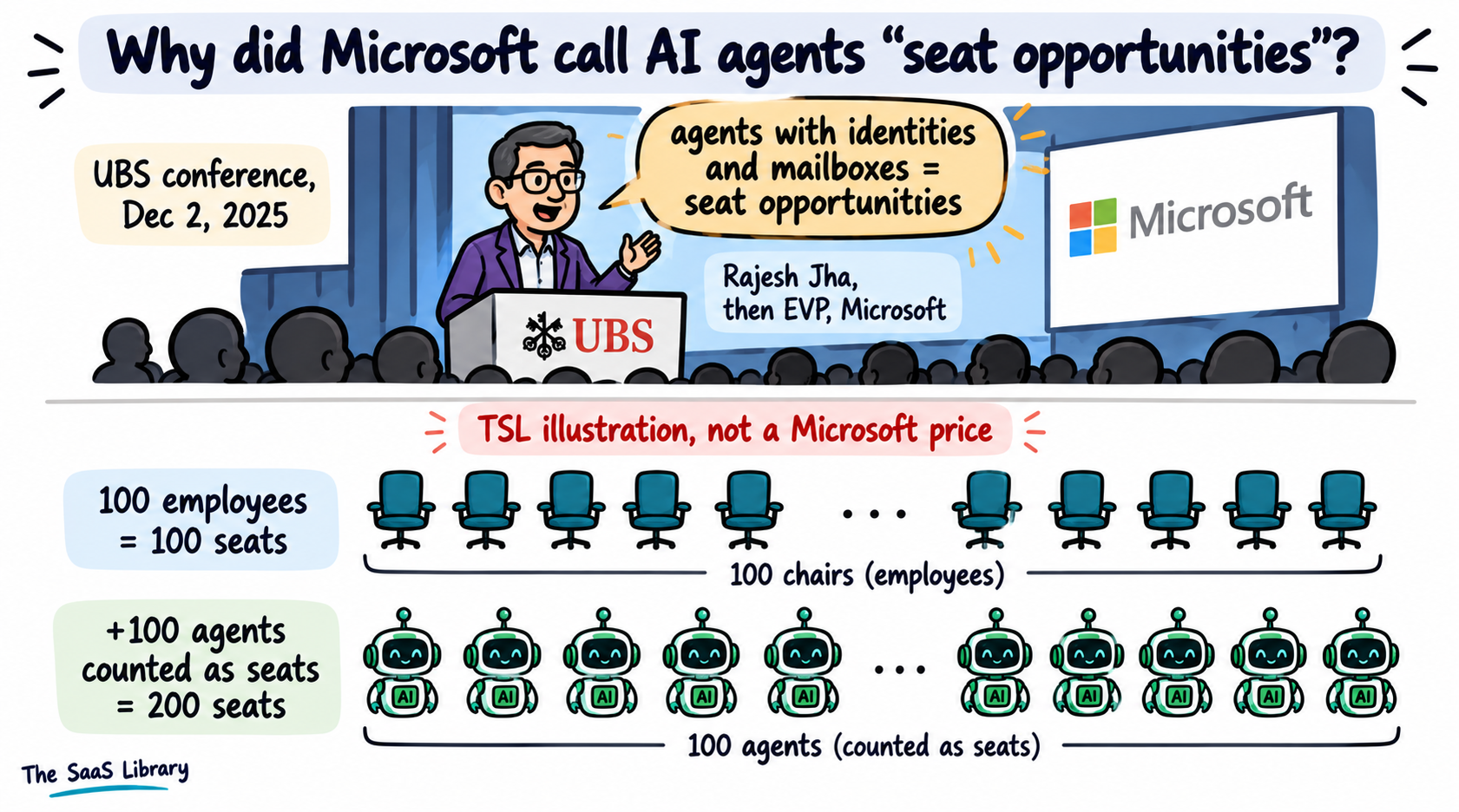
Treat it as a forecast. It came in a conference Q&A, and the transcript contains no pricing announcement. On March 12, 2026, Jha told Microsoft staff he would retire, transition out on July 1 and stay in an advisory role.
The product Microsoft shipped answers differently: its licensing FAQ lists no per-agent charge.
Did Microsoft actually make agents buy a seat?
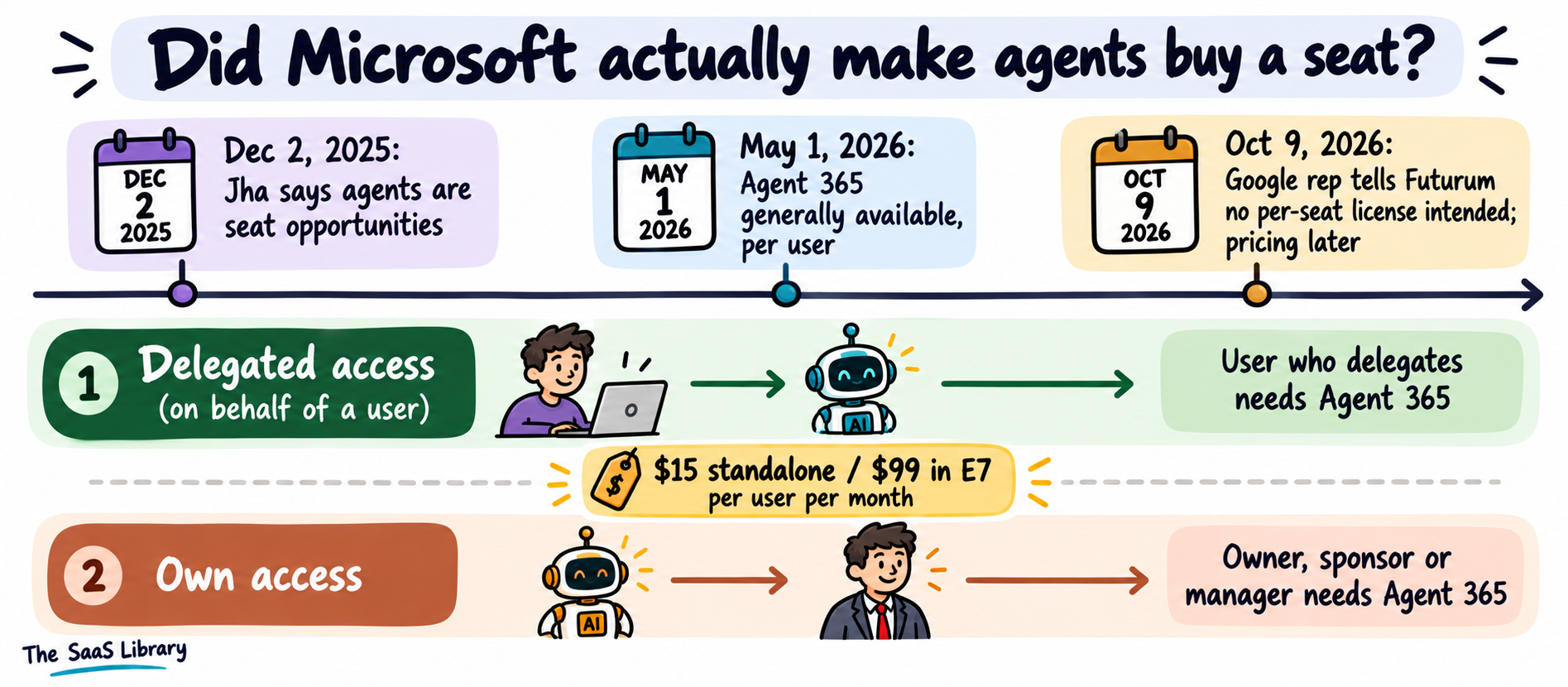
Microsoft did not make agents buy a seat. Agent 365 has been generally available to commercial customers since May 1, 2026 and is licensed per user, at $15 list standalone or $99 inside Microsoft 365 E7. Microsoft’s licensing FAQ says agents do not require their own licenses and adds no per-agent or per-instance charge.
Microsoft shipped the opposite of a per-agent price. Jha’s December remark predicted agents as seats, and the product that followed licenses the people attached to them.
| Date | Who | What was said or shipped | Source |
|---|---|---|---|
| Dec 2, 2025 | Rajesh Jha, Microsoft | Described agents with identities and mailboxes as seat opportunities | Microsoft IR transcript |
| May 1, 2026 | Microsoft | Agent 365 generally available for commercial customers, per user | Microsoft Learn |
| Oct 9, 2026 (reported) | Google, via Futurum | A representative said Google does not intend a per-seat license for coworker agents; pricing details later | Futurum |
So a company pays for the people attached to its agents, not for the agents themselves. This covers the Agent 365 license only; the mailbox account from the previous section is a separate matter.
Who needs an Agent 365 license?
Two groups of people need an Agent 365 license, depending on how the agent gets access. Microsoft’s FAQ splits it by access flow:
| Access flow | What it means | Who needs the license |
|---|---|---|
| Delegated access (on-behalf-of) | The agent acts for a signed-in user | The user who delegates access |
| Own access (non-on-behalf-of) | The agent acts under its own identity | The owner, sponsor or manager of the agent |
Microsoft’s Learn page gives the plain-language test: nightly background processing usually runs as the agent itself, while a user-specific action in chat runs on behalf of the user. The FAQ names an agent called AskHR as its example of an own-access agent.
Why does Google’s answer look similar?
Google’s answer looks similar because a Google representative told Futurum the company does not intend to charge a per-seat license for coworker agents in Workspace. It said pricing details would come closer to wider availability. That is a statement of intent: Futurum notes Google did not disclose pricing or availability dates for most announcements.
Both vendors have left the meter open. Microsoft’s FAQ says Agent 365 has no consumption-based costs “yet,” and Google has said only that it will share pricing later.
See how agents are breaking the per-seat model beyond Microsoft.
Read the per-seat pricing analysis →If no agent buys a seat, the next question is which agent counts as its own user, and Microsoft’s own documents already draw that line.
Is your AI agent an extension of you, or its own user?
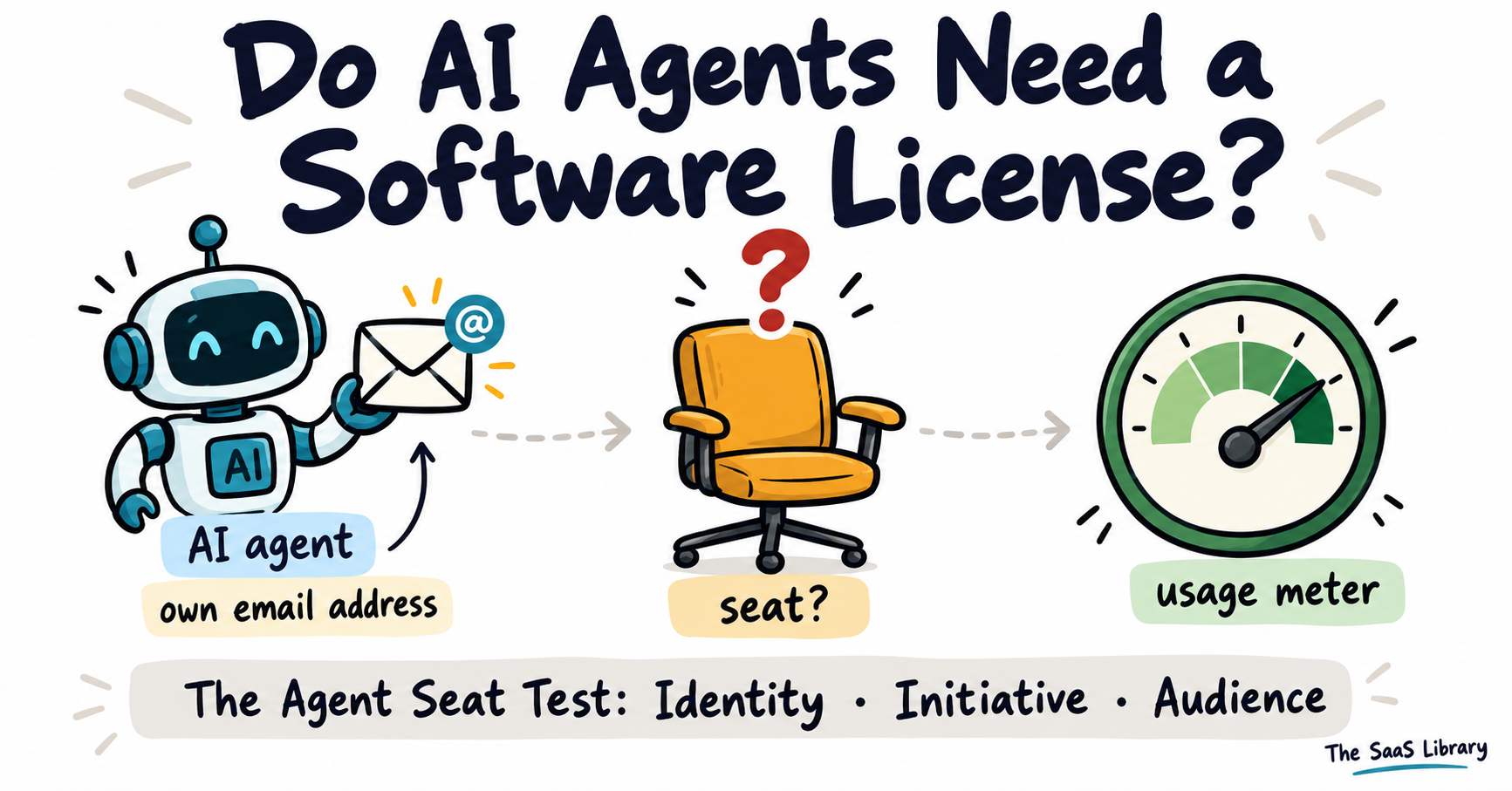
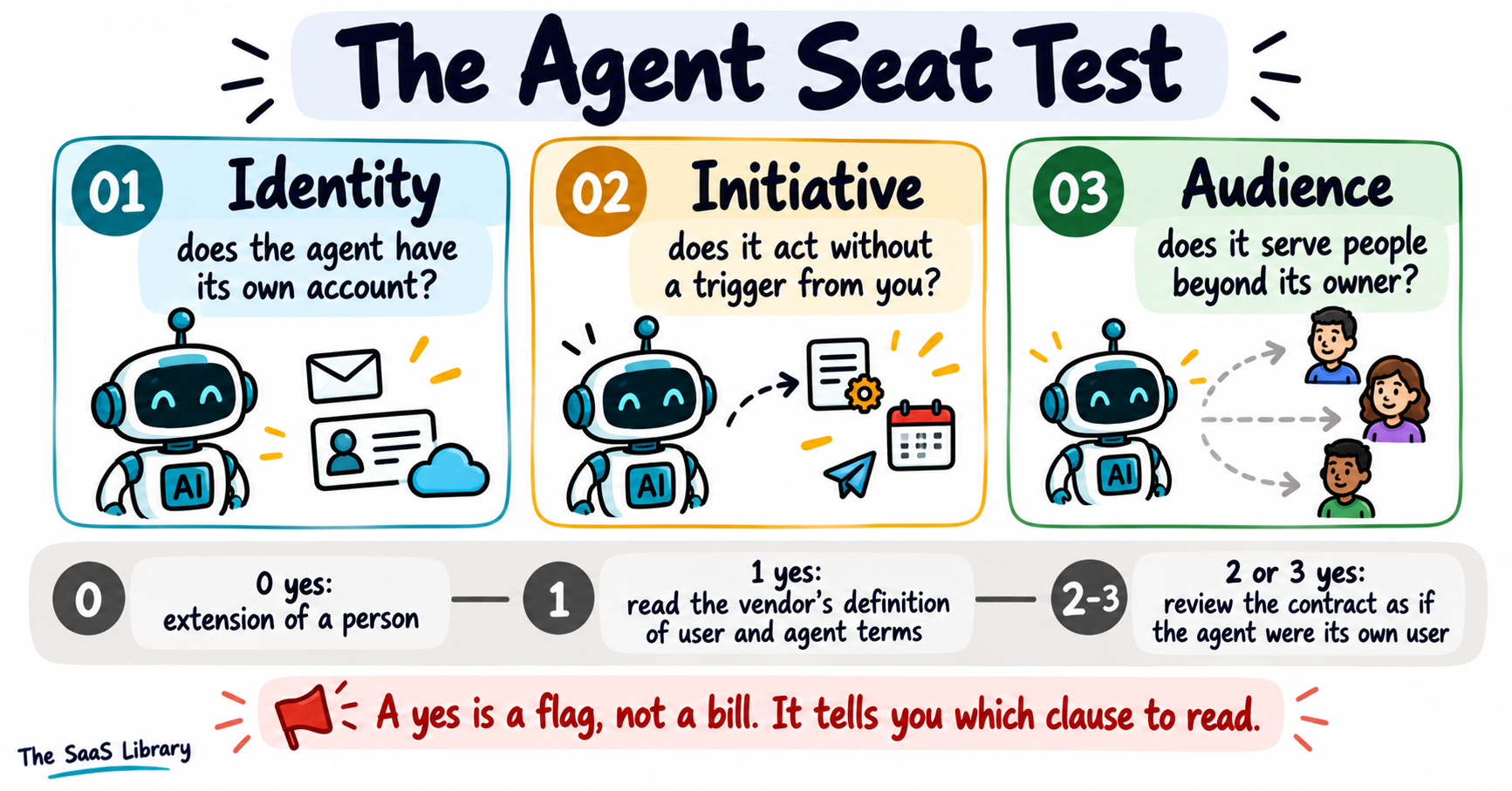
Your AI agent is an extension of you when it acts only on your request, with your permissions, for you alone. It is its own user when it has its own identity, acts without a trigger from you, or serves people beyond you. The Agent Seat Test checks those three: identity, initiative and audience.
Lawyers at Proskauer say asking only whether an agent is a “user” collapses several questions: whether the agent may access the software, whose authority and permissions it uses, on whose behalf it acts, and how its activity is measured and priced.
The same lawyers list four ways a contract could treat an agent:
- an extension of a human user
- a separate licensed or authorized user
- a machine process
- a source of metered consumption
They add that the market is experimenting with different approaches, not converging on one. The vendor table in section 1 shows that split in practice: Microsoft anchors the license to a person, while Atlassian, Intercom, SAP, UiPath and Workday count the work.
What is the Agent Seat Test?
The Agent Seat Test is TSL’s three-question check for which clause of your contract to read for each agent. It is TSL’s framework, built from distinctions that Microsoft, Google, UiPath and Proskauer document. It is not a vendor rule.
The Agent Seat Test turns “is the agent a user?” into three questions you can answer for each agent in one line each.
A yes does not mean you owe a license. It tells you which clause to read. Run the test on each agent before a renewal, and save the three one-line answers with the contract.
How to read it (TSL rule of thumb):
- 0 yes: treat the agent as an extension of a person, and confirm that person is licensed.
- 1 yes: read the vendor’s definition of “user” and its agent terms.
- 2 or 3 yes: review the contract as if the agent were its own user. Find its sponsor, the license behind its account, and the meter.
| Test | Extension of a person | Own user |
|---|---|---|
| Identity | Runs as a signed-in person (Microsoft’s on-behalf-of mode) | Runs as its own agent identity or user account |
| Initiative | A person triggers each action, such as a chat request | Acts on schedules, events or background processing |
| Audience | Serves the person who owns it | Also serves colleagues, affiliates or customers |
| Microsoft Agent 365 license | The user who delegates access | The owner, sponsor or manager of the agent |
| Example | Identity | Initiative | Audience | Reading |
|---|---|---|---|---|
| A user-specific action in chat (Microsoft’s on-behalf-of example) | No | No | The signed-in user | Extension; under Agent 365 the delegating user needs the license |
| Nightly background processing (Microsoft’s service-to-service example) | Yes | Yes | Depends on who uses the output | Own access; the owner, sponsor or manager needs Agent 365 |
| Reading an agent’s own mailbox (Microsoft’s agentic-user example) | Yes | Depends | Depends | Own account; the account can hold licenses |
| A Google coworker agent added to a team Chat space | Yes | Depends | A team | Own identity; Google’s post gives no license terms |
Why does the test ask three questions instead of one?
The test asks three questions because “is the agent a user?” hides three separate contract issues. Proskauer’s list of open questions maps onto them (TSL’s mapping, paraphrased):
| Lawyers’ question (Proskauer, Aug 24, 2026) | Test question |
|---|---|
| Does the agent authenticate under its own provisioned identity, or act on authority delegated by a licensed user? | Identity |
| Is unattended or autonomous access treated differently from human-interactive use? | Initiative |
| Can the agent use the software for multiple employees, affiliates, customers or business units? | Audience |
The fourth issue Proskauer raises, how activity is measured and priced, is where the test points you next: the meter.
Vendors answer these three questions differently, and their own pages show how.
How do other vendors license AI agents?
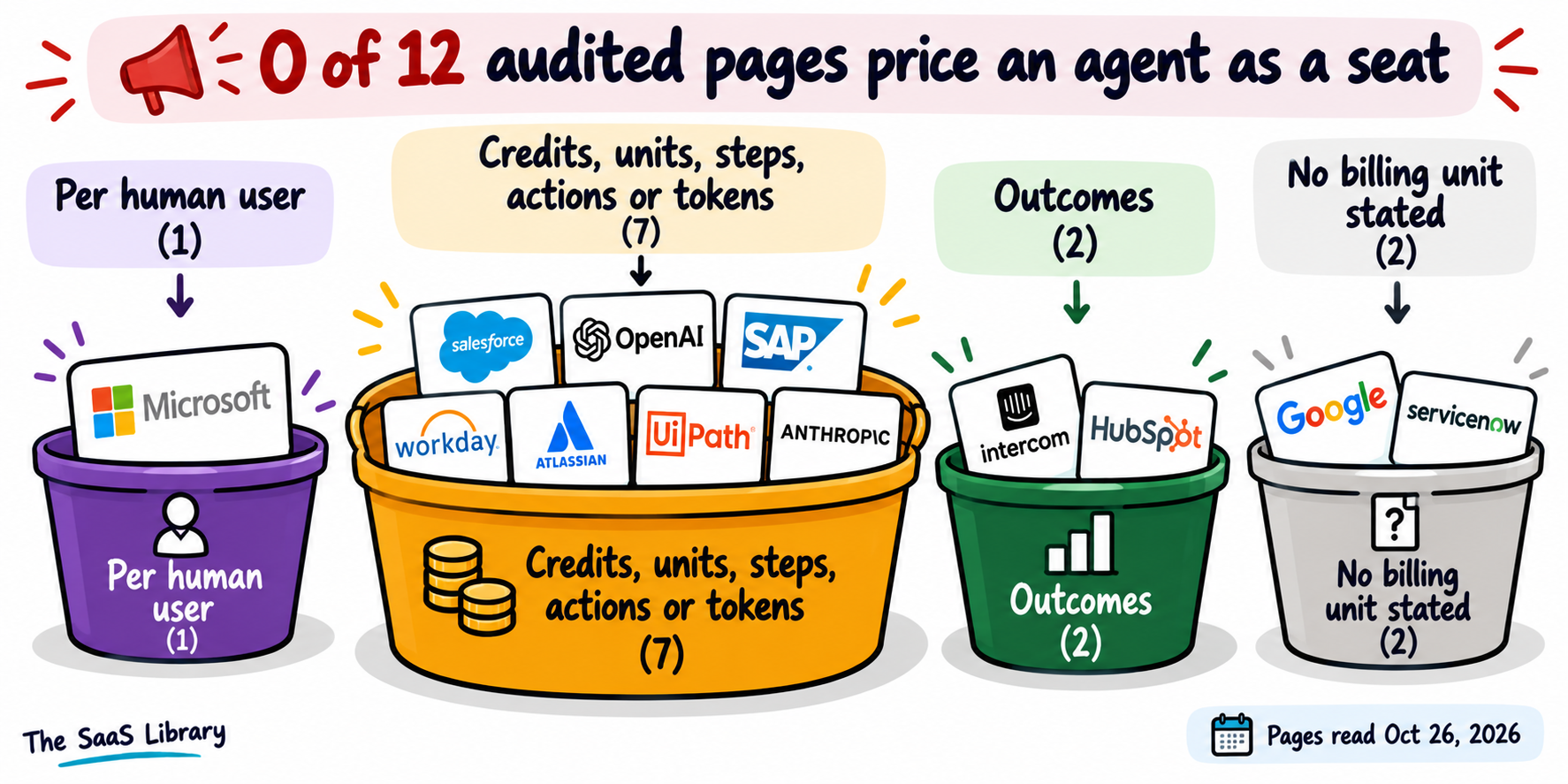
Vendors license AI agents by counting people, work or outcomes, not agents themselves. Of 12 vendors audited through their own published pages, Microsoft counts people, seven count credits, units, steps, actions or tokens, two price outcomes, and Google and ServiceNow state no agent billing unit.
TSL read each vendor’s own pricing, documentation or newsroom page on October 26, 2026. Secondary coverage was excluded, except one analyst report (Futurum) that quotes a Google representative.
| Vendor | Counts agent activity in | Also in the model | Source |
|---|---|---|---|
| Microsoft Agent 365 | Per human user; no per-agent or per-instance charge | $15 standalone, $99 inside E7 | Licensing FAQ |
| Google Workspace coworker agents | Not stated | Post gives no price or license terms; a Google representative told Futurum it does not intend a per-seat license | Google, Futurum |
| Salesforce Agentforce | Flex Credits: $500 per 100,000, one standard action = 20 credits ($0.10); or $2 per conversation | $5 user license (requires Flex Credits); $125 unmetered add-on | Pricing page |
| ServiceNow | Not stated; the April 9, 2026 release announces a tiered offer model with AI in every product, no price or meter | Not stated | Newsroom |
| OpenAI ChatGPT | Credits from a shared pool; on token-based Enterprise, Workspace Agents at $4.00 input, $0.40 cached, $20.00 output per 1M tokens (GPT-5.6 Sol); the same Sol rates are promotional on OpenAI’s API through at least Nov 21, 2026 | Business seats carry per-seat limits | Credits FAQ, rate card, model page |
| SAP Joule | AI Units per agent step: Basic 0.005, Standard 0.01, Advanced 0.025 | Per-user packages | SAP Learning |
| Workday | Flex Credits, metered per completed action | Hybrid model, shifting from per-seat to consumption and outcomes | Workday blog |
| Atlassian Rovo | Credits per invocation (10 for basic agents); successful agent resolutions billed per resolution | Committed packs last 12 months, no rollover; most meters bill from Dec 3, 2026 | Atlassian |
| Intercom Fin | Outcomes, $0.99 each | Seats for human teammates; no seats required for Fin on an existing helpdesk | Intercom |
| HubSpot Breeze | Outcomes: $0.50 per resolved conversation (50 credits); $1 per lead recommended (100 credits) | Available to Pro and Enterprise plans | HubSpot newsroom |
| UiPath | Agent Units or Platform Units per production run; 1 Agent Unit per standard-model call on Flex | Agent consumes no unattended-robot license | UiPath Docs |
| Anthropic* | Every token at standard API rates | Per-user seat fee billed annually, with no included usage | Claude Help Center |
*Disclosure: Anthropic makes Claude, an AI model TSL uses in its research workflow.
| Unit | Vendors | Count |
|---|---|---|
| Per human user | Microsoft | 1 |
| Credits, units, steps, actions or tokens | Salesforce, OpenAI, SAP, Workday, Atlassian, UiPath, Anthropic | 7 |
| Outcomes | Intercom, HubSpot | 2 |
| No billing unit stated | Google, ServiceNow | 2 |
Salesforce and Atlassian also price some resolutions or conversations; the table counts each vendor’s primary unit. No audited page prices an agent as a seat. Microsoft says so outright, and Google and ServiceNow say nothing on the point.
| Model | You pay for | Audited vendors | Example list figure | Watch for |
|---|---|---|---|---|
| Per person | The human tied to the agent | Microsoft | $15 per user per month (Agent 365, standalone) | Prerequisite licenses; no consumption costs “yet” |
| Credits, units, steps, actions | Work done | Salesforce, SAP, Workday, Atlassian, UiPath | Salesforce: 20 credits ($0.10) per standard action; SAP: 0.005 to 0.025 AI Units per step; Atlassian: 10 credits per basic agent invocation | Rollover, limits, how an “action” is defined |
| Outcomes | A completed result | Intercom, HubSpot | $0.99 per Fin outcome; $0.50 per resolved conversation | Who defines “resolved” |
| Tokens | Model input and output | OpenAI (token-based Enterprise), Anthropic | OpenAI Workspace Agents: $4.00 input and $20.00 output per 1M tokens (GPT-5.6 Sol); Anthropic: standard API rates | Task size swings the bill |
The audit counts OpenAI and Anthropic with credits and units, so seven vendors sit in the middle row of the count table.
Why do buyers push back on agent pricing?
Buyers push back because several vendors stack a seat or plan fee on top of a meter. The audit shows six that do: Salesforce, OpenAI Business, Intercom, SAP, Anthropic and HubSpot.
Salesforce’s $5 user license, for example, requires Flex Credits to run. Anthropic’s seat fee includes no usage at all.
Gartner’s George Brocklehurst says agentic systems break the link between user growth and revenue growth for many vendors. So vendors have a reason to price agents as seats or meters, and buyers have a reason to ask which one they are paying. For TSL’s earlier takes on that debate, see Is SaaS dead? and the RenaiSaaS story.
Proskauer’s lawyers list what customers should ask for:
- confirmation that an agent acting only for a licensed user needs no extra seat
- caps or predictable pricing for agent usage
- clarity on whether seat and consumption charges apply cumulatively
- cure and true-up mechanisms before breach or termination
- transparency into how the vendor measures agent activity
Halfway point: the first six sections cover what vendors publish; sections 7 to 12 cover what a contract can do with it.
Vendors that count the work, not the seat, still carry older clauses that can trigger fees without a seat.
Why can an AI agent trigger license fees even without a seat?
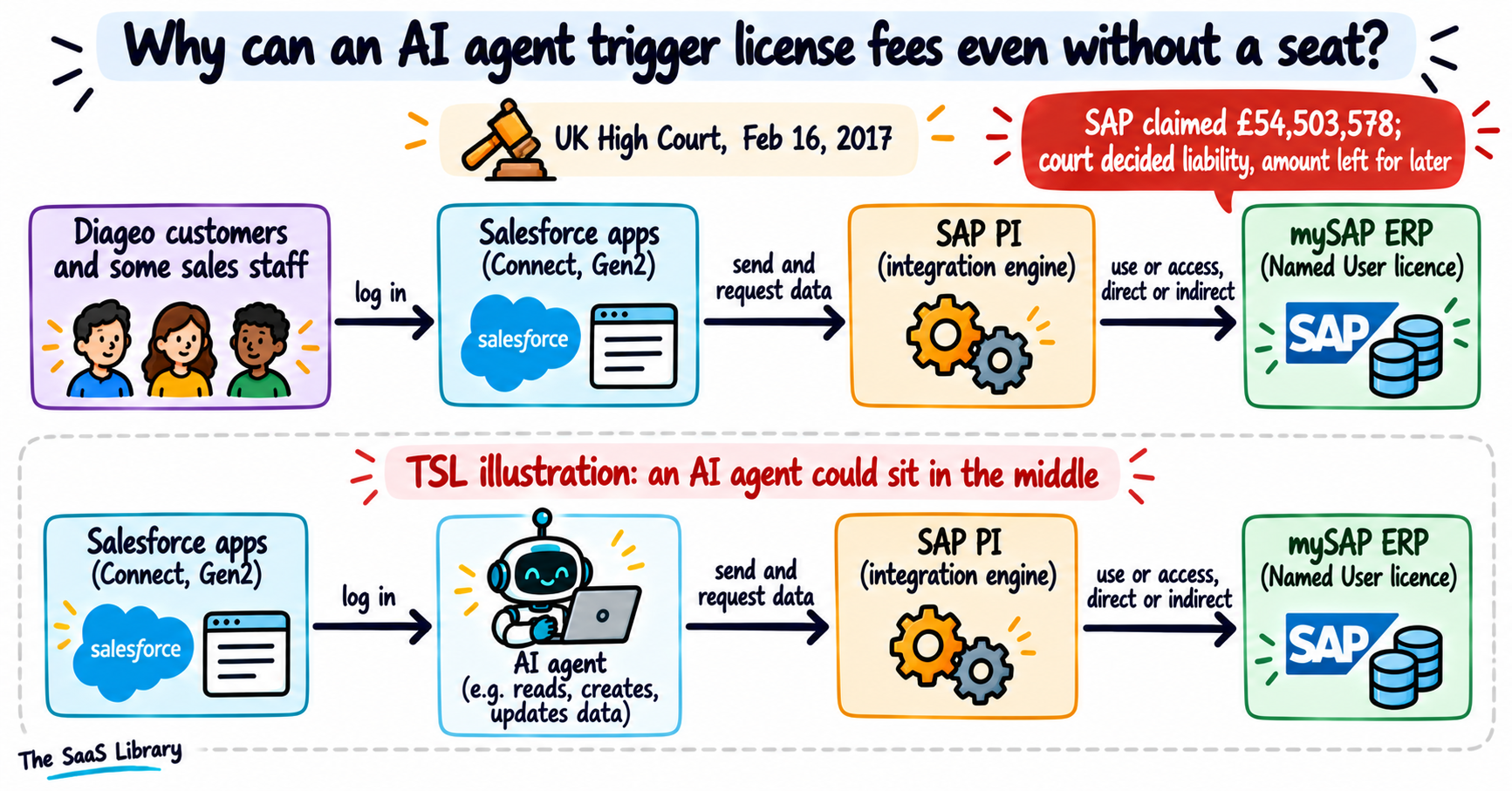
An AI agent can trigger license fees without a seat because some contracts license use or access, not just logins. In SAP v Diageo, a UK court held that customers and some staff reaching SAP software through Salesforce apps used it indirectly, making additional fees payable. Microsoft says multiplexing, including automation, does not reduce required licenses.
The Diageo agreement did not define “use” or “access.” The judge read “use” as applying or manipulating the software, and “access” as gaining visibility of it or a connection to it.
SAP claimed £54,503,578 in additional fees. The court decided liability only and left the amount for a later hearing. So one undefined word in a 2004 contract exposed a 2012 integration to a claim above £54 million.
| Precedent | What happened | Why it matters for agents | Source |
|---|---|---|---|
| SAP v Diageo, UK High Court, Feb 16, 2017 | Diageo’s Salesforce-based apps Connect (customers) and Gen2 (sales staff) exchanged data with SAP’s ERP through SAP PI; the court held those interactions were indirect use or access and unauthorised under the Named User licence | A system that touches licensed software on someone’s behalf can count as that person’s use | Judgment |
| SAP Digital Access, April 2018 | SAP added document-based pricing for indirect use: it counts documents created through indirect access, not users | Vendors can answer bots and devices by metering output | SAP User Groups deck, 2019 |
| Microsoft multiplexing rules | Pooling, automation or indirect access does not reduce licenses needed; the rule applies to access-based licensing | Microsoft’s FAQ applies the same logic to agents tied to unlicensed users | Microsoft guidance, FAQ |
| 4DD Holdings v US, Fed. Cir., Jul 16, 2026 | The Court of Federal Claims found the government exceeded its license by 290,334 Federator cores and 171,421 Studio seats and awarded $12,683,065.86; the Federal Circuit affirmed in part, vacated in part and remanded | Going past a licensed unit can become an infringement claim; the case did not involve AI agents | Federal Circuit opinion, 181 F.4th 1363, Proskauer |
How does multiplexing differ from an AI agent?
Multiplexing differs from an AI agent because an agent can fill three different roles, per Proskauer. It can act as:
- its own non-human principal
- a delegate of a licensed user
- a stand-in for several users at once
Those roles are the Agent Seat Test’s Identity and Audience questions, applied to a contract. Microsoft’s page adds that multiplexing applies only to access-based licensing, so metered and core-based models avoid it. If a vendor meters usage, the question moves to the meter, covered in section 9.
Example (TSL’s illustration, not a ruling).
An agent in a CRM reads order history from a licensed ERP for ten account managers. In Diageo, the court treated customers behind an interface as indirect users because the agreement licensed use or access by named individuals. Whether the same reasoning reaches an agent turns on each contract’s words, which is Proskauer’s point.
What does the RPA precedent show?
The RPA precedent shows vendors responding by counting output instead of users. SAP’s deck says Digital Access counts documents created through indirect access. Reads, updates and deletes are not counted.
SAP says this removes the need to count “users” and addresses concerns about devices and bots. The deck also says indirect access is growing because of devices, machine learning and AI.
Where an RPA bot or device uses SAP through another properly licensed SAP application, SAP’s deck says no additional ERP license is needed, provided the ERP is otherwise licensed. UiPath makes the same split from its side: an agent consumes no unattended-robot license.
These clauses apply when an agent touches software you license. The next risk is an agent using your login on software you do not.
Can your AI agent use your login on someone else’s software?
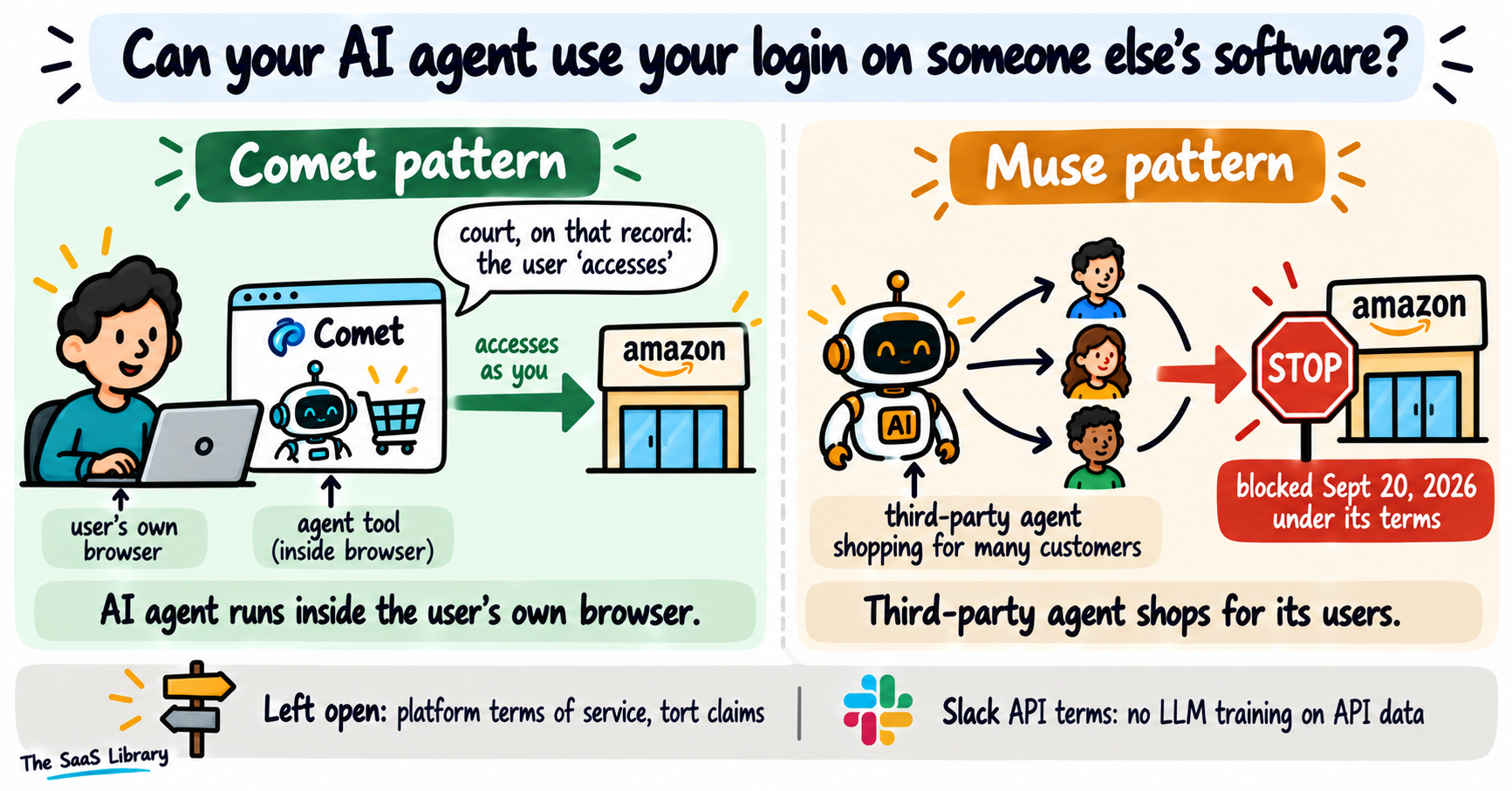
Your AI agent can use your login on someone else’s software, but the platform’s terms can still forbid it. A Ninth Circuit panel held, on one record, that the user, not the AI company, “accesses” the site under the federal computer-fraud law, and left platform terms open. Amazon then blocked Meta’s Muse under its terms.
The Ninth Circuit’s ruling is narrower than the headlines. On August 4, 2026, Judge Milan D. Smith Jr., with Judges Tung and Hinderaker, vacated the preliminary injunction that had barred Perplexity’s Comet agent from Amazon.
The court held Amazon unlikely to succeed on the “access” prong of the federal Computer Fraud and Abuse Act (CFAA) and California’s parallel statute. Amazon petitioned for rehearing en banc on August 18, and the court denied it on September 10.
What did the Ninth Circuit decide, and what did it leave open?
The court decided who “accesses” Amazon when a user directs an AI agent, and it left the rest open. Jones Day reports the reasoning:
- The user directs the agent through their own browser.
- The agent sends screenshots to Perplexity’s servers and receives navigation instructions back.
- Perplexity’s servers never communicate directly with Amazon’s.
- The CFAA’s “whoever … accesses” wording contemplates a person, not a tool.
| Decided on this record | Left open |
|---|---|
| The user, not Perplexity, “accesses” Amazon’s computers under the CFAA and the California statute | Whether a different record could show Perplexity controlled the agent enough to count as accessing |
| The injunction is vacated and the case remanded | Tort claims and other legal theories |
| Rehearing en banc denied Sept 10, 2026 | Amazon’s ability to regulate access through its own terms of service |
Jones Day calls it the first appellate decision on how computer-access statutes apply to agentic AI, and says the court limited its holding to the current record. Bloomberg Law reports the court stressed that its opinion did not “establish a new legal regime governing agentic AI.”
Ballard Spahr adds that the court left room for retailers to enforce their own website terms and pursue contract and tort claims. So the ruling answers a computer-fraud question and leaves the contract question to the platform.
How do platforms respond to agents using a login?
Platforms respond through terms, blocks and sanctioned routes. Three of the four below tell agents to come through a controlled path:
| Platform | What it did or requires | Source |
|---|---|---|
| Amazon | Began blocking Meta’s Muse on Sunday, September 20, 2026; shoppers saw pop-ups saying Muse use violates its terms; Amazon says it asked Meta to remove Amazon from the experience | Bloomberg via The Star, Sep 22, 2026 |
| Slack | Apps offered outside the installing organization may not use API data to train a large language model, bulk export message and file data, or keep persistent copies via its real-time search APIs | Slack API Terms, effective Oct 10, 2025 |
| Workday | Agents run under explicit user delegation through its Agent Gateway; agent identities are registered in its Agent System of Record; partner apps get the same governance | Workday blog, Oct 16, 2026 |
| Microsoft | An agent acting on delegated access is licensed to the user who delegates | Licensing FAQ |
| Perplexity Comet | Meta Muse | |
|---|---|---|
| What the agent does | Shops Amazon for users from the user’s own browser; Amazon alleged it reached private customer accounts | Meta’s agent helps people shop and book appointments |
| Amazon’s route | Lawsuit in a federal court in California; preliminary injunction March 9, 2026 | Block from Sept 20, 2026 under its terms; asked Meta to remove Amazon |
| Outcome so far | Injunction vacated Aug 4, 2026; rehearing denied Sept 10 | Pop-ups say use violates Amazon’s terms; Meta hadn’t responded in the report |
| What it shows (TSL’s reading) | The computer-fraud route narrowed on that record | Terms and technical blocks stay open to platforms |
Amazon’s spokesperson said third-party apps that make purchases for customers on other businesses’ sites should operate openly and respect those businesses’ decisions about participating. Amazon prohibits other companies from deploying automated shopping tools on its site, per the same report.
Slack’s terms add that a real-time search app’s use must be transparent to and reasonably expected by users, and that background scraping unrelated to user queries is prohibited. Workday’s tools run over the Model Context Protocol, and its Agent-Ready Tools for Data are in Early Access.
Example (TSL’s illustration, not a ruling).
Suppose an agent in your own browser reorders supplies from your own account. That is the Comet pattern, where the court looked at who accesses. Now suppose a third-party agent shops that same site for many customers.
That is closer to the Muse pattern, where the platform blocked the agent under its terms. The Agent Seat Test fits both: Identity (your delegated login) and Audience (one user or many) decide which clause to read.
Access rules decide whether an agent may run. The next question is what it costs once it does.
What does an AI agent really cost once it is running?
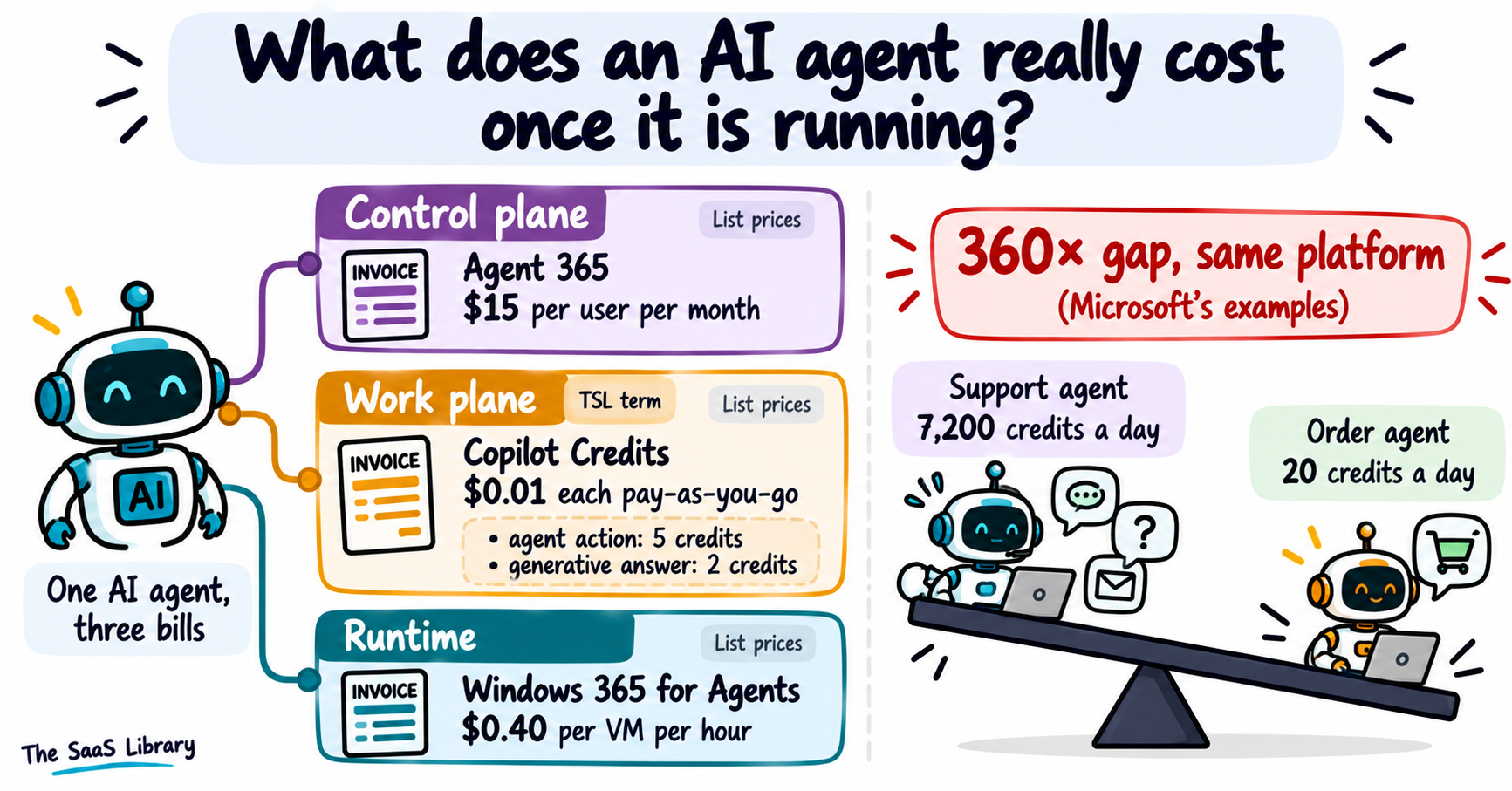
A running AI agent can cost three things: a control-plane fee for governance, a work-plane meter for what the agent does, and sometimes a runtime. At Microsoft those are $15 per user per month for Agent 365, $0.01 per pay-as-you-go Copilot Credit, and $0.40 per VM hour for Windows 365 for Agents.
The same agent can appear on three invoices. Microsoft calls Agent 365 the control plane for managing AI agents.
Here, the control plane is the layer that registers, secures and governs agents. The work plane is the layer where agents do billable work. “Control plane” is Microsoft’s term; “work plane” is TSL’s.
For why vendors price this way, see TSL’s explainer on how AI companies decide pricing.
| Layer | What it pays for | Unit and list price | Source |
|---|---|---|---|
| Control plane | Registering, securing and governing agents | Agent 365: $15 per user per month standalone; no consumption-based costs yet | Licensing FAQ |
| Work plane | What the agent does in Copilot Studio | Copilot Credits: $0.01 each pay-as-you-go, or $200 per month for a 25,000-credit pack | Licensing guidance |
| Runtime | A cloud PC or browser the agent uses | Windows 365 for Agents: $0.40 per VM per hour | Licensing FAQ |
Bring-your-own-model setups, including Azure Foundry models, are billed separately from Copilot Credits.
There is one exception, and it follows the Agent Seat Test’s Identity question. Employee-facing agent usage is included when the user holds Microsoft 365 Copilot ($30 per user per month) and the agent operates under that user’s authenticated identity, within fair-usage limits. Microsoft’s billing rates page says Computer-Using Agents are not included.
What drives the work-plane bill?
Design and traffic drive the work-plane bill, according to Microsoft. Credits per feature:
- classic answer: 1
- generative answer: 2
- agent action: 5
- tenant graph grounding: 10
- agent flow actions: 13 per 100 actions
Example (Microsoft’s own billing examples; monthly figure is TSL arithmetic).
A website support agent averages four classic and two generative answers per customer, for 900 customers a day. That is [(4×1)+(2×2)] × 900 = 7,200 credits a day, about 216,000 over 30 days, or roughly $2,160 at $0.01 per credit.
Microsoft’s order-processing example, with four agent-action calls, is estimated at 20 credits a day. Microsoft’s two daily estimates sit 360 times apart on the same platform.
To forecast before you commit, see TSL’s framework for estimating what agentic AI costs.
What does the meter’s fine print say?
The fine print decides what happens at the limit and what happens to unused balance:
| Vendor | At the limit | Unused balance | Source |
|---|---|---|---|
| Microsoft Copilot Studio | Custom agents are disabled at 125% of prepaid capacity; pay-as-you-go avoids enforcement | Monthly credits don’t roll over; pre-purchase units expire annually | Learn, guidance |
| Salesforce Agentforce | No overage penalty; billed at the contracted rate monthly in arrears | Unused Flex Credits don’t roll over into the next term; Flex Credits and Conversations can’t share an org | Pricing page |
| OpenAI ChatGPT | Enterprise and Edu: advanced features pause when the shared pool is spent unless overages are enabled or credits added | Business credits valid 12 months; Enterprise terms in the Order Form | Help Center |
| Anthropic | Self-serve Enterprise: usage stops for the whole organization at zero credits; sales-assisted: no balance, billed monthly in arrears | Not stated on the billing page | Claude Help Center |
| Workday | Alerts at 80%, 90% and 100% of balance; account teams reconcile instead of shutting access | Not stated in the post | Workday blog |
| Atlassian Rovo | Billing starts Dec 3, 2026 for most meters | Committed packs last 12 months with no rollover | Atlassian |
Three patterns show up:
- Balances expire on different clocks: monthly at Microsoft, per term at Salesforce, and 12 months at OpenAI Business and Atlassian.
- The limit behaves differently: disable, pause, stop organization-wide, bill on, or reconcile.
- Microsoft’s pay-as-you-go meter exists to avoid interruption.
Watch the denominator too. Microsoft’s AI-tool rates are per 10 responses, and its content-processing rate is per page. For the habits that keep a variable bill in check, see TSL’s guide to AI FinOps.
Which meters charge only for results?
Result-based meters charge when an agent completes the task. HubSpot says customers pay only when an agent completes its assigned task, at 50 credits per resolved conversation.
Workday meters most usage when a task completes in production and counts non-production tests in aggregate. TSL’s analysis of HubSpot’s $0.50 bet covers what that shift means for seat pricing.
Ask each vendor how it defines “resolved” or “completed,” because the vendor sets that definition.
Once the meter runs, the next question is who is responsible when the agent makes a mistake.
Who is responsible when an AI agent with its own identity makes a mistake?
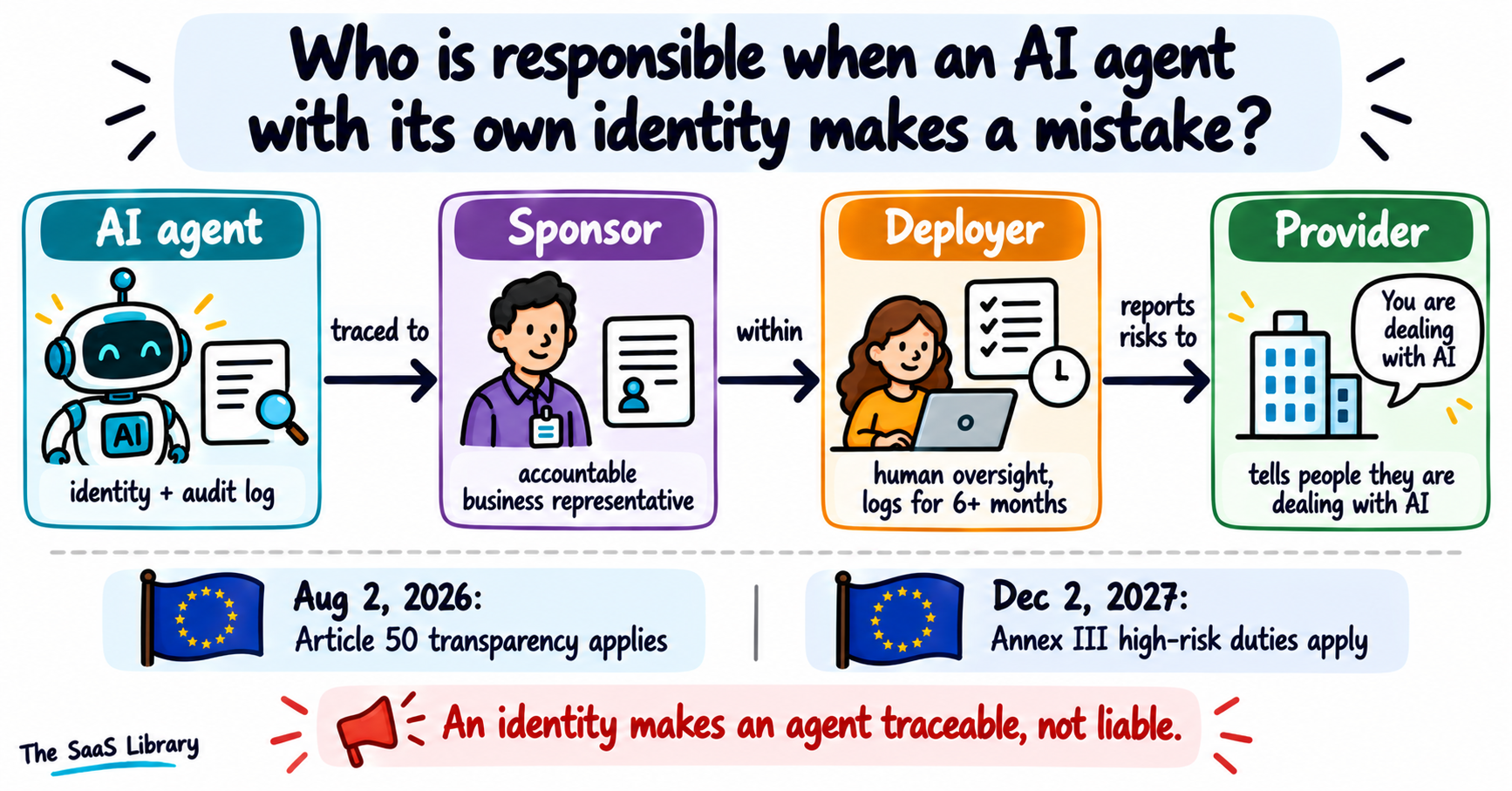
In the documents reviewed here, responsibility for an AI agent’s mistake lands on the people and organizations behind it, not on the agent. Microsoft requires an accountable sponsor for each agent identity, and the EU AI Act puts duties on providers and deployers, including human oversight by natural persons for high-risk systems.
An identity makes an agent traceable, not liable. Google’s post says every action goes to an audit trail attributed to the agent rather than a person.
Attribution answers “what acted,” and the vendors then name a human for “who answers.” For the wider governance picture, see TSL’s analysis of the AI agent governance gap.
| Vendor | What it records | Who is named as accountable | Source |
|---|---|---|---|
| Microsoft | Sign-in and audit logs separate the blueprint, the agent identity and the agent’s user account | Each agent identity needs at least one sponsor, the business representative accountable for the agent | Microsoft Learn |
| Every action attributed to the agent in an audit trail | Not stated; the post says the organization’s security administrators approve each agent’s permissions | Google Cloud blog | |
| Workday | Each agent identity, skill set and execution log registered in its Agent System of Record | Agents execute under explicit user delegation | Workday blog, Oct 16, 2026 |
Example (from Workday’s own description).
An autonomous agent tries an action that exceeds a spending limit or a regional policy rule. The platform routes the request to a human approval workflow or rolls the transaction back, and the log shows which agent identity acted. The person who delegated authority and the approver are the humans in that chain.
What does the EU AI Act say about agent responsibility?
The EU AI Act assigns duties to providers and deployers, and the dates matter. The Commission’s AI Act timeline, updated for the Digital Omnibus on AI, sets these milestones:
| Date | What applies |
|---|---|
| Aug 2, 2026 | Article 50 transparency rules start; enforcement begins for general-purpose AI, prohibitions, transparency and AI literacy |
| Dec 2, 2026 | New prohibitions apply, plus the Article 50(2) transition for systems already on the market |
| Dec 2, 2027 | Rules for high-risk systems in Annex III apply |
| Aug 2, 2028 | Rules for high-risk AI embedded in regulated products (Annex I) apply |
The amending regulation is Regulation (EU) 2026/1744 of July 8, 2026. EUR-Lex lists it as published July 24, 2026 and in force July 27, 2026.
Two articles bear on agents:
- Article 26 (deployers of high-risk systems, from Dec 2, 2027). Deployers must assign human oversight to natural persons with competence, training and authority. They monitor operation, keep logs for at least six months, and where they see a risk they inform the provider and the authority and suspend use. A serious incident must be reported immediately.
- Article 50(1) (providers, since Aug 2, 2026). Providers must design systems intended to interact directly with people so those people are told they are dealing with AI, unless that is obvious. The notice is due at the latest at first interaction.
| Provider | Deployer of a high-risk system | |
|---|---|---|
| Article | Article 50(1) | Article 26 |
| Duty | Design systems that interact directly with people so those people are told they are dealing with AI, unless obvious | Follow the instructions for use; assign human oversight to competent natural persons; monitor; keep logs at least six months; inform the provider and authority and suspend use on risk; report serious incidents |
| Applies from | Aug 2, 2026 | Dec 2, 2027 (Annex III); Aug 2, 2028 (Annex I) |
| Timing detail | Notice at the latest at first interaction | Employers inform affected workers before use at the workplace |
TSL’s reading: an agent that writes to people from its own mailbox is the obvious case to check against Article 50(1). Whether a given agent is “intended to interact directly” with people is a classification question for its provider. For the compliance side, see TSL’s guide to enterprise SaaS AI compliance.
Who pays when an agent’s software is defective?
The new EU Product Liability Directive, Directive (EU) 2024/2853, applies to products placed on the Union market or put into service after December 9, 2026. It covers software, including AI systems. That regime sits on the vendor side, and your contract still decides how loss moves between you and your vendor.
For documented cases of AI systems acting outside their limits, see TSL’s roundup, AI went rogue 6 times.
Responsibility settles on people, so the practical question is what your contracts say before the next renewal.
What should you check in your contracts before your next renewal?
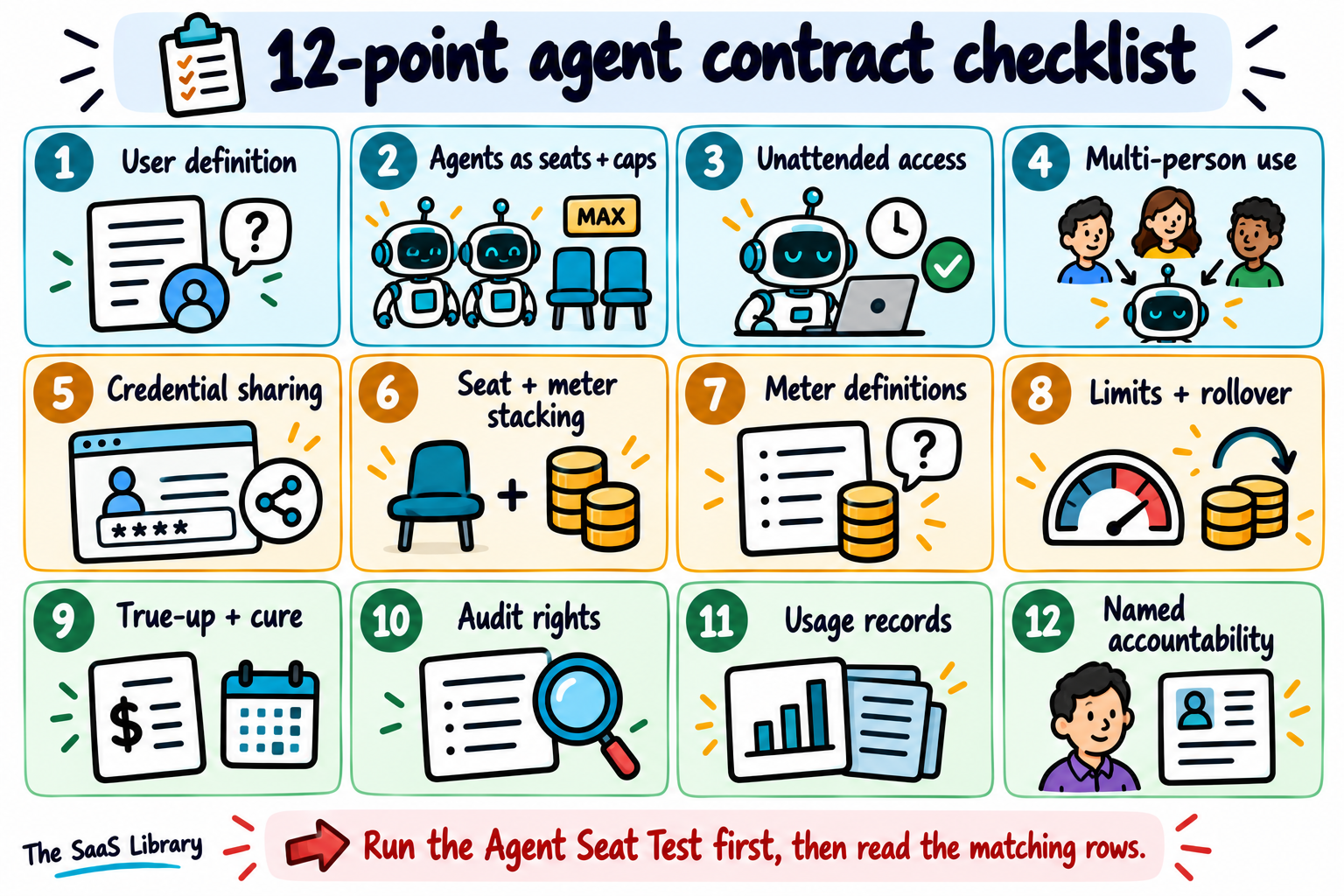
Before your next renewal, check twelve contract points: user definition, agents as seats and per-user caps, unattended and multi-person access, credential sharing, stacked seat and meter charges, meter definitions, limits and rollover, true-up and cure rights, audit rights, usage records, and named human accountability.
Proskauer’s lawyers warn that many agreements negotiated before agents became common define “user” and related metrics mainly for humans. So start with the wording, not the price list.
| # | Clause | Ask your vendor | Evidence from this guide |
|---|---|---|---|
| 1 | Definition of “user” | Must a user be a natural person? | Proskauer lists this as an open question |
| 2 | Agents as seats, and caps | Does each agent need its own seat or entitlement? May one licensed user run unlimited agents? Does an agent acting only for a licensed user need an extra seat? | Proskauer; Microsoft’s FAQ sets no fixed cap per licensed user |
| 3 | Unattended access | Is autonomous access treated differently from human-interactive use? | Proskauer; Microsoft licenses the owner, sponsor or manager of own-access agents |
| 4 | Multi-person use | Can an agent act for several employees, affiliates, customers or business units? | Proskauer; Microsoft’s multiplexing page; SAP v Diageo |
| 5 | Credential sharing | Does a credential-sharing ban cover a user sharing with their own agent? | Proskauer; Slack’s API terms; Amazon’s block of Muse |
| 6 | Stacked charges | Do seat and consumption charges apply cumulatively? | Proskauer; six audited vendors combine a seat or plan with a meter |
| 7 | Meter definitions | What exactly is a credit, action, step or “resolution,” and what is the denominator? | Microsoft Learn rates (per 10 responses, per page); vendors define “resolved” |
| 8 | Limits and rollover | What happens at the limit, and does unused balance carry over? | Section 9 table: disable, pause, stop org-wide, bill on; monthly, per-term and 12-month expiry |
| 9 | True-up and cure | Is there a reasonable cure and true-up before breach or termination? | Proskauer; the Diageo agreement’s clause 6.2 treated accidental or unintentional unauthorised use differently |
| 10 | Audit rights | Do audits cover non-human identities and automated access, and how does the vendor measure agent activity? | Proskauer (both sides); the Diageo agreement’s usage-verification clause |
| 11 | Usage records | Which identity records and usage logs does each side keep? | Proskauer pairs classification with identity records, usage logs and true-up rights; Article 26 requires deployers of high-risk systems to keep logs for at least six months |
| 12 | Named accountability | Who is the named human for each agent identity? | Microsoft Learn requires a sponsor; Article 26 requires human oversight by natural persons |
How does the Agent Seat Test map to the checklist?
The Agent Seat Test tells you which rows to read first for each agent (TSL’s mapping):
| If the answer is yes | Read these rows |
|---|---|
| Identity: the agent has its own account | 1, 2, 12 |
| Initiative: it acts without a trigger from you | 3, 8, 11 |
| Audience: it serves people beyond its owner | 4, 5, 10 |
Example (hypothetical).
A team agent has its own mailbox, runs on a schedule and answers colleagues across two departments. It scores yes on all three questions, so rows 1 to 5, 8, 10, 11 and 12 all apply.
How do you start the review?
Start with the agents, then the contract:
- Inventory every agent, including ones people connected themselves. TSL’s guide to auditing your SaaS stack for shadow AI shows how.
- Run the Agent Seat Test on each one and write three one-line answers.
- Read the matching rows against each vendor’s agreement and order form.
- Ask for written answers. Proskauer advises that customers and providers address agent access expressly in the agreement, so surprises don’t become compliance events or unbudgeted fees.
Atlassian’s metering is one example of why timing matters: most meters bill from December 3, 2026.
What should a SaaS founder check when pricing agents?
A founder who sells software should check the provider-side list from Proskauer:
- whether each agent or service identity requires authorization
- limits on the number of agents associated with one human user
- usage by agents serving multiple users or external customers
- metering of API calls, transactions, tokens, workflows or completed outcomes
- audit rights covering non-human identities and automated access
- true-up mechanisms when agent usage raises consumption while human seats shrink
The audit in section 6 shows the range of answers vendors chose. For methods, see TSL’s guide to pricing research for SaaS founders.
Vendors are already changing how they count agents, so the last section looks at where that is heading.
Where is AI agent licensing heading next?
AI agent licensing is shifting from seat counts toward hybrids of seats, meters and outcomes, but no single framework has emerged, Proskauer says. Workday describes the shift, HubSpot and ServiceNow changed agent pricing or packaging in April 2026, and Microsoft and Google have not set Agent 365 or coworker-agent consumption prices yet.
The direction comes from the vendors themselves. Workday’s blog says the traditional per-seat model is shifting toward a hybrid driven by consumption and outcomes.
Gartner says agentic systems break the link between user growth and revenue growth for many vendors. Proskauer adds that the market is experimenting with several approaches and has not converged on one.
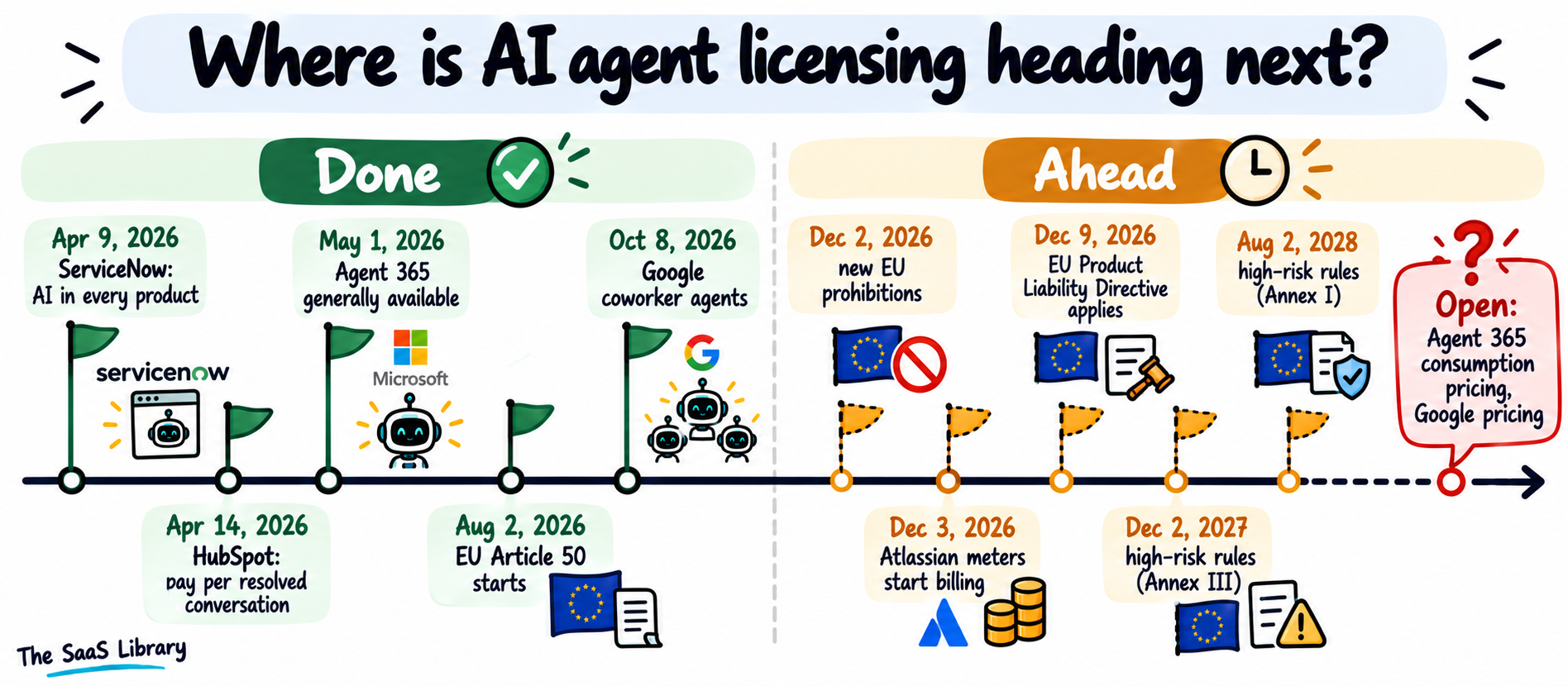
| Date | Move | Status | Source |
|---|---|---|---|
| Apr 9, 2026 | ServiceNow: every customer starts with an AI package under a tiered offer model, with no separate purchase | Done | ServiceNow newsroom |
| Apr 14, 2026 | HubSpot: $0.50 per resolved conversation; $1 per recommended lead | Done | HubSpot |
| May 1, 2026 | Microsoft Agent 365 generally available, per user | Done | Microsoft Learn |
| Aug 2, 2026 | EU AI Act Article 50 transparency rules start | Done | Commission timeline |
| Oct 8, 2026 | Google announces coworker agents with their own Workspace account and email address | Done | |
| Dec 2, 2026 | New EU prohibitions apply; Article 50(2) transition ends | Ahead | Commission timeline |
| Dec 3, 2026 | Atlassian starts billing most Rovo meters | Ahead | Atlassian |
| Dec 9, 2026 | EU Product Liability Directive applies to products placed on the market after this date | Ahead | Gibson Dunn |
| Dec 2, 2027 | EU AI Act rules for Annex III high-risk systems apply | Ahead | Commission timeline |
| Aug 2, 2028 | EU AI Act rules for Annex I product-embedded high-risk AI apply | Ahead | Commission timeline |
Six questions stay open in the sources reviewed:
| Open question | What the source says |
|---|---|
| Will Microsoft add consumption charges to Agent 365? | Its FAQ says there are none “yet” |
| What will Google charge for coworker agents? | A Google representative told Futurum pricing details would come closer to wider availability |
| How far does the Ninth Circuit’s access ruling reach? | The court limited it to the current record and left tort claims and Amazon’s terms open (Jones Day, Ballard Spahr) |
| How do contracts treat agents? | Proskauer says many agreements predate agents and the market is not converging |
| How will “high-risk” be classified in practice? | The Commission’s classification guidelines are due by August 2027, per the Future of Privacy Forum |
| What does ServiceNow meter for agents? | Its April 9 release gives no price or meter |
What should you watch?
Watch for three kinds of signal, none of them predictions:
- Vendor documents. Published agent definitions, caps and meters from vendors that haven’t set them (Microsoft, Google, ServiceNow). Each is a new row for the checklist in section 11.
- Courts. A decision on a different factual record, or on a platform’s terms of service, since the Ninth Circuit left both open.
- EU milestones. The December 2026 and 2027 dates above, the Commission’s high-risk classification guidelines, and the first claims under the Product Liability Directive after December 9, 2026.
The Agent Seat Test stays useful through all of it, because identity, initiative and audience are the questions vendors, courts and regulators keep returning to.
The questions below cover the points readers ask most.
What do people ask about AI agent software licenses?
Do AI agents need their own software license?
AI agents do not need their own software license in the documents audited. Microsoft’s Agent 365 FAQ says agents do not require their own licenses and licenses the person tied to the agent, and nine of twelve audited vendors meter agent work or outcomes. An agent with its own Microsoft mailbox still needs the appropriate licenses for that account.
Does Microsoft make AI agents buy a seat?
Microsoft does not make AI agents buy a seat. Agent 365 has been generally available to commercial customers since May 1, 2026 and is licensed per user, at $15 list price per month standalone or $99 inside Microsoft 365 E7. Microsoft’s FAQ adds no per-agent or per-instance charge, and the owner, sponsor or manager of an own-access agent needs the license.
Can an AI agent have its own email address, and does that change licensing?
An AI agent can have its own email address. Google’s coworker agents get their own Workspace account and email address, and Microsoft’s agent user account can hold a mailbox for tenants in its Frontier preview program. At Microsoft the account can hold licenses, and Google’s launch post states no price or license terms.
What is the Agent Seat Test?
The Agent Seat Test is TSL’s three-question check for which contract clause to read: Identity (does the agent have its own account), Initiative (does it act without a trigger from you) and Audience (does it serve people beyond its owner). A yes is a flag, not a bill.
How do vendors charge for AI agents today?
Vendors charge for AI agents by person, work or outcome. In TSL’s audit of 12 vendors’ own pages, Microsoft charges per human user, seven meter credits, units, steps, actions or tokens, two price outcomes, and Google and ServiceNow state no agent billing unit. No audited page prices an agent as a seat.
Why can an AI agent trigger license fees without a seat?
An AI agent can trigger license fees without a seat because some contracts license use or access, not just logins. In SAP v Diageo, a UK court held that customers and some staff reaching SAP software through Salesforce apps used it indirectly, so additional fees were payable. Microsoft’s guidance says multiplexing, including automation, does not reduce the licenses required.
Can my AI agent use my login on someone else’s software?
Your AI agent can use your login on someone else’s software, but the platform’s terms can still forbid it. On one record, the Ninth Circuit held the user, not the AI company, accesses a site under federal computer-fraud law, and left platform terms open. Amazon then blocked Meta’s Muse under its terms, and Slack bars third-party apps from training LLMs on API data.
What does an AI agent cost once it is running?
A running AI agent can cost $15 per user per month for Agent 365, $0.01 per pay-as-you-go Copilot Credit and $0.40 per VM hour for Windows 365 for Agents at Microsoft. Microsoft’s own example of a support agent handling 900 customers a day uses 7,200 credits daily. Check limits, rollover and overage rules for each vendor.
Who is responsible when an AI agent makes a mistake?
The people and organizations behind an AI agent are responsible when it makes a mistake, in the documents reviewed. Microsoft requires an accountable sponsor for each agent identity, and the EU AI Act puts duties on providers and deployers, including human oversight by natural persons for high-risk systems from December 2, 2027. An identity makes an agent traceable, not liable.
What should I check in my contracts before renewal?
You should check twelve points before renewal: the definition of user, agents as seats and caps, unattended and multi-person access, credential sharing, stacked seat and meter charges, meter definitions, limits and rollover, true-up and cure rights, audit rights, usage records, and named human accountability. Get written answers from each vendor.
So, do AI agents need their own software license?
Not usually, in the documents audited. Microsoft licenses the person tied to an agent, and nine of twelve audited vendors meter the work or the outcome.
The exposure sits in contract words: use, access, sharing, meters and limits. Run the Agent Seat Test on each agent, read the twelve checklist rows against your agreements, and get written answers before renewal.
Read more in AI & Automation.
- Microsoft — Licensing FAQ: Agent 365
- Microsoft — UBS Global Technology Conference transcript (Dec 2, 2025)
- Microsoft Learn — Agent 365 identity
- Microsoft Learn — Agent 365 overview
- Microsoft — Experiences + Devices leadership changes (Mar 12, 2026)
- Microsoft — Multiplexing licensing guidance
- Microsoft — Copilot Studio licensing guidance
- Microsoft Learn — Copilot Studio billing rates and management
- Google Cloud — Welcome to Gemini at Work 2026 (Oct 8, 2026)
- Futurum — Google Gemini agent analysis (Oct 9, 2026)
- UiPath Docs — Agents licensing
- Atlassian — Usage-based pricing
- Intercom — Pricing
- Workday Blog — Usage-based AI pricing (Jul 30, 2026)
- Workday Blog — Workday Data Cloud (Oct 16, 2026)
- SAP Learning — Joule commercial model
- Salesforce — Agentforce pricing
- ServiceNow Newsroom — AI-native packaging release (Apr 9, 2026)
- OpenAI Help Center — Flexible pricing and credits
- OpenAI Help Center — ChatGPT rate card, token-based Enterprise
- HubSpot — Customer Agent and Prospecting Agent pricing (Apr 2026)
- Claude Help Center — Enterprise plan billing
- Slack — API Terms of Service (effective Oct 10, 2025)
- Proskauer Rose LLP — Does Your AI Agent Need Its Own Software License? (Aug 24, 2026)
- SAP UK Ltd v Diageo Great Britain Ltd [2017] EWHC 189 (TCC)
- SAP User Groups — Digital Access webinar deck (2019)
- 4DD Holdings LLC v United States, 181 F.4th 1363 (citation record)
- Ninth Circuit docket 26-1444 — Amazon.com Services v. Perplexity AI
- Jones Day — Ninth Circuit vacates CFAA injunction against Perplexity’s Comet (Sept 2026)
- Ballard Spahr — Who’s Really at the Keyboard? Ninth Circuit opines on agentic AI in e-commerce (Aug 11, 2026)
- Bloomberg Law — Perplexity’s appeal win over Amazon keeps hacking liability risk
- Microsoft — Agent 365, the control plane for agents
- OpenAI — GPT-5.6 model page
- US Court of Appeals for the Federal Circuit — 4DD Holdings v. United States, No. 2024-1996 (Jul 16, 2026)
- Bloomberg via The Star — Amazon blocks Meta’s Muse AI agent (Sep 22, 2026)
- Gartner — US$234 billion of enterprise application software spend at risk (Jul 1, 2026)
- US Copyright Office — NewsNet Issue 1060 (Jan 29, 2025)
- Open Source Initiative — The Open Source Definition
- European Commission AI Act Service Desk — Implementation timeline
- European Commission AI Act Service Desk — Article 26
- European Commission AI Act Service Desk — Article 50
- EUR-Lex — Regulation (EU) 2026/1744
- Future of Privacy Forum — AI Act implementation timeline under the AI Omnibus
- Gibson Dunn — EU Product Liability Directive and software (Mar 2026)