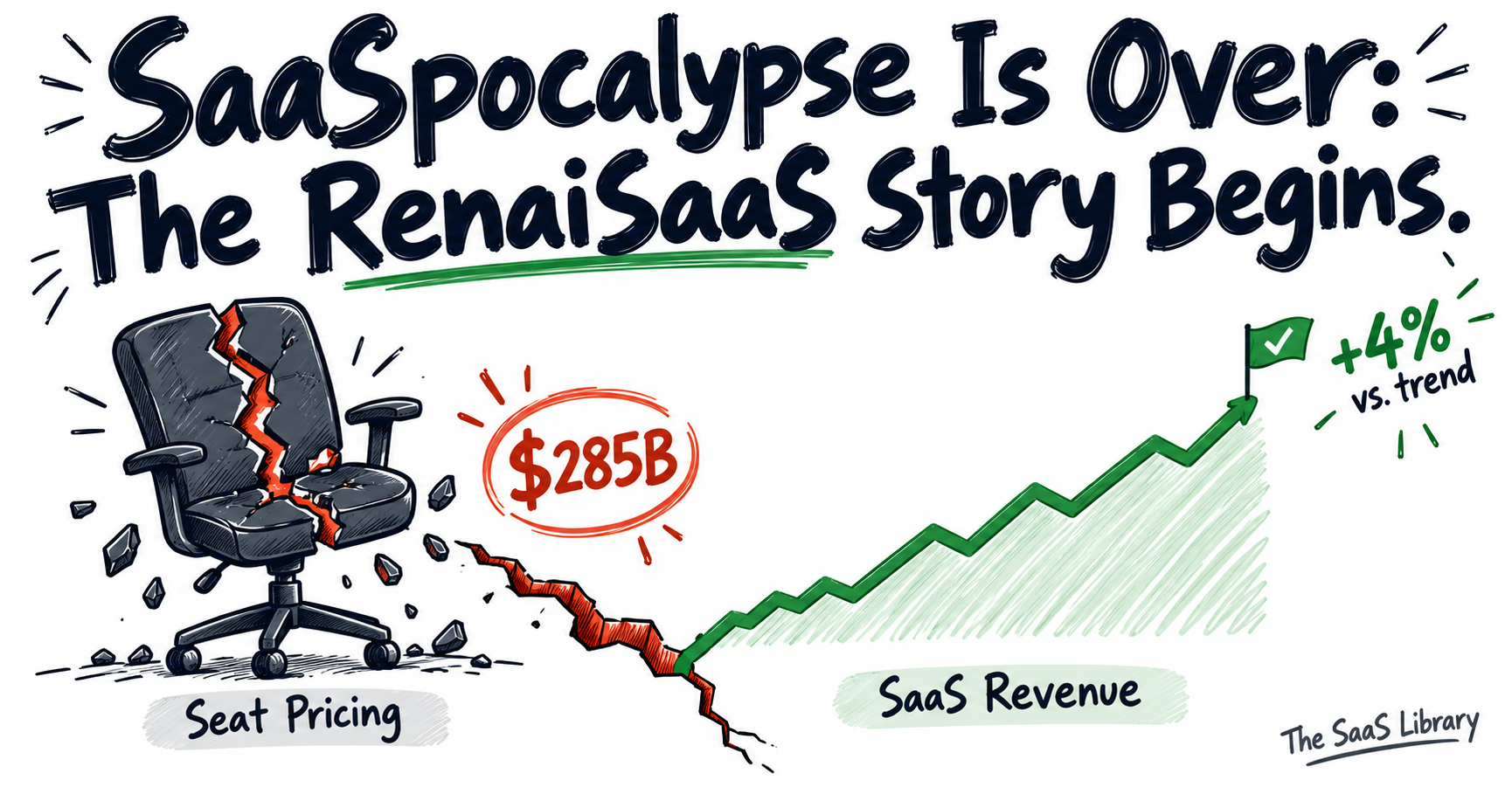
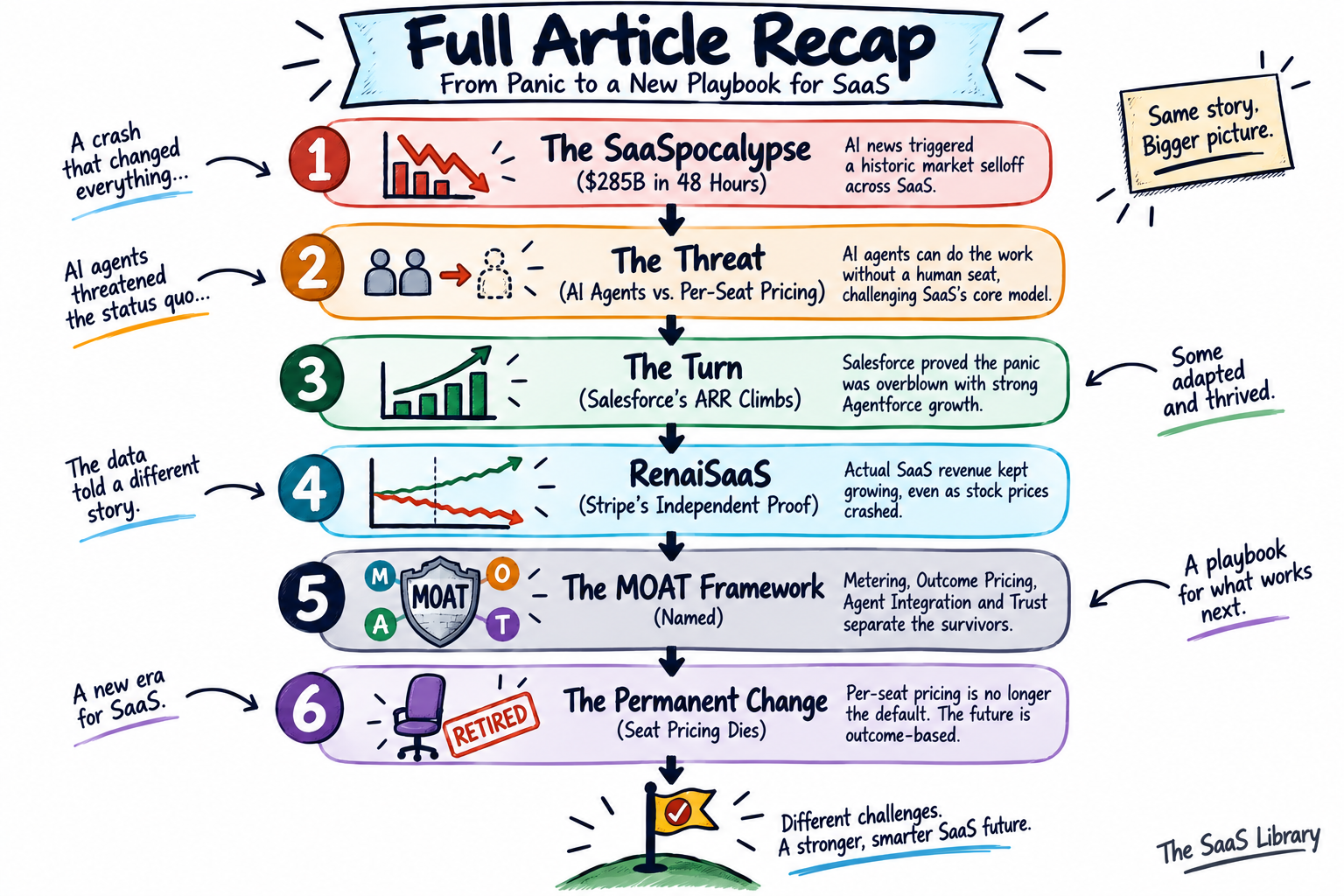
The SaaSpocalypse — a single word coined by one trader — wiped $285 billion off software stocks in 48 hours. Eighteen months later, the company it was supposed to kill posted one of its best quarters ever.
What Was the SaaSpocalypse?
The SaaSpocalypse was the nickname for a sudden, severe selloff in enterprise software stocks in early 2026, triggered by fears that AI agents would replace the per-seat licenses SaaS companies depend on for revenue. The term was coined by Jefferies equity trader Jeffrey Favuzza on February 3, 2026, after roughly $285 billion evaporated from software stocks in 48 hours.
The panic had a precise starting point. On January 12, 2026, Anthropic launched Claude Cowork, a desktop AI agent built to handle multi-step office tasks — organizing files, drafting reports, processing documents — without a human directing every step (VentureBeat, Jan 12, 2026). At launch, it looked like a productivity tool. Eighteen days later, it looked like a threat to an entire industry.
On January 30, 2026, Anthropic pushed 11 open-source plugins for Cowork covering legal, finance, sales, marketing, and customer support workflows — quietly, with no keynote and no press release (TechCrunch, Feb 24, 2026). Investors noticed anyway. By Tuesday afternoon, Wall Street had a name for what was happening: the SaaSpocalypse.
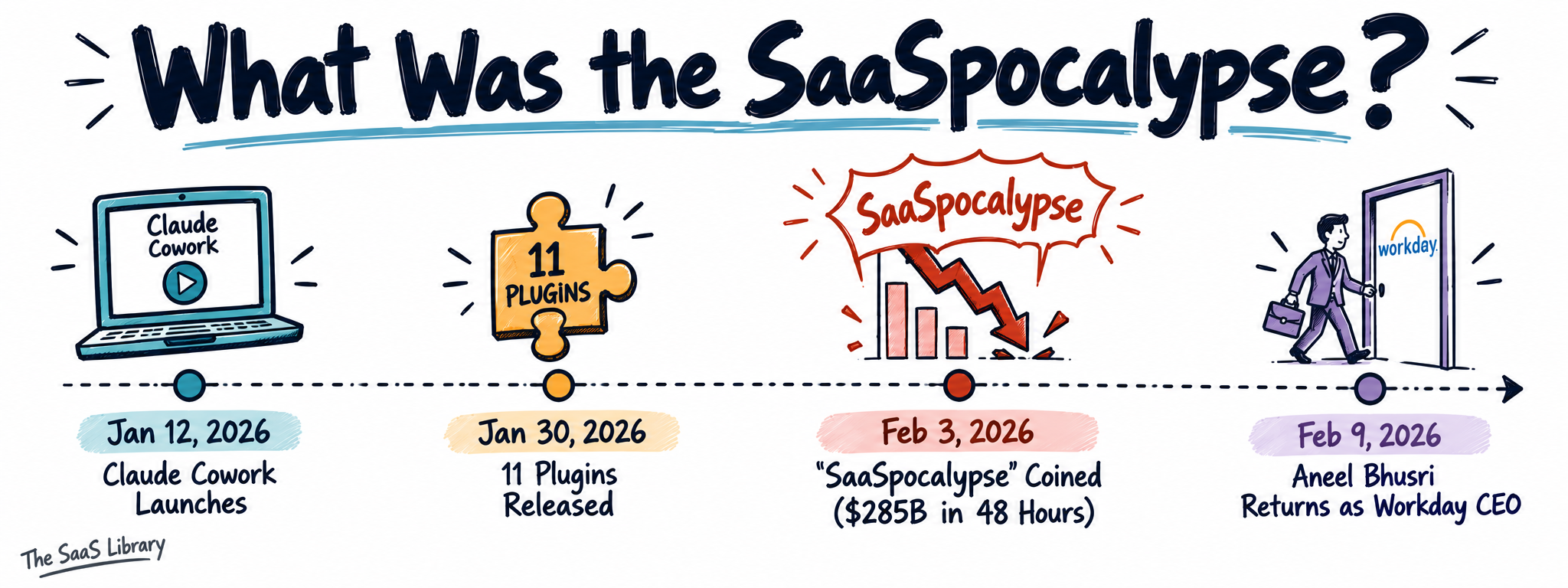
Jeffrey Favuzza, an equity trader at Jefferies, coined the phrase in comments to Bloomberg: “We call it the ‘SaaSpocalypse,’ an apocalypse for software-as-a-service stocks. Trading is very much ‘get me out’ style selling,” (Bloomberg, Feb 3, 2026). The name stuck immediately — it turned an abstract fear about AI agents into a single, quotable word that every CEO on an earnings call would soon be forced to respond to.
| Company | What Happened | Source |
|---|---|---|
| Thomson Reuters | Biggest single-day drop in company history | Bloomberg |
| LegalZoom | Fell nearly 20% | Bloomberg |
| Salesforce, ServiceNow, Adobe | Each fell 7–11% in a single session | Bloomberg |
| SAP | Down roughly a third from yearly highs | Bloomberg |
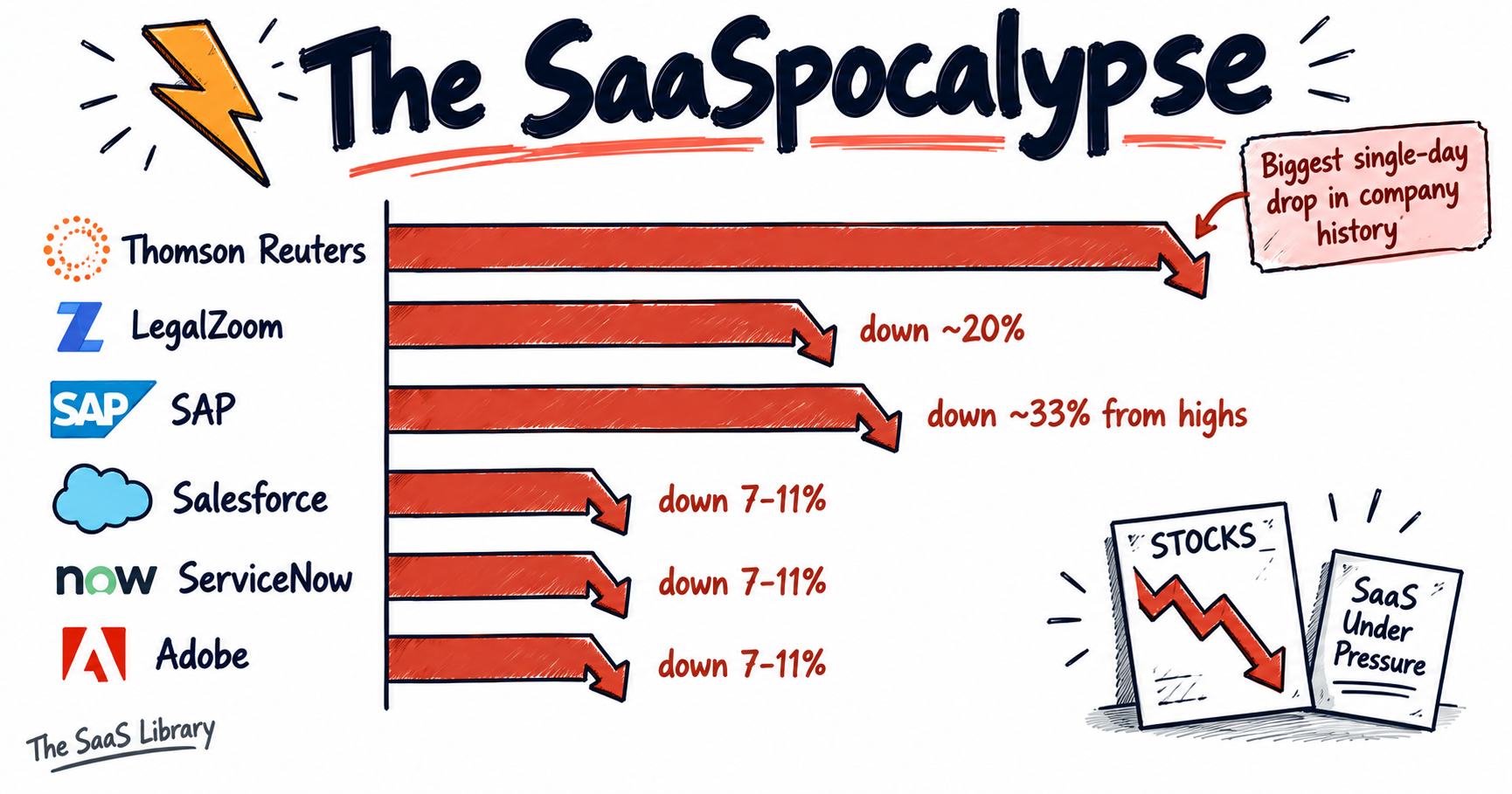
Monday.com became one of the most visible casualties. Its stock fell 36.7% in February 2026 alone, according to S&P Global Market Intelligence data, as investors bet AI agents could replace the kind of workflow tools it sold (The Motley Fool, Mar 2026). By mid-2026, the stock had fallen more than 50% year-to-date — even as the company kept posting double-digit revenue growth (Yahoo Finance / S&P Global, Jul 2026). That gap — a collapsing stock price next to growing revenue — is the first sign the SaaSpocalypse was, at least in part, a story the market told itself faster than the facts could catch up.
Stock price collapse and business collapse are not the same event. Several companies at the center of the SaaSpocalypse — including Monday.com — saw their stock prices fall sharply while their actual revenue kept growing throughout the panic.
The panic reached far enough to pull a founder out of semi-retirement. On February 9, 2026, Workday announced that co-founder Aneel Bhusri was returning as CEO, effective immediately (Workday Newsroom, Feb 9, 2026). Bhusri framed the moment starkly: “We’re now entering one of the most pivotal moments in our history. AI is a bigger transformation than SaaS — and it will define the next generation of market leaders,” (Workday Newsroom, Feb 9, 2026).
A market mood, not a wave of customer cancellations, was strong enough to change who ran a multibillion-dollar company overnight. That single fact sets up the question the rest of this article answers: was the fear driving the SaaSpocalypse actually justified by what was happening inside these businesses — or was it a story that outran the numbers?
Why Did AI Agents Threaten SaaS’s Business Model?
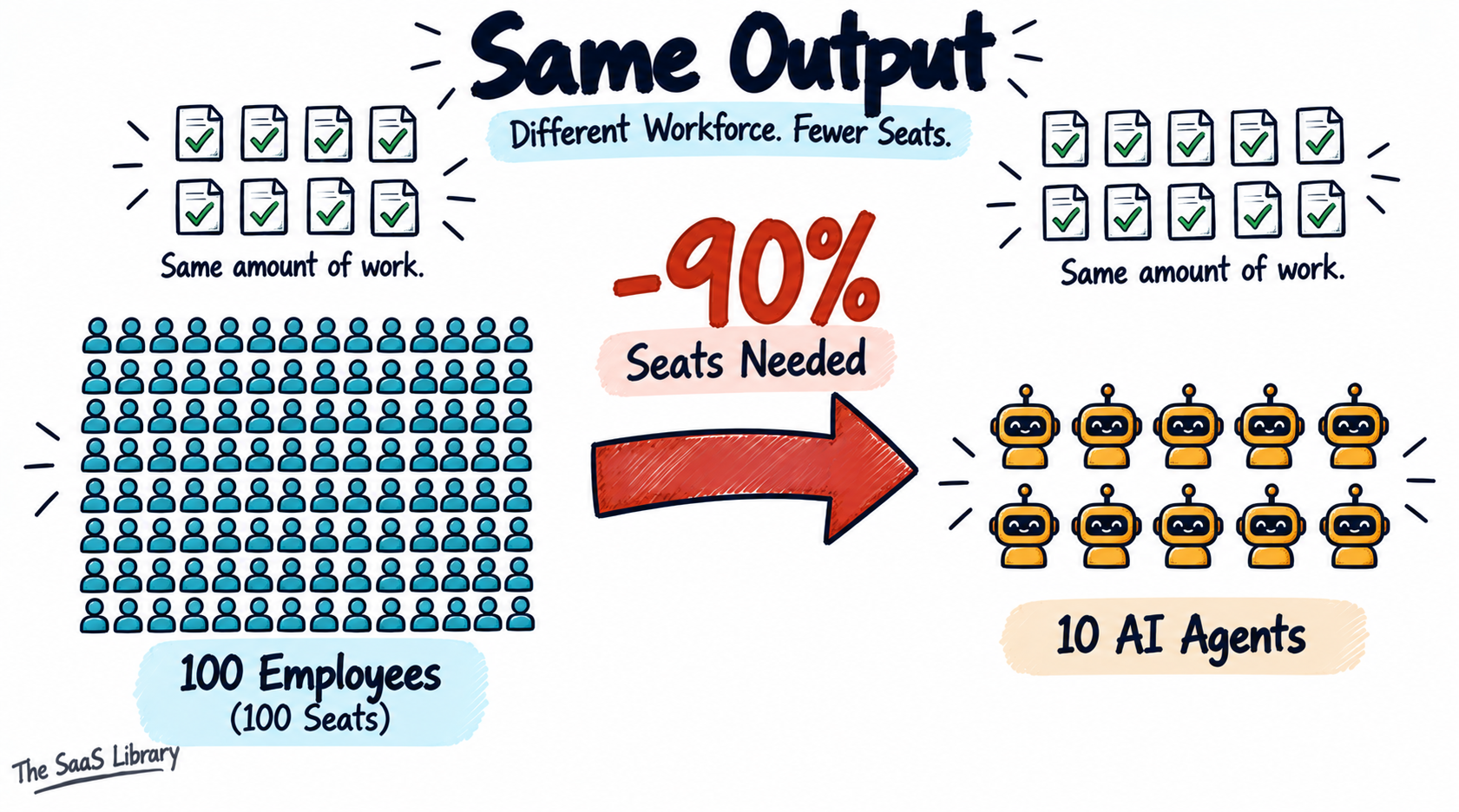
AI agents threatened SaaS’s business model because they attacked the core unit almost every SaaS company charges for: the seat. Most enterprise software is priced per user, per month — the classic subscription model that built the industry over the past two decades. If a single AI agent could do the work of ten employees, the math implied SaaS vendors would need to sell 90% fewer seats to the same customer, even if that customer’s actual output stayed the same.
That fear had a name inside investment banks before it had a name on trading floors. Palantir CEO Alex Karp gave it its clearest public voice on a February 2026 earnings call, arguing AI had become capable enough at managing enterprise workflows that many SaaS companies risked becoming irrelevant (Fortune, Feb 4, 2026). Karp’s comments triggered a fresh $300 billion round of selling across software and chip stocks within days.
Three separate, credible voices weighed in on how real the threat actually was — and they didn’t agree:
| Voice | Position | Source |
|---|---|---|
| Vivek Arya, Senior Analyst, Bank of America | Called the selloff “internally inconsistent” — the market couldn’t rationally believe AI capex would fail AND that AI would obsolete all software at once | Fortune |
| UBS Group | Estimated private credit default rates could hit 13% in a worst-case AI disruption scenario | Bloomberg |
| Matt Garman, CEO, AWS | Called much of the fear “overblown,” but acknowledged incumbents genuinely had to “go win this again” | CNBC / The Register |
If AI investment was strong enough to disrupt software at that scale, the capital spending behind it couldn’t simultaneously be failing — yet the market was pricing in both at once. That contradiction didn’t stop the fear from reaching markets far beyond public equities. UBS Group estimated that between 25% and 35% of the roughly $1.7 trillion private credit market carried meaningful exposure to AI disruption risk (SWI swissinfo.ch, Feb 2, 2026). This detail matters — the fear wasn’t confined to day traders reacting to a headline, it had reached the credit desks that price risk on decade-long loans.
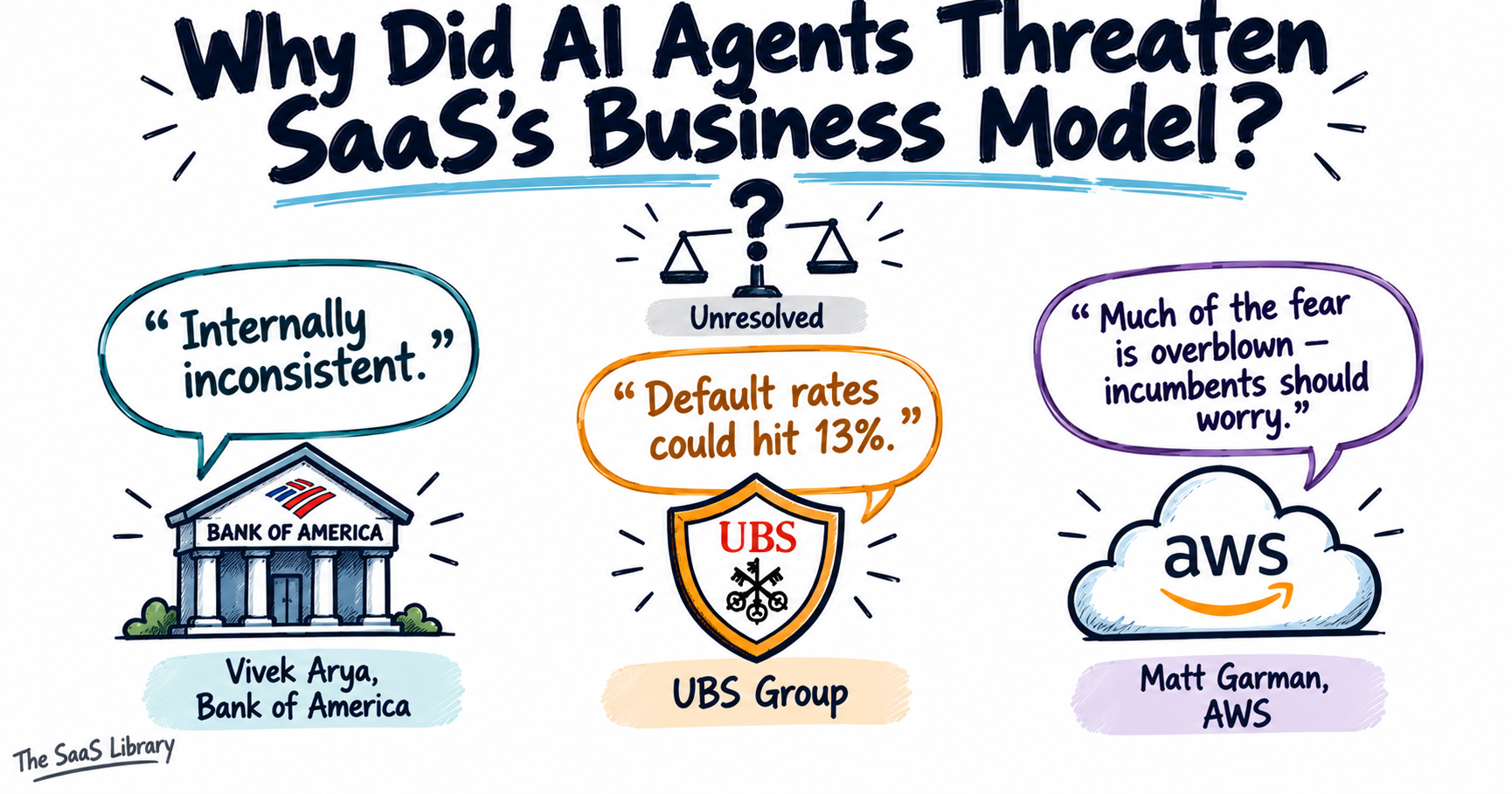
Even Matt Garman, CEO of Amazon Web Services — the cloud infrastructure many AI agents actually run on — didn’t dismiss the disruption outright. Pressed to elaborate two months after calling the fear “overblown,” he was direct: “Every time there is a technology disruption, it is absolutely something that incumbents should worry about… it effectively takes all of the business that’s out there, the trillions of dollars of SaaS products and software products, and dumps them on the table, it says everybody has to go win this again,” (The Register, Apr 7, 2026).
Garman also noted, in the same remarks, that incumbents held real advantages — an existing customer base, deep domain knowledge, and troves of workflow data competitors would need years to replicate. The threat was real, but so was the incumbents’ starting position.
That was the actual shape of the threat by spring 2026: not a settled verdict that SaaS was finished, but a genuine, unresolved argument between people who controlled real capital. The forward price-to-earnings ratio for enterprise software compressed from roughly 39x to 21x in just a few months (Forbes, Feb 4, 2026) — while nobody, including the people running the affected companies, could yet say with confidence which side of Arya’s contradiction would prove true.
See how this same pressure was already reshaping enterprise pricing before the SaaSpocalypse hit.
Read: The Death of Per-Seat Pricing →How Did Salesforce Prove the Panic Wrong?
Salesforce proved the panic wrong by posting three consecutive quarters of accelerating AI-product revenue, then partnering directly with the company whose technology was supposed to replace it. Where the SaaSpocalypse thesis predicted shrinking seat counts and cratering demand, Salesforce’s own numbers moved in the opposite direction, quarter after quarter, in full public view.
| Quarter | Agentforce ARR | YoY Growth |
|---|---|---|
| Q4 FY26 (Feb 2026) | $800 million | — |
| Q1 FY27 (May 2026) | $1.2 billion | +205% |
| Q2 FY27 (Aug 2026) | $1.5 billion | +240% |
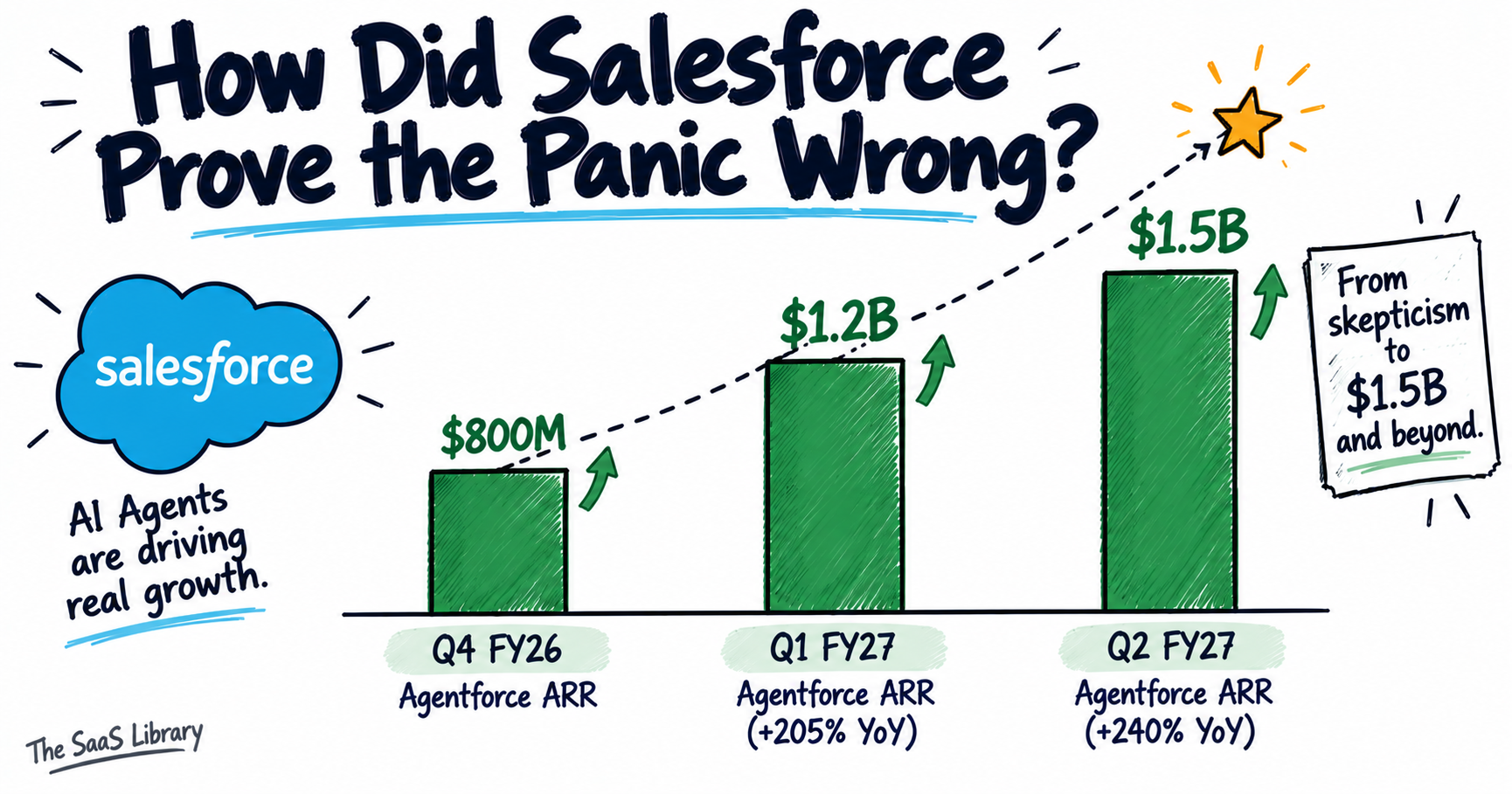
The August 2026 report did more than beat estimates. Net new annual order value posted its strongest growth in four years, seats grew across Agentforce, Sales, Service, and Slack rather than shrinking, and customer attrition sat near its lowest level in company history (CNBC, Aug 29, 2026). Salesforce shares jumped more than 12% on the results (Yahoo Finance, Aug 2026).
Marc Benioff backed the claim with a specific figure: nine of the ten leading AI companies were now Salesforce customers, with their combined spending on the platform up 435% year-over-year (Tekedia, Aug 27, 2026).
The same earnings day produced the twist nobody had priced in. Benioff appeared alongside Dario Amodei, Anthropic’s co-founder and CEO, to announce “Claudeforce” — an integration bringing Salesforce’s customer data directly into Claude’s agentic workflows (CNBC, Aug 26, 2026). The company whose product had triggered the original panic was now building on top of the company it was supposed to make obsolete.
Amodei explained why on the same call: “We’re not interested in destroying anyone. We think of this as a very positive sum thing,” (CNBC, Aug 26, 2026). He pointed to permissions and data governance — Anthropic built “enterprise frontier safeguards” to keep customer data on Salesforce’s side of the boundary rather than replicating decades of access-control infrastructure from scratch.
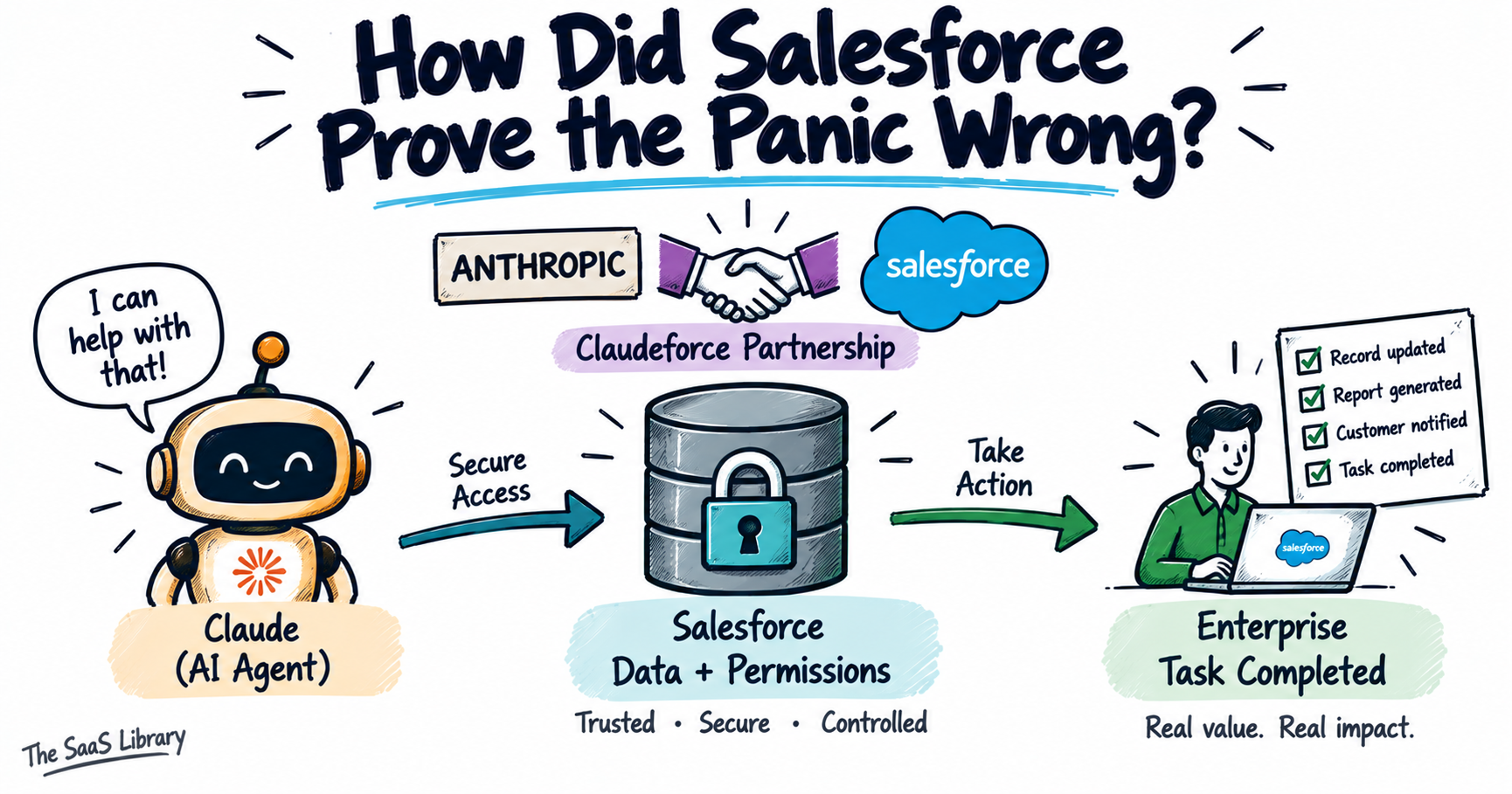
That detail is the actual mechanism behind the reversal, not just the headline. An AI agent that can draft an email doesn’t need much context. An AI agent that can act inside a business — updating a customer record, closing a deal stage — needs exactly what Salesforce already had: permissions, audit trails, and eighteen years of enterprise trust infrastructure. Anthropic didn’t need to defeat that layer. It needed to plug into it. For a deeper look at how permissions and control gaps are shaping enterprise AI agent deployments more broadly, see our piece on the AI agent governance gap.
That single mechanism — agents needing a trusted data and permissions layer more than they need to replace it — is also the thread the next section picks up with independent, third-party evidence.
What Is RenaiSaaS, and What Does the Data Actually Show?
RenaiSaaS is the term Stripe’s economics team coined to describe what its own transaction data revealed: SaaS revenue didn’t just survive the SaaSpocalypse, it grew faster than it had before the panic started. The name and the finding both come from the same source — a report titled “The SaaSpocalypse was more like a RenaiSaaS,” built entirely on real payment data rather than company self-reporting or market sentiment (Stripe Economics, 2026).
This distinction matters more than it might first appear. Every figure discussed in Sections 1 through 3 — Salesforce’s ARR, Benioff’s claims, the stock price swings — came either from the companies themselves or from how investors reacted to them. Stripe’s data comes from neither. It measures actual money moving through actual SaaS businesses, independent of what any CEO says on an earnings call or how any trader feels on a given Tuesday.
How the measurement works: Stripe built the Stripe SaaS Index — a weekly, same-business measure of non-AI SaaS revenue based on real pay-in volume across an average of 72,000 businesses per week in 2026. Because it tracks the same businesses over time, the index isn’t distorted by Stripe gaining or losing market share — it shows what’s actually happening inside SaaS companies’ revenue lines, updated weekly rather than once a quarter.
| Metric | Result | Timeframe |
|---|---|---|
| Year-on-year SaaS revenue growth | Above 30% — at or above prior highs from summer 2023 | As of 2026 |
| Index level vs. pre-SaaSpocalypse trend | 4% higher than trend | 2026 |
| Growth, May–Dec 2025 (pre-crash baseline) | +14% | 8 months |
| Growth, Jan 2026 onward (post-crash) | +21% | Same-year comparison |
All figures above from a single source: Stripe Economics, “The SaaSpocalypse was more like a RenaiSaaS,” 2026.
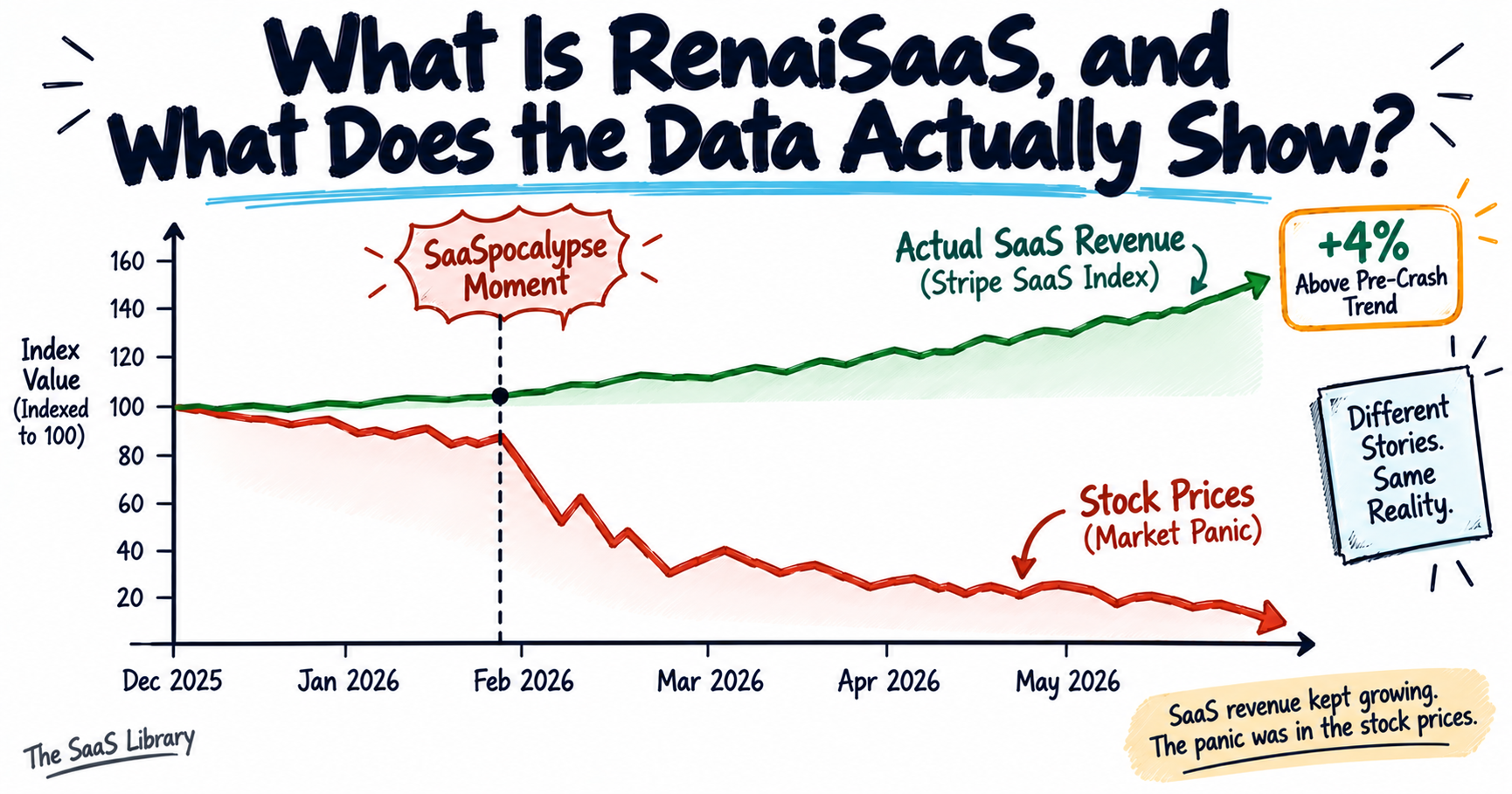
Read plainly, this is the gap at the center of the entire story: while software stocks were losing hundreds of billions in market value, the underlying businesses behind those stocks were growing revenue faster than before the panic began. The stock market and the businesses it claimed to be pricing told two different stories.
That gap is also what separates this claim from simple corporate optimism. Salesforce saying its own numbers are strong is a company defending itself. An independent payments processor showing that SaaS revenue broadly — not just one company’s — accelerated past its own historical trend is a different, stronger kind of evidence. It’s the difference between a defendant’s testimony and an auditor’s report.
None of this means every SaaS company shared equally in the recovery. Stripe’s index measures the sector in aggregate, and aggregates can hide real winners and real casualties sitting inside the same average. Our earlier analysis of B2B SaaS trends in 2026 breaks down which specific categories were pulling that average up versus down. Sorting out which SaaS companies actually earned their place in the RenaiSaaS — and which ones were just riding the sector average — is exactly what separates survivors from casualties, and it’s where this article turns next.
What Separates the SaaS Companies That Survived? The MOAT Framework
What separated the SaaS companies that survived the SaaSpocalypse from those that didn’t was not luck or company size — it was whether they did four specific things in response to AI agents entering their market. Looking across every recovery story covered so far, the same four moves show up again and again. Together, they form a framework worth naming: MOAT — Metering, Outcome pricing, Agent integration, and Trust in proprietary data.
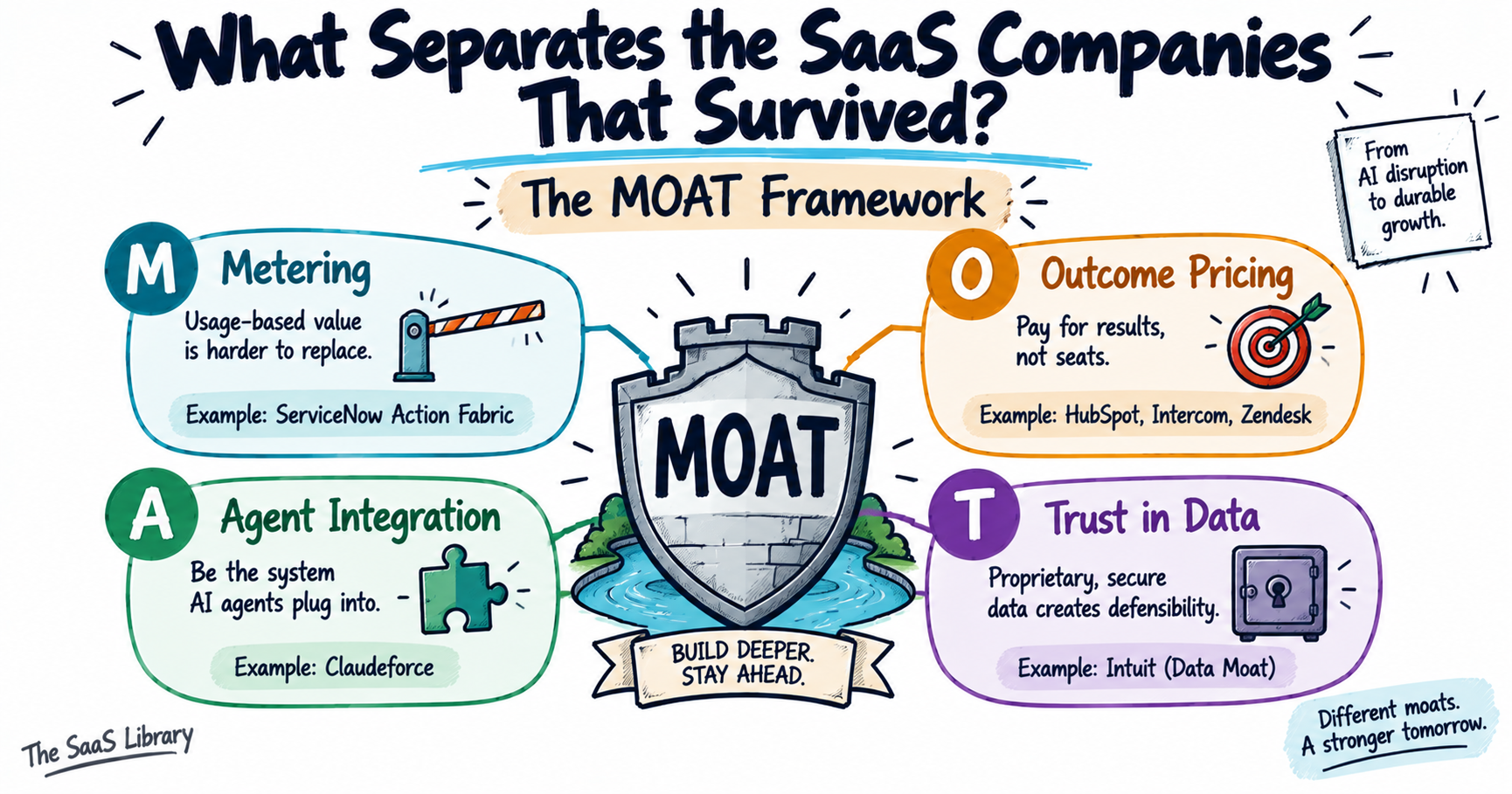
M — Metering: Rather than treating external AI agents as a threat to keep out, ServiceNow built a toll gate and charged for entry. At its Knowledge 2026 event, the company unveiled Action Fabric, an integration layer any external AI agent — including Claude — must pass through to access data or execute workflows inside ServiceNow’s platform (PYMNTS, May 8, 2026). Every action agents take runs through the company’s AI Control Tower, so it is “identity-verified, permission-scoped, and fully auditable,” (ServiceNow Newsroom, 2026). Pricing is action-based — customers pay according to how many operations an agent completes through the layer.
O — Outcome Pricing: Several customer-support platforms rebuilt pricing around what an agent actually accomplishes, not how many people have a login:
| Company | Pricing Model | Rate |
|---|---|---|
| Intercom (Fin) | Per billable outcome | $0.99 |
| Zendesk | Per automated resolution | ~$1.50–$2.00 |
| HubSpot (Breeze) | Per resolved conversation | $0.50 (down from $1.00, April 2026) |
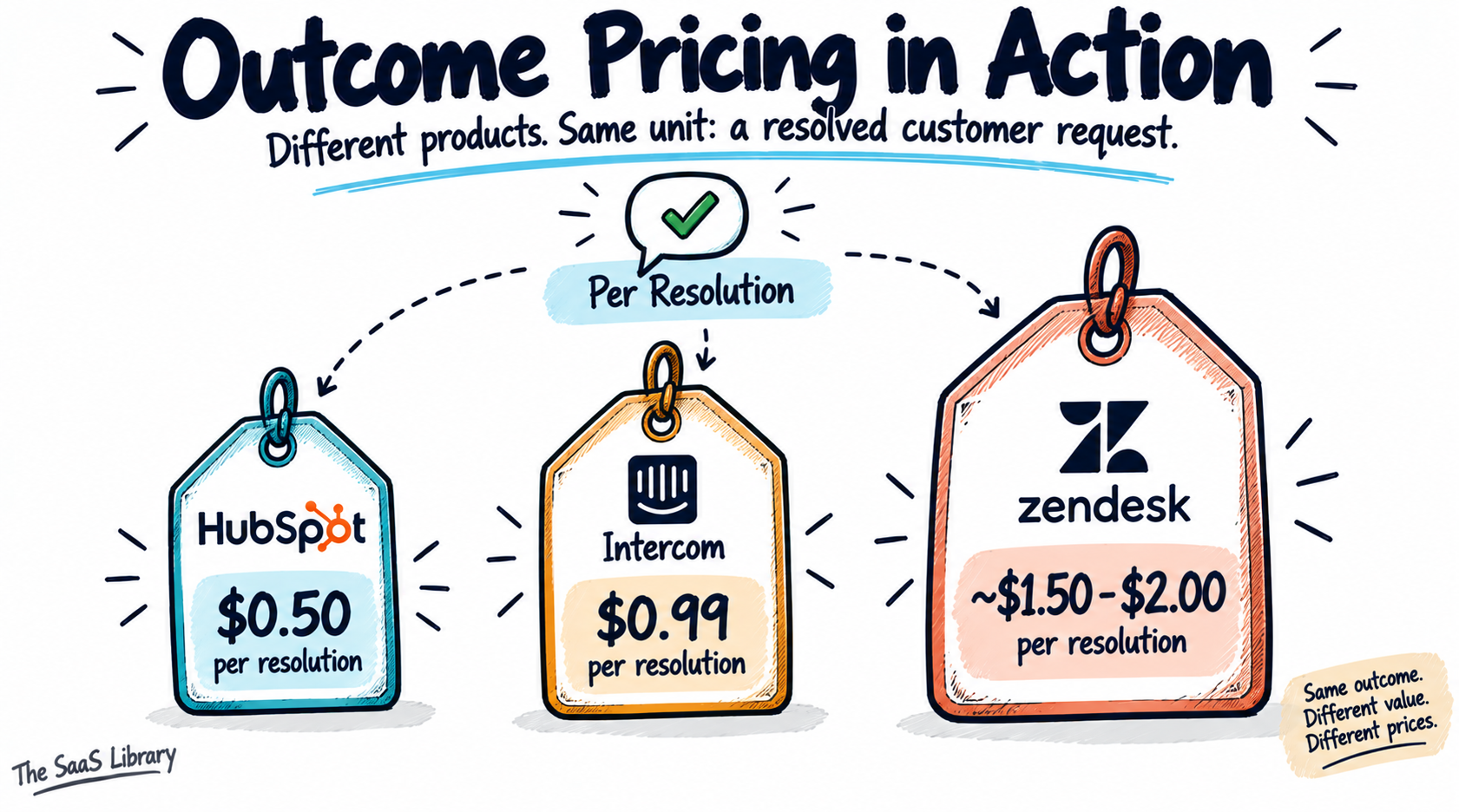
HubSpot’s shift is the most telling, precisely because of its timing. By April 2026, competitors like Sierra ($150M+ ARR on pure outcome pricing) and Intercom ($100M+ ARR on per-resolution) had already proven the model worked, making HubSpot’s move “more expected than bold” rather than a leap of faith (SaaStr, Apr 9, 2026). This is the seat-pricing collapse predicted in Section 2 — except instead of destroying these businesses, it became their next pricing model.
A — Agent Integration: This is the mechanism already covered in Section 3 — Salesforce didn’t out-build Anthropic’s models, it became the trusted data and permissions layer Anthropic’s models needed to operate inside real businesses. The Claudeforce partnership is MOAT’s clearest case study.
T — Trust in Data: Intuit‘s leadership has been explicit that its competitive position rests on data no outside AI company can access — proprietary financial data, deep domain expertise, and platform orchestration capabilities (Investing.com, 2026). That data moat is already generating measurable outcomes: Intuit’s AI agents categorized 237 million transactions in a single month, with 2.8 million customers actively using its AI agents and an 80% repeat engagement rate (Kavout, 2026).
Check your own product against MOAT: Could you charge for external agent access to your data (Metering)? Could you price any part of your product by result instead of seats (Outcome Pricing)? Are you positioned as infrastructure agents plug into, or a workflow they route around (Agent Integration)? What data do you hold that a frontier model genuinely cannot replicate (Trust)? A company that can answer all four is following the same pattern that separated Salesforce, ServiceNow, Intercom, HubSpot, and Intuit from the companies still waiting to see what happens next. For more on how build-vs-buy decisions are playing out in practice, see our analysis of build vs. buy an AI agent.
Is the SaaSpocalypse Really Over?
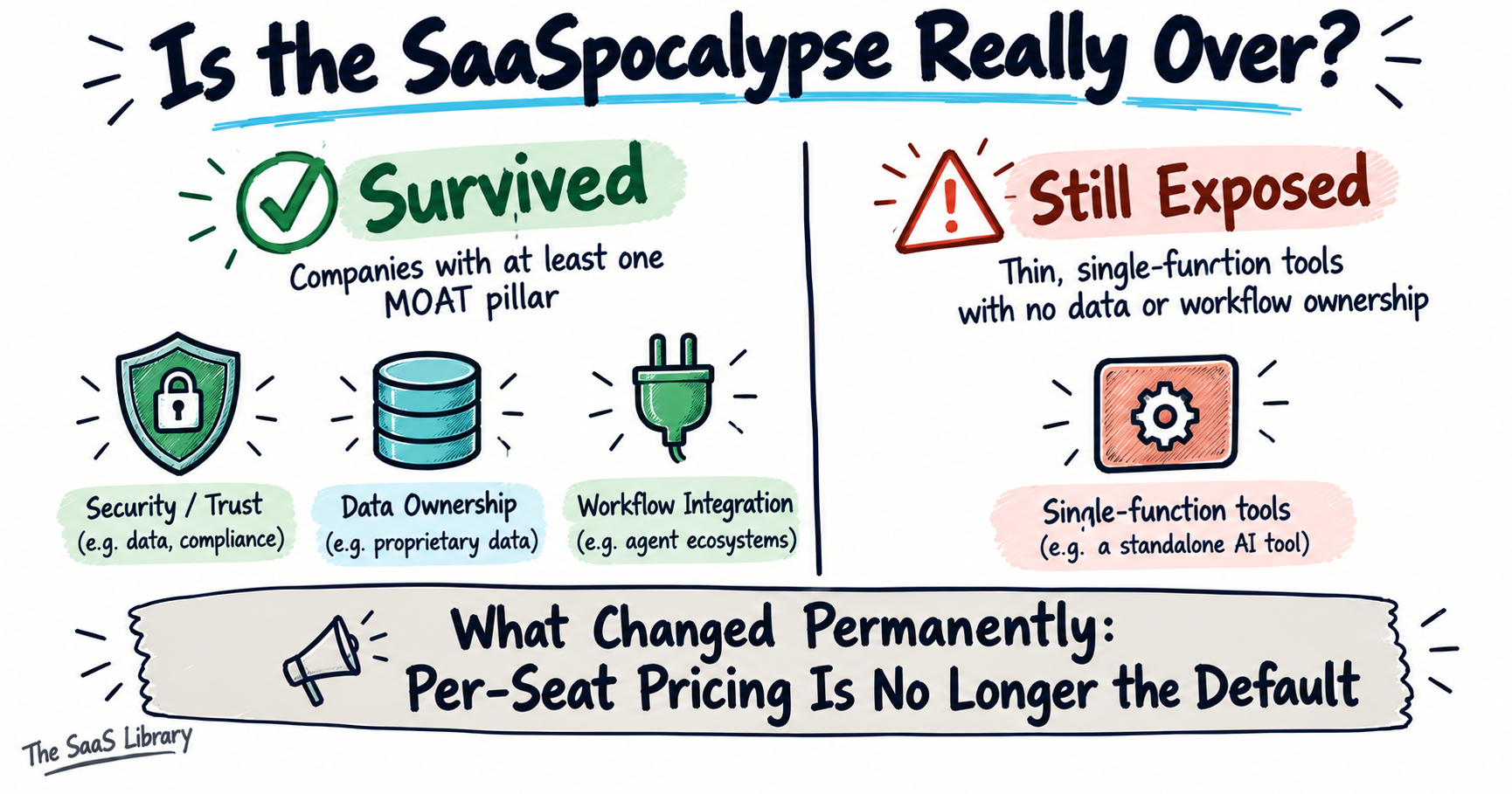
The SaaSpocalypse is not fully over, but the evidence gathered across this article shows the panic ran further than the underlying damage did — and what’s settled now looks less like software’s death and more like a permanent shift in how it gets priced. That distinction, between market perception and operational reality, is exactly how one of the industry’s own researchers described it.
Terra Higginson wasn’t dismissing the risk entirely, though. She specifically flagged single-function SaaS vendors as still genuinely exposed: “Those guys are in trouble right now. They don’t own a lot of the workflow, they don’t own a lot of the transaction, they don’t own a lot of the data, and they’re easy to replicate through vibe coding,” (Forbes, Jun 30, 2026).
That’s the honest shape of “who didn’t make it”: not an entire industry, but a specific category — thin, single-purpose tools with no data moat, no workflow ownership, and no metering, outcome pricing, agent integration, or trust advantage to fall back on. Every company covered in Section 5’s MOAT framework survived precisely because it had at least one of those four things.
Bill McDermott, ServiceNow’s CEO, framed the surviving logic sharply at the same Knowledge 2026 conference where Action Fabric launched: “Every AI pitch you’ve heard lately starts with the LLM. Intelligence is commoditizing. The real competitive differentiator is the orchestration surrounding the models,” (The SaaS Sentinel, Jul 3, 2026).
By mid-2026, software stocks had rebounded roughly 13% from their worst SaaSpocalypse-era lows (Forbes, Jun 30, 2026) — not a full recovery to pre-panic valuations, but a clear signal the market’s most extreme fears had been repriced downward.
The per-seat license — the pricing unit that built the SaaS industry for two decades — is no longer the default answer to “how do we charge for this.” Every company that survived did so by attaching its revenue to something AI agents can’t easily commoditize: metered data access, delivered outcomes, integration trust, or proprietary information. The vendors didn’t disappear. The unit they used to sell by did.
That closing point brings the story back to where it started: one phrase, coined by a single Jefferies trader named Jeffrey Favuzza, moved more capital in 48 hours than most product launches move in a decade. Eighteen months later, the businesses behind that panic mostly survived it — but the pricing model the phrase was named after did not. Whether that counts as the SaaSpocalypse ending, or simply pausing until the next AI release forces the same question again, is the one thing even the people who lived through it aren’t yet willing to say for certain.
Frequently Asked Questions
Is the SaaSpocalypse over?
The SaaSpocalypse is largely over as a stock-market panic, with software stocks rebounding roughly 13% from their worst 2026 lows, but its effect on SaaS pricing is permanent. Per-seat licensing is no longer the default pricing model, even though most major SaaS vendors survived the selloff.
What caused the SaaSpocalypse?
The SaaSpocalypse was triggered by Anthropic’s release of 11 open-source Cowork plugins on January 30, 2026, which showed AI agents could handle specialized business workflows in legal, sales, finance, and marketing. Roughly $285 billion was erased from software stocks within 48 hours as investors feared AI agents would replace per-seat software licenses.
Who coined the term “SaaSpocalypse”?
Jeffrey Favuzza, an equity trader at Jefferies, coined the term “SaaSpocalypse” in comments to Bloomberg on February 3, 2026, describing the software stock selloff as “get me out” style trading.
What is RenaiSaaS?
RenaiSaaS is a term coined by Stripe’s economics team to describe the resilience and revenue recovery of SaaS companies following the 2026 SaaSpocalypse selloff. Stripe’s own transaction data showed SaaS revenue growth accelerated to roughly 4% above its pre-crash trend, based on real payment volume rather than company self-reporting.
Will AI agents replace SaaS companies?
AI agents are unlikely to fully replace established SaaS companies, particularly those that own proprietary data, complex workflows, or systems of record. AI agents generally need the permissions, data, and trust infrastructure that incumbent SaaS platforms already have, which is why companies like Anthropic ended up partnering with Salesforce rather than replacing it.
What is outcome-based pricing?
Outcome-based pricing charges customers for a completed result rather than for a monthly seat. Examples include Intercom’s Fin charging $0.99 per resolved conversation, Zendesk charging roughly $1.50–$2.00 per automated resolution, and HubSpot’s Breeze charging $0.50 per resolved conversation.
What is Claudeforce?
Claudeforce is a partnership announced in August 2026 between Salesforce and Anthropic that integrates Salesforce’s customer data into Claude’s agentic AI workflows. It allows Claude’s agents to operate using Salesforce’s permissions, data governance, and enterprise trust infrastructure rather than replacing it.
What is ServiceNow’s Action Fabric?
Action Fabric is an integration layer ServiceNow launched in 2026 that requires external AI agents, including Claude, to pass through it to access data or execute workflows inside ServiceNow’s platform. Usage is metered and billed based on the number of actions an agent completes.
Which SaaS companies are still at risk from AI disruption?
According to Info-Tech Research Group, thin, single-function SaaS tools that don’t own significant workflow, transaction, or data volume remain the most exposed to AI disruption, since they are the easiest for AI agents or “vibe coding” to replicate.
Is per-seat pricing dead?
Per-seat pricing is no longer the default pricing model across the SaaS industry, even though it hasn’t disappeared entirely. Many major SaaS companies have shifted toward metered, outcome-based, or hybrid pricing models that charge based on usage or results rather than the number of user seats.
Conclusion
If you run a SaaS product today, the SaaSpocalypse already ran the test your business will eventually face. The MOAT Framework — Metering, Outcome pricing, Agent integration, and Trust in data — is the diagnostic that separated the companies that survived from the ones still exposed.
One trader’s phrase moved more capital in two days than most product launches move in a decade, and it permanently killed the per-seat license as SaaS’s default pricing unit — even for the companies that survived everything else about it.
Want to see how these same pricing shifts are playing out across the broader SaaS market? Read our full breakdown of B2B SaaS trends in 2026.
- VentureBeat — Anthropic launches Cowork, Jan 12, 2026
- TechCrunch — Anthropic enterprise agent plugins, Feb 24, 2026
- Bloomberg — “Get Me Out”: Traders Dump Software Stocks, Feb 3, 2026
- The Motley Fool — Why Monday.com Stock Lost 37%, Mar 2026
- Yahoo Finance / S&P Global — Monday.com stock collapse, Jul 2026
- Workday Newsroom — CEO Transition Announcement, Feb 9, 2026
- Fortune — Why the Tech Selloff “Doesn’t Make Sense,” Feb 4, 2026
- Bloomberg — Private Credit Defaults Would Hit 13%, Feb 2, 2026
- SWI swissinfo.ch — UBS Private Credit Warning, Feb 2, 2026
- CNBC — AWS CEO Garman: Fears Overblown, Feb 12, 2026
- The Register — AWS CEO on AI Overhype, Apr 7, 2026
- Forbes — $300 Billion Evaporated, Feb 4, 2026
- Salesforce Investor Relations — Q4 FY26 Results
- Salesforce Newsroom — Q1 FY27 Results, May 27, 2026
- Salesforce Investor Relations — Q2 FY27 Results, Aug 26, 2026
- CNBC — Benioff Calls SaaSpocalypse “Nonsense,” Aug 26, 2026
- Tekedia — 435% AI Spending Surge, Aug 27, 2026
- CNBC — Exclusive Transcript: Benioff & Amodei, Aug 26, 2026
- CNBC — Op-ed: Salesforce Reveals Next AI Battleground, Aug 29, 2026
- Stripe Economics — “The SaaSpocalypse Was More Like a RenaiSaaS,” 2026
- PYMNTS — ServiceNow, SAP, Workday Make AI Agents Pay to Play, May 8, 2026
- ServiceNow Newsroom — Action Fabric Announcement, 2026
- Featurebase — Intercom Pricing 2026, Jul 2026
- Getmacha — Zendesk vs. Intercom Pricing, Jun 2026
- SaaStr — HubSpot’s Pricing Shift, Apr 9, 2026
- Investing.com — Intuit at Goldman Sachs Conference, 2026
- Kavout — Is Intuit’s AI Strategy Real?, 2026
- Forbes — “SaaSpocalypse Maybe Ending, But SaaS Will Never Be the Same,” Jun 30, 2026
- The SaaS Sentinel — SaaSpocalypse 2026 Market Status, Jul 3, 2026