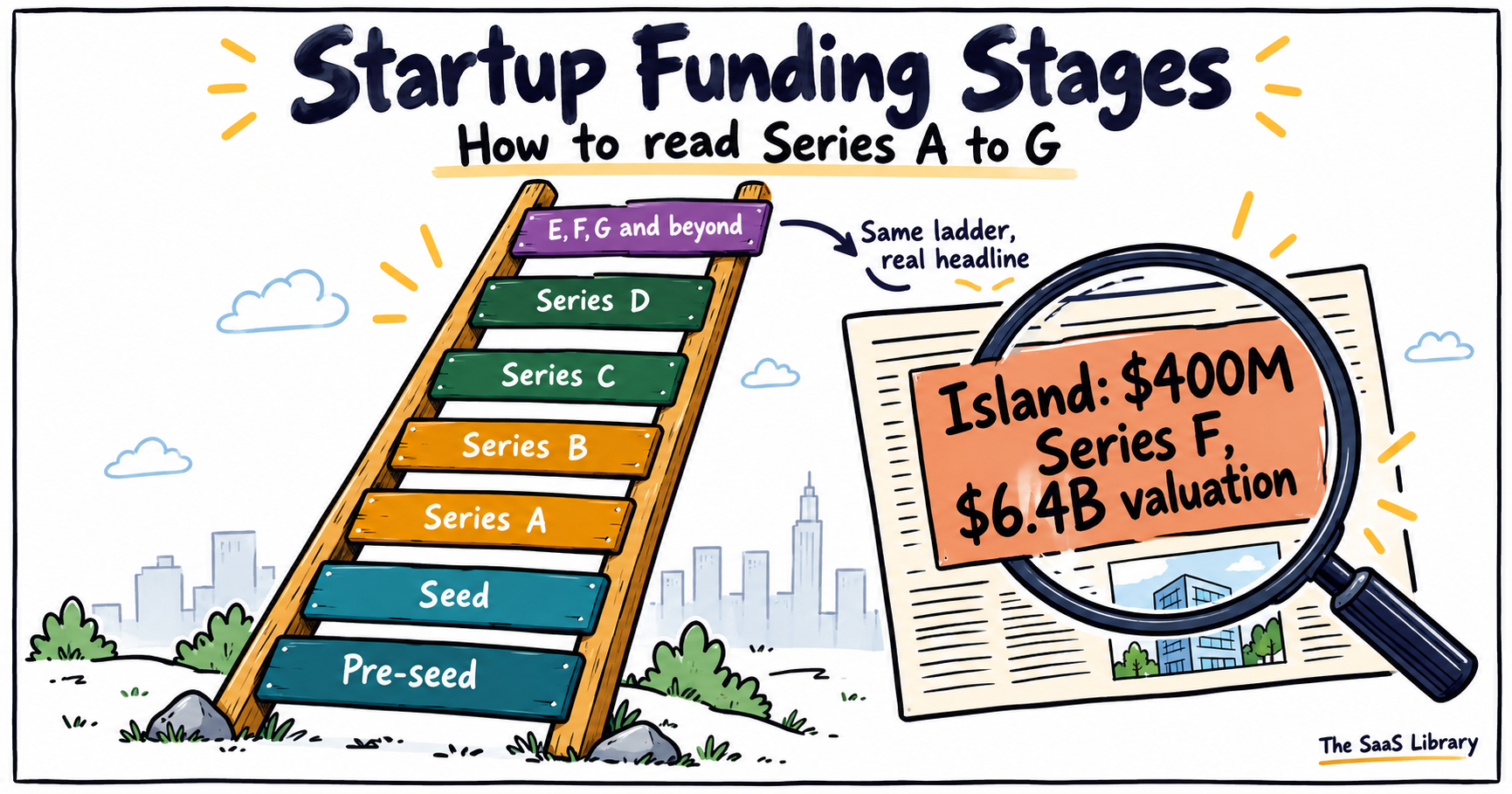
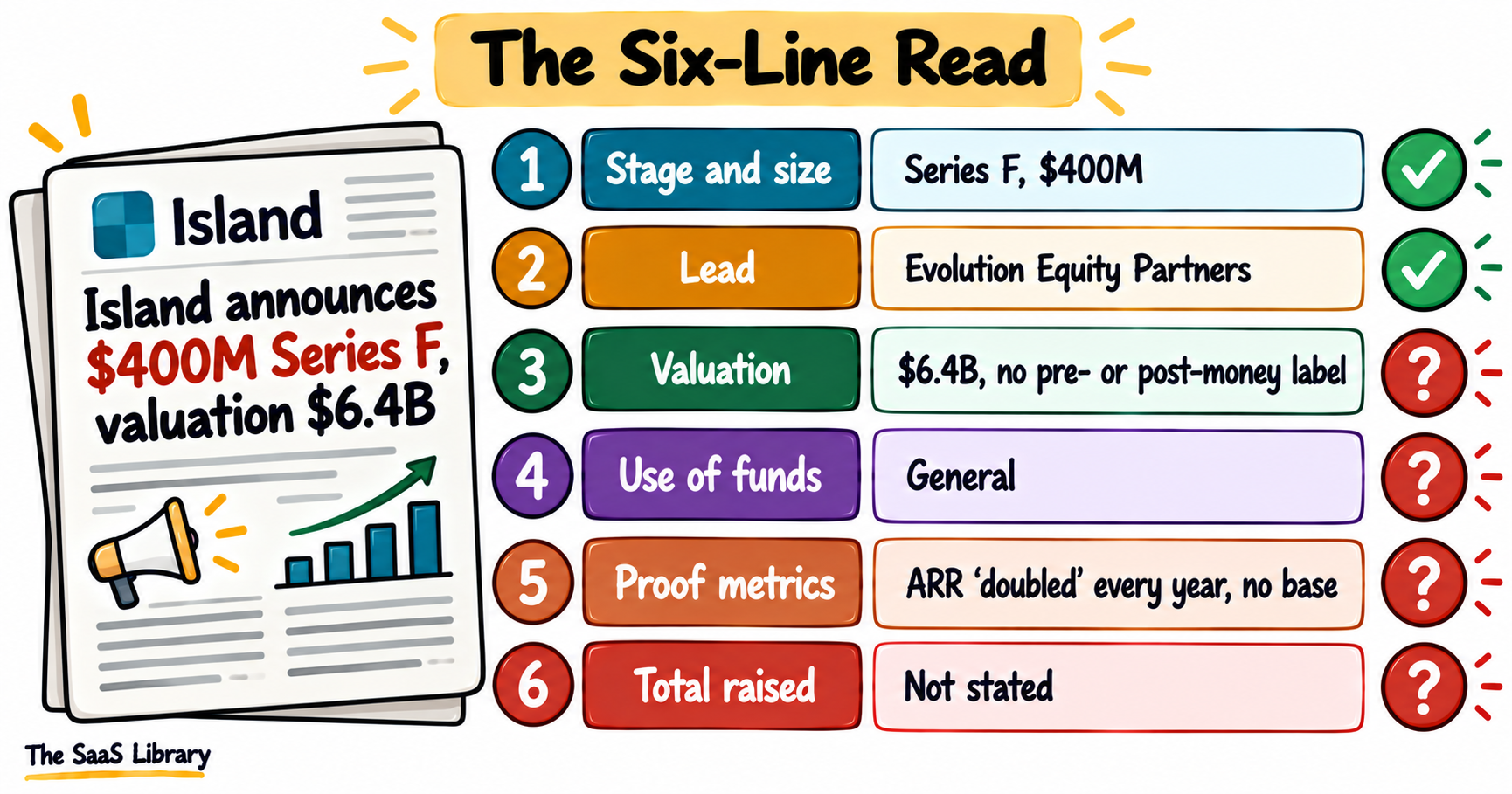
On September 24, 2026, Island announced a $400 million Series F and a $6.4 billion valuation. The headline sounds huge, yet it leaves out three things: what “Series F” measures, what the valuation means, and who gets paid if it goes wrong.
This guide walks one fictional company through every stage, then tests you on real deals.
Startup funding stages are the sequence of investment rounds a software company raises as it grows:
- Pre-seed.
- Seed.
- Series A, B, C and onward.
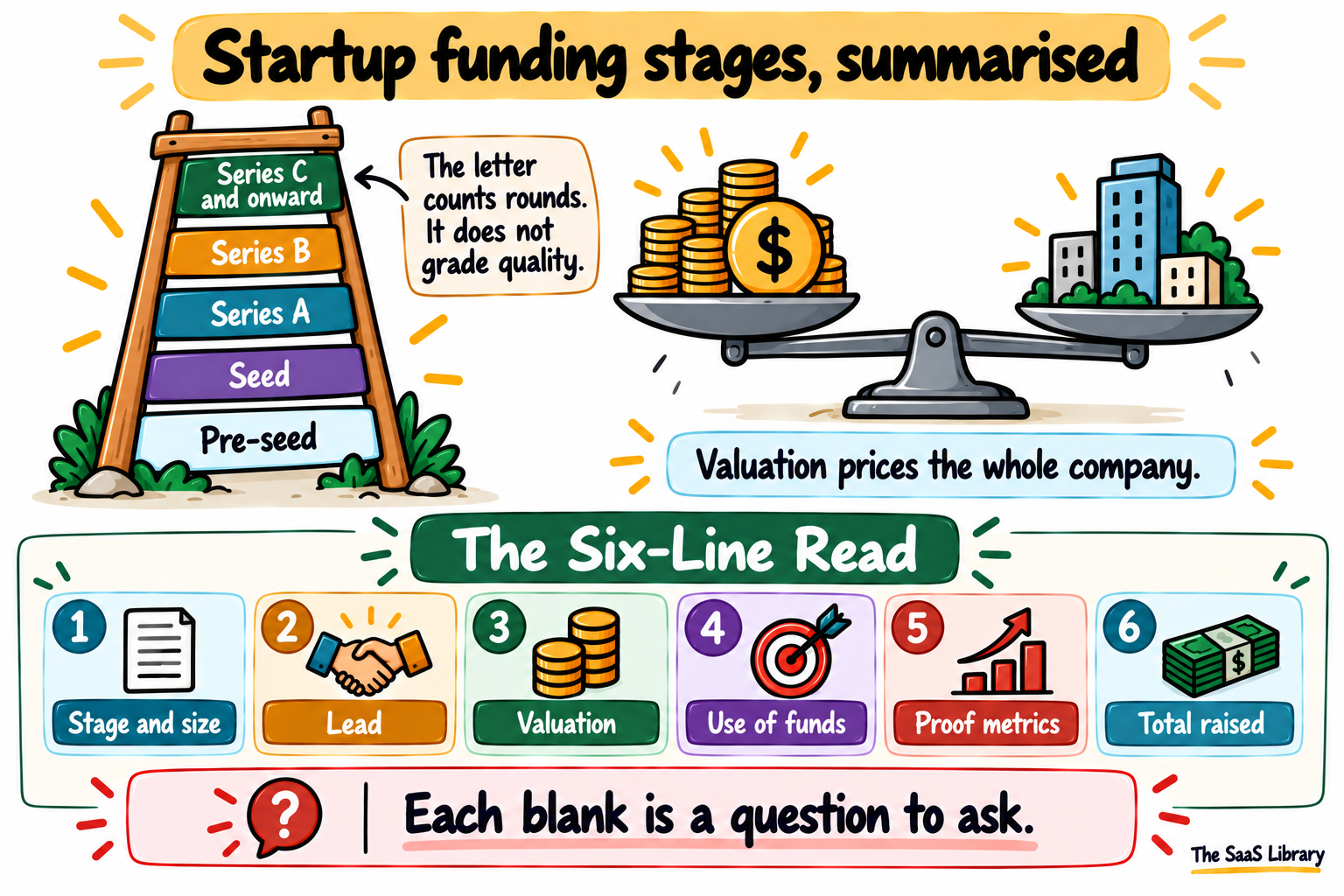
The letters record the order of the rounds, not the amount raised. Most rounds sell equity, such as preferred stock, to new investors.
Preferred stock is stock primarily issued to investors when they finance funding rounds, and common stock is a type of stock generally issued to founders and early employees, according to Carta’s glossary.
What does a funding headline actually tell you?
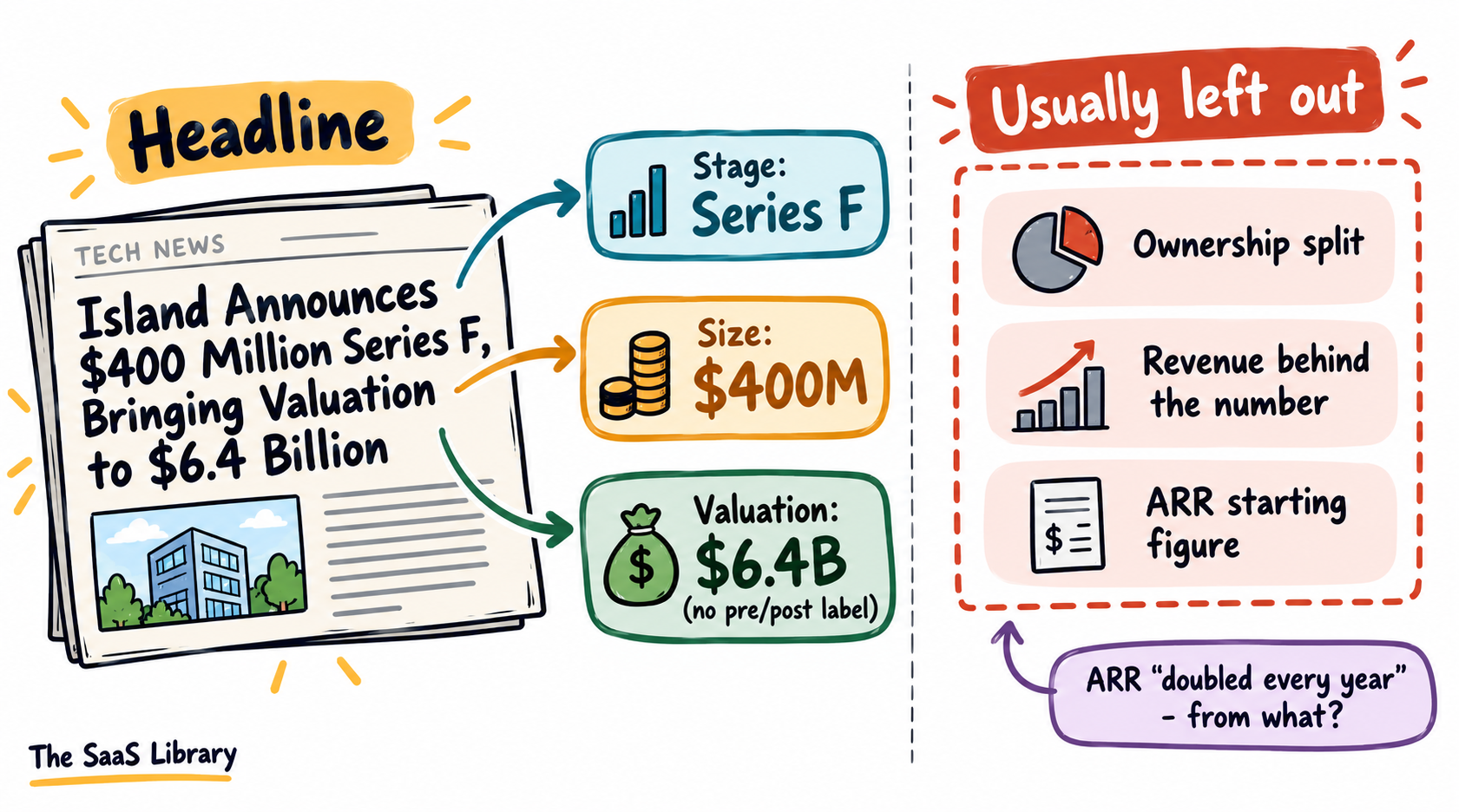
A funding headline tells you three things:
- The round’s stage.
- Its size.
- One valuation figure (sometimes).
The stage names the round’s order, the size is the cash raised, and the valuation is the price investors and the company agreed on. It usually leaves out the ownership split and the revenue behind the number.
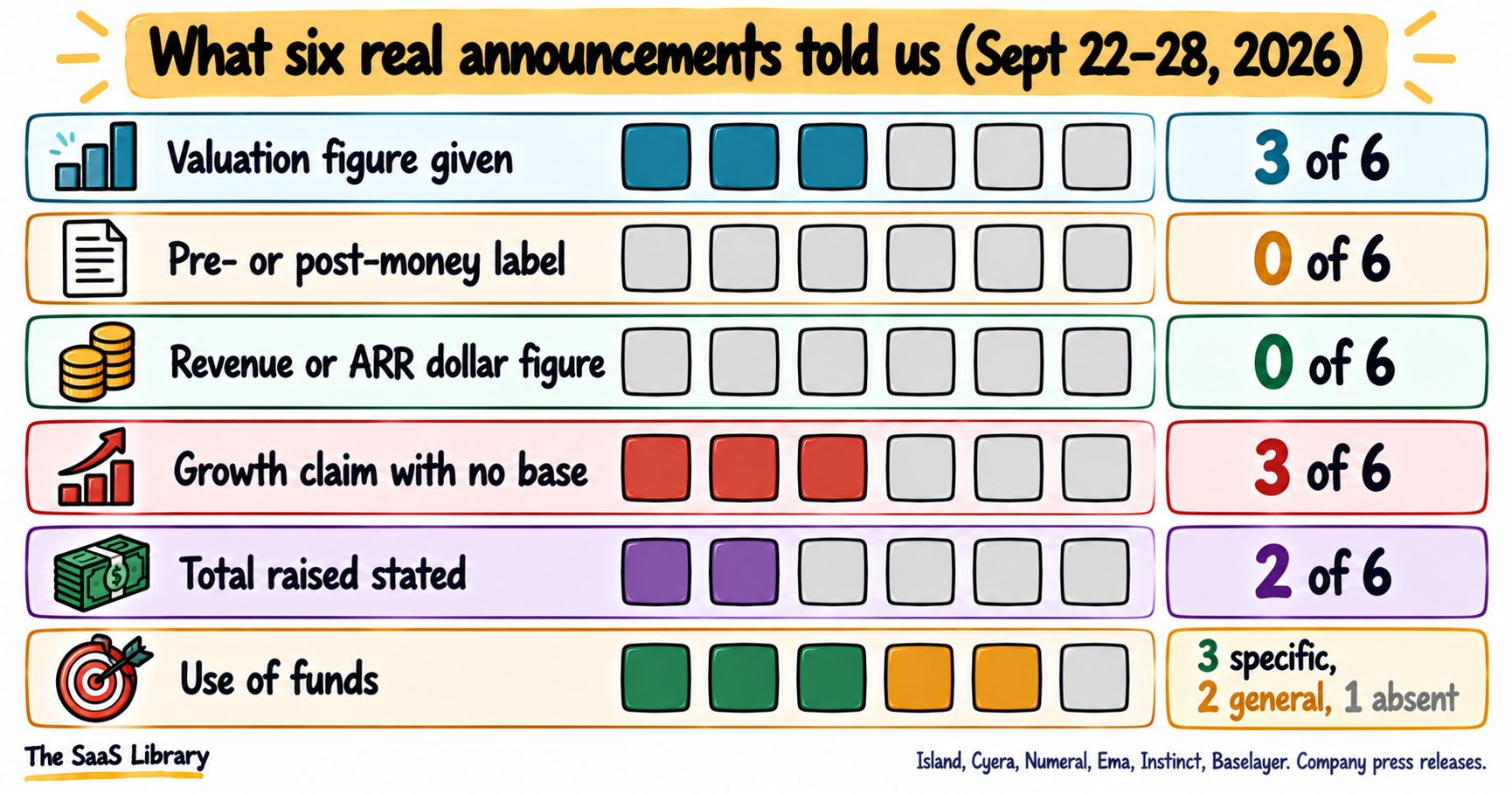
Of six announcements I checked from September 22 to 28, 2026, none labeled its valuation pre-money or post-money, and none gave a revenue figure.
Island’s release says it “has doubled annual recurring revenue (ARR) every fiscal year since its 2022 launch.” ARR is the yearly value of a company’s subscriptions. The release gives no starting figure, so “doubled” has no size.
| Starting ARR | After 4 doublings |
|---|---|
| $1M | $16M |
| $10M | $160M |
Illustrative math. Both companies “doubled every year.” The results differ by ten times.
So a growth claim without a base tells you the direction, not the size. Before you can judge any of these numbers, you need to know why the money exists at all.
Why do investors fund startups at all?
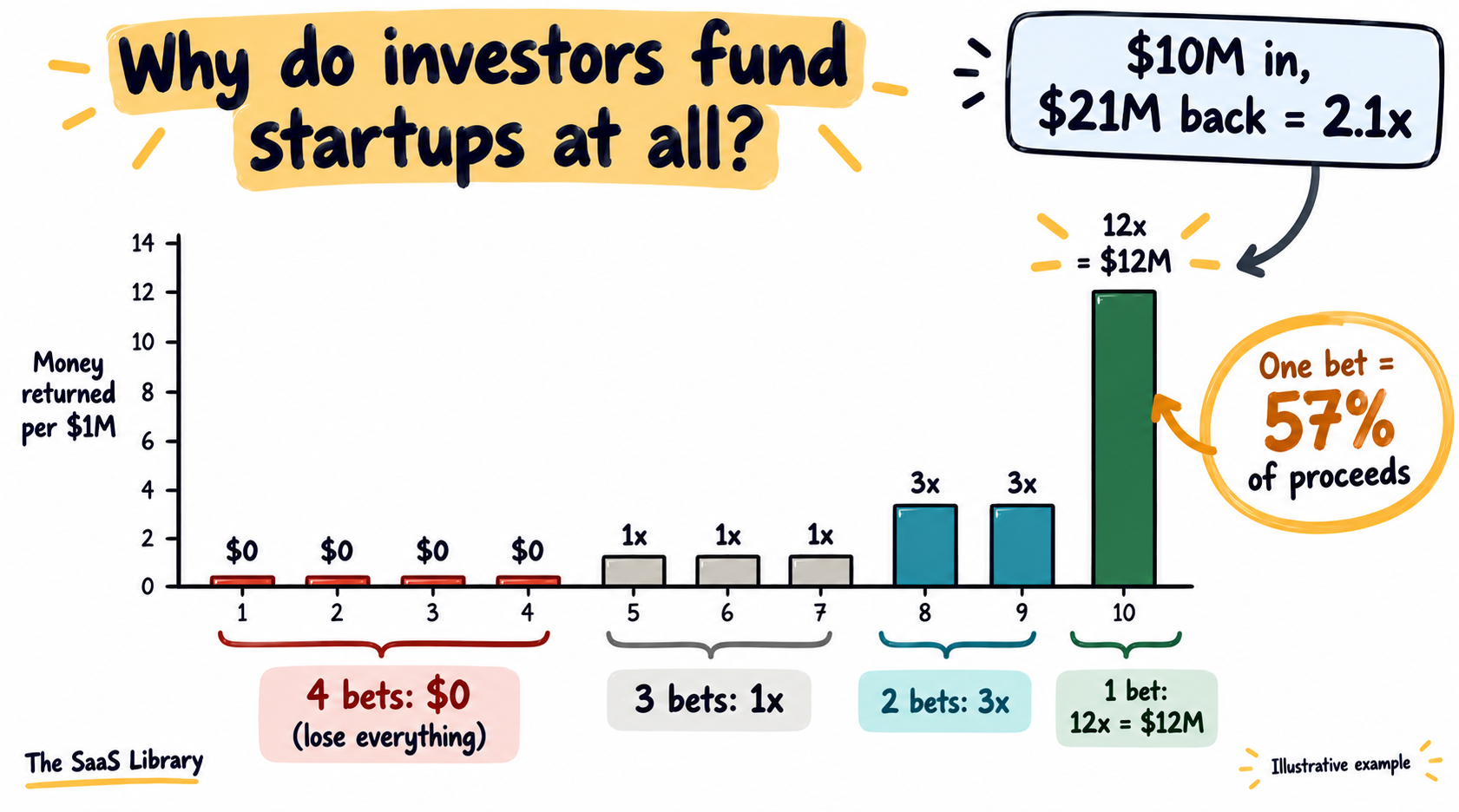
Investors fund startups because venture returns come from a few large winners, not from most companies. A venture fund spreads money across many bets, expects many to lose, and needs a small number to return many times the amount invested. Startups are built to grow fast enough to make that possible.
Correlation Ventures found in a July 2023 analysis of U.S. venture-funded companies that less than 4% of the capital invested in venture-funded companies that exited over the last decade returned 10x or more. Thirty-seven percent returned less than 1x.
Picture a fund making ten $1M bets:
| Bets | Outcome | Returned |
|---|---|---|
| 4 | Lose everything | $0 |
| 3 | Return 1x | $3M |
| 2 | Return 3x | $6M |
| 1 | Returns 12x | $12M |
Illustrative math. The fund puts in $10M and gets back $21M, or 2.1x. The single best bet supplies 57% of that.
Paul Graham defines the target:
That pressure to grow follows the company through every later stage. Next, how that money arrives: the round.
What is a funding round, and what does “Series” mean?
A funding round is one sale of new company shares to investors in exchange for cash. “Series” names the class of preferred stock sold in that round, and the letters follow the order of the rounds: A first, then B, then C. The letter tracks sequence, not size, so startup funding stages are named by order.
Meet Northloop, a fictional SaaS company. All its numbers here are illustrative. Two founders own 100%.
When Northloop raises money, it can sell equity or borrow debt. The SBA describes equity as “a share of ownership” in a business given in exchange for funding, and debt as a loan the business must pay back with any interest. Most venture money is equity.
Carta notes that the stages “follow alphabetically: Series B, Series C, Series D, and so on.” Fidelity puts the rule plainly: “it’s the order, not the amount of money, that determines whether it’s a Series A, Series B, or Series C financing (or beyond).”
So a letter tells you where a company sits in its own sequence, not how good it is. The first round in that sequence usually comes before any letter at all.
What is a seed round?
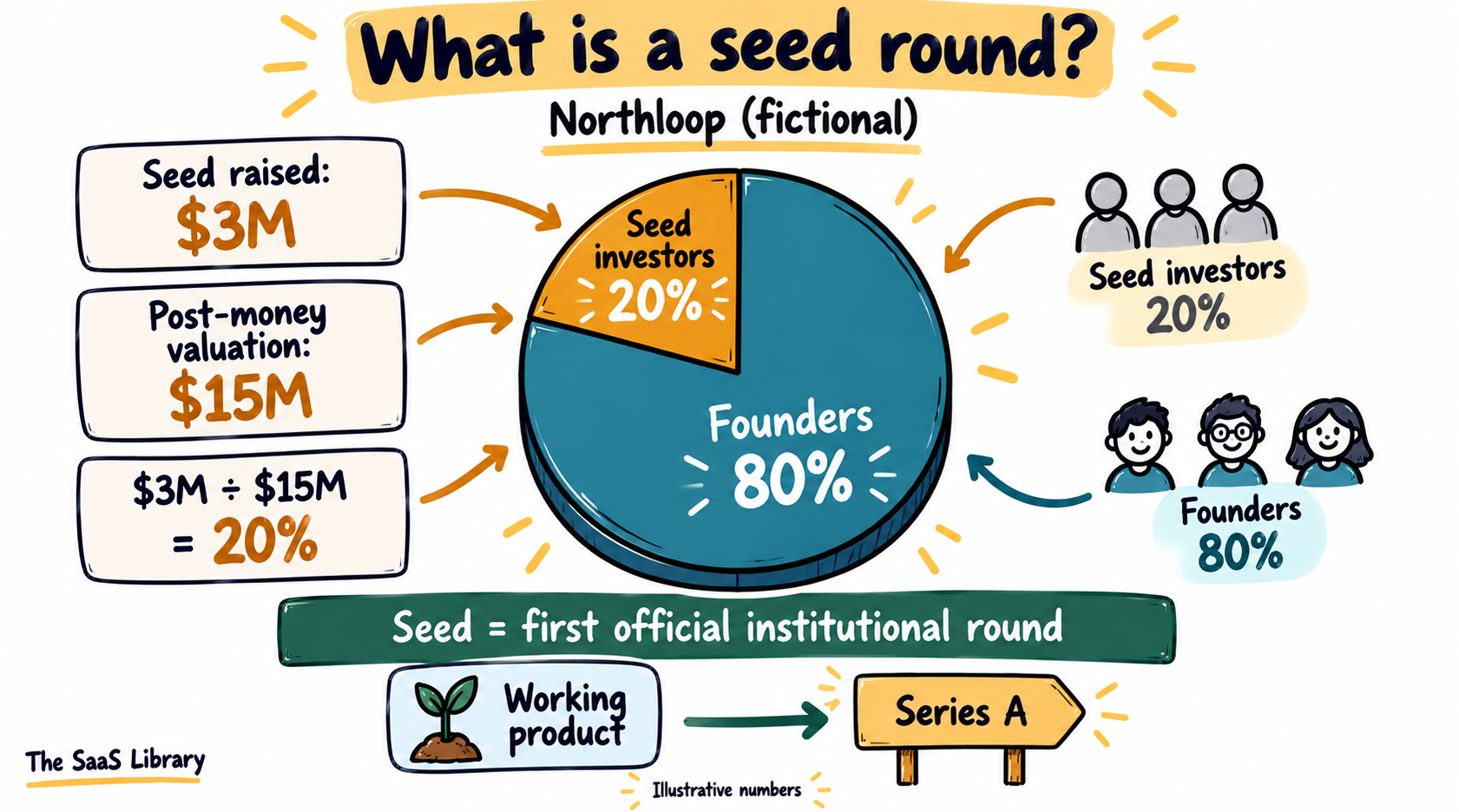
A seed round is the first official round of institutional financing a startup raises to validate its product, hire a founding team, and prove product-market fit. It carries the company from a first working product to a Series A. Seed rounds are small next to later rounds.
Carta’s data on software companies puts the median seed round at $4.1M raised at a $24.3M post-money valuation, with 18% median dilution. That covers rounds from the prior six months to July 2026, and excludes bridges and extensions. Dilution is what happens when a company issues additional shares and so reduces how much of the company existing shareholders own, per Carta’s glossary.
Northloop, our fictional company, raises a $3M seed at a $15M post-money valuation. The investors buy $3M ÷ $15M = 20%, and the founders keep 80%.
Illustrative math. Northloop’s numbers sit near the median but are not real data.
A seed round buys time to prove the product. The paper it arrives on is often not shares at all.
What is a SAFE?
A SAFE, or Simple Agreement for Future Equity, is a short contract an investor signs to fund a startup now in exchange for the right to shares later. Three features define it:
- It converts into shares automatically when the startup raises a priced round.
- It carries no interest.
- It has no maturity date.
Y Combinator introduced the safe on December 6, 2013. Its announcement said the investor buys “not debt, but something more like a warrant,” so there is no need to fix a term or an interest rate.
YC’s own example shows the cap math: raise $1M, sell 15%, and the post-money valuation cap is $1M ÷ 15% = about $6.7M. Later, holders of converted SAFEs can receive a parallel class, often called Series A-1 Preferred Stock, so their rights match their lower price.
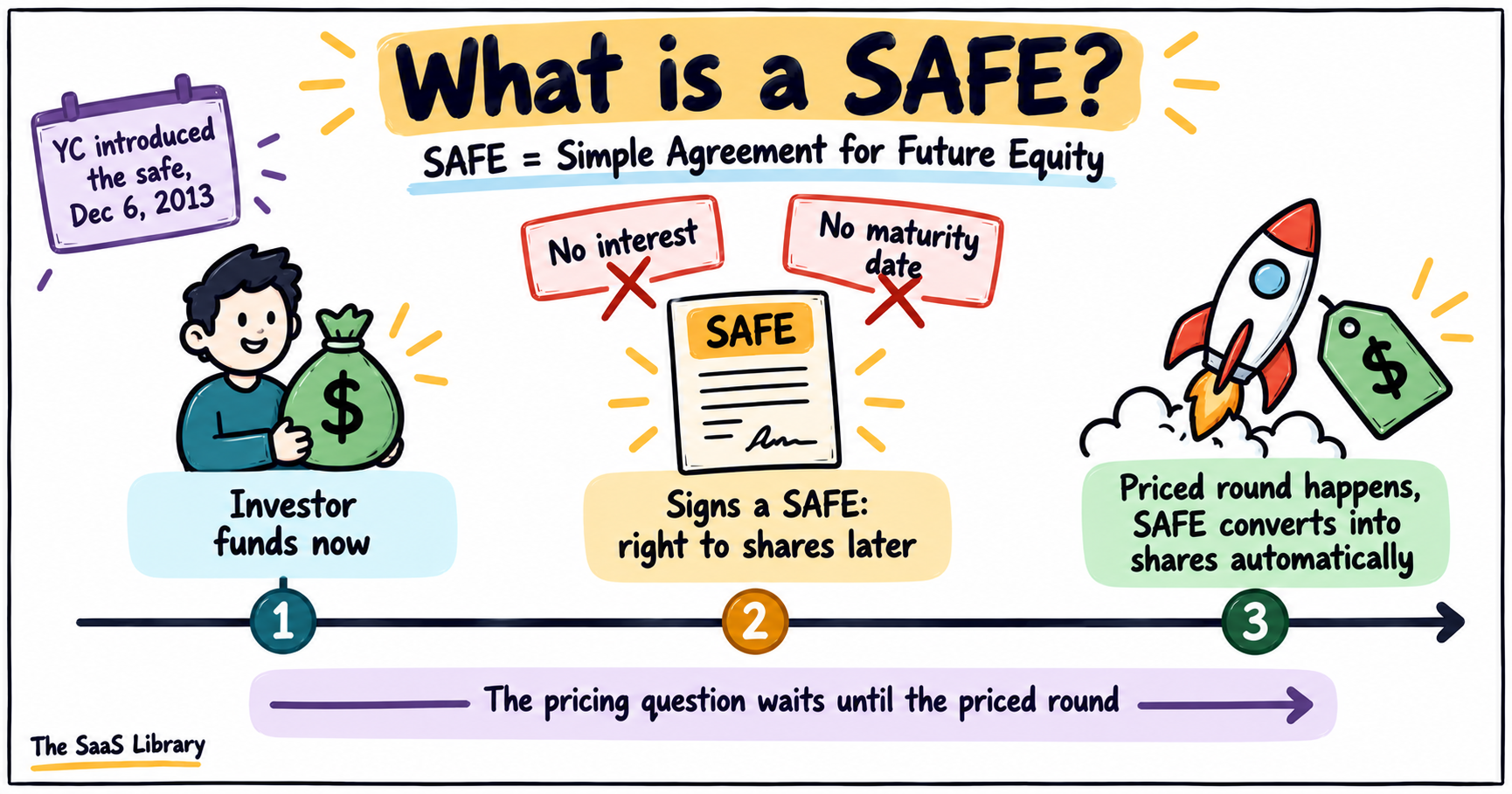
So a SAFE postpones the pricing question until the next priced round. That round is where valuation gets decided.
What are pre-money and post-money valuation?
Pre-money and post-money valuation describe a company’s value on either side of a priced round:
- Pre-money valuation is the company’s estimated value before it receives new capital.
- Post-money valuation is its value after the round closes.
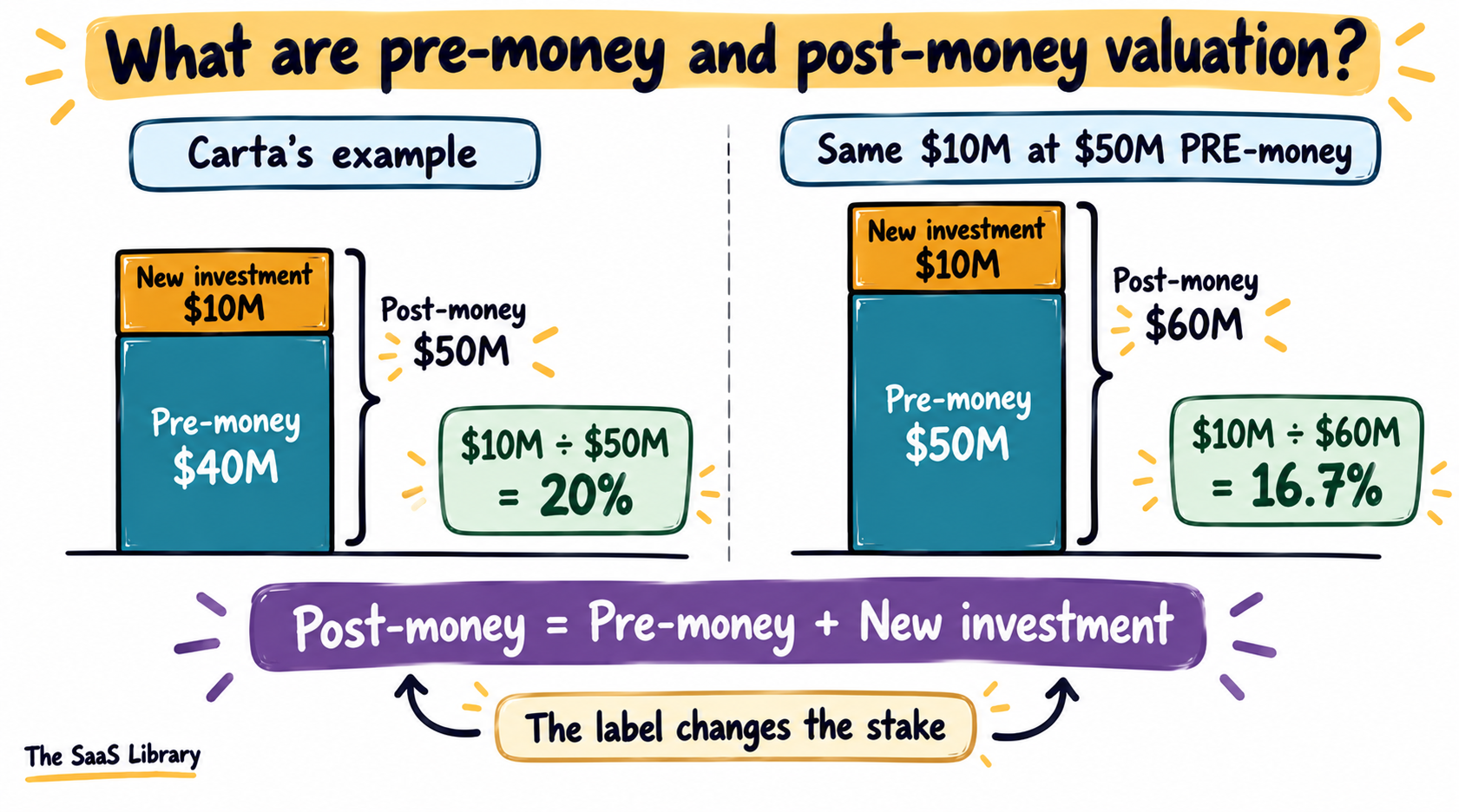
Post-money equals pre-money plus the new investment, and an investor’s ownership equals the investment divided by the post-money valuation.
Carta’s example: an investor offers $10M at a $50M post-money valuation. That implies a $40M pre-money valuation, and $10M is 20% of $50M.
The label changes the answer. If the same $10M went in at a $50M pre-money valuation, the post-money would be $60M, and the investor would own $10M ÷ $60M = 16.7%.
Here is Northloop’s cap table, a list of all the securities a company has issued and who owns them, across three rounds at a flat 20% per round:
| Round | Raise | Pre-money | Post-money | Sold | Founders own | Founders’ paper value |
|---|---|---|---|---|---|---|
| Seed | $3M | $12M | $15M | 20% | 80% | $12M |
| Series A | $12M | $48M | $60M | 20% | 64% | $38.4M |
| Series B | $30M | $120M | $150M | 20% | 51.2% | $76.8M |
Illustrative math. The 20% is a rounding of Carta’s software medians of 18% (seed), 18% (Series A) and 12% (Series B). The table assumes no option pool, the shares of stock a private company reserves for employees, and no debt.
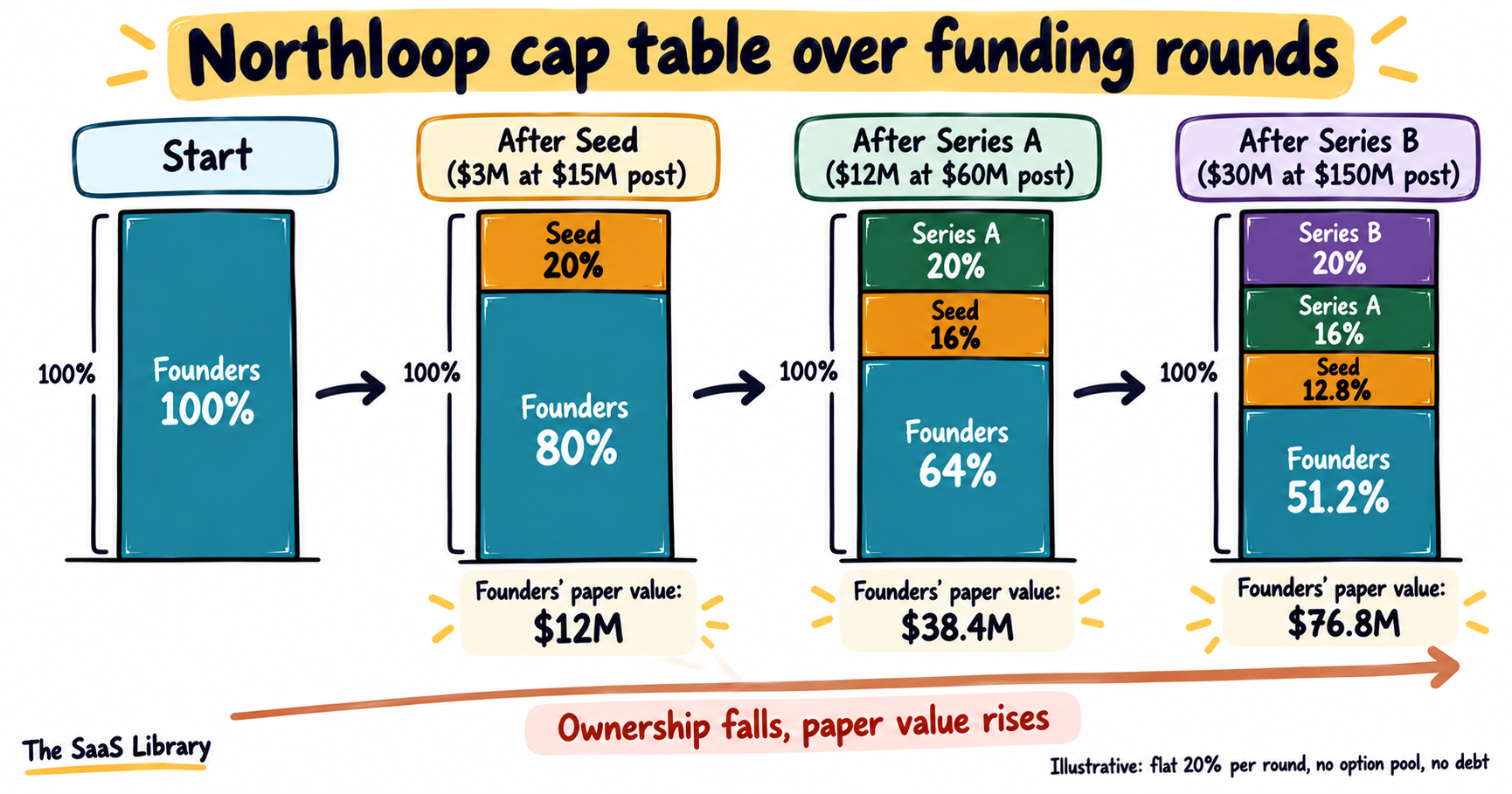
Founders own less each round, yet their stake is worth more, because the company’s value rises faster than their ownership falls. Paper value is not cash. The next section covers how investors arrive at a value for a SaaS company.
How are SaaS companies valued?
SaaS companies are valued as a multiple of revenue, and the multiple rises with growth. Two inputs set the price:
- A revenue figure, usually ARR, the recurring revenue of a business over one year (monthly recurring revenue × 12).
- A multiple that reflects growth.
On September 25, 2026, Clouded Judgement put the median public software company at 4.2x next-twelve-months revenue. Growth split the group sharply:
| Growth tier (projected) | Median multiple | Value of a $10M-ARR company |
|---|---|---|
| Low (under 15%) | 3.3x | $33M |
| Mid (15–22%) | 6.7x | $67M |
| High (over 22%) | 18.0x | $180M |
Illustrative math. This treats Northloop’s ARR as next year’s revenue. The multiples come from public companies, and private rounds are negotiated separately.
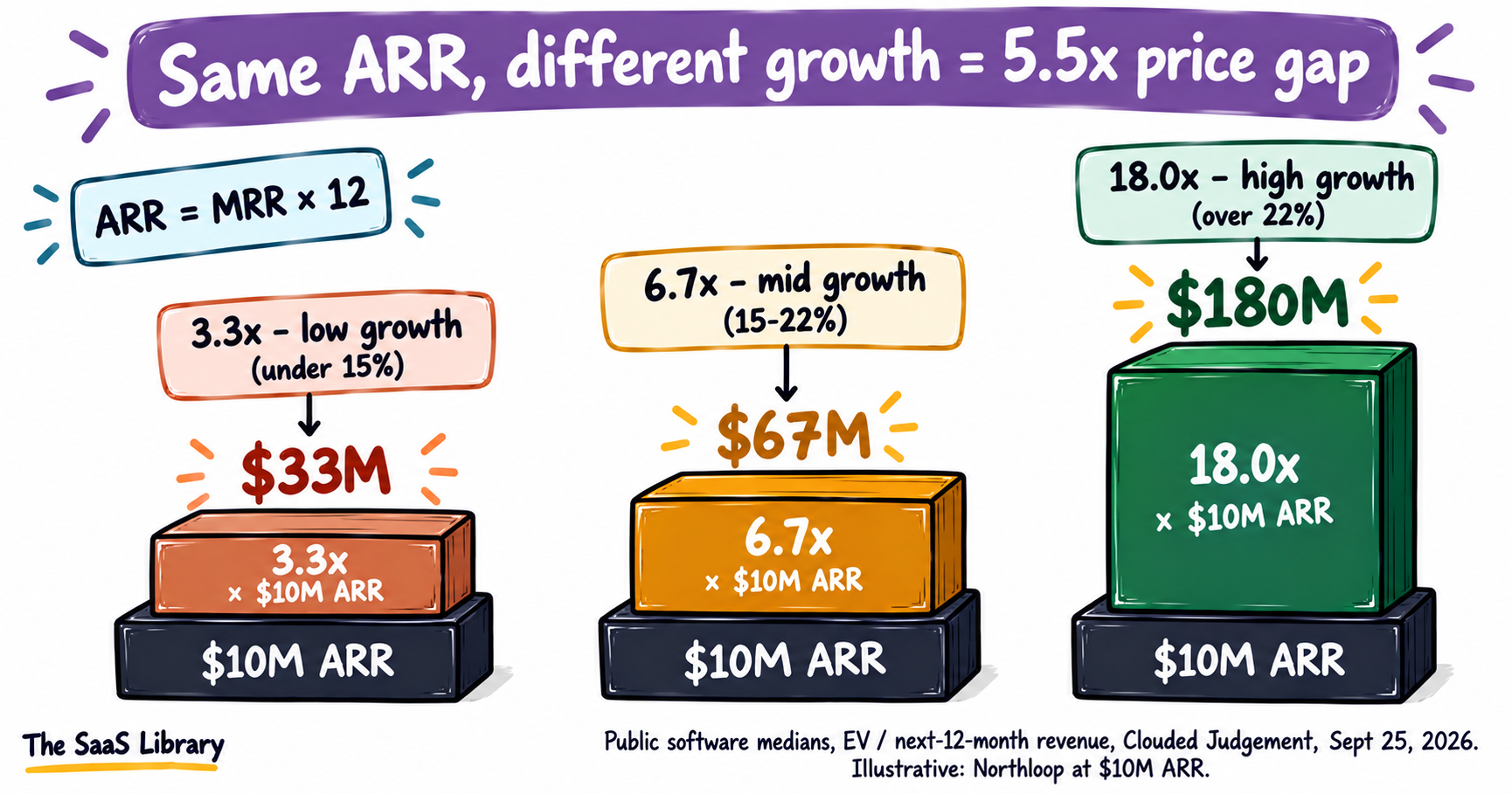
The same $10M of ARR is worth $33M or $180M depending on growth, a 5.5x gap. That is why a headline valuation means little without the growth behind it. For the retention side of this picture, see NRR vs ARR. Next: what investors get for paying that price.
The dashboard-to-agent shift is changing what B2B software buyers pay for, and this guide covers it.
Is SaaS Dead? →What do investors get for their money?
Investors get preferred stock, which carries rights that common stock does not. Four rights matter most:
- Liquidation preference: typically paid first in a sale or wind-down.
- Protective provisions: a veto over specific actions.
- A board seat, typically for the lead investor.
- Anti-dilution protection if a later round prices lower.
Carta writes that a liquidation preference is “typically paid out first as a result of seniority rights”. Under standard terms it equals the original issue price times the shares held. Northloop’s Series B investors paid $30M, so at 1x they are owed $30M before any conversion decision.
Investors also choose. Non-participating holders receive only their preference, but “will convert their preferred shares to common shares when it’s more advantageous.” Participating holders can “double dip”: they take the preference and then share in what remains.
Cooley says protective provisions give an investor “a veto right” against actions that would reduce the investor’s return. CRV says a lead investor “sets the price and terms of your funding round” and “usually takes a board seat.” Cooley defines anti-dilution protection as a provision that gives preferred stock a larger percentage of the company after a down round.
So the price on the headline buys rights as well as shares. The next section shows what those rights pay when things go wrong.
What happens to the money if the company fails?
If a company fails, what is left pays creditors first, then preferred shareholders by seniority, and common shareholders last. Common shareholders often receive little or nothing, while investors can lose money on their shares. A sale below the money raised can also leave founders with nothing.
The SEC’s Investor.gov says creditors, including bondholders, suppliers and employees, “all come before holders of the company’s common stock.” That page covers public-company bankruptcy, and private companies follow the same ordering principle.
Northloop raised $45M in total: $3M, $12M and $30M. Here is what the founders get at different sale prices:
| Sale price | Founders get | Investors get |
|---|---|---|
| $10M | $0 | $10M |
| $30M | $0 | $30M |
| $45M | $0 | $45M |
| $60M | $14.4M | $45.6M |
| $100M | $44.8M | $55.2M |
| $150M | $76.8M | $73.2M |
| $300M | $153.6M | $146.4M |
Illustrative math. Each investor takes a 1x non-participating preference or converts to common, whichever pays more. All series rank equally (“pari passu”), and there is no option pool and no debt.
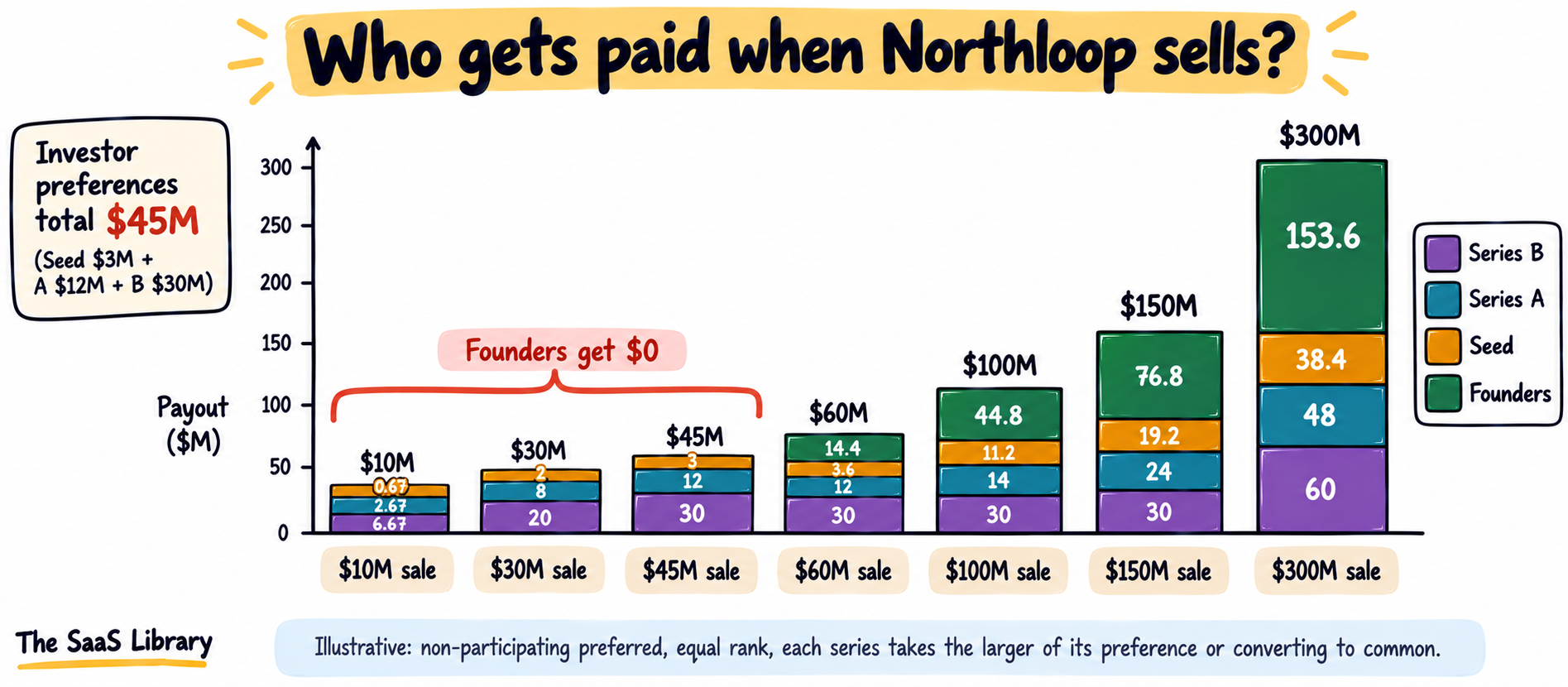
A sale at $45M or less pays founders nothing, even though the company “sold.” The same logic reaches customers. Bench raised $113M and claimed more than 12,000 customers, then shut down on Friday, December 27, 2024. TechCrunch, citing The Information, reported that “the move was forced by a bank calling in Bench’s venture debt.”
So failure hits investors, founders and customers differently. Now that you know what the money buys and what it risks, the next section shows how a round actually gets done.
How does a funding round actually happen?
A funding round happens in four steps:
- A lead investor sends a term sheet with price and terms.
- Both sides sign it, and it is mostly nonbinding.
- Diligence and legal documents follow.
- The round closes, and the company may announce it.
Carta describes a term sheet as a preliminary document that sets out the key financial terms of an investment, and says it is “mostly nonbinding.” Confidentiality, exclusivity (a no-shop clause) and good-faith negotiation bind from signature. Price, economic rights and control rights become binding only in the final stock purchase agreements at closing.
Due diligence, per Cooley GO, is a process where parties to a transaction, as well as their lawyers and accountants, review legal and financial documents relevant to the transaction prior to the finalization of a deal. Gunderson Dettmer says the diligence and documents phase for an early-stage venture financing takes “3-4 weeks on the quick end or 6-7 weeks on a more extended timeline.” Northloop’s Series A lead therefore signs in week zero and closes weeks later, not that day.
A round can also close more than once. Helion announced a $465M Series G at a $15.5B post-money valuation on June 4, 2026, led by Thrive Capital. Its own page later says it closed at $500M in September. That is $35M of new money added after the first close.
Illustrative math. $500M − $465M = $35M.
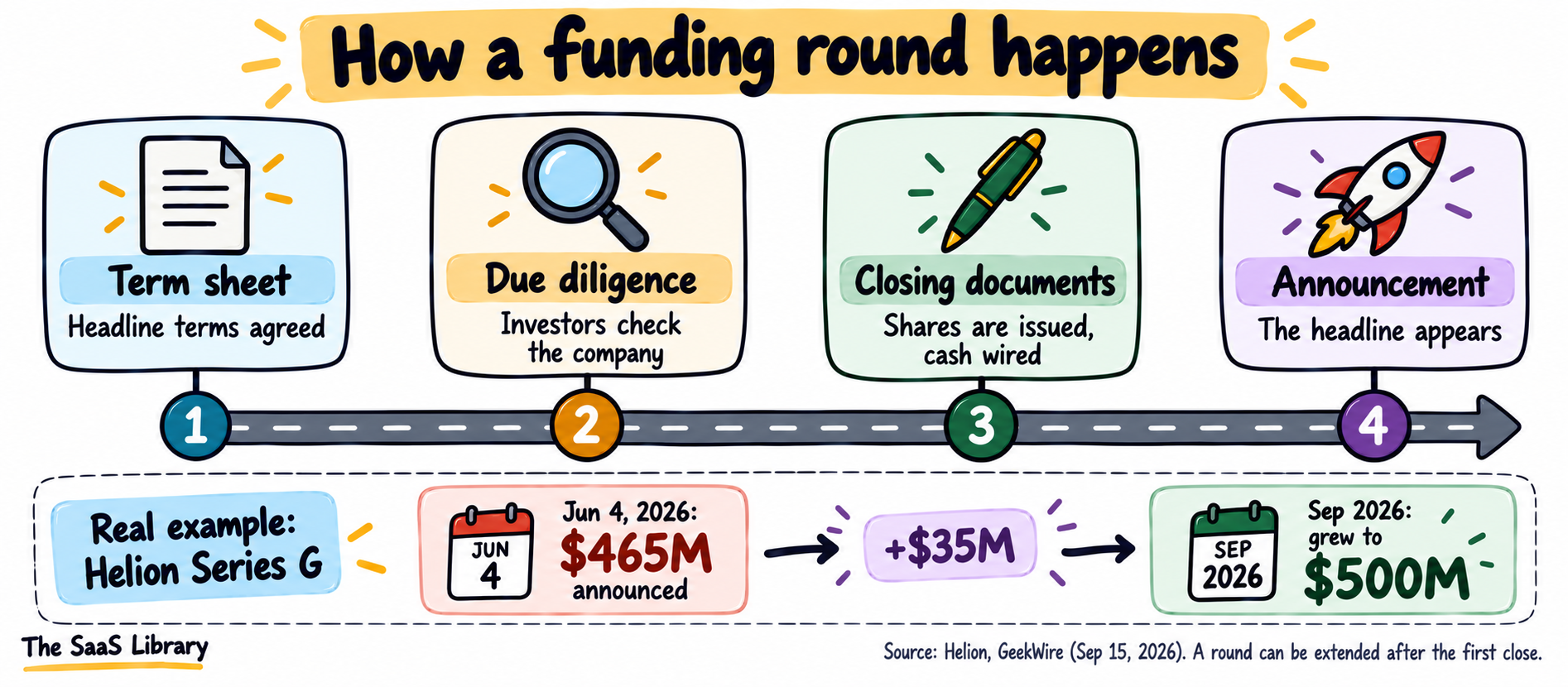
So a headline can show the first close, not the final total, and the date matters. Now the first lettered round.
What is Series A funding?
Series A funding is a startup’s first major round of institutional venture capital financing, raised after it has shown market viability and early traction at the seed stage. On the median, Carta’s software data shows:
- $14.4M raised.
- An $80M valuation.
- 18% dilution.
Carta’s data comes from software companies’ rounds in the six months to July 2026, excluding bridges and extensions.
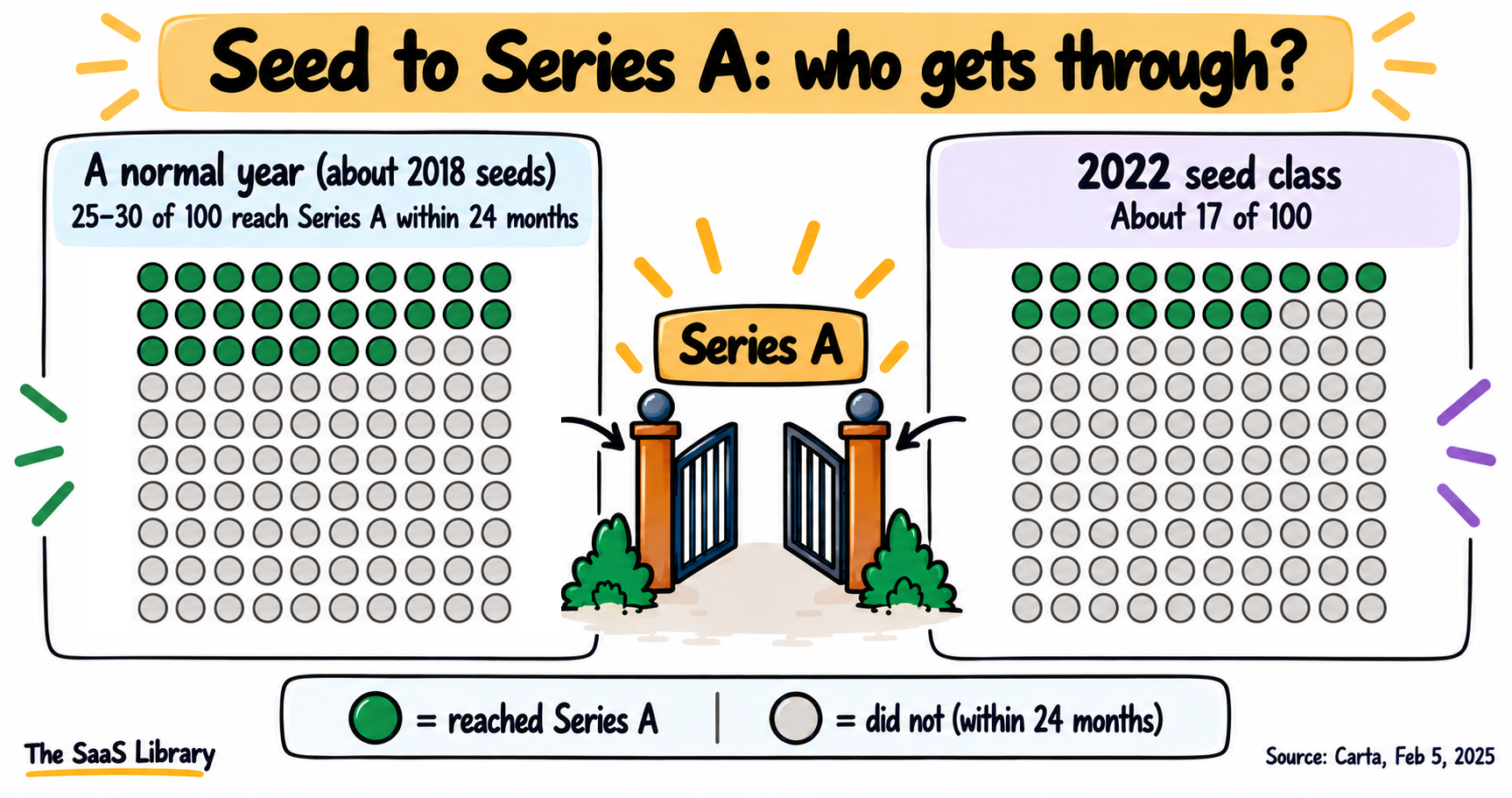
Reaching Series A is the hard part. Carta’s benchmarks put seed-to-Series A graduation after two years at 15% (low), 25% (median) and 35% (high). So of 100 seed-funded companies, about 25 reach Series A within two years at the median.
Carta’s earlier analysis, published February 5, 2025, put a “normal” year (it uses 2018) at “something like 25-30%” of seed startups graduating within 24 months or less. For companies that raised their seeds in 2022, “only 17% or so have made it to Series A in the first two years.”
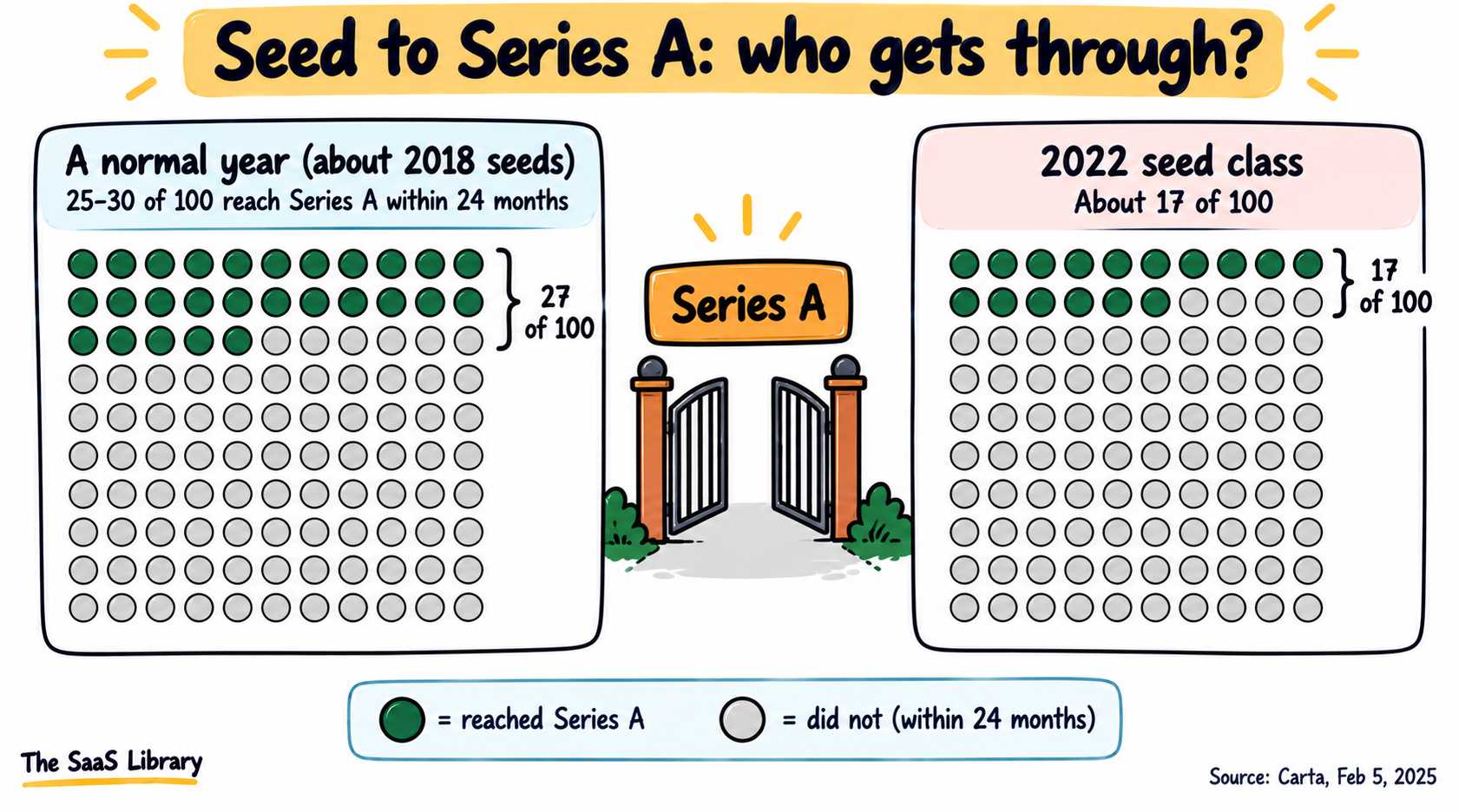
Crunchbase found the same trend for larger seeds: companies that raised $1M+ seeds through 2020 had a graduate rate of 55% or higher, against 24% for the 2023 cohort and 16% for 2024. Younger cohorts have had less time to graduate, so compare them with care.
CRV says the ARR benchmark for a competitive B2B SaaS Series A “generally starts at $2 million to $5 million.” Suppose Northloop has $4M of ARR when it raises $12M at $60M post-money. That is 20% sold and 15x ARR.
Illustrative math. $12M ÷ $60M = 20%, and $60M ÷ $4M = 15x. The $4M ARR is an assumed figure inside CRV’s range.
So Series A is a filter as much as a funding round, and most seed companies do not pass it. Next, the rounds after it.
What do Series B, C and D mean?
Series B, C and D are the later startup funding stages that fund growth once a company has proved its model:
- Series B: raised to “increase their customer base, find new markets, and scale operations.”
- Series C and later: raised to “expand your market reach and grow your company internally.”
Carta adds that later money can be used to “prepare for an initial public offering (IPO), acquire other companies, or expand globally.” The Series B definition comes from Carta’s Series B guide.
The pattern in the numbers is that rounds grow while dilution shrinks. Carta’s software medians, from the same benchmark page as Series A:
| Stage | Median valuation | Median raised | Median dilution |
|---|---|---|---|
| Series A | $80M | $14.4M | 18% |
| Series B | $191M | $25M | 12% |
| Series C | $391M | about $40M | under 10% |
| Series D | $789M | $63M | 8% |
Northloop’s Series B was $30M at $150M post-money, or 20%. At Carta’s 12% median instead, its founders would hold 64% × 0.88 = 56.3% after Series B, not 51.2%.
Illustrative math. Northloop’s flat 20% per round is a simplification, and real medians fall each round.
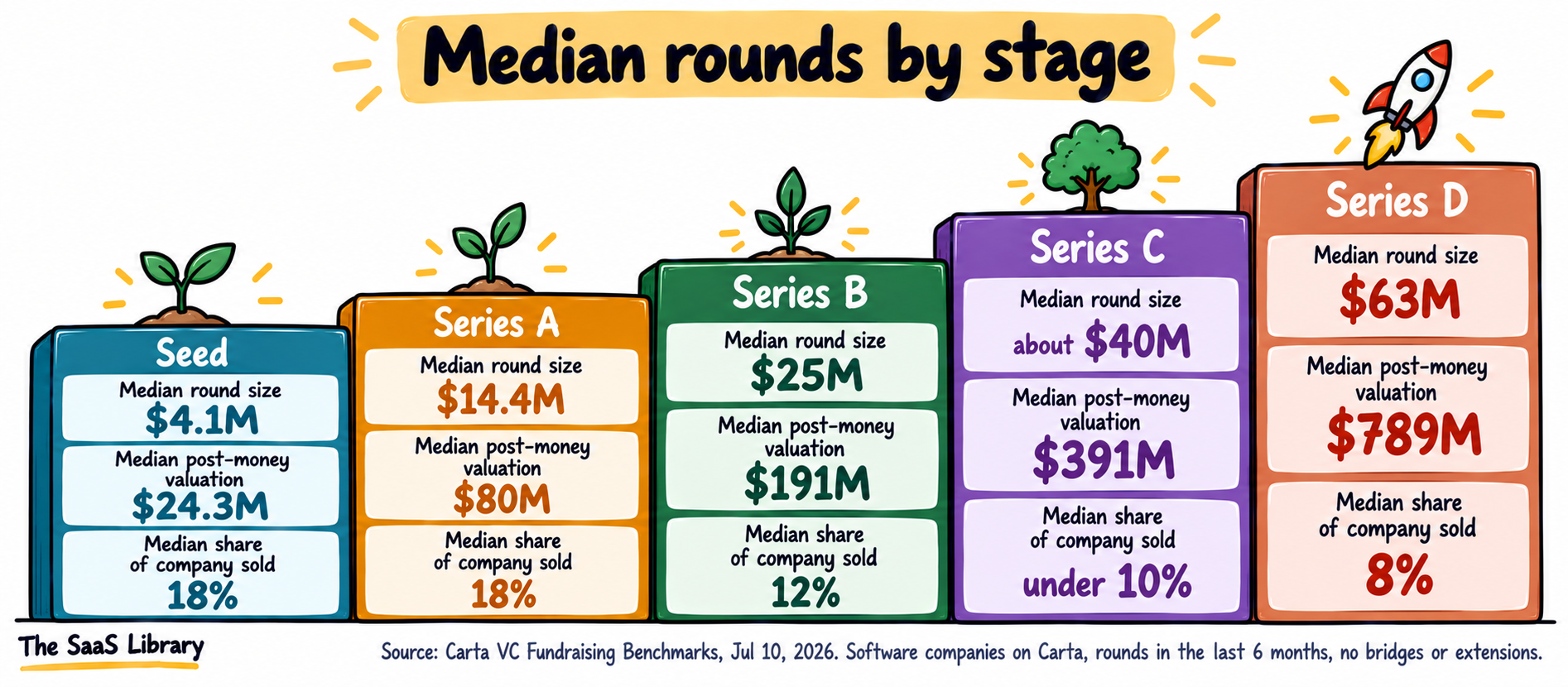
So later rounds cost founders less ownership per dollar raised. The next section covers what the letters past D mean.
What do Series E, F, G and beyond mean?
Series E, F, G and later letters are the latest startup funding stages, and each still counts the order of a company’s rounds. Fidelity’s rule covers them: order, not amount, sets the letter, “(or beyond).” PitchBook calls the period after Series C late stage, “when companies have increased revenue and are near exit.”
Real companies show how far the letters run:
| Company | Round | Raised | Valuation | Date |
|---|---|---|---|---|
| Cyera | Series F, led by Blackstone | $400M | $9B | Jan 8, 2026 |
| Cyera | Latest round, led by Evolution Equity Partners | $600M | $12B | Jun 10, 2026 |
| Cyera | Series G extension from Goldman Sachs Alternatives | $400M | “over $12B” | Sept 22, 2026 |
| Anthropic | Series H | $65B | $965B post-money | May 28, 2026 |
| Databricks | Series L | more than $4B | $134B | Dec 16, 2025 |
| Databricks | “Strategic funding”, no letter | not stated in the first paragraph | $188B | Jul 16, 2026 |
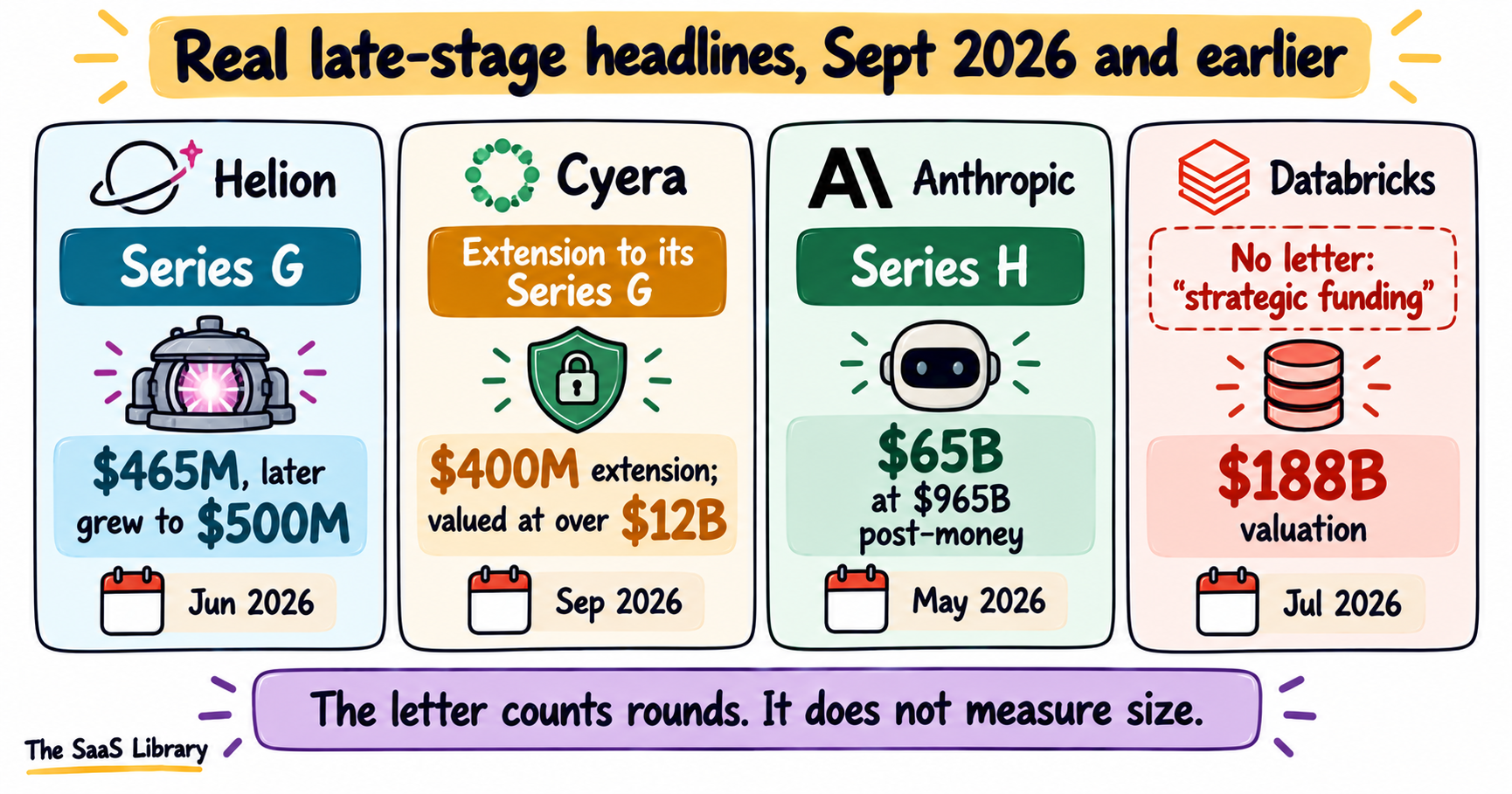
Cyera’s valuation rose from $9B to $12B in five months, a 33% jump. An extension, as the VLP Law Group puts it, is “essentially reopening the last round to bring in new or existing investors under the same terms.” That is why Goldman’s $400M carries the “Series G” label and no new valuation.
So a high letter means many rounds, and it does not by itself mean a better company. Databricks even raised at $188B without naming a letter. Next, why the letters keep stretching is worth its own look, but first, what investors check before they write the check.
What do investors look at before writing the check?
Before writing the check, investors look at measurable signals of whether a company’s growth is real and efficient:
- ARR and how fast it grows.
- Net revenue retention (NRR).
- Burn multiple.
- The Rule of 40.
Each signal has a formula, so you can check it yourself.
ICONIQ’s September 2026 report shows how far apart companies can be on retention. Its fast-growing “Pacesetters” have a median net dollar retention of 120% under $100M ARR and 130% above it, against 99% to 102% for other software companies. ICONIQ calls it net dollar retention, and it works like NRR.
Here are the formulas, with Northloop numbers:
| Signal | Formula | Example |
|---|---|---|
| NRR (Stripe) | (Beginning recurring revenue − churn − downgrades + upgrades) ÷ Beginning recurring revenue × 100 | $100K − $5K churn − $5K downgrades + $20K upgrades = $110K, so 110% |
| Burn multiple (David Sacks, Apr 23, 2020) | Net Burn ÷ Net New ARR | $2M ÷ $1M = 2.0 |
| Rule of 40 (Brad Feld, Feb 3, 2015) | “The 40% rule is that your growth rate + your profit should add up to 40%.” | 30% growth + 10% profit margin = 40% |
Illustrative math. The Northloop figures are invented to show the formulas.
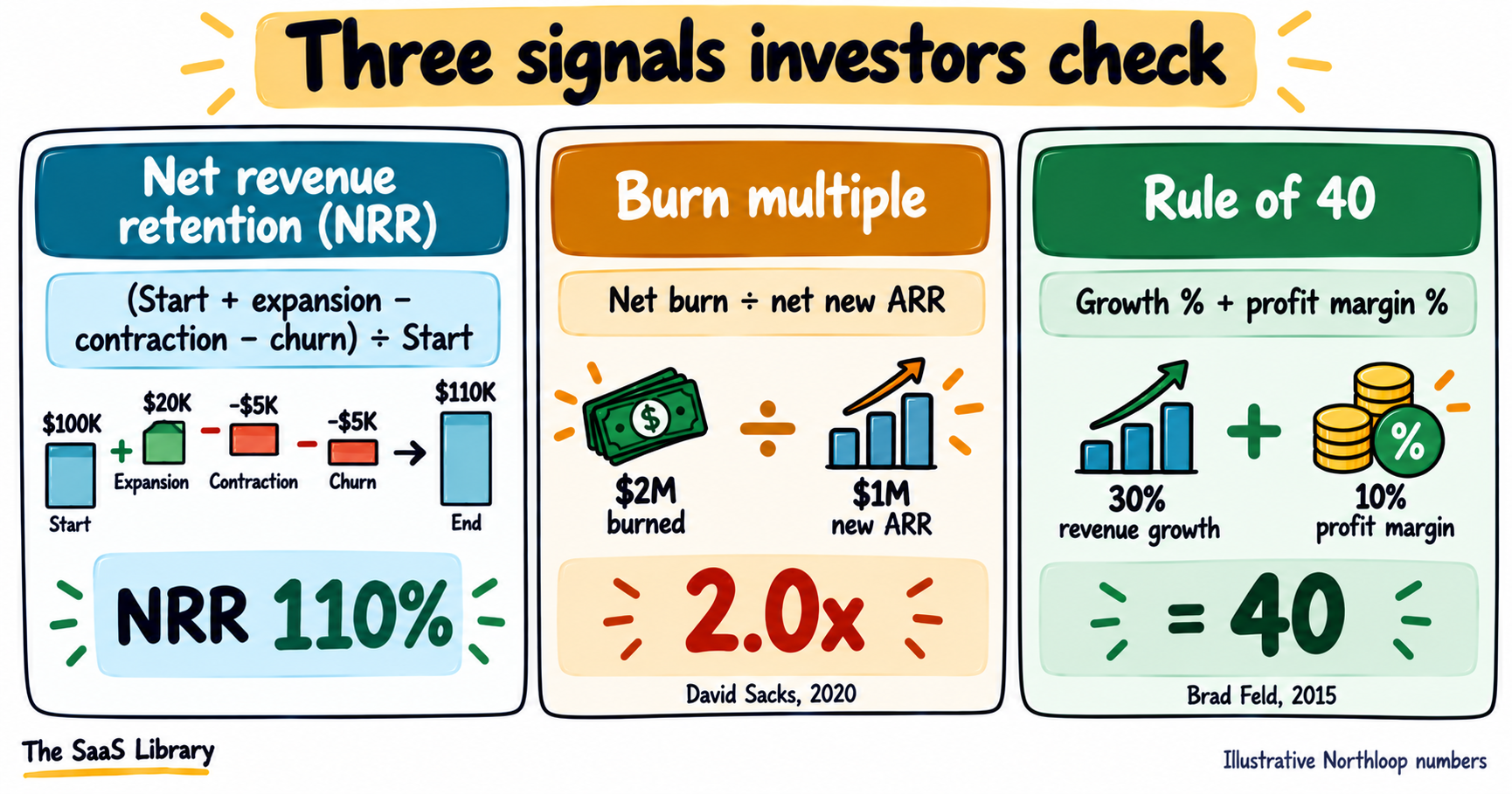
An NRR above 100% means existing customers pay more over time, even with no new sales. A high number on one signal can hide a weak one, which is why investors read them together. Next, what the company does once the money lands.
What do companies actually do with the money?
Companies spend funding money on a few repeating costs, and SaaS Capital’s medians for private B2B SaaS show the split as a share of ARR:
- Research and development: 22%.
- Sales: 15%.
- General and administrative: 15%.
- Support and success: 9%.
- Marketing: 8%.
In the same data, equity-backed companies spend 101% of ARR and bootstrapped ones 96%. Forty-eight percent of equity-backed companies operate at a loss, against 17% of bootstrapped ones. The sample is over 1,000 companies, published June 10, 2026.
On $5M of ARR, Northloop’s median lines come to R&D $1.1M, sales $750K, G&A $750K, support $450K and marketing $400K. At the 101% median, total spending is about $5.05M a year. Runway is how long a startup can sustain operations at its current spending rate before exhausting its available cash: at $0.4M of monthly net burn, $8M lasts 20 months.
Illustrative math. $5M × 22% = $1.1M, $5M × 101% = $5.05M, and $8M ÷ $0.4M = 20 months. The categories are separate medians and should not be added.
That 20 months sits inside published targets. Y Combinator’s Geoff Ralston wrote in 2016 that founders raise for a set number of months, “usually 12-18”, and Carta says most founders aim to raise enough to fund 18-24 months of operations.
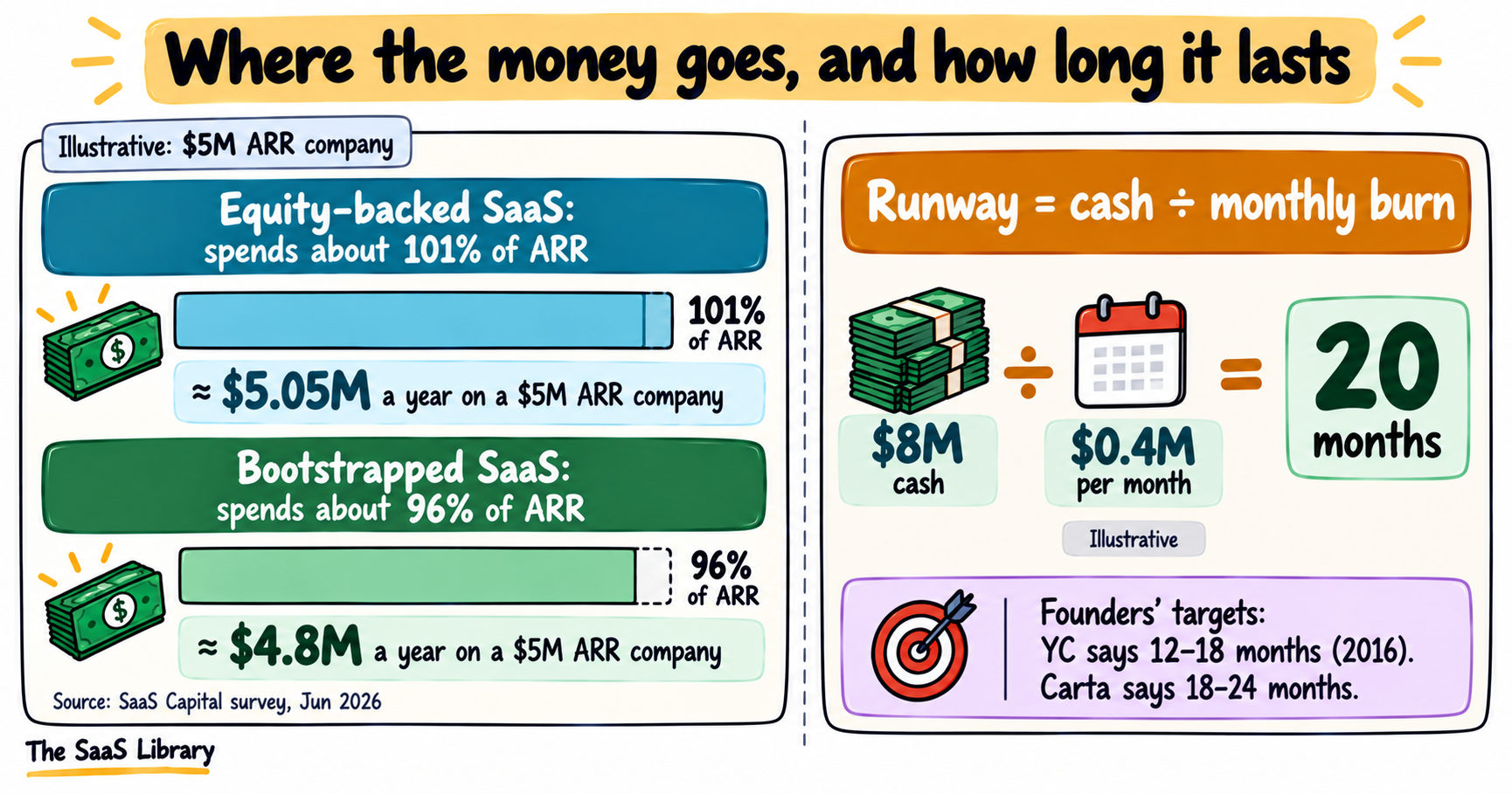
Not every dollar goes to the company. A tender offer is “a formal, company-sponsored secondary transaction allowing shareholders to sell a certain amount of their company stock at a predetermined price per share.” Databricks said its Series J capital was “expected to be used towards providing liquidity for current and former employees, as well as pay related taxes.” If Northloop raised $10M and $8M bought employee shares, $2M would reach the company.
So a big round can mean a small increase in the company’s own cash. The next section looks at why the letters have stretched so far.
Why are the Series letters stretching?
Series letters are stretching alongside four shifts in 2026 data:
- AI takes most venture capital.
- Very large rounds arrive as early as Series A.
- New unicorns are appearing faster.
- Enterprise software IPOs are scarce.
The letters count rounds. The shifts change what those rounds look like.
| Shift | The number | Source |
|---|---|---|
| AI takes most capital | More than 70% of Q2 2026 global startup capital went to AI companies. OpenAI and Anthropic took $217B, 43% of the record $510B raised in H1. | Crunchbase, Jul 2, 2026 |
| Large rounds come early | At least 114 Series A rounds of $100M or more in 2026, about $33B in total. More than 70% of them went to AI startups. | Crunchbase, Sept 23, 2026 |
| Valuations split | A Series A AI foundation-model startup raises at a $300M median valuation, a non-AI one at $55M. | Carta, Q1 2026 |
| More unicorns | 195 companies joined the unicorn board in H1 2026, against 193 in all of 2025. | Crunchbase, Aug 10, 2026 |
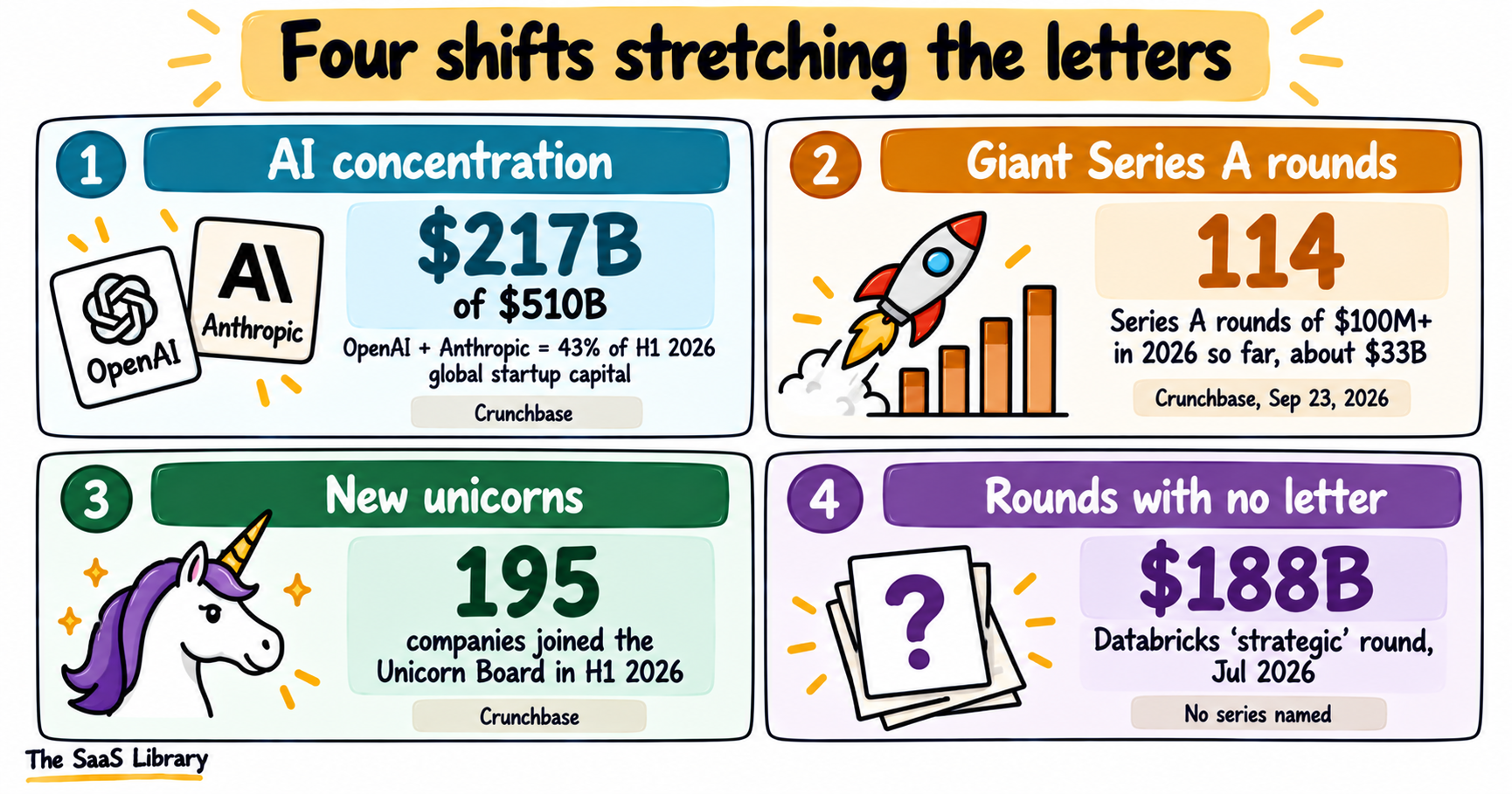
A unicorn is a private company with a post-money valuation of $1 billion or more, per Crunchbase. The term dates to 2013, when Aileen Lee counted 39 such US software companies, “about .07 percent of venture-backed consumer and enterprise software startups.”
On the other side, Crunchbase wrote that “Enterprise software, long a staple industry among venture-backed IPOs, was essentially a no-show this year.”
None of these sources says the shifts cause the longer letter chains. They describe the conditions in which the chains run. So compare startup funding stages only within one sector, because a $300M median and a $55M median are different markets. Next, the ways to fund a company without a new letter at all.
What are the other ways to fund a SaaS company?
A SaaS company has four other main ways to fund itself besides new venture equity:
- Bootstrapping: growing without outside equity.
- Venture debt: a loan sized from the last equity round.
- A private equity buyout: an investor buys the company.
- An IPO: selling shares to the public.
Bootstrapping is, in Carta’s words, “the process of starting and growing a company using your own resources, without relying on outside capital.” SaaS Capital’s August 2026 benchmark page shows a growth gap: bootstrapped private B2B SaaS companies report median growth of 20%, against 25% for equity-backed ones.
Carta says venture debt typically equals “between 20 to 35 percent of the total raised during the equity financing.” SVB says loan sizes run 25% to 35% of the latest equity round, and that “the first rule of venture debt is that it follows equity; it doesn’t replace it.”
For Northloop’s $30M Series B, Carta’s range would allow a loan of about $6M to $10.5M. A loan must be repaid, and Bench’s shutdown shows what happens when a lender calls it in.
Private equity works differently. In September 2025, PROS agreed to be acquired by Thoma Bravo in an all-cash deal valuing PROS at about $1.4 billion. HBS Online notes that a leveraged buyout is often “financing most of the deal with debt.”
The SEC says going public “typically refers to when a company undertakes its initial public offering, or IPO, by selling shares of stock to the public, usually to raise additional capital.” Renaissance Capital counted 31 IPOs raising $34.9B in its Q3 2026 review, or $8.4B without SK hynix’s $26.5B offering.
Illustrative math. $30M × 20% = $6M, and $30M × 35% = $10.5M.
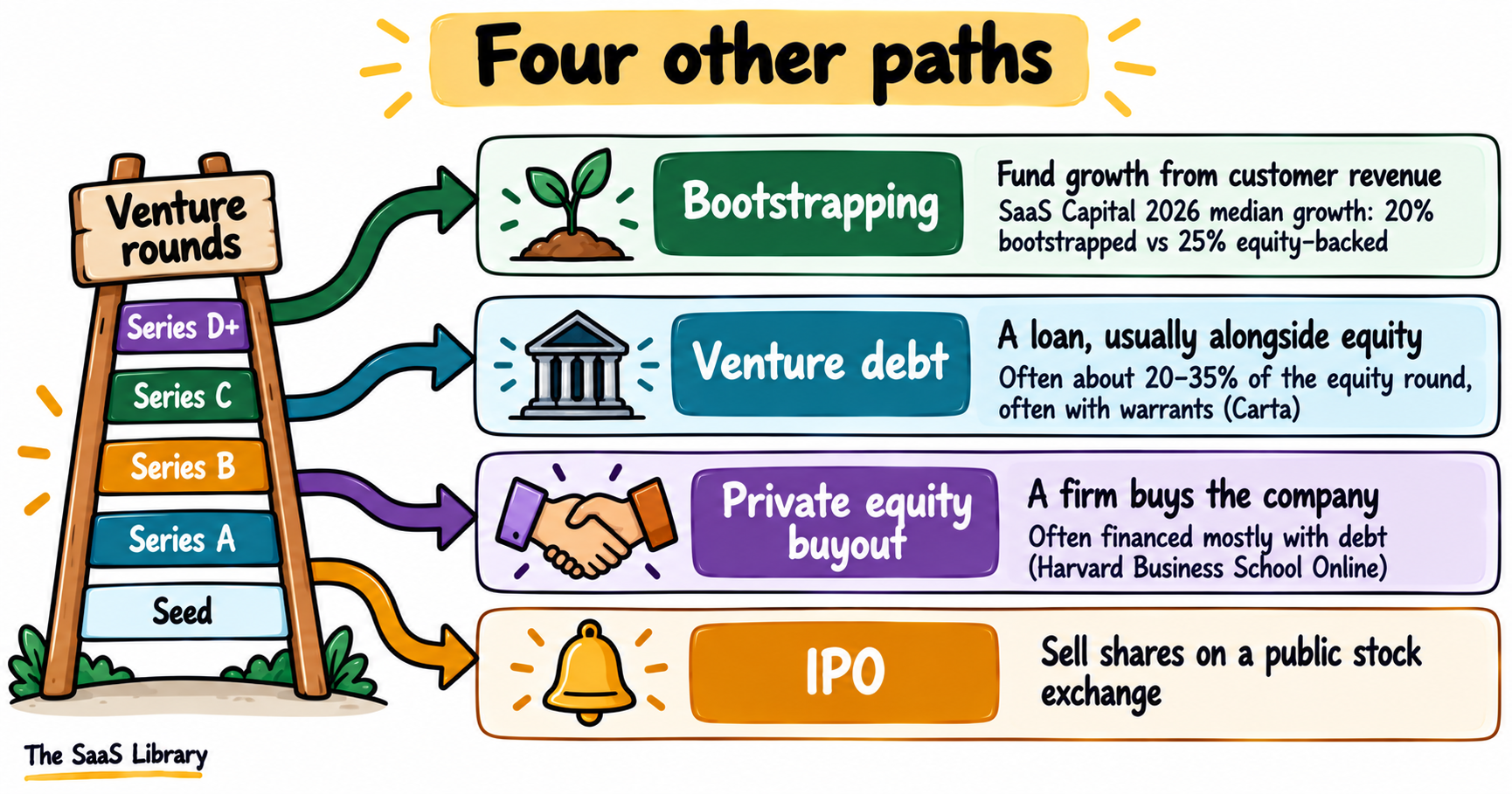
Each route trades something different: ownership, repayment or control. Now, what happens when a round prices lower than the last.
What is a down round, and is it a red flag?
A down round is a financing round whose pre-money valuation is lower than the previous round’s post-money valuation. Carta lists three effects:
- Anti-dilution provisions let earlier investors buy more shares at the new, lower price.
- Employee stock options can end up “underwater.”
- In a strong economy, it can signal that growth is slowing.
Down rounds were not rare recently. Carta’s Q1 2026 report says the down-round rate “fell to 11.4% in Q1,” from a 2023 peak of 22% and back to 2019–2020 levels. Carta also says a down round can “hit hard on employee morale and make recruiting and retaining people more difficult.”
Suppose Northloop raises a Series C at a $100M pre-money valuation, after its Series B post-money valuation of $150M. That is 33% lower. It raises $20M, so post-money is $120M and the new investors own $20M ÷ $120M = 16.7%.
| After Series B | After the down round | |
|---|---|---|
| Company value | $150M (post-money) | $120M (post-money) |
| Founders’ ownership | 51.2% | 42.7% |
| Founders’ paper value | $76.8M | $51.2M |
Illustrative math. The founders’ 51.2% × ($100M ÷ $120M) = 42.7%. The table leaves out anti-dilution, which would give earlier investors extra shares and lower the founders further.
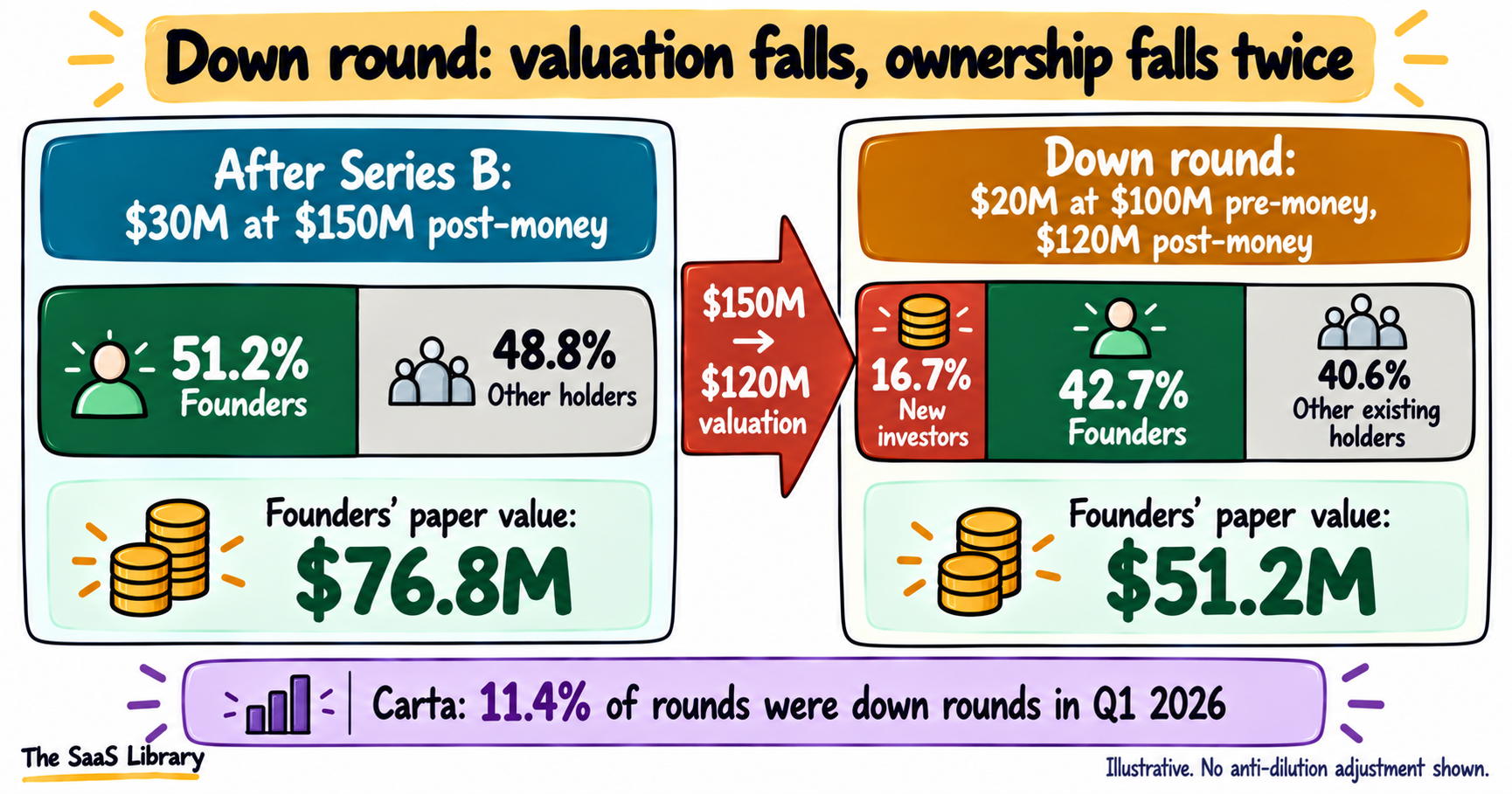
A bridge round is different. Carta calls it “extra money a company raises between priced rounds from its existing investors,” used to reach the next round. An extension, defined earlier, reopens the last round on the same terms.
So a down round is a signal to read, not a verdict: the reason and the terms decide what it means. Now, how the whole ladder ends.
How does the ladder end?
The ladder of startup funding stages ends in one of four ways:
- An IPO, when the company sells shares to the public.
- An acquisition, when another company or investor buys it.
- A shutdown, when the company fails.
- Continued private ownership, with tender offers giving holders liquidity.
Shutdowns are the least-told ending. Carta counted 966 startup shutdowns in 2024, against 769 in 2023. That is a 26% rise.
Staying private is now a common route. Carta reports that tender-offer activity reached a four-year high in H1 2026: 71 offerings totaling about $3 billion, nearly 70% of them run by companies at Series C or later.
Acquisitions can run in either direction. In July 2026, Cyera signed a letter of intent to acquire Oasis Security for about $1 billion, mostly in cash. The IPO route, covered earlier, produced 31 listings in Renaissance’s Q3 review.
Illustrative math. 966 ÷ 769 = 1.26. Back on Northloop’s payout table, a $150M sale pays founders $76.8M, and a $45M sale pays them nothing.
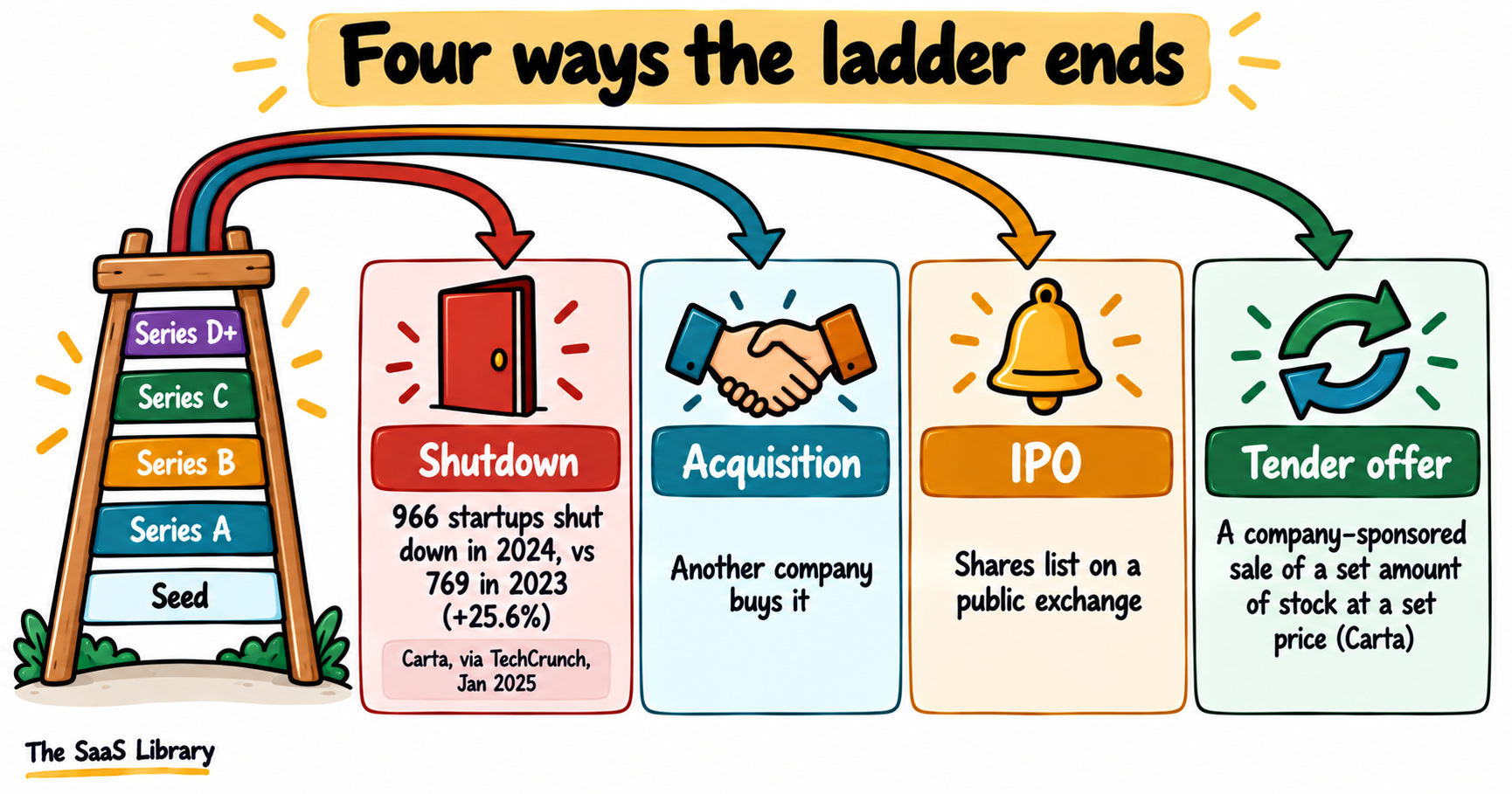
So the ending you get sets who is paid, and the same company can pay founders $0 or $76.8M depending on the price. One more ending question: who is allowed to buy in?
One test in the SEC’s Regulation D is the accredited investor. Under Rule 501(a), a person qualifies with a net worth above $1,000,000 (alone or with a spouse, excluding the primary residence), or income above $200,000 ($300,000 joint) in each of the last two years, with a reasonable expectation of the same this year.
Does a vendor’s funding round mean the software is safe to buy?
A vendor’s funding round does not, on its own, make its software safe to buy. It shows that investors backed the company at one moment, not that the product will stay available, priced or supported. I searched for a study linking a vendor’s funding to customer outcomes and found none.
Two real cases show different risks:
- Bench raised $113M and had more than 12,000 customers, yet it shut down on December 27, 2024. Its notice said the platform “will no longer be accessible,” and TechCrunch’s headline said thousands of businesses were left without access to their accounting and tax documents. The cause, covered earlier, was a lender calling in venture debt.
- Clearbit was acquired by HubSpot in December 2023, and its free tools were sunset on April 30, 2025. The Logo API shut down on December 8, 2025.
Neither vendor was small or unfunded. The risk was continuity, and a contract can address it. Three protections come from legal sources:
- Data return. The ABA says “upon termination of the agreement the customer may take its data to a new cloud provider.”
- Price caps. The same article says “the amount of any future price increases should be capped.”
- Escrow, with a caveat. Silicon Valley Software Law notes that for SaaS, “Mere possession of a functional copy of the source code and data may not be sufficient” in the event of a release condition.
Illustrative math. A 10% cap on a $50,000 contract limits next year’s bill to $55,000.
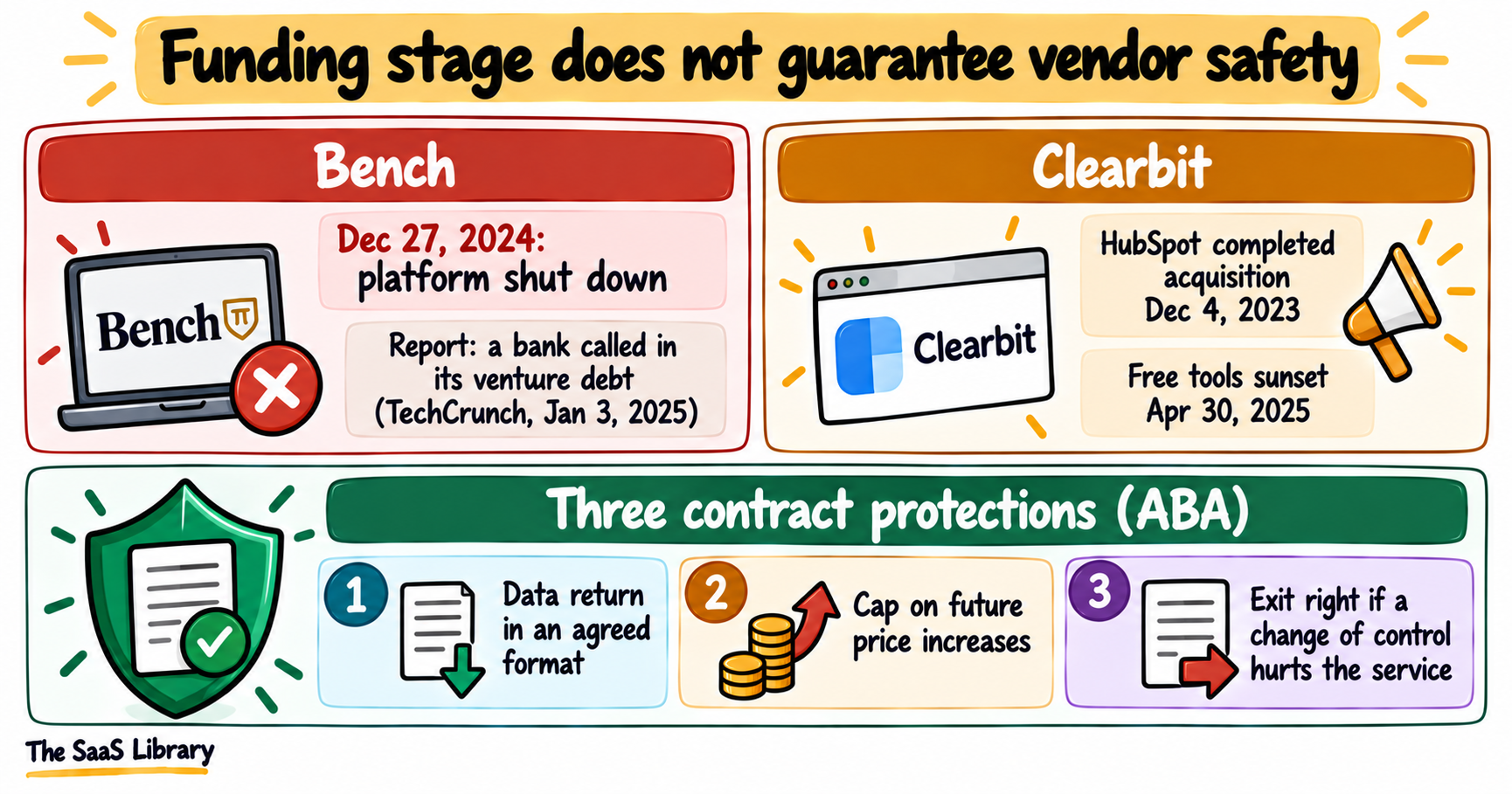
So a bigger round is a reason to look closer, not a reason to skip the checks. For the buyer-trust side, see SaaS Buyer Skepticism and the Trust Gap. Last, how to verify any claim yourself.
How can you check a funding claim yourself?
You can check a funding claim in four steps:
- Read the company’s own release for the amount, the round, the valuation label and the lead investor.
- Search the SEC’s EDGAR system for a Form D, the notice of an exempt offering of securities.
- Compare a second report of the same deal.
- Treat every database as incomplete.
The SEC says Form D “is a notice of an exempt offering of securities”, filed within 15 days after the first sale and publicly available on EDGAR. Compare its dates with the announcement.
Databases have limits. Crunchbase says “no database of private companies or their funding rounds is 100% complete or up to date, not even Crunchbase.” Dealroom says “venture capital investment data is all self-reported,” and shows a 2015 seed count that rose from 3,990 to 5,680 after later reporting.
Try it on Island. Its release says the $6.4 billion valuation is “more than doubling since 2024.” Half of $6.4B is $3.2B, so the 2024 valuation was below $3.2B. The release does not name it.
Illustrative math. 5,680 ÷ 3,990 − 1 = 42%, and $6.4B ÷ 2 = $3.2B.
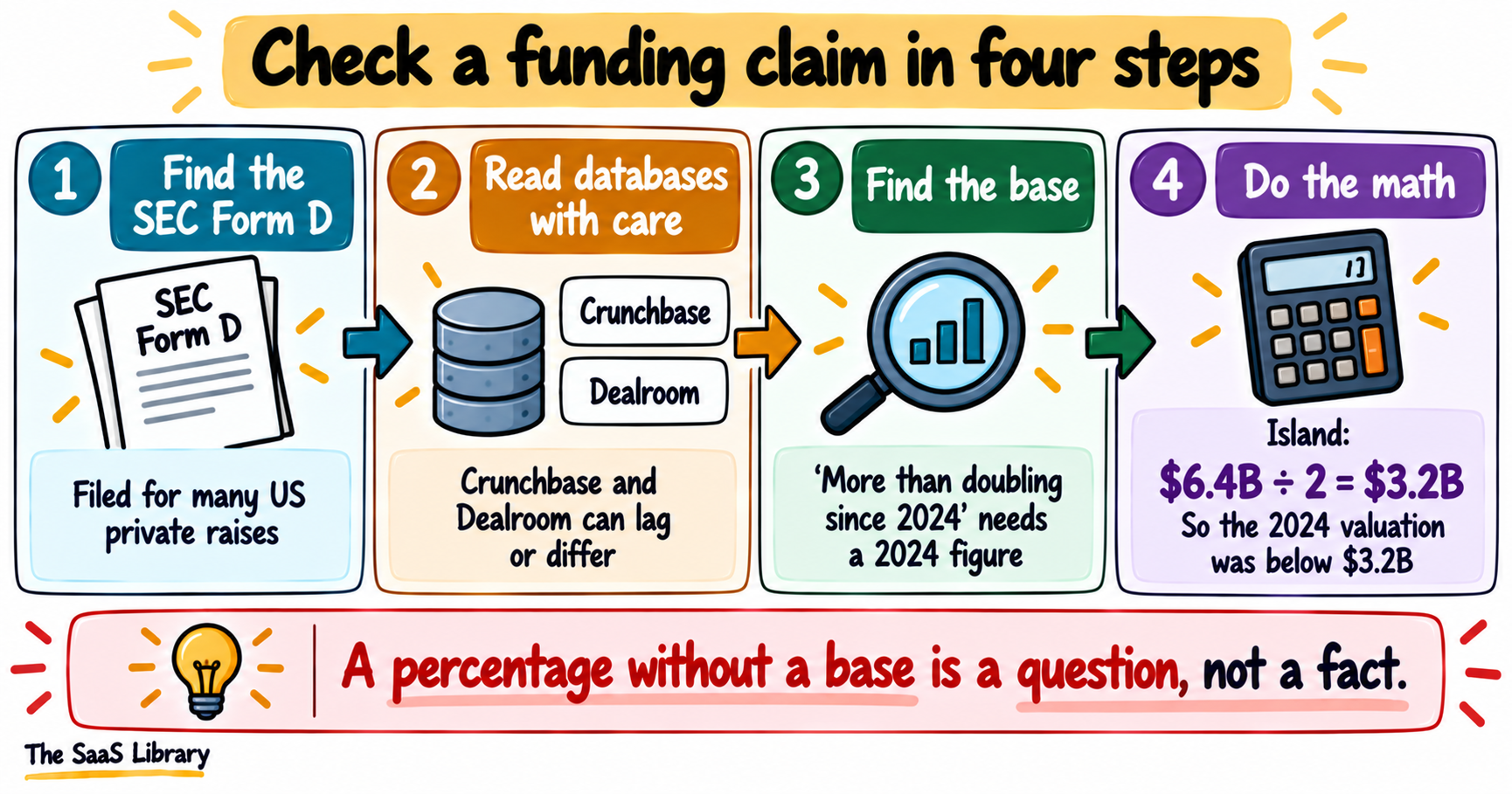
So every check leaves one gap unfilled, and the release never fills all of them. The next section turns these checks into one repeatable read.
How do you read any funding announcement in Six Lines?
You read a funding announcement in six lines, called The Six-Line Read, and each line has one question:
A blank line is not a verdict. It is a question to ask.
Total raised appears in only two of six releases. Here are the six deals announced from September 22 to 28, 2026, on lines 1 to 3:
| Deal | 1. Stage and size | 2. Lead | 3. Valuation |
|---|---|---|---|
| Island | Series F, $400M | Evolution Equity Partners | “$6.4 billion valuation,” no pre/post label |
| Cyera | $400M extension to its Series G | Series G led by Evolution Equity; extension from Goldman Sachs Alternatives | “over $12 billion,” no label |
| Numeral | Series C, $100M | Insight Partners | Not stated |
| Ema | Series B, $77M | Creaegis | “More than quadruples its valuation,” no dollar figure |
| Instinct | Series C, $1B | Names Sequoia, Benchmark and Coatue; no single lead seen | “$10 Billion Valuation,” no label |
| Baselayer | Series A, $35M | M13 | Not stated |
And on lines 4 to 6:
| Deal | 4. Use of funds | 5. Proof metric | 6. Total raised |
|---|---|---|---|
| Island | General: “next phase of growth and innovation” | ARR “doubled every fiscal year since its 2022 launch,” no base | Not stated |
| Cyera | Specific: AI security roadmap, federal market, EMEA and APAC | None | Not stated |
| Numeral | Specific: product, new industries, team | “327% year-over-year increase in total transaction volume,” no base | $157M |
| Ema | Specific: go-to-market and platform | “Revenue 50X over the past 24 months,” no base | $140M |
| Instinct | General: “bring Instinct to more people” | None; “still in early access” | Not stated |
| Baselayer | Not stated | “2,300+ financial institutions”; no revenue figure | Not stated |
What the six lines show across all six deals:
- A valuation figure appears in 3 of 6 (Island, Cyera, Instinct), and a pre-money or post-money label in 0 of 6.
- A revenue or ARR dollar figure appears in 0 of 6.
- A growth claim with no base appears in 3 of 6 (Island, Numeral, Ema).
- Total raised appears in 2 of 6 (Numeral, Ema).
Use the numbers to see what a growth claim hides. Numeral’s “327% increase” means 4.27 times last year’s volume, and Ema’s “50X in 24 months” would be about 7.1 times per year if growth were steady. Neither release says what the starting number was.
Illustrative math. 1 + 3.27 = 4.27, and √50 = 7.07. Both assume the claim means what it says.
So The Six-Line Read turns a headline about startup funding stages into six questions, and the blank lines tell you what to ask. The last section clears up the myths that headlines leave behind.
What do people most often get wrong about funding stages?
People most often get funding stages wrong in seven ways. They read the valuation as cash, the letter as quality, and the announcement as money already in the bank, among others. The table gives each myth and its correction. Each correction rests on a source or a worked example in this guide.
| Myth | What is true | Evidence |
|---|---|---|
| “A company that sells for more than it raised pays its founders.” | Not always. Investors’ preferences are paid first, so a sale at or below the total raised can pay founders nothing. | Northloop raised $45M, so founders get $0 at $10M, $30M and $45M and $14.4M at $60M (illustrative). Carta: a liquidation preference is “typically paid out first.” |
| “The valuation is the money raised.” | The valuation is the price of the whole company. The round buys only a slice. | Island raised $400M at a $6.4B valuation. If that is post-money, the round bought 6.25%. If it is pre-money, it bought 5.9%. The release does not say which. |
| “A higher Series letter means a safer, better company.” | The letter counts rounds, in order. | Fidelity: “it’s the order, not the amount of money.” Bench raised $113M and shut down (TechCrunch, Dec 27, 2024). |
| “A SAFE is a loan.” | A SAFE converts into shares at the next priced round, with no interest and no maturity date. | YC’s comparison table lists interest “None” and maturity “None.” YC’s 2013 announcement called the original safe “not debt, but something more like a warrant.” |
| “When a round is announced, the cash is in the bank.” | Rounds can close in parts, and some money goes to holders, not the company. | Helion’s $465M round later grew to $500M (GeekWire, Sept 15, 2026). Databricks said Series J money was for “liquidity for current and former employees.” |
| “A down round means the company is failing.” | A down round can signal slowing growth. It is also common enough to be a signal to read, not proof of failure. | Carta: the down-round rate was 11.4% in Q1 2026, from a peak of 22% in 2023. |
| “Every round costs founders about 20%.” | Median dilution falls with stage. | Carta’s software medians: seed 18%, Series A 18%, Series B 12%, Series C under 10%, Series D 8%. Northloop’s flat 20% is a simplification. |
Two of these myths lean on math you can rerun. Use the Northloop tables from the pricing and failure sections, and swap in your own numbers. Each correction points at a line of The Six-Line Read, so run the six lines on the next headline you see. The FAQ, the glossary of terms and the conclusion follow.
Frequently Asked Questions
What is Series A funding?
Series A funding is a startup’s first major round of institutional venture capital financing, raised after it has shown market viability and early traction at the seed stage. Carta’s software medians are $14.4M raised at an $80M valuation, with 18% dilution. CRV says a competitive B2B SaaS Series A generally starts at $2M to $5M in ARR.
What is the difference between Series A, B and C?
Series A, B and C are successive startup funding stages, and the letter counts their order. Series A is the first major institutional round. Carta says Series B funding is typically raised to “increase their customer base, find new markets, and scale operations.” Series C and later rounds “help expand your market reach and grow your company internally.”
What does Series C funding mean?
Series C funding is the third lettered round, raised after Series A and B. Carta says Series C and later rounds “help expand your market reach and grow your company internally.” Carta’s software median is nearly $40M raised at a $391M valuation, with under 10% dilution. Companies may use it to prepare for an IPO, acquire others or expand globally.
What is a SAFE note?
A SAFE, or Simple Agreement for Future Equity, is a short contract an investor signs to fund a startup now in exchange for the right to shares later. It converts into shares automatically when the startup raises a priced round. Y Combinator’s comparison table lists no interest and no maturity date.
Is Series A or Series B better?
Neither is better. Series A and Series B are points in a sequence, and the letter counts order, not quality. Carta’s software medians are $14.4M at 18% dilution for Series A and $25M at 12% for Series B. Carta’s median seed-to-Series A graduation after two years is 25%.
What is a good Series A, B or C amount?
No single amount is good, because medians differ by stage and sample. Carta’s software medians for rounds in the six months to July 2026 were $14.4M for Series A, $25M for Series B and nearly $40M for Series C, excluding bridges and extensions. Judge a round against its stage and sector.
What comes after Series C, and how many rounds are there?
There is no fixed number of startup funding stages after Series C. Series D, E, F and later letters follow in order, and Fidelity’s rule covers them “or beyond.” Anthropic has raised a Series H, Databricks a Series L, and Databricks’ $188B round named no letter. A company can also end in an IPO, an acquisition or a shutdown.
What are Series D, E, F and G?
Series D, E, F and G are later rounds in the same sequence. Carta’s software median for Series D is $63M raised at a $789M valuation, with 8% dilution. Real examples include Cyera’s $400M Series F at a $9B valuation and Helion’s $465M Series G at a $15.5B post-money valuation.
What is a unicorn startup?
A unicorn is a private company with a post-money valuation of $1 billion or more, per Crunchbase. In 2013, Aileen Lee counted 39 such US software companies, about .07 percent of venture-backed consumer and enterprise software startups. Crunchbase added 195 companies to its unicorn board in the first half of 2026, against 193 in all of 2025.
What is the difference between pre-money and post-money valuation?
Pre-money valuation is a company’s estimated value before new capital in a priced round, and post-money valuation is its value after. Post-money equals pre-money plus the new investment. Carta’s example: $10M at a $50M post-money valuation implies $40M pre-money, and the investor owns $10M ÷ $50M, or 20%.
What is a down round?
A down round is a financing round whose pre-money valuation is lower than the previous round’s post-money valuation. It can trigger anti-dilution rights, push employee options underwater and, in a strong economy, signal slower growth. Carta reports the down-round rate was 11.4% in Q1 2026, down from a 22% peak in 2023.
Does a bigger round mean a safer vendor?
No. A bigger round shows investors backed the company, not that the product will stay available. Bench raised $113M and shut down on December 27, 2024. HubSpot sunset Clearbit’s free tools after acquiring it. Contract terms help: data return at termination, capped price increases and, with caveats, escrow.
How can I check a funding announcement’s claims?
Check four things: the company’s own release, an SEC Form D on EDGAR, a second report of the deal, and the gaps in any database. The SEC says a Form D is filed within 15 days after the first sale. Crunchbase says no private-company database is 100% complete or up to date.
Conclusion
The Six-Line Read turns any startup funding stages headline into six questions. Island’s: a $400M Series F, led by Evolution Equity, at a $6.4B valuation with no pre- or post-money label, a general use of funds, ARR that “doubled” from an unstated base, and no total raised.
Now explain it back: the letter counts rounds, the valuation prices the whole company, and each blank is a question to ask.
Next, see the trends behind 2026’s rounds: B2B SaaS Trends in 2026
- Fidelity Private Shares — the order of the rounds, not the amount raised
- SEC — such as preferred stock
- Carta — Carta’s glossary
- Correlation Ventures — less than 4% of the capital invested in venture-funded companies that exited over the last decade returned 10x or more
- Paul Graham — Paul Graham, co-founder, Y Combinator
- SBA — equity as “a share of ownership”
- Carta — the stages “follow alphabetically: Series B, Series C, Series D, and so on.”
- Carta — $4.1M raised at a $24.3M post-money valuation, with 18% median dilution
- Y Combinator — December 6, 2013
- Y Combinator — YC’s own example
- Altum Legal — a parallel class, often called Series A-1 Preferred Stock
- Carta — Carta’s example
- Stripe — recurring revenue of a business over one year
- Clouded Judgement — Clouded Judgement
- Carta — a liquidation preference is “typically paid out first as a result of seniority rights”
- Cooley GO — give an investor “a veto right”
- CRV — CRV
- Cooley GO — Cooley defines anti-dilution protection
- SEC Investor.gov — creditors, including bondholders, suppliers and employees, “all come before holders of the company’s common stock.”
- TechCrunch — Bench
- Carta — a preliminary document that sets out the key financial terms of an investment
- Cooley GO — Cooley GO
- Gunderson Dettmer — “3-4 weeks on the quick end or 6-7 weeks on a more extended timeline.”
- Helion — Helion announced a $465M Series G
- GeekWire — closed at $500M in September
- Carta — Carta’s benchmarks
- Carta — earlier analysis
- Crunchbase — same trend for larger seeds
- CRV — ARR benchmark for a competitive B2B SaaS Series A
- Carta — “prepare for an initial public offering (IPO), acquire other companies, or expand globally.”
- Carta — Carta’s Series B guide
- PitchBook — late stage
- TechCrunch — Cyera
- Cyera — Cyera
- Cyera — Cyera
- Anthropic — Anthropic
- Databricks — Databricks
- Databricks — Databricks
- VLP Law Group — “essentially reopening the last round to bring in new or existing investors under the same terms.”
- ICONIQ — median net dollar retention of 120% under $100M ARR and 130% above it
- Stripe — NRR
- David Sacks — Burn multiple
- Brad Feld — Rule of 40
- SaaS Capital — equity-backed companies spend 101% of ARR and bootstrapped ones 96%
- J.P. Morgan — how long a startup can sustain operations at its current spending rate before exhausting its available cash
- Y Combinator — “usually 12-18”
- Carta — Carta says
- Carta — tender offer
- Databricks — Series J capital
- Crunchbase — Crunchbase, Jul 2, 2026
- Crunchbase — Crunchbase, Sept 23, 2026
- Carta — Carta, Q1 2026
- Crunchbase — Crunchbase, Aug 10, 2026
- TechCrunch — 39 such US software companies, “about .07 percent of venture-backed consumer and enterprise software startups.”
- Crunchbase — Crunchbase wrote
- Carta — Carta’s words
- SaaS Capital — shows a growth gap
- Carta — “between 20 to 35 percent of the total raised during the equity financing.”
- SVB — SVB
- PROS — PROS agreed to be acquired by Thoma Bravo
- HBS Online — leveraged buyout
- SEC — going public “typically refers to when a company undertakes its initial public offering, or IPO, by selling shares of stock to the public, usually to raise additional capital.”
- Renaissance Capital — 31 IPOs raising $34.9B
- Carta — bridge round
- TechCrunch — 966 startup shutdowns in 2024, against 769 in 2023
- Carta — tender-offer activity reached a four-year high in H1 2026
- TechCrunch — signed a letter of intent to acquire Oasis Security
- Cornell LII — Rule 501(a)
- TechCrunch — shut down on December 27, 2024
- Clearbit — free tools were sunset on April 30, 2025
- HubSpot — Logo API
- American Bar Association — “upon termination of the agreement the customer may take its data to a new cloud provider.”
- Silicon Valley Software Law — “Mere possession of a functional copy of the source code and data may not be sufficient”
- SEC — Form D “is a notice of an exempt offering of securities”
- Crunchbase — Crunchbase
- Dealroom — Dealroom
- Numeral — Numeral
- Ema (GlobeNewswire) — Ema
- Instinct (Business Wire) — Instinct
- Baselayer (PR Newswire) — Baselayer
- Y Combinator — Y Combinator’s comparison table
- Island — Island announced a $400 million Series F and a $6.4 billion valuation