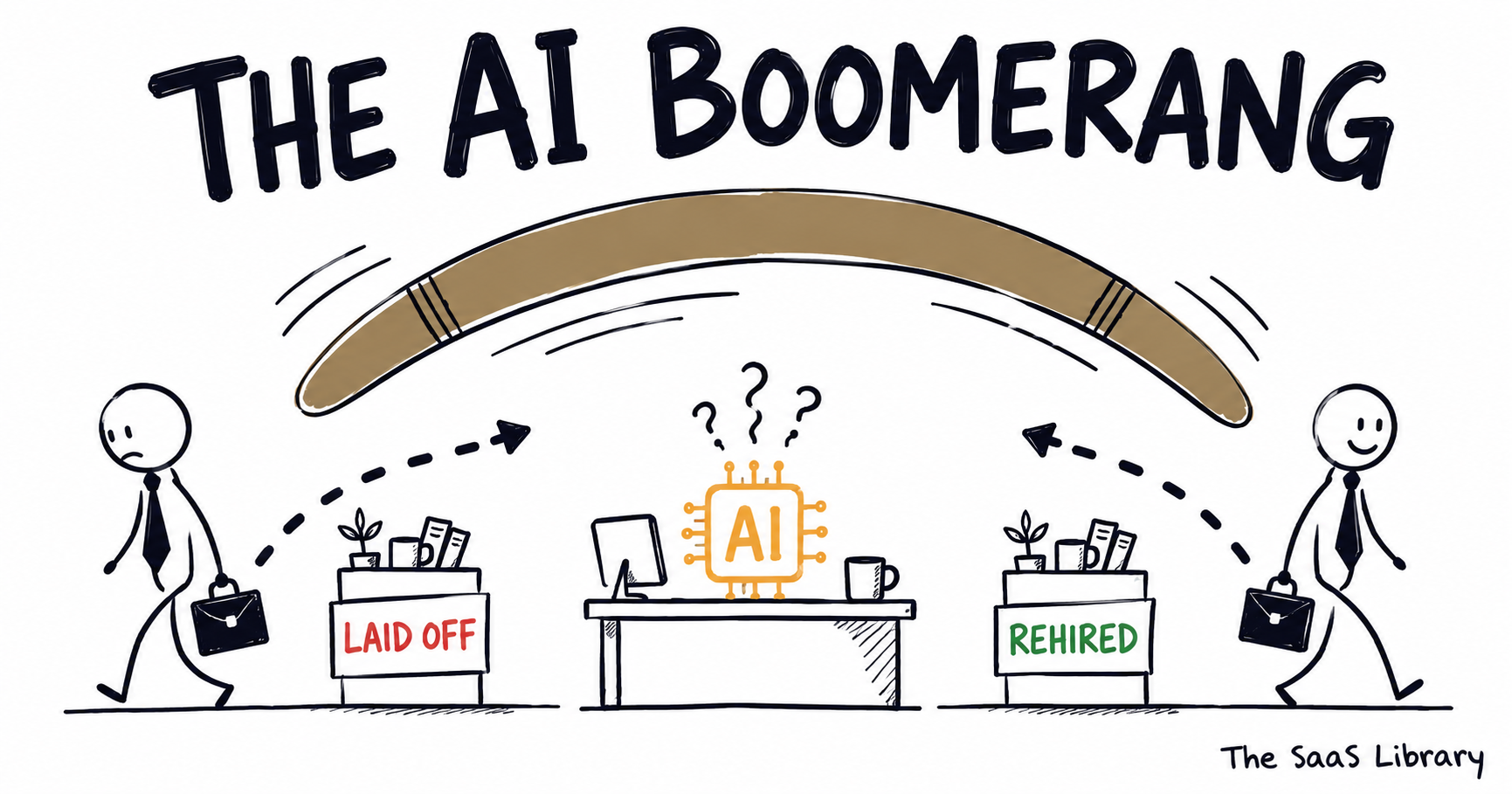
AI layoffs regret is spreading through corporate America. Companies spent 2025 telling investors that AI made thousands of employees unnecessary — in 2026, many of those exact employees are getting rehired.
How Many Workers Have Actually Lost Their Jobs to AI?
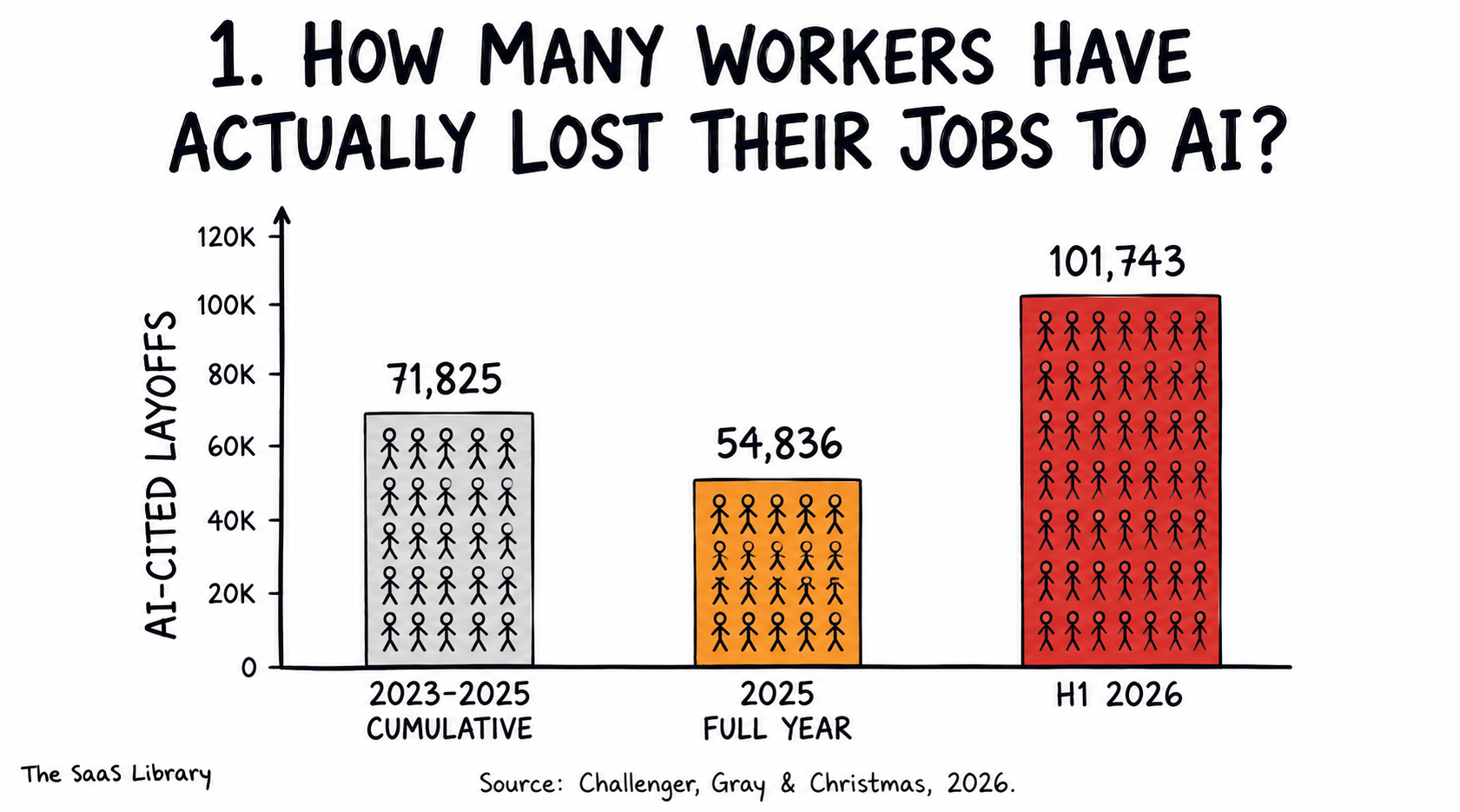
Workers have lost their jobs to AI in six-figure numbers in 2026, with cuts accelerating sharply. Employers attributed 101,743 layoffs to AI in the first half of 2026 alone — nearly double all of 2025’s 54,836 — and AI has led every layoff category for four straight months, per Challenger, Gray & Christmas.
Workers have lost their jobs to AI in six-figure numbers so far in 2026 alone. Challenger, Gray & Christmas recorded 101,743 AI-attributed layoffs between January and June 2026 — nearly double the 54,836 recorded across all of 2025. AI has now led every layoff reason category for four consecutive months, from March through June 2026.
Behind that acceleration is a sector that moved faster than almost any other in its history. Technology alone accounted for 139,156 job cuts through June 2026 — and even Challenger’s own analysts think the real AI-driven number is higher than what companies are willing to admit. Andy Challenger, the firm’s chief revenue officer, has said employers increasingly reach for softer language like “technological update” specifically to keep the AI label off the announcement.
| Period | AI-cited layoffs | Share of all cuts |
|---|---|---|
| 2023–2025 cumulative | 71,825 | ~3.5% |
| 2025 full year | 54,836 | ~5% |
| H1 2026 | 101,743 | ~23% |
That distinction matters more than it sounds. A company that says “AI” is making a bet about the future. A company that hides behind “technological update” already suspects the bet didn’t pay off — and would rather nobody ask what happened to the people who were cut for it.
None of this happened by accident. Behind every one of those cuts was a leadership team that believed, with real conviction, that artificial intelligence could do the job a person used to do — and that belief is where this story actually starts.
Why Did Executives Believe AI Could Replace Their Employees?
Executives believed AI could replace their employees because nearly every CEO around them expected it to. A 2026 Mercer survey found that almost all company leaders anticipated some AI-driven headcount reduction within two years — even though only about a third believed their own organization could actually combine human and machine work well.
Executives believed AI could replace their employees because the belief was contagious before it was tested. A 2026 Mercer survey of company leaders, reported via Tom’s Hardware, found that nearly all of them expected AI to drive at least some headcount reduction within two years. Fewer than a third believed their own organization could actually combine human and AI labor effectively — meaning most leaders were cutting for a capability they privately doubted they could manage.
That gap between confidence and readiness wasn’t hidden. It was published, discussed, and then acted on anyway. Oxford Economics went further and found that many companies announcing AI-driven layoffs were, more accurately, correcting for pandemic-era overhiring — and used AI as the more palatable story to tell investors and boards. The term now circulating for this is financially motivated cuts wearing a technology narrative: “AI-washing.”
Before you cut a role for AI, know what the tooling actually costs once it’s running at scale.
See the AI cost framework →The pressure to look decisive mattered as much as the technology itself. A company trimming headcount for “cost-cutting” reads as retreat. A company trimming headcount for “AI transformation” reads as strategy. Forrester’s research found many organizations announcing AI-related layoffs didn’t yet have a mature, tested AI system ready to fill the roles they were eliminating — the technology was the story, not the plan.
None of this means the technology was irrelevant. It means the decision to cut came before the proof that it would work — and the next question is whether anyone checked.
Did Companies Have Data to Justify Laying Off Employees for AI?
Companies mostly did not have data to justify laying off employees for AI. A Harvard Business Review survey of over 1,000 executives found AI-related layoffs were made almost entirely in anticipation of what the technology might do, not evidence of what it had already done.
Companies mostly did not have data to justify laying off employees for AI. Thomas Davenport’s survey for Harvard Business Review, covering more than 1,000 executives, found that AI-related workforce cuts were made almost completely in anticipation of AI’s potential — while the companies making those cuts were still waiting for generative AI to deliver the productivity gains they’d promised investors.
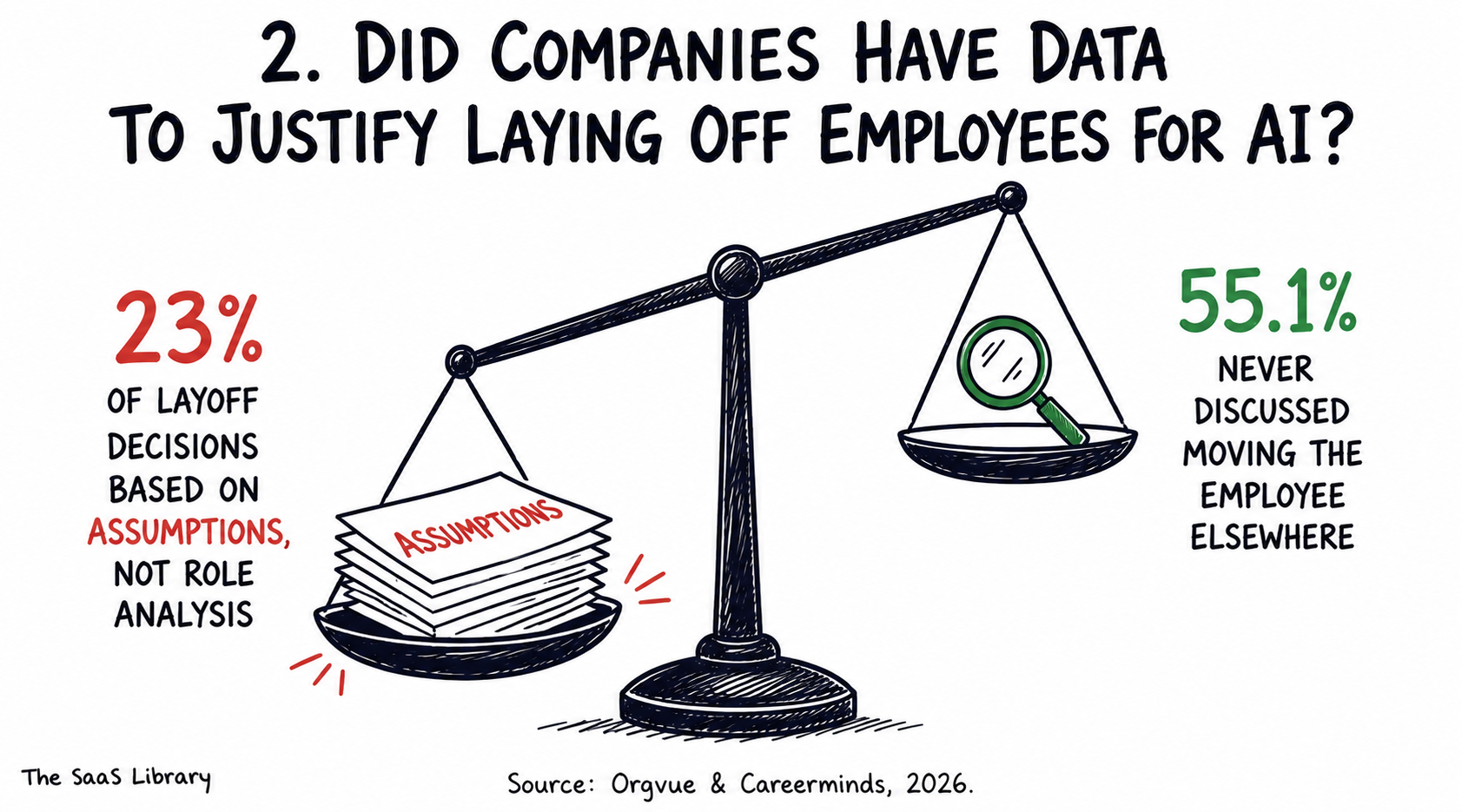
The gap gets more specific the closer you look at it. Orgvue’s own research found that 23% of companies making AI-linked layoffs admitted the decision was based on general assumptions about what AI could do, not a role-by-role analysis of what the eliminated employees actually did all day. Careerminds found something similar from the other side of the table: 55.1% of HR leaders said reskilling or redeployment for the affected employees was never formally discussed before the cuts were made.
23% of companies making AI-linked layoffs admit the decision was based on assumptions about AI, not analysis of the actual role (Orgvue, 2026). 55.1% never even discussed moving the affected employee somewhere else first (Careerminds, 2026). Somewhere inside that gap is every person who lost a job to a decision nobody ran the numbers on.
That check would have shown up somewhere. It didn’t — not until the layoffs were already done and the people were already gone.
Why Couldn’t AI Actually Replace These Employees?
AI couldn’t actually replace these employees because it excelled at the routine share of the work and failed at exactly the part that required judgment. Four companies — Ford, IBM, Commonwealth Bank of Australia, and Klarna — hit that same wall in four different industries, then rehired to fix it.
AI couldn’t actually replace these employees because it excelled at the routine share of the work and failed at exactly the part that required judgment.
Ford: The Graybeard Return
Ford found this out in its own factories. The company had leaned on automated systems for quality inspection and design review, cutting experienced engineers along the way — until quality problems started surfacing that the automated systems weren’t catching. Charles Poon, Ford’s vice president of vehicle hardware engineering, put it plainly:
Ford rehired, promoted, or newly hired 350 veteran engineers — a group the company internally calls its “graybeard” engineers — to mentor younger staff and catch what automation missed. Ford topped J.D. Power’s 2026 Initial Quality Study for the first time since 2010 after bringing them back.
IBM: The Last 6%
IBM’s version of the same problem was narrower, and in some ways more revealing. Its AI system resolved 94% of routine HR requests without any issue.
IBM’s AI system resolved 94% of routine HR requests. The remaining 6% included ethical judgment calls — the exact cases a person, not a policy, is supposed to make. (IBM, via CNBC, 2026)
IBM’s chief human resources officer, Nickle LaMoreaux, later explained the company’s decision to triple entry-level hiring in the US: “If we don’t continue to invest in entry-level hires, what happens in three to five years? There’s no pipeline; the well simply dries up.”
The same gap shows up in how AI itself gets trained. A technique called Reinforcement Learning with Verifiable Rewards (RLVR) has become one of the primary ways companies train AI models without a human checking every output — the model generates an answer, a rule-based verifier checks it against a known correct result, and the model reruns until it matches. It works well for math and code, where “correct” can be checked automatically. It has no answer for the other kind of task. Researchers building RLVR systems have said as much themselves: the method captures correctness, not helpfulness, safety, or tone — the exact qualities IBM’s remaining 6% turned out to require. The industry’s own fix for removing humans from the loop only works on the narrow slice of work that doesn’t need one.
Commonwealth Bank: When the Voice Bot Couldn’t Keep Up
Commonwealth Bank of Australia’s failure was more public. The bank replaced more than 40 customer service roles with an AI voice bot, then watched call volumes surge as the system couldn’t keep up with real customer demand. CBA reversed the redundancies within months and admitted, in a public statement, that its “initial assessment that the 45 roles in our Customer Service Direct business were not required did not adequately consider all relevant business considerations.” A union official called the reversal “a massive win for workers.”
Klarna: 700 Agents, Minus the Judgment
Klarna’s collapse ran the longest before anyone said so out loud. The Swedish fintech cut hundreds of customer service roles after claiming its AI chatbot could handle the equivalent of 700 human agents. Customer satisfaction declined. CEO Sebastian Siemiatkowski eventually acknowledged that cost had been “a too predominant evaluation factor,” and the company began rehiring humans into the roles it had just eliminated.
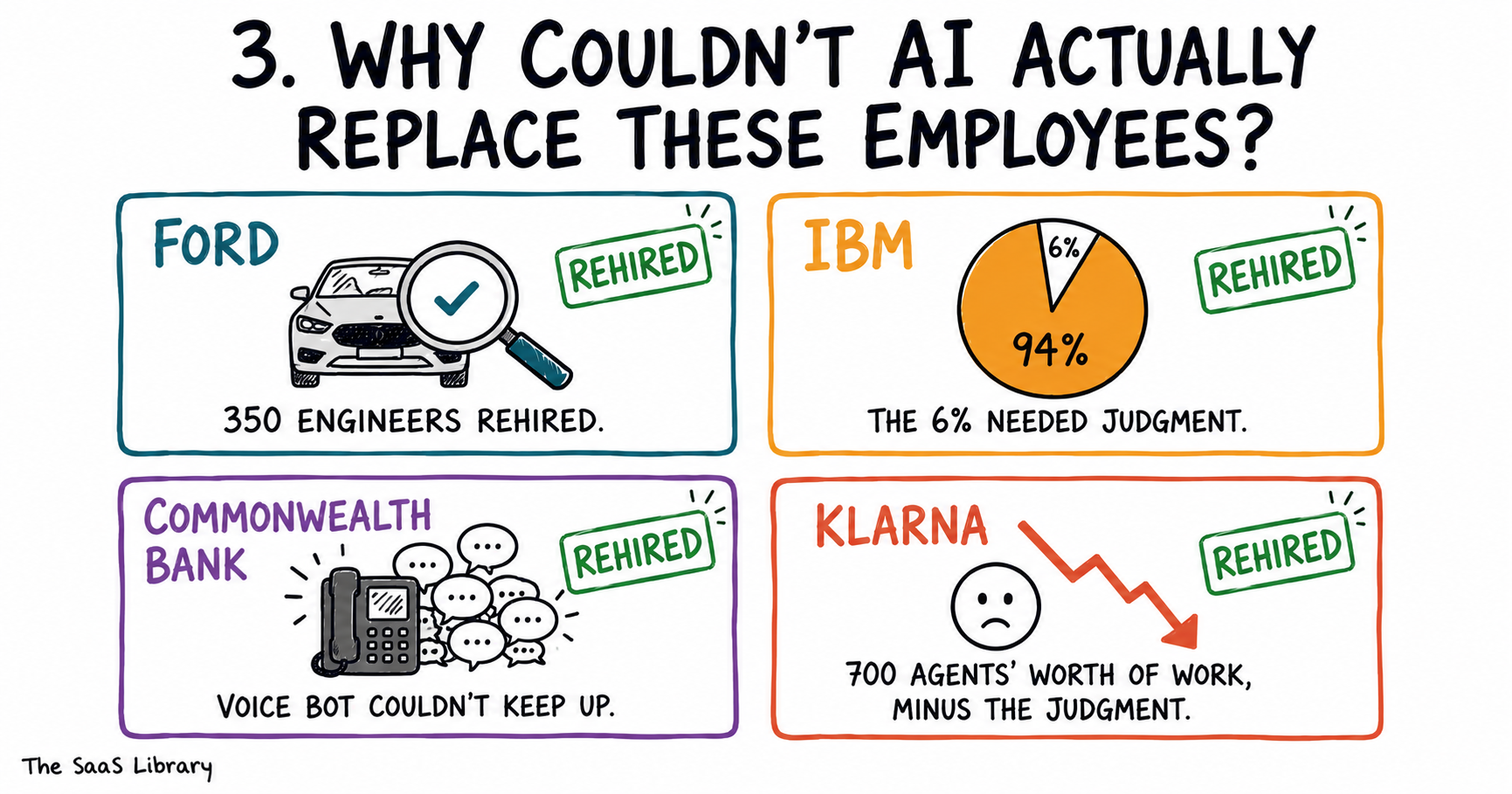
Four companies, four industries, one pattern repeating itself: the work AI couldn’t do wasn’t a technical edge case. It was judgment, context, and the willingness to be accountable for a decision — the parts of the job nobody thought to put in the AI’s job description because no one thought a person would ever need to be hired back to do it.
How Widespread Is AI Layoffs Regret, and What Are Companies Doing About It?
So far, this is a story about a bet that didn’t pay off. What’s left is what companies did once they realized it — and whether it actually worked.
AI layoffs regret is widespread, and companies are responding by rehiring. Orgvue’s 2025 survey found 55% of business leaders who made AI-linked redundancies admitted the decision was wrong, and separately, Robert Half found 32% of US hiring managers who cut a role for AI have already rehired for the same or a similar position.
AI layoffs regret is widespread, and companies are responding by rehiring. Orgvue’s 2025 survey of business leaders found that among the 39% who made employees redundant because of AI, 55% later admitted the decision was a mistake. Forrester reached a similar number through separate research: 55% of employers now say they regret laying off workers because of AI. Two different firms, two different survey methods, the same conclusion arrived at twice.
The rehiring isn’t evenly spread. Robert Half’s survey of nearly 2,000 US hiring managers found finance leading the reversal at 44%, followed by HR at 35% and technology at 32%.
| Sector | Rehired for a role cut for AI |
|---|---|
| Finance | 44% |
| HR | 35% |
| Technology | 32% |
| All industries (average) | 32% |
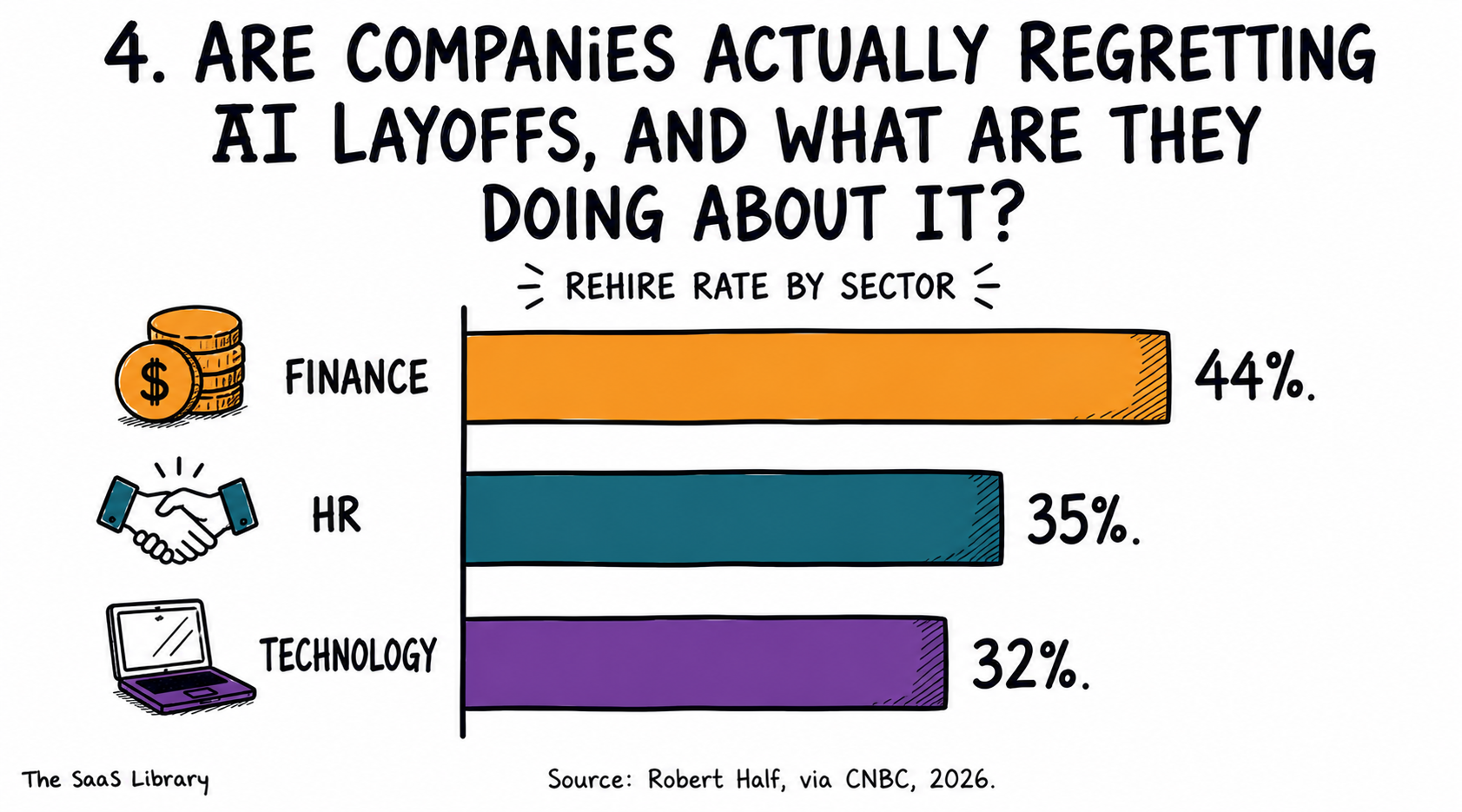
Finance topping that list is not a coincidence. It’s one of the most judgment-heavy functions in any company — the same category of work that keeps showing up as the part AI couldn’t absorb in the previous section.
The speed of the reversal is what makes this hard to write off as caution rather than regret. Careerminds surveyed 600 HR professionals who had made AI-driven layoffs in the prior year and found that 52.1% had already rehired for the eliminated roles within six months, and another 17.8% had started within three. Only 2.1% waited more than a year. Companies weren’t quietly reconsidering over time. They were reversing course almost as fast as they’d made the cut.
That speed says something the regret percentages don’t. A company that takes years to admit a mistake might just be slow to notice. A company that rehires within three months already knew.
Is the Rehiring Actually Succeeding — Or Are Workers Moving On Without It?
The rehiring is not clearly succeeding financially, and a portion of laid-off workers are not waiting for it. Only 26.7% of companies that rehired after AI layoffs came out financially ahead, according to Careerminds, while Forrester warns that much of the “rehiring” may not even mean the same people getting their jobs back.
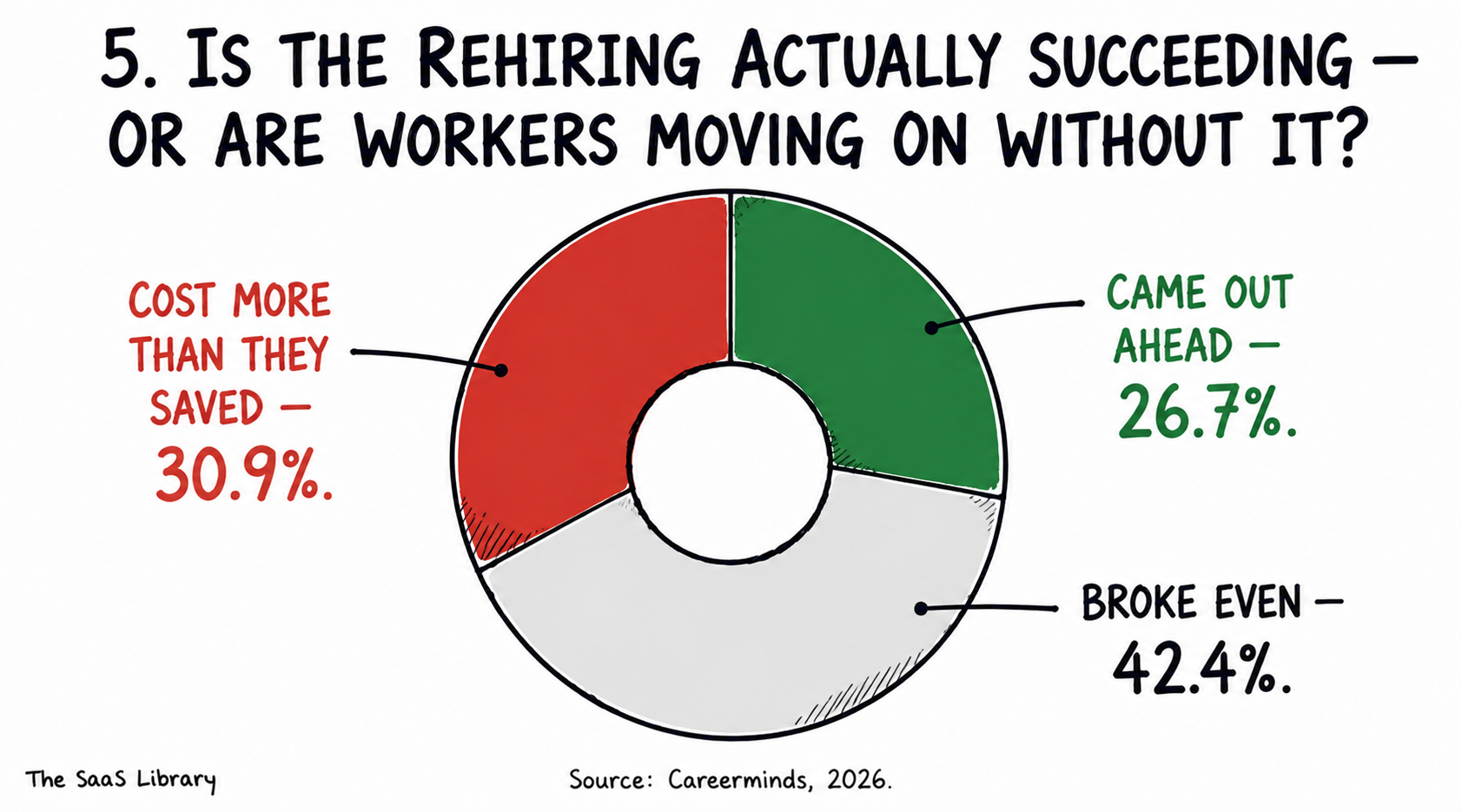
The rehiring is not clearly succeeding financially, and a portion of laid-off workers are not waiting for it. Careerminds found that nearly 31% of companies that rehired after AI-driven layoffs ended up spending more than they’d saved from the original cuts, and another 42.4% broke even — meaning fewer than three in ten came out ahead. Those figures don’t count the costs that don’t show up on a balance sheet: lost institutional knowledge, declining morale, customers who’d already moved on.
There’s a harder truth underneath the rehiring headlines. Forrester’s research doesn’t just predict that AI-attributed layoffs will reverse — it predicts they’ll reverse cheaper. The firm expects much of this work to return “offshore, or at significantly lower salaries,” which means the person answering the phone at the reopened role may not be the person who was let go from it.
Rehiring a role and rehiring a person are not the same event. Forrester’s research suggests companies are more likely to refill the job than to call back the specific employee they laid off — often at a lower salary, sometimes in a different country entirely.
Some workers never waited to find out. LinkedIn’s own data shows “Founder” as one of the fastest-growing titles people add to their profiles — up 60% year-over-year across Europe, with the UK specifically up 69% and the Netherlands up 85%. Labor-market analytics firm Revelio Labs tracked the same pattern in the US: the share of job switchers becoming entrepreneurs nearly doubled between early 2022 and early 2025, and the average age of someone making that switch has dropped to under 34.
The reasoning behind that shift is straightforward. The same AI capability that made a company think it didn’t need a department is available to a single person for a few thousand dollars a year, not a few hundred thousand in payroll. A former employee doesn’t need to out-earn their old salary immediately — they need to out-run the six-month wait Careerminds found most rehired workers actually got.
So the honest picture isn’t “companies fired people and now they’re making it right.” It’s messier: some rehiring is real and expensive, some of it is quieter and cheaper than it looks, and some of the people who got cut have already stopped waiting to find out which one they’d get.
Will AI Ever Fully Replace Human Workers?
AI will not fully replace human workers based on the evidence available now, though credible experts disagree sharply about the future. Yale’s Budget Lab found no statistically significant effect on unemployment through March 2026 for workers in high-AI-exposure occupations, and the European Central Bank found firms using AI intensively were about 4% more likely to be hiring, not less.
AI will not fully replace human workers based on the evidence available now, though credible experts disagree sharply about the future — and their own positions keep shifting. Anthropic CEO Dario Amodei told Axios in May 2025 that AI could eliminate up to 50% of entry-level white-collar jobs within five years and push unemployment to 10–20%. A year later, at a May 2026 briefing alongside JPMorgan CEO Jamie Dimon, he was invoking the Jevons Paradox instead — the 19th-century observation that efficiency gains expand demand for a resource rather than shrinking it.
OpenAI CEO Sam Altman moved in the opposite direction. At a Sydney banking conference in May 2026, he admitted: “I thought there would have been more impact on entry-level white-collar jobs being eliminated by now than has actually happened. I’m delighted to be wrong about this.”
The data collected so far leans toward the skeptics. Yale’s Budget Lab found no statistically significant effect on unemployment through March 2026 for workers in high-AI-exposure occupations — though the Lab’s own director has cautioned against reading this as proof the disruption isn’t coming, only that it hasn’t shown up yet. The European Central Bank found AI-intensive firms were about 4% more likely to be hiring than firms that don’t use AI heavily.
My read: the evidence supports a narrower claim than either CEO originally made. AI is displacing codifiable, high-volume, routine work — which is exactly why entry-level roles keep showing up as the most exposed category throughout this article. What the data doesn’t support is AI displacing judgment, accountability, or the ability to repair a relationship after something goes wrong — the same four things Ford, IBM, Commonwealth Bank, and Klarna all rediscovered the hard way.
PwC’s 2026 Global AI Jobs Barometer, drawn from more than a billion job postings across 27 countries, found something that complicates the doom narrative further: companies in the most AI-exposed sectors grew headcount 52% since 2018, compared to 36% for the least AI-exposed companies. The firms most associated with AI disruption are, on average, the ones hiring the most people — not the fewest.
None of this settles whether AI eventually crosses into judgment-based work. Even the two men building it can’t agree, and both have already changed their minds once. It settles what’s true right now, which is that the boundary between what AI can do and what it can’t has moved slower than the last three years of layoff announcements implied.
The Human Layer: How AI and People Should Actually Work Together
Every company that cuts for AI is making a bet about which parts of a job actually need a person. Ford, IBM, Commonwealth Bank, and Klarna all bet wrong about the same four things — and a broader pattern researchers have found across the industry makes their mistake look almost routine: companies that automate aggressively often end up cutting the very staff who would have caught the AI’s mistakes, because nobody categorized oversight as a job worth keeping. The companies pulling ahead didn’t wait to find out the hard way.
The pattern across every company in this article is the same: they cut the layer first and rebuilt it under pressure. IKEA and Ford show what it looks like to design the Human Layer in before the layoffs, not after.
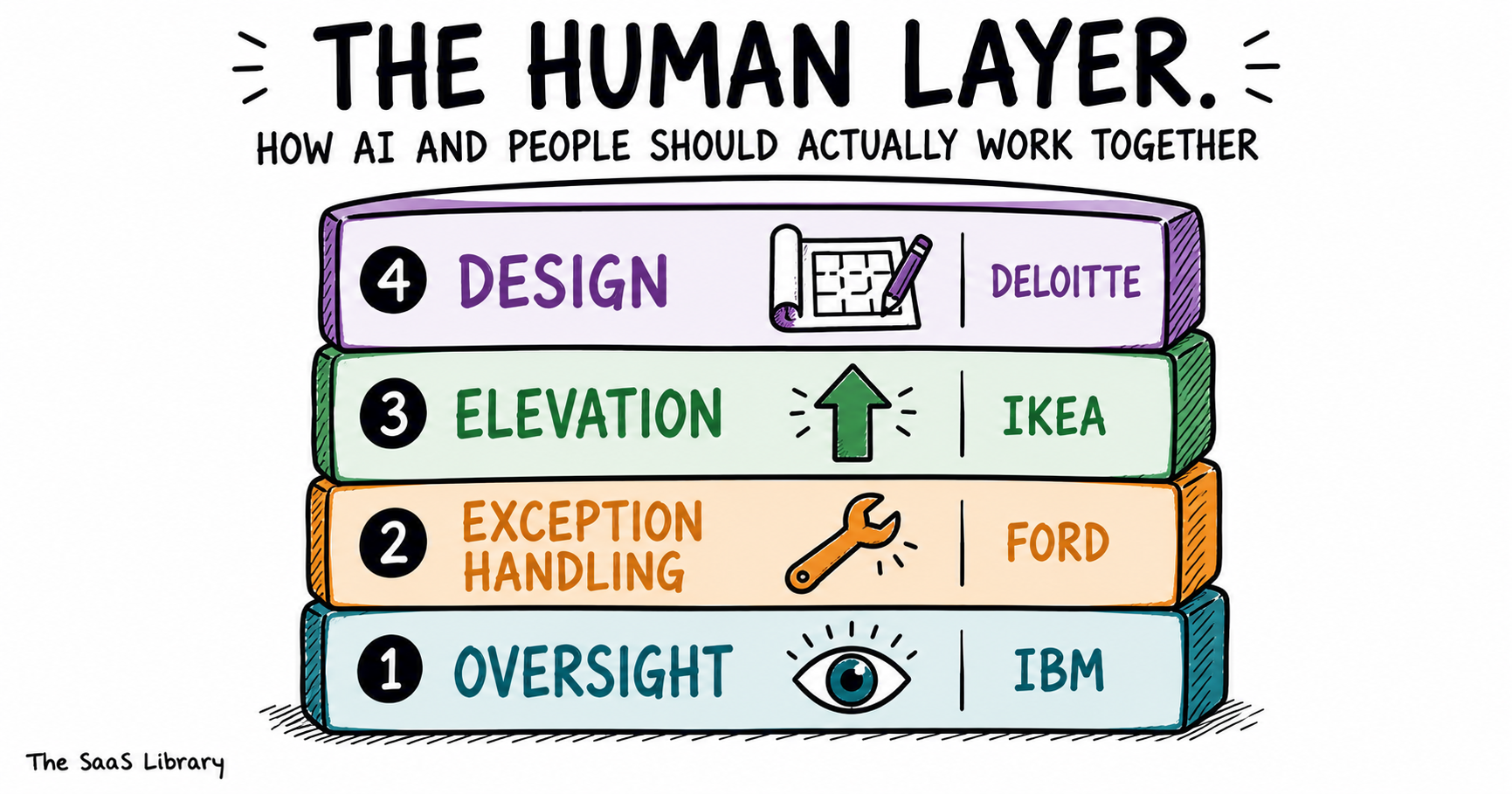
The Human Layer was never the part of the business AI was going to replace. It was the part keeping AI usable. IKEA and Ford designed for it before the pressure hit, and it shows in their numbers. The companies you just read about designed for it after — while writing rehire offers to the people they let go a year earlier.
Frequently Asked Questions
What is the AI Boomerang?
The AI Boomerang is the term used to describe companies laying off employees in favor of AI, then rehiring those roles once the technology fails to fully replace the work. Careerminds found that 52.1% of companies making AI-driven layoffs rehired within six months (Careerminds, 2026).
How many jobs have been lost to AI in 2026?
Employers attributed 101,743 layoffs to AI between January and June 2026, nearly double the 54,836 recorded across all of 2025 (Challenger, Gray & Christmas, 2026).
Why did companies believe AI could replace their employees?
Companies believed AI could replace their employees because nearly all surveyed executives expected some AI-driven headcount reduction within two years, even though most doubted their own organization could combine human and AI labor effectively (Mercer, 2026 Global Talent Trends).
Did companies have data to support their AI layoff decisions?
Companies mostly did not have data to support their AI layoff decisions. A Harvard Business Review survey of more than 1,000 executives found the cuts were made in anticipation of AI’s potential, not evidence of its performance (Davenport, Harvard Business Review, 2026).
Why couldn’t AI actually replace human employees?
AI could not actually replace human employees because it handled routine, high-volume tasks well but failed at judgment calls. IBM’s AI system resolved 94% of routine HR requests, but the remaining 6% required human judgment on ethical questions (IBM, via CNBC, 2026).
Are companies actually regretting AI layoffs?
Companies are regretting AI layoffs in large numbers. Orgvue’s 2025 survey found 55% of business leaders who made AI-related redundancies admitted the decision was wrong, and Forrester separately found the same 55% regret figure in its own research (Orgvue, 2025; Forrester, Predictions 2026).
Which industries are rehiring the most workers after AI layoffs?
Finance is rehiring the most workers after AI layoffs, at 44%, followed by HR at 35% and technology at 32%, against an all-industry average of 32% (Robert Half, via CNBC, 2026).
Is rehiring after AI layoffs financially worth it for companies?
Rehiring after AI layoffs is financially worth it for fewer than three in ten companies. Careerminds found 30.9% of companies spent more on rehiring than they’d saved from the original cuts, and 42.4% broke even (Careerminds, 2026).
Are companies rehiring the same employees they laid off?
Companies are not always rehiring the same employees they laid off. Forrester’s research indicates much of this work is returning offshore or at lower salaries, meaning the role is refilled without the original employee necessarily being the one rehired (Forrester, Predictions 2026).
Are laid-off workers starting their own businesses instead of waiting to be rehired?
Some laid-off workers are starting their own businesses instead of waiting to be rehired. LinkedIn data shows “Founder” titles rose 69% year-over-year in the UK and 85% in the Netherlands, and Revelio Labs found the share of job switchers becoming entrepreneurs nearly doubled between 2022 and 2025 (LinkedIn, 2026; Revelio Labs, 2025).
Will AI eventually replace human workers entirely?
AI is unlikely to replace human workers entirely based on current evidence. Yale’s Budget Lab found no meaningful change in unemployment through March 2026 for workers in AI-exposed occupations, and the European Central Bank found AI-intensive firms were slightly more likely to be hiring (Yale Budget Lab, 2026; European Central Bank, 2026).
What is the Human Layer framework?
The Human Layer framework is a four-stage model — Oversight, Exception Handling, Elevation, and Design — describing how companies that succeed with AI keep people in roles AI cannot fully cover, rather than cutting them and rehiring under pressure later.
Conclusion
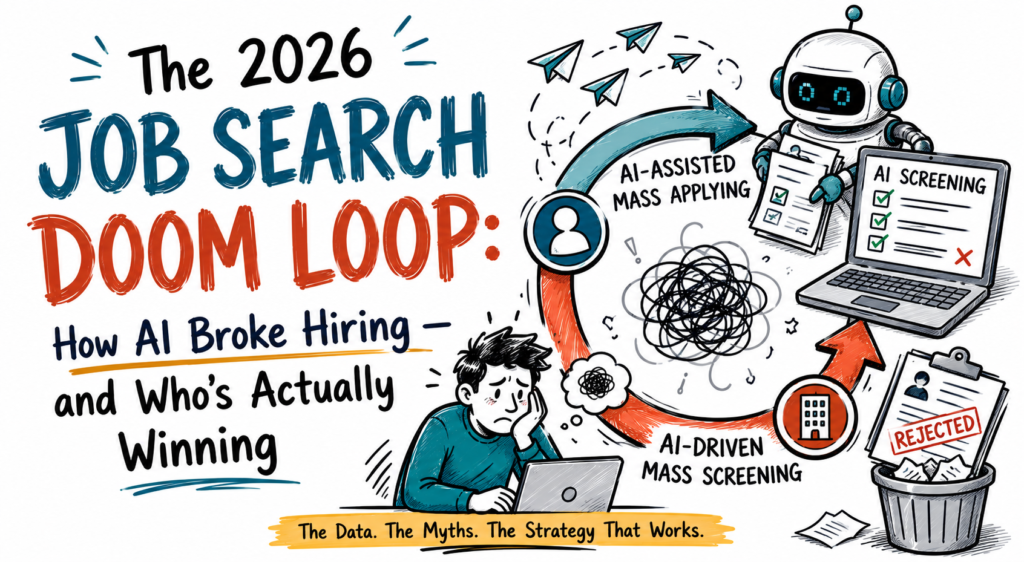
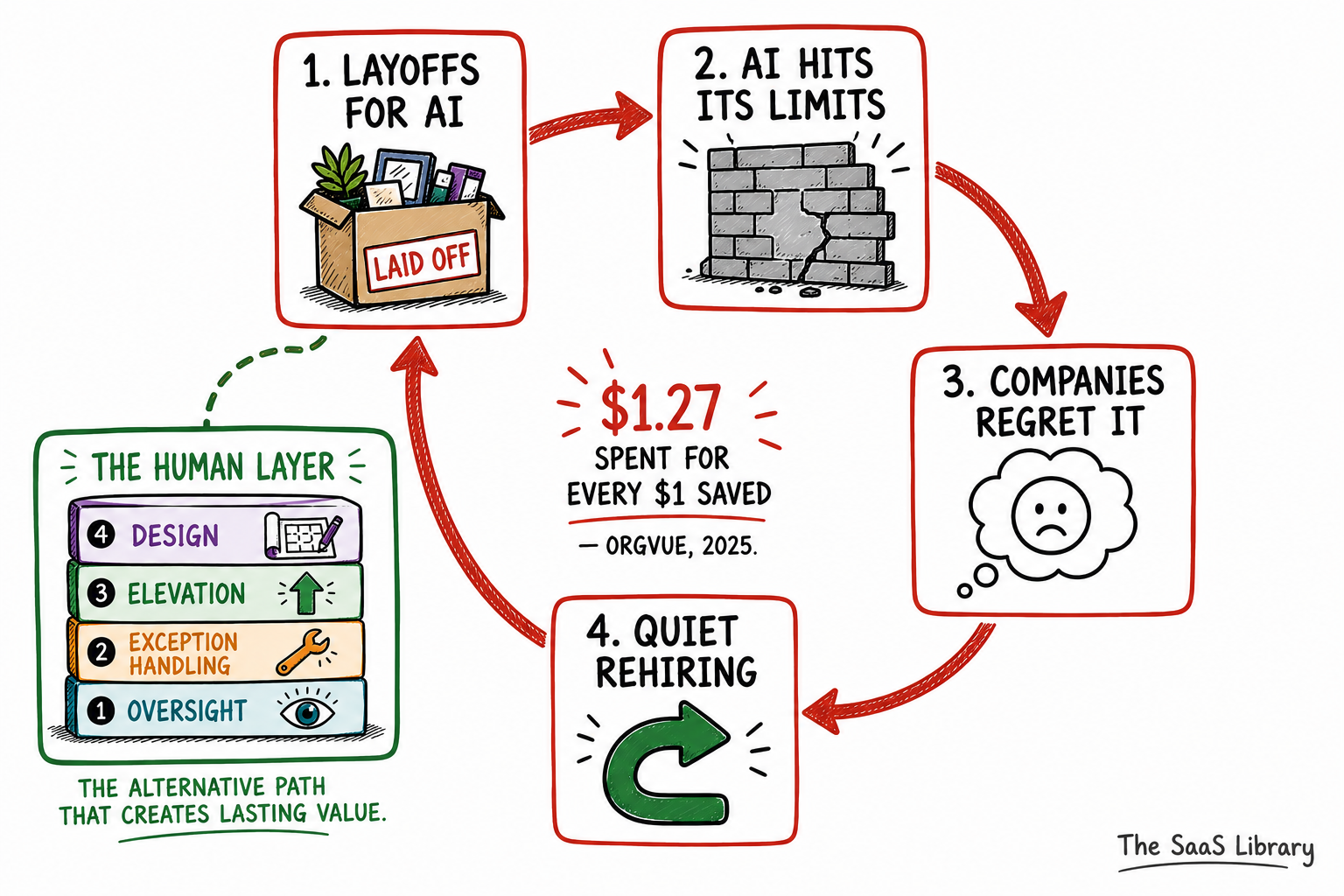
The AI Boomerang isn’t a story about artificial intelligence failing. It’s a story about companies discovering the Human Layer only after they’d already cut it — Ford, IBM, Commonwealth Bank, and Klarna all paid for the same lesson in rehires, not savings. AI layoffs regret turned out predictable, not exceptional: Orgvue put a number on the cost, $1.27 spent for every $1 companies thought they saved. IKEA and Ford show the alternative was available all along. If AI is reshaping how your team hires, The 2026 AI Hiring Doom Loop covers the other half.
- Challenger, Gray & Christmas — 2025 Year-End Report
- Challenger, Gray & Christmas — June 2026 Report
- Challenger, Gray & Christmas — March 2026 Report
- Challenger, Gray & Christmas — April 2026 Report
- CNBC — Employers Reversing AI Layoffs, July 2026
- Careerminds — Cost of AI Layoffs, February 2026
- Harvard Business Review — Davenport, January 2026
- Fortune / Oxford Economics, January 2026
- Forrester — Press Release, January 2026
- Forrester — Predictions 2026, November 2025
- CFO Dive — AI Job Cuts Underreported
- Orgvue — 2025 Annual AI Survey
- Orgvue — Fire-and-Rehire Cycle Study, March 2026
- Orgvue — The $40 Billion Secret, November 2025
- Visier data, via Mezha, November 2025
- IBTimes UK — Robert Half Sector Breakdown
- CareerMetrics — Klarna, March 2026
- PYMNTS — IKEA Reskilling, May 2026
- Deloitte — 2026 Global Human Capital Trends
- Axios — Dario Amodei Interview, May 2025
- Fortune — Amodei’s Jevons Paradox Shift, May 2026
- TIME — Sam Altman Remarks, May 2026
- IndexBox — LinkedIn Founder Title Data, March 2026
- Revelio Labs — Entrepreneurship Era, November 2025
- Emergent Mind — RLVR Technical Summary
- Yale Budget Lab — Tracking AI’s Labor Market Impact, 2026
- European Central Bank — ECB Blog, March 2026
- PwC — 2026 Global AI Jobs Barometer, June 2026