This Claude models comparison covers all 16 Claude models Anthropic has released since 2023 — but the more interesting story isn’t sitting side by side in a table. It’s vertical: how did Claude evolve from a cautious, safety-first chatbot into a model capable of completing a two-month engineering task in a single day? This is the story of Claude evolution — and what it reveals about where AI is heading.
| Model | Best For | SWE-bench Pro | Context | Price (in/out per 1M) |
|---|---|---|---|---|
| Claude Fable 5 | Complex, long-horizon coding & research | 80.3% | 1M tokens | $10 / $50 ⚠ Suspended |
| Claude Opus 4.8 | Enterprise agents & orchestration | 69.2% | 1M tokens | $5 / $25 |
| Claude Sonnet 4.6 | Everyday coding & content — best value | 69.2% | 1M tokens | $3 / $15 |
| Claude Haiku 4.5 | High-volume, low-latency tasks | — | 1M tokens | $1 / $5 |
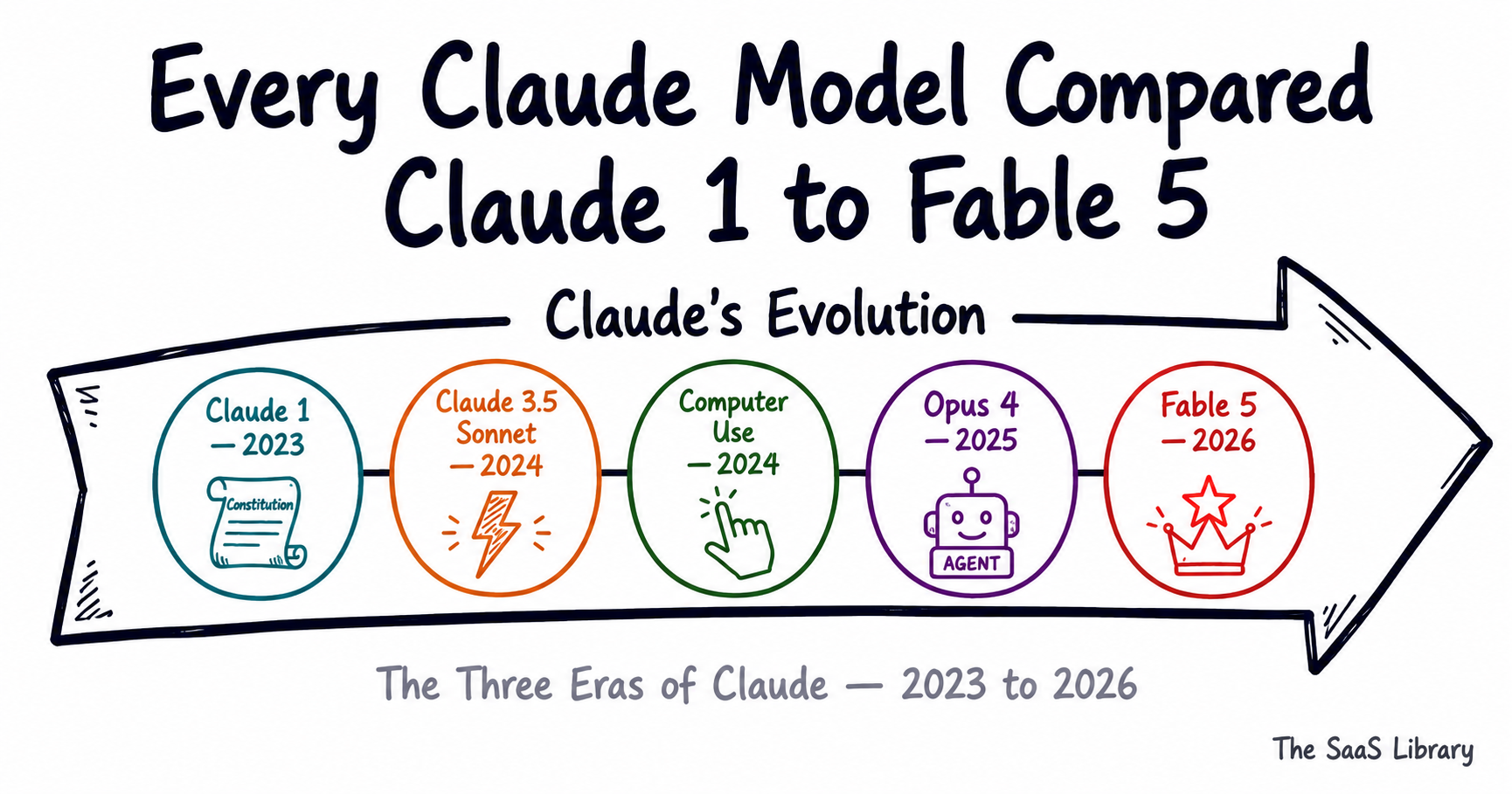
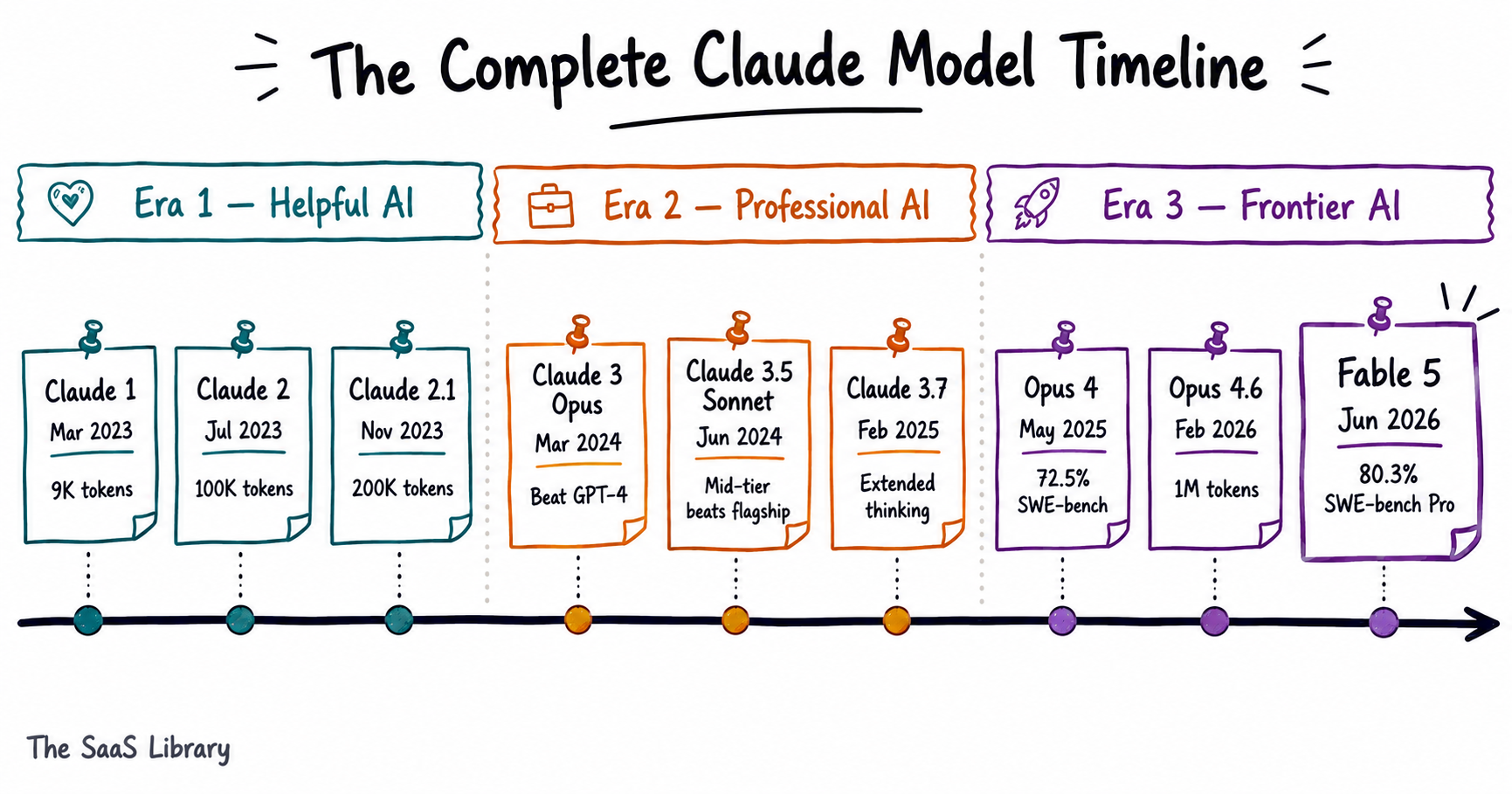
Claude has evolved across three distinct eras since March 2023. Era One (2023) established safety and long-context as foundations. Era Two (2024–early 2025) made Claude genuinely useful for professional work. Era Three (2025–2026) shifted the focus from tool to autonomous collaborator. Fable 5, released June 2026, is the current frontier.
The Complete Claude Model Timeline: All Claude Versions Explained
The table below is a complete Claude model list — every major Anthropic Claude model in the Claude release history, in chronological order, with verified release dates, context windows, the single most important innovation each model introduced, and the audience it was built for.
| Model | Release | Context Window | Key Innovation | Primary Audience |
|---|---|---|---|---|
| Claude 1 | Mar 14, 2023 | 9K → 100K tokens (May 2023) | Constitutional AI; first public Claude | Early adopters, API developers |
| Claude Instant | Mar 14, 2023 | 9K tokens | Fast, low-cost companion model | High-volume API use cases |
| Claude 2 | Jul 11, 2023 | 100K tokens | Improved reasoning and coding; public claude.ai launch | Developers, general public |
| Claude 2.1 | Nov 21, 2023 | 200K tokens | 200K context; system prompts; tool use beta | Enterprise workflow automation |
| Claude 3 Haiku | Mar 4, 2024 | 200K tokens | Speed + cost efficiency; vision input | Chatbots, customer-facing apps |
| Claude 3 Sonnet | Mar 4, 2024 | 200K tokens | Balanced performance-to-cost; vision | Mid-market developers |
| Claude 3 Opus | Mar 4, 2024 | 200K tokens | Beat GPT-4 across major benchmarks | Enterprise, research, complex tasks |
| Claude 3.5 Sonnet | Jun 20, 2024 | 200K tokens | Mid-tier outperforms prior flagship; Artifacts | Developers, coding, agentic workflows |
| Claude 3.5 Sonnet v2 | Oct 22, 2024 | 200K tokens | Computer Use public beta | Agentic developers |
| Claude 3.7 Sonnet | Feb 24, 2025 | 200K tokens | First hybrid reasoning + extended thinking | Technical users, complex problems |
| Claude Opus 4 | May 22, 2025 | 200K tokens | Long-horizon agentic workflows; 72.5% SWE-bench | Enterprise agents, coding |
| Claude Opus 4.5 | Nov 24, 2025 | 200K tokens | First above 80% SWE-bench Verified; 67% price cut | Agentic software engineering |
| Claude Opus 4.6 | Feb 5, 2026 | 1M tokens | 1M context; parallel subagent orchestration | Enterprise, long-horizon agents |
| Claude Opus 4.7 | Apr 16, 2026 | 1M tokens | 3× vision resolution; multi-agent coordination | Production agentic systems |
| Claude Opus 4.8 | May 28, 2026 | 1M tokens | ~4× fewer code flaws; Dynamic Workflows | Enterprise orchestration |
| Claude Fable 5 | Jun 9, 2026 | 1M tokens | Mythos-class; 80.3% SWE-bench Pro | Power users, researchers, enterprise |
Current active Anthropic Claude models: Claude Fable 5 (suspended Jun 12), Claude Opus 4.8, Claude Sonnet 4.6, Claude Haiku 4.5. Claude Sonnet 4 and Opus 4 retired June 15, 2026.
Claude version history: how Claude compares to GPT across the same timeline
Claude and GPT have evolved in parallel since 2023. The table below maps each generation side by side — showing how the capability race between Anthropic and OpenAI has played out year by year.
| Year | Claude Flagship | GPT Equivalent | Key Shift |
|---|---|---|---|
| 2023 | Claude 1 / Claude 2 | GPT-4 | Claude introduced Constitutional AI and the first 100K context window — capabilities GPT-4 did not match at the time |
| 2024 | Claude 3 Opus / Claude 3.5 Sonnet | GPT-4o | Claude 3 Opus beat GPT-4 on major benchmarks; Claude 3.5 Sonnet disrupted the assumption that bigger always means better |
| 2025 | Claude Opus 4 / Opus 4.5 | GPT-5 | Claude Opus 4.5 became the first model above 80% SWE-bench Verified; Anthropic cut Opus pricing 67% while maintaining the capability lead |
| 2026 | Claude Fable 5 | GPT-5.5 | Fable 5 leads GPT-5.5 by 21.7 points on SWE-bench Pro (80.3% vs 58.6%) — the largest cross-vendor gap in the history of the rivalry |
Claude model comparison: current models by capability
Not all Claude models are equal across task types. The table below shows relative strength across reasoning, coding, writing, and agentic tasks — to help you match model to workload.
| Model | Reasoning | Coding | Writing | Agents | Price (per 1M in/out) |
|---|---|---|---|---|---|
| Claude Fable 5 | ★★★★★ Best | ★★★★★ 80.3% SWE-Pro | ★★★★★ Best | ★★★★★ Best | $10/$50 ⚠ Suspended |
| Claude Opus 4.8 | ★★★★☆ Excellent | ★★★★☆ 69.2% SWE-Pro | ★★★★☆ Excellent | ★★★★★ Best available | $5/$25 |
| Claude Sonnet 4.6 | ★★★☆☆ Strong | ★★★★☆ 69.2% SWE-Pro | ★★★★☆ Excellent | ★★★☆☆ Good | $3/$15 ✓ Best value |
| Claude Haiku 4.5 | ★★☆☆☆ Capable | ★★☆☆☆ Capable | ★★★☆☆ Good | ★★☆☆☆ Basic | $1/$5 ✓ Lowest cost |
The progression visible in the timeline is not primarily about context windows or benchmark scores. It is about three distinct strategic problems Anthropic was solving at each stage — and understanding those problems tells you more about the future of AI than any individual metric.
Era One — Helpful AI: The Early Claude History (2023)
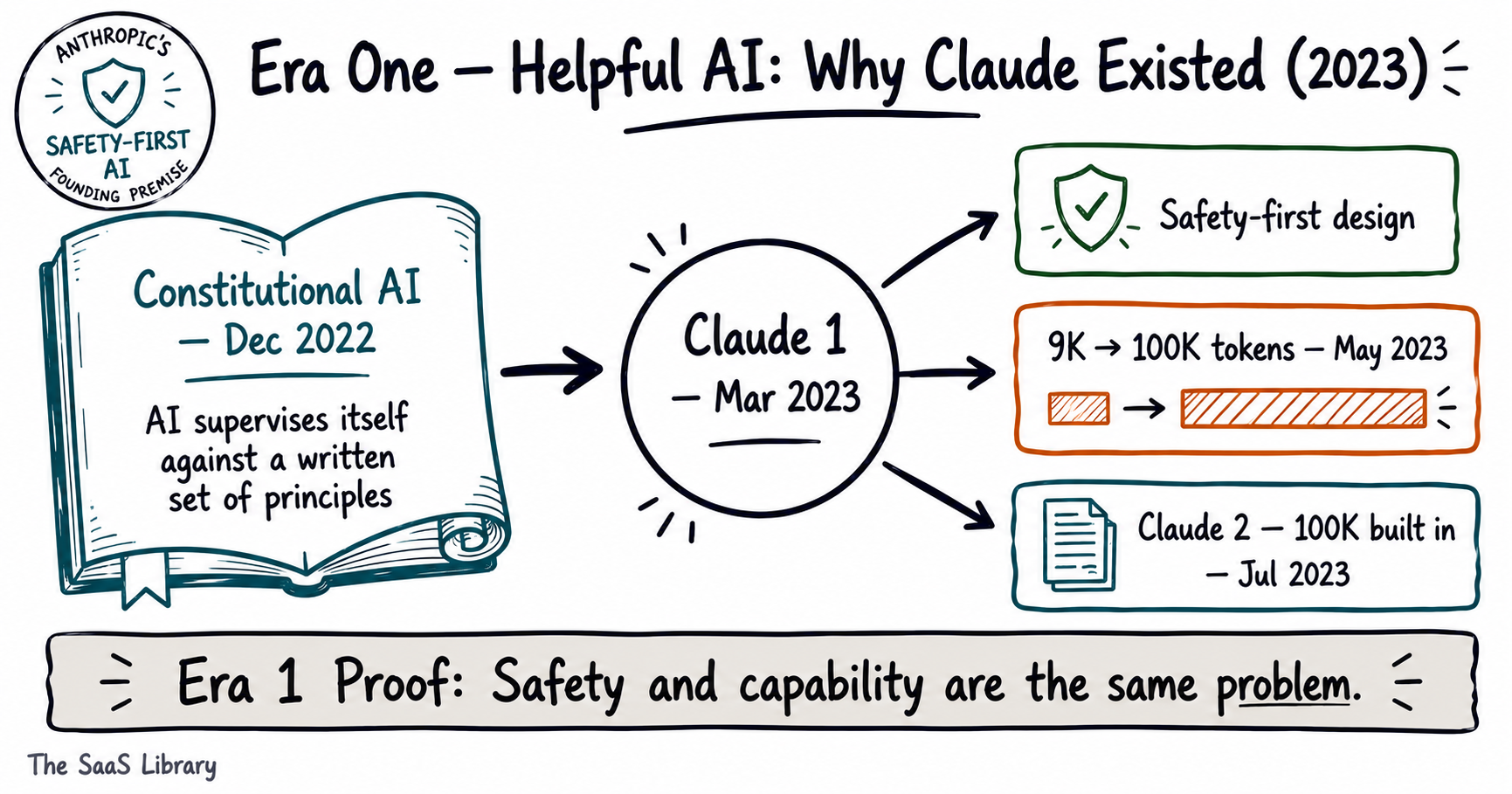
Claude existed because Anthropic believed the AI industry was moving too fast toward capability and not fast enough toward safety — and that the only credible way to make that argument was to build a model that proved both were possible at the same time.
Constitutional AI: the decision that shaped everything
Every Claude model ever released is built on a training methodology Anthropic published in December 2022: Constitutional AI. Rather than relying entirely on human feedback to shape model behaviour, Constitutional AI gives the model a written set of principles — a constitution — and trains it to evaluate and revise its own outputs against those principles.
Claude 1, Claude Instant, and the 100K window
Claude launched publicly on March 14, 2023, alongside Claude Instant. Eleven weeks later, Anthropic expanded Claude’s context window to 100,000 tokens — the first frontier lab to reach this threshold. Claude 2 (July 11, 2023) launched with 100K built in, alongside the public claude.ai launch. Claude 2.1 (November 21, 2023) extended to 200K tokens and introduced system prompts and tool use in beta — the earliest signal of the agentic direction the Claude 4 generation would later pursue.
Want a full deep-dive on Fable 5 — the most capable Claude model ever released to the public?
Read: Claude Fable 5 Review →Era Two — Professional AI: When Claude Became Useful for Work (2024–Early 2025)
Claude became genuinely useful for professional work in March 2024 — when the Claude 3 family established Claude as a credible alternative to GPT-4 — and again in June 2024, when Claude 3.5 Sonnet broke the assumption that the most expensive model was automatically the best choice.
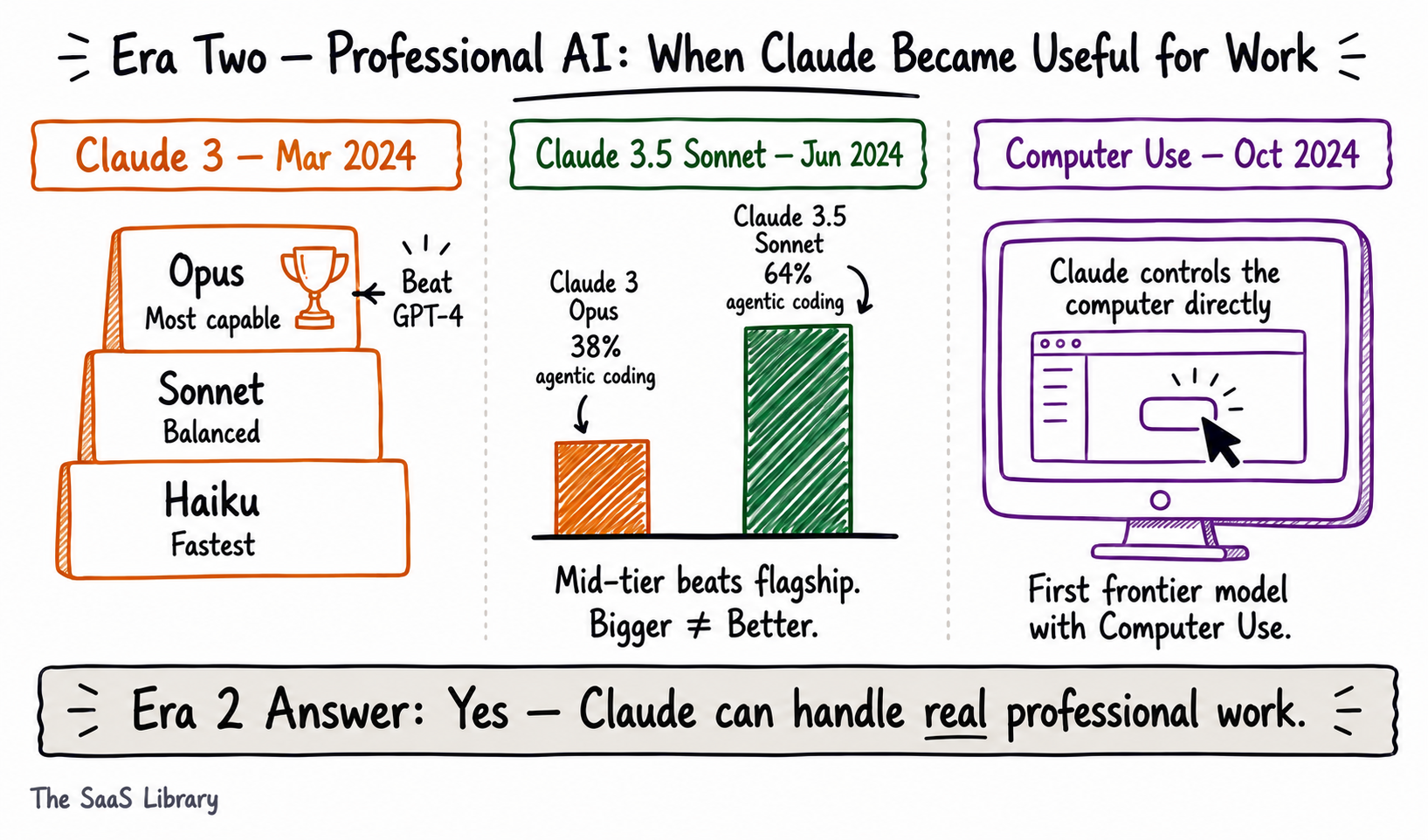
The Claude 3 family: March 4, 2024
Claude 3 launched as three models simultaneously — Haiku, Sonnet, and Opus. Claude 3 Opus outperformed GPT-4 across graduate-level reasoning (GPQA), undergraduate knowledge (MMLU), and coding (HumanEval). Claude 3 also introduced vision input across all three tiers.
Claude 3.5 Sonnet: when bigger stopped meaning better
Claude 3.5 Sonnet (June 20, 2024) outperformed Claude 3 Opus across most benchmarks while running at twice the speed and costing significantly less. On Anthropic’s internal agentic coding evaluation, Claude 3.5 Sonnet solved 64% of problems compared to Claude 3 Opus’s 38%. Bigger stopped meaning better. For teams evaluating Claude against ChatGPT, this was the release that shifted the decision.
Computer Use: October 22, 2024
Claude 3.5 Sonnet v2 introduced Computer Use — the ability to perceive a screen, move a cursor, click buttons, and type text autonomously. First publicly available frontier model to offer this capability. Claude stopped being a model you queried and started becoming a model you deployed as an agent.
Claude 3.7 Sonnet: February 24, 2025
Claude 3.7 Sonnet introduced extended thinking — a hybrid reasoning mode in which Claude works through a problem step by step before producing a final response. It also launched alongside the Claude Code research preview, signalling that Era Three was already beginning.
Era Three — Frontier AI: When Claude Became a Collaborator (2025–2026)
Era Three began in May 2025 with a shift in how Anthropic framed Claude. The question was no longer whether Claude could handle professional work. The question was whether Claude could work autonomously — over extended periods, on tasks requiring real-world judgment, with minimal human intervention.
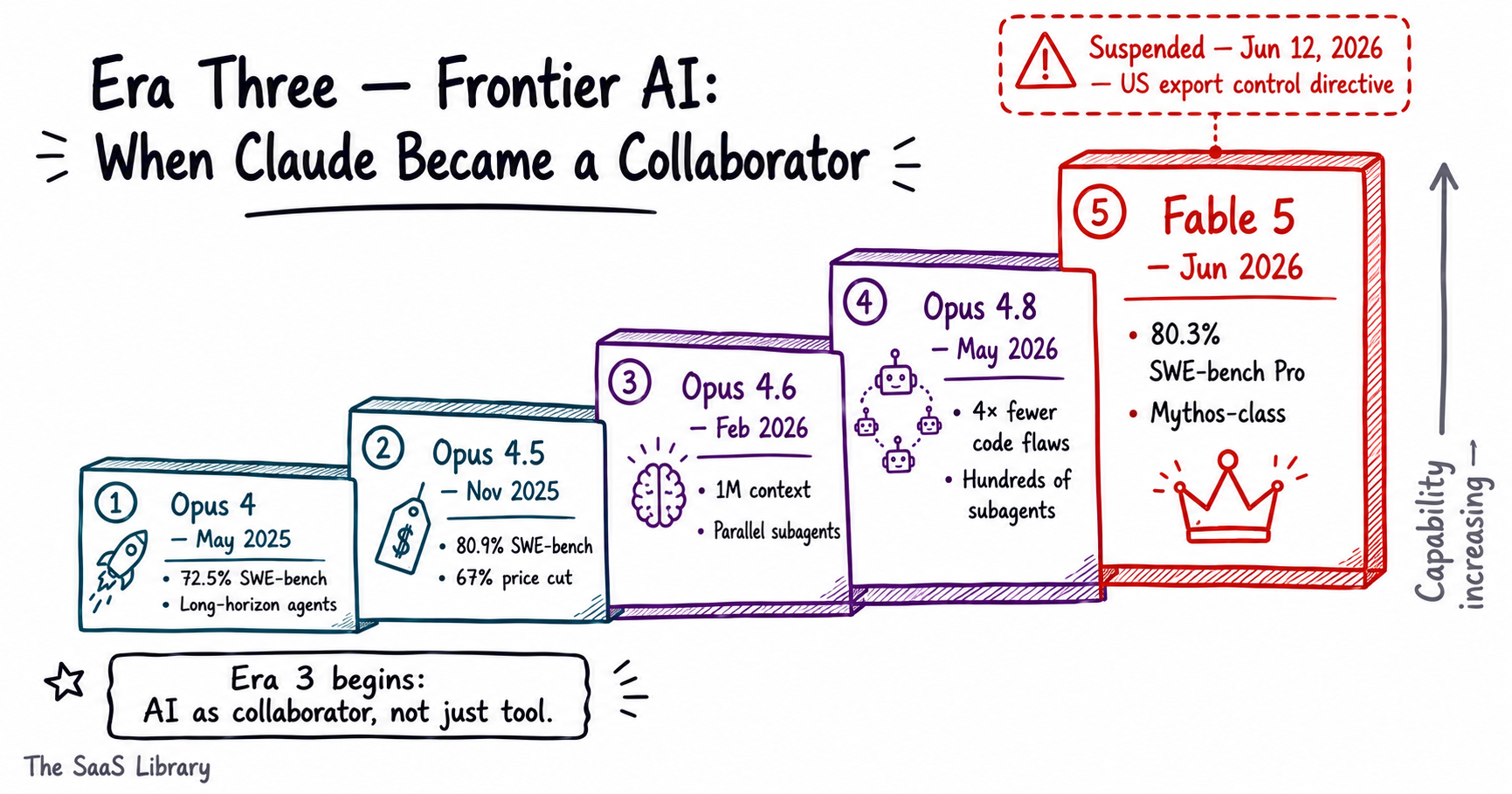
Claude Opus 4 through 4.8
Claude Opus 4 (May 22, 2025) launched as the first agent-first Claude model, scoring 72.5% on SWE-bench Verified. Understanding how to pick your first AI agent workflow became a practical question for enterprise teams from this point.
Opus 4.5 (Nov 24, 2025) — first model above 80% SWE-bench Verified (80.9%); 67% price cut. Opus 4.6 (Feb 5, 2026) — 1M-token context; parallel subagent orchestration. The question of whether to build or buy an AI agent became significantly more answerable at this price point. Opus 4.8 (May 28, 2026) — ~4× fewer code flaws; Dynamic Workflows; hundreds of parallel subagents.
Claude Fable 5: June 9, 2026
Claude Fable 5 — the first publicly available Mythos-class model. 80.3% SWE-bench Pro vs Opus 4.8’s 69.2% and GPT-5.5’s 58.6%. For a full deep-dive, see our Claude Fable 5 review. More on the restricted Mythos Preview launch: The AI Model Too Dangerous to Release.
Three days after launch, the US government issued an export control directive requiring Anthropic to suspend access to both Claude Fable 5 and Claude Mythos 5. Claude Opus 4.8 is the recommended alternative. The governance readiness gap in enterprise AI is a structural challenge this suspension makes concrete.
The cost implications of frontier AI also warrant attention. Understanding what agentic AI actually costs before deploying Fable 5-class models at scale is essential planning.
The Three Eras Framework
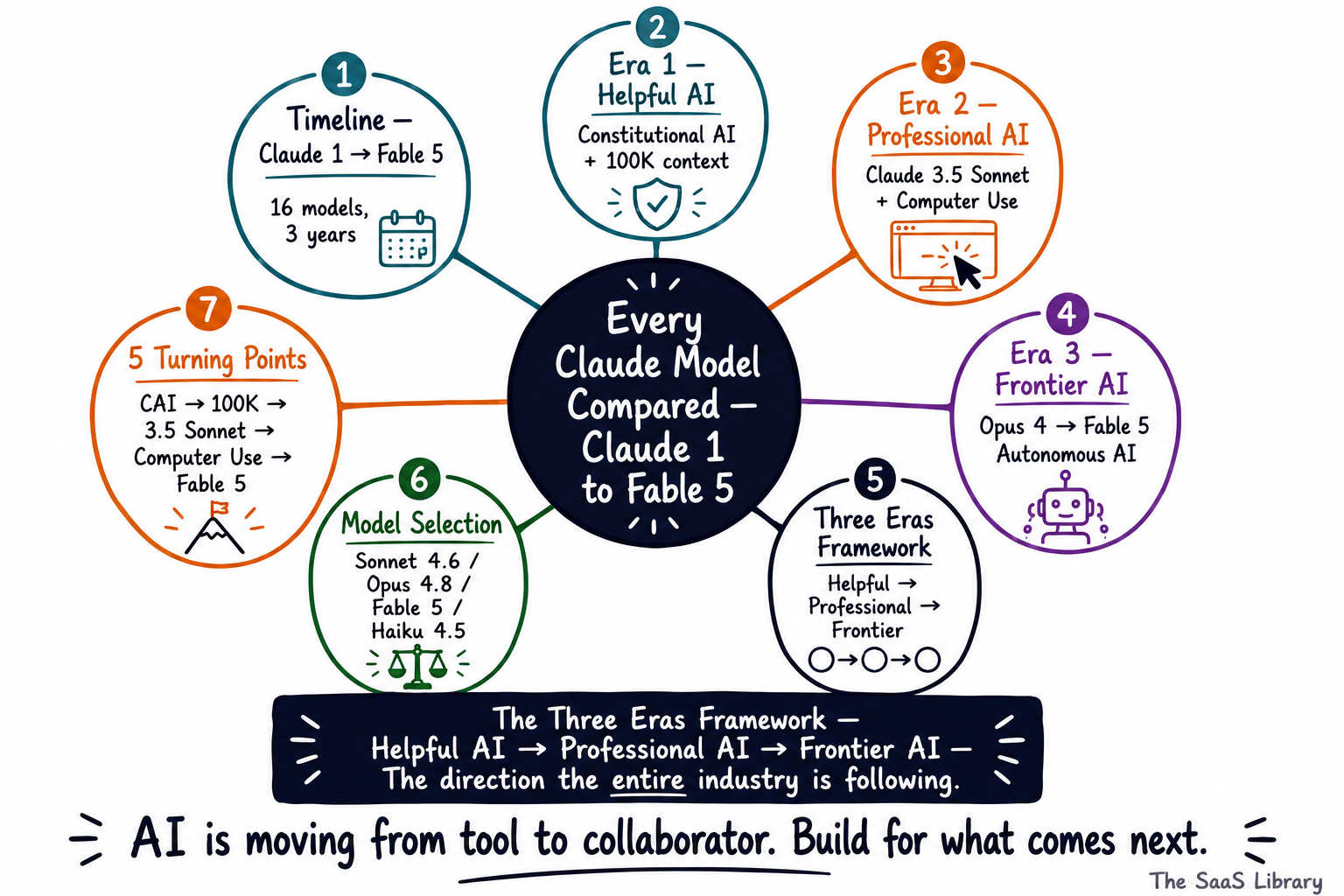
The Three Eras Framework is the pattern that emerges when you look at Claude’s full history not as a sequence of model releases, but as a sequence of problems Anthropic was solving. Each era is defined by a single question. Each answer unlocked the next.
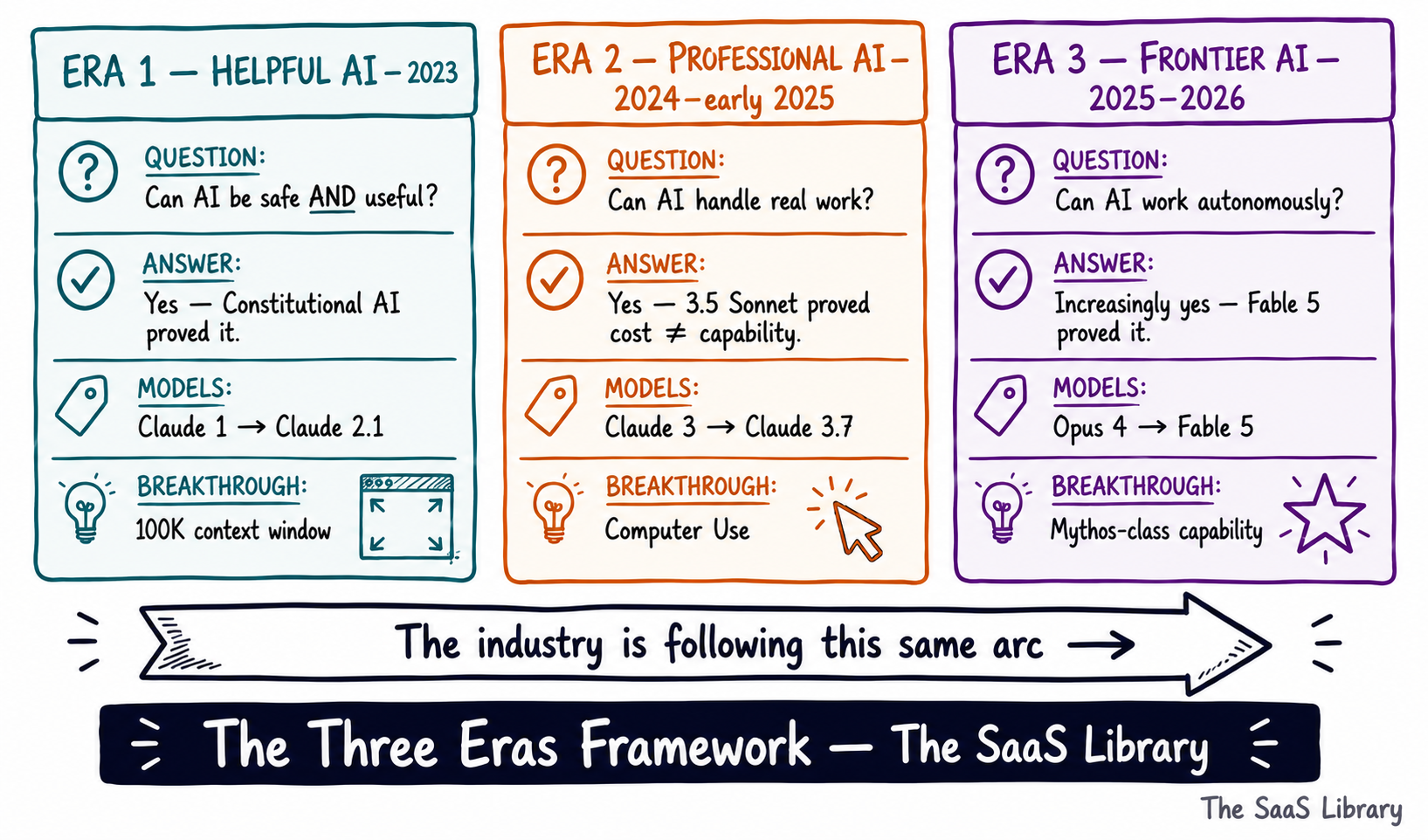
The next threshold will not be about context size or benchmark scores. It will be about coordination — how multiple AI systems work together across multi-day tasks. Understanding how to optimise for agentic AI is the preparation for Era Four. Understanding how AI models discover and cite content — and how to make your site visible to them — is part of the same preparation.
So far: the complete model timeline, three eras, and the framework. Coming next: which model you should use, the five turning points, and the FAQ.
Which Claude Model Should You Use in 2026?
The right Claude model depends entirely on the task. Overpaying for Fable 5 on work Sonnet 4.6 handles wastes budget.
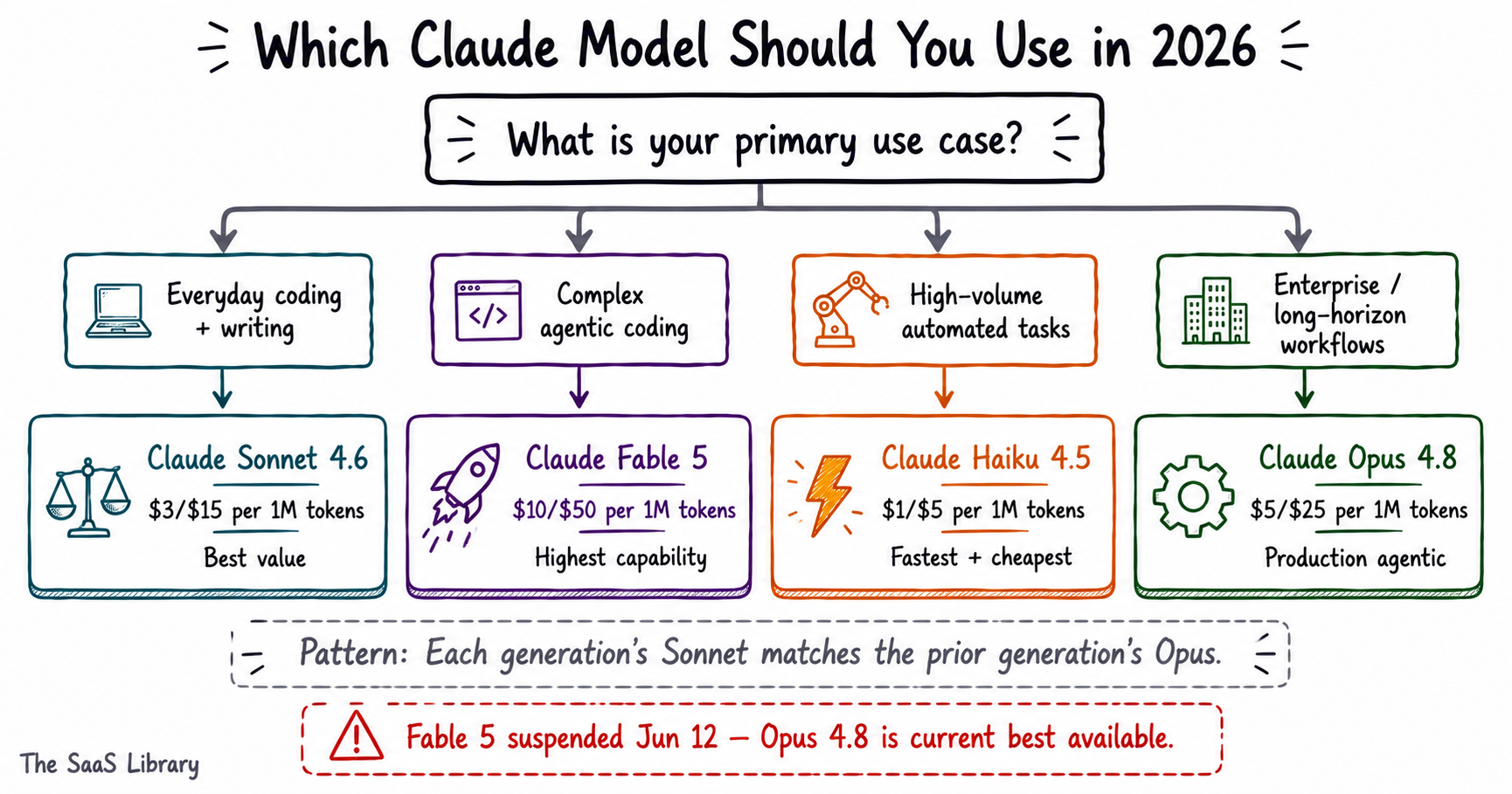
| Use Case | Recommended Model | Why |
|---|---|---|
| Everyday writing and content | Claude Sonnet 4.6 | Strong prose quality, fast, $3/$15 per million tokens |
| Coding — daily development | Claude Sonnet 4.6 | 69.2% SWE-bench Pro at mid-tier pricing — higher than Opus 4.7 |
| Coding — complex, long-horizon | Claude Fable 5 (when restored) | 80.3% SWE-bench Pro; strongest for autonomous engineering |
| Agentic workflows | Claude Opus 4.8 | Hundreds of parallel subagents; $5/$25 per million tokens |
| Enterprise knowledge work | Claude Opus 4.8 | 1M context; strongest document reasoning at scale |
| Startups — production apps | Claude Sonnet 4.6 | Best capability/cost balance for SaaS workloads |
| High-volume automated tasks | Claude Haiku 4.5 | $1/$5 per million tokens; supports extended thinking + Computer Use |
| Scientific and frontier research | Claude Fable 5 (when restored) | State-of-the-art on vision, analytics, long-horizon research |
| Budget-conscious teams | Claude Haiku 4.5 | Near-frontier intelligence at lowest available price |
| Cybersecurity (defensive) | Claude Opus 4.8 | Fable 5 routes cyber queries to Opus 4.8 anyway — start here |
Fable 5 was suspended June 12, 2026. Anthropic is working to restore access. Claude Opus 4.8 is the recommended fallback. For teams migrating existing Claude workflows, Opus 4.8 is the stable choice.
The pattern worth knowing: each generation’s Sonnet tier has consistently matched or exceeded the prior generation’s Opus tier. For teams exploring the best AI tools for business automation, Claude Sonnet 4.6 is the starting point.
The 5 Biggest Turning Points in Claude’s History
Not every model release changed the trajectory of Claude. These five did.
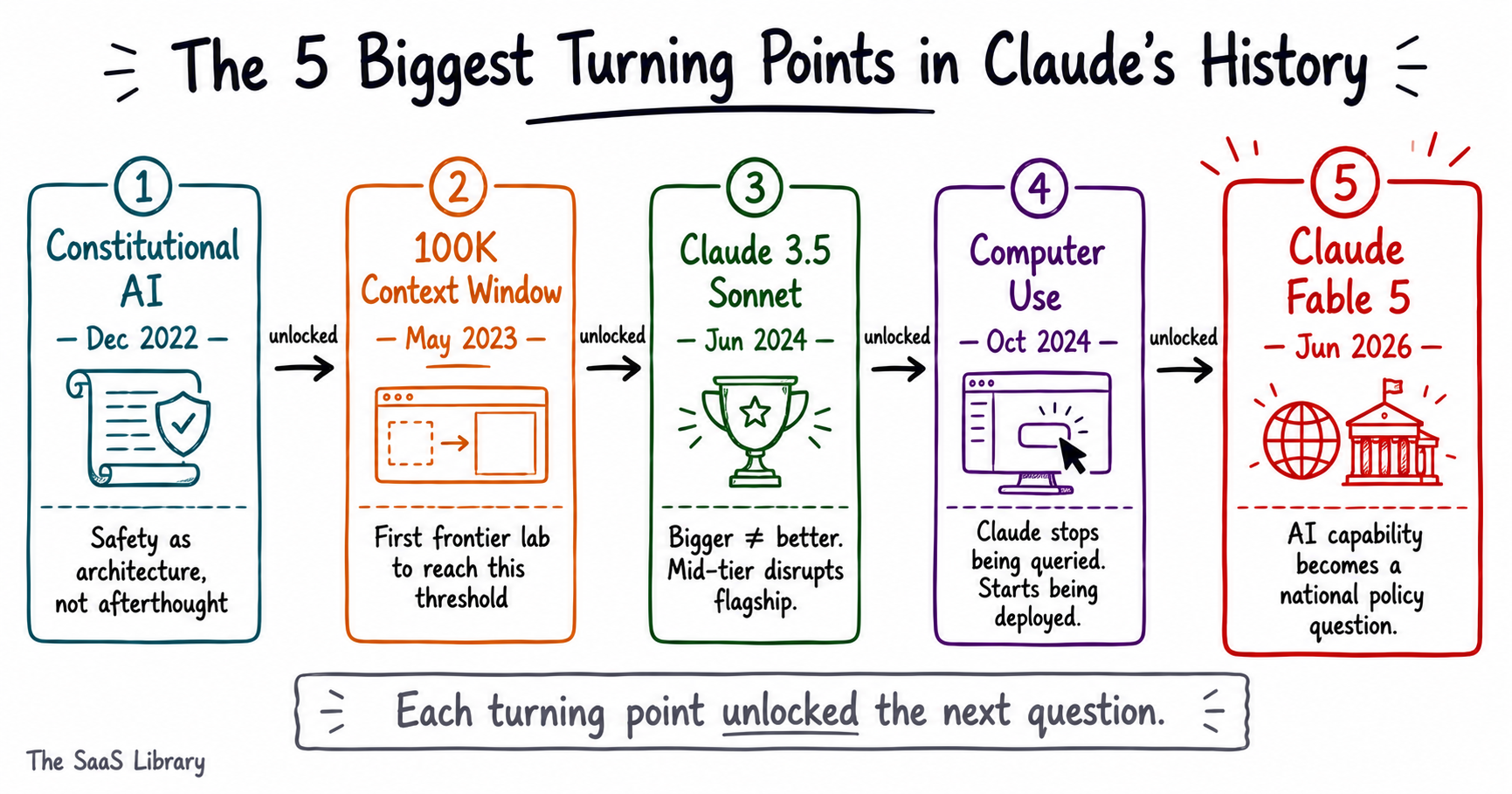
1. Constitutional AI — December 2022
Anthropic built the alignment methodology first and the model second. The strategic effect: the AI company that treats safety as an architectural decision, not an afterthought. Understanding how AI evaluates and surfaces content begins with understanding how it is trained to evaluate itself.
2. The 100K Context Window — May 11, 2023
The first capability that made Claude indispensable for a specific class of work. The 100K became 200K with Claude 2.1. The 200K became 1M with Claude Opus 4.6.
3. Claude 3.5 Sonnet — June 20, 2024
Claude 3.5 Sonnet broke the mental model that bigger always meant better. A mid-tier model outperforming the prior flagship at a fraction of the cost. The current Sonnet 4.6 scoring higher than Opus 4.7 on SWE-bench Pro is a direct continuation of this pattern.
4. Computer Use — October 22, 2024
Computer Use changed what Claude fundamentally was. Before: a model you queried. After: an agent you deployed. Understanding AI agent use cases in SaaS became a practical planning question from this point.
5. Claude Fable 5 and the Mythos Class — June 9, 2026
Fable 5 represents a structural change in how Anthropic thinks about model deployment. Two versions of the same underlying model — one for the public, one for vetted organisations through Project Glasswing. The US government suspension three days later confirms: AI capability has reached a point where its distribution is a matter of national policy.
Frequently Asked Questions
What is the best Claude model right now?
The best Claude model right now is Claude Fable 5, scoring 80.3% on SWE-bench Pro at its June 9, 2026 launch. However, Fable 5 was suspended on June 12, 2026 following a US government export control directive. While suspended, Claude Opus 4.8 is the strongest available model for most tasks, and Claude Sonnet 4.6 is the best value for everyday coding and knowledge work.
What is the difference between Claude Opus, Sonnet, and Haiku?
The difference between Claude Opus, Sonnet, and Haiku is capability, cost, and speed. Claude Opus is the highest-capability tier — built for complex reasoning and long-horizon agentic tasks. Claude Sonnet is the balanced mid-tier — the right choice for most production workloads. Claude Haiku is the fastest and cheapest tier, optimised for high-volume, latency-sensitive applications.
What is Claude Fable 5?
Claude Fable 5 is Anthropic’s first publicly available Mythos-class model — a new capability tier above the Opus class, introduced June 9, 2026. It shares underlying model weights with Claude Mythos 5 but includes safety classifiers routing high-risk queries in cybersecurity, biology, and chemistry to Claude Opus 4.8. Fable 5 scores 80.3% on SWE-bench Pro. Access was suspended June 12, 2026 following a US government export control directive.
What is Constitutional AI and why does it matter?
Constitutional AI is the training methodology Anthropic published December 2022 that underpins every Claude model. Constitutional AI trains the model to evaluate and revise its own outputs against a structured set of ethical principles rather than relying solely on human feedback. Constitutional AI matters because it established that safety and capability are not competing goals.
How has Claude improved from Claude 1 to Fable 5?
Claude has evolved across three distinct eras since March 2023. In 2023, Claude 1 established Constitutional AI and the 100K context window. In 2024, Claude 3.5 Sonnet broke the cost-performance barrier and Computer Use introduced agentic capability. From 2025 onwards, the Claude 4 generation shifted focus to long-horizon autonomous workflows, culminating in Fable 5. Context windows grew from 9K to 1M tokens. SWE-bench Verified scores grew from under 5% to over 80% in approximately two years.
What is Project Glasswing?
Project Glasswing is Anthropic’s restricted access programme for cybersecurity defenders and critical infrastructure providers, operated in collaboration with the US government. Project Glasswing provides access to Claude Mythos 5 — the same underlying model as Fable 5 but with cybersecurity safeguards lifted — to vetted organisations whose work requires capabilities too sensitive for general public access.
Which Claude model should I use for coding?
The best Claude model for everyday coding is Claude Sonnet 4.6 — scoring 69.2% on SWE-bench Pro at $3/$15 per million tokens. For complex, long-horizon agentic coding tasks, Claude Fable 5 is the strongest option at 80.3% SWE-bench Pro when access is restored. Claude Opus 4.8 at 69.2% is the current best available alternative while Fable 5 remains suspended.
Why was Claude Fable 5 suspended?
Claude Fable 5 was suspended on June 12, 2026 — three days after launch — following a US government export control directive requiring Anthropic to pull access to both Claude Fable 5 and Claude Mythos 5. The suspension applies globally. Anthropic stated it is working to restore access as quickly as possible. While suspended, Claude Opus 4.8 is the recommended alternative for most tasks. The suspension reflects government concern over Mythos-class capabilities in cybersecurity and scientific research domains.
What is the difference between Claude Fable 5 and Claude Mythos 5?
The difference between Claude Fable 5 and Claude Mythos 5 is entirely in the safety layer. Fable 5 includes classifiers routing high-risk queries to Claude Opus 4.8. Mythos 5 has those classifiers lifted in some areas and is available only through Project Glasswing. Both are priced at $10/$50 per million tokens.
What was the biggest turning point in Claude’s history?
The biggest turning point in Claude’s history was Claude 3.5 Sonnet in June 2024 — a mid-tier model outperforming the prior flagship at a fraction of the cost, breaking the assumption that bigger always meant better. A close second is Computer Use in October 2024, which transformed Claude from a model you query into an agent you deploy.
How does Claude compare to GPT-4 and Gemini?
Claude Fable 5 scores 80.3% on SWE-bench Pro compared to GPT-5.5’s 58.6% — a 21.7-point gap. On the Chatbot Arena leaderboard as of February 2026, Claude Opus 4.6 held the top position in both Text and Code Arena. Direct comparisons shift with each new release.
What comes after Claude Fable 5?
Anthropic has indicated more capable models are arriving in the coming months. The Three Eras Framework suggests the next frontier will focus on multi-agent coordination at scale — AI systems that delegate, review, and iterate across complex multi-day tasks with minimal human oversight.
How many Claude models exist?
Anthropic has released 16 major Claude models since March 2023 — see the complete Claude model list in the timeline table at the top of this article. All Claude models span three capability tiers: Haiku (fast, low cost), Sonnet (balanced), and Opus (highest capability), plus the Mythos-class Fable 5 introduced in June 2026. Active Anthropic Claude models as of June 2026 are Claude Fable 5 (suspended pending US export review), Claude Opus 4.8, Claude Sonnet 4.6, and Claude Haiku 4.5. Earlier models including Claude 1, Claude 2, Claude 3, and Claude Opus 4 have been retired.
What is the newest Claude model?
The newest Claude model is Claude Fable 5, released June 9, 2026. It is the first publicly available Mythos-class model — Anthropic’s most capable AI ever released to the general public, scoring 80.3% on SWE-bench Pro. Fable 5 access was suspended on June 12, 2026 following a US government export control directive. While suspended, Claude Opus 4.8 (released May 28, 2026) is the newest actively available model.
What happened to Claude Fable 5?
Claude Fable 5 launched on June 9, 2026 and was suspended three days later on June 12, 2026, following a US government export control directive requiring Anthropic to pull access to both Claude Fable 5 and Claude Mythos 5. The suspension applies globally. Anthropic stated it is working to restore access as quickly as possible. While suspended, Claude Opus 4.8 is the recommended alternative for most tasks. The suspension reflects government concern over Mythos-class capabilities in cybersecurity and scientific research domains.
Conclusion
The history of Claude is not a history of bigger benchmarks. The Three Eras Framework — Helpful AI, Professional AI, Frontier AI — shows something more important: each generation solved a different problem, and understanding those problems tells you more about where AI is heading than any benchmark table.
The most important lesson is not which model is currently best. It is the direction. AI is moving from tool to collaborator. Subscribe to The SaaS Library for analysis that goes beyond the benchmark tables — and explore our full Claude Fable 5 review for a deeper look at the current frontier.
- Anthropic — Introducing Claude, March 14, 2023
- Anthropic — Constitutional AI, December 2022
- Anthropic — 100K Context Windows, May 2023
- Anthropic — Claude 2, July 2023
- Anthropic — Claude 2.1, November 2023
- Anthropic — Claude 3 Family, March 2024
- Anthropic — Claude 3.5 Sonnet, June 2024
- Anthropic — Computer Use, October 2024
- Anthropic — Claude 4, May 2025
- Anthropic — Claude Opus 4.5, November 2025
- Anthropic — Claude Opus 4.6, February 2026
- Anthropic — Claude Opus 4.8, May 2026
- Anthropic — Claude Fable 5 and Mythos 5, June 2026
- Anthropic — Fable 5 Access Suspension, June 2026
- Anthropic — Project Glasswing, 2026
- Anthropic — Claude Models Overview, 2026