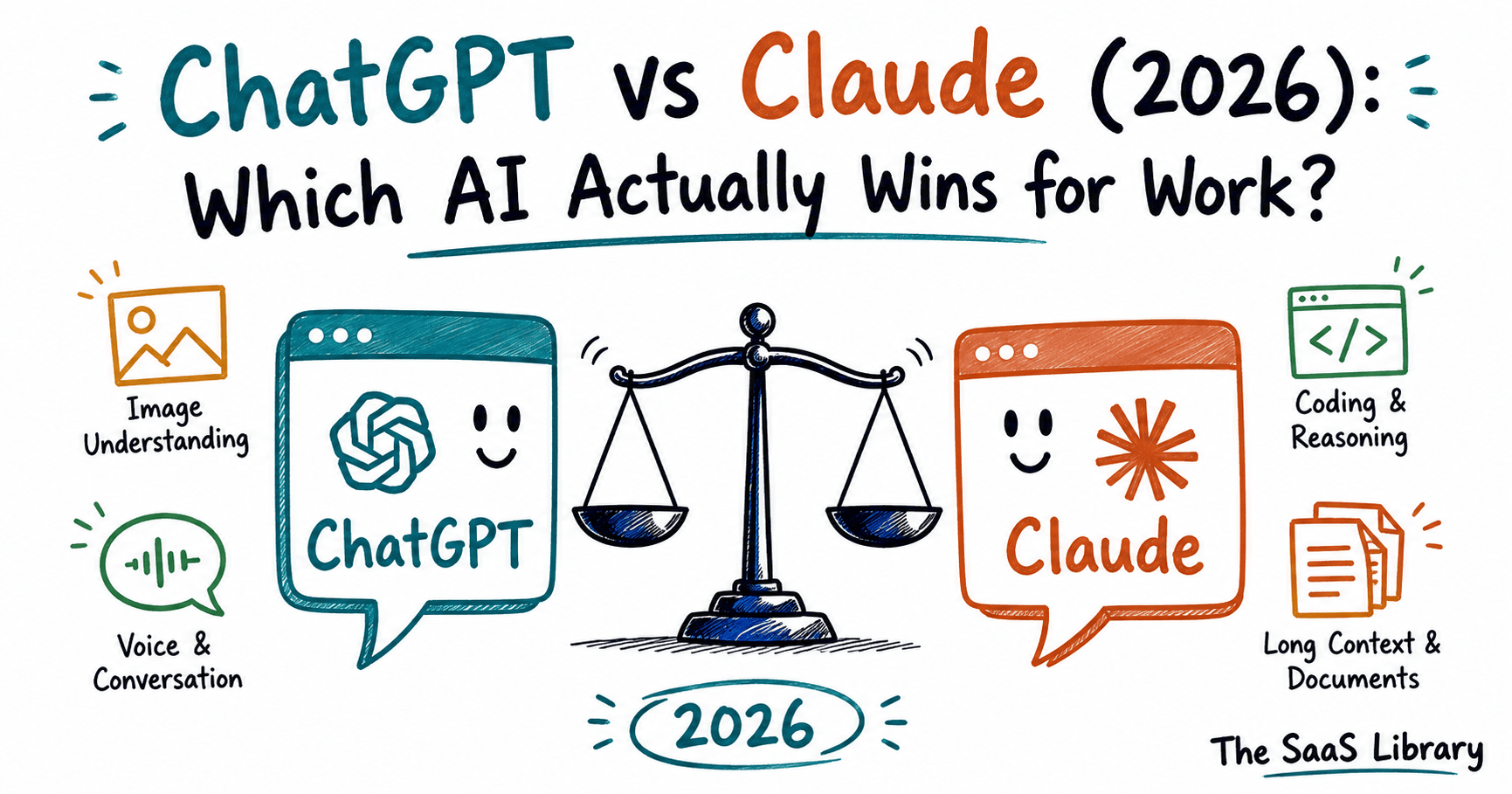
ChatGPT and Claude no longer compete on being the same kind of tool — they’ve split into two different bets on what work needs.
This isn’t another ChatGPT vs Claude roundup built only on vendor claims and a benchmark table. This comparison combines current, dated product data; independent benchmark evidence with the harness named for every score; enterprise-adoption data from Menlo Ventures and Ramp; a full feature-by-feature breakdown; an original four-task test run directly on real SaaS founder work; and a named decision framework, the TSL AI Router™, for routing each task to the right tool.
Which AI Wins for Work in 2026, ChatGPT or Claude?
Claude wins for coding, long-document analysis, and enterprise deployment — it leads Menlo Ventures’ enterprise LLM spend data and scores higher on Artificial Analysis’s Intelligence Index. ChatGPT wins for native image generation, real-time voice, and reach, with 900 million weekly users. Neither wins outright; the right pick depends on which of those a founder actually needs.
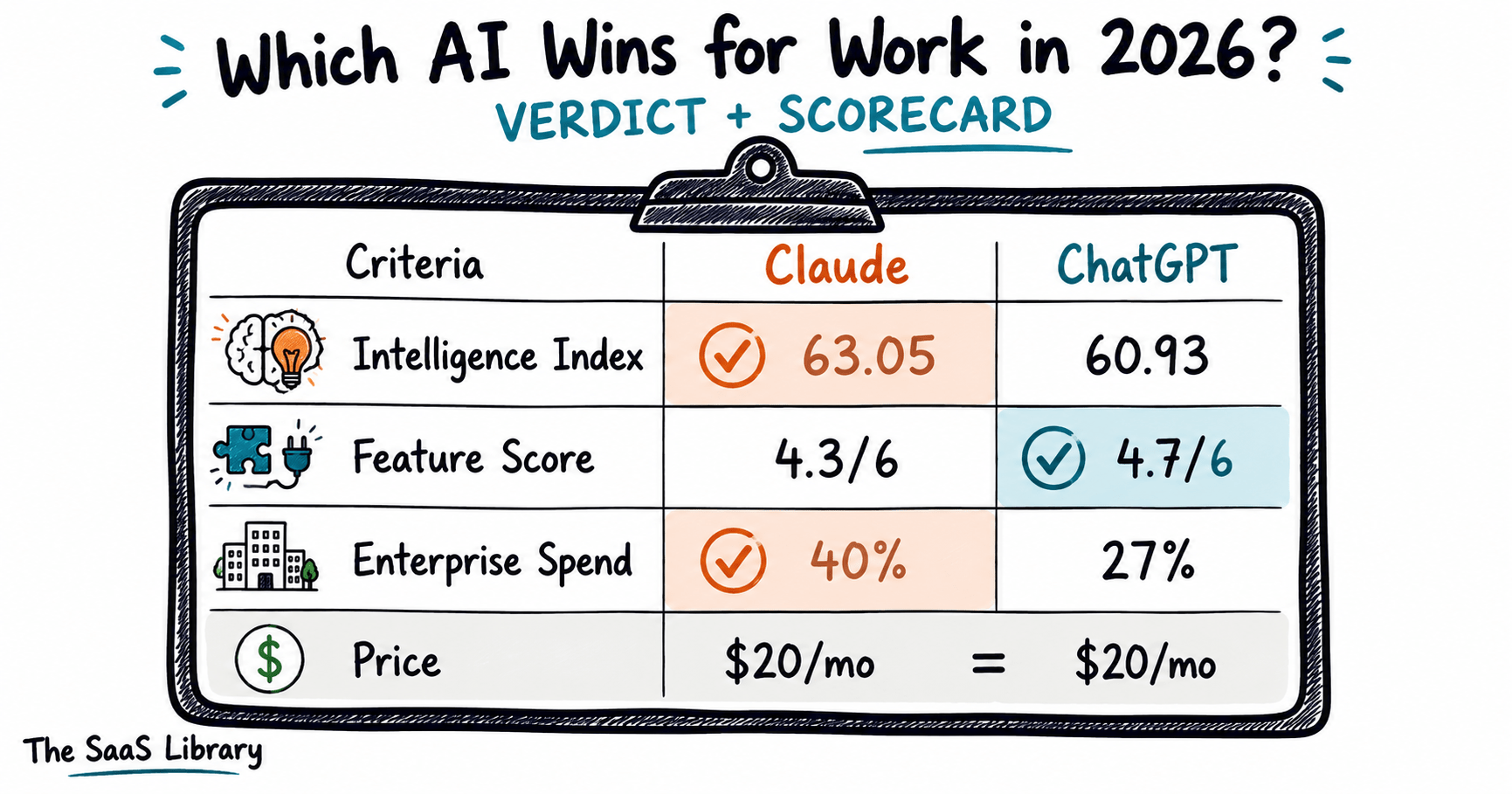
Claude and ChatGPT each win, just on different scoreboards. On Artificial Analysis’s Intelligence Index — a live composite of reasoning, coding, and knowledge benchmarks, checked August 15, 2026 — Claude Opus 5 scores 63.05 against GPT-5.6 Sol’s 60.93. Flip to the same tracker’s Feature Score, and ChatGPT leads 4.7 out of 6 to Claude’s 4.3, almost entirely because of connectors: 9 out of 10 versus Claude’s 3 out of 10.
| Criteria | ChatGPT | Claude | Winner |
|---|---|---|---|
| Intelligence Index (Artificial Analysis, Aug 15, 2026) | GPT-5.6 Sol: 60.93 | Opus 5: 63.05 | Claude |
| Feature Score, 6 categories (Artificial Analysis, Aug 15, 2026) | 4.7 / 6 | 4.3 / 6 | ChatGPT |
| Enterprise LLM spend share (Menlo Ventures, Dec 2025) | 27% | 40% | Claude |
| Standard paid tier | $20/mo (Plus) | $20/mo (Pro) | Tie |
Claude wins 2 of 4 criteria, ChatGPT wins 1, with one tie. The Artificial Analysis rows are live-tracked, not a fixed report — re-verify them if this article gets refreshed later. The Menlo Ventures figure is a static December 2025 report and won’t move on its own.
That split — Claude ahead on raw capability, ChatGPT ahead on product breadth — is the real story of ChatGPT vs Claude 2026, and it holds up through every section below.
What’s the Difference Between ChatGPT and Claude?
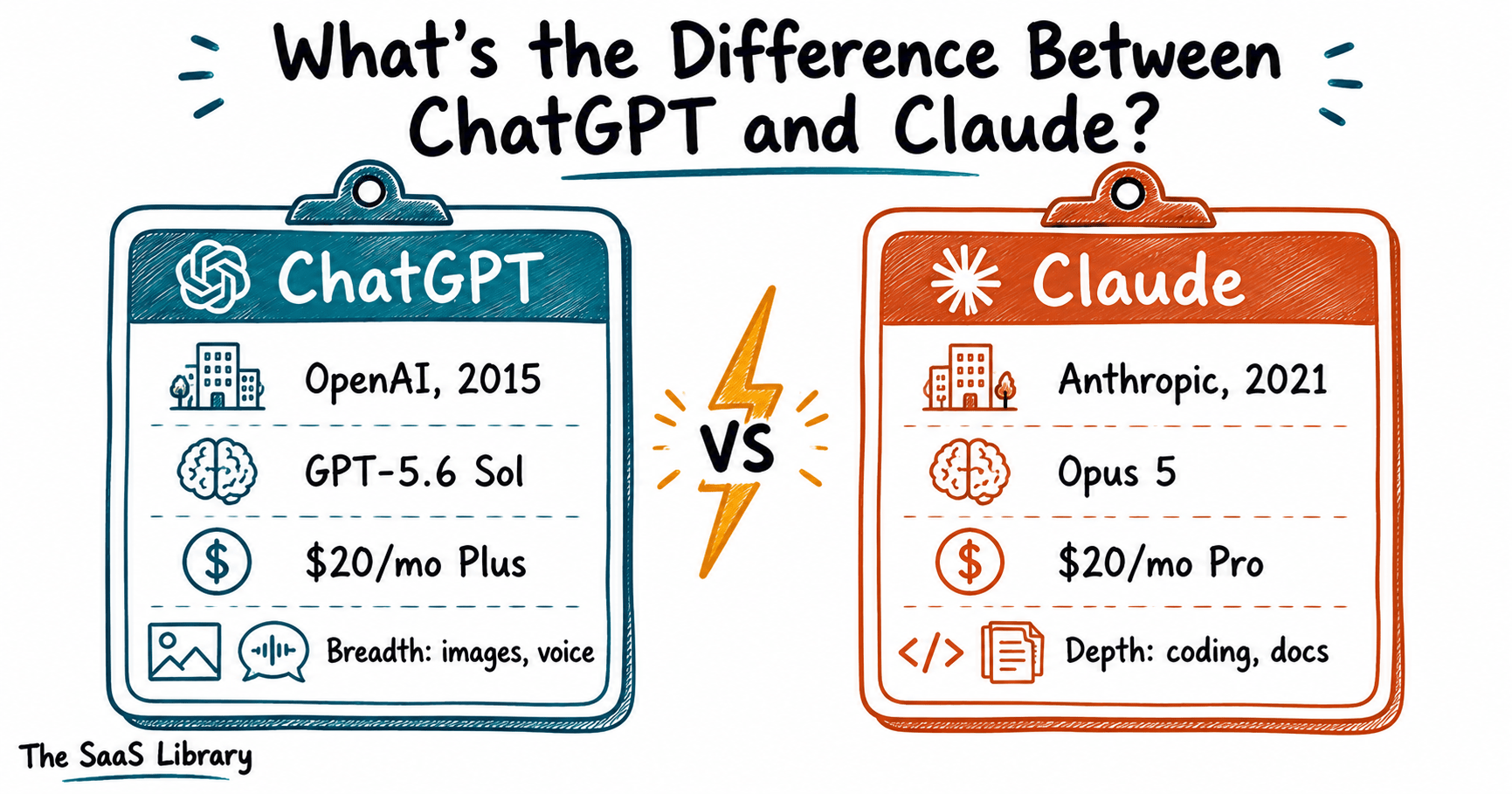
ChatGPT and Claude differ in who builds them, what each is actually built for, and which model answers when you open the app. OpenAI was founded in San Francisco in 2015. Anthropic followed in 2021, founded by former OpenAI researchers who left to build AI around a stronger safety focus. Both are now frontier-class labs — the real differences in 2026 are in specialization and product shape, not raw capability.
| Field | ChatGPT | Claude |
|---|---|---|
| Developer | OpenAI | Anthropic |
| Founded | 2015, San Francisco | 2021, San Francisco |
| Current flagship | GPT-5.6 Sol (Plus and above) | Claude Opus 5 — released July 24, 2026 |
| Free-tier default | GPT-5.6 Luna — default since Aug 6, 2026 | Claude Sonnet 5 — default since June 30, 2026 |
| Pricing | Free · Go $8/mo · Plus $20/mo · Pro $100–200/mo | Free · Pro $20/mo · Max $100–200/mo |
| Primary use case | General productivity, image generation, voice, broad ecosystem | Coding, long-document analysis, enterprise, agentic work |
Curious how Claude’s own model lineup evolved to get here?
See Every Claude Model Compared →How Do ChatGPT and Claude Compare on the Numbers?
ChatGPT and Claude pull apart hardest on the numbers behind them, not the models themselves. ChatGPT dominates consumer reach by every published measure; Claude dominates enterprise spend and revenue by every published measure. Both facts are true at once, and neither cancels the other out.
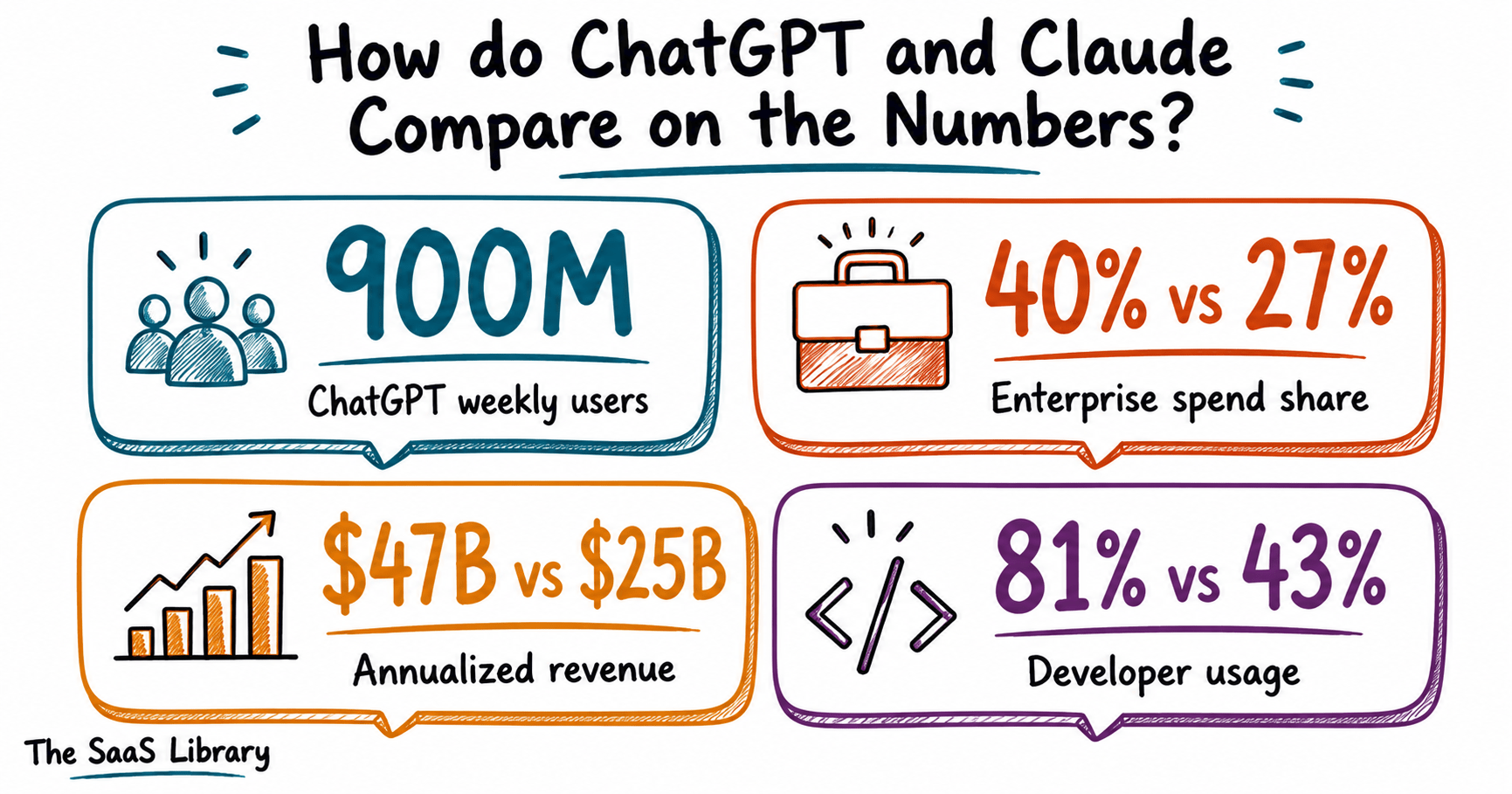
Worth being direct about a gap in that first row: there’s no comparable Claude consumer-user figure to put next to ChatGPT’s 900M. OpenAI publishes an official weekly-active-user number; Anthropic doesn’t publish one at all. Third-party estimates for Claude’s monthly users range from roughly 12 million to 245 million depending on the source and what they’re actually counting — a spread too wide to treat any single number as fact. That gap is itself informative: Claude’s growth story is enterprise and developer-led, not consumer-led, and Anthropic’s own disclosures back that reading — Menlo Ventures also puts Claude at 54% of the enterprise coding market against OpenAI’s 21%, as of December 2025.
One more data point worth surfacing here, since it speaks directly to switching behavior: Ramp’s AI Index — built from actual card-spend data across more than 50,000 US companies, not a survey — shows Claude passing ChatGPT in business adoption for the first time with April 2026 data (34.4% vs 32.3%, published May 2026), rising to 41% vs 39.5% in Ramp’s June 2026 release — the same release in which Ramp updated its tracking methodology, so treat the size of that later jump with some caution even though the direction is consistent across releases. Ramp’s own analysis puts a harder number on the caveat: of businesses using either platform, 52% use both — read this as businesses adding Claude, not replacing ChatGPT with it.
Also worth naming directly: Stack Overflow’s 2025 Developer Survey found OpenAI’s GPT models used by 81% of developers against Claude Sonnet models at 43% — ChatGPT still leads raw developer usage even in a category where Claude leads production adoption, which is exactly the kind of nuance a single headline stat erases.
What Is Claude Actually Good At? What Is ChatGPT Actually Good At?
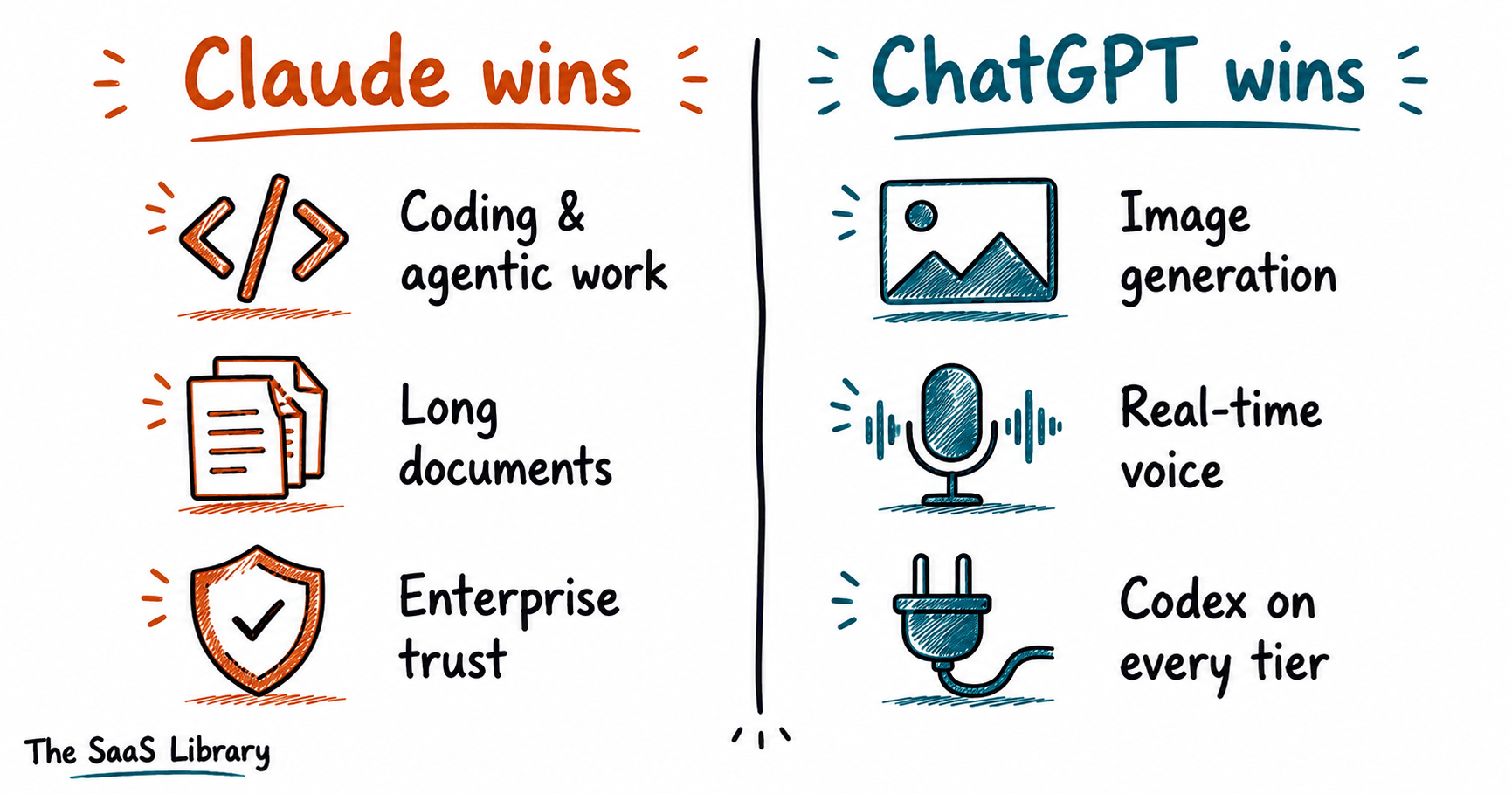
Claude is built for depth — coding, long documents, and autonomous work that runs for hours without supervision. ChatGPT is built for breadth — image generation, voice, and a product surface that does more different things inside one app.
Claude — where it wins
- Coding, especially agentic work. Claude Code is included in every paid plan and reached an estimated $2.5B annualized revenue by February 2026 (Zapier, citing Anthropic). Weekly active users of Claude Code doubled between January 1 and February 12, 2026 (Anthropic). Worth stating plainly since it cuts against the narrative: on Artificial Analysis’s own Coding Agent Index, GPT-5.6 Sol actually leads at 80, with Claude’s harness (Fable 5 + Claude Code) close behind at 77. Claude’s real coding edge shows up in production market share, not this specific live benchmark — Menlo Ventures puts Claude at 54% of the enterprise coding market against OpenAI’s 21%.
- Long-document and agentic reasoning under ambiguity. Opus 5, Sonnet 5, and Fable 5 all run 1M-token context. In our own testing later in this piece, Claude’s answers stayed disciplined about only using evidence actually given, rather than reaching outside it.
- Enterprise trust. 54% of the enterprise coding market runs on Claude, against OpenAI’s 21% (Menlo Ventures, Dec 2025).
Claude cannot generate images at any tier — it can only analyze images you upload. It has no live voice mode. And usage limits are the most-cited complaint in Claude’s own user community — 5-hour rolling windows plus weekly caps on every tier, shared between chat and Claude Code (Morph, citing r/ClaudeAI threads).
ChatGPT — where it wins
- Native image generation, on every tier including Free. ChatGPT Images replaces DALL·E as OpenAI’s official image tool — DALL·E is being fully retired from ChatGPT on August 30, 2026 (OpenAI’s release notes).
- Real-time voice, via Advanced Voice Mode — Claude has no equivalent at any price.
- Codex ships on every tier including Free, not gated to paid plans the way some of Claude Code’s usage is.
Sora — OpenAI’s video generator — was discontinued as a consumer app in April 2026, with the API shutting down entirely September 24, 2026 (Morph); “ChatGPT does video” is no longer accurate as of this article. And the single most-upvoted complaint about ChatGPT across comparison threads is tone — its tendency toward agreement even when pushback would serve the user better (Morph, citing a 407-point r/ChatGPT thread).
How Do ChatGPT and Claude Compare Feature by Feature?
ChatGPT and Claude split almost every feature row cleanly — one has it, the other doesn’t, with very little genuine overlap left to argue about.
| Feature | ChatGPT | Claude |
|---|---|---|
| Image generation | ChatGPT Images, native, every tier incl. Free — replaces DALL·E, retiring Aug 30, 2026 (source) | Not available — analyzes uploaded images only |
| Video generation | Not available — Sora discontinued April 2026, API shuts down Sept 24, 2026 (source) | Not available — never offered |
| Voice mode | Advanced Voice Mode, real-time conversation | Not available — dictation input only |
| Coding agent | Codex — every tier incl. Free | Claude Code — included with every paid plan |
| Standard context window | ~1.05M tokens (GPT-5.6) | 1M tokens (Opus 5, Sonnet 5, Fable 5) |
| Web search | Native, all tiers | Native, all tiers |
| Memory | Yes | Yes, incl. Free tier |
| Microsoft 365 integration | Native — Copilot runs on OpenAI models | Available via Claude for Excel, Word, PowerPoint, GA May 7, 2026 — Opus 5 also added to Copilot’s own model picker July 24, 2026 |
| Enterprise coding market share | 21% (Menlo Ventures, Dec 2025) | 54% (Menlo Ventures, Dec 2025) |
| Standard paid tier | $20/mo (Plus) | $20/mo (Pro) |
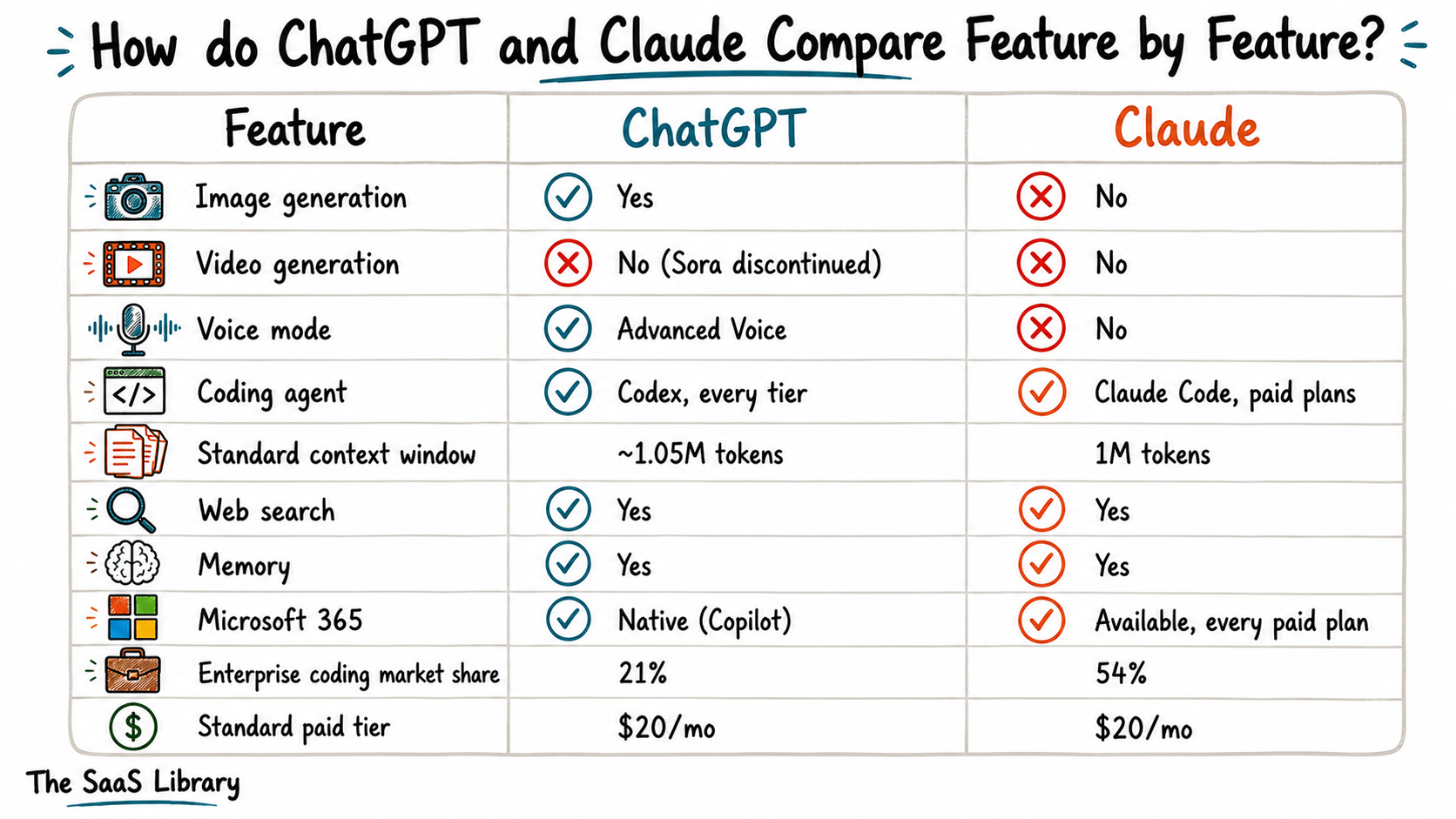
Two rows are worth a second look rather than a checkmark. Microsoft 365 is the one place these two genuinely overlap now — Claude shipping as a native Office add-in and landing inside Copilot’s own model picker means “ChatGPT owns Microsoft” stopped being true as of mid-2026, even though Copilot itself still runs primarily on OpenAI models. And context window is close enough (1M vs ~1.05M) that neither side has a real edge there anymore — a genuine change from when Claude’s context lead was a headline differentiator.
How Should You Choose Between ChatGPT and Claude?
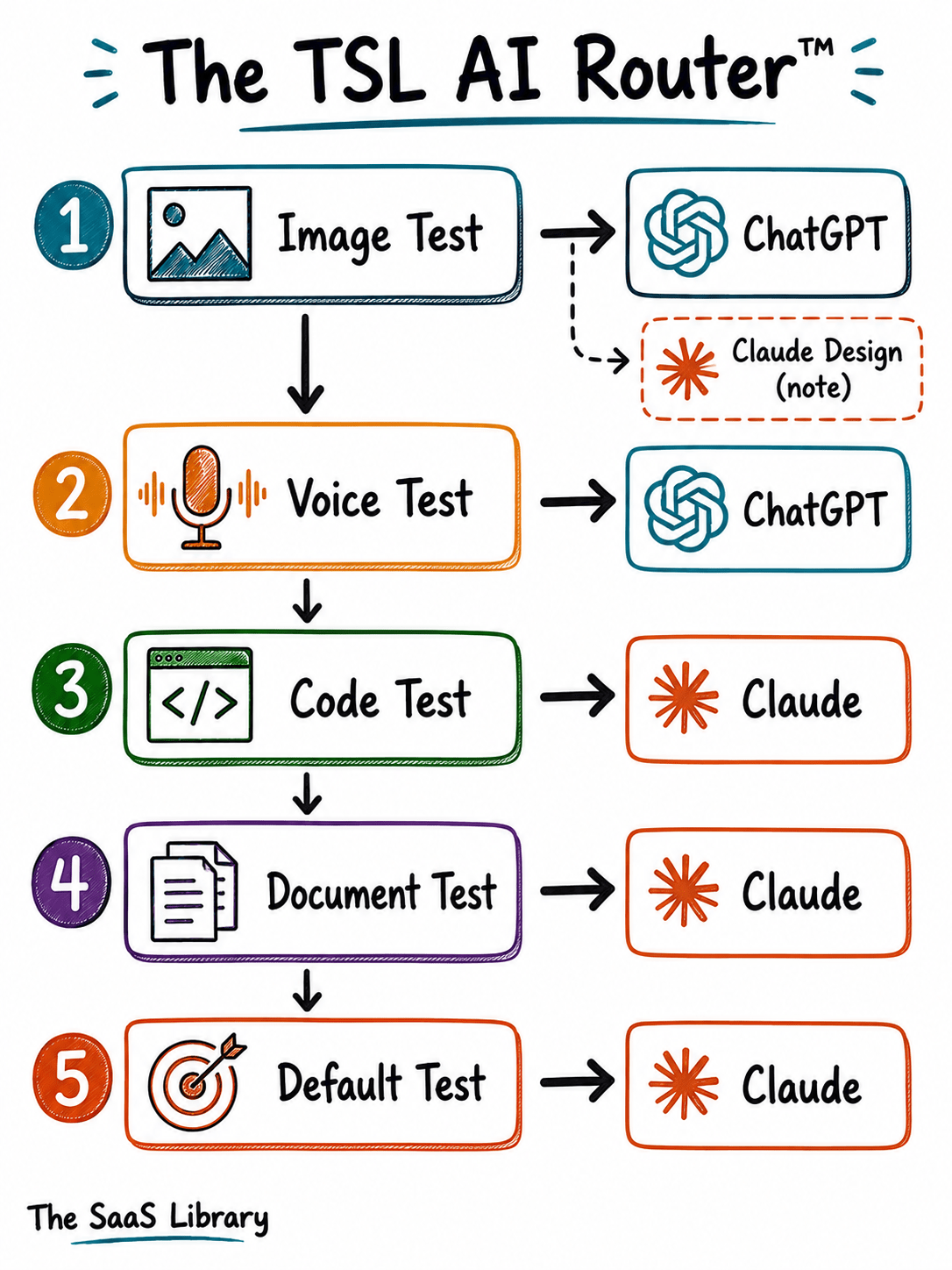
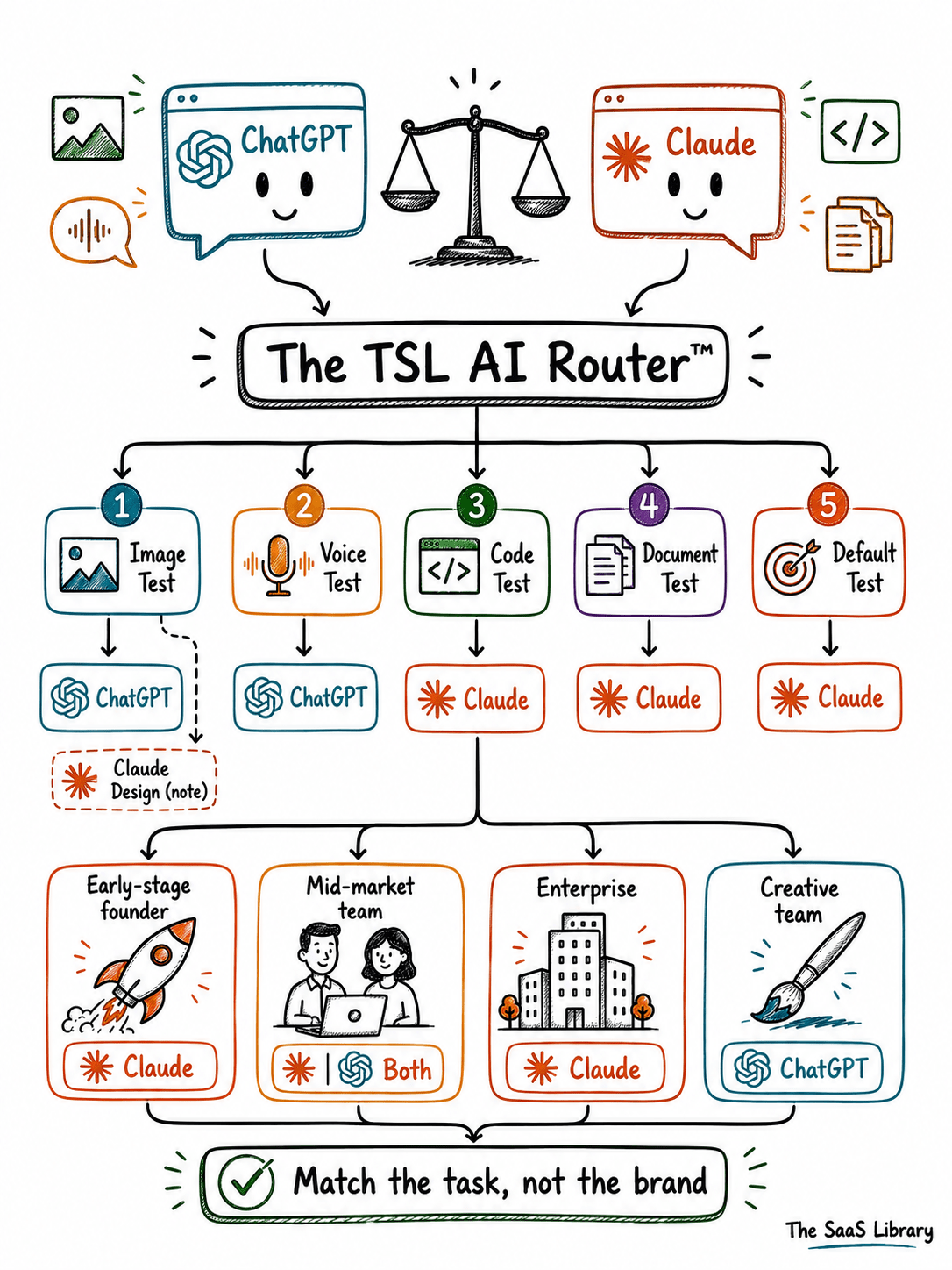
You should choose between ChatGPT and Claude by running five tests in order and stopping at the first one that applies — not by picking one tool for everything and hoping it covers every task.
The honest caveat on step 1: Claude Design closes a gap, it doesn’t erase one. If your actual deliverable is a photograph-style image — an ad creative, a product shot — nothing here changes; that’s still ChatGPT, no exception.
Are People Actually Switching from ChatGPT to Claude?
Some people are switching, but “switching” overstates what the data actually shows — most businesses are adding Claude, not replacing ChatGPT with it.
The market-share numbers are real and moving fast. Sensor Tower’s State of AI 2026 report, cited by TechCrunch, found ChatGPT fell below 50% of global AI-assistant app usage for the first time in March 2026, down to 46.4% by May — while Claude’s share roughly tripled over the same window. Anthropic itself reported free-user growth above 60% since January 2026, with paid subscribers more than doubling over the same period (Built In).
The spend data tells a similar story with a sharper edge. Ramp’s AI Index — built from real card and invoice data across more than 50,000 US companies, not a survey — shows Claude passing ChatGPT in business adoption for the first time with April 2026 data: 34.4% vs 32.3%, published in Ramp’s May 2026 release. That gap widened to 41% vs 39.5% in Ramp’s June 2026 release, though Ramp changed its measurement methodology that same month, so the later figure isn’t a clean apples-to-apples continuation of the earlier trend — only the direction is. A year earlier, per Ramp’s own historical data, Anthropic sat under 8% of businesses while OpenAI led near 32% — meaning Claude’s share grew roughly fivefold in twelve months even accounting for the methodology shift.
The same Ramp data shows 52% of businesses already run both Claude and ChatGPT, and switching costs between them are low. Read the trend as businesses routing tasks to whichever model fits — not as a mass exodus from one to the other. The right framing isn’t “people are leaving ChatGPT for Claude.” It’s “the model you reach for by default has stopped being a fixed choice.”
One anecdotal data point worth naming, not leaning on: at April 2026’s HumanX conference — one of the industry’s largest gatherings — TechCrunch’s own headline read “everyone was talking about Claude,” and CNBC separately called it “Claude mania.” That’s a mood, not a statistic, and it’s included here as color, not evidence.
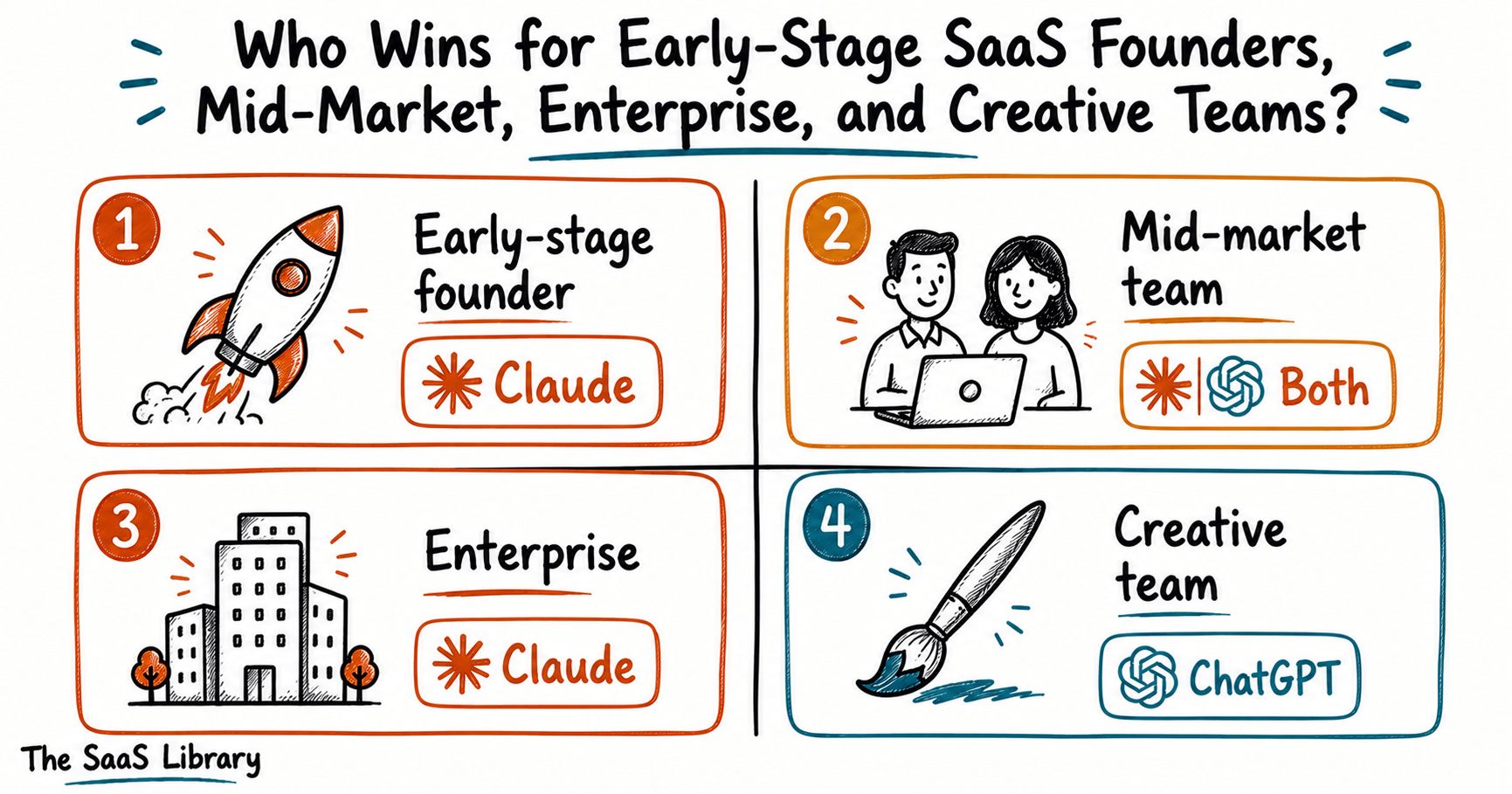
Who Wins for Early-Stage SaaS Founders?
Claude wins for early-stage SaaS founders — the same pattern our own testing found later in this piece holds at the team level, not just per-task. Claude Code ships free with the $20 Pro plan and does work a founder would otherwise pay a junior developer for. Claude Projects hold persistent context across a product spec, competitor research, and an investor deck without re-explaining yourself each session.
The writing gap matters more than it looks. In our own investor-update test later in this piece, Claude’s version read like something a founder would actually send without heavy editing — the exact deliverable this persona writes constantly. If your team is small enough that you’re personally touching product cost planning, our breakdown of what agentic AI actually costs is the natural next read before you commit budget either way.
Use ChatGPT for the one thing Claude genuinely can’t do at this stage — quick social or marketing visuals via native image generation. Everything else routes to Claude by default at this size.
Who Wins for Mid-Market SaaS Teams?
Both tools win for mid-market SaaS teams, split by task rather than by winner. Ramp’s AI Index already showed 52% of businesses running both — mid-market is exactly where that dual-tool pattern shows up, because the team is big enough to have distinct coding and creative workflows that genuinely want different tools. Route engineering and long-document work to Claude, creative and quick-turnaround work to ChatGPT.
If your team is layering AI-driven automation across tools rather than picking one assistant, why every SaaS tool is racing to become MCP-compatible explains the connector layer both platforms are building toward. For teams evaluating a broader automation stack, 15 best AI tools for business automation covers the adjacent tooling this comparison doesn’t.
Who Wins for Enterprise and Regulated SaaS Teams?
Claude wins for enterprise and regulated SaaS teams, and the gap is wider here than anywhere else in this comparison. Menlo Ventures puts Claude at 40% of enterprise LLM spend against ChatGPT’s 27%, and 54% of the enterprise coding market against 21% — both as of December 2025.
Trust, not just capability, is driving that split. For teams in this position, our coverage of the Claude model Anthropic itself restricted under export control is directly relevant context. If your team is auditing what AI tools already have access to inside your stack, our shadow-AI audit framework is the right starting point.
Who Wins for Creative and Marketing Teams?
ChatGPT wins for creative and marketing teams, clearly and without much of the nuance the rest of this comparison needed. Native image generation on every tier, real-time voice, and a permissive brainstorming style suit exploratory creative work better than Claude’s more disciplined, evidence-bound approach.
If your team’s output is written content rather than visuals, that verdict flips — see best AI writing tools in 2026 for where Claude fits into a broader writing stack.
How Do ChatGPT and Claude Compare on Real SaaS Founder Tasks?
ChatGPT and Claude compare unevenly across real SaaS founder tasks on those exact default models — no clean sweep either way, and the two clearest differences aren’t the ones most “ChatGPT vs Claude” comparisons even test.
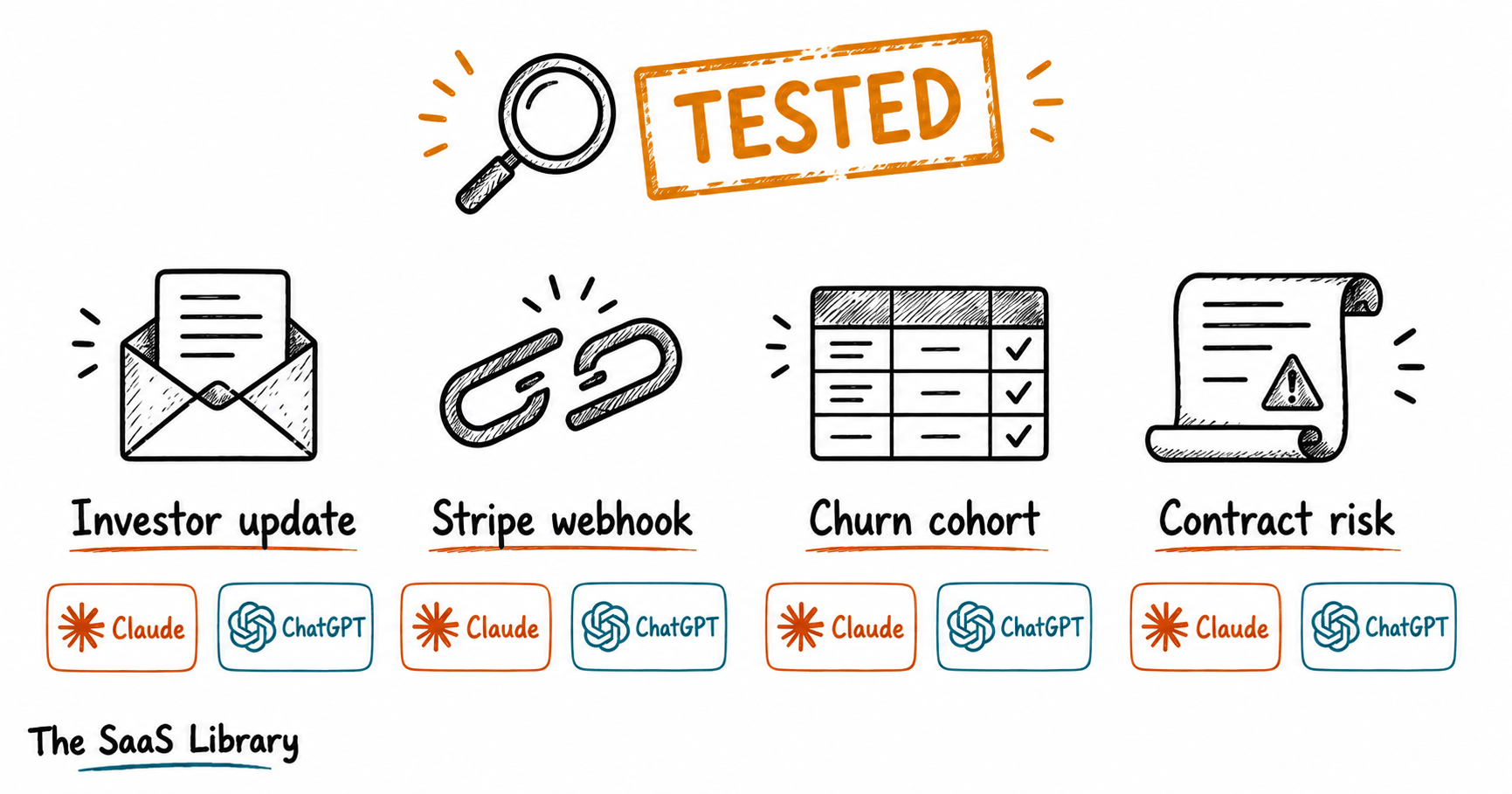
We didn’t run the usual “write me an email” prompts. We picked four tasks a SaaS founder actually deals with — an investor update, a broken Stripe payment webhook, a churned-customer cohort, and a vendor contract clause — and ran the exact same prompt through both tools. Nothing was edited. Nothing was cherry-picked. Here’s what came back.
Models tested: GPT-5.6 Luna (ChatGPT’s default on Free and Go as of Aug 6, 2026) and Claude Sonnet 5 (Claude’s default on Free and Pro as of June 30, 2026) — the models most people actually encounter before deciding whether to subscribe, not the $200/month flagships.
Tasks: 4 real-world SaaS founder tasks — investor update, Stripe webhook debug, churn cohort prioritization, contract risk flag.
Method: The identical prompt was given to both systems for each task.
Editing: Outputs are reproduced exactly as returned — no trimming, no rewriting, no cherry-picking.
Evaluation: Compared for correctness, reasoning discipline, usefulness, and sourcing.
Limitations: This is a four-task qualitative comparison, not a statistically representative benchmark. Results are directional, not proof that one model outperforms the other on every task — see “What This Test Does — and Doesn’t — Prove” below.
| Task | What it tested | What we found |
|---|---|---|
| Investor update | Tone under ambiguity | Both structured it near-identically. ChatGPT stayed formal and report-style throughout. Claude leaned conversational, closer to how a founder actually talks. |
| Debug a Stripe webhook | Technical precision under ambiguity | Both correctly found the real bug. On “why only 1-in-20 requests fail,” Claude explained it from inside the code shown; ChatGPT said the code should fail every time, then reached for infrastructure causes outside the code. |
| Churn cohort prioritization | Reasoning and data handling | Both landed on the same two fixable patterns (bugs, missing SSO). They ranked the #1 priority differently — Claude went cheapest-fix-first, ChatGPT went biggest-dollar-loss-first with an explicit small-sample-size caveat. |
| Contract risk flag | Precision and sourcing | Both flagged the same four real risks. ChatGPT inferred Indian jurisdiction unprompted and cited two live legal sources; Claude stayed jurisdiction-neutral and cited none. |
On the contract test, the gap ran the other way: ChatGPT grounded its legal claims in two real, linked sources; Claude’s answer was equally thorough but cited nothing, meaning you’d have to verify it yourself before trusting it in a negotiation.
So what does this actually mean for you? It means matching the tool to what the task actually punishes you for getting wrong. If you’re debugging something ambiguous, Claude’s answer stayed more disciplined about only using what was in front of it. If you’re using AI for anything with real legal or factual stakes, ChatGPT’s habit of citing sources is worth more than its formal tone costs you. That’s the same logic behind the TSL AI Router™ above.
What This Test Does — and Doesn’t — Prove
Four tasks can’t represent every real-world workflow, model behavior changes over time, and a different prompt on the same task can produce a different result. Neither model’s connectors, tool access, or reasoning-effort setting were varied across the test — a different configuration could shift individual outcomes. Treat this as a directional read on two specific models’ behavior on August 15, 2026, not a statistically meaningful benchmark or a claim that either model wins every task of this type.
That distinction matters for how you read the benchmark numbers elsewhere in this piece too. Benchmark scores answer “how does a model perform on a standardized evaluation” — the Artificial Analysis and Menlo Ventures figures cited throughout this article. This four-task test answers a narrower question: “how did these two systems behave on these specific SaaS-founder workflows.” Neither is proof of universal superiority; used together, they’re more useful than either alone.
Who Should NOT Use ChatGPT? Who Should NOT Use Claude?
Claude is not for anyone who needs a photorealistic image, a real-time spoken conversation, or a tool with fully automatic cross-session memory — three genuine, current gaps, not soft caveats.
- Anyone needing photorealistic image generation — Claude cannot produce raster images at any tier; Claude Design makes interactive HTML prototypes, not photos
- Voice-first workflows — no real-time spoken conversation exists on Claude at any price
- Teams fully inside Microsoft 365 wanting a single default — Copilot runs primarily on OpenAI models, even with Claude now available as a Copilot model option
- Anyone who wants the broadest pre-built third-party integration library immediately — Claude’s MCP ecosystem is real but younger than ChatGPT’s
- Users who want memory to work with zero setup — Claude Projects need deliberate context-building; ChatGPT’s memory is more automatic
- Developers wanting a coding agent bundled at $20 with no extra cost beyond the base plan — Codex ships on Free too, but Claude Code is the one included specifically with the $20 Pro tier
- Teams enterprise-purchasing on trust and safety documentation specifically — Claude leads 40% of enterprise LLM spend to ChatGPT’s 27%
- Anyone who needs output that doesn’t read as AI-generated on first pass — the “agreeable filler” tone complaint was the single most-upvoted gripe in comparison threads reviewed for this piece
- Budget-conscious dev teams wanting agentic coding without separate spend beyond the base subscription
Which AI Should You Use for Your Specific Workflow?
Which AI you should use depends on the specific workflow, not a general “which is better” verdict — pick the scenario below that matches what you actually do most.
Use Claude with Claude Code, included on every paid plan. Claude runs 54% of the enterprise coding market against ChatGPT’s 21%, and our own webhook-debugging test found Claude’s technical explanation stayed disciplined about only using the code it was actually shown.
Use ChatGPT. Native image generation on every tier including Free — Claude cannot generate raster images at any price. For a UI prototype rather than a photo, Claude Design is a real alternative.
Use Claude. Its context window (1M tokens) is now close enough to ChatGPT’s ~1.05M that raw size isn’t the differentiator it used to be — Claude’s stronger claim is staying coherent across the full window.
Use both, deliberately routed. Ramp’s AI Index shows 52% of businesses already run both — route engineering and long-document work to Claude, creative work to ChatGPT. The TSL AI Router™ above gives the exact decision sequence.
Use Claude. In our own investor-update test earlier in this piece, Claude’s version read like something a founder would send without heavy editing.
What Are the Most Common Myths About ChatGPT vs Claude?
The most common myths about ChatGPT vs Claude mostly come from outdated information, not bad-faith spin — the tools change fast enough that a fact from six months ago is often just wrong now.
Myth: Every “ChatGPT vs Claude” comparison you find is current.
FalseWe checked the SERP directly for this piece. Most pages found for the exact query “chatgpt vs claude” cite at least one superseded model — GPT-5.4, GPT-5.5, Claude Opus 4.6/4.7, or “Claude Sonnet 4.6” all still appear as “current” on pages carrying 2026 dates. One high-authority page even lists Claude’s voice mode as “Yes,” which is incorrect as of this writing. Check the publish and update date on anything you read, not just the year in the title.
Myth: ChatGPT is smarter than Claude.
False, as a blanket claimOn Artificial Analysis’s Intelligence Index (checked Aug 15, 2026), Claude Opus 5 scores 63.05 against GPT-5.6 Sol’s 60.93. Flip to the same tracker’s Feature Score and ChatGPT leads instead. Neither model is broadly “smarter” — they lead on different, specific measures.
Myth: You have to pick one and commit.
FalseRamp’s AI Index shows 52% of businesses already run both Claude and ChatGPT, and switching costs between them are low. At $20/month each, running both costs less than most single SaaS line items on a business’s stack.
Myth: ChatGPT’s 92% Fortune 500 adoption means it’s the better enterprise tool.
NuancedThat figure is real, but usage and preference aren’t the same measurement. Menlo Ventures found Claude holds 40% of enterprise LLM spend against ChatGPT’s 27% — many Fortune 500 companies run both, so the two stats describe overlapping adoption, not competing dominance.
Myth: Claude being “safer” just means more refusals and a less useful tool.
FalseIn our own contract-review test earlier in this piece, Claude gave a thorough, accurate risk breakdown — it wasn’t refusal or hedging that separated the two answers, it was that ChatGPT cited live legal sources and Claude didn’t. Safety-oriented design and usefulness weren’t in tension in any of the four tests we actually ran.
Myth: Benchmark scores tell you which AI is better for your work.
NuancedScaffold and harness differences can swing agentic benchmark scores by several points between providers — which is exactly why this piece names the specific tracker behind every number rather than citing a bare percentage. Developer-preference data, enterprise-adoption data, and your own task-specific testing are more reliable signals than any single leaderboard.
Conclusion
ChatGPT is the stronger all-round choice when your workflow depends on images, voice, ecosystem breadth, and integrated tools. Claude is the stronger choice when your workflow centers on coding, long documents, disciplined reasoning, and enterprise-oriented work. For mixed SaaS teams, the evidence in this piece points toward deliberate use of both rather than forcing one universal standard.
The TSL AI Router™ settles this faster than any scorecard: image or voice sends you to ChatGPT, code or long documents send you to Claude, and everything else defaults to Claude unless a specific task already routed you elsewhere. That sequence, not a single “winner,” is the actual answer this comparison found.
The single biggest takeaway from testing both directly: neither tool wins by default anymore, and the real skill in 2026 is knowing which one to reach for, task by task — not picking a side and staying loyal to it. If you’re deciding what your team should standardize on next, our breakdown of what agentic AI actually costs is the natural next read before you commit budget to either platform.
- Anthropic — Claude Sonnet 5 launch announcement, June 30, 2026
- Anthropic — Claude Opus 5 launch announcement, July 24, 2026
- OpenAI — Previewing GPT-5.6 Sol, 2026
- TechCrunch — ChatGPT reaches 900M weekly active users, February 27, 2026
- TechCrunch — OpenAI brings unlimited ChatGPT text chats to free users, August 6, 2026
- Menlo Ventures — 2025: The State of Generative AI in the Enterprise, December 9, 2025
- Artificial Analysis — AI Chatbots Comparison (live), checked August 15, 2026
- Anthropic — Series H press release, May 2026
- Stack Overflow — 2025 Developer Survey, AI section
- Ramp — AI Index, May 2026 release
- Ramp — AI Index, June 2026 release
- Ramp — “The AI race has a new frontrunner, but no clear winner,” May 19, 2026
- OpenAI Help Center — ChatGPT Release Notes
- Morph — Claude vs ChatGPT: An Honest Comparison, updated August 12, 2026
- Built In — Why Are Millions of Users Leaving ChatGPT for Claude?, March 11, 2026
- Zapier — Claude vs. ChatGPT: Which is Best?, updated May 31, 2026
- Anthropic — Series G funding announcement, 2026
- Anthropic — Introducing Claude Design by Anthropic Labs, April 17, 2026
- The New Stack — Claude for Microsoft 365 general availability, May 2026
- Microsoft 365 Copilot Blog — Claude Opus 5 available in Microsoft 365 Copilot, July 24, 2026
Frequently Asked Questions
Is ChatGPT or Claude better in 2026?
Neither ChatGPT nor Claude is better across the board — Claude wins coding, long-document analysis, and enterprise trust; ChatGPT wins image generation, voice, and consumer reach. On Artificial Analysis’s Intelligence Index, Claude Opus 5 leads at 63.05 vs GPT-5.6 Sol’s 60.93; on the same tracker’s Feature Score, ChatGPT leads instead.
What’s the difference between ChatGPT and Claude?
ChatGPT and Claude differ in developer, founding date, and specialization: OpenAI (2015) built ChatGPT for breadth — images, voice, ecosystem; Anthropic (2021) built Claude for depth — coding, long documents, enterprise trust.
Is ChatGPT or Claude better for coding?
Claude is better for coding in production terms — it holds 54% of the enterprise coding market against ChatGPT’s 21% (Menlo Ventures, Dec 2025). On a specific live benchmark, Artificial Analysis’s Coding Agent Index actually favors GPT-5.6 Sol (80) over Claude’s harness (77) — real-world share and one live benchmark don’t point the same direction, and both are worth knowing.
Is ChatGPT or Claude better for writing?
Claude is generally the stronger writer — in our own testing, its investor-update draft read like something a founder would send without heavy editing, while ChatGPT’s stayed more formal and report-style throughout.
How much do ChatGPT and Claude cost?
ChatGPT and Claude cost the same at the standard tier — $20/month each (Plus and Pro), with Free, $8/mo Go (ChatGPT only), and $100–200/mo premium tiers on both sides.
Can ChatGPT generate images? Can Claude?
ChatGPT can generate images natively on every tier via ChatGPT Images, replacing DALL·E, which OpenAI retires from ChatGPT on August 30, 2026. Claude cannot generate images at any tier — it can only analyze images you upload.
Does ChatGPT or Claude have a real-time voice mode?
ChatGPT has a real-time voice mode called Advanced Voice Mode. Claude has no live voice mode at any tier — it only accepts dictation as text input.
Are people actually switching from ChatGPT to Claude?
Some businesses are switching, but most are adding Claude alongside ChatGPT rather than replacing it — Ramp’s data shows 52% of businesses using either platform already run both.
Which AI is safer, ChatGPT or Claude?
Claude is generally considered the more safety-oriented of the two, built around Anthropic’s Constitutional AI approach — though in our own direct testing, safety-oriented design didn’t come at the cost of usefulness in any of the four tasks tested.
Is Claude available on Microsoft 365?
Yes — Claude is available on Microsoft 365. Claude for Excel, Word, and PowerPoint reached general availability on May 7, 2026, and Claude Opus 5 was added directly to Copilot’s own model picker on July 24, 2026.
Should a SaaS founder use ChatGPT or Claude?
Early-stage SaaS founders should generally default to Claude — Claude Code ships free with the $20 Pro plan and does work a founder would otherwise pay a developer for, and Claude’s writing tested stronger for founder-specific deliverables like investor updates in our own testing.