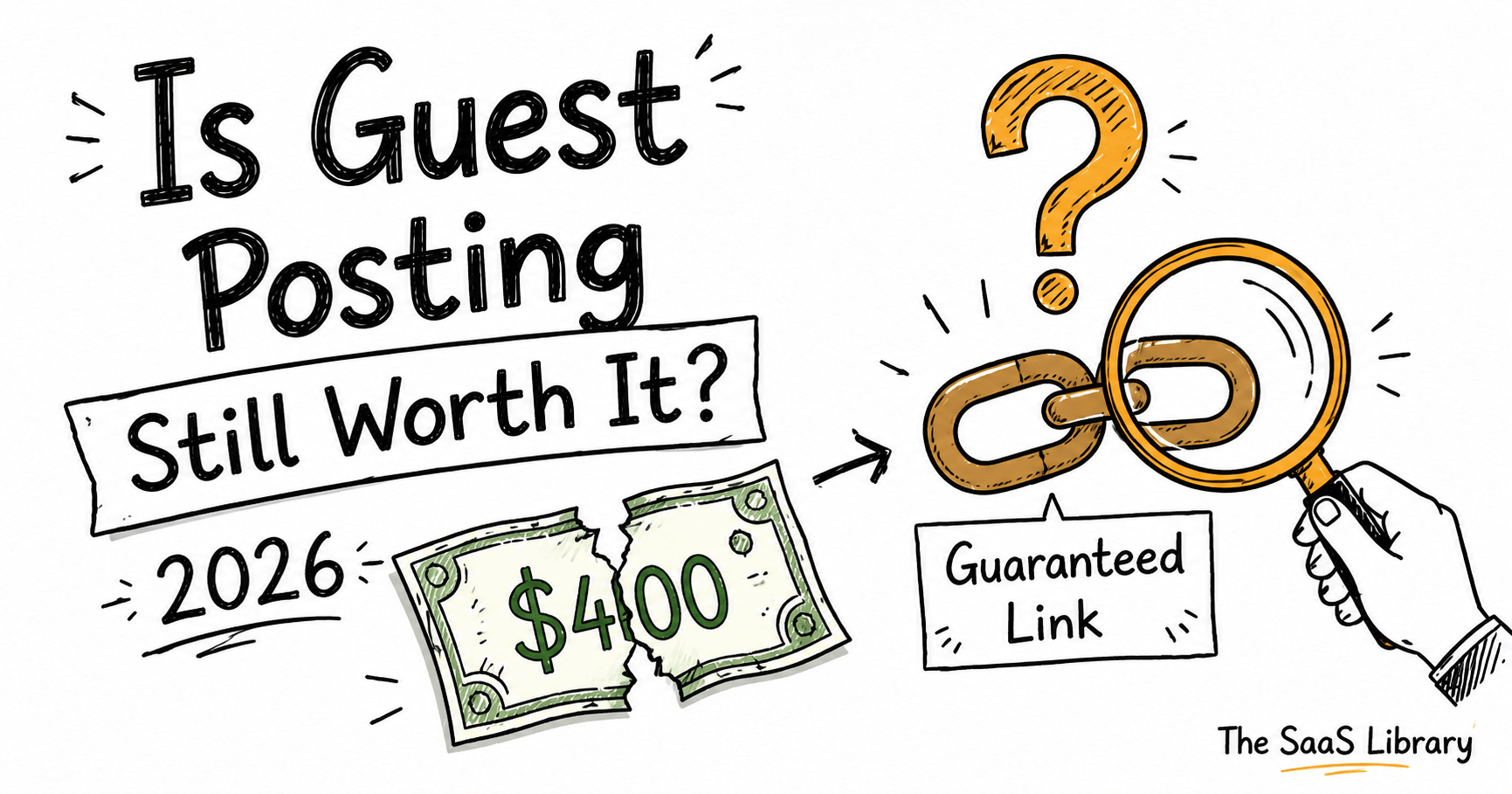
A publisher just offered you a guest post for $400, with a guaranteed link. Google has been telling buyers and sellers not to trust that exact offer since 2014 — most just never checked.
Is guest posting still worth it in 2026? A publisher just offered you a guest post for $400, with a guaranteed link — and that offer is the reason the question needs a real answer, not a quick one. Google’s own policy, a decade of enforcement, and this week’s pricing data all point the same direction, and it doesn’t match what most guest-post pitches promise. This breaks down what’s real, what’s marketing, and what to check before you pay.
⚙ This article includes a live calculator. Plug in the details of any offer and get an evidence-based price range in seconds — built from the same 2026 marketplace data cited throughout this piece.
Jump to the calculator ↓Is guest posting dead, or did something else die?
Guest posting is not dead. What died is guest posting built purely for backlinks — Google has treated that specific practice as a policy violation since at least 2014, and its spam policy still names it directly today. Genuine guest contributions for audience, brand, and referral traffic were never affected and continue to work in 2026.
Guest posting survived. What got buried in 2014 was something narrower: mass-produced articles submitted to any site that would take them, written solely to plant a link. Matt Cutts, then head of Google’s webspam team, called it out by name: “stick a fork in it: guest blogging is done; it’s just gotten too spammy.”
Even in that same post, Cutts drew a line most retellings drop since. He wasn’t calling for guest blogging to disappear — only for businesses to stop treating it as a link-building shortcut.
Google’s spam policy still draws that exact line today. It names “links with optimized anchor text in articles, guest posts, or press releases distributed on other sites” as the violation — not guest posting as a format.
So the “guest blogging is dead” headline oversimplified from day one. The abuse pattern died. Writing for someone else’s audience didn’t — and Google has said so, in some form, for over a decade.
What did Matt Cutts actually say in 2014 — and what got lost in translation?
Cutts said guest blogging had become too spammy to use as a link-building tactic — not that writing for other publications was banned. His post targeted mass-produced, link-driven content specifically, and he added he wouldn’t personally accept a guest post unless he could vouch for the writer.
Cutts’s actual post was narrower than a decade of retellings suggests. As head of Google’s webspam team, he wrote: “stick a fork in it: guest blogging is done; it’s just gotten too spammy.” That line alone launched a thousand “guest blogging is dead” headlines. The rest of the post didn’t support that reading.
He wasn’t targeting the format. He was targeting a specific pattern: identical articles mass-submitted to any site that would take them, written for the link and nothing else. His own follow-up comments made the distinction explicit — spam sites had “latched on to ‘guest blogging’ as their link-building strategy.”
- He drew a personal-vouching line, not a blanket ban. He said he’d only accept a guest post from someone he could vouch for personally or knew well — a standard for editorial judgment, not a rule against the format.
- He clarified the nofollow exception directly. A guest post link that carries a nofollow tag falls within Google’s guidelines regardless — the problem was never the article, it was the undisclosed dofollow link riding on it.
The headline won because “guest blogging is dead” is simpler than “a specific abuse pattern within guest blogging is dead.” Twelve years on, Google’s spam policy still draws the same narrow line Cutts drew — not against the format, against the scheme.
What does “guest posting” even mean today?
Guest posting means at least six different things today — organic pitches, paid sponsored posts, ongoing contributor roles, digital PR placements, link insertions, and PBN networks — and each carries a different risk and value profile. Treating them as one activity is why so much advice about guest posting contradicts itself.
“Guest posting” means at least six different things today, and most of the confusion in this space starts right here — a claim that’s true for one type gets applied to all of them.
| Type | Who writes it | Payment | Link status | What it actually is |
|---|---|---|---|---|
| Organic guest post | You, pitched on merit | None | Editorially given, often dofollow | Real guest blogging — the site wants your expertise |
| Paid guest post / sponsored post | You or the site | You pay | Should be sponsored/nofollow | Advertising, dressed as editorial |
| Contributor program | You, ongoing | None or revenue share | Usually one dofollow author-bio link | Relationship-based, recurring |
| Digital PR placement | A journalist, using your quote or data | None | Natural editorial link, often dofollow | You’re the source, not the author |
| Link insertion (“niche edit”) | No new content — link added to an old article | You pay | Should be sponsored, rarely is | The riskiest category — pure link scheme |
| PBN / marketplace network | Bulk-farmed content | You pay per placement | Fake-organic, undisclosed | The exact abuse pattern Google’s policy targets |
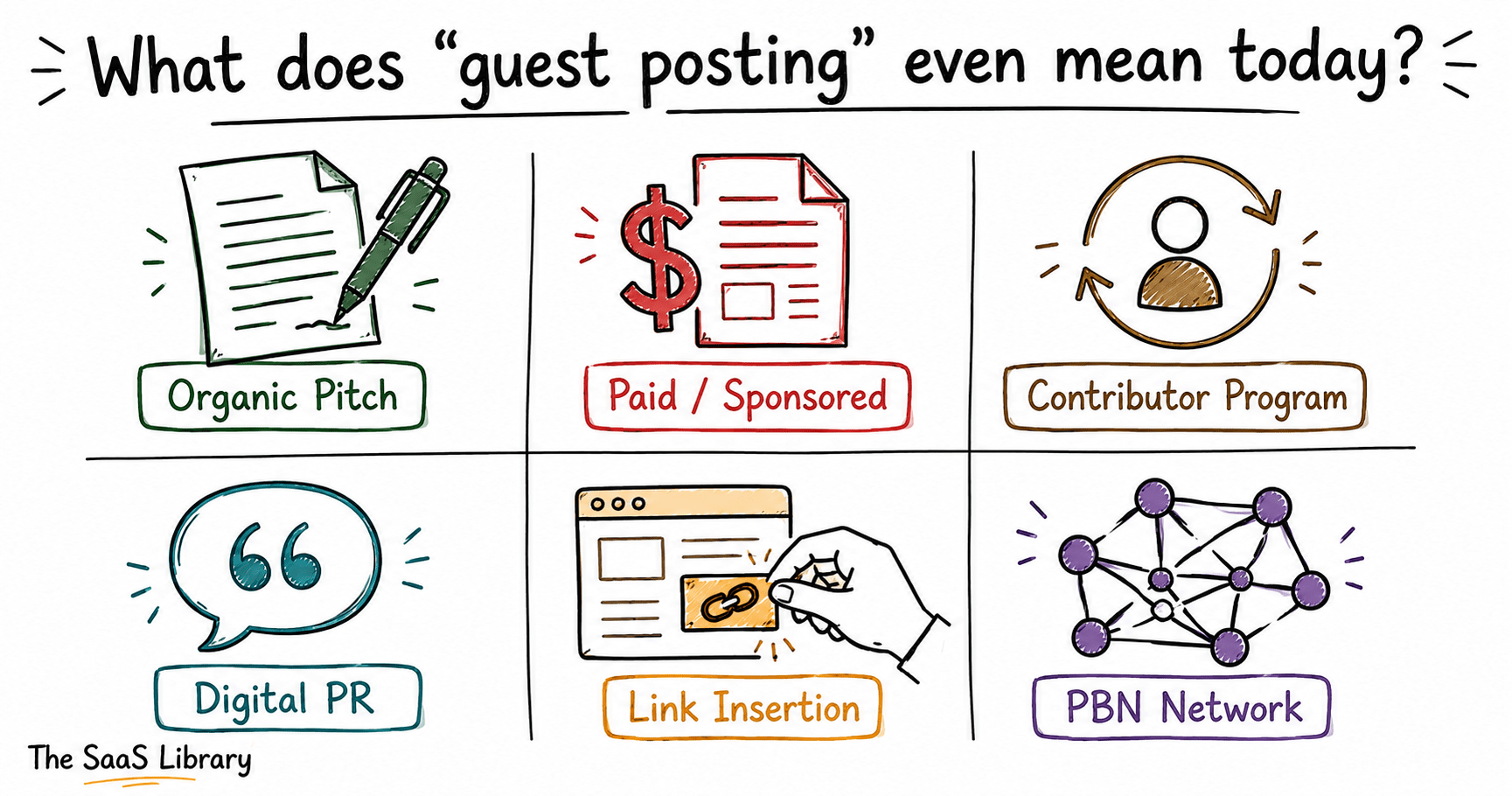
Three of these barely resemble each other. A digital PR placement involves no article-writing on your part at all — a journalist quotes you.
A link insertion involves no writing at all, period — someone edits an existing page to add your link. Only the top two rows involve you actually drafting a guest article.
This matters for one reason: every rule in this piece — Google’s policy, Mueller’s comments, the pricing data — applies differently depending on which row a given pitch falls into. “Is guest posting worth it” isn’t one question. It’s six, and Google draws that line clearly — starting with what its policy actually says.
What does Google actually say about paid and guest-post links?
Google says paid and guest-post links are allowed only when tagged sponsored or nofollow, and its spam policy names untagged guest-post link campaigns as a violation outright. John Mueller has gone further, stating guest-post links built for SEO carry zero ranking value and get devalued algorithmically over time.
Google says paid and guest-post links are allowed only when tagged sponsored or nofollow, and its spam policy names the exact practice this piece keeps returning to: “large-scale article marketing or guest posting campaigns with keyword-rich anchor text links” as a link scheme. The same policy calls out “advertorials or native advertising where payment is received for articles that include links that pass ranking credit” — a paid guest post with an undisclosed link, described almost exactly.
The fix is disclosure, not avoidance. Google’s own guidance says buying and selling links is a normal part of the web’s economy, as long as the link carries rel=”sponsored” or rel=”nofollow”. In 2021, Google went further and put site owners on notice directly: sites running sponsored or guest content without proper link tags risk algorithmic and manual actions.
John Mueller has been more blunt than the policy language. Asked directly about guest-post links built for SEO, he said: “Those links have zero value. It’s a waste of time if you’re just doing it for the links.” He’s also explained why that’s true mechanically — Google has years of training data on this exact pattern, enough that “the largest part of those links are just ignored automatically.”
That last point matters more than it sounds. A devalued link isn’t a penalized link. Nothing shows up in Search Console. The site doesn’t drop in rankings.
The link simply does nothing — which means a buyer can pay for a placement, see no red flags anywhere, and still have gotten zero SEO value for the money. Silence isn’t confirmation it worked.
In 2020, Semrush — a tool most SaaS marketers already use — launched a paid “Guest Posting” service inside its own Marketplace, advertised as delivering “a cascade of high-quality, natural links to your site, boosting your rankings.” John Mueller responded on Twitter directly, calling it “an unnatural link — the kind the webspam team might take action on.” Semrush pulled the product within days. In their own words: “We made a decision to pause the guest blog post editorial/outreach offerings and refund all orders.” (Search Engine Roundtable, 2020) If a company with Semrush’s SEO expertise got this wrong publicly, “surely the professionals selling this know something we don’t” isn’t a safe assumption to make about any guest-post offer.
Google’s rule hasn’t moved since 2014: disclose the link, or don’t expect it to count. What’s changed is enforcement, and it works more quietly than most people assume.
What’s the difference between dofollow, nofollow, sponsored, and UGC links?
The difference is that dofollow passes ranking credit by default, while nofollow, sponsored, and UGC are all attributes that tell Google not to count a link toward rankings — sponsored marks paid links, UGC marks user-submitted content, and nofollow covers everything else you can’t vouch for.
The difference between dofollow, nofollow, sponsored, and UGC comes down to one question: which links is Google willing to count toward rankings? Only one of the four does anything by default.
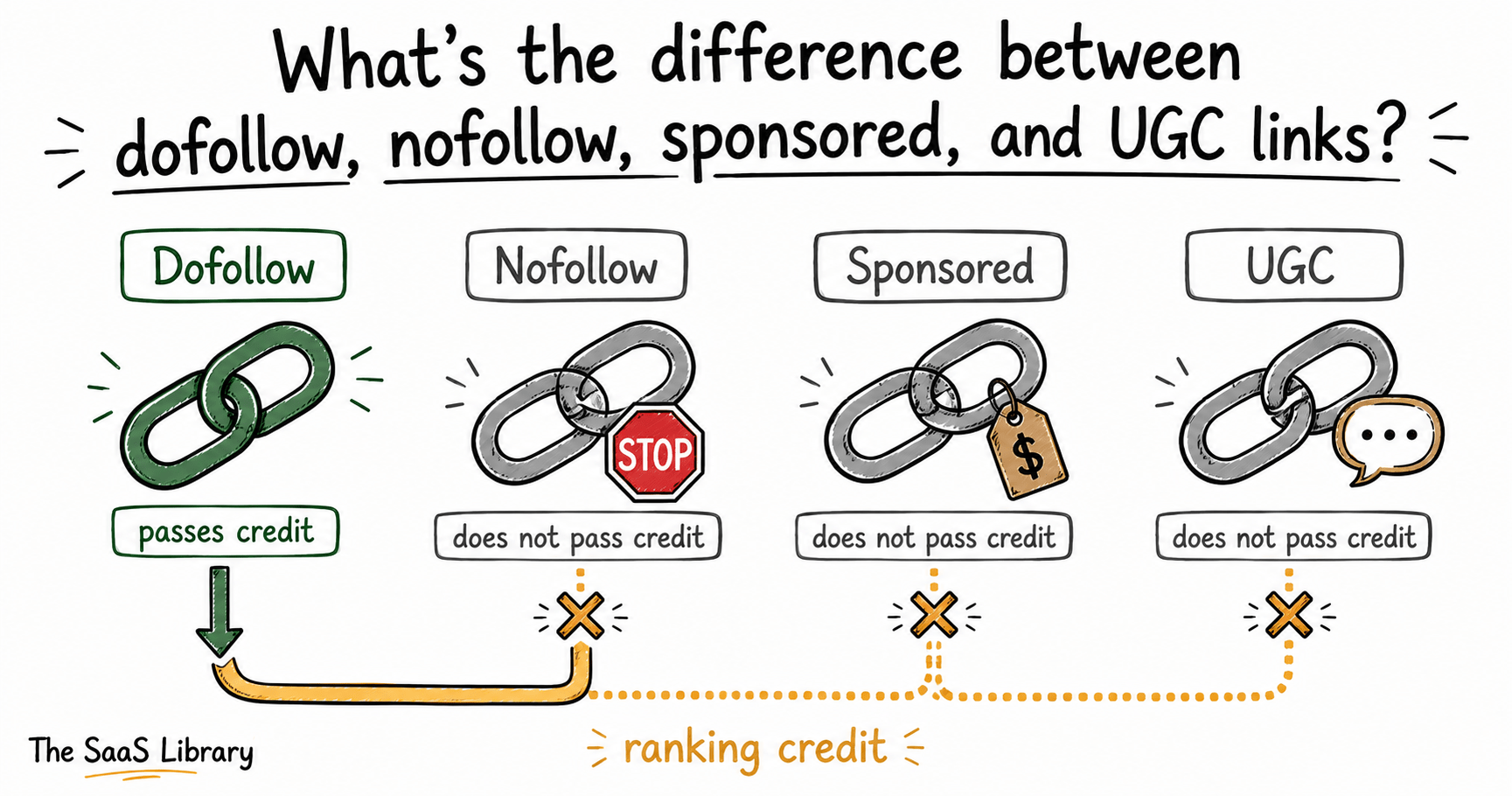
- Dofollow is the absence of a tag, not a tag itself. Any plain <a href> with no rel attribute passes ranking credit automatically — this is still true today.
- Nofollow was introduced in 2005 to fight comment spam. It tells Google not to associate your site with, or pass credit to, the linked page.
- Sponsored was added in 2019 specifically for paid links. Google’s own guidance is direct: “rel=’sponsored’: identifies links on a site that were created as part of advertising, sponsorships or similar agreements.”
- UGC covers user-generated content — comments, forum posts, guest submissions you didn’t fully vet — where you can’t personally vouch for the link.
Here’s the part most guides skip: since 2020, all three non-default attributes became hints, not commands. Google’s own framing: “each of these three attributes will be treated as hints about which links to exclude as ranking signals.” In practice, Google still treats them the way it always treated nofollow — generally excluded from ranking credit — but it reserves the right to use the underlying link data for pattern detection regardless of the tag.
Mislabeling a genuine editorial link as sponsored when no payment happened isn’t neutral — Google has said the effect is the same as if the tag weren’t there at all, so over-tagging costs you real credit for nothing. Tags can also be combined: rel=”sponsored nofollow” is valid and common for paid links a publisher wants doubly covered.
The tag you should expect on a paid guest post is sponsored or nofollow. Anything untagged and paid is the exact pattern the next section explains how Google actually catches. Related reading: what technical SEO means in the AI era covers how these signals fit into the bigger crawlability picture.
Do nofollow and sponsored tags really block all SEO value?
Yes, for passing ranking credit — Google treats tagged links as excluded from rankings, not as a soft suggestion. What the tags don’t do is stop Google from crawling the link, reading it for context, or using the pattern to detect manipulation. Tagged and blocked-from-ranking are not the same as invisible.
Nofollow and sponsored tags do block SEO value — specifically, the ranking credit a link would otherwise pass. Google’s own framing confirms links carrying these attributes “generally won’t be followed, but can still be found through other sources.”
That second half is the part people miss. The tag blocks credit, not visibility.
Google still crawls tagged links when it finds them another way, still reads the anchor text and surrounding content, and still uses that data to build a picture of your site’s link patterns. A nofollow tag doesn’t make a link invisible to the algorithm — it just tells the algorithm not to count it as an endorsement.
There’s a second nuance, and it cuts against over-caution too. Mislabeling backfires in both directions:
- Under-tagging (a paid link left untagged) risks the exact policy violation covered earlier — undisclosed paid links that pass ranking credit.
- Over-tagging (marking a genuine editorial link sponsored when no payment occurred) doesn’t play it safe. It just throws away real credit the link would otherwise have earned.
So “does the tag block all SEO value” has two honest answers layered on top of each other. For ranking credit specifically: yes, reliably, by design. For the link disappearing from Google’s understanding of your site entirely: no — and that’s exactly the mechanism the next section explains, because it’s also how Google catches the links that were never tagged at all.
What happens inside Google’s algorithm when you buy a link?
What happens is Google’s SpamBrain system detects the link, strips its ranking credit, and moves on — no penalty, no warning, no entry in Search Console. Google calls this “neutralizing” the link rather than penalizing the site, and for most bought links, this silent devaluation is the only thing that happens.
What happens inside Google’s algorithm is almost anticlimactic — it just turns the link off, silently, without ever telling anyone.
Google’s own December 2022 announcement described the mechanism directly: “Today, we’re leveraging the power of SpamBrain to neutralize the impact of unnatural links on search results.” SpamBrain is Google’s AI-based spam-prevention system, and this update marked the first time it was pointed specifically at links — detecting “both sites buying links, and sites used for the purpose of passing outgoing links.”
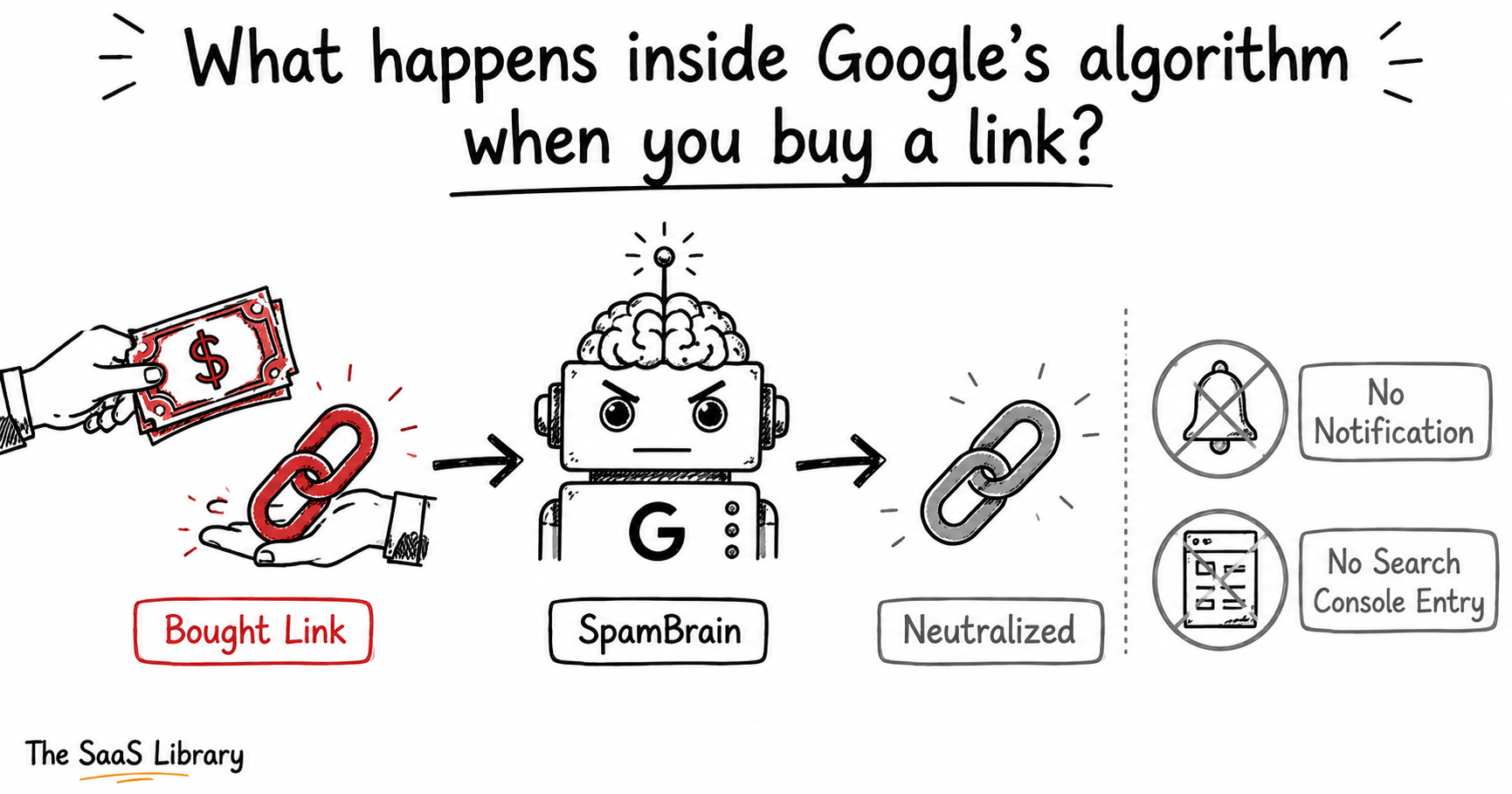
“Neutralize” is a precise word choice, not a euphemism. The link isn’t removed, flagged, or reported anywhere. It simply stops passing ranking credit — as if the tag had been nofollow all along, whether or not anyone ever added one.
This is why John Mueller has consistently downplayed the need to manually clean up suspicious links. Asked whether site owners should proactively disavow questionable backlinks, his answer was blunt: “I’d either ignore it or use the disavow file (for the worse domains).” Random spammy links pointing at your site generally aren’t worth the effort — SpamBrain has almost certainly already zeroed them out.
| Outcome | What happens | Visibility |
|---|---|---|
| Algorithmic devaluation (default) | Link neutralized silently | No notification, no ranking drop, no visible trace |
| Manual action (exception) | Human reviewer flags a clear, large-scale pattern | Visible Search Console notice, requires a fix before recovery |
A bought link that “seems fine” months later isn’t proof it worked. It’s usually proof of the first outcome, not the absence of one. Google escalates to the second far more often than most guest-post buyers expect.
Has anyone actually been penalized for this recently?
Yes — CNN, USA Today, Forbes, and the Wall Street Journal all lost search visibility to manual actions in 2024, and Google confirmed it wasn’t algorithmic. A separate 2024 case shows a single legitimate guest blog post triggering a manual action tied to the network it came from, with Mueller commenting on it directly.
Google has penalized specific, named publishers for this in the past two years — not hypothetically, not quietly.
In May 2024, Google enforced a new “site reputation abuse” policy by removing entire sections of major sites from search results — and confirmed the mechanism directly. Search Engine Land reported: “sites as large as CNN, USA Today, Fortune, and LA Times are seeing their coupon directories no longer ranking for coupon-related keyword phrases,” and Google told them “these are manual actions, not algorithmic actions.” (Search Engine Land)
The policy targets a specific pattern: hosting third-party content mainly to borrow the host’s ranking strength. Google’s own definition: “when third-party pages are published with little or no first-party editorial oversight or involvement, where the purpose is to manipulate Search rankings by taking advantage of the first-party site’s ranking signals.”
By late 2024, the list of casualties had grown. Search Engine Journal confirmed manual actions “affecting properties like CNN Underscored and WSJ Buyside,” with CNN Underscored down to just 10 URLs indexed. Forbes Advisor’s health section was reportedly wiped entirely around the same time.
This isn’t only a problem for the sites hosting the content — it’s a live enforcement pattern, still active. In February 2024, Search Engine Roundtable reported a case where a legitimate guest blog post triggered a manual action because of the network distributing it. John Mueller responded directly, noting: “It’s been a decade,” and pointed to Cutts’s original 2014 post as still relevant — his direct question to the blogger: would you agree that “a lot of what Matt has said a decade ago still applies today”?
- These are manual, not algorithmic — meaning a human reviewer looked at the pattern and acted, which means Google can point to it directly if asked.
- The targets were large, sophisticated publishers — not small blogs guessing at the rules. Scale and reputation didn’t provide protection.
- Recovery required removing or noindexing the content — the manual action lifts, but the traffic built on it doesn’t come back.
Enforcement happened to CNN. It can happen to anyone running the same pattern at a smaller scale.
How big is the guest-post and backlink market today?
The guest-post and backlink market is estimated at roughly $26 billion in 2025, projected to reach $57 billion by 2030 — but every figure available comes from SEO-industry aggregators and vendors, not neutral market analysts. Treat the size as directional, not precise, and treat the source as part of the story.
Big enough to have its own research reports. Whether those reports are trustworthy is a different question.
The most-cited figure: “the global link-building services market is estimated at $25.97 billion in 2025, projected to grow to $57.07 billion by 2030.” A narrower slice — just the software used to run outreach campaigns — is separately estimated in the billions and projected to keep growing through the decade.
Here’s the catch worth sitting with before trusting either number: the sources reporting these figures sell the thing they’re sizing.
This isn’t unique to this industry, but it means the incentive runs one direction — bigger market size, more credible-sounding pitch to prospective clients. The inconsistency shows up fast once you compare sources directly — different research firms have published wildly different “link building tool market” figures within the same two-year window, with no explanation for the swing.
Numbers like this aren’t malicious. They’re just built on inconsistent methodology, and nobody’s checking.
What’s actually verifiable: this is a real, standing industry with named platforms, publisher-facing sales teams, and enough transaction volume that individual marketplaces report tens of thousands of completed placements — covered directly in the next section. The multi-billion-dollar framing is probably directionally correct. The specific numbers are marketing collateral wearing a market-research citation.
What does a guest post actually cost in 2026?
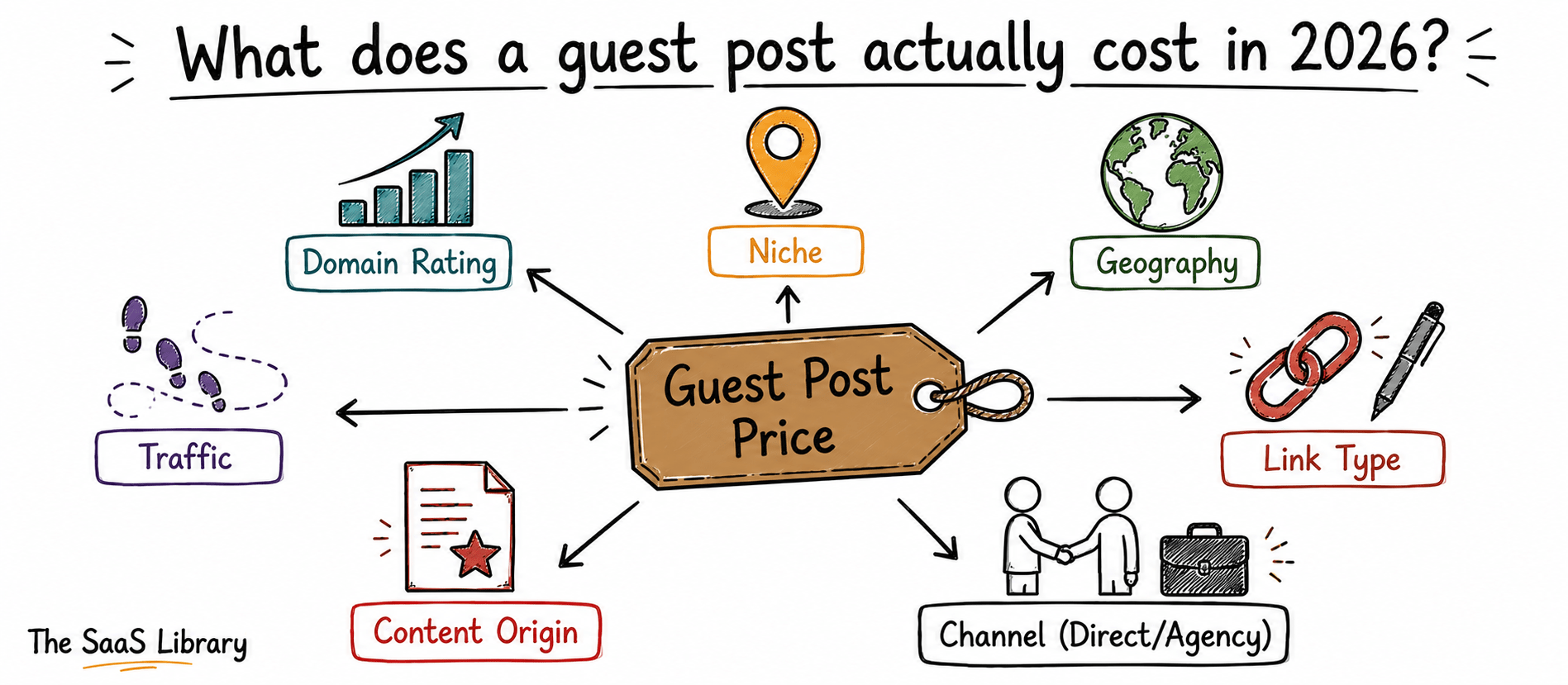
A guest post typically costs $150–$900, with the average sitting around $459, but the final price depends on at least seven separate factors — domain rating, niche, geography, traffic, link type, content requirements, and whether you buy direct or through a marketplace. No single number describes this market honestly.
A guest post’s real 2026 price tag depends on seven variables most sellers never disclose upfront — which is exactly why the number people quote each other varies so much. Nobody wants to say the real number out loud, either — buyers don’t want to admit what they paid, and sellers don’t want to publish a rate card that makes their $50 site look cheap next to a competitor’s $2,000 one.
The most recent large-scale study — Adsy’s analysis of 52,671 websites — puts the average guest post at $459, up from $427 the year before, a 7.5% increase year over year. But “average” hides more than it reveals here. The same study found “listed backlink prices are 4x higher than actual transaction prices” — meaning sellers routinely list one number and quietly accept far less.
Here’s what actually moves the price, based on the largest available datasets — including how the same metrics can mean wildly different prices depending on niche:
| Factor | How it moves price | Data point | Source |
|---|---|---|---|
| Domain Rating (DR) | Higher DR = sharply higher price, non-linear | DR 81–90 sites saw a 46% price jump year-over-year; each +10 DR tier adds roughly 32% | Adsy, 52,671 sites, 2026 |
| Niche/vertical (real transactions) | Narrower spread than assumed — driven by CLV and supply, not “riskiness” | Sports $246, Casino $252, Finance $221, Automotive $185, Law/Gov $180 — full spread only ~2.25x | PressWhizz, 22,703 real placements, 2026 |
| Niche/vertical (listed/asking prices) | Can invert the “risky niche = expensive” assumption entirely | Gambling/adult sites priced lowest overall ($238) due to 70% having zero organic traffic — but the same niche filtered to DR50+/10k+ traffic jumps to $1,109 | BuzzStream, ~500,000 sites, 2026 |
| Geography | Core English-speaking markets cost meaningfully more | US/UK/Canada/Australia/Ireland ~50% above global average | Adsy, 2026 |
| Organic traffic | Real visitors add cost independent of DR | Sites with 100,000+ monthly visits sell for ~218% more than sites under 1,000 | PressWhizz, 2026 |
| Link type | Guest posts cost more than link insertions, gap widens at higher DR | Link insertions run 56% cheaper on average | Adsy, 2026 |
| Content origin | Original research/expert quotes/custom writing costs more | Costs more than a generic 600-word placement | Outreachz, 2026 |
| Listed vs. actual price | Sellers list high, buyers pay less | Listed prices average 4x actual transaction prices | Adsy, 2026 |
| Channel (direct vs. agency) | Middlemen add substantial markup | Agency-sourced placements average roughly 4x direct-purchase cost | BuzzStream, 2026 |
A second large dataset backs the same shape, even with different absolute numbers — BuzzStream’s independent analysis put the average guest post link at $365, with quality placements “averaging $930 by stronger traffic and authority thresholds” before any vendor markup is added.
How much should you actually expect to pay, by site tier?
Four tiers cover almost every offer you’ll see. Compare whatever you’re quoted against this before you agree to anything.
| Tier | Typical DR/DA range | Expected price | What you’re actually getting |
|---|---|---|---|
| Budget | DR 20–30 | $100–$150 | Real placement, but likely thin traffic and looser editorial standards |
| Mid-tier | DR 30–50 | $150–$500 | The most common range — verify traffic yourself here |
| Premium | DR 60–70 | $400–$930 | Genuine authority and traffic, if the DR isn’t inflated by a private link network |
| Elite / top-tier | DR 65+ with 10,000+ verified traffic | $3,130–$6,018 via vendor | The tier that actually clears the quality bar — only 1.37% of sites qualify |
Why the same DR can cost $180 or $1,100, depending on the niche
PressWhizz’s real-transaction data shows the whole spread between the priciest and cheapest niche is only about 2.25x — narrower than most buyers expect. But BuzzStream’s listed-price data shows gambling and adult sites priced lowest overall ($238) because 70% of that inventory carries zero organic traffic — filtered down to genuinely high-quality sites, the same niche jumps to $1,109. A 1,500-site niche study from iCopify found DR, DA, and traffic are only weakly linked to price in some verticals — a $25–$50 placement on a DR 65–72 site can outperform a $500+ placement elsewhere, driven by community credibility rather than the metric.
What this means practically: a “DR 50, $250” quote isn’t one price point — it’s at least three different products depending on the niche and the quality filter applied.
The takeaway for a newcomer on either side of this transaction: a $50 “high-authority guest post” and a $900 one are not the same product priced differently. They’re usually different products entirely — and the price gap is the market quietly telling you which is which.
Why do guest-post pricing studies disagree with each other so wildly?
Guest-post pricing studies disagree because they measure different things and call it the same thing. Listed prices, actual paid prices, quality-filtered averages, and unfiltered marketplace averages produce wildly different numbers for the same niche — and almost no study specifies which one it’s reporting.
Guest-post pricing studies disagree this wildly for a simple reason: they measure entirely different transactions and report them under one price tag.
We built the calculator in this article by pulling from five separate datasets, and the gambling niche alone exposed the problem directly. BuzzStream’s marketplace-wide analysis found gambling and adult sites priced lowest of any category — because “the gambling site inventory in this marketplace is overwhelming junk, with about 70%… having no organic traffic at all.” Filter that same category down to sites that actually clear DR 50+ and 10,000+ traffic, and the average jumps to $1,109 — a 4.6x difference, same niche, same source, just a different quality threshold applied.
Meanwhile, PressWhizz’s dataset — built from 22,703 real completed sales rather than marketplace listings — put gambling at a flat $252, and explicitly noted the whole spread between the priciest niche and the market median was “about 2.25x, which is narrower than most buyers expect.”
Neither study is wrong. They’re answering different questions:
- Listed price vs. paid price: most published averages are what sellers ask, not what buyers actually pay — Adsy’s own data shows listed prices run roughly 4x actual transaction prices.
- Filtered vs. unfiltered inventory: a study covering every listed site (including thousands with zero traffic) will always undercut a study that pre-screens for real authority.
- Sample source: a single marketplace’s internal sales data reflects that platform’s specific buyer pool, not the market as a whole.
None of this makes pricing data useless — it makes single numbers useless. A guest post “costs $164” and “costs $459” and “costs $1,109” are all defensible claims, depending entirely on what was filtered, listed, or sold.
The fix isn’t picking the study that sounds most authoritative. It’s asking which of those three questions the number in front of you is actually answering — which is exactly what a factor-by-factor price check forces you to do, one variable at a time instead of one flattened average.
Why do 98% of guest-post sites fail basic quality checks?
Most guest-post marketplace sites exist to sell placements, not to serve readers — so they were never built to pass a quality filter in the first place. Applying real thresholds for authority and traffic to a marketplace of roughly 500,000 sites left just 1.37% qualifying as high-quality or top-tier.
98% of guest-post sites fail basic quality checks for a structural reason, not a coincidence — the marketplace was never designed to produce quality inventory at scale.
BuzzStream analyzed a marketplace of roughly 500,000 guest-post sites and applied a straightforward filter — real Domain Rating plus real traffic, not self-reported metrics. The result: only 1.37% of guest-post sites are High Quality or Top Tier.
That filter wasn’t harsh. It didn’t demand elite-level authority — just a DR/DA around 65+ paired with 10,000+ monthly organic visitors, a bar most genuinely operating publications clear without trying. Applying it dropped the qualifying pool from 897 sites to 68.
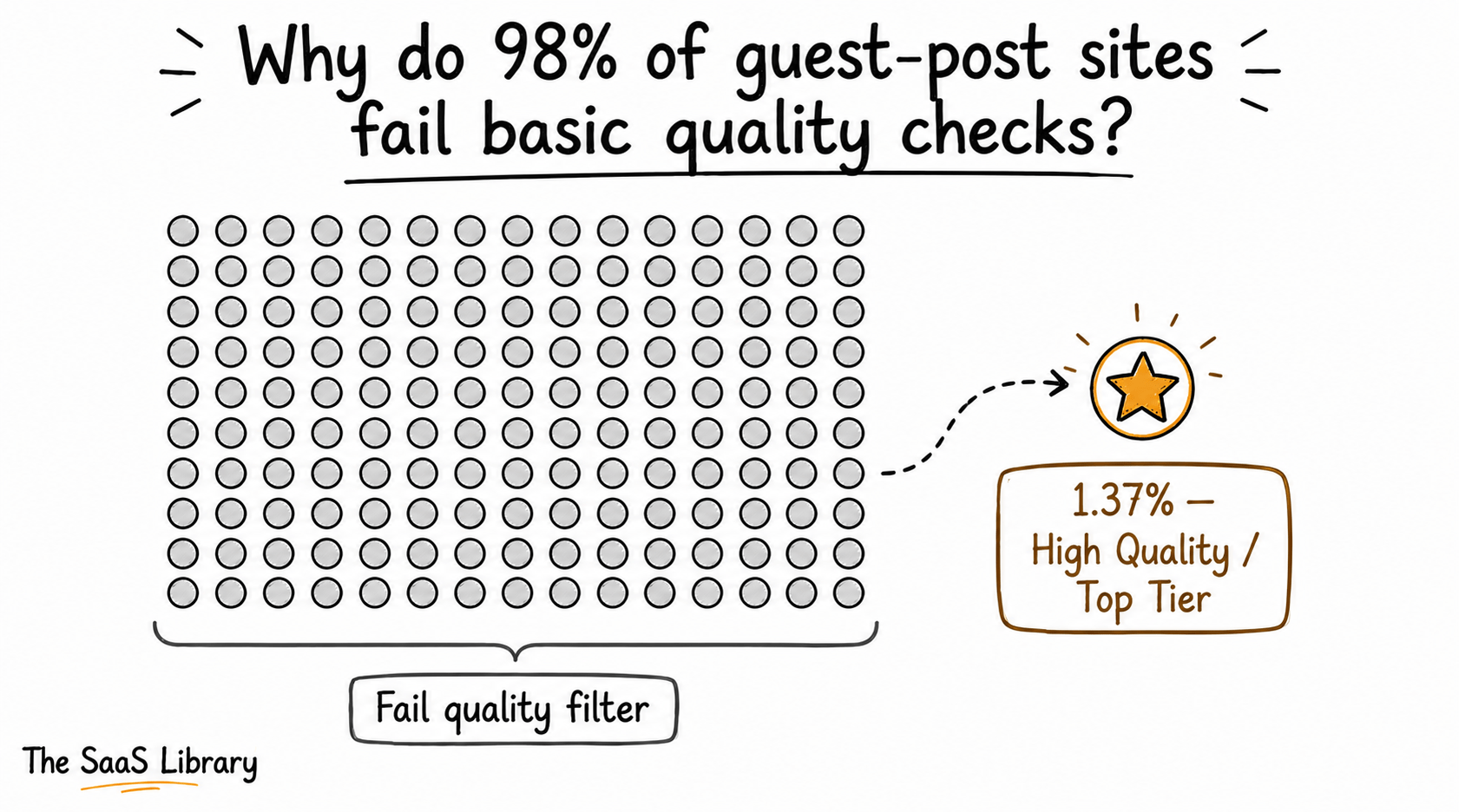
The other 98.63% aren’t necessarily fake. Most are just structurally incapable of delivering what a buyer assumes they’re paying for:
- No real audience. Roughly 86% of marketplace sites carry under 10,000 monthly traffic and DR under 40 — inventory built to look plausible on a listing page, not to be read.
- Metrics without substance behind them. A domain can reach DR 50–60 through internal link networks while pulling fewer than 500 real visitors a month — the score is real, the audience isn’t.
- Existence for the transaction itself. Some sites were created specifically to sell placements, meaning “guest post” describes their entire business model, not an occasional monetization tactic on top of real content.
This is the gap the pricing data in the last two sections kept circling without naming directly. A DR 50 site charging $250 and a DR 50 site charging $250 can be selling completely different things — one a genuine placement in front of real readers, the other a link sold by a site that exists to sell links.
The metric matches. The product doesn’t. Related reading: how AI-generated content is eroding trust in thought leadership covers a similar volume-over-substance failure mode.
Do guest posts and sponsored links actually help you get cited by AI like ChatGPT and Google AI Overviews?
No, not meaningfully. Paid and advertorial content accounts for just 0.3% of what AI systems actually cite, while earned media accounts for 84%. Separately, brand mentions correlate with AI visibility roughly three times more strongly than backlinks do. Paid placements are the weakest-evidenced strategy in this entire space.
Guest posts and sponsored links carry almost no weight in what AI systems actually choose to cite, based on the most direct measurement available — an analysis of 25 million real citations.
Muck Rack’s Generative Pulse team has run this test three separate times, most recently analyzing “more than 25 million links from ChatGPT, Claude and Gemini responses across 17 industries.” The result has held steady across all three editions: “Earned media accounts for 84% of all AI citations. Paid and advertorial content accounts for 0.3%.” Across three separate study periods stretching back to July 2025, “earned media has ranged from 82% to 89%” — consistent, not a one-time anomaly.
Ahrefs ran a separate, independent study measuring a different question — not what gets cited, but what predicts a brand showing up at all. Analyzing 75,000 brands, they found “web mentions (0.664) correlate much more strongly than backlinks (0.218)” with AI Overview visibility — brand mentions land roughly three times stronger as a predictor than backlinks do. The top three predictive factors were all off-site brand signals, not link metrics.
Two different studies, two different methods, the same direction: what earns AI citation is being talked about by independent sources, not being linked to by a paid placement.
- Muck Rack measured actual citations — what AI systems chose to cite, out of 25 million real links, across three points in time.
- Ahrefs measured predictive correlation — which signals statistically track with a brand appearing in AI Overviews at all, across a large brand sample.
Neither study found a meaningful role for paid or guest-post links specifically. A guest post can still generate a brand mention — someone reads it, references your name elsewhere, and that mention is what AI systems actually track.
But the link itself, especially a paid or tagged one, isn’t what’s doing the work. If a marketplace is selling you a guest post as an “AI visibility” tactic, the study that would back that claim doesn’t currently exist — and the studies that do exist point the other way.
What does the data really say about backlinks and AI visibility?
Backlinks still correlate positively with AI visibility, just weakly compared to other signals — and the strongest of all measured factors isn’t a link at all. Ahrefs’ expanded study found YouTube mentions correlate at 0.737, branded web mentions at up to 0.709, and backlinks trail at 0.218, with content volume mattering even less.
The data says backlinks still correlate positively with AI visibility, just weakly compared to other signals — and the strongest measured factor isn’t a link at all.
Ahrefs expanded its original study to cover ChatGPT and Google AI Mode alongside AI Overviews, and the full ranking is worth seeing in one place rather than a single cherry-picked number:
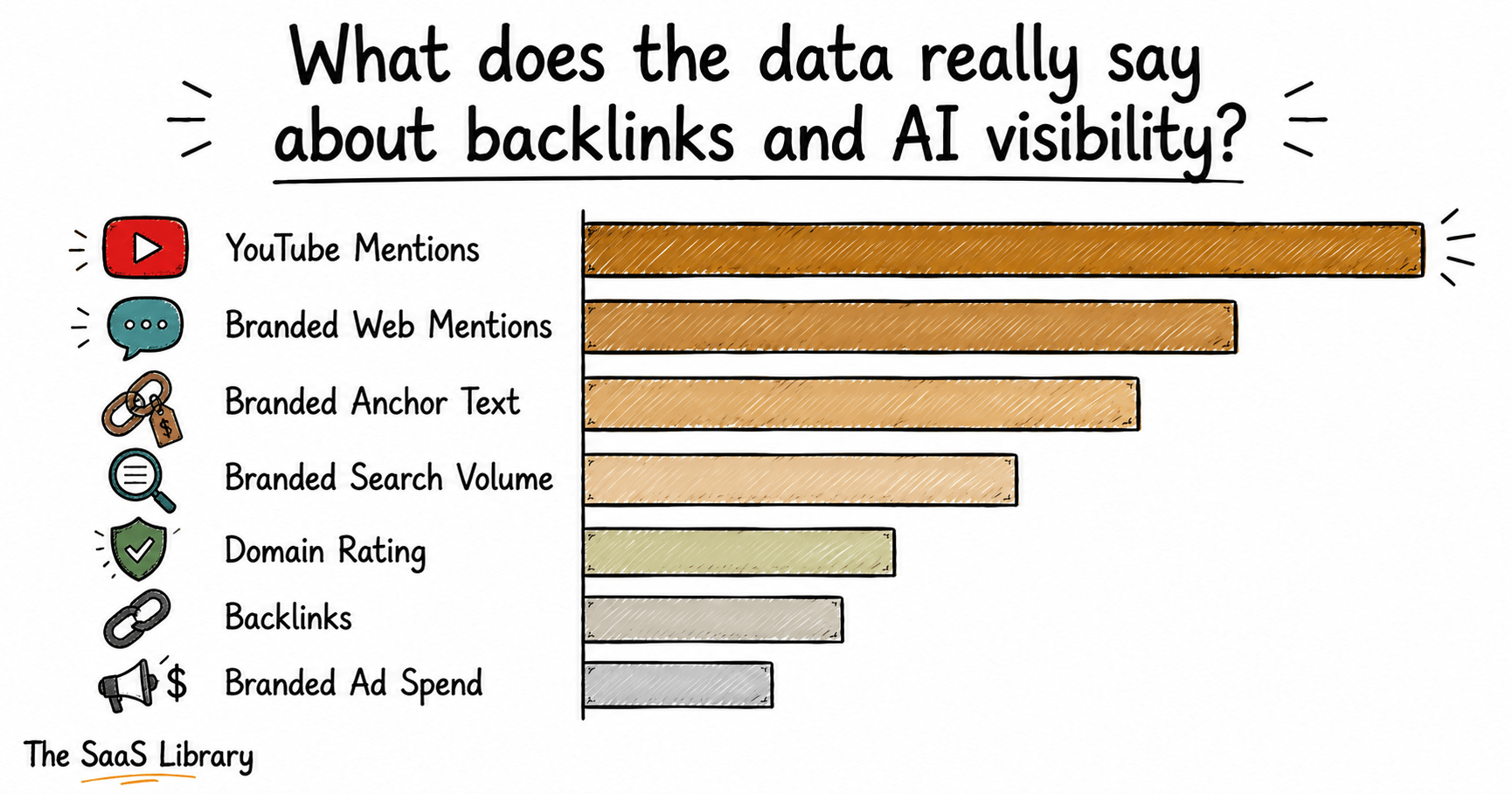
| Signal | Correlation with AI visibility | What it measures |
|---|---|---|
| YouTube mentions | 0.737 | Brand referenced in video content |
| Branded web mentions | 0.664–0.709 | Brand name appearing anywhere across the web, linked or not |
| Branded anchor text | 0.527–0.628 | Brand name specifically inside a hyperlink |
| Branded search volume | 0.392–0.466 | How often people search the brand name directly |
| Domain Rating | 0.266–0.326 | Composite authority score |
| Backlinks (referring domains) | 0.218 | Raw link count |
| Branded ad traffic/cost | 0.215–0.216 | Paid advertising spend and traffic |
The pattern across every row: off-site brand signals beat on-site or link-based signals, consistently. Even branded ad spend — companies paying directly for visibility — barely outperforms plain backlinks, and both sit well below anything involving being mentioned or discussed independently.
Ahrefs is careful about what this does and doesn’t prove: “correlation is not causation. The data shows brands with high AI visibility also have high cross-platform presence — not that opening a YouTube channel triggers AI citations.” The honest reading isn’t “go make YouTube videos instead of building links.” It’s that AI visibility rewards being genuinely, independently talked about across many surfaces — and no single purchased placement, on its own, replicates that.
So the practical shift isn’t from links to some other single tactic. It’s from “acquire a link” to “earn a mention” — and a mention doesn’t require a backlink, a payment, or a guest post to count. Related reading: how SEO, AEO, and GEO tools actually collect their data covers the measurement side of this shift in depth.
What link-building tactics actually work in 2026?
Digital PR, journalist outreach, and original research are the tactics with real evidence behind them — digital PR is rated most effective by SEO professionals by a wide margin, and both Google’s own commentary and the AI-citation data point the same direction. Guest posting still has a role, but not as the primary tactic.
The link-building tactics that actually work in 2026 are digital PR, journalist outreach, and original research — with real evidence behind each one, unlike most of what marketplaces sell.
Aira and Editorial.Link’s State of Link Building 2026 survey asked working SEO professionals to rate tactic effectiveness directly, not guess at it. Digital PR won by a wide margin — rated most effective by roughly 48.6% of respondents, more than three times the next-closest tactic.
That’s not a marginal preference. It’s a near-consensus among people whose job is judging what actually moves rankings.
This lines up with two things already established in this piece. John Mueller has personally endorsed the category: “I love some of the things I see from digital PR, it’s a shame it often gets bucketed with the spammy kind of link building.” And the AI-citation data from the last section points the same direction — digital PR produces exactly the kind of independent, earned mention that correlates with AI visibility, where a paid guest post link doesn’t.
What separates digital PR from guest posting isn’t the outlet, it’s who initiates the link. A journalist citing you because you’re a genuine source produces a link Google reads as a real endorsement.
You paying to place your own writing on someone else’s site produces the exact pattern the spam policy targets. Same destination link, structurally different signal.
Three tactics show up repeatedly in the effective category, all sharing one trait — the link exists because someone independently decided you were worth citing, not because you paid for placement:
- Expert commentary / journalist outreach. Responding to reporter queries with genuine expertise, so the resulting mention is earned, not purchased.
- Original research or data. Publishing something nobody else has — a study, an audit, a dataset — gives other sites a real reason to link to you unprompted.
- Contributor relationships built over time. Becoming a recurring, trusted voice on a relevant publication, where any resulting link is a byproduct of credibility, not the goal itself.
Guest posting isn’t excluded from this list — it’s just demoted. Used for genuine audience-building, on a real site, without expecting the link to carry ranking weight, it still does its original job. It just isn’t the tactic the data says to lead with anymore.
How do you evaluate a guest post or sponsored post offer before paying?
You evaluate it by checking five things: real traffic verified independently, how the link will be tagged, whether the price matches the DR-and-niche range, the site’s actual editorial standards, and whether the pitch leans on rankings. A clean answer on all five signals a legitimate offer; a vague answer on any one is a reason to walk away.
You evaluate a guest post or sponsored post offer by running it through five checks, none of which take more than a few minutes.
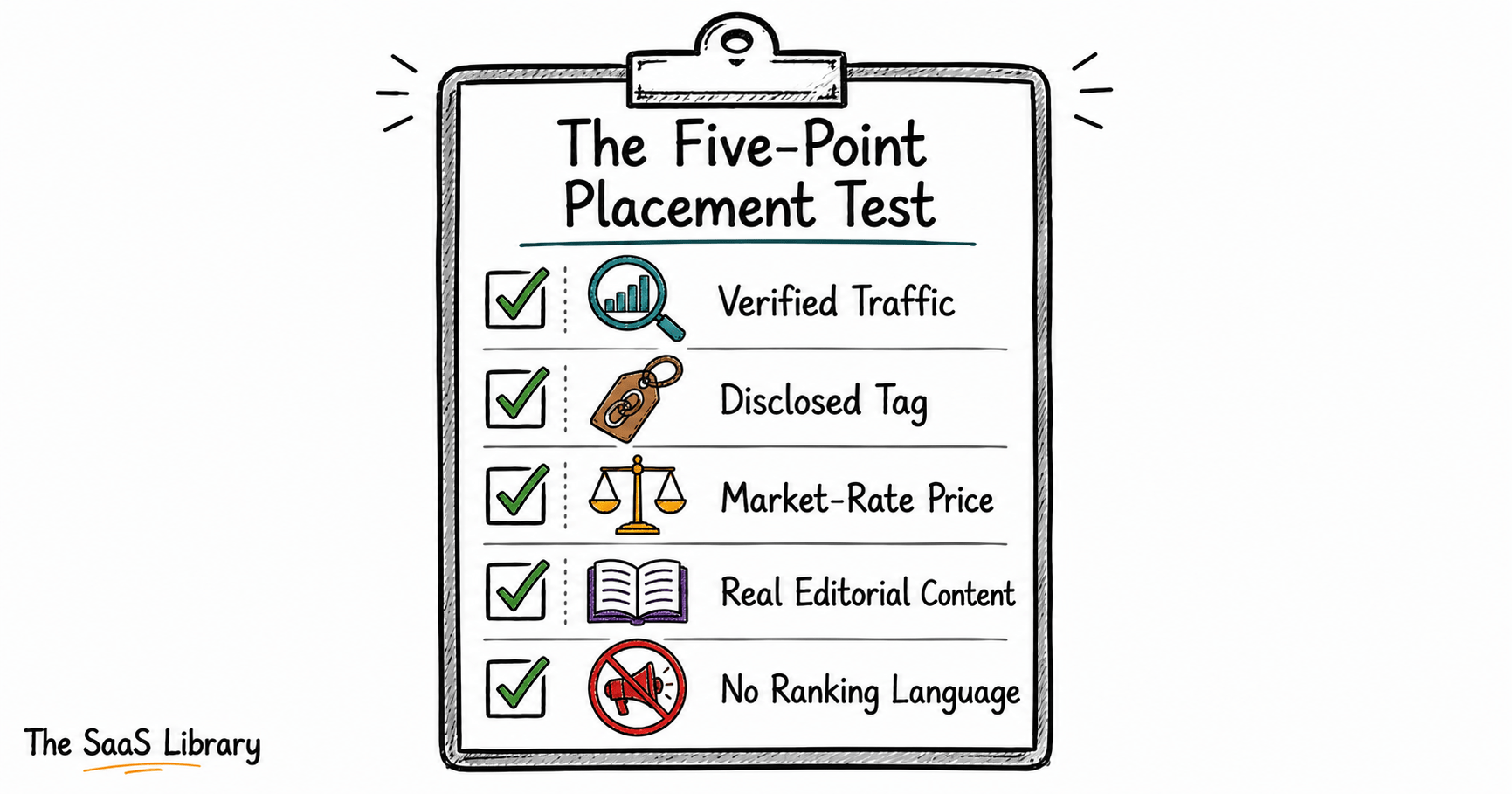
Run all five and the picture clarifies fast. An offer that passes traffic verification, answers the tagging question straight, prices in range, shows real editorial content, and doesn’t lean on ranking language is a reasonable media buy.
An offer that fails two or more of these isn’t a guest post — it’s a link sale wearing a guest post’s clothing. That risk runs both directions — including for the site selling the placement. Related reading: Google Search Console vs. Semrush for verifying site data covers exactly which tools to use for check #1.
What are the red flags of a bad guest-post deal?
The red flags of a bad guest post deal are: guaranteed rankings in the pitch, same-day or 24-hour delivery, prices far below the DR/niche range, refusal to say which tag the link will carry, seller-reported traffic with no way to verify it, and a site that publishes guest content almost exclusively. Any one is worth a pause. Two or more is a clear pass.
The red flags of a bad guest post deal are consistent enough to check in under a minute, once you know what to look for:
- “Guaranteed rankings” or “guaranteed page 1” language. No legitimate publisher can promise this — Google’s own devaluation mechanics mean even a real, well-placed link carries no guaranteed effect.
- Same-day or 24-hour “guest post” delivery. Genuine editorial review takes time. Instant delivery almost always means the content goes up unreviewed on a site built for exactly that speed.
- Price far below the range for the claimed DR and niche. A DR 50 site at $40 isn’t a bargain — it’s a sign the traffic is fabricated or the DR was built through a private link network.
- Vague or evasive answers about the link tag. A seller who won’t commit to sponsored or nofollow — or insists dofollow is “standard practice” — is either uninformed or knowingly selling the exact scheme covered earlier.
- Traffic numbers with no independent way to verify them. A screenshot from the seller’s own dashboard isn’t evidence.
- A site publishing almost nothing but guest content. If nearly every recent article reads like a placement from an unrelated brand, the site’s real business model is selling links, not publishing.
None of these individually proves a scam — a legitimately busy publisher might occasionally quote a fast turnaround, for instance. The signal is in the count.
One flag deserves a direct question before paying. Two or more, especially the guarantee and the tagging evasion together, is close to a certain pass — that combination specifically describes the exact link-scheme pattern Google’s spam policy names outright.
What’s the risk for the website selling the placement, not just the one buying it?
The risk for the website selling the placement is a manual action that strips outbound-link authority sitewide, not just on the offending post. Documented Search Console warnings show Google telling publishers directly: “We have disabled your authority for your outbound links.” Every buyer conversation in this piece has a mirror-image seller conversation, and it’s rarely discussed.
The risk for the website selling the placement is a penalty that hits every link the site has ever given out, not just the one it sold.
Search Engine Journal documented a real Search Console warning sent to a publisher: “We have detected that some of your articles are guest posts… We have disabled your authority for your outbound links. Please set your outbound links to nofollow and submit a review request.” That’s not a warning about one bad link. It’s Google disabling the authority a site’s outbound links carry, across the board, until the publisher fixes the pattern and requests review.
This isn’t an isolated report. The same article cites an SEO consultant describing a separate client who was hit with what he called “an unnatural outbound link penalty” — directly tied to guest posts the site had accepted without vetting. His framing of the risk is blunt: “This is the price you pay when you allow ‘guest posts’ without proper due diligence.”
- The penalty is sitewide, not per-article. A buyer who gets a devalued link loses that one link’s value. A publisher who gets this manual action loses outbound authority across their entire domain until they fix it.
- Recovery requires a review request, not just a fix. Removing or nofollowing the bad links isn’t enough on its own — the site has to formally request Google re-evaluate it, with no guaranteed timeline.
- Reputational cost compounds the ranking cost. Once a site is known for selling unvetted placements, legitimate contributors and advertisers become harder to attract — the exact trust asset that made the site worth paying for in the first place.
Every red flag in the last section protects the buyer. This is the risk that should make a publisher just as cautious about which guest posts they accept — selling a link isn’t free money if it costs the thing that made the site sellable.
So — is guest posting worth it for your website?
Guest posting is worth it for traffic, brand exposure, and relationships — it is not worth it as a ranking or AI-citation strategy, and nearly every guest-post pitch in your inbox is selling the version that doesn’t work. The Five-Point Placement Test tells you which version you’re actually being offered.
Guest posting is worth it, but only for what it can actually deliver — and by now, that list is specific, not vague. Real referral traffic from a relevant audience.
Brand credibility from association with a publication people trust. Relationships that compound over time. All three are genuine, all three are verifiable, and none of them require a dofollow link to happen.
What it isn’t worth is what most pitches are actually selling. Google’s own policy has drawn this line since 2014.
Mueller has called the SEO value of these links zero. SpamBrain neutralizes most of them without anyone ever knowing.
And the newest data point — the AI-citation numbers — closes the last gap the marketing pitches were still leaning on: paid placements aren’t quietly earning you ChatGPT or AI Overview citations either. Earned media is doing that, at 84% to 0.3%.
So the $400 offer from the opening of this piece isn’t a yes-or-no question anymore. It’s the Five-Point Placement Test: real traffic, correct tagging, a price that matches the market, real editorial standards, and a pitch that doesn’t lean on rankings.
Pass all five, and it’s a reasonable media buy — priced and understood correctly. Fail two or more, and it’s the exact scheme Google has spent over a decade telling publishers and buyers not to run.
The clarity this piece set out to provide comes down to one shift: stop asking “is guest posting worth it” and start asking “which guest post is this.” The answer changes completely depending on which one you’re holding.
Frequently Asked Questions
Is guest blogging still relevant in 2026?
Guest blogging is still relevant in 2026 for audience-building and brand exposure. It’s not relevant as a ranking tactic — Google has treated guest posts built purely for links as a policy violation since 2014.
Does Google penalize guest posting?
Google doesn’t penalize the format itself. It penalizes undisclosed paid or guest-post links that pass ranking credit, either through silent algorithmic devaluation (the common outcome) or, in clear large-scale cases, a manual action.
What is a PBN in SEO?
A PBN is a Private Blog Network — a group of websites, often disguised as independent, controlled by one owner specifically to build links to a target site. It’s one of the highest-risk link schemes Google’s spam policy targets.
Does nofollow hurt SEO?
Nofollow does not hurt SEO by itself — a nofollow tag simply excludes a link from passing ranking credit; it doesn’t penalize the linking site or the target page. Mislabeling a genuine editorial link as nofollow when it didn’t need to be wastes potential credit, but it isn’t a penalty.
How much does a guest post cost in 2026?
A guest post typically costs $150–$900 in 2026, averaging around $459, though the real price depends on domain rating, niche, traffic, geography, link type, and buying channel — use the calculator in this article for a range specific to your situation.
Do guest posts help with ChatGPT or AI Overview citations?
Guest posts do not meaningfully help with ChatGPT or AI Overview citations. Paid and advertorial content accounts for just 0.3% of what AI systems actually cite, versus 84% for earned media, per Muck Rack’s analysis of 25 million citations.
What should I ask a publisher before paying for a guest post?
You should ask a publisher directly how the link will be tagged (sponsored or nofollow), verify their traffic independently, and check their price against current market ranges. A publisher who’s vague about tagging is the clearest single red flag.
Is digital PR better than guest posting?
Digital PR is better than guest posting for link-building effectiveness — it’s rated most effective by roughly 48.6% of SEO professionals, more than three times the next-closest tactic, according to Aira and Editorial.Link’s 2026 survey.
What happens if I sell guest post links from my website?
What happens is you risk a manual action that disables your site’s outbound-link authority entirely, not just on the paid post — Google has sent this exact warning to publishers directly, requiring a fix and formal review request to recover.
Is it illegal to buy backlinks?
Buying backlinks is not illegal — it’s a violation of Google’s guidelines, not the law. The consequence is a ranking/policy issue (devaluation or manual action), not a legal one.
What’s the difference between a guest post and a sponsored post?
A guest post is usually framed as editorial contribution; a sponsored post is explicitly paid advertising. Functionally, if money changed hands for either, Google requires the same disclosure — a sponsored or nofollow tag on any resulting link.
Will guest posting still work in the future?
Guest posting will still work for traffic, relationships, and brand exposure — nothing in Google’s policy or the AI-citation data suggests that changing. As a ranking or AI-visibility shortcut, the evidence points the other direction and has for over a decade.
Conclusion
Guest posting isn’t dead — the version built purely for links is. Run any offer through the Five-Point Placement Test in this piece before you pay: verified traffic, a disclosed tag, a market-rate price, real editorial content, and a pitch that doesn’t lean on rankings.
Pass all five, it’s worth it. Fail two or more, walk away.
Try the Guest Post Price Estimator above to check your next offer, or read Is SEO Still Worth It for B2B SaaS in 2026? for the wider picture.
- Google Search Central — Spam Policies for Google Web Search
- Google Search Central Blog — A reminder on qualifying links and our link spam update, 2021
- Google Search Central Blog — Evolving nofollow: new ways to identify the nature of links, 2019
- Google Search Central — Qualify Outbound Links documentation
- Matt Cutts — The decay and fall of guest blogging for SEO, 2014
- Torque Magazine — Matt Cutts on Guest Blogging and SEO, 2014
- Search Engine Journal — Google Penalties on Guest Post Articles, 2020
- Search Engine Roundtable — Semrush Marketplace Selling Links Against Google’s Guidelines, 2020
- Search Engine Land — Semrush Drops Paid Guest Blogging Service After Google Policy Scrutiny, 2020
- Search Engine Roundtable — Google Site Reputation Abuse Policy Expanded, 2024
- Adsy — Link Building Pricing in 2026 (52,671 Websites Analyzed)
- PressWhizz — Guest Post Pricing, 22,703 Real Placements Analyzed, 2026
- BuzzStream — The Cost of Guest Posts, Based on 500k Sites, 2026
- Outreachz — Guest Post Pricing Guide, 2026
- Editorial.Link / Aira — State of Link Building 2026 Survey
- Ahrefs — An Analysis of AI Overview Brand Visibility Factors, 75,000 Brands, 2025
- Muck Rack — Generative Pulse: What Is AI Reading?, May 2026