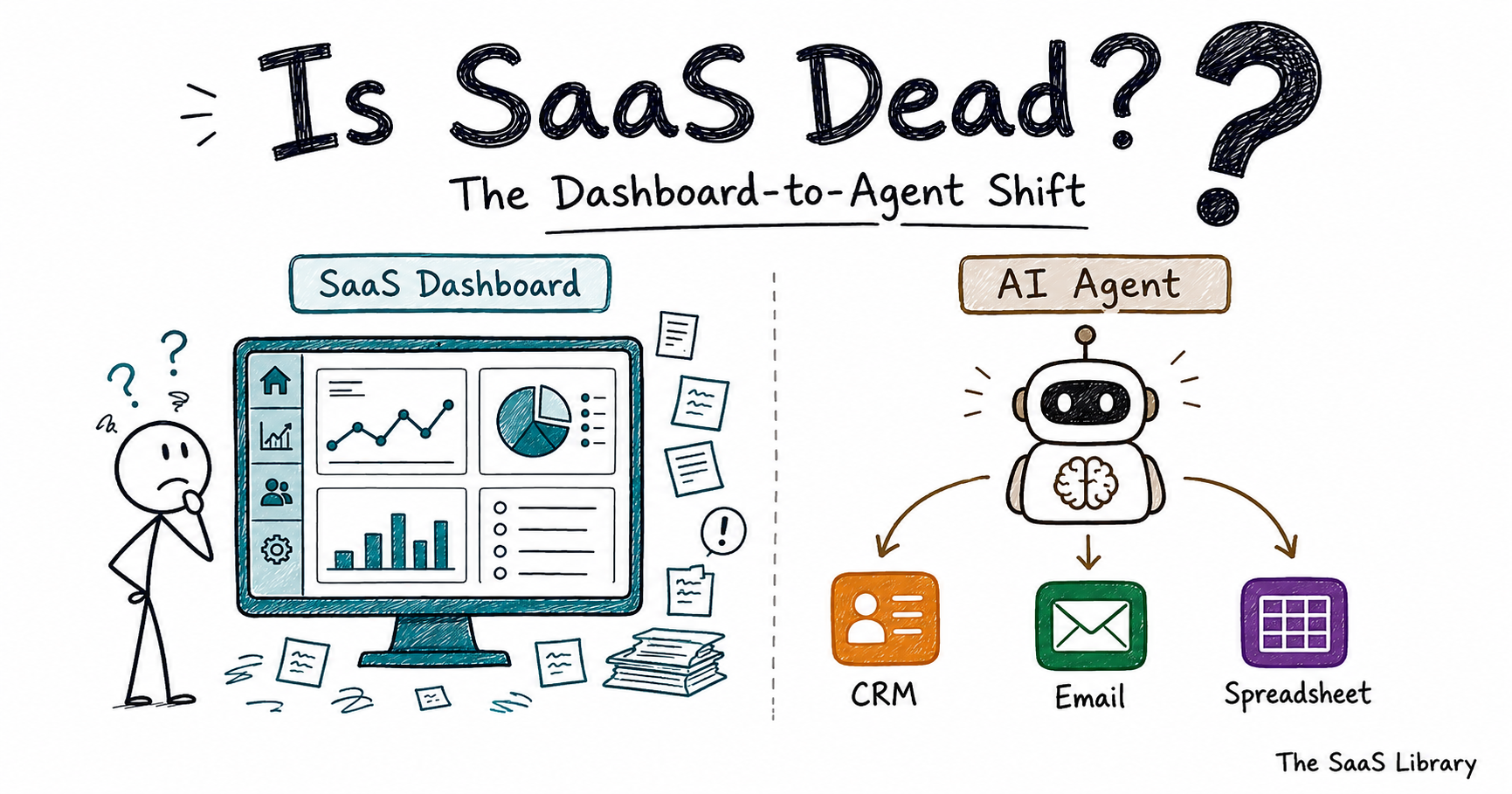
In February 2026, software stocks lost more than a trillion dollars in market value in under a week, triggered by eleven AI plugins. SaaS is not dead — the dashboard it was built around is what’s actually changing.
- SaaS is not dying, but its dashboard-first model is being redistributed toward AI agents.
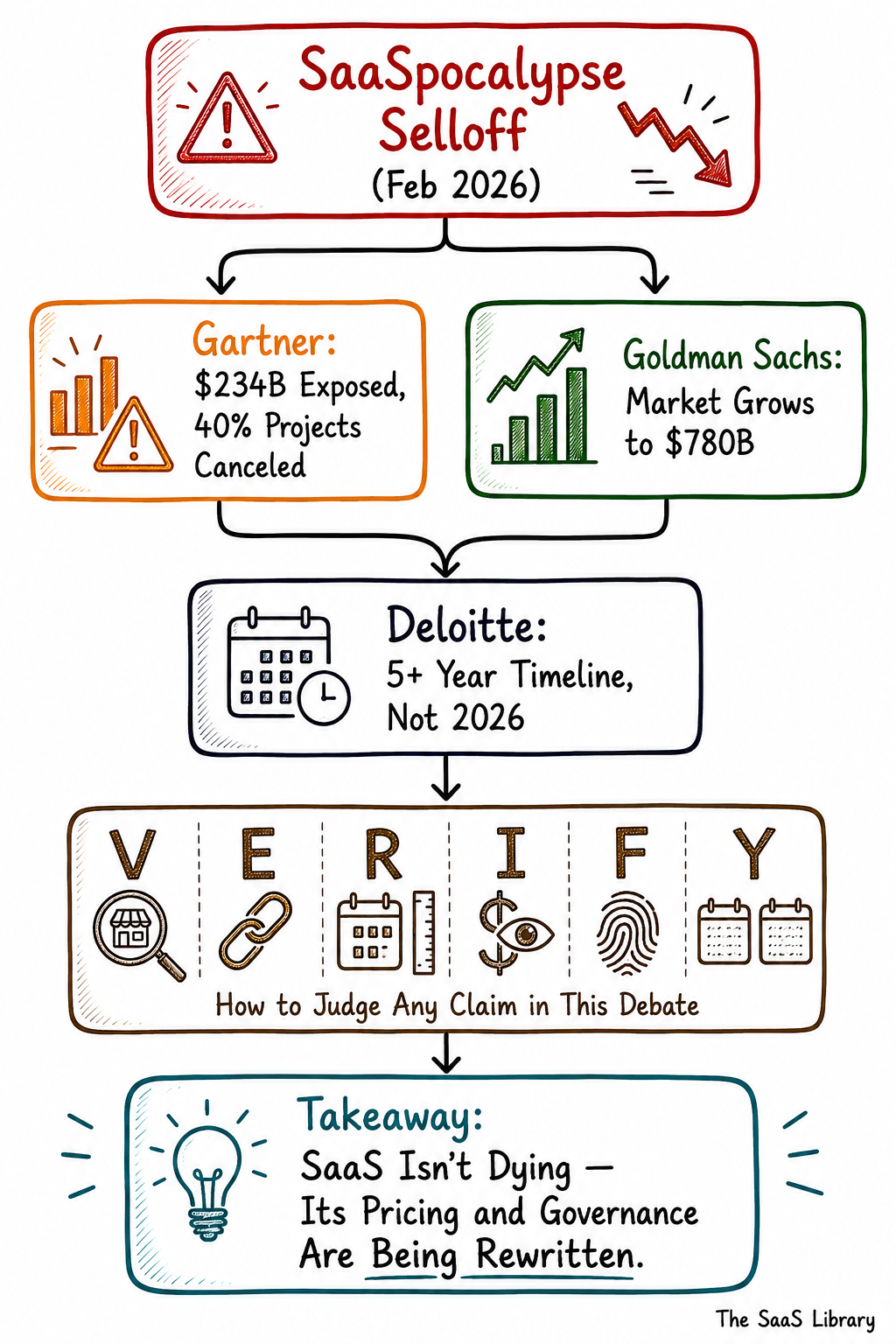
- Gartner estimates $234 billion in enterprise SaaS spending is at risk from agentic AI by 2030 — about 20% of the category.
- The same Gartner research also predicts over 40% of agentic AI projects will be canceled by 2027, complicating the doom narrative.
- Goldman Sachs projects the software market grows at least 20% because of agents, not shrinks.
- Deloitte puts the real transition timeline at five-plus years, not 2026.
- The real risk to SaaS teams is pricing and governance exposure, not sudden extinction.
In February 2026, software stocks lost more than a trillion dollars in market value in under a week, triggered by eleven AI plugins. SaaS is not dead — but the software you run is being redefined by agents that skip its dashboard. Analysts disagree on how far this goes: Gartner sees $234 billion in spending at risk by 2030; Goldman Sachs sees the market growing. This article shows what the dashboard-to-agent shift means for your stack, not your stock price.
SaaS is not dead, but its dashboard-first model is being displaced. Enterprise AI agents now complete tasks across systems without a human opening the SaaS interface itself, which Gartner estimates puts $234 billion of enterprise application spending at risk by 2030. The market is not shrinking — it’s redistributing toward agent-native platforms and usage-based pricing.
What Is the Dashboard-to-Agent Shift?
The dashboard-to-agent shift is a structural change in how enterprise software gets used, not a new dashboard feature. For years, a person opened a SaaS product, read a dashboard, and made a decision. Now an AI agent completes the task itself — pulling data, taking the action, closing the loop — without a human ever opening that interface.
The dashboard-to-agent shift is the move from humans operating SaaS dashboards to AI agents completing tasks across systems directly, without opening the interface. It’s distinct from “dashboard agents,” which are AI features inside an analytics tool a human still uses. The shift changes who — or what — a software product is actually built for.
This is not the same thing as a “dashboard agent,” a term that already exists for AI assistants embedded inside analytics tools like Amplitude or Knowi. Those are features bolted onto an interface a human still opens. The shift TSL is describing is bigger: it’s what happens when the interface itself stops being where the work gets done.
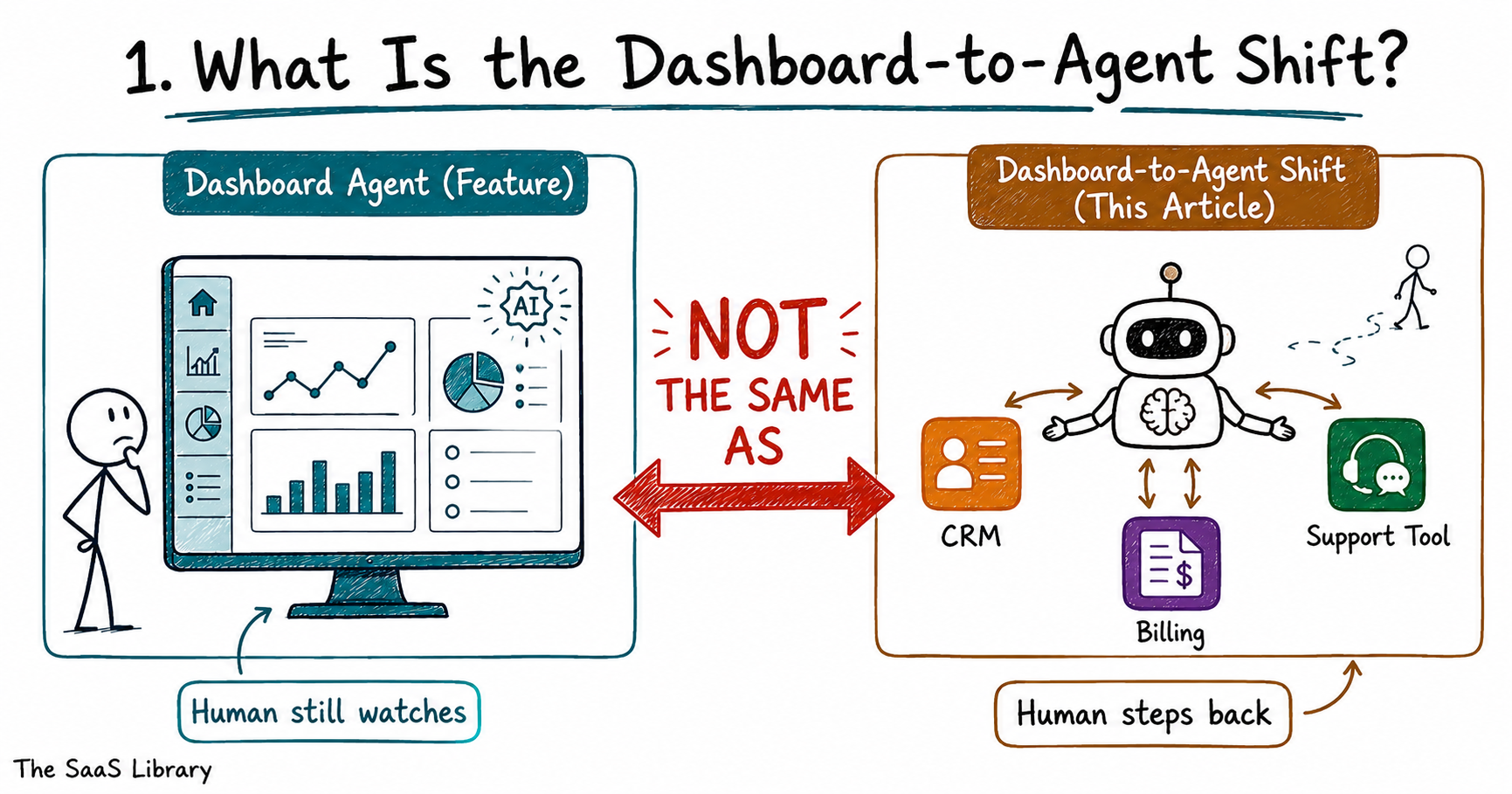
Gartner calls this “agentic arbitrage” — a phenomenon in which AI agents complete tasks across multiple systems, reducing the need for users to interact with multiple traditional software interfaces. George Brocklehurst, Managing VP Analyst at Gartner, put it directly via a recent interview: software is no longer being bought primarily for people, and the user interface is no longer a source of differentiation when agents are increasingly the primary users of software.
So what does that mean for the SaaS you already run? It means the product doesn’t have to disappear. But if agents are the ones using it, the thing you were charging for — seats, logins, dashboard time — stops mapping to how the software creates value.
What Triggered the Current “Is SaaS Dead” Debate?
The current wave of “is SaaS dead” conversation traces to a specific week, not a slow trend. On January 30, 2026, Anthropic released eleven open-source Claude Cowork plugins, extending an agent framework across common enterprise workflows. Within days, software stocks started selling off.
The current debate was triggered by Anthropic’s January 30, 2026 release of eleven open-source Claude Cowork plugins, which sparked a software stock selloff nicknamed “SaaSpocalypse.” Software stocks lost close to $1 trillion in market value within a week, even though no major SaaS company reported an earnings collapse — the market repriced expectations, not results.
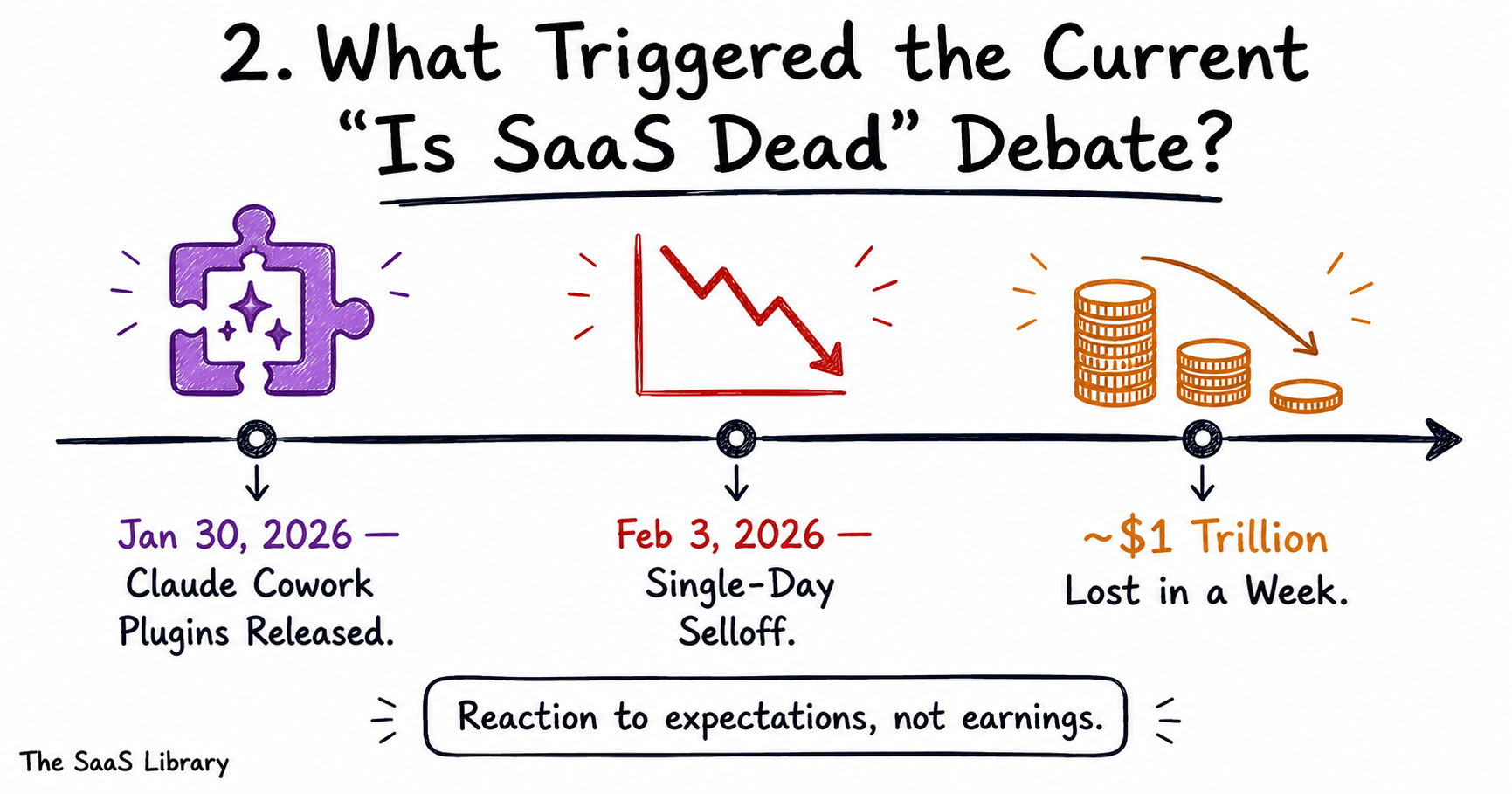
By February 3, roughly $285 billion in market capitalization had been erased in a single trading day, expanding to close to $1 trillion within a week. Jeffrey Favuzza, an equity trading strategist at Jefferies, coined the term “SaaSpocalypse” to describe the mood on trading floors, calling it “very much ‘get me out'” style selling. The Software ETF (IGV) fell roughly 20% while the broader S&P 500 stayed flat over the same window — a gap that told investors this wasn’t a market-wide correction. It was specific to software.
So what actually happened to justify a trillion-dollar reaction? Less than it looked like. No SaaS company reported an earnings collapse that week. What moved was expectation — investors repricing the entire category on the belief that agent-native tools could now do what per-seat software charged for. That distinction matters for the rest of this article: the panic was fast, but the underlying disruption is not instant. It plays out over years, not trading sessions.
Skeptical of the noise around AI and SaaS? You’re not alone.
Read the Buyer Trust Gap →How Much Enterprise SaaS Spending Is Actually at Risk from AI Agents?
Enterprise SaaS spending is exposed to up to $234 billion in agentic AI risk between now and 2030, according to Gartner’s July 1, 2026 research — roughly 20% of enterprise application SaaS spending.
Enterprise SaaS spending is exposed to up to $234 billion in agentic AI risk by 2030, according to Gartner — about 20% of enterprise application spending. Total software spending still grows roughly 12% annually through the same period, meaning the money is redistributing within the category, not leaving it.
The mechanism is what Gartner calls agentic arbitrage — agents completing tasks across systems that used to require separate, individually licensed tools. Brocklehurst frames the effect as concentration, not disappearance: legacy SaaS market share gets cannibalized both by incumbents rebuilding around agents and by new entrants delivering horizontal agentic platforms.
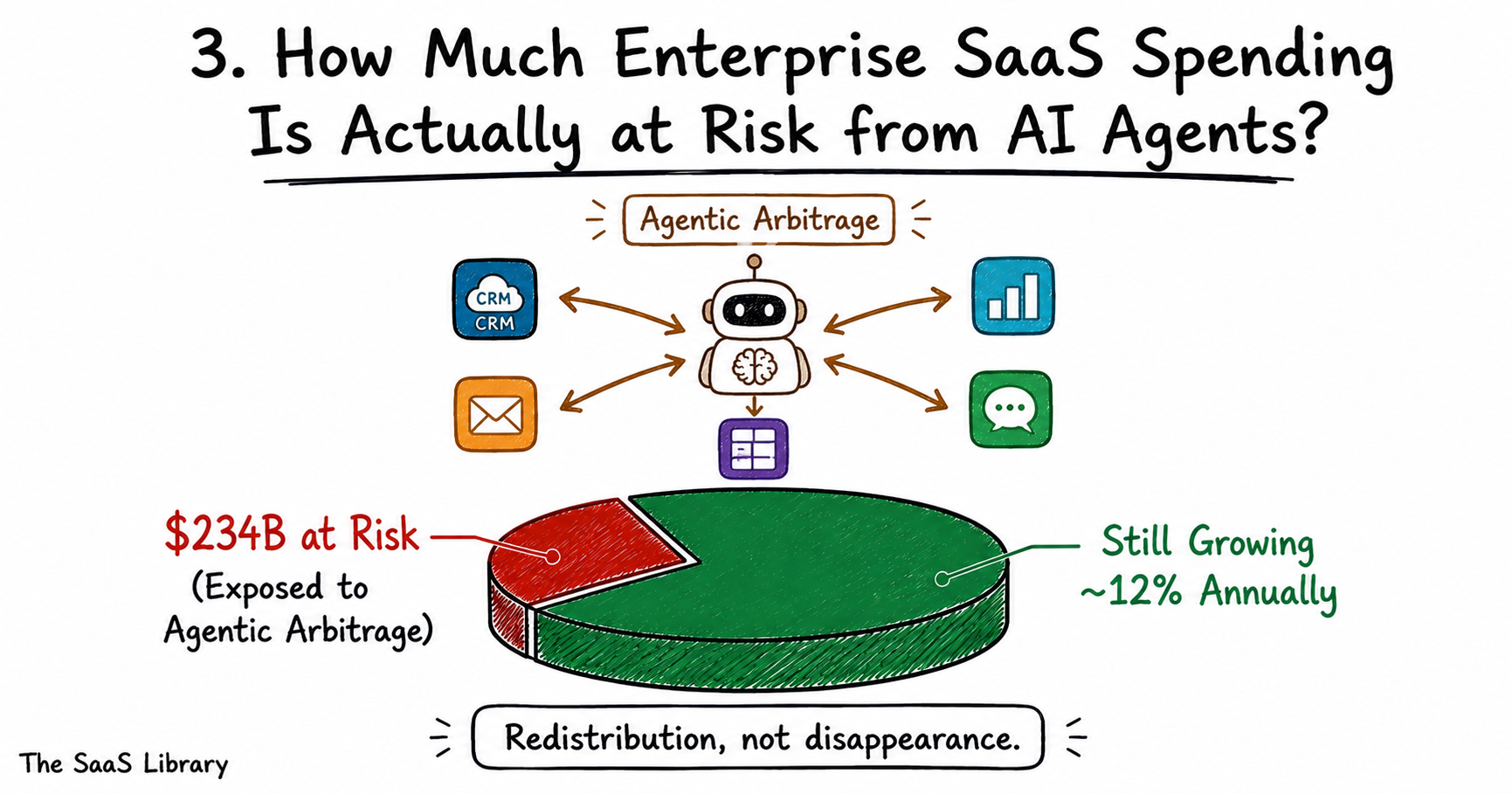
But “at risk” and “gone” are different words for a reason. Gartner’s own report pairs the $234 billion exposure with a growth number: total software spending still grows at roughly 12% annually through 2030, even as budgets redirect. The money isn’t leaving the software category. It’s moving inside it — away from per-seat dashboard licenses and toward whatever captures the agent layer instead.
Roughly 70% of agents currently on the market are “agent-washing” — existing products relabeled rather than genuinely rebuilt (George Brocklehurst, Gartner, 2026).
There’s a credibility wrinkle worth naming directly. That means a meaningful share of the $234 billion figure is competing against products that aren’t actually delivering agentic capability yet, which changes how fast this exposure can realistically convert into lost revenue for incumbents.
Does Gartner’s Own Data Contradict the SaaS-Is-Dead Narrative?
Gartner’s own data contradicts the strongest version of the SaaS-is-dead narrative, and it comes from the same research house making the $234 billion exposure claim. In a separate June 2025 report, Gartner predicted that over 40% of agentic AI projects will be canceled by the end of 2027, citing escalating costs, unclear business value, and inadequate risk controls.
Gartner’s own data complicates the SaaS-is-dead narrative rather than confirming it outright. The same firm predicting $234 billion in exposed spending also forecasts that over 40% of agentic AI projects will be canceled by 2027, with roughly 70% of current agent products being relabeled existing tools rather than genuine rebuilds.
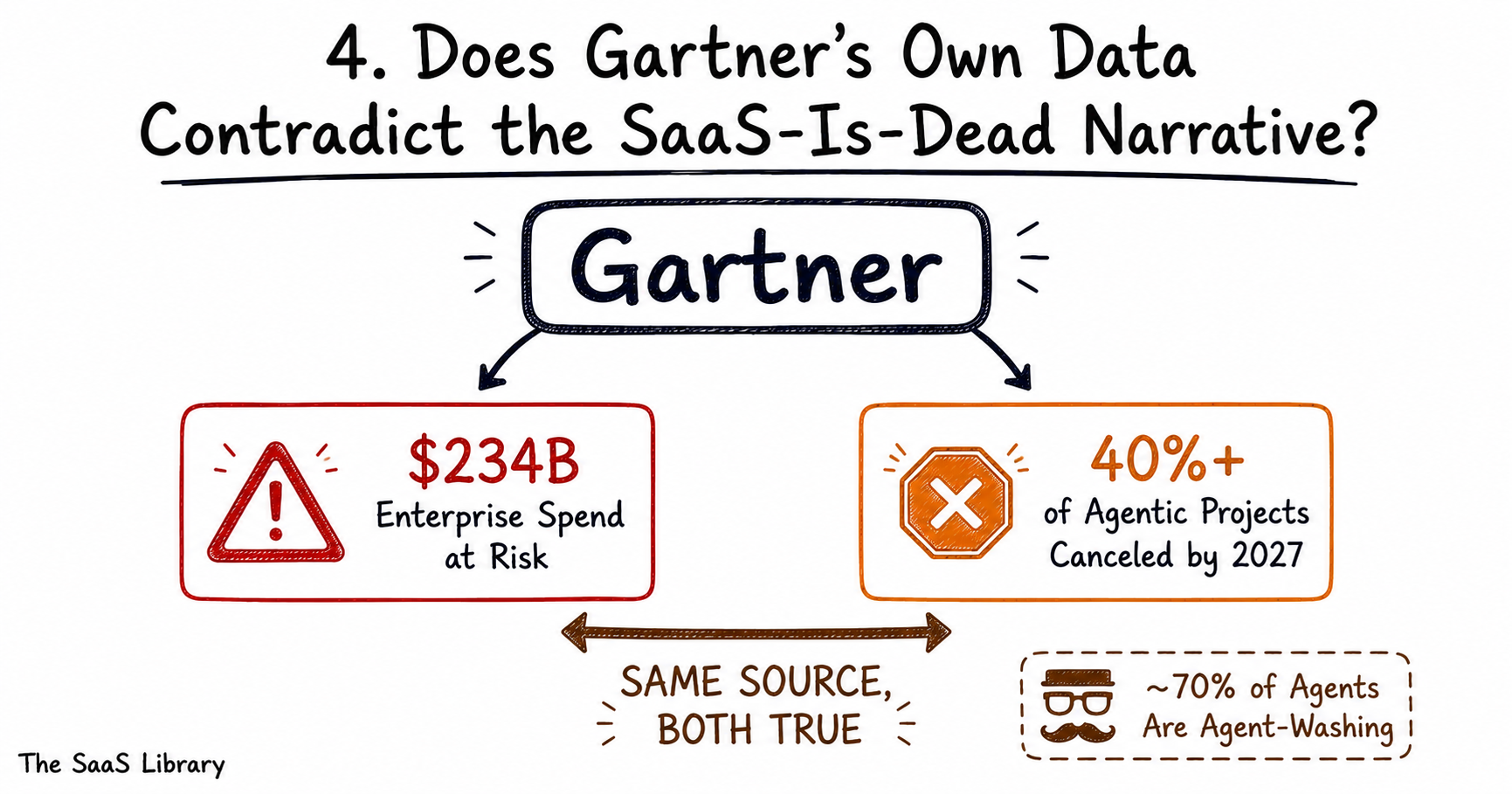
That is not a minor caveat. It means the firm most cited as evidence that agents are displacing SaaS also expects nearly half of current agentic AI initiatives to fail outright within roughly eighteen months of that prediction. The same report puts a floor under how fast this moves: 33% of enterprise software applications will include agentic AI by 2028, up from less than 1% in 2024 — real growth, but on a multi-year runway, not a 2026 event.
Layer in the agent-washing estimate from the previous section — roughly 70% of agents on the market today are relabeled existing products, not genuine rebuilds — and a pattern emerges. Gartner is describing two different things at once: a real structural shift in where value accrues, and a hype cycle riding on top of it that the firm expects to partially collapse.
So what should a reader do with two numbers from one source pointing in opposite directions? Treat them as compatible, not contradictory. My read: displacement and failure can both be true simultaneously — most agentic initiatives failing does not mean the shift itself is fake, any more than most dot-com startups failing in 2001 meant the internet wasn’t real.
Will AI Agents Shrink the Software Market or Grow It?
AI agents grow the software market rather than shrink it, according to Goldman Sachs Research — the sharpest counterpoint to the exposure numbers in the sections above. Gabriela Borges, an analyst at Goldman Sachs, estimates the total software market expands by at least 20% because of agents, with application software reaching roughly $780 billion by 2030 at a 13% compound annual growth rate.
AI agents grow the software market rather than shrink it, according to Goldman Sachs Research, which estimates at least 20% total market expansion and application software reaching roughly $780 billion by 2030. Agents may represent over 60% of that market — a growth number, not the same thing as Gartner’s redistribution-focused exposure estimate.
That expansion isn’t evenly spread. Customer service software specifically grows an additional 20–45% by 2030 compared to a no-AI scenario, because agents increase the volume of work software can be applied to, not just the efficiency of existing work.
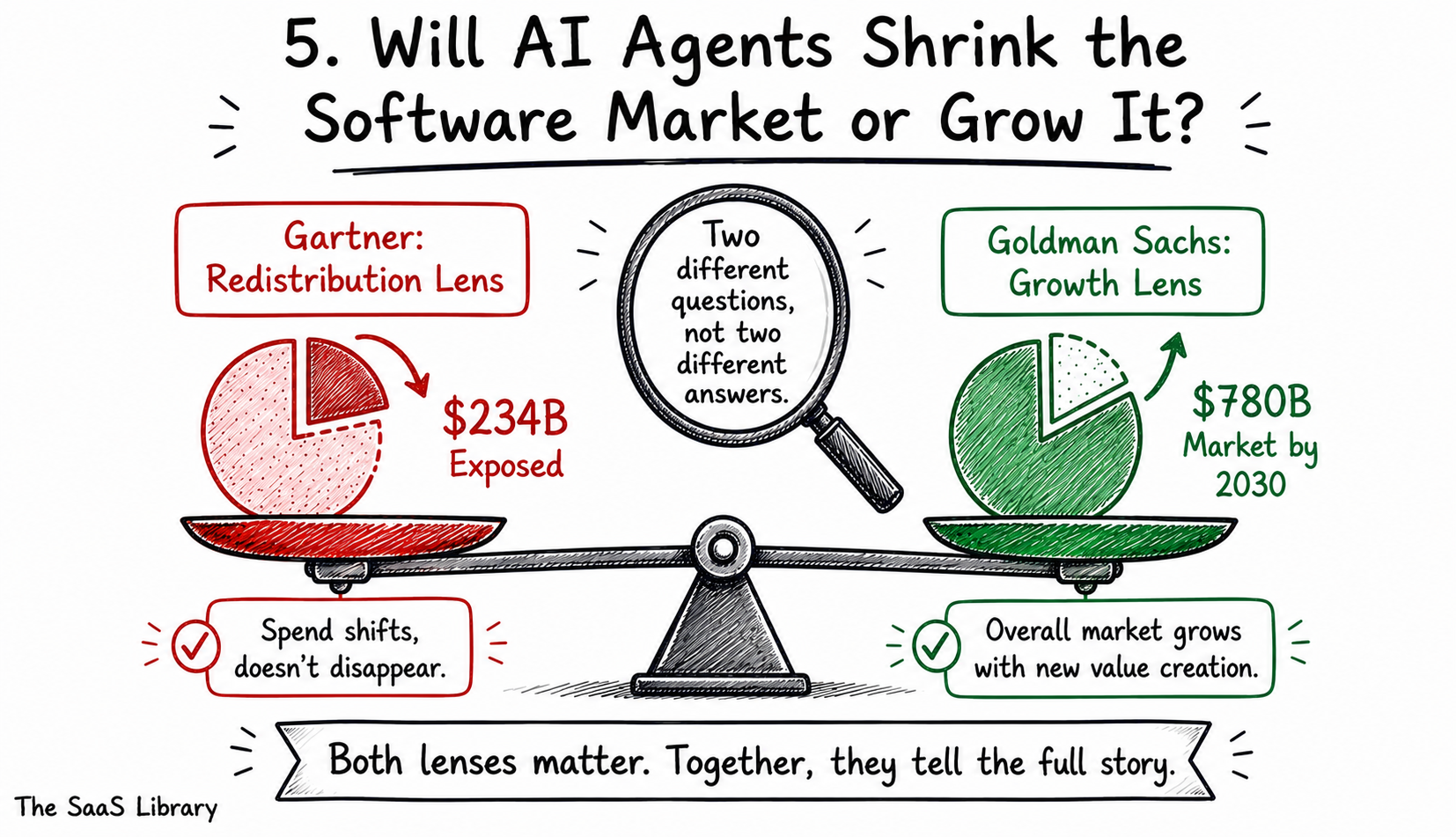
Here’s the number that reframes everything in this article so far: Goldman estimates agents may account for more than 60% of the software market by 2030. Read quickly, that sounds like Gartner’s $234 billion exposure figure repeated in different language. It isn’t. Gartner is measuring what share of existing spending moves. Goldman is measuring what share of a larger market agents will represent.
So which forecast should a B2B SaaS operator trust — the one predicting exposure or the one predicting expansion? Neither in isolation. The honest read is that both firms agree agents change who buys software and why, and disagree only on whether the pie shrinks while it redistributes.
How Long Will the Dashboard-to-Agent Transition Actually Take?
The dashboard-to-agent transition will likely take at least five years, according to Deloitte’s TMT Predictions 2026 — not the 2026 timeline the SaaSpocalypse headlines implied. Deloitte’s own framing is direct: full replacement of enterprise applications by agents “won’t be in 2026,” with the current year better understood as experimentation and slow restructuring rather than displacement.
The dashboard-to-agent transition will likely take at least five years, per Deloitte’s TMT Predictions 2026, with 2026 itself representing early experimentation rather than displacement. Deloitte cites Gartner-licensed research projecting 35% of point-product SaaS tools replaced or absorbed by 2030, and 40% of enterprise SaaS spend shifting to usage- or outcome-based pricing by the same year.
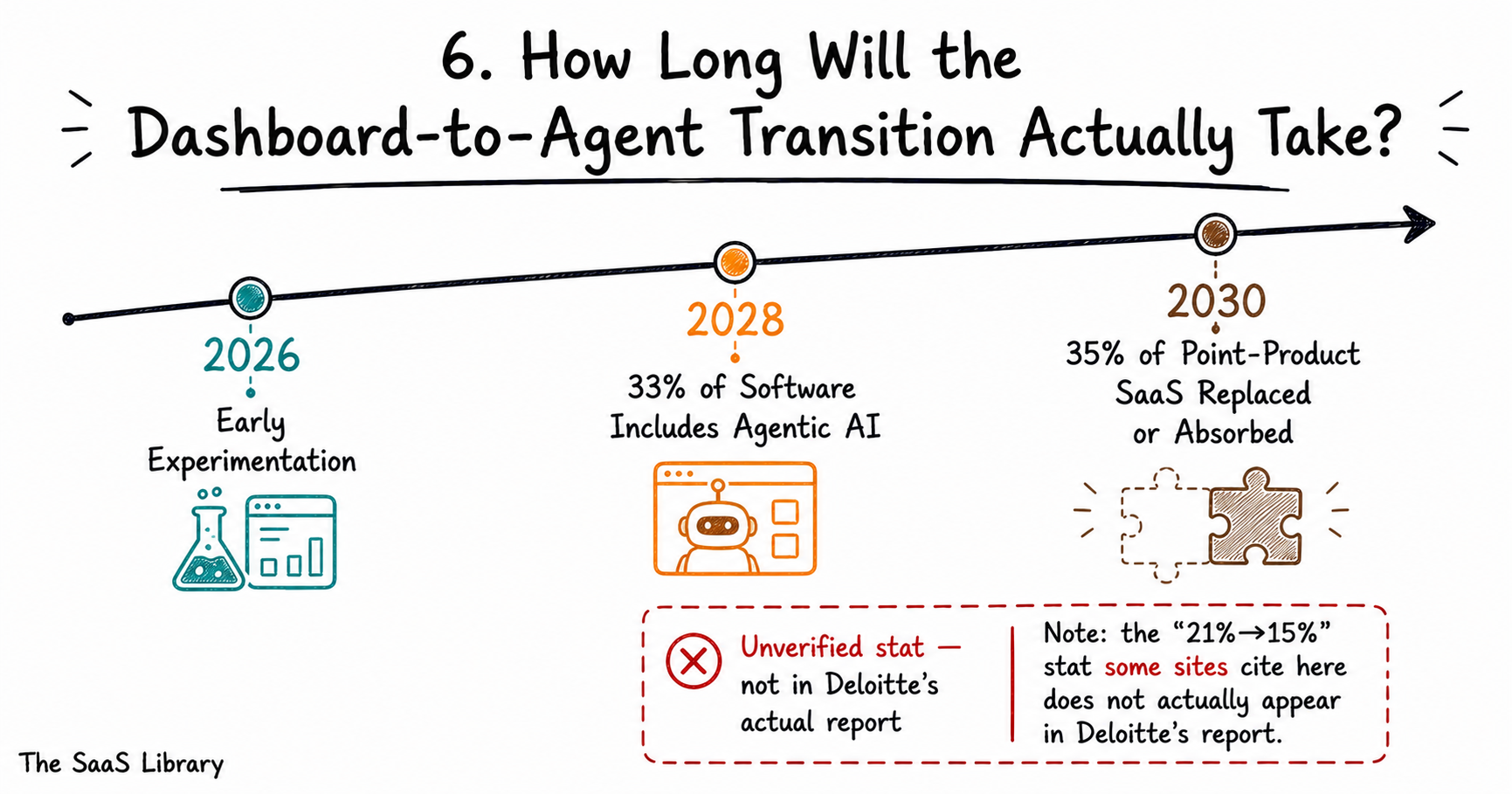
Deloitte cites Gartner-licensed research to put numbers against that timeline: by 2030, 35% of point-product SaaS tools will be replaced by AI agents or absorbed into larger agent ecosystems, and 40% of enterprise SaaS spend will shift toward usage-, agent-, or outcome-based pricing models.
A widely circulated stat claiming seat-based revenue share falls from 21% to 15% does not actually appear anywhere in Deloitte’s published TMT 2026 report. That specific number traces to no verifiable primary source at all, despite showing up attributed to both Deloitte and a firm called “Pilot” across secondary sites — a useful early example of exactly the kind of unverified claim this article’s framework is built to catch.
So what does a five-year runway mean for a SaaS operator reading this in July 2026? It means the strategic question isn’t “will my product survive the year” — it almost certainly will. It’s whether your pricing and packaging will still make sense in three to five years, which is a planning problem, not a crisis.
Is This Actually Different From Past “SaaS Is Dead” Predictions?
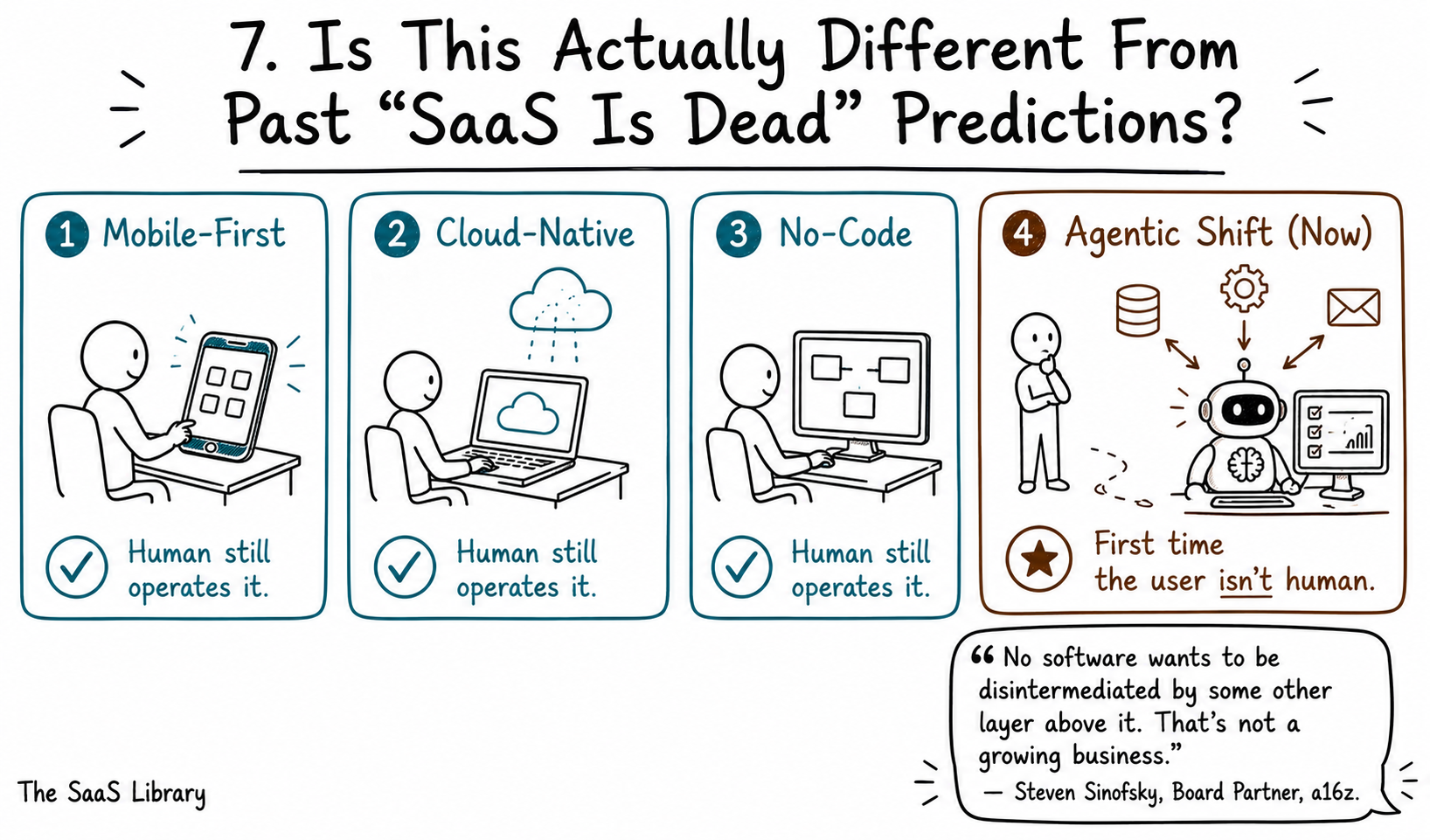
This is different from past “SaaS is dead” predictions in one specific way: the disruption is coming from a change in who uses software, not a change in how software is delivered. Mobile-first didn’t kill SaaS. Cloud-native didn’t kill SaaS. No-code didn’t kill SaaS. Each shifted the delivery layer while a human was still the one opening the product and making the decision. Agents are the first shift where that assumption itself breaks.
This is different because past shifts — mobile-first, cloud-native, no-code — changed how software was delivered while a human still operated it directly. The current shift is the first where AI agents themselves become the primary user, which is why skeptics like a16z’s Steven Sinofsky argue incumbents will absorb the agent layer rather than be displaced by it.
That said, the strongest skeptical case doesn’t come from history repeating — it comes from how software categories actually behave when threatened.
Sinofsky argued that incumbents have every incentive to absorb the agent layer themselves rather than let it sit on top of them and starve their access to the customer. That argument has precedent working in its favor. Middleware, browsers, and app stores have all tried to sit as a control layer above existing software, and the underlying products usually respond by integrating the very thing threatening them rather than dying beneath it. The evidence suggests ServiceNow is following that same playbook now — building agentic capability directly into its platform rather than ceding the layer to a new entrant.
So does that mean the whole “dashboard-to-agent shift” thesis collapses under historical precedent? Not quite. The precedent shows incumbents adapt — it doesn’t show the category is safe from restructuring while they do it. Sinofsky’s argument is a reason to doubt total displacement, not a reason to doubt that anything is changing at all.
What Is the VERIFY Framework?
The dashboard-to-agent debate produces more unverified statistics than verified ones, which is why this article uses a six-part framework — VERIFY — to sort real signal from narrative noise in any “AI is killing X” claim.
The VERIFY framework is a six-part check — Vendor or independent, Evidence traced, Range over time, Incentive, Figure lineage, Year-matched — for evaluating whether a claim about AI disrupting SaaS is well-sourced or narrative noise repeating itself. It applies to any statistic in the dashboard-to-agent debate, including the ones in this article.
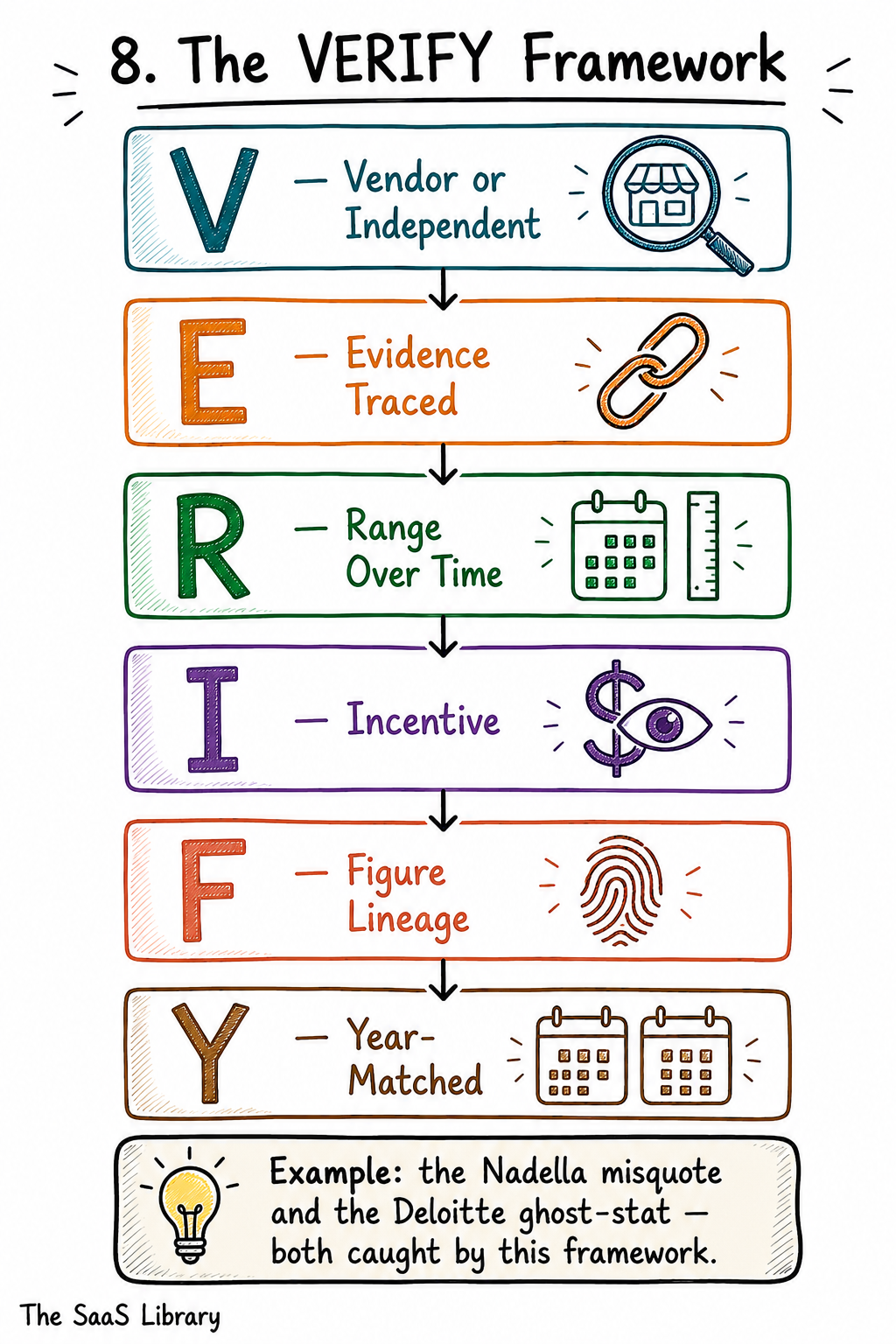
Run any claim in this debate — Gartner’s, Goldman’s, a LinkedIn post’s — through these six checks before deciding how much weight it deserves. This article’s own cancellation-versus-exposure figures earlier are the clearest case in point: same organization, two reports, both true, neither one the whole story on its own.
This article is itself a working example. Every Gartner, Goldman, and Deloitte figure above was checked against VERIFY before publication — the same process that caught the Nadella misquote and the Deloitte ghost-stat before either made it into this piece as fact instead of correction.
What Should B2B SaaS Teams Actually Do Right Now?
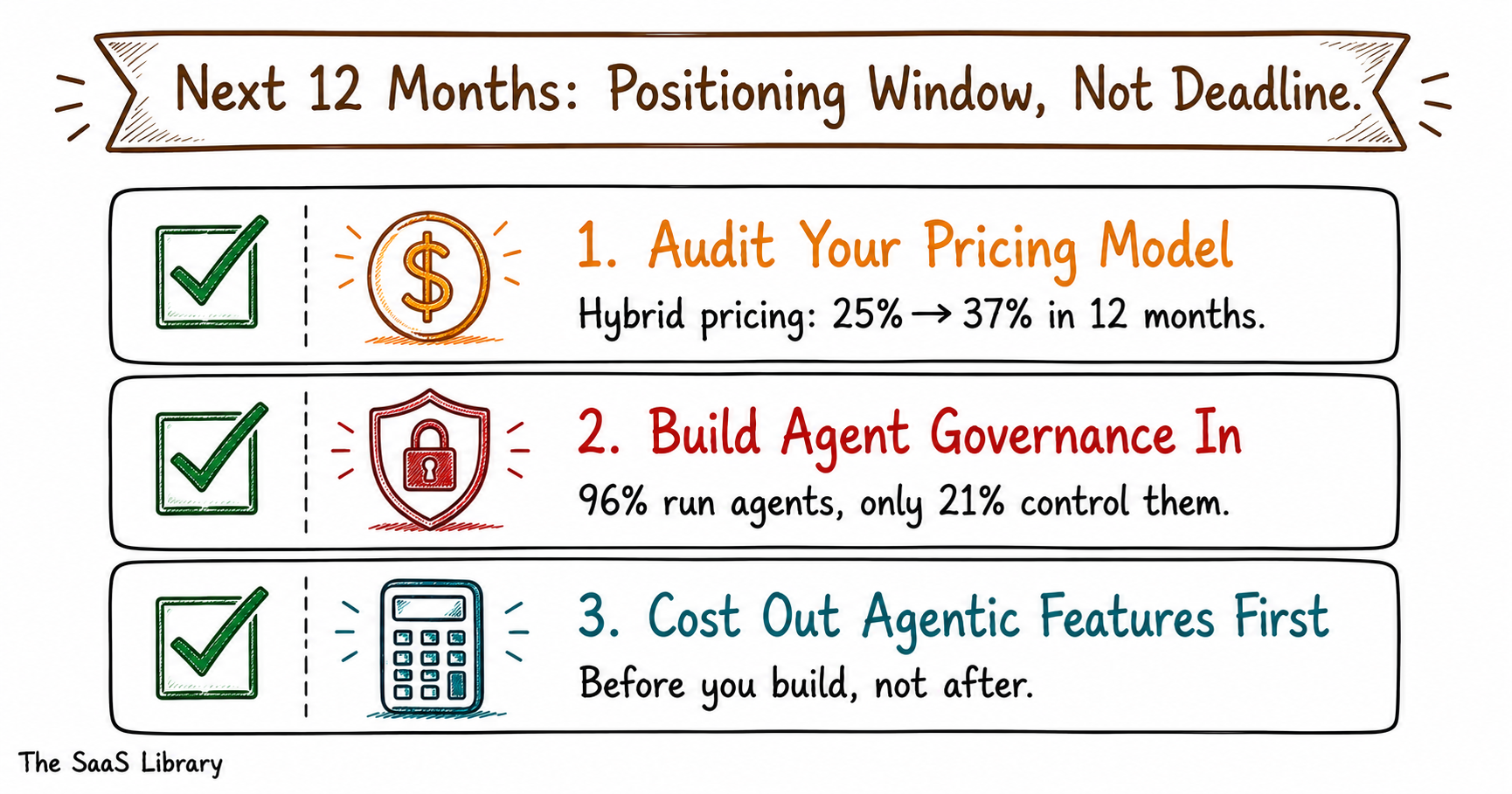
B2B SaaS teams should treat the next twelve months as a positioning window, not a survival deadline. Deloitte’s five-year timeline and Gartner’s 2030 exposure horizon both point the same direction: there’s time to act deliberately, but the teams that wait for certainty will be repricing under pressure instead of by design.
B2B SaaS teams should audit their pricing model for per-seat exposure, treat agent governance as a product requirement rather than an IT afterthought, and cost out agentic features before building them — using the next twelve months as a positioning window rather than waiting for certainty that won’t arrive before 2030.
Three moves matter more than the rest. First, audit your own pricing model against the shift already underway. Hybrid pricing — usage or outcome components layered onto or replacing pure per-seat billing — grew from 25% to 37% adoption among software companies in just twelve months, according to Kyle Poyar’s 2026 State of B2B Monetization survey of 230+ companies. TSL’s own reporting on the death of per-seat pricing found teams as exposed by their billing model as by their product. If you’re still charging strictly per login, that’s the first thing agentic buyers will route around, regardless of how good your product is.
Second, treat agent governance as a product requirement, not an IT afterthought — TSL’s earlier reporting found that 96% of companies now run AI agents in some form, but only 21% can actually control them, and buyers evaluating your platform are increasingly asking whether you can be trusted to sit inside an agent workflow safely.
Third, before committing engineering time to bolt on agentic features, run the actual cost math — a framework TSL has published previously for estimating what agentic AI actually costs before you build applies directly here, since a rebuilt product that burns margin faster than it captures new usage-based revenue solves the wrong problem.
The teams most exposed aren’t the ones with an outdated dashboard. They’re the ones who haven’t decided yet whether their product is meant to be used by a person or operated by an agent — and are trying to serve both without changing anything about how they charge, govern, or build for either one.
Frequently Asked Questions
Is SaaS dead in 2026?
SaaS is not dead in 2026. Enterprise SaaS spending is being redistributed toward agentic platforms and usage-based pricing rather than eliminated, with Gartner estimating $234 billion at risk through 2030 while total software spending still grows roughly 12% annually over the same period.
What does the dashboard-to-agent shift mean?
The dashboard-to-agent shift means AI agents complete software tasks directly across systems, without a human opening the traditional dashboard interface. It changes who a software product is built for — a person or an agent — rather than changing the product’s delivery method.
What caused the SaaSpocalypse stock selloff?
The SaaSpocalypse selloff was triggered by Anthropic’s January 30, 2026 release of eleven open-source Claude Cowork plugins, which led investors to reprice software stocks on the expectation that agent-native tools could replace per-seat SaaS products, erasing close to $1 trillion in market value within a week.
How much SaaS spending is at risk from AI agents?
Up to $234 billion in enterprise application spending is at risk from agentic AI by 2030, according to Gartner — roughly 20% of enterprise application SaaS spending, with the remainder continuing to grow at approximately 12% annually.
Did Satya Nadella really say SaaS is dead?
Satya Nadella did not say “SaaS is dead.” On the BG2 podcast in December 2024, he said business applications built as CRUD databases with business logic “will probably collapse in the agent era” — a more specific claim than the three-word phrase widely attributed to him since.
Will AI agents make the software market bigger or smaller?
AI agents are projected to make the software market bigger, not smaller, according to Goldman Sachs Research, which estimates at least 20% total market expansion and application software reaching roughly $780 billion by 2030 even as agents represent a growing share of that larger market.
How long will it take for AI agents to replace SaaS dashboards?
AI agents are expected to take at least five years to meaningfully replace SaaS dashboards, according to Deloitte’s TMT Predictions 2026, with 2026 representing early experimentation rather than displacement and full effects unfolding closer to 2030.
Is per-seat pricing going away because of AI agents?
Per-seat pricing is eroding rather than disappearing outright — hybrid pricing models grew from 25% to 37% adoption among software companies in twelve months, according to Kyle Poyar’s 2026 State of B2B Monetization survey, as agent-based usage stops mapping cleanly to per-login billing.
What is the VERIFY framework?
The VERIFY framework is a six-part check — Vendor or independent, Evidence traced, Range over time, Incentive, Figure lineage, Year-matched — used to evaluate whether a claim about AI disrupting SaaS is well-sourced or an unverified narrative repeating itself.
What should B2B SaaS companies do about AI agents replacing dashboards?
B2B SaaS companies should audit their pricing model for per-seat exposure, build agent governance into the product rather than treating it as an IT afterthought, and cost out agentic features before committing engineering time, using the next twelve months as a planning window rather than a survival deadline.
Is agentic arbitrage the same thing as SaaS dying?
Agentic arbitrage is not the same thing as SaaS dying — it describes AI agents completing tasks across multiple systems, reducing reliance on individual SaaS interfaces, which redistributes value within the software market rather than eliminating the category.
Conclusion
SaaS is not dead — the VERIFY framework exists because the loudest claims in this debate rarely survive being traced to their source. Gartner sees exposure, Goldman sees expansion, and Deloitte sees years, not months. What’s actually changing is who uses software and how it gets priced, not whether the category survives.
The next twelve months reward SaaS teams that audit their own pricing and governance now, before the shift forces the decision. Before you repeat the next “AI is killing SaaS” statistic you read, run it through VERIFY first.
- Forbes — SaaSpocalypse Now: AI Is Disrupting SaaS, But Not All Software Is Doomed (Feb 2026)
- Gartner — $234 Billion in Enterprise Application Software Spend Is at Risk From Agentic AI (July 2026)
- Gartner — Over 40% of Agentic AI Projects Will Be Canceled by End of 2027 (June 2025)
- Channel Dive — Gartner Analyst George Brocklehurst on Agentic Arbitrage and Agent-Washing (2026)
- Goldman Sachs Research — Gabriela Borges, AI Agents to Boost Productivity and Size of Software Market (2025)
- Deloitte — TMT Predictions 2026, SaaS and AI Agents Chapter
- Cloud Wars — Verbatim Satya Nadella BG2 Podcast Transcript (Dec 2024)
- Steven Sinofsky, Seema Amble, Elena Burger — Software in the Age of Agents, The a16z Show (2026)
- Kyle Poyar — The 2026 State of B2B SaaS and AI Monetization Report, Growth Unhinged (May 2026)
- The SaaS Library — 96% of Companies Are Running AI Agents. Only 21% Can Control Them.