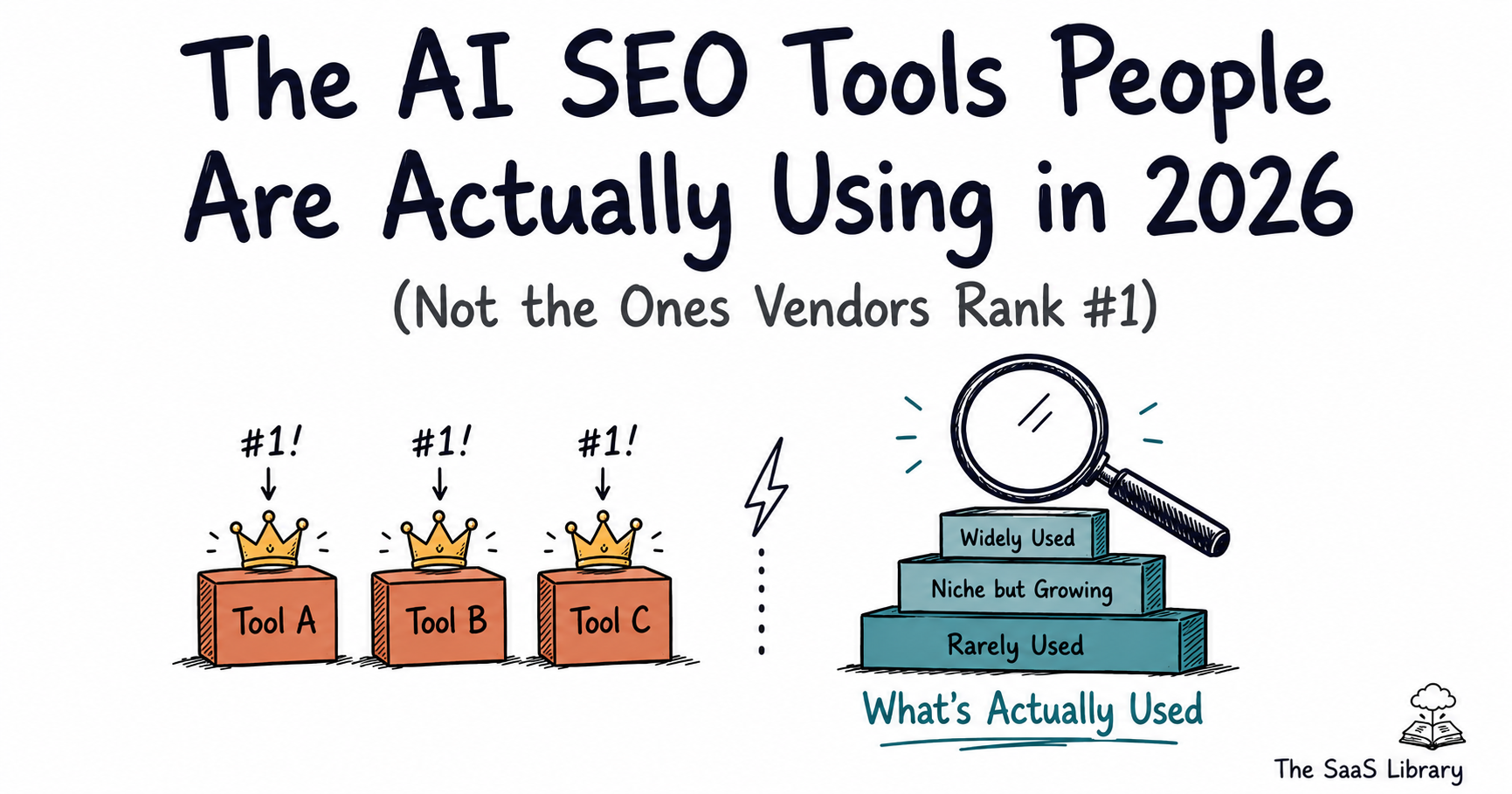
Half the “best AI SEO tools 2026” lists ranking right now were written by the tools reviewing themselves. This guide isn’t one of them.
What AI SEO Tools Are People Actually Using in 2026?
People are actually using a narrower set of tools than vendor rankings suggest — Ahrefs and Semrush for existing SEO workflows with bolted-on AI-visibility add-ons, and Peec AI or Otterly.ai for dedicated AI-citation tracking at accessible prices. Profound leads at the enterprise tier. Many practitioners still rely on manual prompt-checking over any paid tool.
The AI SEO tools 2026 market has a dirty secret: half the “best of” lists ranking it were written by the tools themselves. Ryze AI crowns itself #1 in its own roundup. So does LatticeOcean. Rankability calls itself “the only AI SEO tool I use every day” — on its own blog. This guide skips the self-crowning and covers what’s actually available, what practitioners are really buying, and why the two lists don’t match.
What follows is organized around that gap: the terminology, the market’s short history, the full category map, and — most importantly — the difference between what gets funded and what gets used.
What Do “AI SEO,” “GEO,” and “AEO” Actually Mean?
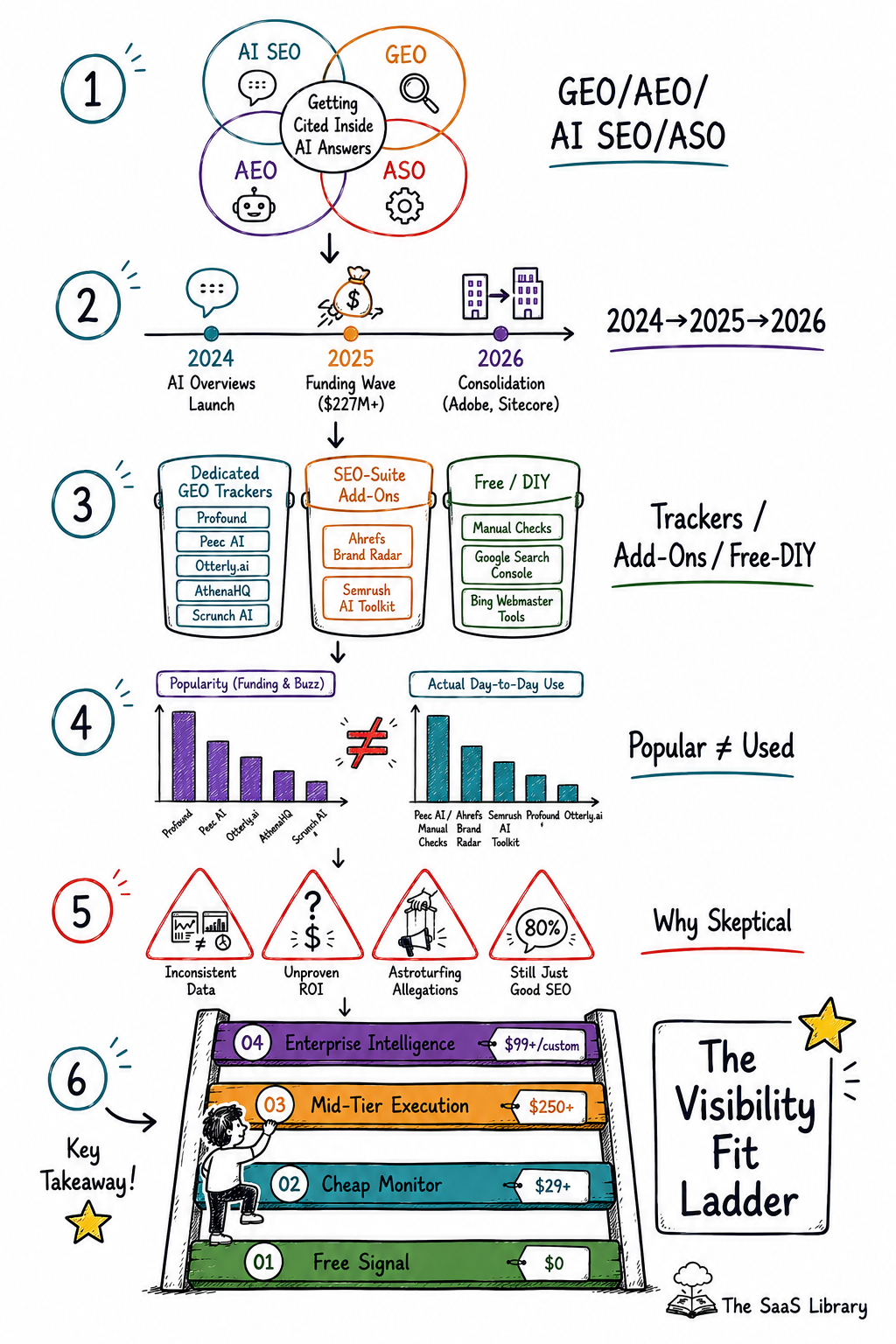
“AI SEO,” “GEO,” and “AEO” all mean the same thing: getting cited or mentioned inside an AI-generated answer instead of ranking a blue link. Generative Engine Optimization (GEO) is the formal term, coined by a team including Princeton and Georgia Tech researchers in a 2024 paper that measured how content changes affect visibility inside AI-generated answers (Aggarwal et al., arXiv, 2024). Answer Engine Optimization (AEO) and “AI SEO” describe the identical practice under different marketing labels — the industry hasn’t settled on one term yet.
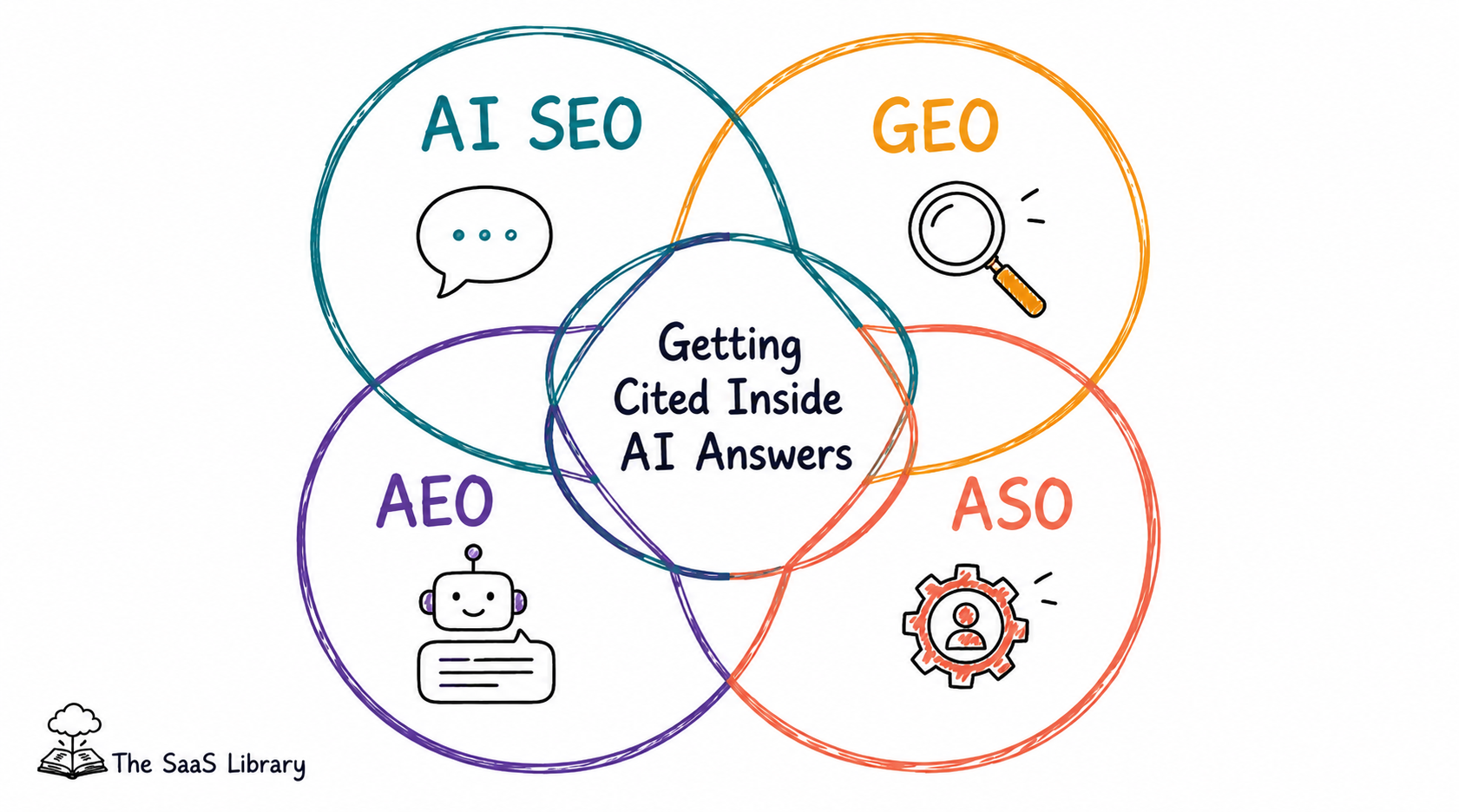
All three terms point at one goal: appearing inside the answer ChatGPT, Perplexity, Gemini, or Google’s AI Overviews generate, instead of hoping a user clicks through to your page — a framing Google itself has weighed in on, since its own AI search guide calls GEO and AEO still just SEO. This distinction matters because the tools in this guide split cleanly along it — some optimize traditional SEO with AI-assisted workflows, others track and improve AI-answer visibility specifically, and a growing number try to do both. The GEO tooling search category itself went from niche to roughly 22,000 monthly searches within a single year, a scale that reflects how fast the terminology moved from academic paper to marketing buzzword (Industry Lens, 2026).
Adobe has also begun pushing a fourth label, Agentic Search Optimization (ASO) — its term for optimizing content so autonomous AI agents, not just chatbots answering questions, can act on it, following the Semrush acquisition. Whether ASO becomes a distinct discipline or folds back into GEO is still unsettled as of mid-2026. If you want the fuller picture of how this terminology shift changed technical SEO practice itself, our definition and audit guide to technical SEO in the AI era goes deeper on that.
For a deeper look at why this shift broke traditional measurement entirely, our breakdown of how SEO, AEO, and GEO tools actually collect data covers the mechanics. Here, the terminology sets up the real question: which tools do people reach for once they’ve accepted the shift is real?
How Did the AI SEO Tools Market Get Here?
The AI SEO tools market got here through a compressed three-year arc: a platform shift, a funding gold rush, and now consolidation — all inside about 24 months. Google began serving AI-generated answers directly inside search results in 2024, and Perplexity, ChatGPT’s browsing mode, and Microsoft’s Copilot followed in the same window, pulling clicks away from the ten blue links every SEO tool had been built to measure (Search Engine Land, 2026).
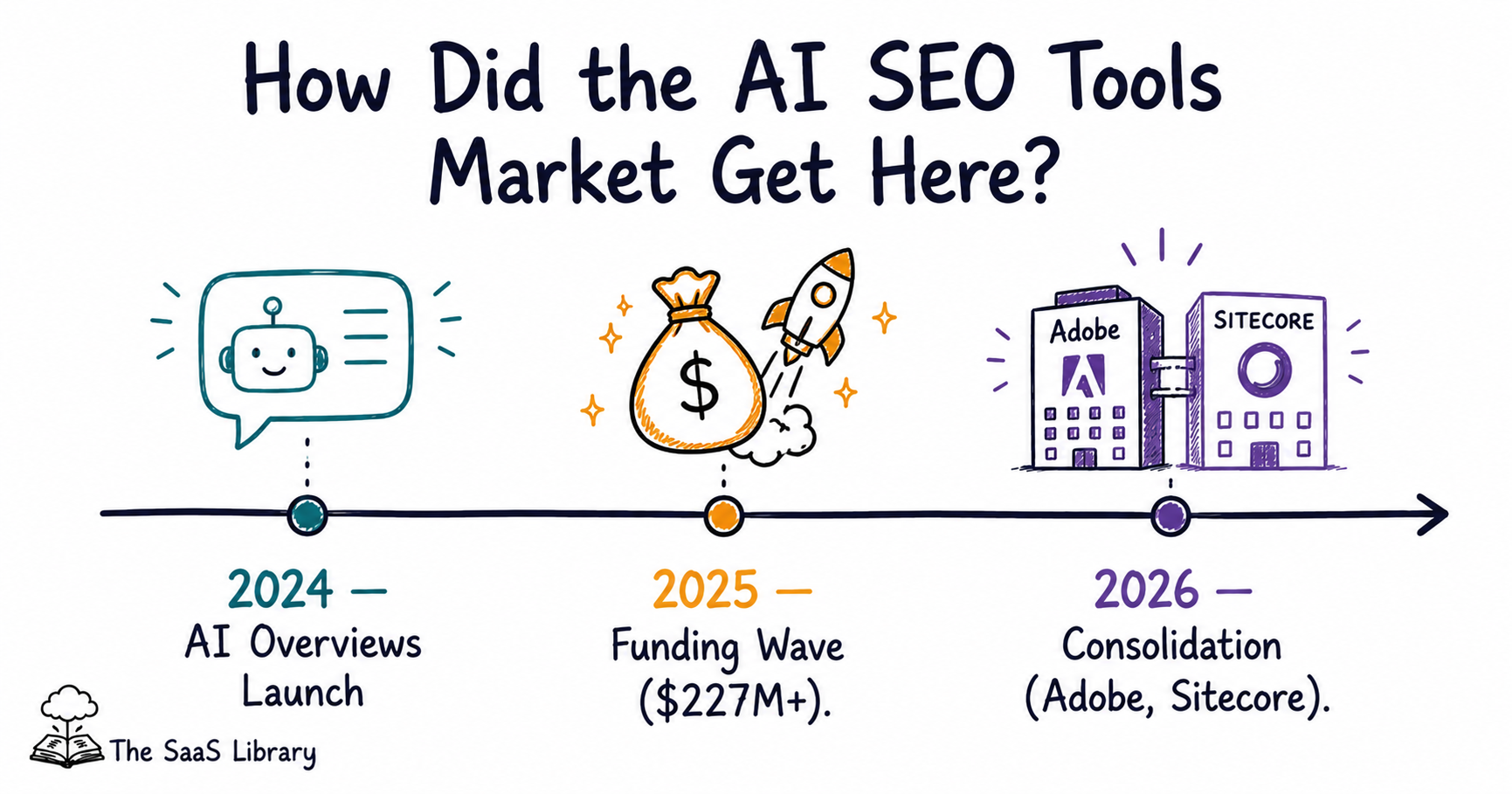
That question triggered a funding wave. Profound raised a $96 million Series C at a $1 billion valuation in February 2026, six months after a $35 million Series B (Fortune, 2026). Peec AI closed a $21 million Series A in November 2025 after crossing $4 million in annual recurring revenue within ten months of launch. Scrunch AI raised $19 million total across seed and Series A rounds through July 2025 (PitchBook, 2026). Kevin Indig’s Growth Memo tallies more than $227 million in venture capital poured into AI-visibility tracking specifically — a scale that signals investor conviction, not proven return on that spend.
Want the free-tier baseline before spending anything? Check whether your GSC Generative AI report is live — it takes five minutes and costs nothing.
Check Search Console →Consolidation followed almost immediately. Adobe agreed to acquire Semrush for $1.9 billion in November 2025, a deal that closed April 28, 2026 and folded Semrush’s AI Toolkit into Adobe’s marketing suite (Adobe Newsroom, 2025). Sitecore acquired Scrunch AI on May 28, 2026 (PitchBook, 2026). Regulatory pressure compounded the shift — the UK’s Competition and Markets Authority pushed Google toward the AI-visibility reporting it added to Search Console in June 2026, and the EU AI Act’s Article 50 transparency rules take effect August 2, 2026. Three years in, the category has gone from academic paper to a market undergoing its first acquisition cycle — which is exactly the pace that makes “which tool should I actually buy” a harder question than any listicle admits.
What Tools Are Actually Available in the Market?
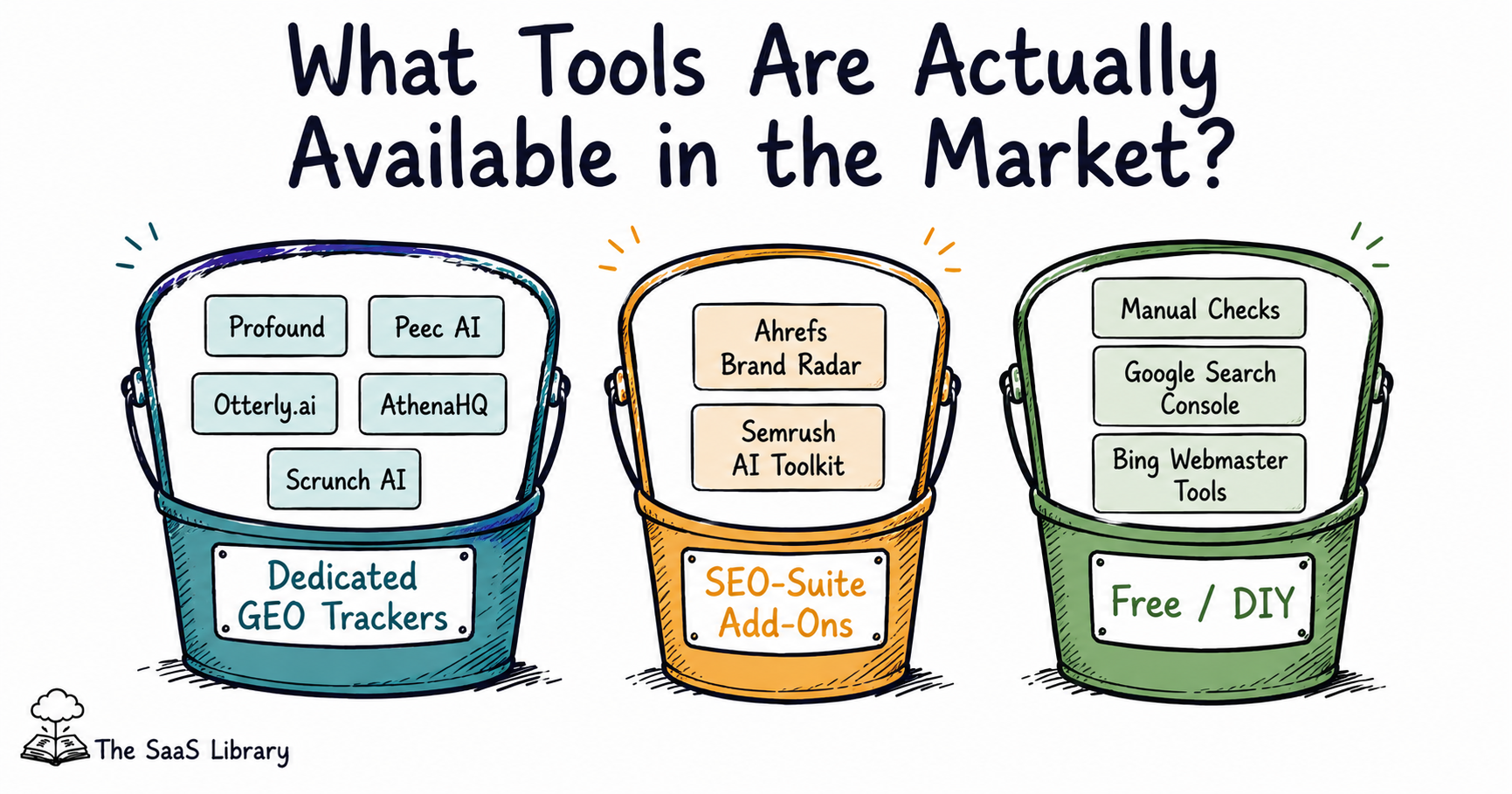
The tools actually available in the market fall into three categories:
- Dedicated AI-visibility trackers — built only to monitor AI-answer mentions and citations
- SEO-suite add-ons — bolt the same tracking onto platforms you may already pay for
- Free or DIY methods — cover the same ground by hand, at no cost
Confusing these three is why most buying decisions go wrong.
What Do Dedicated AI-Visibility Trackers Actually Do?
Search “best AI SEO tools 2026” right now and the pattern repeats within the first three results: the tool being reviewed ranks itself first, on its own blog. That’s not a one-off — it’s the norm this guide is written against.
Dedicated AI-visibility trackers exist for one job: running a fixed set of prompts against AI platforms on a schedule and reporting whether your brand gets mentioned or cited.
Profound, founded in 2024 by James Cadwallader and Dylan Babbs, runs daily browser-level queries across ChatGPT, Perplexity, Google AI Overviews, Gemini, and Copilot — using real browser sessions rather than API calls, which the company argues more closely replicates what actual users see. It now serves over 700 enterprise customers, including roughly 10% of the Fortune 500.
Peec AI, built in Berlin by Marius Meiners, Tobias Siwonia, and Daniel Drabo, tracks nine engines including ChatGPT, Gemini, Claude, and DeepSeek, and reports Visibility, Position, and Sentiment as its core metrics.
Otterly.ai, the most accessible entry point in this category, earned a Gartner Cool Vendor designation in 2025 and starts at $29 a month for 15 tracked prompts.
AthenaHQ, a Y Combinator company founded by ex-Google Search and DeepMind engineers, differentiates on native Shopify and GA4 revenue attribution — a genuine gap most competitors in this category haven’t closed.
So what actually separates these products? Not the engines they track — most cover the same five or six platforms now. It’s whether the tool stops at reporting a visibility gap, or tries to help you close it.
How Do SEO-Suite Add-Ons Differ From Dedicated Trackers?
SEO-suite add-ons differ from dedicated trackers by starting from your existing keyword and backlink data, then layering AI-visibility monitoring on top of it.
Ahrefs Brand Radar tracks six platforms — Google AI Overviews, AI Mode, ChatGPT, Perplexity, Gemini, and Copilot — built on a prompt database drawn from over 260 million real searches, priced in tiers of $129/mo (5 tracked prompts), $249/mo (10 prompts), and $449/mo (20 prompts) (Digiday, May 2026).
Semrush’s AI Toolkit does the same job from inside Semrush’s existing keyword and traffic data, and became an Adobe product after the $1.9 billion acquisition closed in April 2026. If you’re weighing free Google-native data against a paid Semrush subscription more broadly, our comparison of Search Console and Semrush covers that trade-off in depth.
The appeal here is obvious if you’re already paying for Ahrefs or Semrush: one more login, not a new subscription. The catch is that prompt limits scale quickly with cost — a team needing more than 20 tracked prompts on Ahrefs is already past the $449/mo tier.
What Are Practitioners Doing Instead of Paying for a Tool?
Practitioners are increasingly skipping paid tools entirely and running the same checks by hand. The method is simple: pick 15 to 20 fixed prompts a real buyer would type, run them through ChatGPT, Perplexity, and Gemini in a logged-out session once a month, and log who gets mentioned. It takes about an hour and costs nothing.
A more technical version of the same idea uses the Perplexity API directly — consultant Justin McKelvey has reported that a typical Sonar query costs about a penny, putting a 20-prompt monthly audit well under a dollar.
Google Search Console’s own Generative AI performance report, added in June 2026, offers a free complementary data point — though it currently shows impressions only, with no clicks or query-level detail. Bing Webmaster Tools is actually ahead of GSC here — its AI Performance dashboard launched in February 2026, four months earlier, and added grounding query-to-page mapping and a Citation Share metric by mid-2026.
Between manual checks, a free GSC or Bing report, and a one-off API script, the free tier of this market covers more ground than most people assume before they reach for a credit card.
Table A shows what’s available. What it doesn’t show is which of these tools hold up once you’re actually using them — that’s where pros and cons matter more than category labels.
Table A — Tools by Category
| Category | Tool | Engines Tracked | Starting Price | Best For |
|---|---|---|---|---|
| Dedicated GEO Tracker | Profound | ChatGPT, Perplexity, Google AI Overviews, Gemini, Copilot | $99/mo (single engine) | Enterprise brands needing deep, browser-verified data |
| Dedicated GEO Tracker | Peec AI | ChatGPT, Gemini, Claude, Perplexity, Google AI Mode, DeepSeek, Copilot, Llama, Grok | ~€89/mo | Mid-market teams wanting broad engine coverage, unlimited seats |
| Dedicated GEO Tracker | Otterly.ai | ChatGPT, Perplexity, Google AI Overviews, Copilot (Gemini/AI Mode as add-ons) | $29/mo | Solo operators and small teams on a tight budget |
| Dedicated GEO Tracker | AthenaHQ | ChatGPT, Perplexity, Gemini, Claude, Grok, Meta AI + 2 more | ~$295/mo | E-commerce teams needing native GA4/Shopify revenue attribution |
| Dedicated GEO Tracker | Scrunch AI | Multiple engines + AI-crawler analytics | ~$250–300/mo | Brands wanting machine-readable content serving (AXP) alongside tracking |
| Dedicated GEO Tracker | Brandlight | Enterprise-scale multi-engine | Custom/enterprise | Large brands at Kimberly-Clark, LG, Estée Lauder scale |
| Dedicated GEO Tracker | Goodie AI | 11 engines | ~$399/mo | Teams wanting monitoring + content + attribution in one closed loop |
| Dedicated GEO Tracker | LLMrefs | 10 engines | ~$79/mo | Budget-conscious indie operators |
| Dedicated GEO Tracker | ZipTie.dev | 3 engines (deep URL-level analysis) | ~$59–99/mo | Teams prioritizing real-user-behavior data over broad coverage |
| Dedicated GEO Tracker | Knowatoa | Multiple + hallucination detection | ~$59/mo (free tier available) | Competitive share-of-voice tracking on a budget |
| Dedicated GEO Tracker | RankScale | Widest engine coverage in category | Budget | Technical users comfortable with a steeper learning curve |
| Dedicated GEO Tracker | Writesonic GEO | ChatGPT, Perplexity, Google AI Overviews, Gemini, Claude, Copilot | ~$79/mo | Teams wanting content generation and visibility tracking together |
| SEO-Suite Add-On | Ahrefs Brand Radar | Google AI Overviews, AI Mode, ChatGPT, Perplexity, Gemini, Copilot | $129–$449/mo, tiered by prompt volume | Existing Ahrefs users wanting AI visibility alongside backlink data |
| SEO-Suite Add-On | Semrush AI Toolkit | ChatGPT, Perplexity, Gemini, Google AI Overviews | Included with Semrush plans | Existing Semrush users, especially post-Adobe integration |
| Free / DIY | Manual Prompt-Checking | Any engine you test by hand | $0 | Anyone testing feasibility before committing budget |
| Free / DIY | Google Search Console (Generative AI report) | Google AI Overviews, AI Mode, Discover AI | $0 | Confirming Google-side AI impressions on your own pages |
| Free / DIY | Bing Webmaster Tools (AI Performance dashboard) | Copilot/Bing AI | $0 | More mature AI reporting than GSC’s equivalent as of mid-2026 |
| Free / DIY | HubSpot AI Search Grader | Multiple, one-shot snapshot | $0 | A single free baseline check, not ongoing monitoring |
| Free / DIY | Frase AI Visibility Checker | Multiple, one-shot snapshot | $0 | Same use case as HubSpot’s tool — quick, free, non-recurring |
| Free / DIY | Perplexity API self-checker | Perplexity only | ~$1/mo (pennies per query) | Technical users wanting scheduled, low-cost tracking |
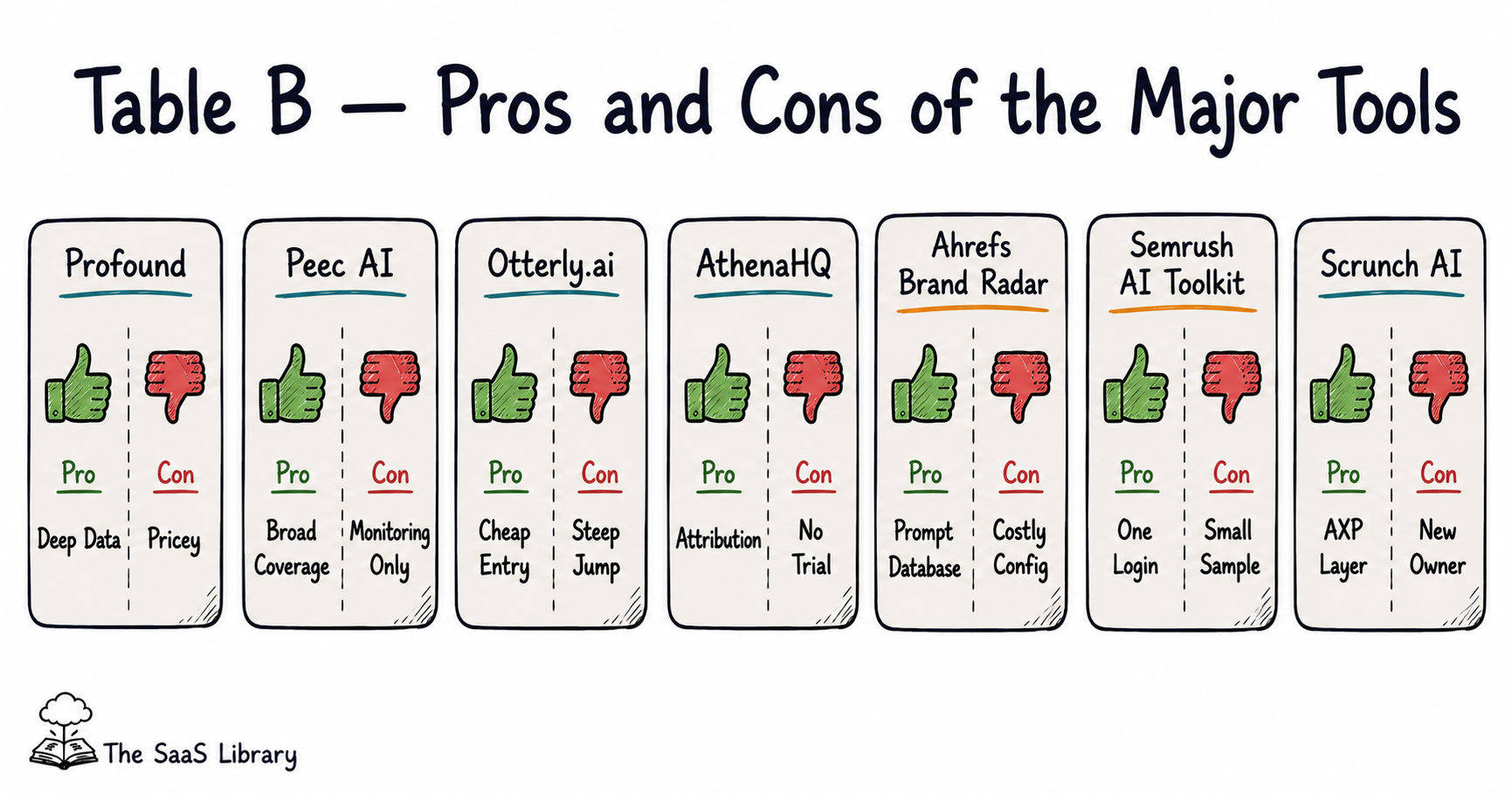
Table B — Pros and Cons of the Major Tools
| Tool | Pros | Cons |
|---|---|---|
| Profound | Deepest enterprise data (browser-verified, not just API-polled); serves 700+ customers including ~10% of the Fortune 500; strong customer support | Enterprise pricing scales fast — agencies report up to ~$1,000/mo; entry tier is thin for the price |
| Peec AI | Broadest engine coverage (9 platforms); unlimited seats on all plans; fast-growing with strong customer traction | Monitoring-only — no content drafting or revenue attribution |
| Otterly.ai | Cheapest credible entry point ($29/mo); Gartner-recognized; clean UI | Steep jump from Lite to Standard tier; Gemini and AI Mode cost extra as add-ons |
| AthenaHQ | Native GA4/Shopify revenue attribution — a real differentiator; built by ex-Google Search/DeepMind engineers | No free trial; starts at $295/mo, higher floor than Otterly or Peec |
| Ahrefs Brand Radar | Built on a 260M+ search-backed prompt database; integrates directly with existing keyword/backlink data | Prompt limits scale quickly with cost; no native Claude or Grok coverage |
| Semrush AI Toolkit | Zero extra login for existing Semrush users; now backed by Adobe’s resources post-acquisition | Based on a small illustrative sample in Semrush’s own published research; pricing may drift upward under Adobe |
| Scrunch AI | Agent Experience Platform (AXP) serves machine-readable content directly to AI crawlers; includes hallucination detection | Recently acquired by Sitecore (May 2026) — product direction and pricing may shift under new ownership |
| Manual Prompt-Checking | Free; full control over which prompts and platforms you test; no vendor lock-in | Time-consuming at scale; no built-in tracking over time |
| Google Search Console | Free; direct from Google, no third-party estimation involved | Impressions only — no clicks, CTR, or query-level data; still rolling out region by region |
A pattern worth naming before moving on: across every tool in this table, the practitioner complaint is consistent — the same prompts produce different answers depending on which tool asks them, because LLM outputs are non-deterministic by design. No comparison table can fix that; it’s a feature of the technology being measured, not a flaw in any single product.
Which Tools Are Most Popular — and Which Are Actually Being Used?
So far: three categories of tool exist, and two comparison tables show what each costs and where each falls short. What’s still unclear is which of these tools people actually reach for — and that gap between popularity and real use is the point of everything that follows.
The tools most popular by funding and mindshare are not the tools most commonly used day-to-day — that gap is the single most important thing to understand before buying anything in this category. Profound leads on popularity: a $1 billion valuation, 700+ enterprise customers, and constant press coverage make it the name most marketers recognize first. Peec AI leads on a different measure — genuine usage growth, crossing roughly $10 million in annualized revenue off real customer adoption rather than brand recognition alone.
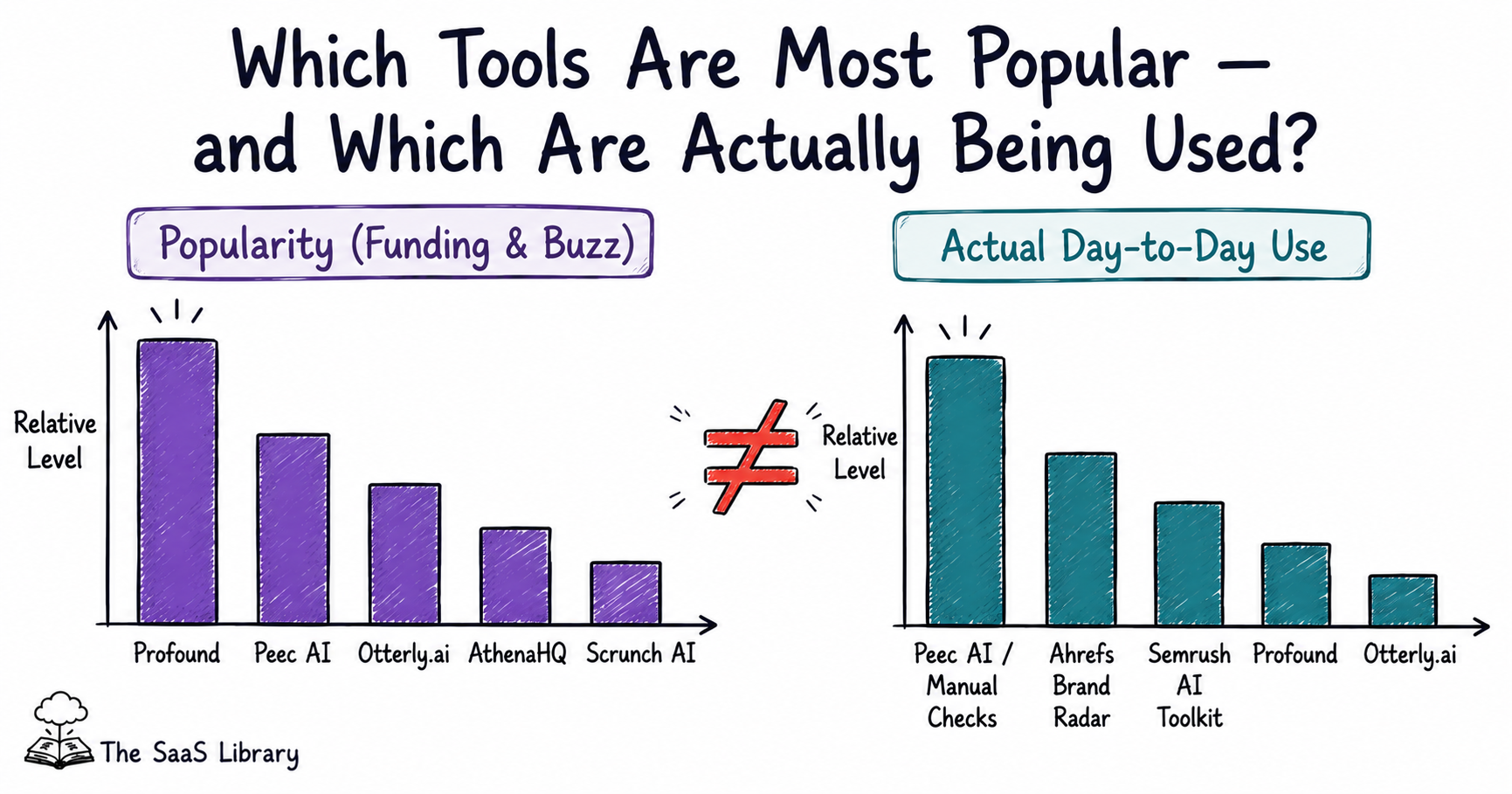
But recognition isn’t the same as reliance. VML’s Heather Physioc, testing the category directly, described running roughly 17 tools in parallel rather than settling on one — a sign that no single product has actually won the trust of a senior practitioner yet.
Paul Dyer, CEO of the AI-native agency /prompt, put it plainly to Digiday: “The same thing that bedeviled SEO analytics… is now bedeviling GEO. If you use three different tools and give them the same prompts, you get three different answers” (Digiday, May 2026).
That inconsistency is why manual, DIY-style checking hasn’t disappeared even as paid tools have multiplied. It’s also worth separating AI-visibility tool usage from the broader habit of using AI for SEO tasks generally — Semrush’s own 2026 survey of 100 marketers found 60% use tools like ChatGPT for keyword research and 48% for content brainstorming, but only about 1 in 5 use AI to draft full articles outright. Popularity buys a tool attention. Actual adoption is decided by whether its numbers can be trusted enough to act on — and right now, most practitioners aren’t fully convinced any one tool has cleared that bar.
Why Are Practitioners Skeptical of These Tools?
Practitioners are skeptical of these tools because the data they produce is inherently inconsistent, the return on investment remains unproven, and at least one senior SEO has alleged coordinated marketing campaigns behind the hype. This isn’t a minority view — it runs through nearly every serious practitioner account of the category.
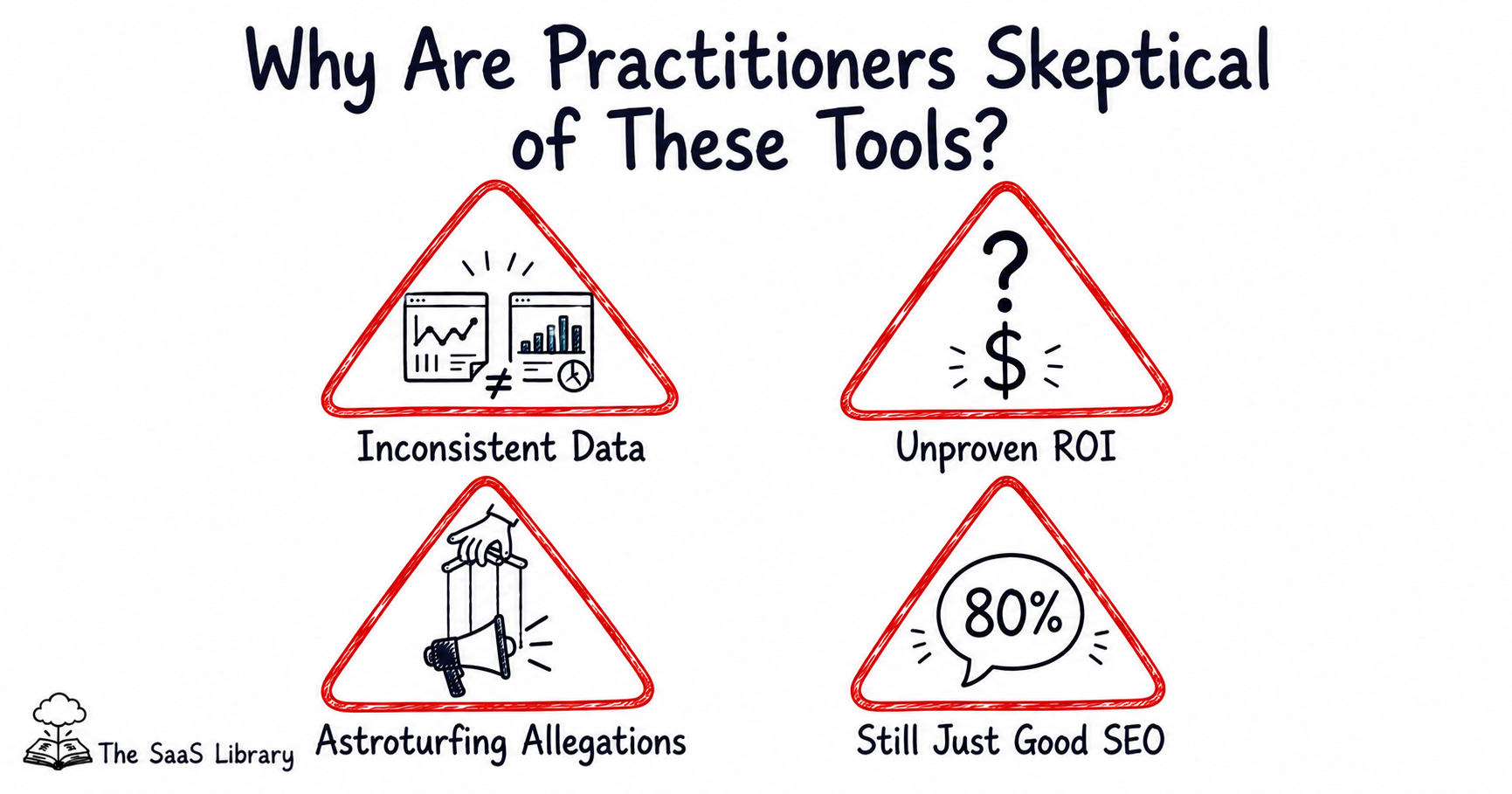
The consistency problem starts with the technology itself. Software engineers reviewing the category argue that the clean “leaderboard” numbers these tools produce hide a false sense of precision, since the underlying LLM outputs are non-deterministic by design — the same mechanism behind why ChatGPT gives different answers to the same question. Brainlabs put it bluntly in its own analysis: none of the AI visibility data available today is fully accurate, because the prompt-volume figures are probabilistic estimates and mention rates fluctuate from run to run of the exact same query.
That inconsistency feeds directly into a return-on-investment problem. One practitioner who tested multiple tools side by side found no consistent correlation between rising AI-brand mentions and any actual increase in traffic or conversions.
Lily Ray, VP of SEO Strategy at Amsive, has documented coordinated “GEO disinformation campaigns,” in which emerging GEO tools allegedly offered payment to micro-influencers to push a “SEO is dead” narrative. Separately, her own analysis of sites promoted as GEO-vendor case studies found organic traffic declines of 49%, 43%, 42%, 38%, 34%, and 29% at specific named companies following Google’s core updates in early 2026 — the opposite outcome the case studies had promised.
Near-perfect review scores on small review bases follow a pattern industry watchers associate with early, vendor-seeded reviews rather than organic sentiment. Perhaps the most quoted line in this entire debate comes from uSERP’s Jeremy Moser, who argues the category oversells what it’s actually built on:
None of this means the tools are worthless — directional monitoring and competitive gap-spotting still have real value. It means the honest read on this category, as of 2026, is “useful benchmark, not a source of truth” — and any tool or vendor that claims otherwise is the one to be most skeptical of.
How Should You Choose, Based on Your Situation?
You should choose a tool based on your situation, not a ranked list — because the right choice for a solo operator and the right choice for an enterprise team are almost never the same product. The Visibility Fit Ladder sequences four tiers by who actually needs each one, so you spend only what your current stage justifies.
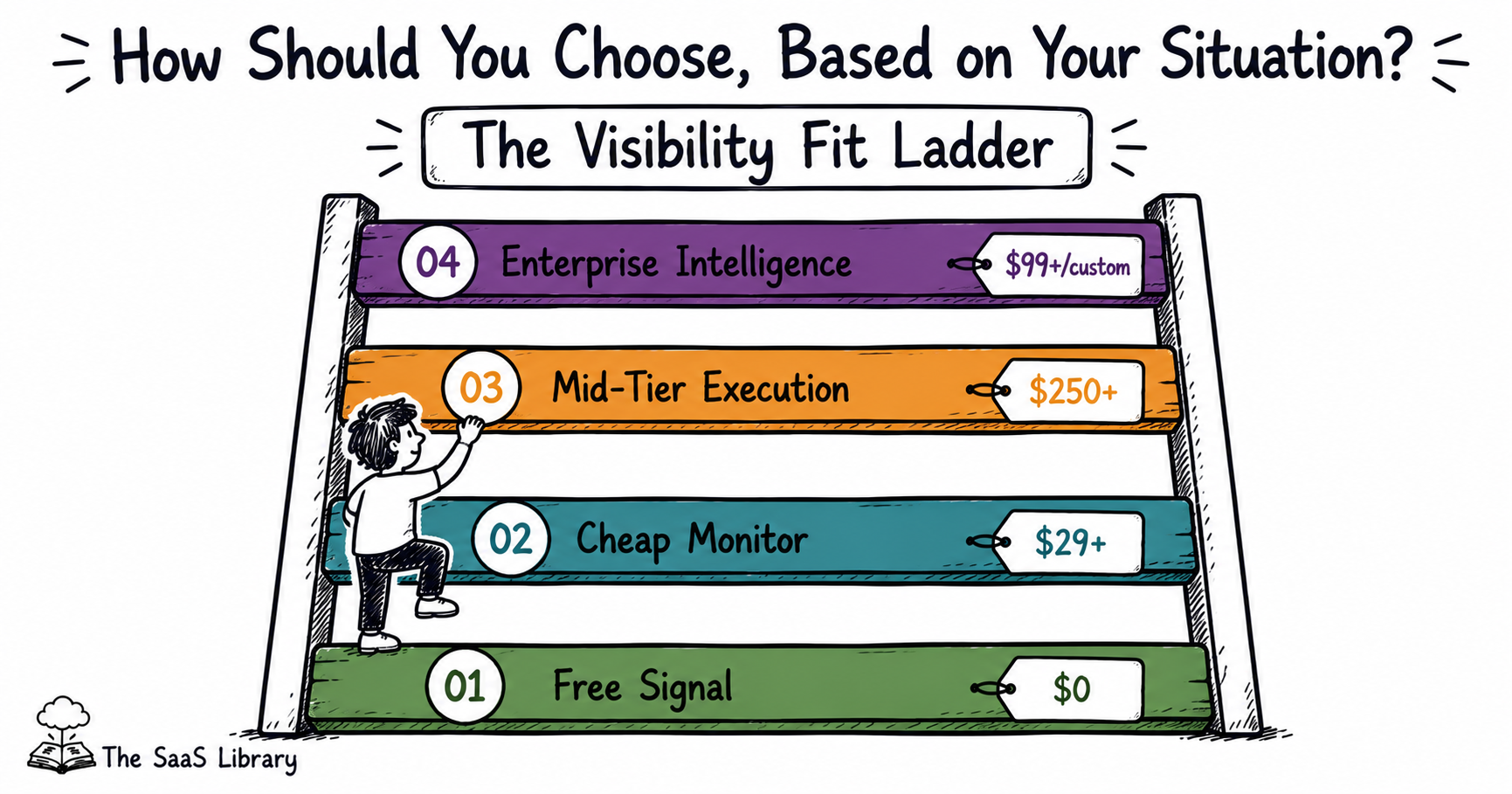
The ladder only works climbed in order. Jumping straight to an enterprise tool before you’ve confirmed AI referral traffic is even material to your business means paying enterprise prices to answer a question a free GSC check could have answered first. Climb one rung, confirm it’s earning its cost, then decide whether the next one is worth it.
What’s Next for AI SEO Tools?
What’s next for AI SEO tools is a shift from passive monitoring to active, agentic execution — plus regulatory pressure that will force more data transparency than vendors currently offer voluntarily. Both forces are already visible in 2026, not speculative.
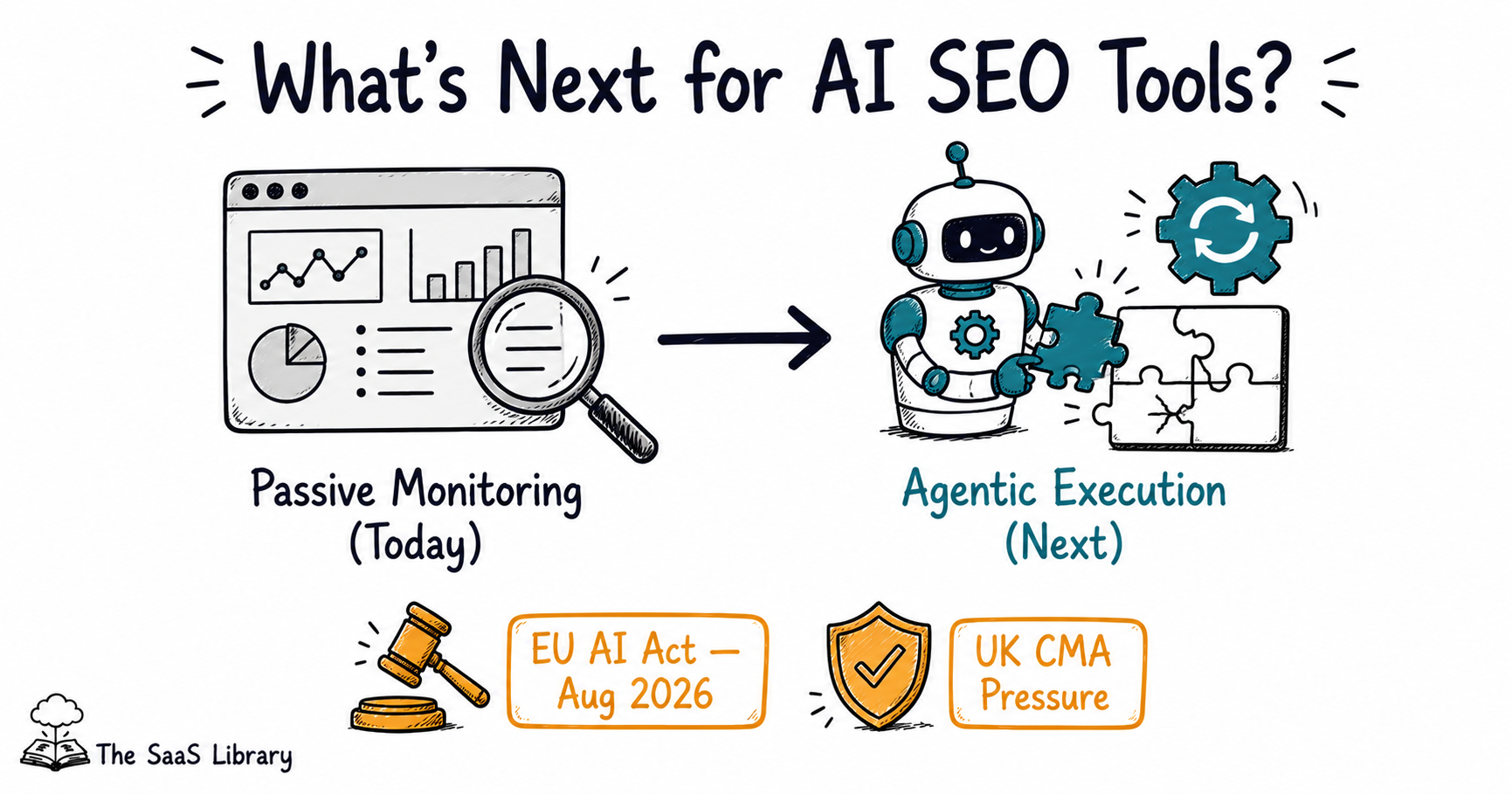
The execution shift is furthest along at Profound, which has begun rolling out “Profound Agents” — automation that acts on a visibility gap instead of just reporting it. Ahrefs is building toward the same idea with an autonomous assistant it calls Agent A. E-commerce-focused platforms are moving fastest here: one vendor’s “Onsite Agent” continuously scans a storefront’s codebase to automatically repair broken schema and internal-link structures that block AI crawlers, rather than waiting for a human to read a report and fix it manually. Our piece on agentic AI optimization covers this shift from passive dashboards to active agents in more depth.
The EU AI Act’s Article 50 transparency obligations take effect August 2, 2026, establishing traceability requirements for AI-generated content that will likely force AI platforms to share more citation data than they currently do voluntarily.
The UK’s Competition and Markets Authority has already demonstrated this pattern works — its pressure on Google is the direct reason Search Console’s Generative AI performance report exists at all, rolling out UK-first before reaching other markets.
One thing is unlikely to change regardless of new regulation or better agents: the non-determinism problem. LLMs are built to generate a different response every time by design, not by flaw — there is no stable rank to measure the way there was with a traditional SERP position. Better tools may narrow the gap between competing platforms’ numbers, but no amount of engineering removes the fact that the same prompt run twice can produce two different answers. That’s the one part of this category that isn’t a temporary limitation waiting on venture funding to solve it.
Frequently Asked Questions
What are AI SEO tools?
AI SEO tools are software platforms that use artificial intelligence to handle search optimization tasks — ranging from traditional keyword research and content briefs to tracking whether a brand gets mentioned inside AI-generated answers from ChatGPT, Perplexity, or Google’s AI Overviews.
What is the difference between AI SEO and GEO?
The difference between AI SEO and GEO is mostly terminology, not substance — both describe optimizing content to be cited or mentioned inside AI-generated answers, with GEO (Generative Engine Optimization) being the more formal, research-derived term.
Which AI SEO tools are most popular?
The most popular AI SEO tools by funding and enterprise adoption are Profound, Ahrefs Brand Radar, and Semrush’s AI Toolkit — though popularity by funding doesn’t always match which tools practitioners actually rely on day-to-day.
Which AI SEO tools do people actually use the most?
People actually use Peec AI and Otterly.ai most commonly for dedicated AI-visibility tracking at accessible price points, alongside manual prompt-checking and existing SEO-suite add-ons like Ahrefs or Semrush for teams who already pay for those platforms.
Are free AI SEO tools any good?
Free AI SEO tools like Google Search Console’s Generative AI report, Bing Webmaster Tools, and manual prompt-checking can cover a genuinely useful baseline — they just require more manual effort and offer less automation than a paid tracker.
Do I need a paid tool to track AI visibility?
You don’t need a paid tool to track AI visibility if you’re willing to run a fixed set of prompts by hand each month — many practitioners still do exactly this instead of paying for a dashboard.
How much do AI visibility tools cost?
AI visibility tools cost anywhere from $0 for manual or free options to $29–99 a month for accessible trackers like Otterly.ai, up to $295 a month or more for enterprise-tier platforms like AthenaHQ or Profound.
Can AI SEO tool data be trusted?
AI SEO tool data should be treated as directional rather than precise, since the same prompts often produce different results across different tools due to the non-deterministic nature of how large language models generate answers.
What happened to Scrunch AI?
Scrunch AI was acquired by Sitecore on May 28, 2026, following $19 million in total funding raised across its seed and Series A rounds.
Is Ahrefs Brand Radar worth the cost?
Ahrefs Brand Radar is worth the cost mainly for teams already paying for an Ahrefs base plan, since its tiered pricing (from $129 to $449 a month) scales with prompt volume and can climb quickly for teams tracking more than 20 prompts.
Does Google Search Console show AI Overview data?
Google Search Console shows AI Overview data through its Generative AI performance report, launched in June 2026 — though it currently reports impressions only, without clicks, CTR, or query-level detail.
What’s next for AI SEO tools?
What’s next for AI SEO tools is a shift from passive monitoring toward agentic execution — tools that don’t just report a visibility gap but actively fix it — alongside new regulatory transparency requirements taking effect in 2026.
Conclusion
The Visibility Fit Ladder isn’t a ranking — it’s a route. Start with free signal, move up only when the tier below stops being enough, and treat every tool’s numbers as directional, not exact.
The market’s real lesson for 2026 isn’t which product wins; it’s that none of them have, yet, and the practitioners who get the most value are the ones running a stack that matches their actual stage rather than chasing whichever tool raised the biggest round this quarter.
Still weighing whether any of this is worth budget at all? Read our take on whether SEO is still worth it for B2B SaaS in 2026 →
- Fortune — Profound Raises $96M at $1B Valuation (2026)
- Digiday — Marketers Question Expensive AI Visibility Tools (May 2026)
- Digiday — Media Briefing: A Cottage Industry of GEO Vendors (March 2026)
- Lily Ray — A Reflection on SEO, GEO & AI Search in 2025 (Substack, January 2026)
- PitchBook — Scrunch AI Company Profile (2026)
- Adobe Newsroom — Adobe to Acquire Semrush (2025)
- SparkToro — Zero-Click Search Data (2026)
- Aggarwal et al. — GEO: Generative Engine Optimization (arXiv, 2024)
- Semrush — Marketer AI-Usage Survey (January 2026)
- Google Search Central Blog — Generative AI Performance Reports (June 2026)
- Bing Webmaster Blog — AI Performance Dashboard (February 2026)
- Ahrefs Help — About Brand Radar
- Search Engine Land — What New AI Search Data Reveals (2026)
- Peec AI — Product Site
- Profound — Product Site