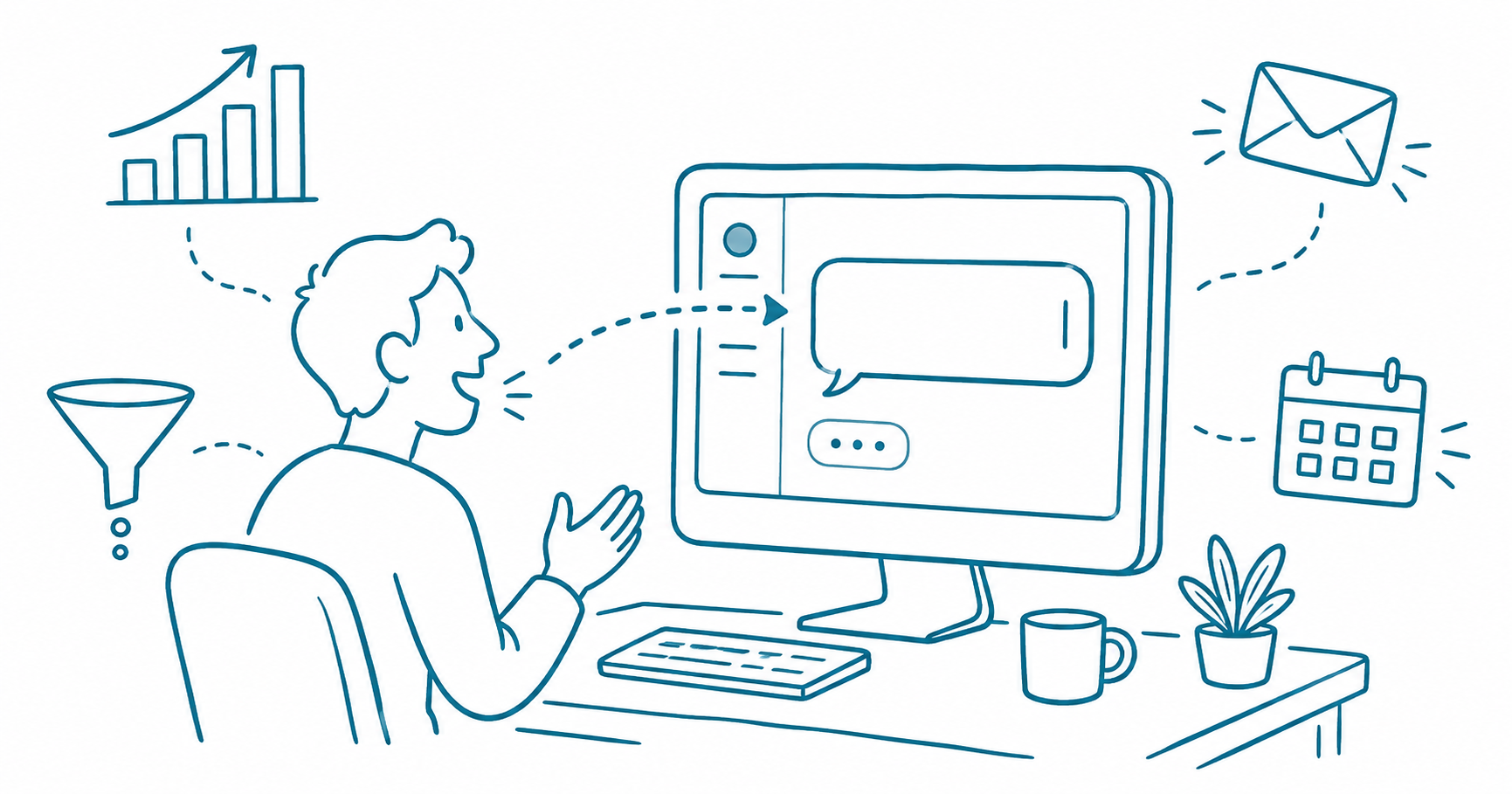
You have had the idea for months. A calculator, a dashboard, a tool your team actually needs. It sits in a doc somewhere, waiting for a developer who will never prioritise it. Vibe coding changes that equation — and it is not just for founders and engineers anymore.
Vibe coding for marketers means describing a tool you need in plain English and letting AI generate the working code — no developer, no ticket, no waiting. The term was coined by Andrej Karpathy in February 2025, and what started as an engineering experiment has quietly become one of the most practical shifts in how B2B SaaS marketing teams operate. If you want to understand how AI tools are reshaping the broader marketing stack, our guide to AI tools for marketing automation covers the full landscape. This article covers the 8 specific things you can build yourself, right now, ranked from easiest to hardest.
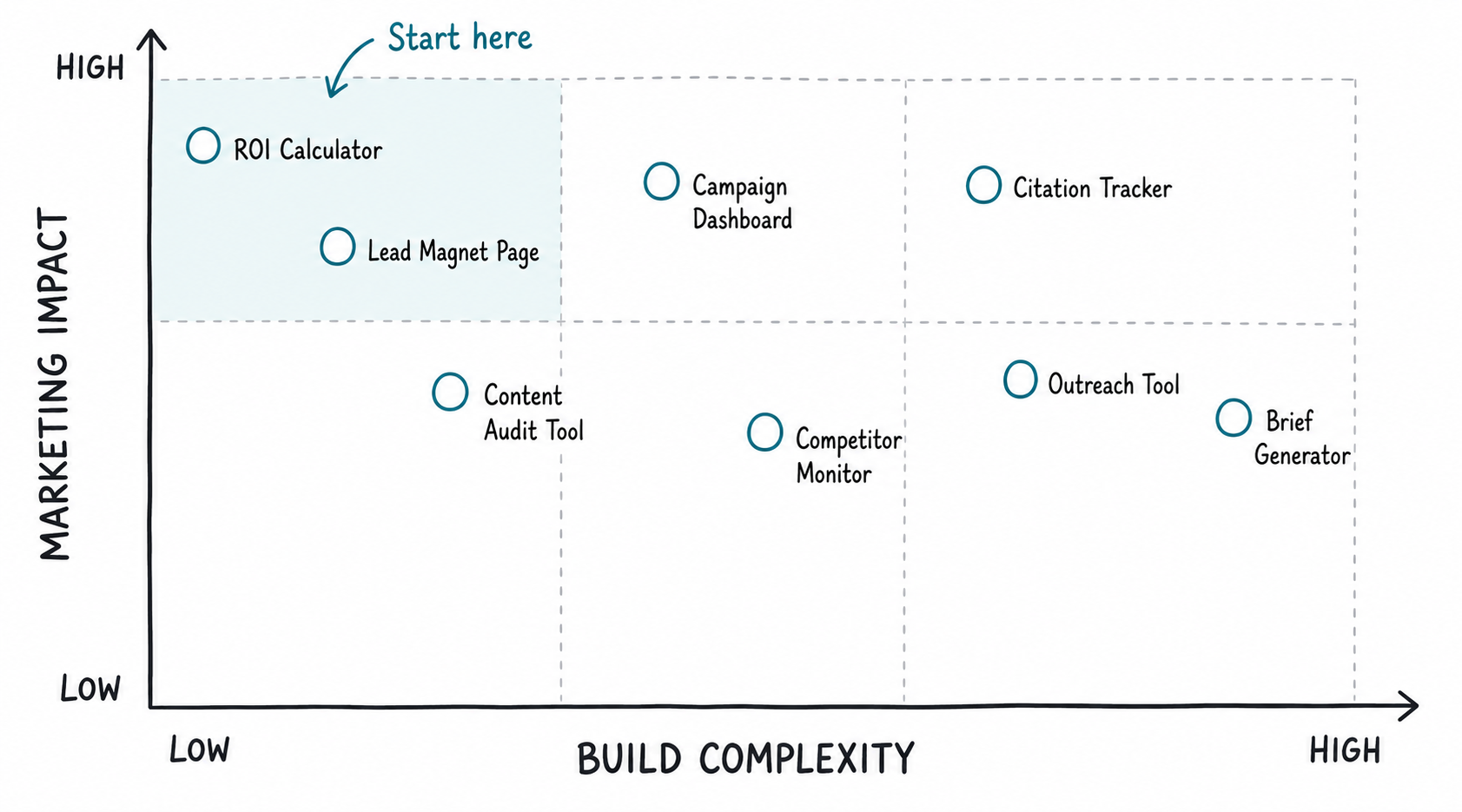
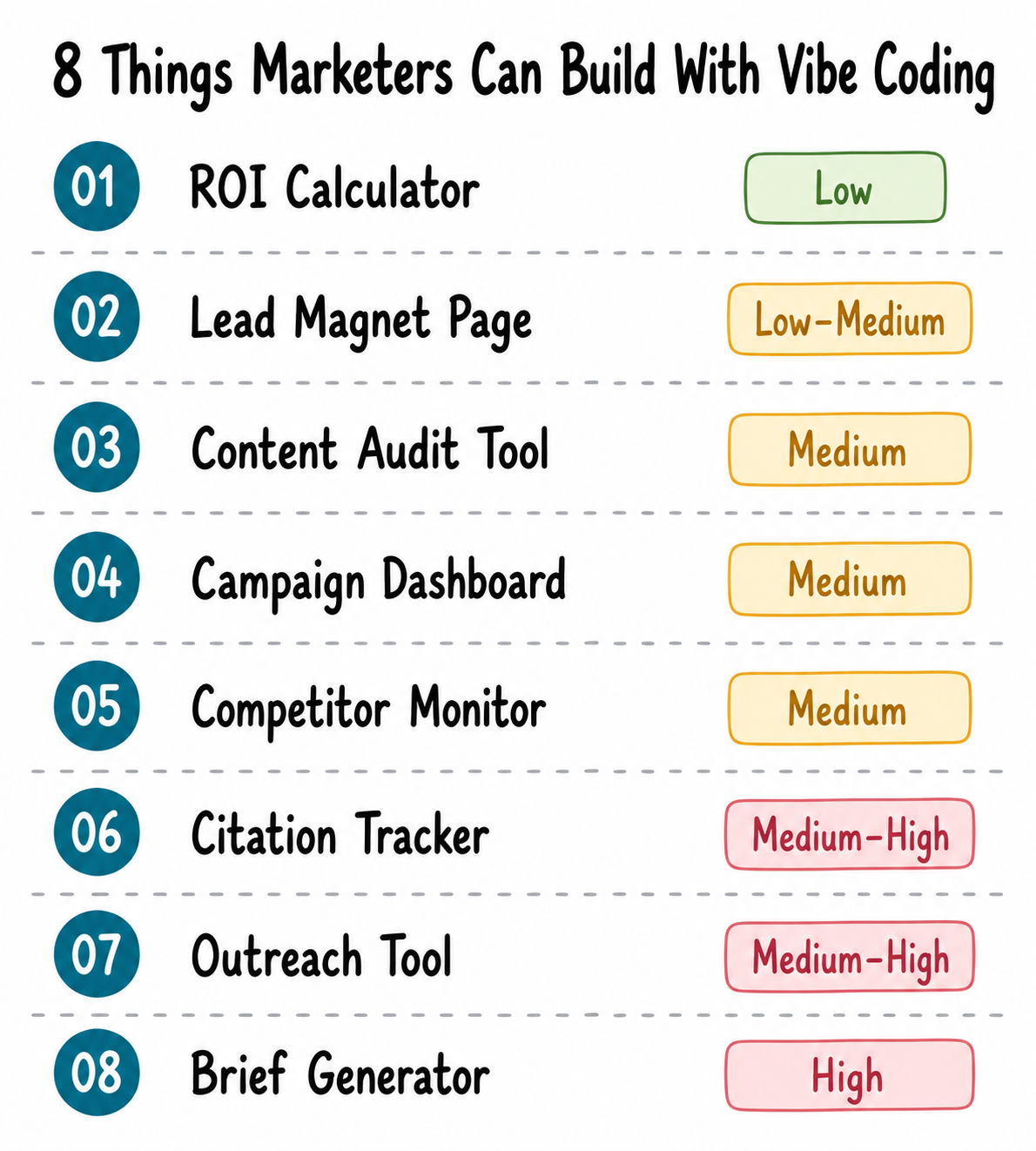
Not every vibe coding project is equal. Some take an afternoon. Some take weeks. The Marketer Complexity Stack maps 8 use cases across build complexity and marketing impact so you know exactly where to start based on your current skills and what your team actually needs.
The Marketer Complexity Stack is a deployment framework developed by The SaaS Library that ranks vibe coding use cases for non-technical marketers across two axes — build complexity and marketing impact — so B2B SaaS marketers can identify which tool to build first based on their current skills and workflow gaps.
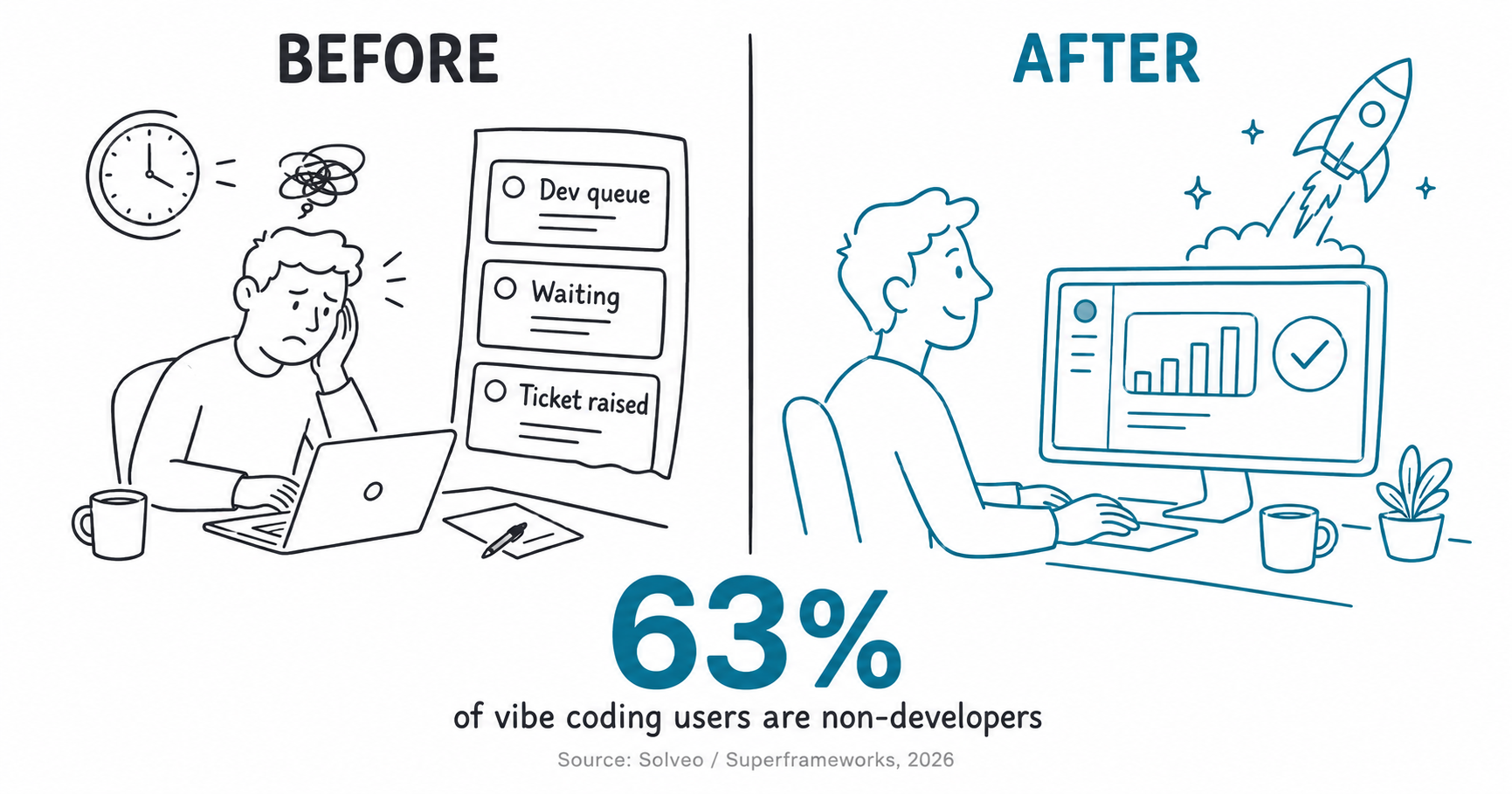
Vibe coding is no longer a developer-only practice. The majority of people building with AI coding tools today have no technical background. This article maps 8 tools B2B SaaS marketers are already building — from a campaign ROI calculator to a campaign brief generator — ranked by the Marketer Complexity Stack so you know exactly where to start.
Use cases in the top-left quadrant — high marketing impact, low build complexity — are where most marketers should begin.
The Calculator That Finally Answers “Was It Worth It?”
Campaign ends, spreadsheet opens, two hours disappear. ROI calculation is manual, inconsistent, and always produced after the moment when it would have been most useful.
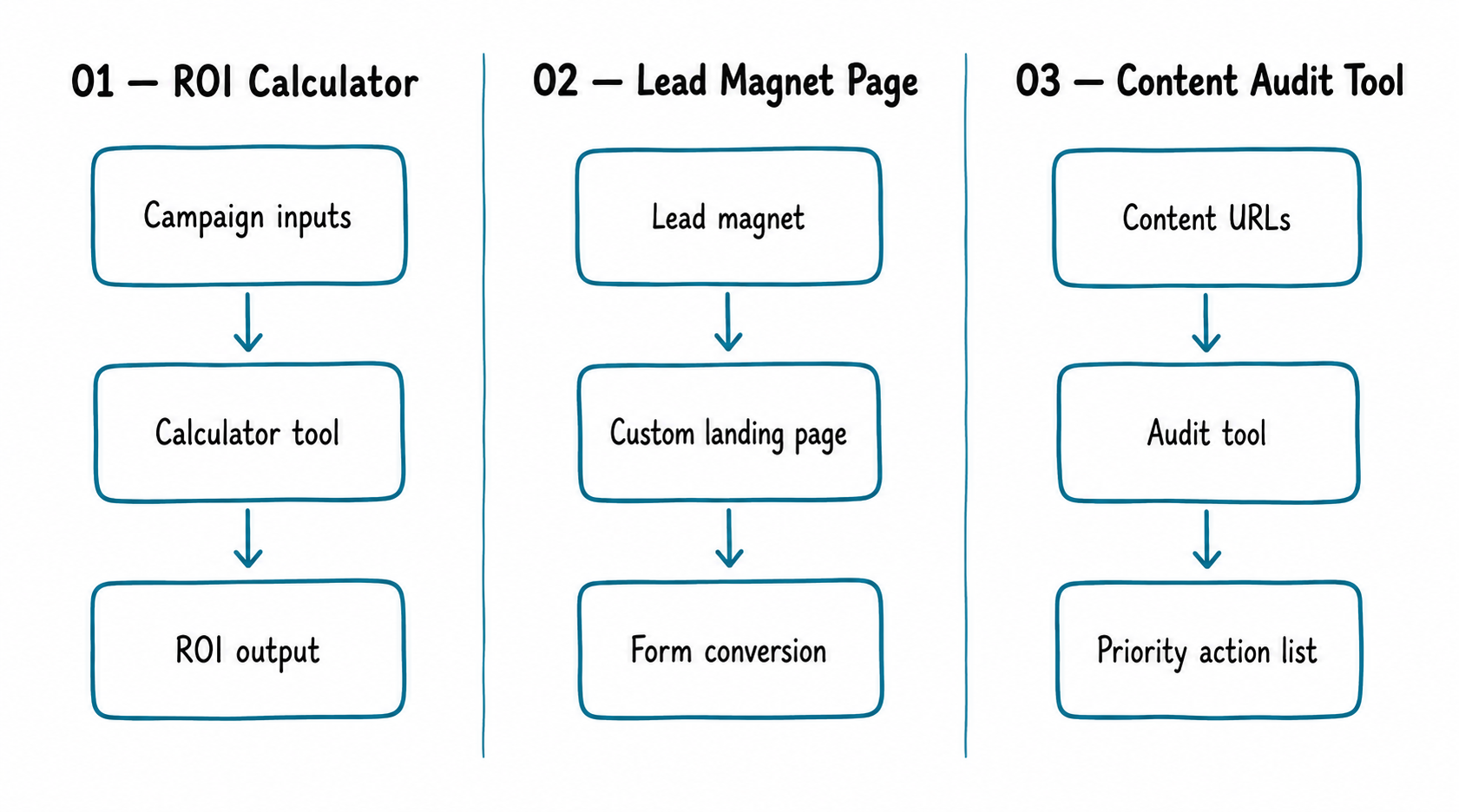
A vibe-coded ROI calculator takes campaign inputs — spend, leads generated, conversion rate, average deal value — and outputs a clean ROI figure instantly. Tim Metz, Director of Marketing at Animalz, built exactly this using Cursor. The tool lives at a permanent URL, works for any campaign type, and continues generating leads long after the initial build. No developer involved.
The Landing Page Your Lead Magnet Has Always Needed
Your lead magnet is strong. The page it lives on is a generic form with no logic, no design, and no real reason for anyone to convert beyond the offer itself.
A vibe-coded landing page built in Lovable or v0 gives your lead magnet a custom home — with conditional logic, brand-matched styling, and a layout built around the offer. You describe what you want, iterate on what the AI builds, and deploy without writing a line of code. This is the top use case for non-developer vibe coders, with UI generation accounting for 44% of all vibe coding projects built by non-technical users. For converting leads once they arrive, our guide on AI lead scoring for B2B SaaS covers the next step.
The Audit Tool You Keep Meaning to Build
Content audits happen in spreadsheets, across five tabs, with data pulled manually from GSC, Ahrefs, and wherever else it lives. It takes a full day to set up and half a day to run — so most teams do it once a year at best.
A vibe-coded audit tool pulls content performance data into a single interface, flags decay, surfaces gaps, and outputs a prioritised action list. Page Sands at SandsDX built a Messaging Drift Analyzer this way — paste your positioning doc, give it URLs, and it shows exactly where live copy has drifted from strategy. Our HEO content audit guide covers the framework this kind of tool should run against.
Demo, don’t memo.
The Dashboard That Ends the Monday Morning Report
Weekly reporting means logging into three platforms, exporting CSVs, pasting into a deck, and formatting for 45 minutes. Every single Monday. The data exists — pulling it together is the problem.
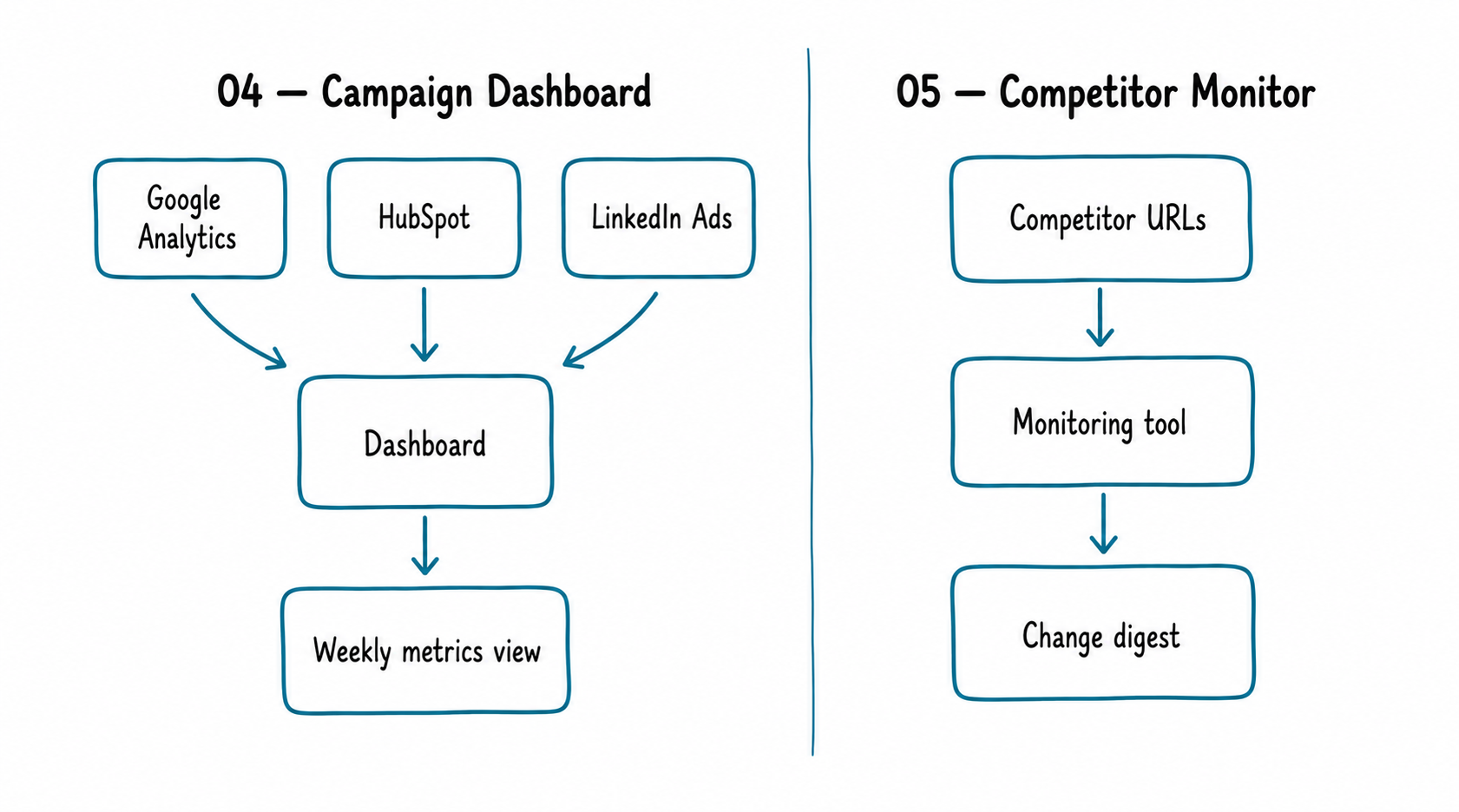
A vibe-coded dashboard connects to existing APIs — Google Analytics, HubSpot, LinkedIn Ads — and surfaces the metrics the team actually looks at in one place. A non-technical ops manager at a B2B SaaS company built exactly this using Lovable. The sales team's 10+ hours of weekly manual reporting dropped to zero. For the automation layer that keeps data flowing, our guide to AI workflow automation covers the connected stack.
The Monitor That Watches While You Work
Competitor tracking is manual — you check their site when you remember, screenshot pricing pages, and save notes in a doc that nobody reads consistently.
A vibe-coded monitoring tool checks competitor pages on a schedule, flags changes in messaging, pricing, or positioning, and sends a digest to your inbox or Slack. Page Sands at SandsDX built a Positioning Differentiator this way — it cross-references competitor sites and surfaces claim overlaps automatically. His Brand Narrative Analyzer does the same across your own pages, flagging where your story has drifted between homepage and about page.
The code is the easy part. Knowing what to build is the hard part. It always was.
Is Your Brand Invisible to AI Search?
You have no idea whether ChatGPT or Perplexity mention your brand when someone asks about your category. Most B2B SaaS brands do not appear — and do not know it.
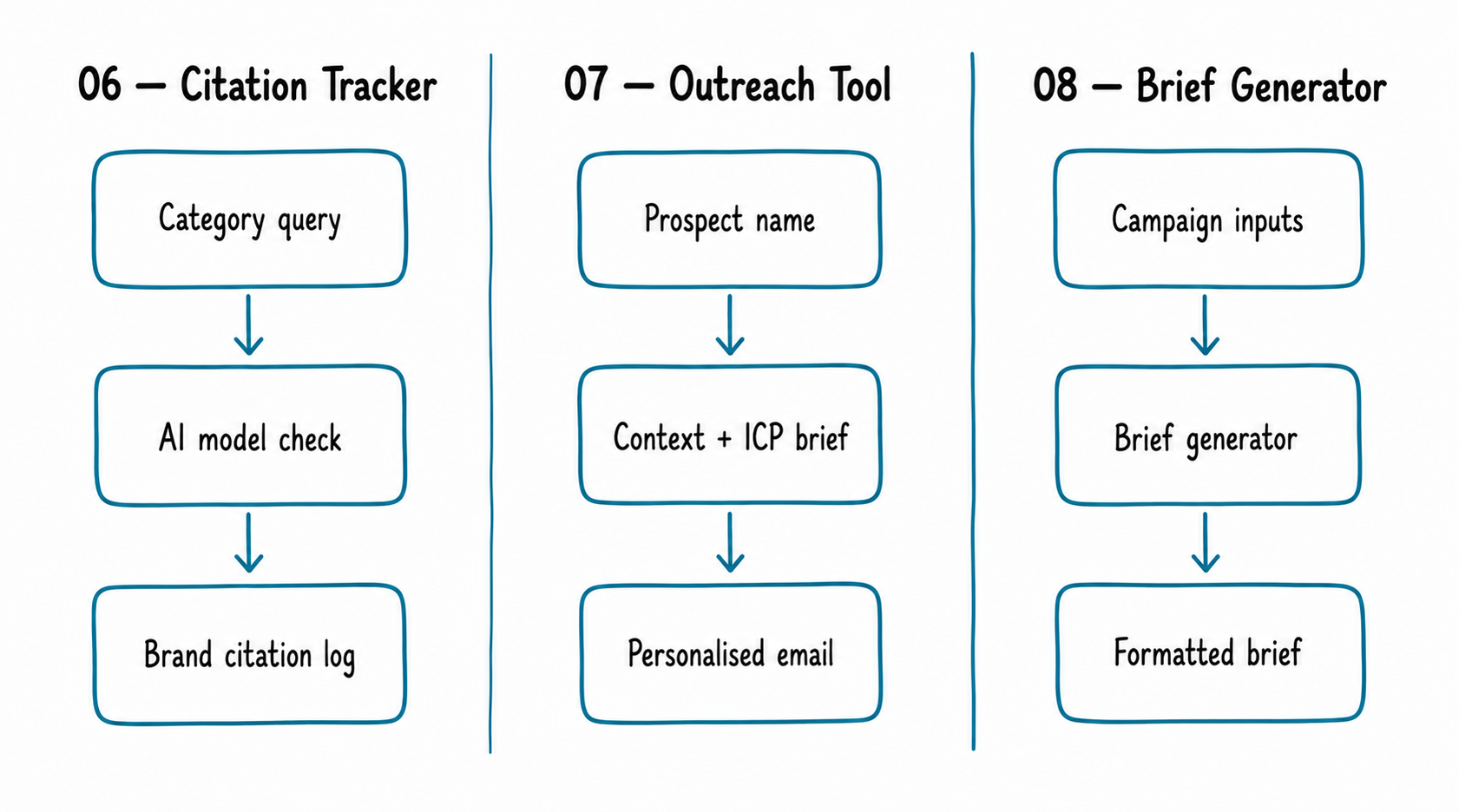
A vibe-coded citation tracker makes API calls to AI models, asks category-level questions, and logs whether your brand appears — and who gets cited instead. Page Sands built this at SandsDX and it became the fastest-spreading tool in his GTM lab. The competitive intelligence angle is immediate: if three competitors appear in every AI response and you do not, that is a gap with a measurable fix. See our ChatGPT vs Claude comparison to understand which AI models to prioritise, and our AEO optimisation guide for how to improve your citations once you have the data.
The Outreach Tool That Does the Research For You
ABM and cold outreach live or die on the first line. Writing personalised openers at scale is either slow or generic — rarely both fast and good at the same time.
A vibe-coded outreach tool takes a prospect's company name, pulls public context, and generates a personalised first line or full email against your ICP and messaging framework. The tool enforces your tone, your positioning, and your targeting criteria — not a generic AI prompt that produces the same opener for every prospect. This is where prompt engineering depth starts to matter, because the quality of the output is only as good as the brief you give the tool. For the AI tools that power this kind of workflow, our ChatLLM review covers a multi-model approach worth considering.
The Brief That Never Gets Lost in a Google Doc
Campaign briefs are slow to write, inconsistent in format, and interpreted differently by every person who reads them. The brief your team receives is never quite the brief you wrote.
A vibe-coded brief generator takes structured campaign inputs — goal, audience, channel, budget, timeline — through a form interface and outputs a formatted, consistent brief your team can act on immediately. This is the most complex build on the stack because useful output requires deep prompt engineering. Generic brief generators produce generic briefs. The value comes from encoding your team's specific strategy, voice, and decision criteria into the system prompt. Understanding how AI engines process and surface structured content — covered in our guide on Hybrid Engine Optimisation — helps you build the brief logic correctly from the start.
The marketers winning with vibe coding are not the most technical — they are the most specific. They pick one problem, describe it precisely, and ship something that works for their team this week. The tool does not need to be perfect. It needs to exist.
Start with one use case from the low-complexity quadrant. Show your team what you built. Then move right on the Marketer Complexity Stack. See our full breakdown of AI tools for marketing automation for the broader stack these tools sit inside.
The Marketer Complexity Stack ranks vibe coding use cases by build complexity and marketing impact so non-technical marketers know where to start — not just what is possible. The ROI Calculator and Lead Magnet Page sit in the top-left quadrant: high impact, low complexity, ships this week.
Once you have built in the low-complexity zone, the next question is how to make what you have built discoverable. Our guide on Answer Engine Optimisation covers the optimisation layer that should follow every build.
What Should You Build First?
Marketers who understand how AI engines discover, process, and cite content will have a structural advantage over those who do not — read our guide on Hybrid Engine Optimisation to understand what comes next after you build.
Frequently Asked Questions
Vibe coding is the practice of describing software in plain English and letting AI generate the working code. The term was coined by Andrej Karpathy in February 2025. Yes, marketers can use it — 63% of active vibe coding users are non-developers, and the most common use cases are exactly the kinds of tools marketers need: calculators, landing pages, dashboards, and internal automation tools.
B2B SaaS marketers are building ROI calculators, lead magnet landing pages, content audit tools, campaign performance dashboards, competitor monitoring tools, AI citation trackers, personalised outreach email tools, and campaign brief generators. The Marketer Complexity Stack in this article ranks all eight by build complexity and marketing impact so you know which to attempt first.
It depends on complexity. A simple ROI calculator or landing page can be functional in an afternoon of iteration. A campaign dashboard pulling from multiple APIs typically takes days to a week. A campaign brief generator with real prompt engineering depth can take two to three weeks. The first build always takes longer than the second — the pattern becomes faster once you have done it once.
For marketers with no coding background, Lovable and v0 by Vercel are the most accessible starting points — both generate full interfaces from text descriptions without requiring any local setup. Claude works well for simpler tools built directly in the chat interface. Cursor is better suited once you are comfortable with the basic loop and want more control over the output.
The Marketer Complexity Stack is a deployment framework developed by The SaaS Library that ranks vibe coding use cases for non-technical marketers across two axes — build complexity and marketing impact — so B2B SaaS marketers can identify which tool to build first based on their current skills and workflow gaps.