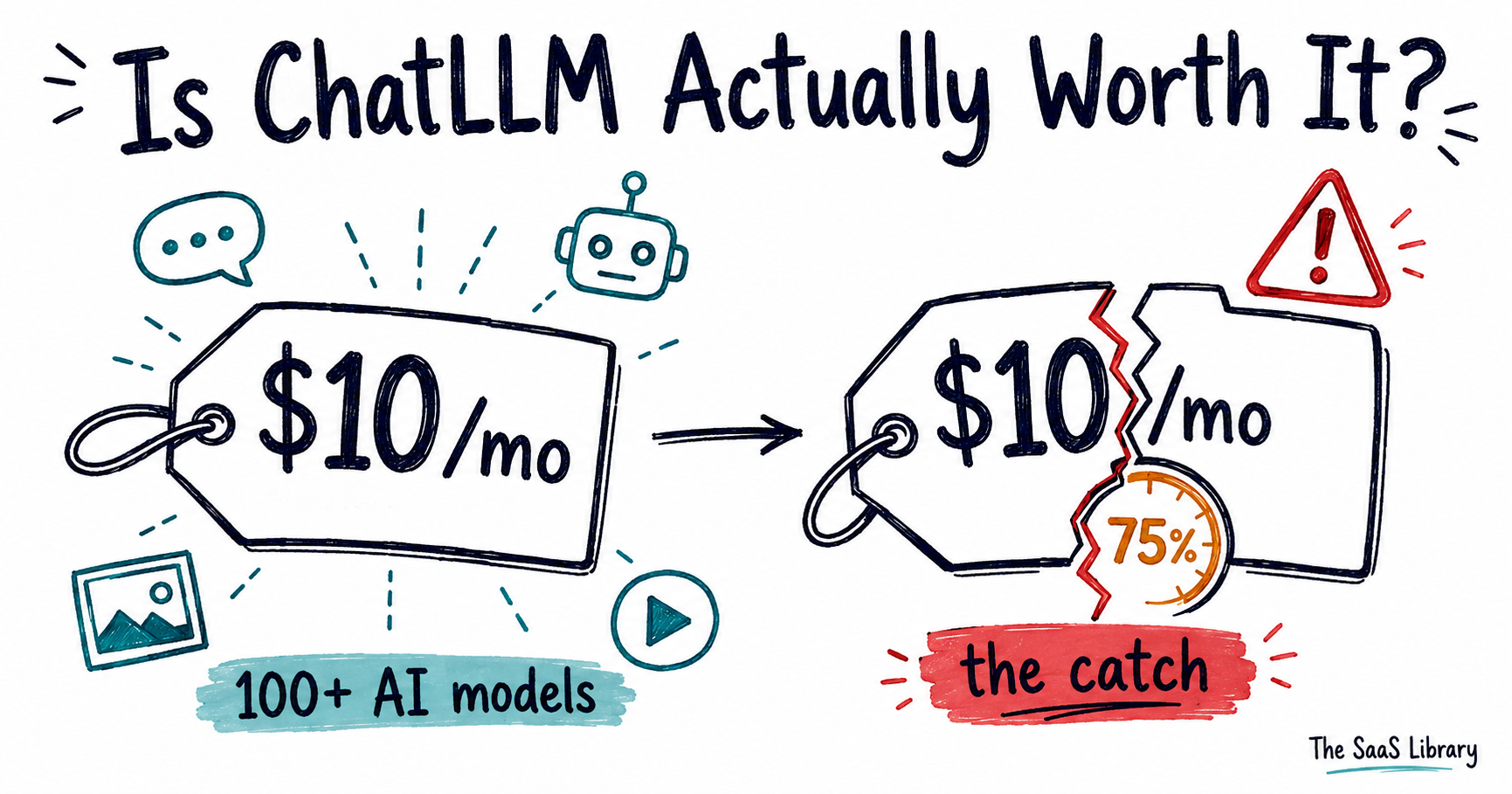
Everyone’s seen the pitch by now — one AI subscription, every major model, ten dollars a month. This review checks whether that pitch actually holds.
Removed the “quiet 2026 IPO prep” claim — no credible source behind it.
Removed the “#1 on Terminal Bench” claim as a current fact — true in November 2025, not the story anymore.
Removed an old Trustpilot stat pulled from a tiny 6-review sample.
Added the DeepAgent name change — it’s officially Abacus AI Agent now (since March 2026), and almost nobody covering this has caught it.
Added the OpenClaw credit-drain incident and the well-documented “75% lockout” pattern, backed by real user reports.
Corrected the entire model lineup and Terminal-Bench standings to reflect what’s actually true today.
What Is ChatLLM, and Who Makes It?
ChatLLM is a multi-model AI subscription built by Abacus.AI, a San Francisco company that gives users chat access to over 100 outside AI models — GPT, Claude, Gemini, and dozens more — under a single $10-to-$20-a-month login instead of a single in-house model.
Abacus.AI didn’t start out building chatbots. Bindu Reddy, Arvind Sundararajan, and Siddartha Naidu founded the company in 2019 as RealityEngines.AI, a deep-learning research lab aimed at giving businesses without a data-science team access to prediction and personalization tools. The company rebranded to Abacus.AI in July 2020 alongside a $13 million Series A round.
Reddy runs the company as CEO. Before Abacus, she led AI Verticals at AWS and headed product for Google Apps, including Docs, Sheets, and Slides — the kind of background that explains why Abacus builds broad productivity tooling rather than a single narrow model. Sundararajan, the CTO, came from Uber’s autonomous-vehicle division; Naidu leads ML and research.
The company has raised $90.3 million across four rounds, most recently a $50 million Series C in October 2021 co-led by Tiger Global and Coatue. No new priced funding round has been publicly reported since.
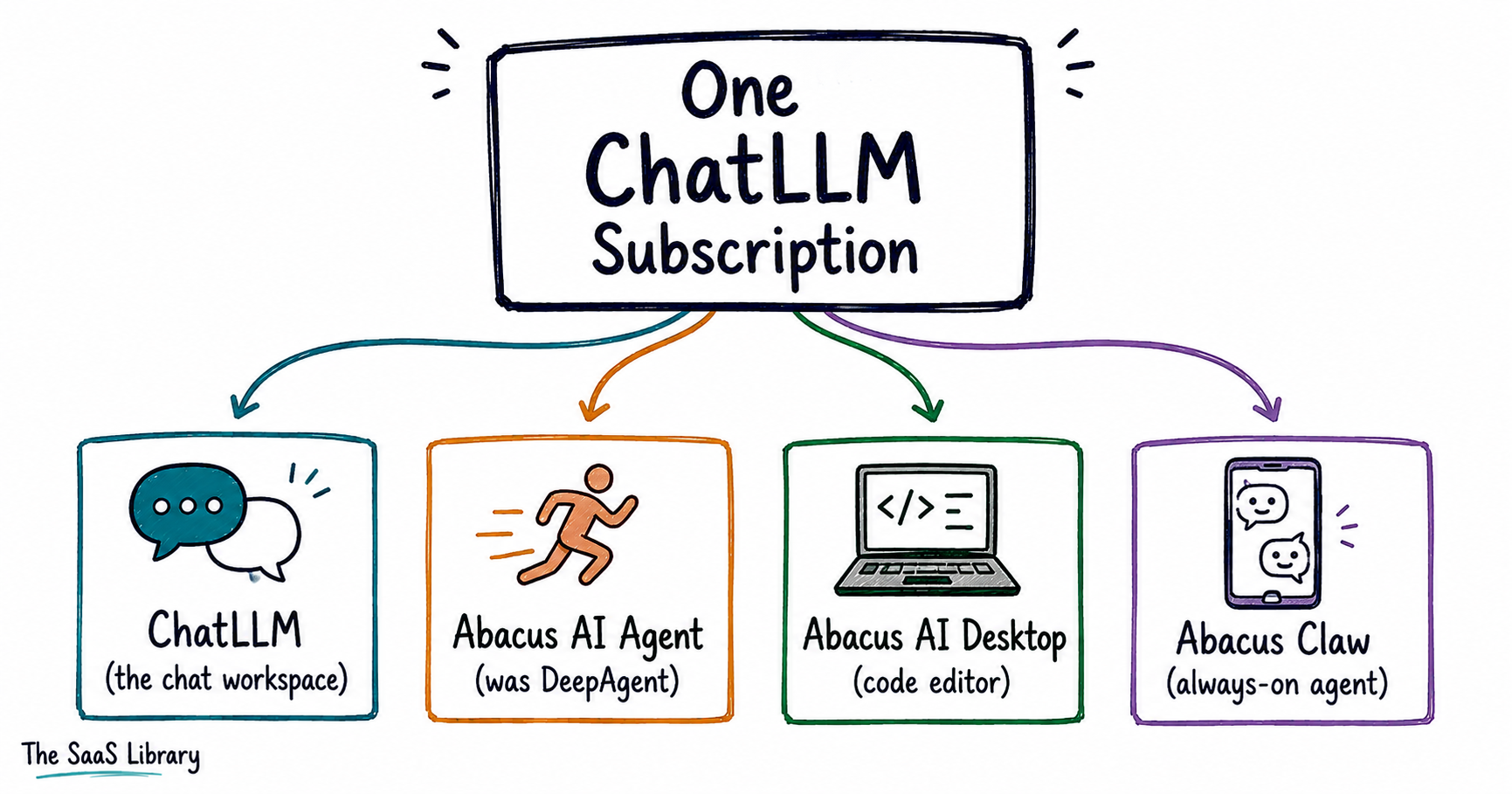
ChatLLM is the consumer-facing product built on top of that infrastructure — but it’s not the only name you’ll see. Three products sit under the same subscription and are easy to confuse:
| Product | What it actually is |
|---|---|
| ChatLLM | The chat workspace itself — the interface where you pick a model and talk to it |
| Abacus AI Agent | The autonomous task-runner (this used to be called DeepAgent — more shortly) |
| Abacus AI Desktop | A separate AI code editor with a CLI, chat, and VS Code extension |
| Abacus Claw | An always-on personal agent that runs inside WhatsApp, Telegram, or Slack with persistent memory |
Getting these straight matters before anything else in this review, because most of the confusion in other coverage of ChatLLM traces back to treating these as one thing. The pitch is simple. What it’s actually made of isn’t — and that’s where the real questions start.
How Much Does ChatLLM Really Cost?
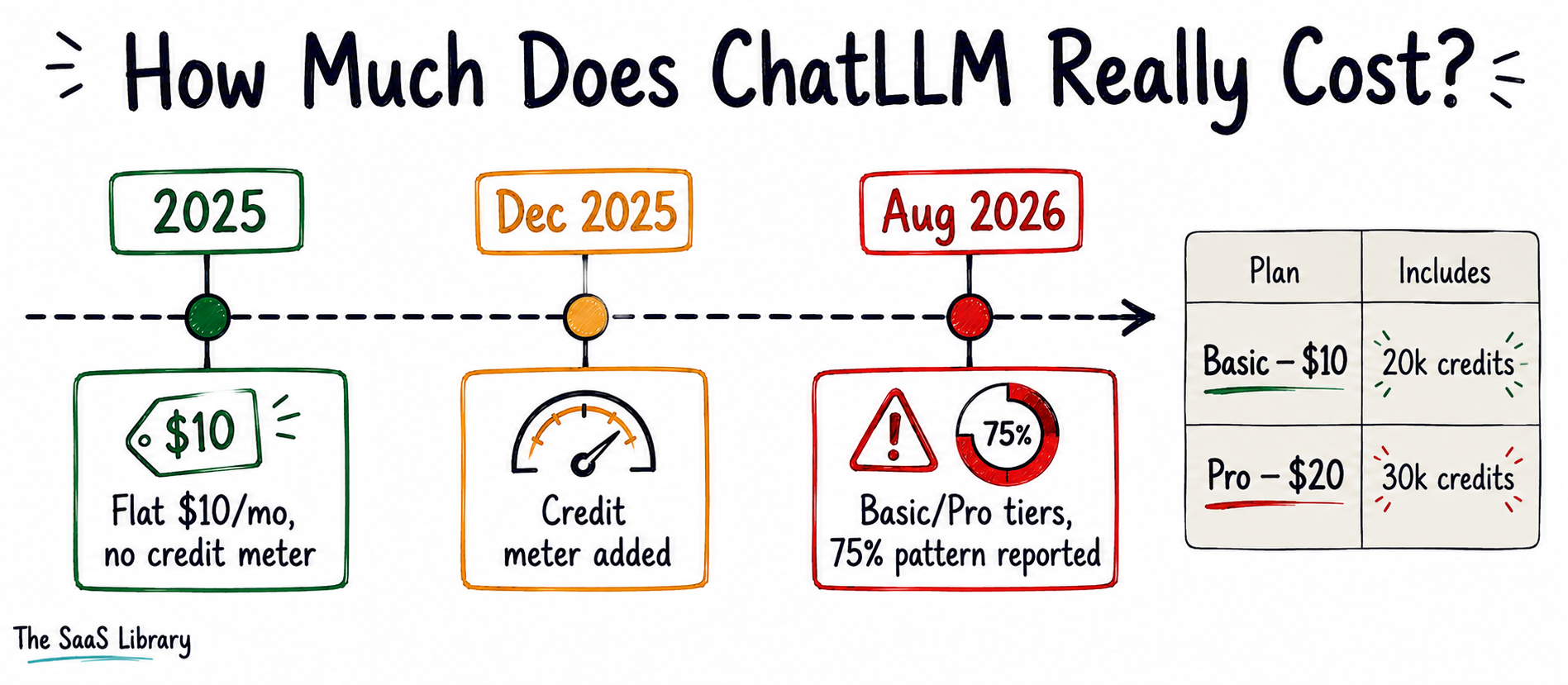
ChatLLM costs $10 a month for the Basic plan (discounted to $7 for your first month) or $20 a month for Pro, with Enterprise pricing handled separately through Abacus.AI’s sales team. Basic includes 20,000 monthly credits and 3 agent conversations; Pro includes 30,000 credits and unrestricted agent use.
The price wasn’t always this complicated. ChatLLM launched in 2025 as a flat, unmetered $10-a-month plan with no visible credit system at all — archived snapshots of the pricing page show only that single tier through September 2025. A credit meter and the Basic/Pro split were bolted on starting December 2025, once heavier features like agents and video generation needed a way to ration usage.
| Plan | Price | Monthly credits | Abacus AI Agent | Abacus AI Studio (video) |
|---|---|---|---|---|
| Basic | $7 first month, then $10/mo | 20,000 | Capped at 3 conversations/mo | Capped at 3 conversations/mo, 2,500 credits each |
| Pro | $20/mo | 30,000 | Unrestricted | Unrestricted |
| Enterprise | Custom — sales-led | Custom | Unrestricted | Unrestricted |
Both are confirmed directly in the official ChatLLM FAQ and Abacus.AI’s billing FAQ.
That credit system is where most of the real complaints start. Abacus doesn’t publish a per-model credit rate, so there’s no way to calculate your bill in advance. One Trustpilot reviewer wrote:
That’s not just a complaint — Abacus’s own billing FAQ confirms the mechanic directly: “if you only paid $7 to access the Basic Tier, you will only receive 14k credits.” The 20,000-credit figure only applies once you’re paying the full $10.
Beyond that specific promo mechanic, multiple independent reviewers describe hitting a wall at roughly 75% of their monthly credit pool, where premium models get throttled or locked even though a quarter of the paid-for balance is technically still there. Abacus.AI’s own FAQ doesn’t document that 75% threshold anywhere — this specific mechanic remains user-reported, not vendor-confirmed. Another Trustpilot reviewer reported losing 6,000 of their 20,000 monthly credits after uploading around 10 PDFs across a couple of days of light use — roughly 50 cents a prompt on a subscription marketed as $10 flat.
That gap between what’s vendor-confirmed and what’s only user-reported is worth sitting with before you commit a card number — and it’s part of a broader pattern in how AI companies actually decide their pricing in the first place. The pitch survives the price check. Whether the models behind it are worth what you’re paying is next.
What Models and Tools Do You Actually Get for That Price?
For that price, you get chat access to more than 100 AI models, including the current flagship lines from OpenAI, Anthropic, Google, and xAI, plus a growing list of image and video generators — all switchable from the same conversation, with Abacus.AI adding new models within 24 to 48 hours of their public release.
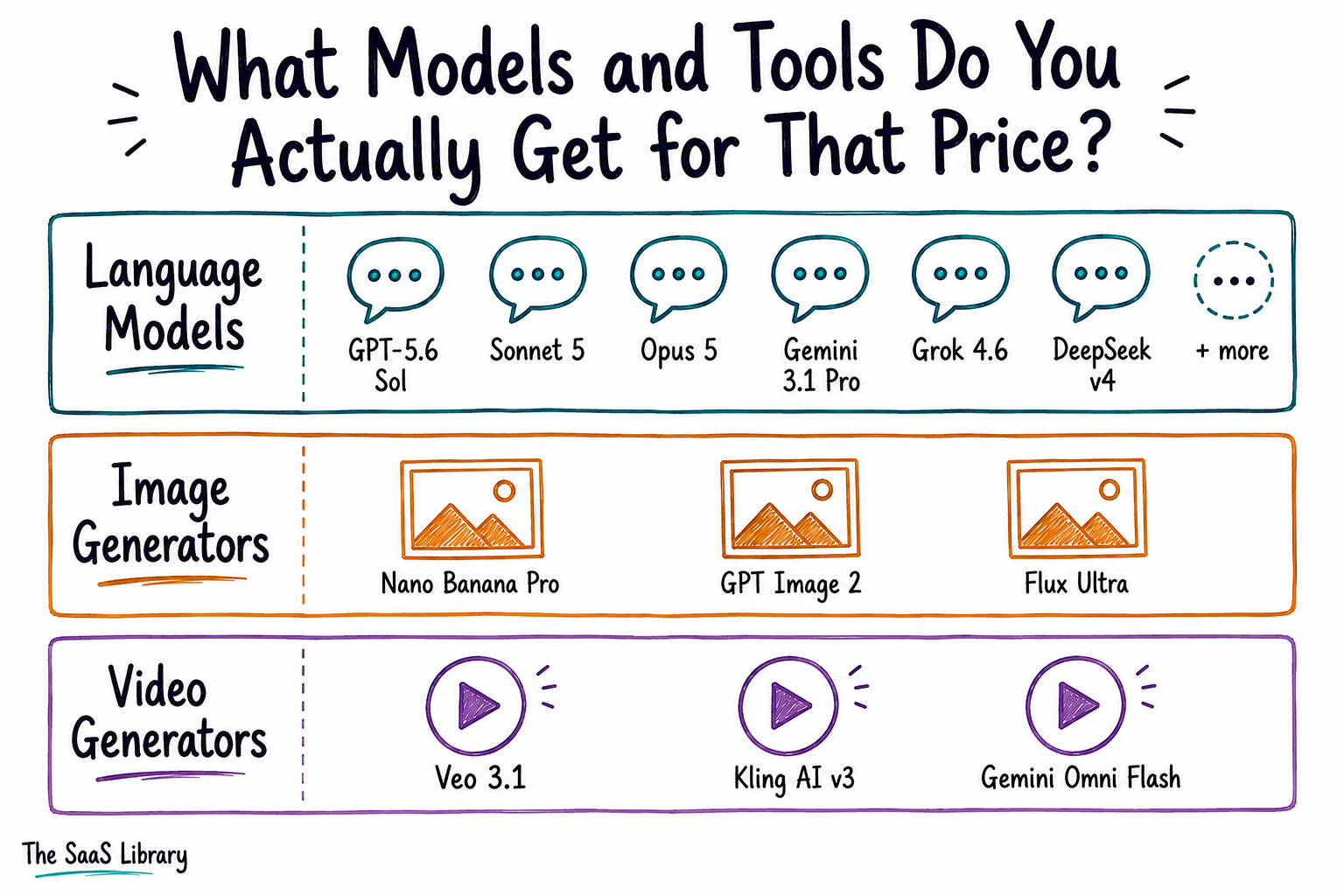
Abacus.AI’s own FAQ lists the current roster directly, and it’s worth reading in full because most third-party reviews are quoting an older version of it. As of August 2026, ChatLLM includes:
| Category | Models included |
|---|---|
| Language models | GPT-5.6 Sol, Sonnet 5, Opus 5, Fable 5, Gemini 3.1 Pro, Gemini 3.7 Flash, Grok 4.6, Qwen 3.8 Max, DeepSeek v4, Kimi K3, GLM 5.3, Ox Alpha (an anonymous “stealth” model — its developer’s identity hasn’t been publicly disclosed), and 20 other closed and open-source models |
| Image generators | Nano Banana Pro, GPT Image 2, Flux Ultra, Nano Banana 2, FLUX 2 Pro, Recraft, Ideogram 3.0 |
| Video generators (via Abacus AI Studio) | Gemini Omni Flash, Veo 3.1, Kling AI v3, Seedance 2.5 (ByteDance’s own official launch announcement confirms this model, but names their current image model “Seedream 5.0 Pro” — not “Seedream 4.5” as Abacus’s FAQ lists it) |
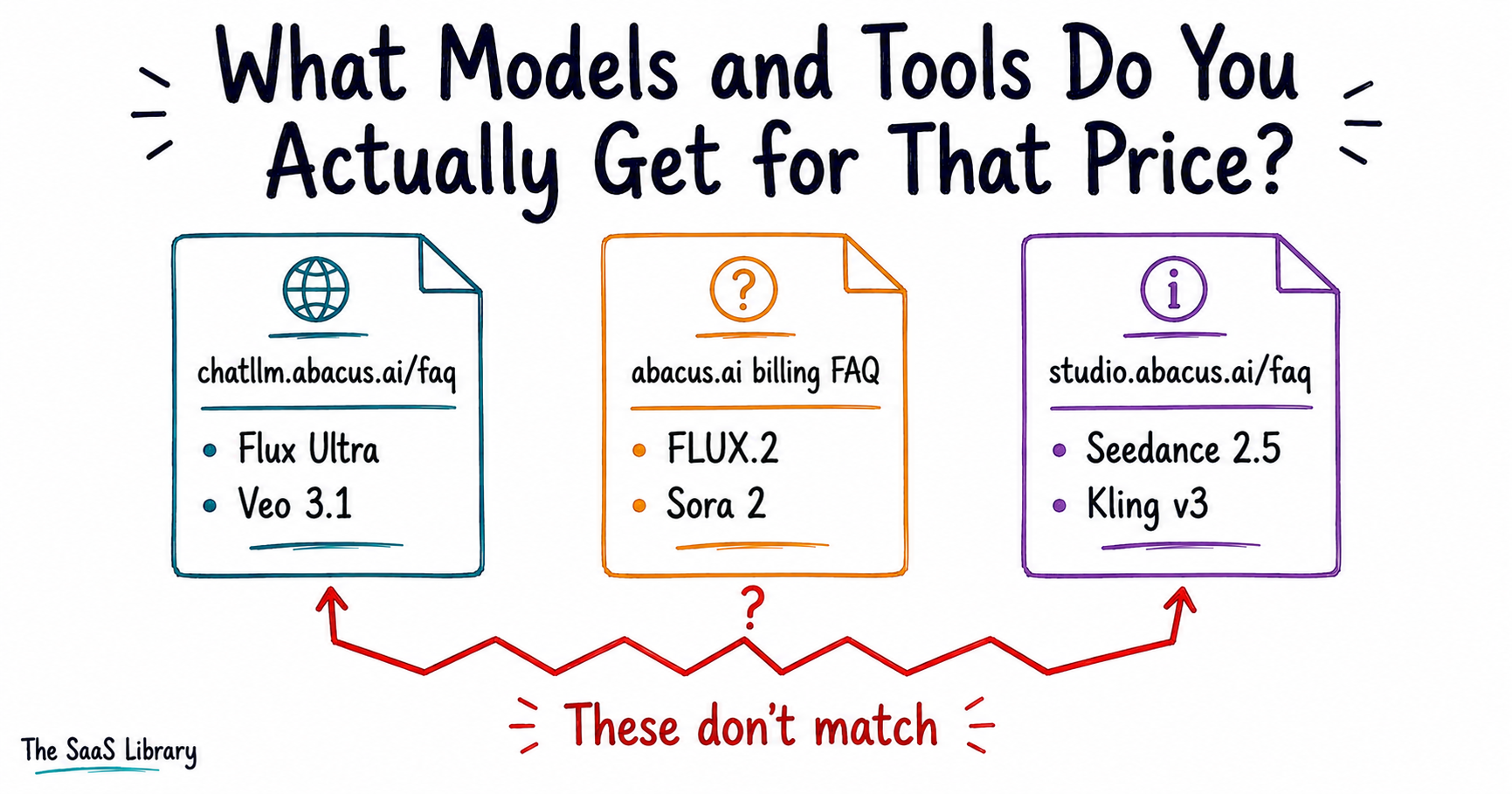
Worth flagging directly: the image and video names above come from chatllm.abacus.ai/faq, but the same billing FAQ referenced above lists a different set — GPT Image 1.5, FLUX.2, and Flux Kontext instead of GPT Image 2 and Flux Ultra, and Sora 2, Wan, Lumalabs, Hailuo, and RunwayML instead of Gemini Omni Flash and Veo 3.1. And Abacus AI Studio’s own FAQ lists a third, distinct roster again. All three are Abacus’s own current pages. That’s not a third party getting it wrong — it’s the company’s own product documentation failing to agree on what it actually offers.
That’s the “100+ models” claim Abacus markets — and it holds up against the official list, even if the exact names shift every few months. If you want to see how these individual models actually stack up against each other rather than just sitting in one bundle, our ChatGPT vs. Claude 2026 breakdown goes deeper on that specific matchup.
Want the model-level comparison before you look at the bundle?
Read ChatGPT vs. Claude 2026 →You’re not expected to manually pick a model every time, either. A router called RouteLLM analyzes your prompt and selects a suitable model automatically. Separately, Abacus’s own billing documentation confirms a second tier of lighter models that stay usable on an unlimited basis even after you’ve spent your monthly credits — though they still accrue credit usage in the background:
| Unlimited-tier model | Provider |
|---|---|
| GPT-5 Mini | OpenAI |
| Gemini 3 Flash | Google DeepMind |
| Grok Code Fast | xAI |
| GLM 4.7 | Z.ai |
| Kimi K2 | Moonshot AI |
| Llama 4 | Meta |
On update speed, the claim checks out: Abacus states it adds new models within 24 to 48 hours of release, and the roster above includes models that only became publicly available in the past few months. What the model list doesn’t tell you is how much each one costs you in credits, or which ones are worth reaching for — and one of the biggest reaches, an agent that claims to code better than most, is exactly where the paper trail gets shaky.
What Happened to DeepAgent?
What happened to DeepAgent is a rename, not a shutdown — Abacus.AI renamed it Abacus AI Agent on March 1, 2026, as part of a routine platform update, and the new name has been rolling out across the product ever since. The underlying tool didn’t change; only the label did.
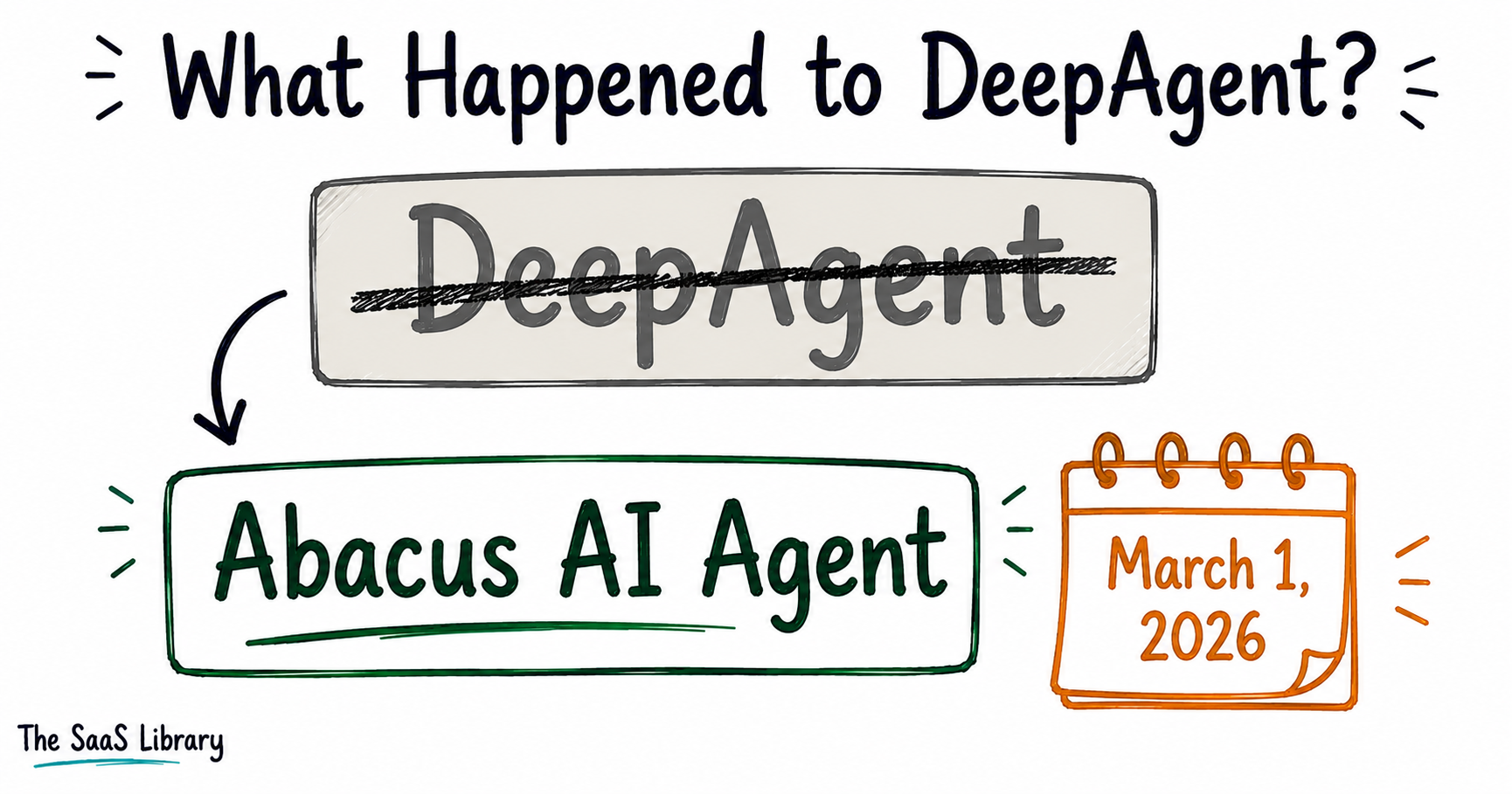
Abacus.AI confirmed the rename directly in its own March 2026 platform update notes, attributed to Christopher Yates, Head of Presales Data Science at Abacus.AI:
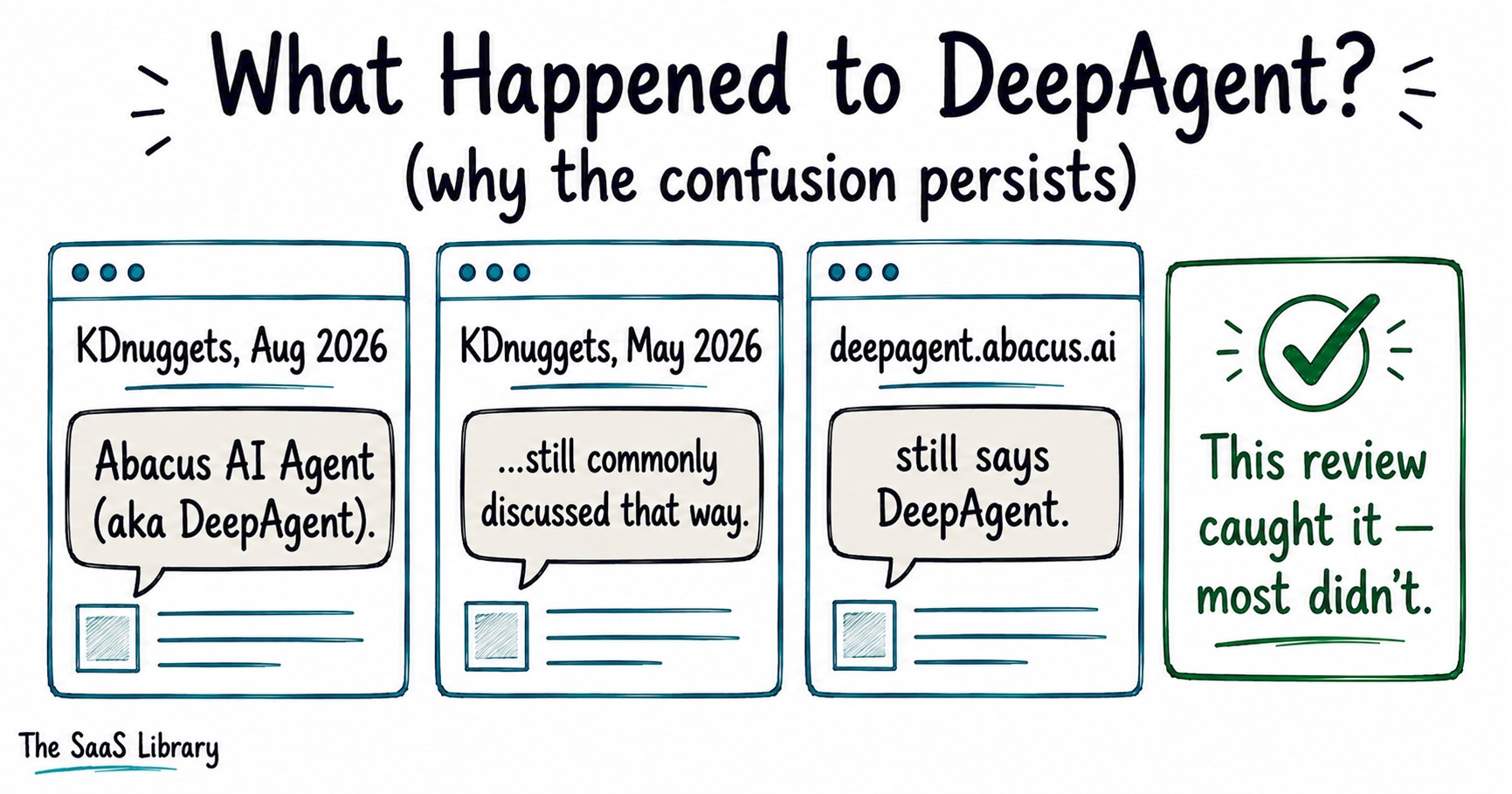
That’s a small line in a changelog, but it matters more than it looks. Search for reviews of ChatLLM today and most of them still say “DeepAgent” — including pieces published well after the rename, like KDnuggets’ August 2026 review, which calls it “Abacus AI Agent (Also known as ‘DeepAgent’),” and a May 2026 KDnuggets piece that still calls it “DeepAgent” in its own byline coverage, noting only in passing that it “was previously known by many users as DeepAgent, and it is still commonly discussed that way” — treating the rename as a footnote rather than the headline it probably should be. Even Abacus’s own product domain still runs on the old name — deepagent.abacus.ai is the live URL for what the interface now calls Abacus AI Agent.
If you’re the kind of reader who understands this space by comparing an AI agent to a standard chatbot in the first place, it’s worth being precise about what actually changed here versus what didn’t. Our breakdown of the difference between an AI agent and a chatbot covers that distinction in general; Abacus AI Agent fits squarely on the “agent” side of that line — it doesn’t just respond to a prompt, it executes multi-step tasks on its own.
What it actually does hasn’t changed with the rename. Per Abacus.AI’s own product page, Abacus AI Agent “will create apps, videos, presentations and workflows” — a general-purpose autonomous agent, not a narrow coding tool. On the Basic plan, it’s capped at 3 conversations a month; Pro removes that cap entirely, as covered in the pricing breakdown above.
The name is the only thing that’s new. What it can actually do — and whether it’s any good — is a separate question, and it’s the one that matters more.
Is Abacus AI Agent Actually the Best Coding Agent, Like It Claims?
Abacus AI Agent is not currently the best coding agent available — it topped a widely repeated “#1 on Terminal Bench” claim in November 2025, but that claim traces to a single third-party review, not Abacus’s own announcement, and it hasn’t held up: as of August 2026, GPT-5.6 Sol, Claude Opus 5, and Grok 4.6 lead the current Terminal-Bench 2.1 leaderboard, and Abacus’s agent doesn’t appear on it at all.
Here’s where the claim actually comes from. A November 21, 2025 entry in Deeper Insights’ Abacus AI review states: “Abacus.AI coding agent hits #1 on Terminal Bench leaderboard – beats Claude Code, Codex, and every other publicly available agent.” That’s the exact sentence most later coverage repeats. It’s worth being precise about what this is and isn’t: it’s a claim made by a third-party review site, not a statement from Abacus.AI’s own press channels, and no independently archived Terminal-Bench leaderboard snapshot from that date could confirm it. Abacus does maintain its own public run-log repositories for Terminal-Bench submissions, showing the company was genuinely participating in the benchmark around that time — but participating and being independently verified as #1 are two different things.
Whatever the case was in November 2025, it isn’t the case now. Per the Artificial Analysis Terminal-Bench v2.1 leaderboard: “GPT-5.6 Sol (xhigh) scores the highest on Terminal-Bench v2.1 with a score of 89.5%, followed by Claude Opus 5 (Adaptive Reasoning, Max Effort) with a score of 89.1%, and Grok 4.6 (high) with a score of 88.4%.”
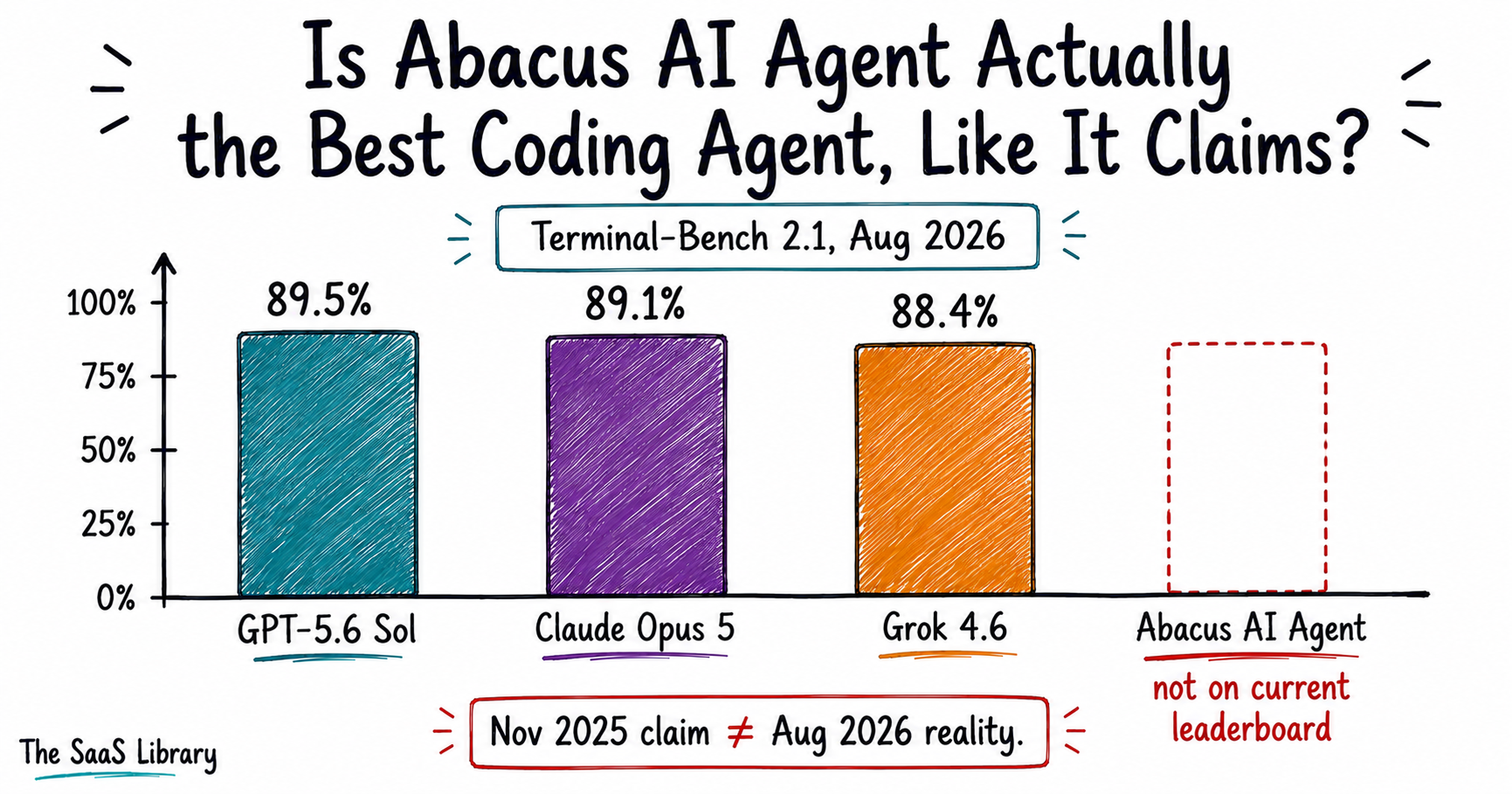
Abacus AI Agent does not appear anywhere on that leaderboard. It’s also absent from every other current mirror of the same benchmark checked for this review, including Vals AI’s Terminal-Bench 2.1 tracker and CodingFleet’s compiled 2.1 rankings, both updated within the past two weeks and each covering dozens of models.
That’s not proof Abacus AI Agent is bad at coding tasks — it’s proof the specific “#1” claim that keeps circulating is stale and shouldn’t be repeated as current fact, which is exactly what most other ChatLLM reviews are still doing.
If you’re weighing whether an agent like this actually belongs in your workflow rather than just how it benchmarks, our guide to building an AI agent step by step is a useful next read — and our breakdown of 8 AI agent use cases you can deploy right now covers where agents like this one actually earn their keep, separate from leaderboard bragging rights.
ChatLLM vs. ChatGPT Plus vs. Claude Pro vs. Google AI Pro: How Does It Actually Compare?
ChatLLM undercuts all three native subscriptions on price — $10 versus $20, $20, and $19.99 a month respectively — while bundling access to all of their underlying models in one place. What it doesn’t bundle is each platform’s own ecosystem: Claude Projects, the GPT Store, and Google’s Workspace integration all stay behind their native subscriptions.
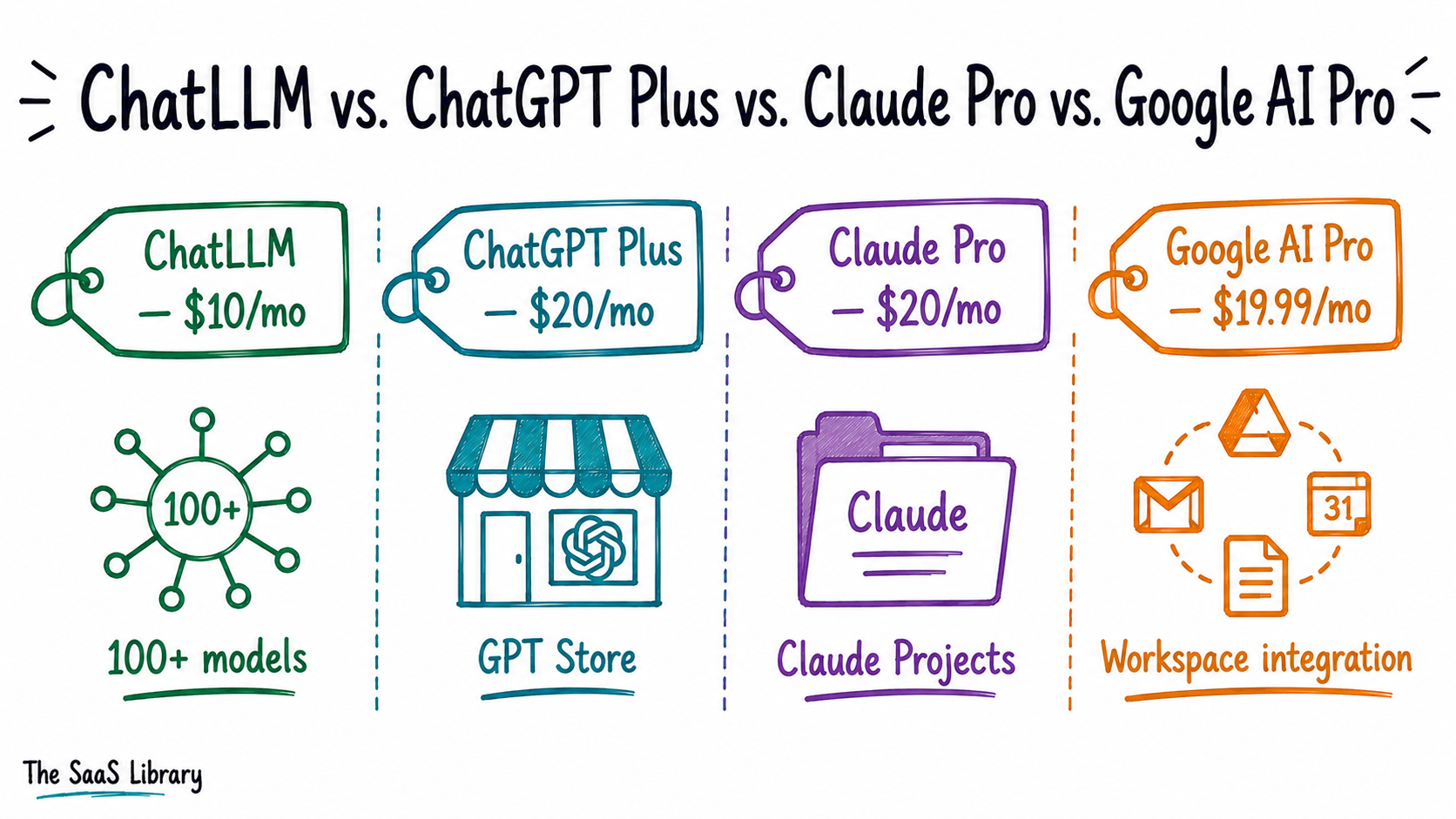
Here’s the actual price comparison, verified against current listings:
| Plan | Price/month | What it includes |
|---|---|---|
| ChatLLM Basic | $10 ($7 first month) | 100+ models across providers, 20,000 credits, capped agent/video use |
| ChatGPT Plus | $20 | GPT-5.6 family, GPT Store/Custom GPTs, native voice mode |
| Claude Pro | $20 | Claude Sonnet 5/Opus 5, Claude Projects, Claude Code |
| Google AI Pro | $19.99 | Gemini 3.1 Pro, Google Workspace integration, 5TB storage |
(Pricing cross-verified against AI Pricing Guru’s daily-updated subscription tracker, which pulls directly from each provider’s own pricing page — current as of August 24, 2026.)
The price gap is real, but it’s not the whole story. Each native subscription bundles something ChatLLM doesn’t replicate:
- Claude Projects — a persistent workspace that holds your instructions, files, and context across every conversation. Per one detailed 2026 comparison, “Claude Projects is the better-built workspace” for solo operators and small teams doing writing-heavy work — and it’s private to your account or team, with no equivalent public option.
- The GPT Store — ChatGPT’s public marketplace of Custom GPTs, where you can publish a GPT and share it publicly, by link, or restrict it to your organization — a distribution layer the same comparison confirms Claude Projects simply doesn’t have, and one ChatLLM has no equivalent for either.
- Google Workspace integration — Google AI Pro’s native tie-in to Gmail, Docs, and Drive, plus 5TB of storage bundled into the subscription.
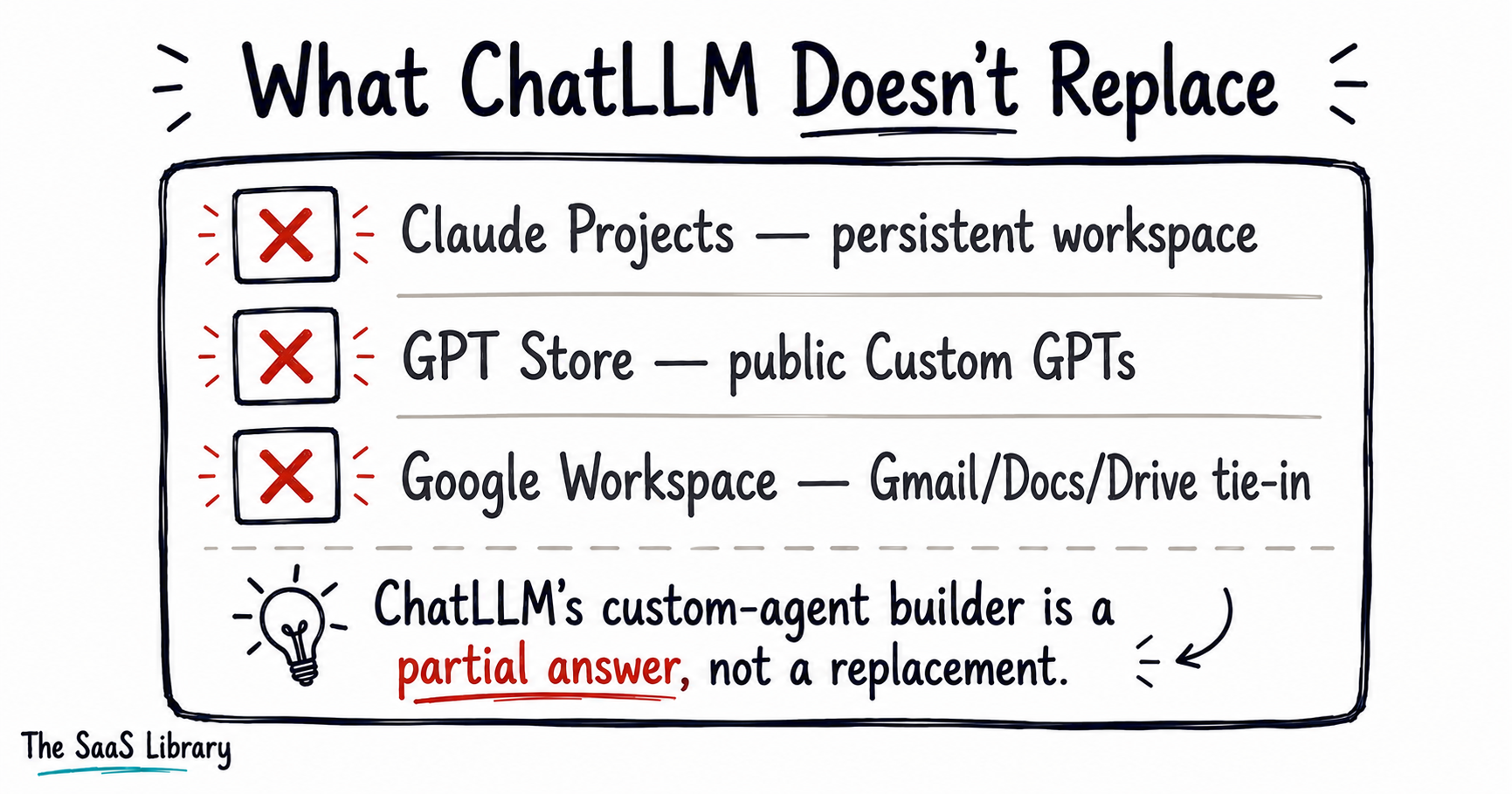
ChatLLM’s own custom-agent builder is a partial answer to Projects and Custom GPTs, but it’s not the same thing — it lacks a public storefront, and it isn’t purpose-built around any single provider’s document or workspace ecosystem the way Claude Projects or Google’s integration are.
The honest read: ChatLLM’s $10 price buys you breadth — every model family, one login — but not depth in any single ecosystem. Whether that trade is worth it depends entirely on whether you actually use Projects, the GPT Store, or Workspace integration today, which is exactly what the next section is built to help you figure out.
Is ChatLLM Actually Trustworthy? What Do Real Users Say?
Real users are split almost exactly in half — Abacus.AI’s main Trustpilot profile sits at 3.5 out of 5 across 195 reviews, while the ChatLLM-specific subdomain sits much lower at 1.9 out of 5 across just 14 reviews. The gap between those two numbers tells you more than either number alone: people are largely fine with Abacus.AI as a company, and considerably less fine with ChatLLM’s credit system and support specifically.
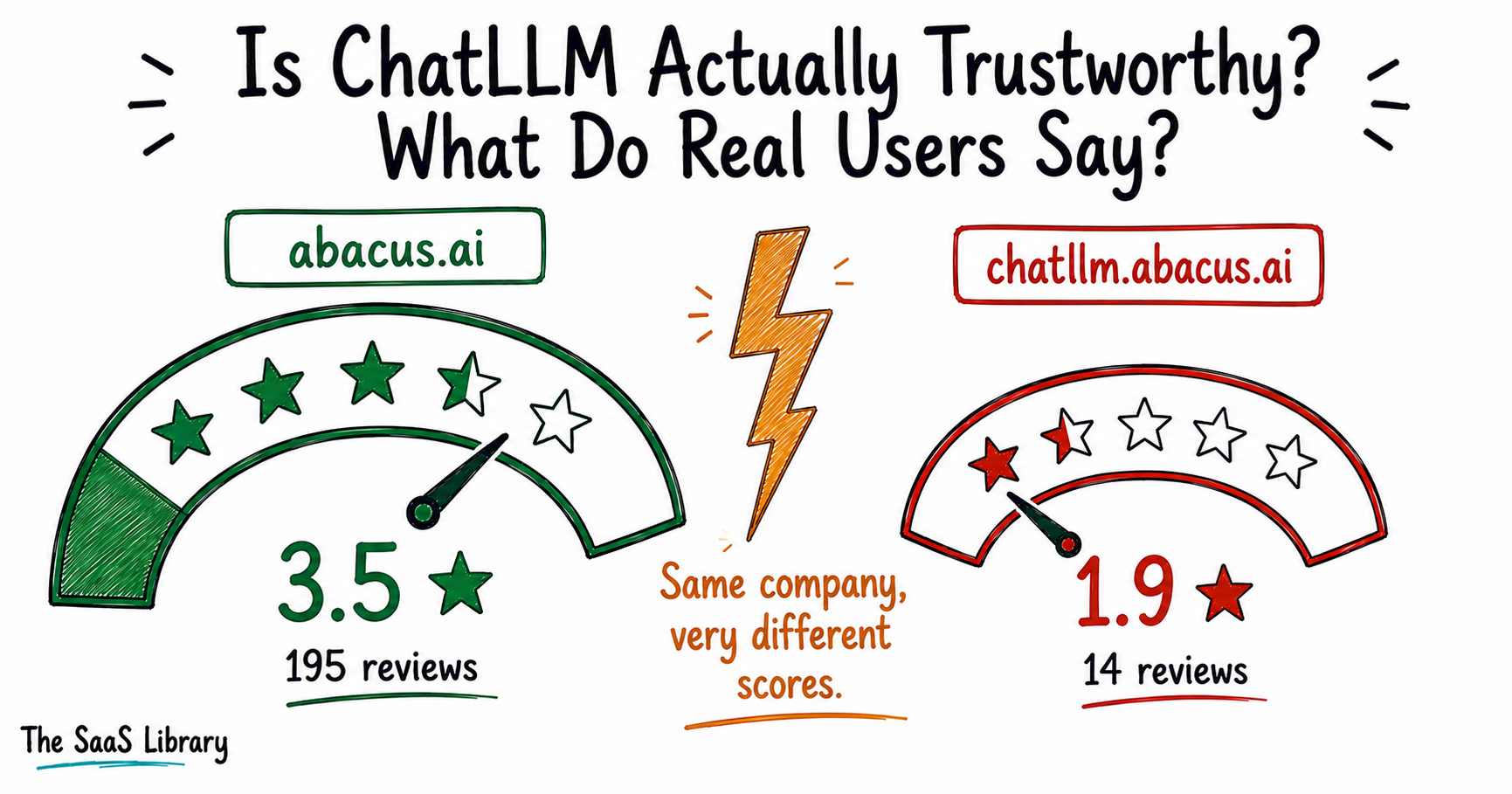
Both figures come directly from Trustpilot’s own listing for abacus.ai, captured for this review: “abacus.ai · 3.5 · 195 reviews,” alongside a sidebar of related profiles showing “chatllm.abacus.ai · 1.9 · (14).” That’s a genuinely small sample for the ChatLLM-specific number, so treat it as directional rather than statistically solid — but the sentiment in those 14 reviews lines up with complaints that show up far more often on the larger abacus.ai profile too.
| Profile | Rating | Reviews |
|---|---|---|
| abacus.ai (Trustpilot) | 3.5/5 | 195 |
| chatllm.abacus.ai (Trustpilot) | 1.9/5 | 14 |
| Abacus.ai (G2) | 4.3/5 | 14 |
The positive reviews on that same abacus.ai Trustpilot page cluster around one theme: consolidation. Several reviewers describe it saving both time and money by replacing multiple separate subscriptions with a single login — the same theme that shows up independently on G2, where reviewers cite time saved from not switching between tools.
The negative reviews cluster just as tightly around the credit system. On the ChatLLM-specific Trustpilot page, one reviewer wrote:
Separately, other reviewers on the main abacus.ai page describe losing thousands of credits on small tasks and being locked out with no warning once they crossed an undisclosed threshold.
There’s also a specific, documented incident worth knowing about. Per eesel AI’s review of Abacus AI alternatives: “A documented Reddit report described Abacus’s OpenClaw product — accessible to all ChatLLM subscribers — silently consuming credits on every page refresh, exhausting one user’s full monthly balance plus purchased top-ups in under a week without building anything. The user got no support response, and the complaint was deleted from the Abacus subreddit.” That’s a single documented report, not a pattern confirmed across many users — but it’s specific, dated, and matches the broader credit-opacity complaints described above.
Support responsiveness is the other recurring complaint. Multiple reviewers on the abacus.ai Trustpilot page describe billing disputes and refund requests met with generic or absent replies — a pattern that shows up repeatedly enough across different reviewers that it doesn’t need a second verbatim quote from the same page to establish.
None of this makes ChatLLM untrustworthy in any absolute sense — plenty of users are genuinely happy, and the positive reviews aren’t fake-sounding or generic. But the specific, recurring shape of the complaints — credit drain, no advance warning, slow or absent support — is exactly the kind of risk worth weighing before you hand over a card number, which is precisely what the framework in the next section is built to help you do.
How Do You Know If ChatLLM Is Actually Right for You?
You know if ChatLLM is actually right for you by running your situation through four checks — Subscription Count, Ecosystem Lock-in, Agent Load, and API Ceiling. We’re calling this The Seat Swap Test, and it’s built directly from the trade-offs already covered in this review.
Everything in this review points to the same underlying question: are you actually the kind of user ChatLLM was built to save money for, or are you the kind of user who’d be trading away something you rely on? The Seat Swap Test turns that into four concrete checks, in order.
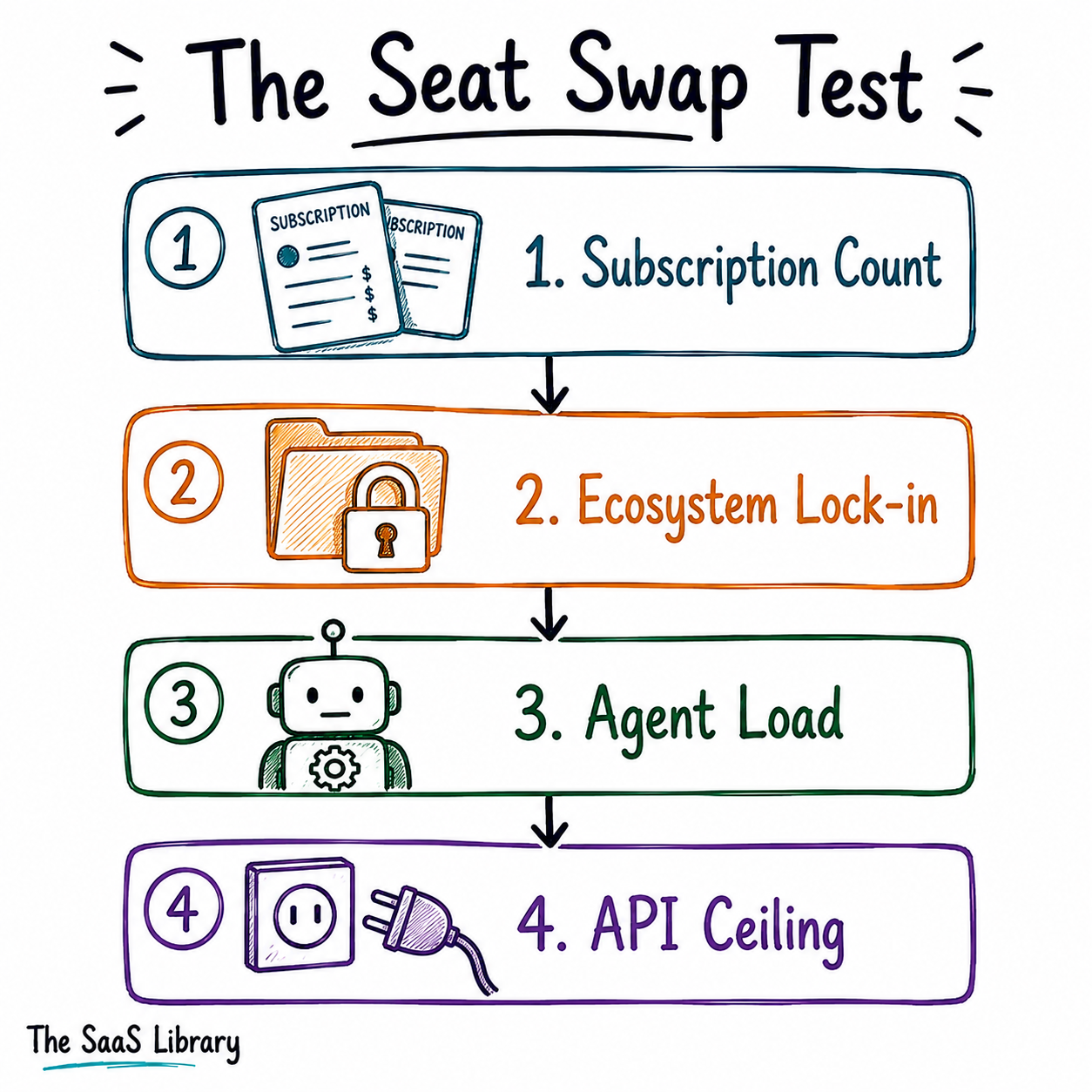
Run all four, and the pattern that falls out is usually clear: light, spread-out users pass most checks and save real money; anyone with a deep dependency on one native ecosystem, heavy agent use, or a future need for API access is trading away more than the $10–$20 difference is worth.
How Much Could You Actually Save by Switching to ChatLLM?
How much you could save depends entirely on which subscriptions you’re currently paying for and which ChatLLM plan you’d switch to — the calculator below does that math directly, using the verified pricing from this review, so you don’t have to do it by hand.
Every number in this section’s tool traces back to the same sources already cited earlier in this review:
| Subscription | Price | Source |
|---|---|---|
| ChatGPT Plus | $20/month | AI Pricing Guru |
| Claude Pro | $20/month | AI Pricing Guru |
| Google AI Pro | $19.99/month | AI Pricing Guru |
| ChatLLM Basic | $10/month ($7 first month) | chatllm.abacus.ai/faq |
| ChatLLM Pro | $20/month | Abacus.AI billing FAQ |
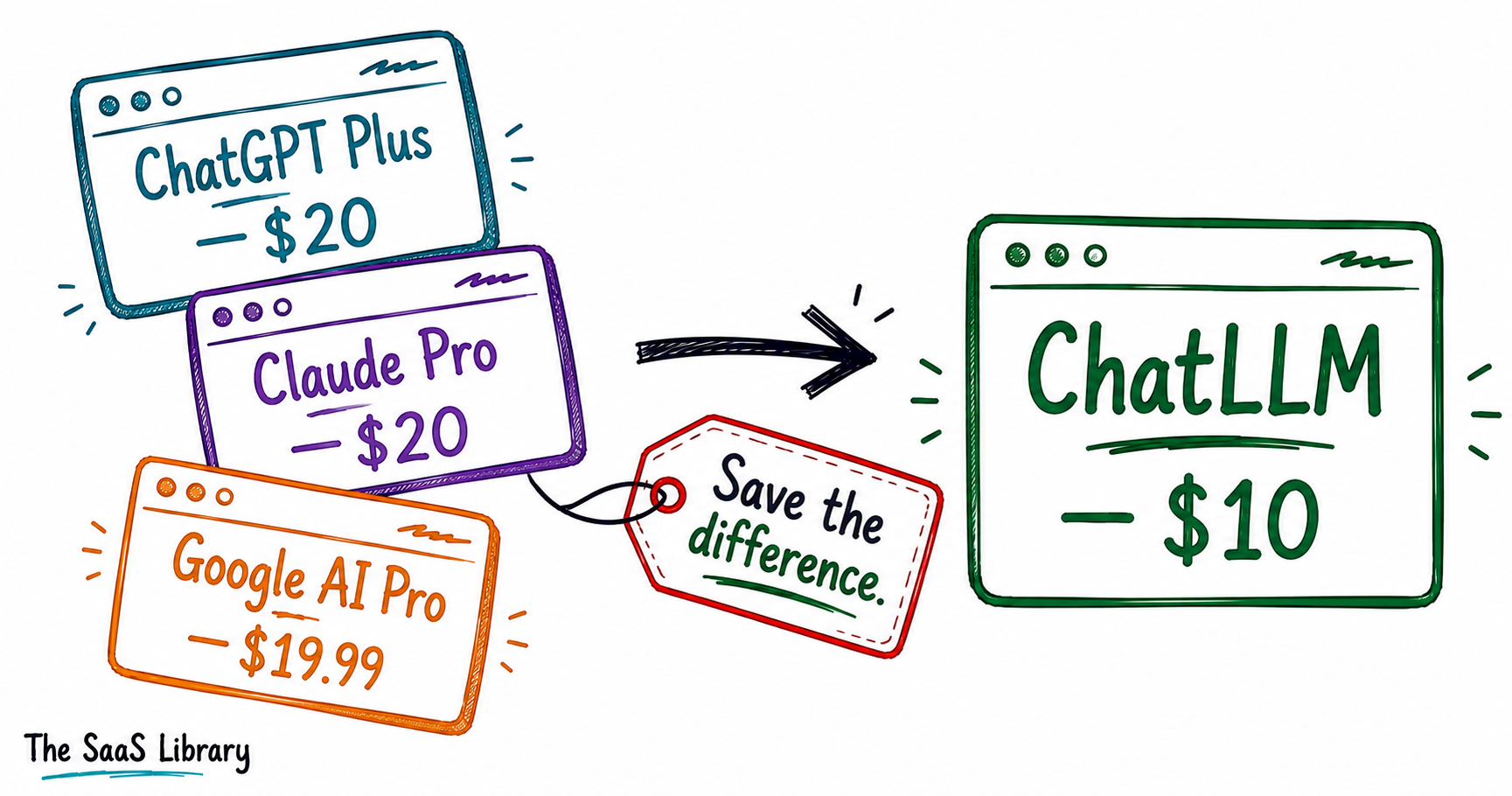
One honest limit worth stating up front: the calculator above compares list prices only. It can’t price in what you’d give up — Claude Projects, the GPT Store, Google Workspace integration, or a predictable, non-credit-metered bill — because that value is personal to how you actually use those features. Run the numbers here, then weigh the result against the Seat Swap Test above before you decide.
Who Should Actually Use ChatLLM in 2026?
Who should actually use ChatLLM comes down to four groups: (1) developers who want multiple coding models without juggling accounts, (2) content and creative teams switching between writing, image, and video tools, (3) businesses automating repetitive knowledge work, and (4) anyone currently paying for two or more AI subscriptions they use lightly. It’s the wrong fit for anyone who only uses one model for one task type, or who needs predictable, business-critical uptime.
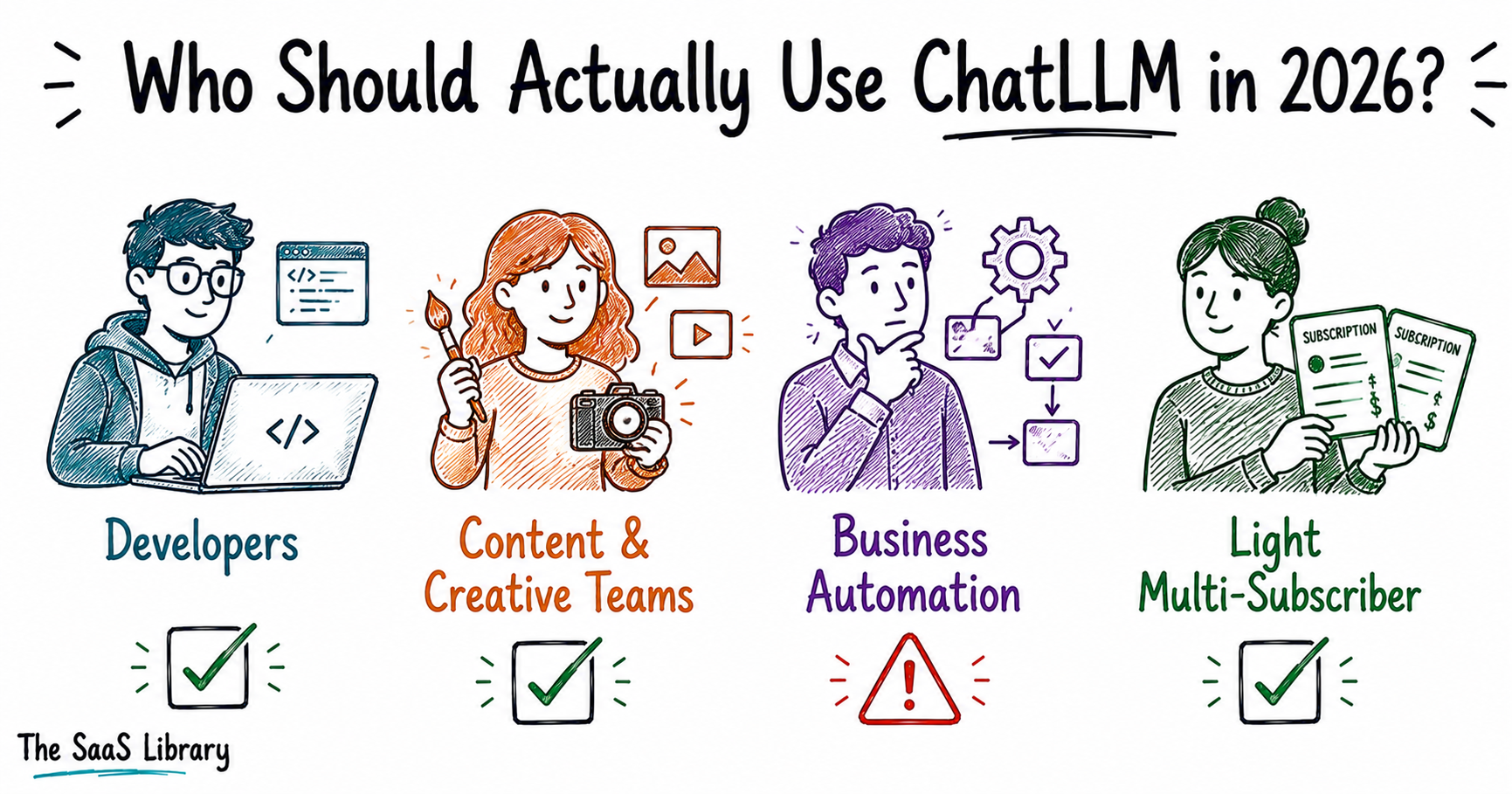
Here’s how those groups actually break down, based on firsthand accounts rather than marketing copy:
| Reader type | Where it works | Where it doesn’t |
|---|---|---|
| Developers | Multi-model access for different coding tasks; Abacus AI Desktop’s PR review handles first-pass code review reliably | Not a replacement for deep, context-specific review |
| Content & creative teams | Abacus AI Studio “consolidates 25+ creative models into one workspace, which reduces both cost and context-switching” | Credit-metered video/image generation still needs monitoring for heavy use |
| Business automation | Document processing, research synthesis, and workflow automation are named strengths across multiple reviews | Business-critical, uptime-sensitive work is a real risk — see caveat below |
| Light multi-subscriber | Anyone spreading casual use across ChatGPT, Claude, and Gemini saves real money | Heavy single-platform users lose more in ecosystem depth than they save |
One firsthand account is worth quoting directly. A developer who spent 60 days testing ChatLLM against their existing $60/month stack — ChatGPT Plus, Claude Pro, and Perplexity Pro combined — ran it against real pull requests and reported:
That same review is also direct about who shouldn’t bother: users who only need one model for one task — someone doing nothing but long-form writing with Claude, for instance — are better off subscribing to that one tool directly rather than paying for breadth they won’t use.
eesel AI, which sells a competing purpose-built customer-support AI tool, argues that ChatLLM’s credit model is unsuitable for anything business-critical, since a credit pool “that quietly cuts off mid-shift” breaks trust fast in live support settings. That’s a real structural point even coming from an interested party — it lines up with the credit-lockout pattern already covered in this review, not just competitive positioning.
Run your own situation through the Seat Swap Test above, and the pattern from this table should already tell you which side of it you land on.
Conclusion
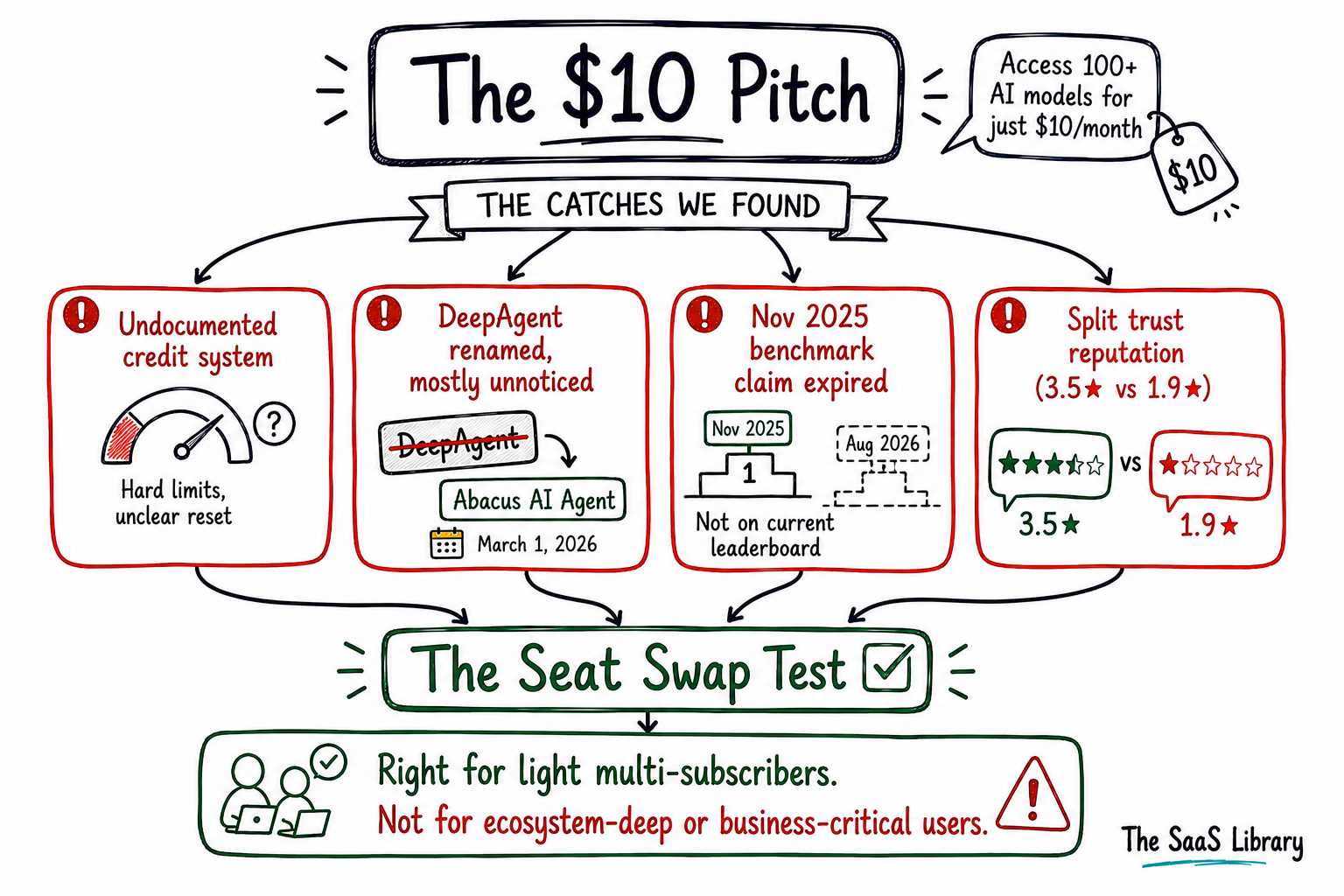
ChatLLM’s $10 pitch is real — but so is its catch. It genuinely bundles 100+ models for less than one native subscription costs, through an undocumented credit system and a product rename (DeepAgent) most reviews still miss. Run your situation through the Seat Swap Test above: light multi-subscribers get a real deal; anyone deep in Claude Projects, the GPT Store, or Google Workspace — or needing business-critical uptime — loses more than they save. Use the calculator above to see your exact number before you decide.
- Abacus.AI — ChatLLM FAQ
- Abacus.AI — Billing FAQ
- Abacus.AI — March 2026 Platform Update (DeepAgent rename)
- Abacus AI Studio — Official FAQ
- Crunchbase News — RealityEngines/Abacus.AI founding
- PR Newswire — Abacus.AI rebrand announcement
- TechCrunch — Abacus.AI Series C
- Artificial Analysis — Terminal-Bench v2.1 Leaderboard
- Deeper Insights — Abacus AI Review
- Trustpilot — abacus.ai reviews
- Trustpilot — chatllm.abacus.ai reviews
- G2 — Abacus.ai
- eesel AI — Abacus AI reviews and alternatives
- KDnuggets — Honest Abacus AI Review, August 2026
- oTechWorld — 60 Days With Abacus AI ChatLLM
- AI Pricing Guru — Subscription Pricing Tracker
- SoloAI Kit — Claude Projects vs. ChatGPT Custom GPTs
Frequently Asked Questions
Is ChatLLM a good platform?
ChatLLM is a genuinely good platform for one specific kind of user — someone spreading light use across two or more AI subscriptions — but it’s held back by an undocumented credit system and support gaps that show up repeatedly in user reviews.
What is ChatLLM?
ChatLLM is a multi-model AI subscription from Abacus.AI that gives you chat access to more than 100 outside AI models — including GPT, Claude, and Gemini — for $10 to $20 a month.
How much does ChatLLM cost?
ChatLLM costs $10 a month for Basic ($7 for the first month) or $20 a month for Pro, with custom Enterprise pricing handled separately through Abacus.AI’s sales team.
Is Abacus.AI worth it?
Abacus.AI is worth it for the same reason ChatLLM itself is: broad model access at a low price, though that depends on how much you value ecosystem features like Claude Projects or the GPT Store that Abacus.AI doesn’t replicate.
Is Abacus.AI safe?
Abacus.AI is safe in the sense that it states it doesn’t train on your data and holds SOC-2 Type 2 and HIPAA compliance, though that’s separate from the credit-transparency and support issues real users report.
What happened to DeepAgent?
What happened to DeepAgent is a rename, not a shutdown — Abacus.AI renamed it Abacus AI Agent on March 1, 2026, though most third-party coverage, including pieces published after the change, still calls it DeepAgent.
Does ChatLLM have a free trial?
ChatLLM does not have a traditional free trial, but the Basic plan is discounted to $7 for your first month before moving to the standard $10 rate.
What are ChatLLM credits and how do they work?
ChatLLM credits are the platform’s internal usage-metering unit, spent on messages, image and video generation, and agent tasks at rates Abacus.AI has not published.
Is ChatLLM better than ChatGPT?
ChatLLM is not straightforwardly better than ChatGPT — it includes GPT models alongside many others for less money, but it doesn’t include ChatGPT’s own ecosystem, like the GPT Store’s Custom GPTs.
Is ChatLLM better than Claude?
ChatLLM is not straightforwardly better than Claude either — it includes Claude as one option among many, but it doesn’t replicate Claude Projects, the persistent-workspace feature many Claude Pro users rely on.
Can I use ChatLLM for coding?
You can use ChatLLM for coding through Abacus AI Agent and Abacus AI Desktop, though its “#1 on Terminal Bench” claim is from November 2025 and current leaderboards rank other models ahead of it.
Is Abacus AI Agent the same thing as ChatLLM?
Abacus AI Agent is not the same thing as ChatLLM — ChatLLM is the multi-model chat interface, while Abacus AI Agent is the separate autonomous task-execution tool bundled with the same subscription.
What’s the catch with ChatLLM’s $10 price?
The catch with ChatLLM’s $10 price is a credit system that isn’t fully documented — users widely report premium model access getting throttled at around 75% of the monthly pool, even though Abacus.AI’s own FAQ doesn’t state that threshold anywhere.