You ranked number one. Your traffic dropped anyway. Here is what your page is missing — and exactly how to fix it, layer by layer.
Hybrid engine optimization (HEO) is the practice of optimising your content to rank on traditional search engines like Google while simultaneously getting cited by AI platforms like ChatGPT, Perplexity, and Google AI Overviews. It unifies SEO, AEO, and GEO into one workflow — and it changes how you need to think about every page you publish. If you are new to the concept, our complete guide to what HEO is and why it matters covers the full picture before you audit.
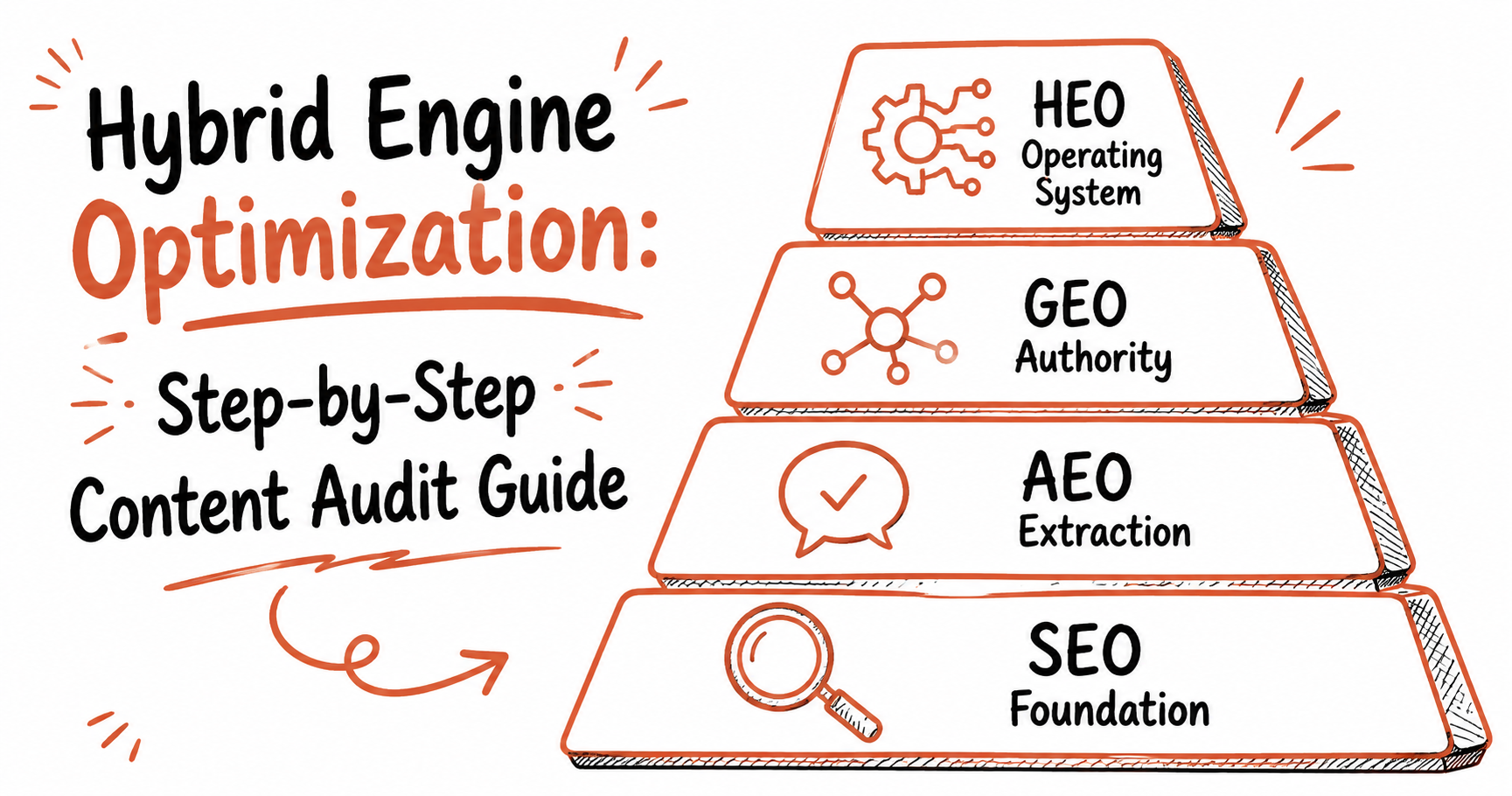
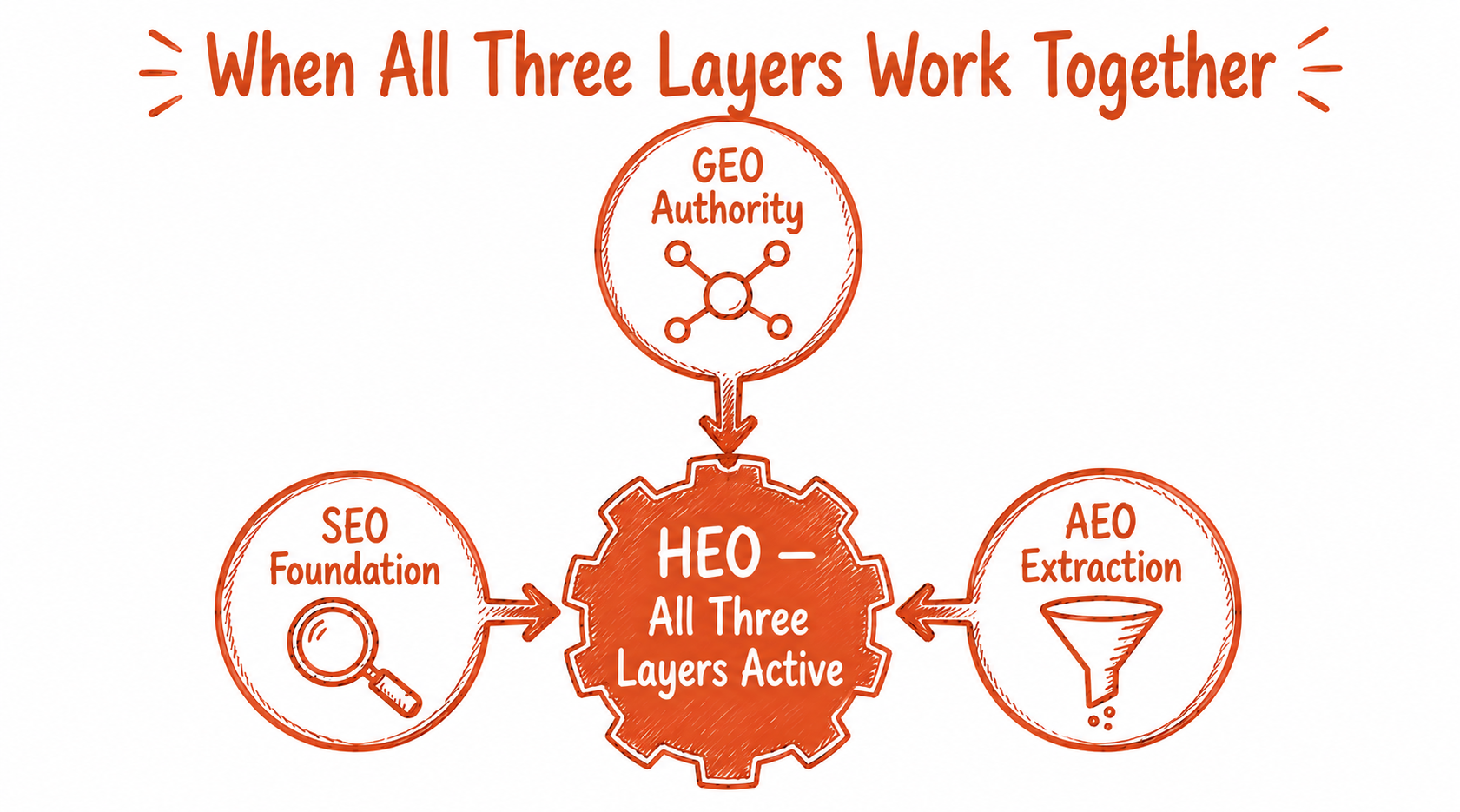
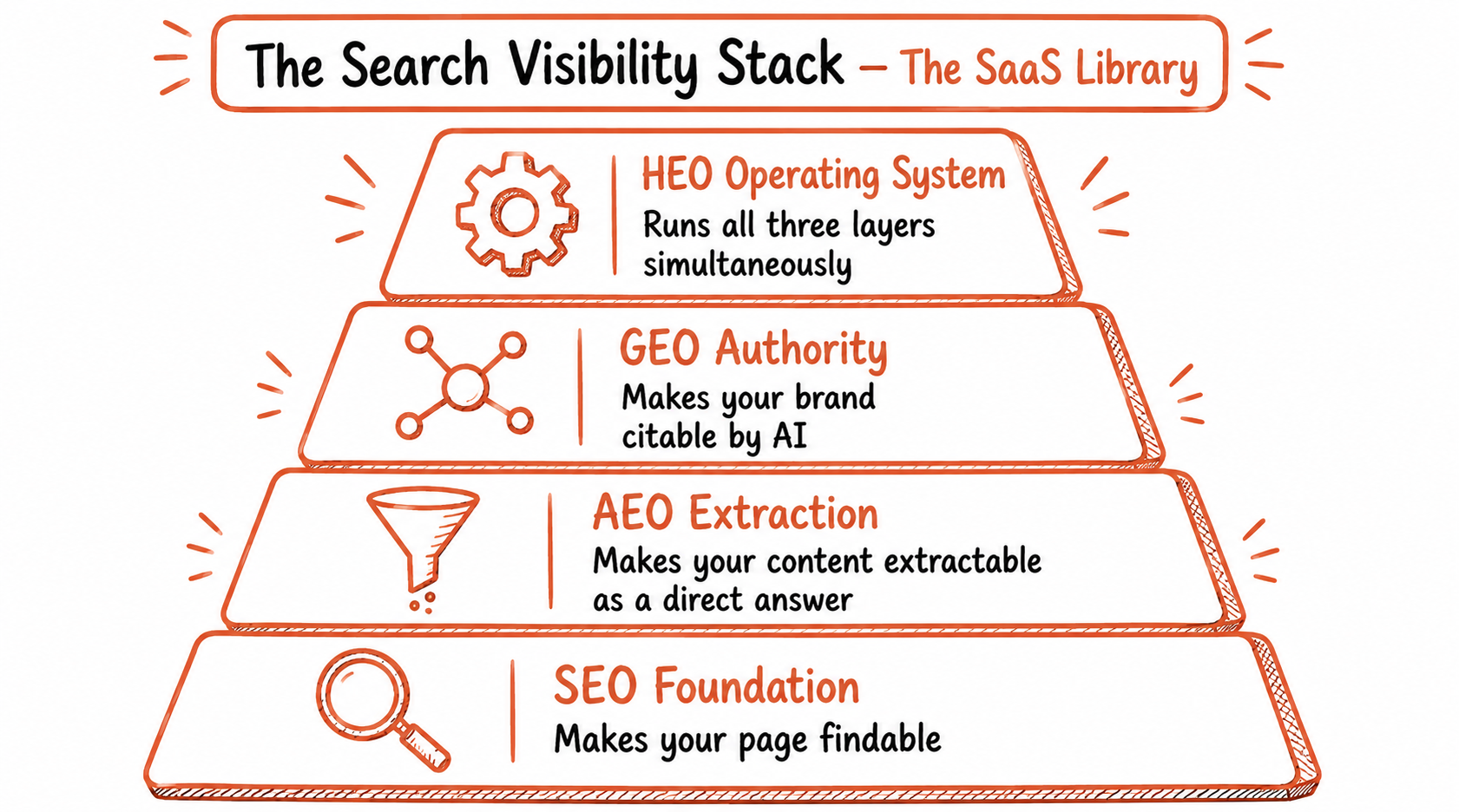
This guide is the workbench version. You bring a page to it, run it through each layer of the Search Visibility Stack in sequence, and finish with a score that tells you exactly where your page is losing visibility and what to fix first. SEO is the foundation. AEO is the extraction layer. GEO is the authority layer. The HEO Content Scoring Model ties all three together.
Is Your Page Ready to Be Optimised?
Four technical gates must clear before content-level work begins. If any fail, fix them first. Content optimisation on a technically broken page produces no measurable result.
-
Is the page indexed by Google? Check: type
site:yourdomain.com/your-page-urlinto Google. If no result appears, the page is not indexed and nothing else matters until it is. -
Are AI crawlers blocked? Open
yourdomain.com/robots.txtand confirm GPTBot, ClaudeBot, PerplexityBot, and Google-Extended are not disallowed. This is covered in full in Step 2. - Does the page load in under 2.5 seconds (LCP)? Check: run the URL through Google PageSpeed Insights. A slow page is crawled less frequently by both Googlebot and AI bots.
- Is the page mobile-usable? Check: run through Google Mobile-Friendly Test. Google uses mobile-first indexing — mobile usability failures rank below all optimised competitors.
Does Your Technical Foundation Actually Hold Up?
Most technical SEO issues are invisible until they compound. A page with slow load times, broken internal links, or indexing gaps is invisible to both Google and AI crawlers before any content optimisation begins — and no amount of BLUF restructuring or schema markup will compensate for a broken foundation.
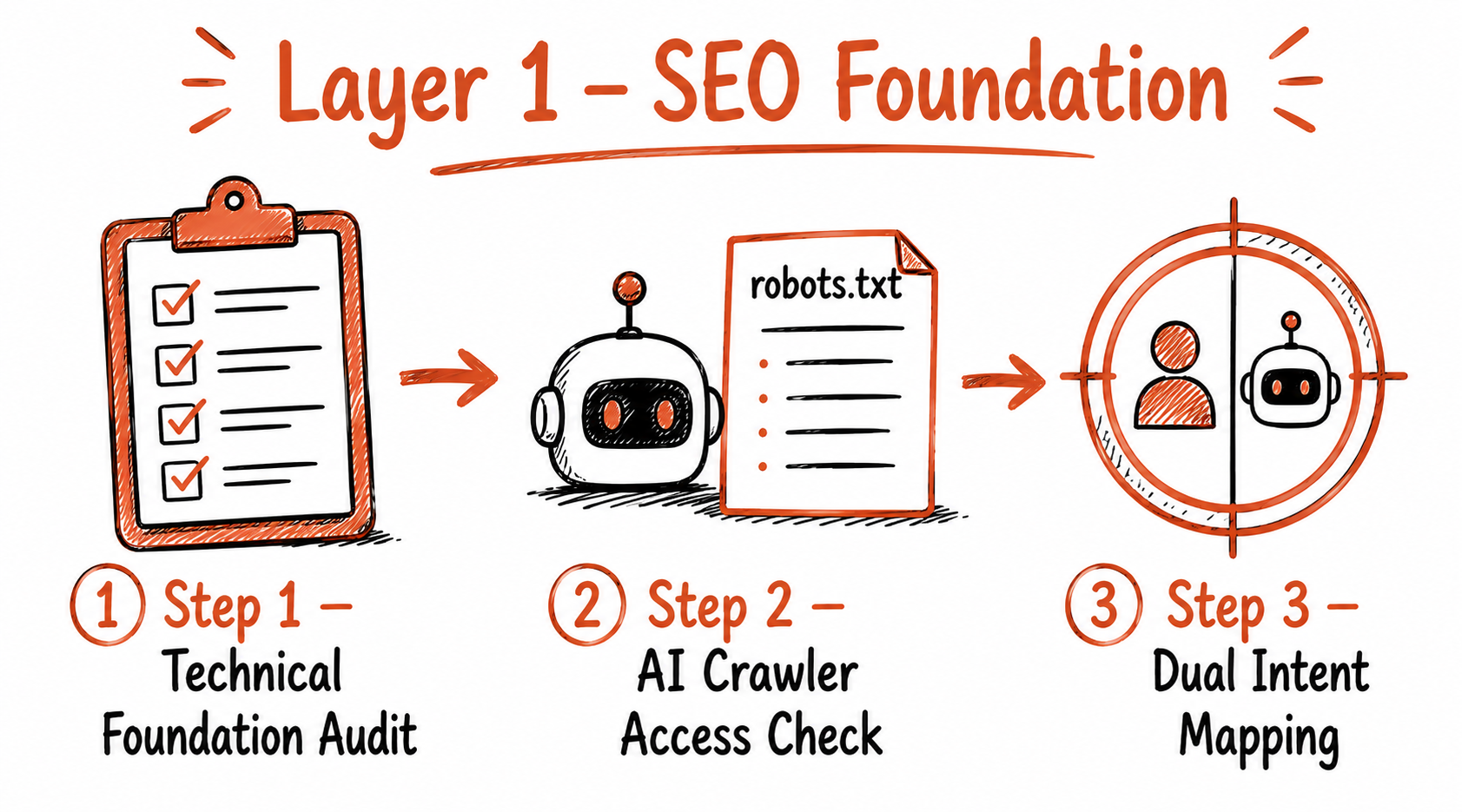
Run five checks on your page: confirm Core Web Vitals pass (LCP under 2.5s, INP under 200ms), verify the URL is indexed in Google Search Console, fix any broken internal links pointing to or from this page, confirm the URL is in your XML sitemap, and verify HTTPS is active with no mixed content warnings. Both Googlebot and AI crawlers evaluate these signals before reading a single word of your content.
Tools: Google Search Console, PageSpeed Insights, Screaming Frog.
Are AI Crawlers Being Blocked From Your Page?
A single misplaced line in robots.txt can block every AI crawler from your site simultaneously. GPTBot, ClaudeBot, PerplexityBot, and Google-Extended are all blocked if you disallow all crawlers — a default CMS setting that most site owners never check. If these bots cannot reach your pages, no content-level optimisation will produce AI visibility.
Open yourdomain.com/robots.txt and confirm none of the four major AI crawlers appear under Disallow. Then go further: check your server logs or set up Google Tag Manager to track which bots are actually visiting, how often, and which pages they prioritise. This crawler-log approach is the core insight of Jori Ford’s original HEO framework from SEO Week 2025 — it gives you real bot behaviour data rather than theoretical estimates.
Tools: robots.txt manual check, Screaming Frog Log File Analyser, Google Tag Manager.
What Does a Human Want — and What Does an AI Want?
Most content is written for one audience — the human reader. AI systems have a different extraction need. They want a clean, direct answer in the first paragraph of each section. Writing for only one of these audiences leaves half your visibility on the table before you have written a single optimised sentence.
For each H2 section on your page, ask two questions before rewriting anything: what does a human reader want from this section — depth, context, examples? And what would an AI want to extract — a concise, standalone answer in the first 40–60 words? Map both. This dual-intent map is the planning layer that makes Steps 4 and 5 coherent rather than mechanical. Google’s own guidance confirms that AEO and GEO are extensions of SEO, which validates why this mapping step must happen before content restructuring begins.
Can an AI Extract a Direct Answer From Every Section?
Most pages bury their answers. A section heading promises an answer, then the first paragraph spends three sentences on context, background, or transition before delivering the point. AI systems extract from the first 40–60 words of each section. If your answer is not in those first sentences, it will not be cited — regardless of how good the rest of the section is.
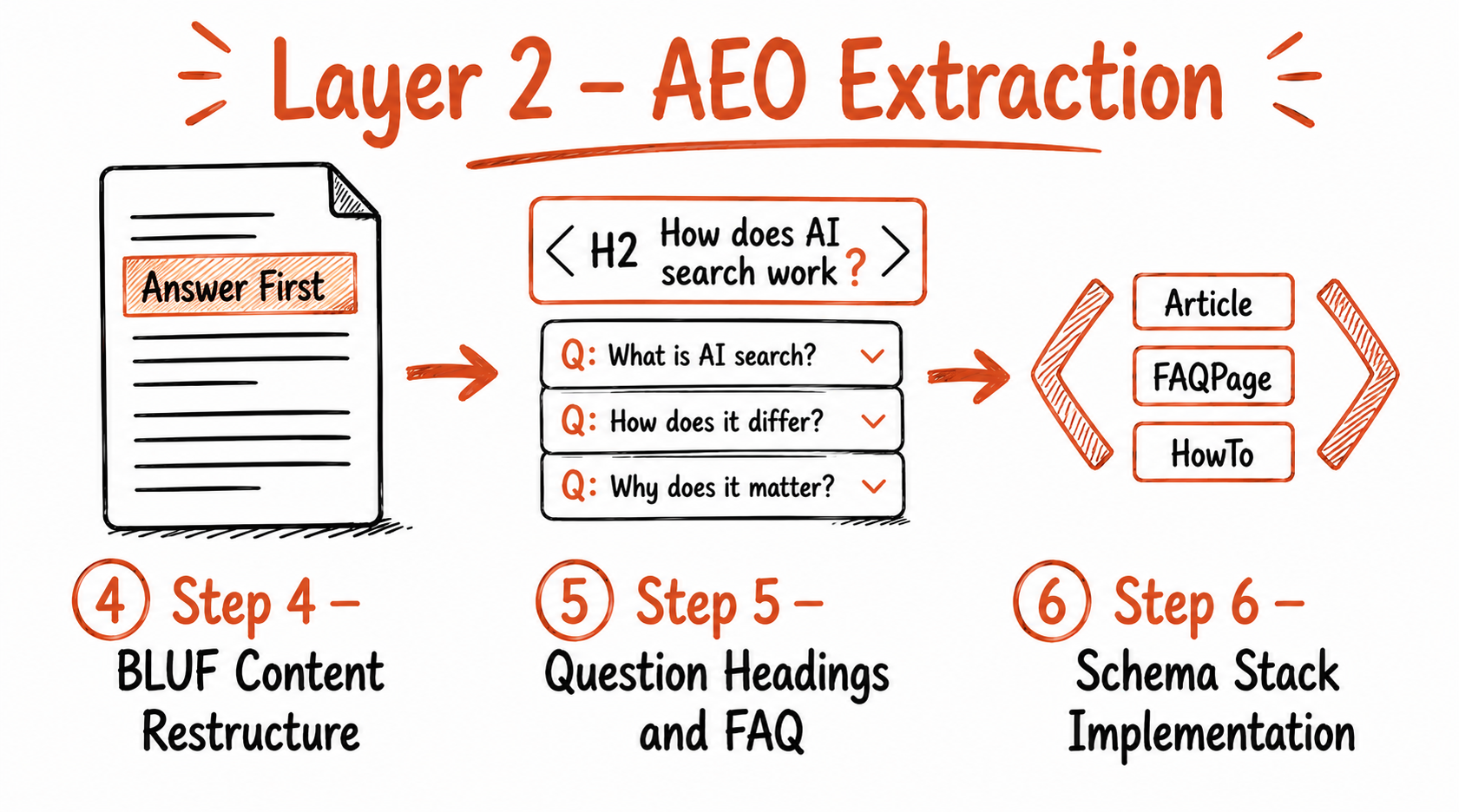
Rewrite the opening of every H2 section using the BLUF rule — Bottom Line Up Front. The first one or two sentences must fully answer the question implied by the heading. Everything after is supporting depth for human readers. Test each section by reading only the heading and the first two sentences — if the answer is complete and self-contained, it passes. This is the single highest-impact content change for most pages. For a deeper guide on this technique, our guide to optimising your blog for AI search in 2026 covers BLUF implementation in full detail.
Tools: Manual audit — read heading and first two sentences of each section only.
Are Your Headings and FAQ Structured for Machines?
Generic headings like “Our Approach” or “Key Benefits” tell AI systems nothing. AI engines match user question intent directly to question-format headings. A heading phrased as a question is simultaneously an answer extraction target — it tells the machine exactly what this section addresses and signals that a direct answer follows.
Rewrite H2 and H3 headings as direct questions that mirror how users search — “How does X work?” rather than “How X Works.” Add a FAQ section at the bottom with a minimum of four questions, each answered in 40–60 self-contained words. Add FAQPage schema to match the HTML exactly. Heading format and FAQ structure are the two most frequently missed AEO signals on otherwise well-optimised pages. FAQ schema remains a high-value AEO signal despite changes to rich results display. For a complete AEO implementation guide, our step-by-step AEO guide covers every check in depth.
Tools: Manual heading audit, Google Search Console (People Also Ask data), AlsoAsked.
Does Your Page Have a Machine-Readable Layer?
Well-written content without schema forces AI systems to infer what your page is about. Schema markup is the explicit, machine-readable layer that removes that inference — telling crawlers exactly what type of content this is, who wrote it, what questions it answers, and who published it. Without it, you are relying on machines to guess correctly every time.
Implement Article, FAQPage, BreadcrumbList, and Person schema at minimum on every post. Add HowTo schema if the page is a step-by-step guide. Add Organisation schema on your About page and homepage. Validate every schema block using Google’s Rich Results Test before publishing. FAQPage schema is the single highest-impact addition for most sites — it explicitly signals Q&A structure to both Google and AI crawlers simultaneously. Optimising without understanding how AI reads your schema is the hidden cost most brands pay when they skip this step.
Tools: Google Rich Results Test, Schema.org, Yoast SEO / RankMath.
Does Your Page Know Who Wrote It and Who Published It?
AI systems cite entities — brands, people, and organisations they can verify across multiple sources. A page with no named author, no author bio, and no Organisation schema is an anonymous document. Anonymous documents are rarely cited, because AI models have no way to verify the authority behind the claim.
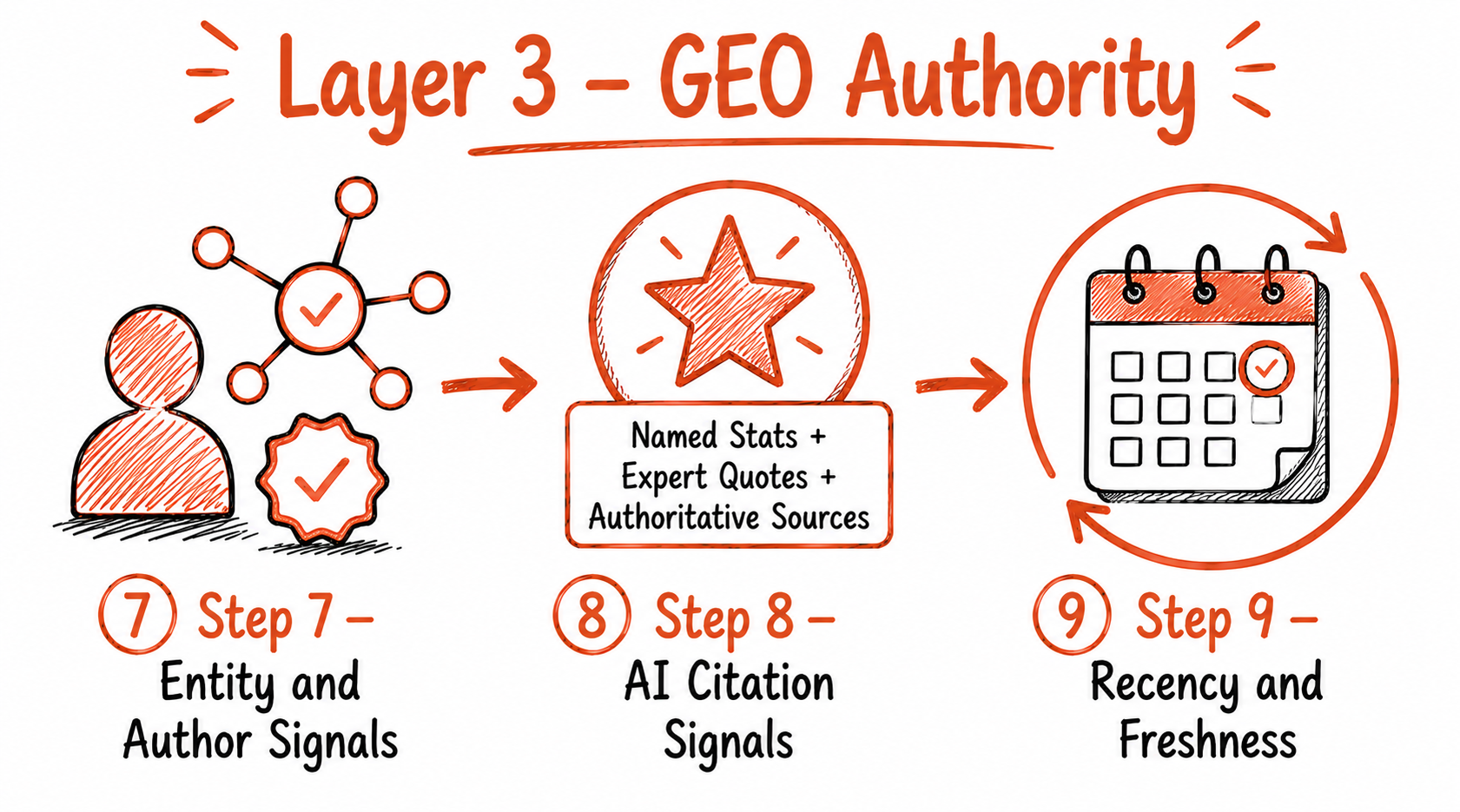
Add a named author bio with real credentials and a link to a consistent author profile page. Implement Person schema on the author bio and Organisation schema on your homepage and About page. Confirm your brand name, description, and contact details are identical across your website, Google Business Profile, and LinkedIn. Consistency across sources is what builds entity recognition — entity presence is the GEO layer of the Search Visibility Stack that most brands underestimate.
Tools: Schema.org Person and Organisation markup, Google Business Profile, LinkedIn company page.
Does Your Content Give AI a Reason to Cite It?
Indexed, well-structured, entity-rich content still gets ignored by AI systems if it offers nothing original. AI models gravitate toward content that provides what they cannot generate themselves — specific statistics with named sources, direct expert quotes, and verifiable claims traced to primary sources rather than aggregators.
Add at least two or three original statistics with named sources and years, cited inline at the point of use. Include at least one direct quote from a named authority. Link to primary sources — research papers, official announcements, and first-party studies. The Princeton GEO research from November 2023 found that adding statistics improved AI visibility by up to 40%, expert quotations by up to 32%, and authoritative citations by up to 30%. These are not marginal improvements — they are the difference between a page that gets cited and one that gets ignored. When evaluating which AI platforms to target, understanding how ChatGPT and Claude differ helps you prioritise where your citation signals matter most.
Is Your Content Fresh Enough to Be Cited?
AI platforms strongly prefer recent sources. Content published in 2023 and never updated loses citation authority to fresher content on the same topic — even if the original article is more thorough. Recency is a first-order signal for AI tools in a way it was never quite so critical for traditional SEO rankings.
Update your published or modified date only when content has substantively changed — not for cosmetic edits. Refresh statistics with current figures, update examples, and add a visible “Updated [Month Year]” marker in the content body. Re-submit the URL in Google Search Console after significant updates. Set a refresh schedule: cornerstone pages every 60–90 days, supporting pages annually. The goal is not to pretend content is new — it is to ensure AI models can see that a real person is actively maintaining it.
Tools: Google Search Console (Request Indexing), WordPress date settings.
How HEO-Ready Is Your Page? Score It Now.
The HEO Content Scoring Model evaluates your page across five dimensions spanning all three layers of the Search Visibility Stack. Work through the checker below — answer each question honestly for the specific page you are auditing. Your score will show exactly which dimension to fix first.
Where Do You Go From Here?
Frequently Asked Questions
Hybrid engine optimization (HEO) is a unified search strategy that optimises content for traditional search engines like Google and AI platforms like ChatGPT and Perplexity at the same time. Traditional SEO targets blue-link rankings only. HEO adds AEO and GEO layers on top, so content is findable, extractable as a direct answer, and citable by AI.
Check your content against three layers. For SEO: confirm the page is indexed, loads under 2.5 seconds, and is mobile-usable. For AEO: verify each section opens with a direct answer and carries FAQPage schema. For GEO: confirm your author is a named entity, stats are cited to primary sources, and your brand appears consistently across the web.
No. Start with your top 10 pages by impressions in Google Search Console. These carry the most visibility potential. Apply the HEO Content Scoring Model to each one and fix the lowest-scoring layer first. Most pages need targeted edits — BLUF restructuring, schema addition, or entity signals — not full rewrites.
At minimum: Article, FAQPage, BreadcrumbList, and Organisation schema on every post. Add Person schema for named authors and HowTo schema for step-by-step guides. FAQPage schema is the highest-impact single addition for most sites — it signals extractable Q&A structure to both Google and AI crawlers simultaneously.
The HEO Content Scoring Model is a diagnostic framework developed by The SaaS Library that evaluates a single page against the three layers of the Search Visibility Stack — SEO foundation, AEO extraction, and GEO authority — producing a 0–100 score that shows where the page is HEO-ready and where it is not.