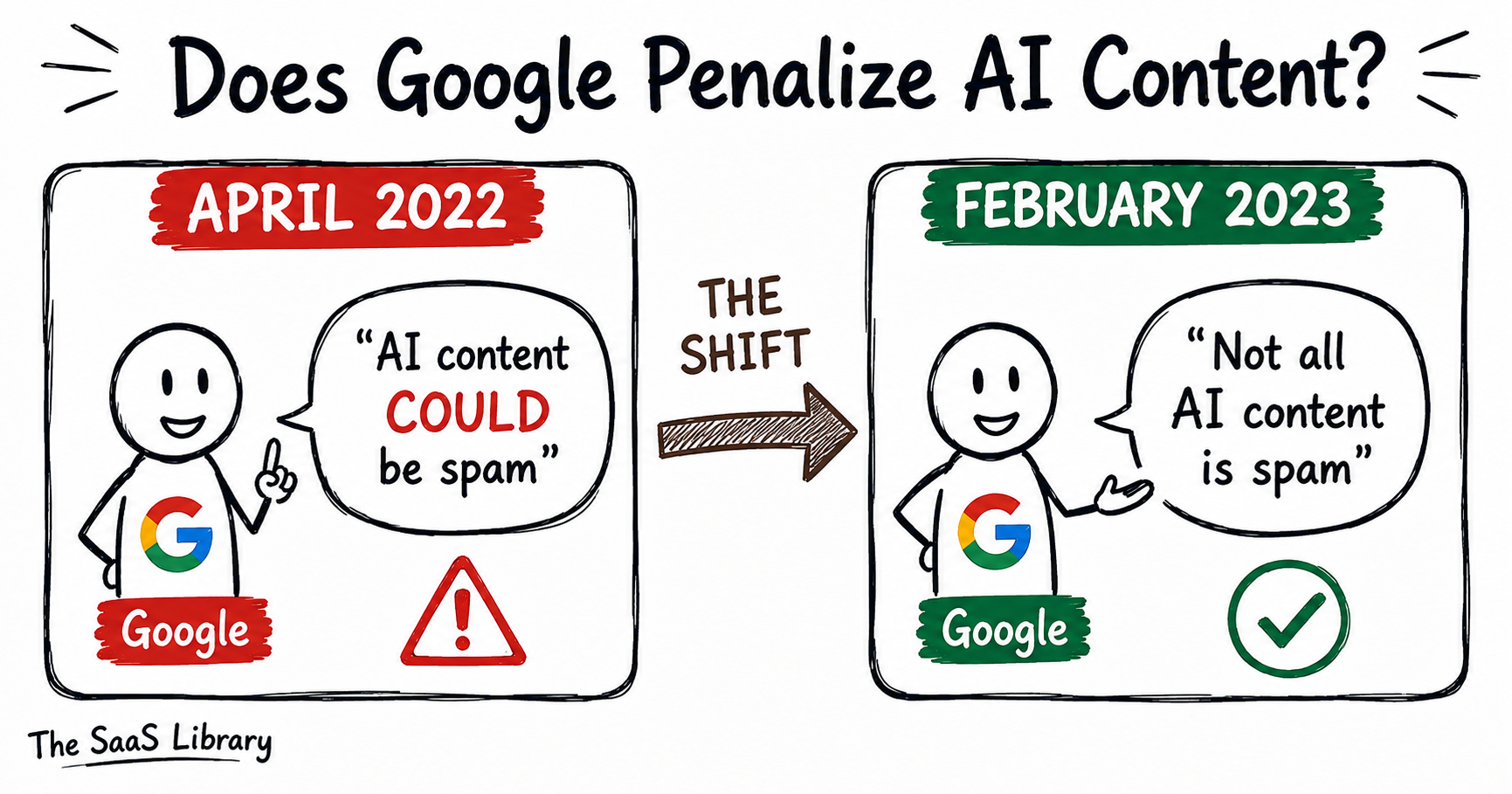
In 2022, Google said AI-generated content could be treated as spam. By 2023, its own team said the opposite — and today, over four in five pages ranking on page one contain some AI involvement.
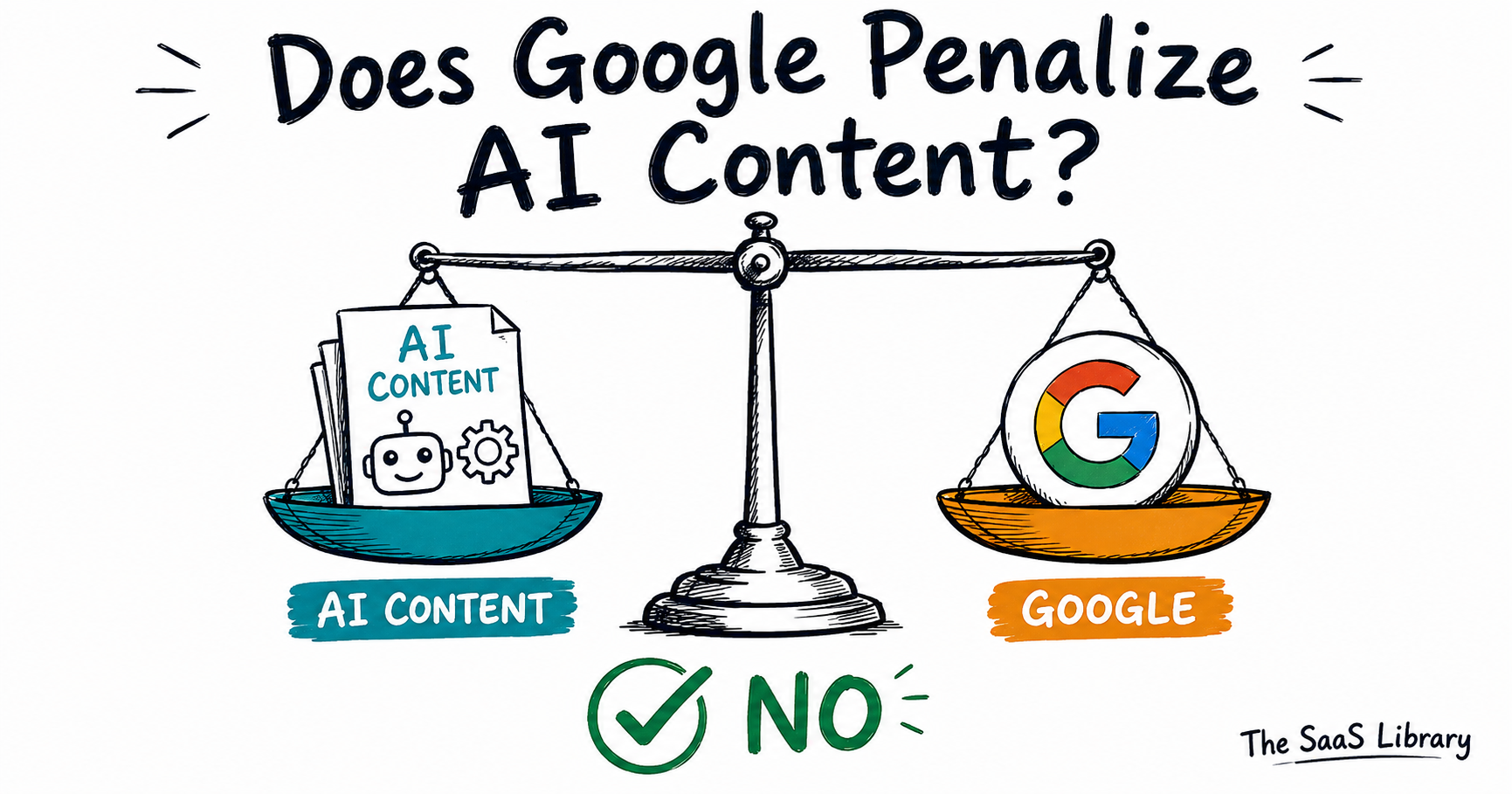
Does Google Penalize AI Content?
Google does not penalize content simply because it was created using artificial intelligence — its systems evaluate helpfulness and originality, not the tool used to produce it.
Google’s position became substantially more permissive and explicit. In April 2022, John Mueller described AI-generated content as something that could be treated as spam under the guidelines of the time. By February 2023, Google’s own Search Central team said the opposite: “not all use of automation, including AI generation, is spam” — Source, Feb 8, 2023. That shift is deliberate, and it’s the actual policy today.
Translation? Google doesn’t have an “AI detector” flipping a switch on your rankings. What it does have is a system built to catch one specific thing: content made at scale, with little to no human effort, purely to game search results. Whether that content came from a person or a chatbot doesn’t matter to Google. What matters is whether it’s actually useful.
So if you’re using AI to draft, and a real person is fact-checking, editing, and adding something the internet didn’t already have — you’re not the target. If you’re running your own blog through AI tools, this breakdown of optimizing for AI search covers the practical side of doing that well. If you’re mass-publishing unedited AI output across a hundred pages hoping something sticks — you might be.
What Does Google Actually Penalize?
Google penalizes scaled content abuse — content published at volume, with little effort or originality, specifically to manipulate search rankings.
Google names this scaled content abuse — publishing many pages primarily to manipulate search rankings rather than to help users, regardless of whether a human, an AI, or a mix of both produced them. Source: Google Search Central This policy was introduced on March 5, 2024, as part of that year’s March 2024 core update, and Google was explicit that it applies “no matter whether content is produced through automation, human efforts, or some combination of human and automated processes.” A human cranking out 200 thin pages a week can trigger this exact same policy as an AI doing it.
Google names five specific behaviors under this policy:
| Behavior | Why It’s Flagged |
|---|---|
| Using AI (or any similar tool) to generate many pages | No added value for the reader — volume without substance |
| Scraping search results, feeds, or other content | Little original value, even with synonym-swaps or translation tricks |
| Stitching content from different pages together | Nothing new added on top of what already exists |
| Creating multiple sites to hide scaled content | Structural attempt to disguise the pattern from detection |
| Publishing keyword-stuffed pages that barely make sense | Written for rankings, not for a human reader |
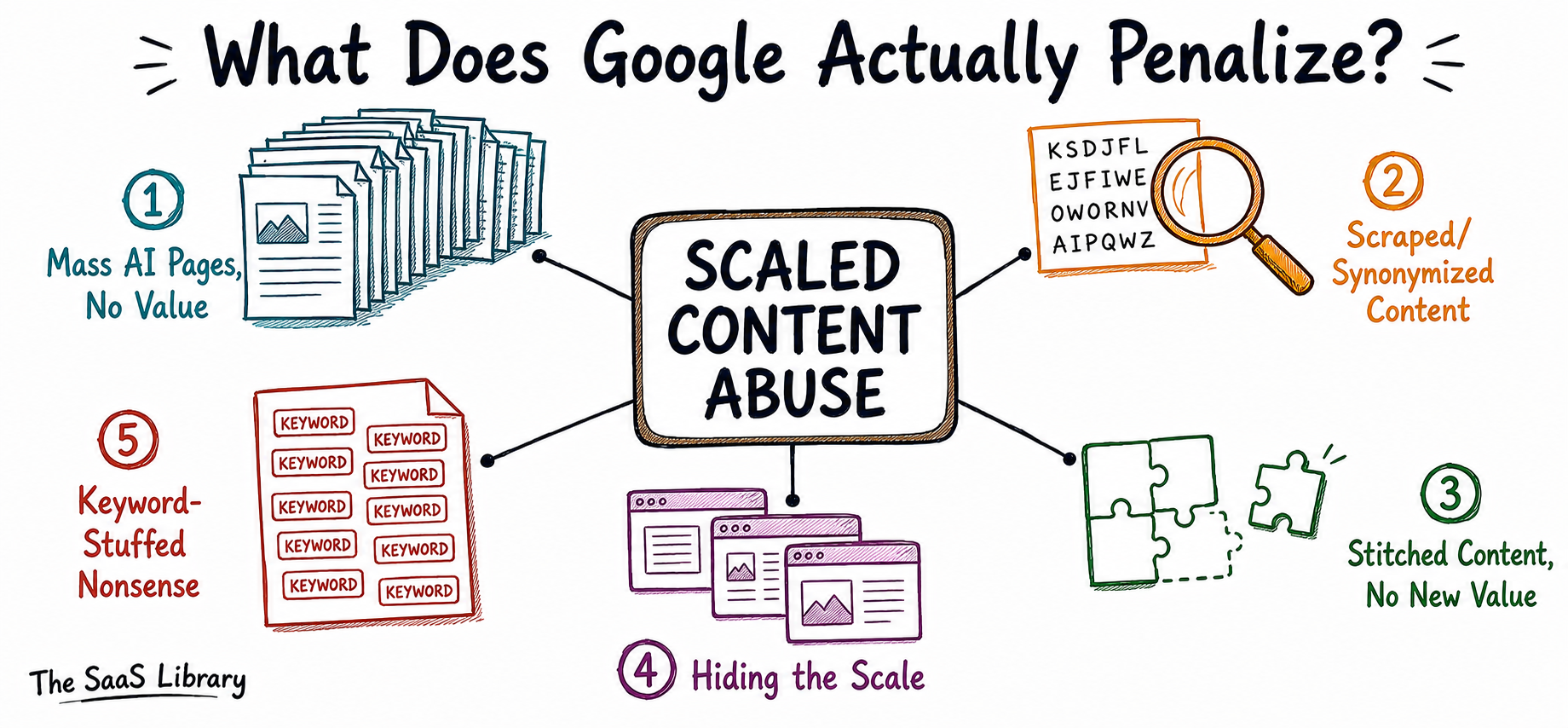
Notice what’s missing from that table: “used AI.” It’s not there. The line Google draws is about what the page does for the reader, not what tool wrote it.
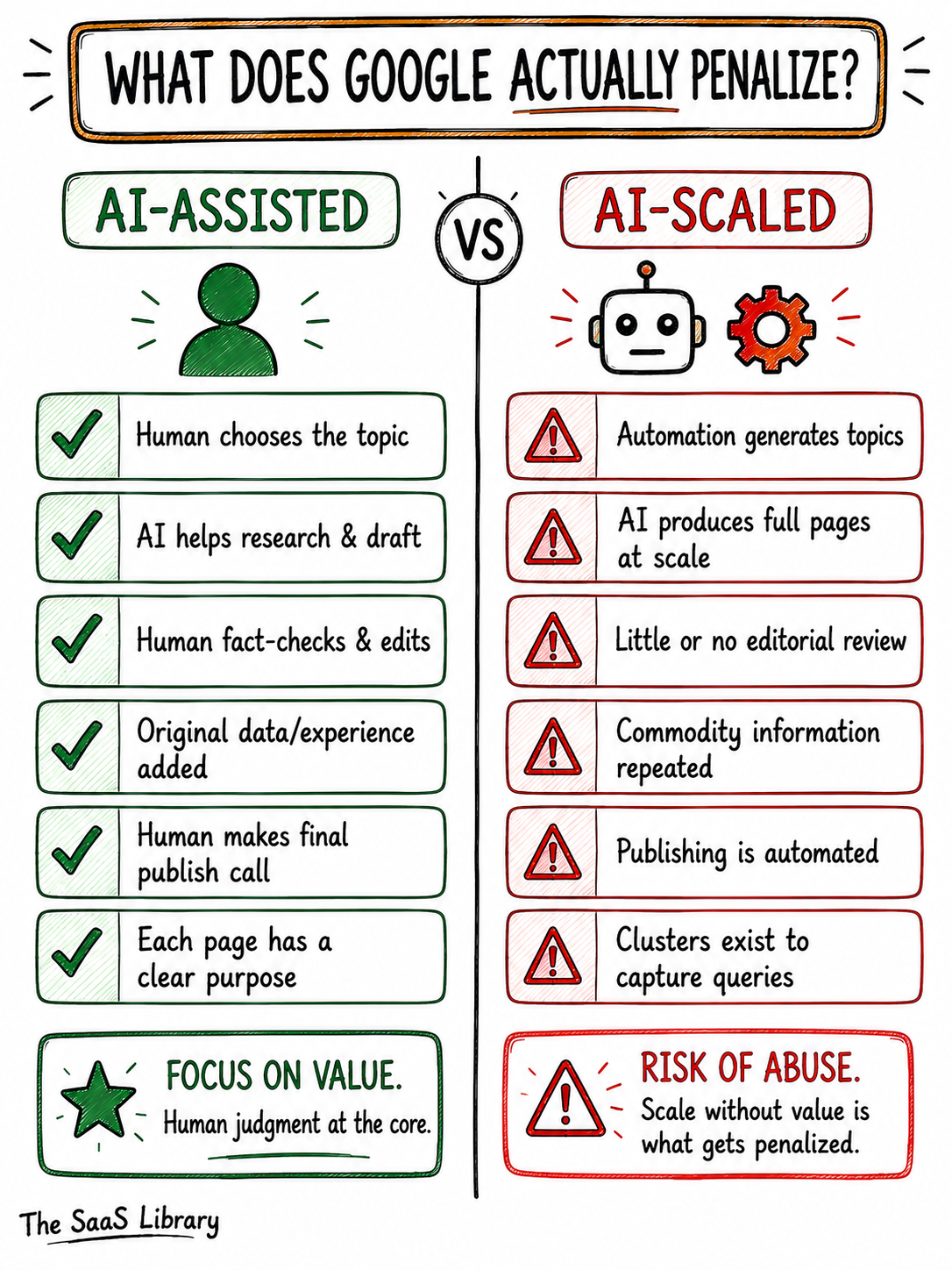
The distinction that actually matters here isn’t AI vs. human — it’s AI-assisted vs. AI-scaled.
| AI-Assisted | AI-Scaled |
|---|---|
| Human chooses the topic | Automation generates hundreds of topics |
| AI helps with research and drafting | AI produces complete pages at scale |
| Human fact-checks and edits | Little or no editorial review |
| Original experience or data is added | Commodity information is repeated |
| Human makes the final publishing decision | Publishing is automated |
| Individual pages have a clear purpose | Large clusters exist mainly to capture queries |
This isn’t a new idea Google invented for the AI era, either. It’s an expansion of an older policy on “spammy automatically-generated content” that existed well before ChatGPT. The 2024 update just widened the net to make sure the same enforcement applies regardless of which automation tool is doing the spinning.
So if you’re using AI to help draft, and a real person is editing for accuracy, adding something original, and making sure it actually helps the reader — that’s the same standard behind writing for AEO in the first place — you’re nowhere near this policy. That’s the whole difference between AI as leverage and AI as a substitute for actual editorial judgment, which is exactly what erodes SEO results when teams skip it. If you’re publishing AI output straight through, unedited, across dozens of pages hoping some of it ranks — that’s exactly what this policy exists to catch.
Want the technical side of this? Our AI-era audit framework breaks down exactly how Google’s crawlers and quality systems evaluate a page today.
Read the Technical SEO Audit Framework →What Happened With Google’s August 2026 Spam Update?
Google described the August 2026 rollout as a normal spam update enforcing its existing spam systems and policies — it ran globally from August 18 to August 21, 2026, and introduced no new spam categories.
This update actually ran longer than either of 2026’s earlier spam updates — 2 days and 16 hours, despite widespread claims it was the fastest rollout of the year. Here’s what Google confirmed, from the Search Status Dashboard:
- Started: August 18, 2026, 9:27 AM Pacific Time
- Finished: August 21, 2026, 1:49 AM Pacific Time
- Total runtime: 2 days, 16 hours
- Scope: global, every language, every region
Google itself described it in plain terms on X and LinkedIn: “This is a normal spam update, and it will roll out for all languages and locations.” Source: Google Search Central, cited via Search Engine Land
Google would not disclose what percentage of search queries or sites this update actually touched. Any number you’ve seen circulating claiming a specific impact figure didn’t come from Google.
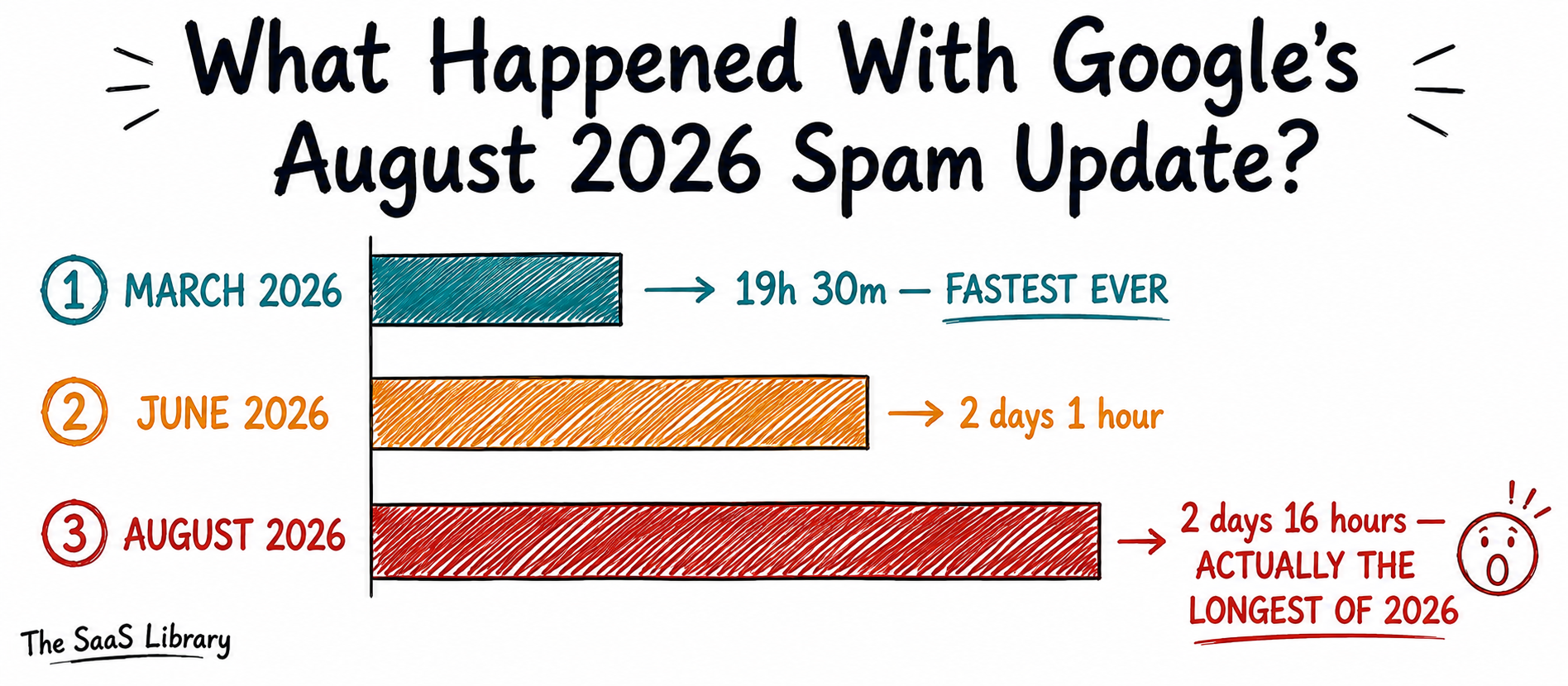
It does not specifically target link spam or the site reputation abuse policy, per Barry Schwartz’s direct confirmation with Google. Source: Search Engine Roundtable No new spam policy categories were introduced. This was also the third spam update of 2026, following updates in March and June — both of which Google also called “normal,” and neither of which introduced new policies either.
What Changed in 2026: AI Search Is Now Part of the Spam Equation
This didn’t happen in isolation. Google made three separate moves across 2026 — a policy clarification, a new measurement tool, and this spam update — and they’re worth treating as three distinct events, not one causing the next.
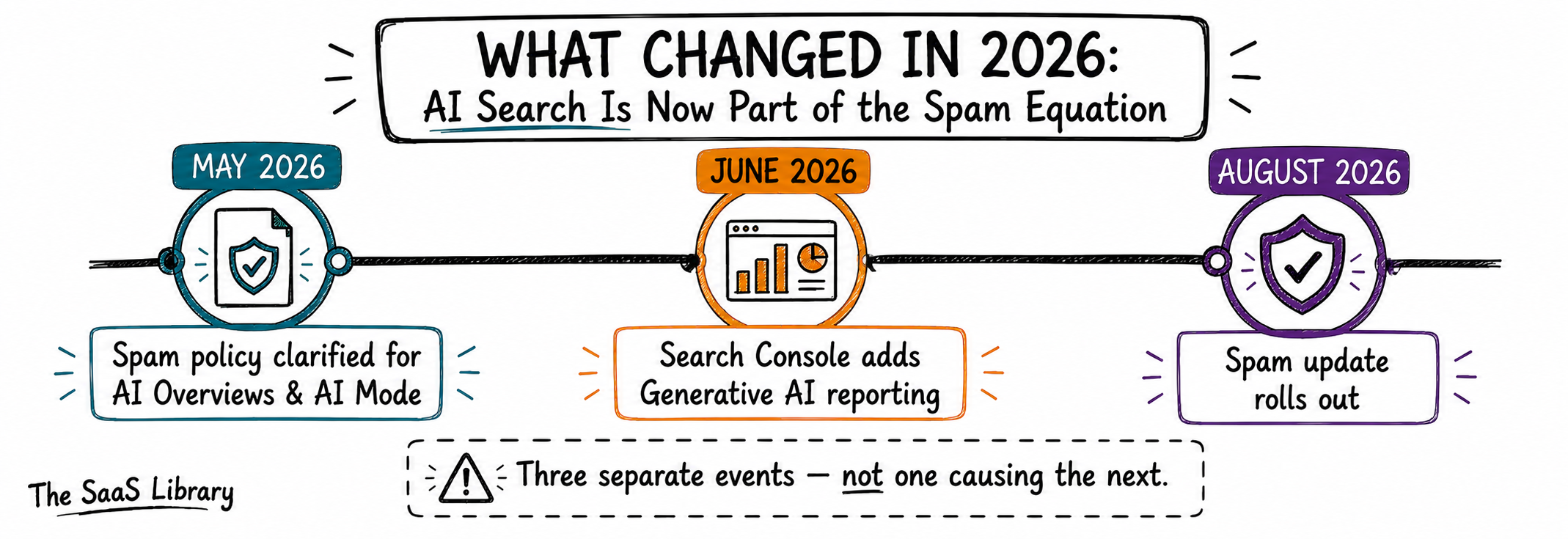
- May 15, 2026 — spam policies clarified to cover AI Overview/AI Mode manipulation. This was a policy clarification, not a new “AI spam” category, and it does not mean normal AI-search optimization is spam — the same territory covered in Google’s AI Search Guide, which makes clear that GEO and AEO are still fundamentally SEO.
- June 3, 2026 — Google launched dedicated Generative AI performance reports in Search Console, separating AI Overview/AI Mode impressions from standard organic data for the first time. Source: Google Search Central
- August 18–21, 2026 — this spam update, described as normal enforcement of existing policy.
Google’s 2026 AI Search Guidance
Google’s current guidance for AI Overviews and AI Mode is that existing SEO fundamentals still apply — there’s no separate technical playbook to learn. “There are no additional requirements to appear in AI Overviews or AI Mode, nor other special optimizations necessary.” Source: Google Search Central Both features use a technique called query fan-out — issuing multiple related searches across subtopics to build a response — meaning a page can get pulled in through a related sub-question, not just its exact target keyword. Google’s emphasis throughout stays the same: helpful, reliable, people-first, non-commodity content — a concept covered in depth later in this article.
So far, nothing here says “AI.” Which brings us to the actual question everyone’s asking.
Is the August 2026 Update Really Targeting AI Content?
Google has not confirmed that the August 2026 spam update specifically targeted AI-generated content. Some industry reports suggested mass-generated content was among the patterns affected, but those observations are not equivalent to a Google confirmation.
Where the rumor started
The theory picked up steam on forums like r/SEO within days of the rollout, where site owners began reporting AI-heavy pages losing rankings — and, on the flip side, other users posting screenshots of their own rankings climbing as competitors dropped. Source: Entireweb, Justia
The theory also leans on the real May 2026 policy clarification described above. That’s a real, confirmed change. But it happened three months before the August update, and Google has never linked the two.
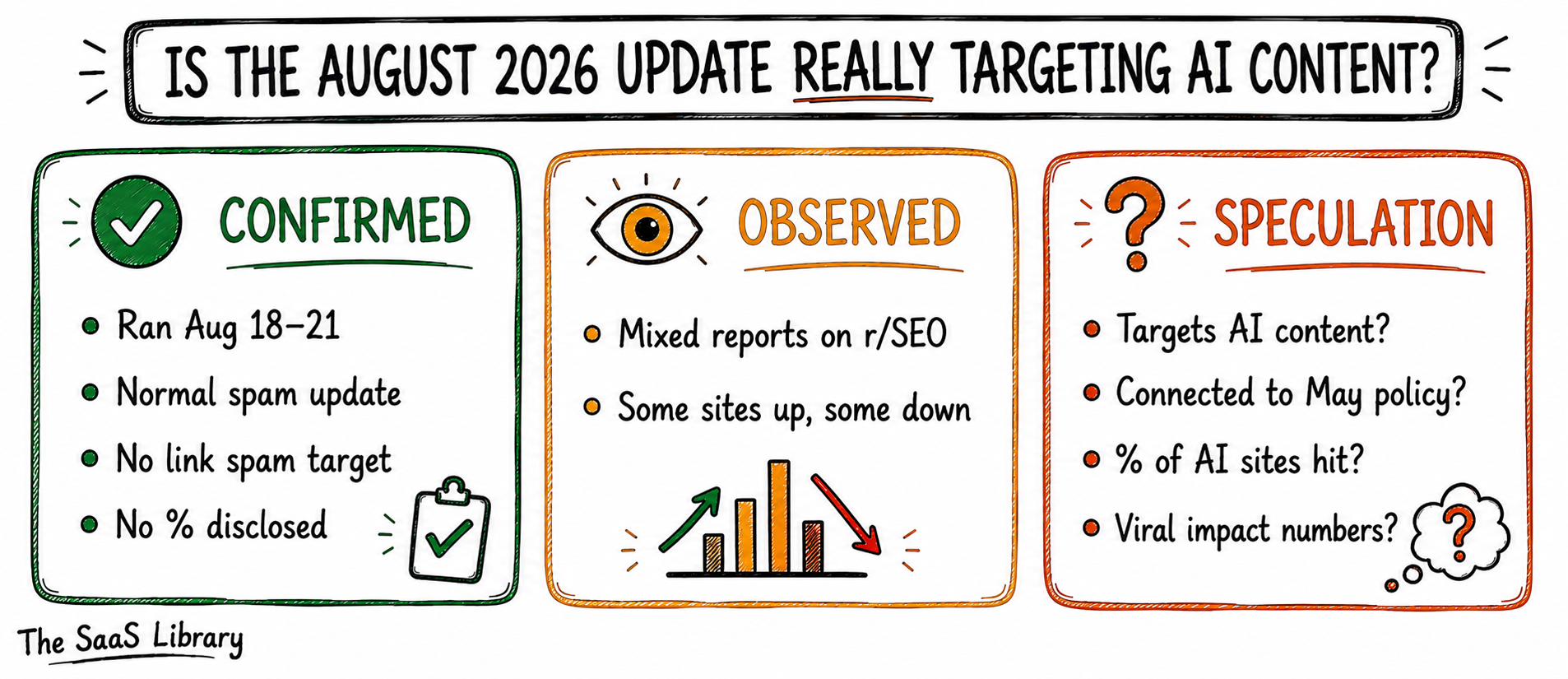
What’s confirmed vs. what’s speculation
| Confirmed by Google | Observed by the SEO Community | Speculation |
|---|---|---|
| Ran Aug 18–21, 2026, globally | Mixed reports on r/SEO | Targets AI content specifically? |
| “Normal spam update,” no new policies | Some sites up, some sites down | Connected to the May 15 clarification? |
| Does not target link spam or site reputation abuse | — | A specific % of AI sites lost rankings? |
| Google would not disclose query/site impact % | — | Any numeric impact figure circulating online |
What recognized SEO analysts actually said
- Barry Schwartz (Search Engine Roundtable) confirmed directly with Google what the update excludes, but reported Google would not share impact data — he did not claim an AI-targeting confirmation.
- Glenn Gabe (GSQi) said he was watching to see if the update reduced spam aimed at gaming AI answer engines specifically — a hope and a hypothesis, not a confirmed finding.
- Marie Haynes noted SpamBrain appeared to be catching more sites using manipulative tactics broadly — not a specific “AI content” callout.
None of the recognized analysts who cover Google updates for a living claimed Google confirmed AI-targeting. The strongest anyone said was “it’s plausible, given the May policy change” — which is inference, not evidence.
What Google confirms vs. what we infer
Here’s the fuller evidence picture, rated by actual evidence status rather than a simple confirmed/unconfirmed split:
| Claim | Evidence Status |
|---|---|
| Google does not prohibit AI-generated content simply because AI was used | CONFIRMED |
| Scaled content abuse can involve AI-generated content | CONFIRMED |
| Google’s spam policies apply to AI Overviews and AI Mode | CONFIRMED |
| The August 2026 update was a Google spam update | CONFIRMED |
| The August 2026 update specifically targeted AI content | NOT CONFIRMED |
| Google uses a publicly documented AI detector as a ranking penalty | NOT ESTABLISHED |
| AI-heavy pages can rank | OBSERVED |
| AI-heavy pages always rank worse | NOT ESTABLISHED |
| AI content can create long-term quality problems when it lacks authority, originality, or trust | SUPPORTED BY OBSERVATIONAL EVIDENCE |
The rumor exists because two true things happened close together and got merged into one causal story. Correlation in timing isn’t the same as a confirmed connection — and Google has had every opportunity to confirm this link and hasn’t.
Has Google Ever Actually Penalized AI Content Before?
Yes — in March 2024, Google issued manual actions against a wave of sites built on unedited, AI-generated content, giving the clearest real precedent for what triggers enforcement.
There is one clear historical episode that shows this playing out in practice, and it happened alongside the March 2024 core update — the same rollout that introduced the Scaled Content Abuse policy.
What actually happened
| Tracker | Sample Size | Sites Hit with Manual Actions | Traffic Impact |
|---|---|---|---|
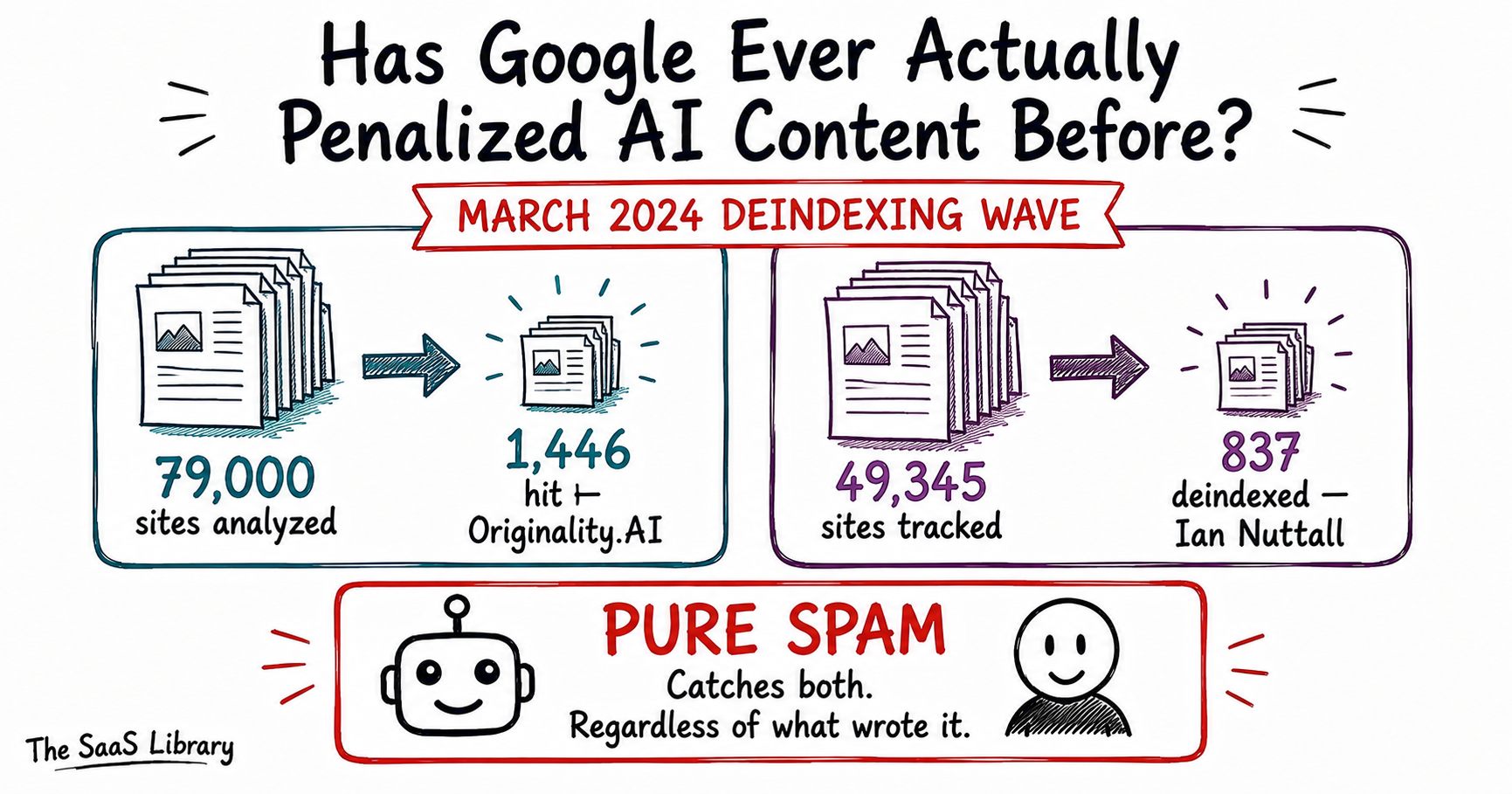
| Originality.AI | ~79,000 sites analyzed | ~1,446 sites (about 2%) | Over 20 million monthly visitors lost collectively |
| Ian Nuttall (independent) | 49,345 sites tracked | 837 sites removed entirely (~1.7%) | Not separately quantified |
Sources: Originality.AI, March 8, 2024; Search Engine Journal, citing Ian Nuttall’s tracking
Originality.AI went further and sampled 14 of the deindexed sites directly: 100% showed clear signs of AI-generated content, and 7 of the 14 had AI content making up more than 90% of their published articles. Source: Originality.AI
Why this isn’t quite as simple as “Google penalized AI”
The sites hit weren’t labeled by Google as “AI violations” — they were classified under the general Pure Spam manual action category, which can catch both AI and human-produced content, since production method never enters its criteria. Source: Google Search Console Help
- AI-content detectors have a known false-positive risk, so “100% of sampled sites showed AI signs” doesn’t mean every flagged word was actually AI-written.
- Even John Mueller’s own personal website was briefly caught in this same deindexing wave — and nobody suggests Google’s Search Advocate was secretly running an AI content farm.
March 2024 shows that fully automated, unreviewed content published at scale leaves a detectable fingerprint Google’s systems can catch. It does not show that AI authorship itself is the trigger. Skipping that editorial layer is exactly the trust problem covered in AI-Generated Content Is Killing Thought Leadership in 2026 — the same shortcut that costs rankings here costs buyer trust there. The pattern is consistent throughout: volume without value gets caught, whatever tool produced the volume.
Does AI Content Actually Rank Worse on Google?
It depends what’s being measured — three separate studies looked at this question and reached three different answers, and the reason why matters more than any single number.
The honest picture here is more complicated than any single study suggests. Rather than picking the one result that fits a tidy conclusion, here’s all three, side by side.
We prioritized Google’s own documentation for policy claims, original research for quantitative findings, and independent reporting for update observations. Where studies produced different results, we compared their samples, methods, and time horizons rather than treating them as contradictory evidence.
| Study | Sample | Method | Finding |
|---|---|---|---|
| Ahrefs (2025) | 600,000 pages, established ranking sites | Correlation across the live web | 0.011 correlation — negligible |
| Semrush (April 2026) | 42,000 blog pages / 20,000 keywords | GPTZero classification, established ranking sites, survey of 224 SEO professionals | Human content 8x more likely to rank #1 |
| SE Ranking × Search Engine Land (16-month experiment) | 2,000 fully AI-generated, unedited articles on 20 brand-new domains | Controlled experiment, zero authority, zero editing | 71% indexed within 36 days — only 3% remained in the top 100 after 3 months |
Sources: Ahrefs, 2025; Semrush, via Search Engine Land, April 2026; SE Ranking / Search Engine Land, 2026
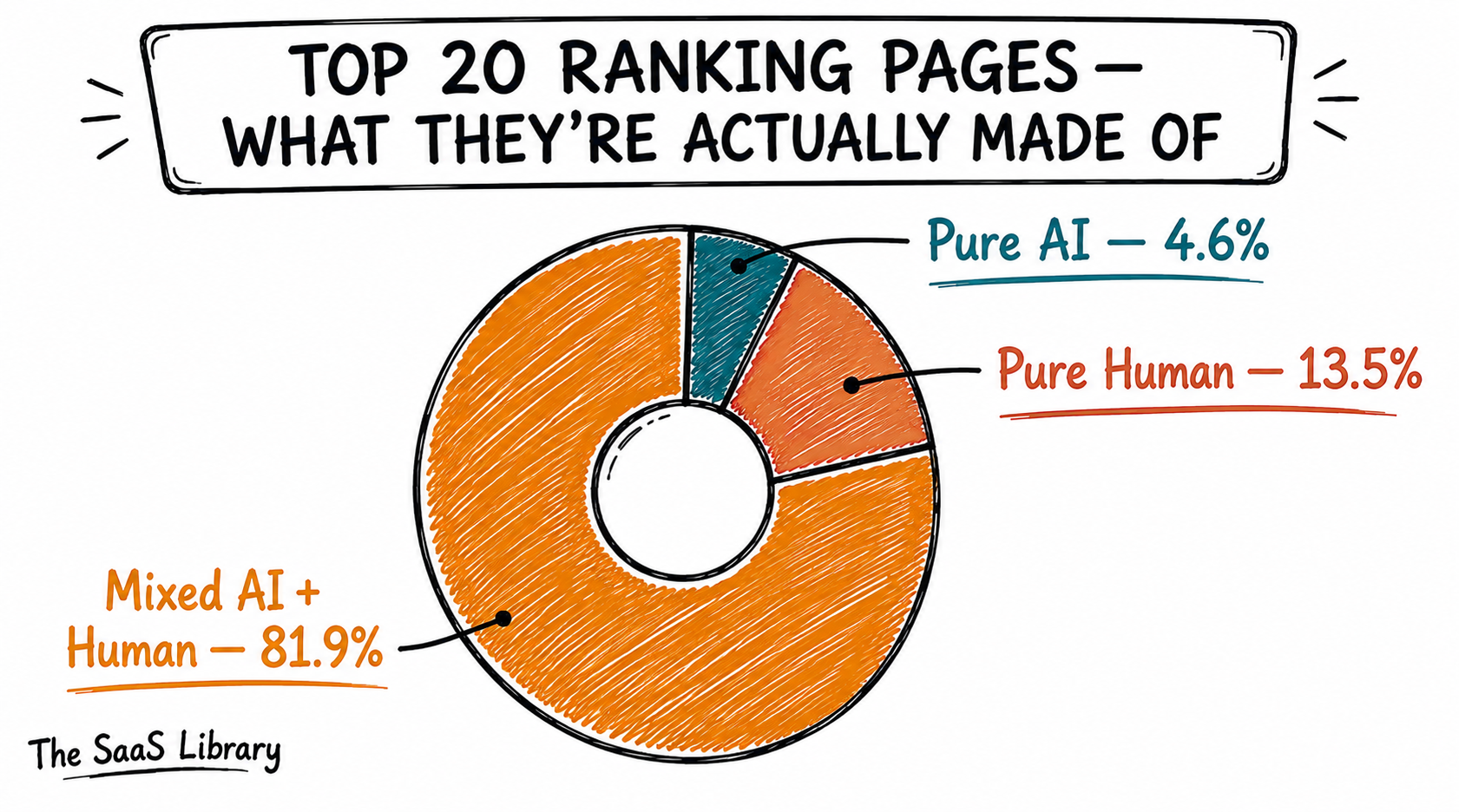
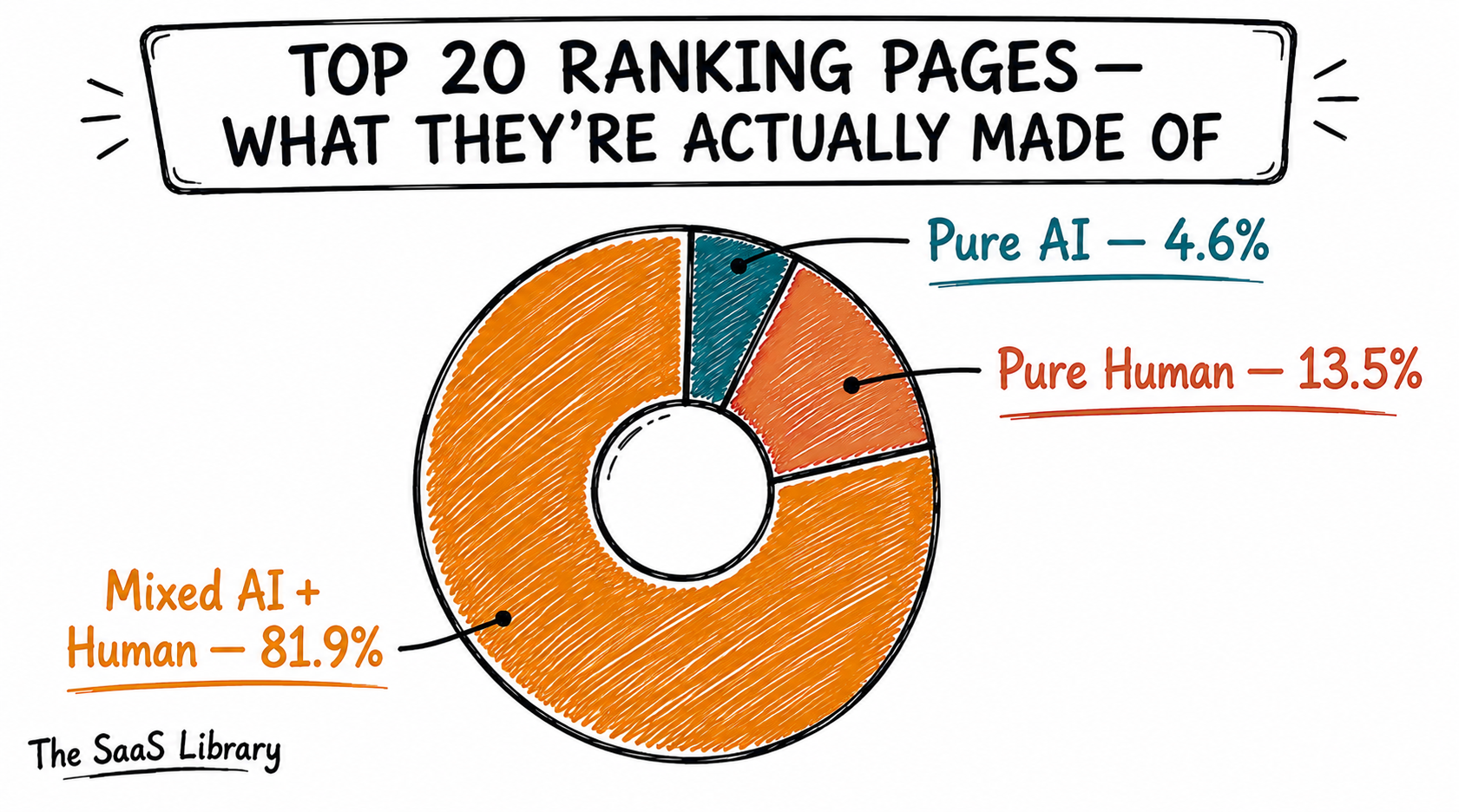
Looking at the Ahrefs composition data specifically: 86.5% of top-20 ranking pages contain some AI involvement, split across pure AI, pure human, and mixed content, classified using Ahrefs’ own AI-content detector — the same category of tool covered in our look at which AI SEO tools people actually use.
Indexation tells a related but distinct story — it drops only modestly as AI-content percentage rises, from about 49% for low-AI pages to about 40% for very-high-AI pages.
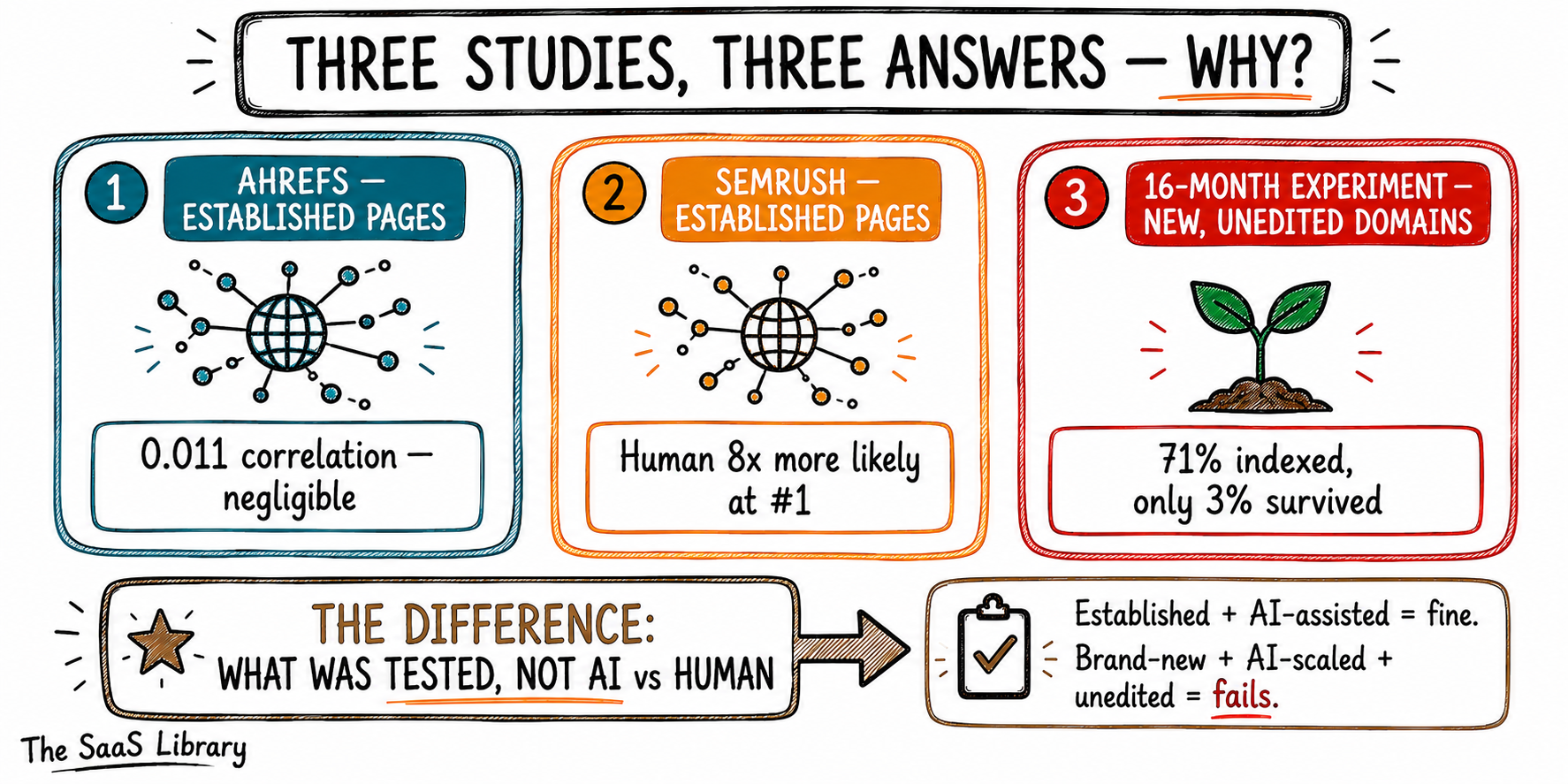
The reconciliation: Ahrefs and Semrush both measure already-established, already-ranking pages across the live web — a mix that’s overwhelmingly AI-assisted, not AI-scaled. The 16-month experiment isolates the opposite extreme: pure AI-scaled content, no authority, no editing, no exceptions. That’s exactly why it collapsed. These three studies answer genuinely different questions — one measures ranking composition, one measures correlation, one measures long-term sustainability on zero-authority domains. None of them proves that AI authorship alone is a ranking penalty.
Semrush has also published separate self-reported survey data (700+ users) suggesting an even more favorable view of AI content performance. That data is self-reported marketing content rather than the independently-classified study above, so we’re weighting the GPTZero-based study as the primary evidence here.
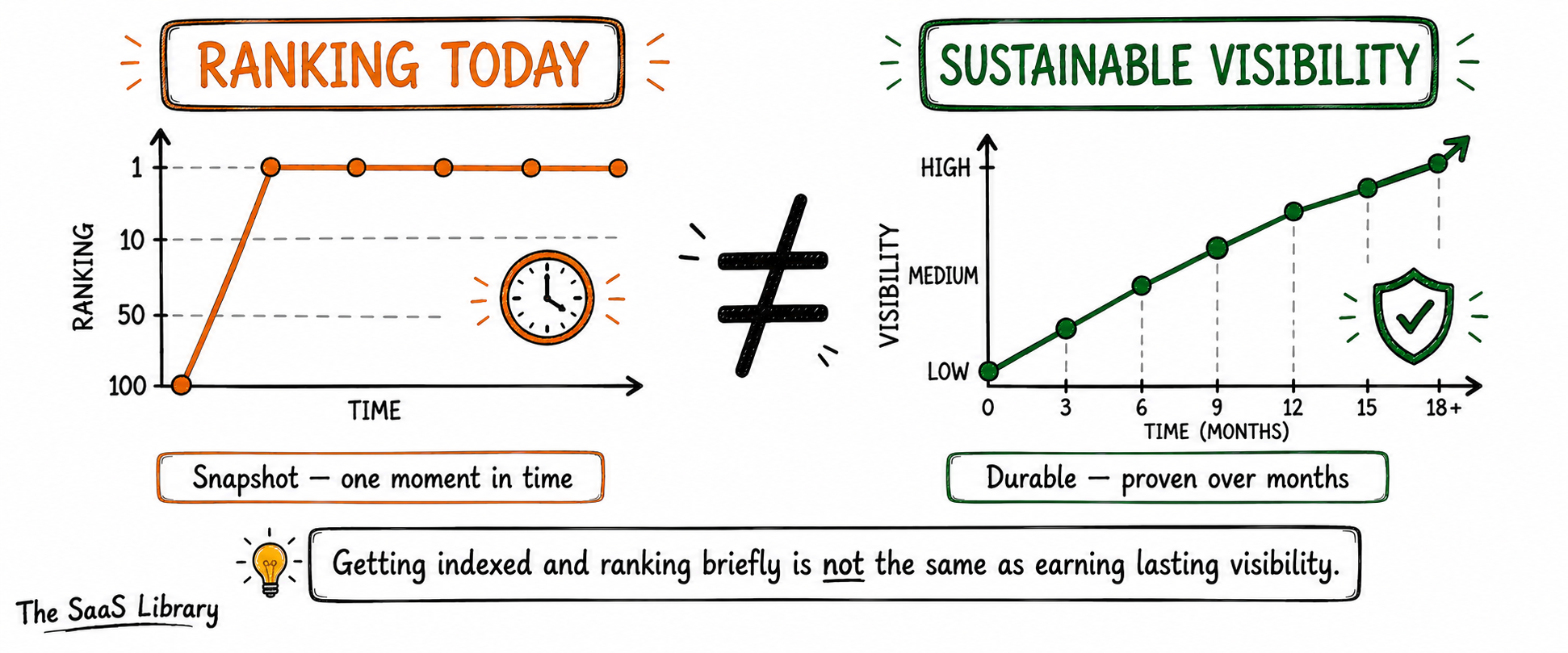
Ranking today is not the same as building durable search visibility. A page can rank temporarily without proving the underlying content strategy is strong. The real question isn’t “can AI content rank?” — it’s “can it keep earning visibility once freshness and quality systems evaluate it over time?”
This lines up with a pattern covered in our breakdown of how SEO, AEO, and GEO tools actually collect their data — every measurement tool has its own blind spots, and “AI content detected” is a pattern-match, not a ranking signal Google confirmed using.
How Do You Use AI Content Without Getting Penalized?
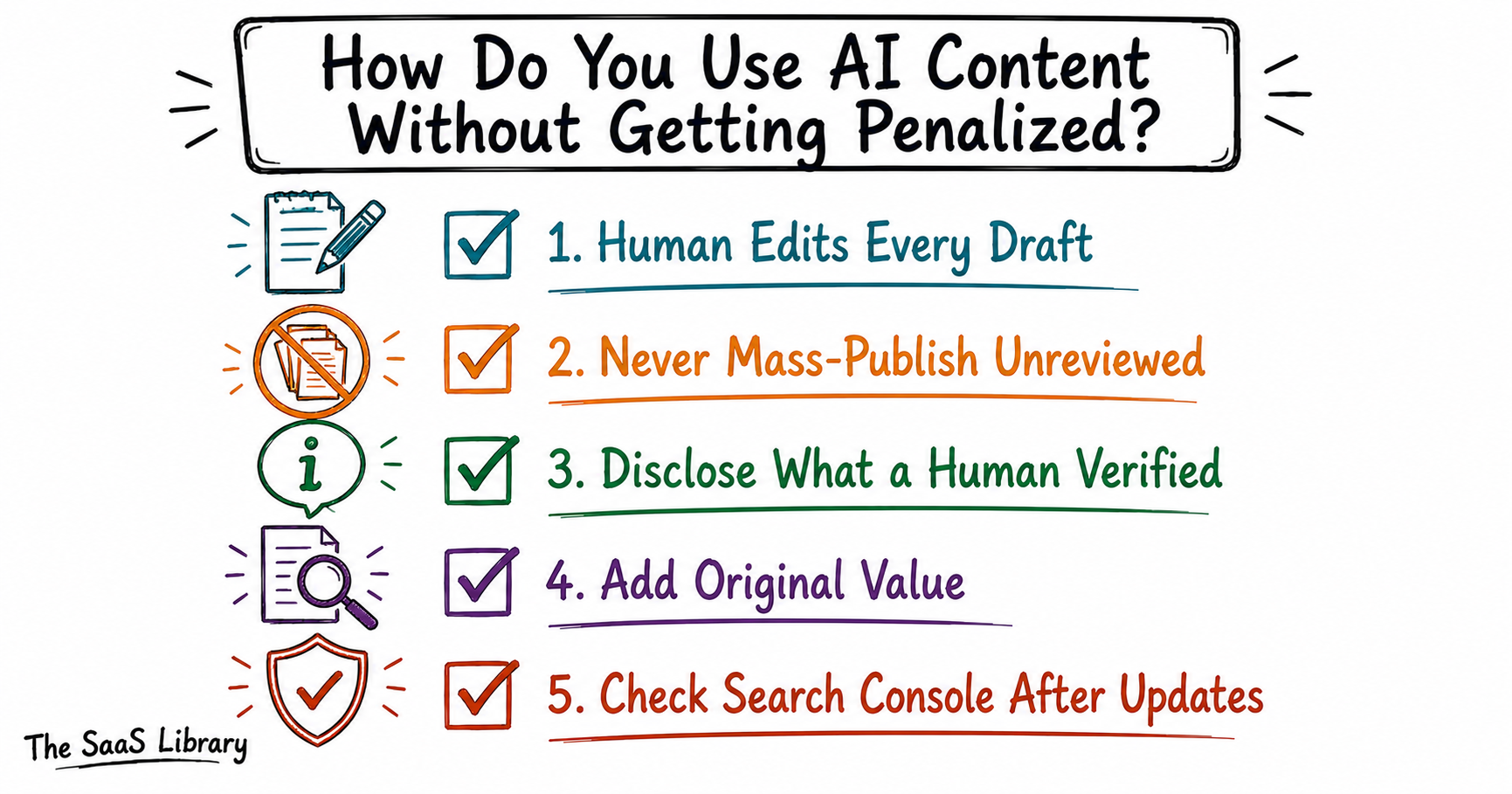
You use AI content without getting penalized by keeping a human in the editorial loop at every stage — verifying facts, adding original insight, and never publishing unreviewed AI output at scale.
| Practice | What the Evidence Shows |
|---|---|
| Keep a human editing every AI draft | Google’s own generative-AI guidance warns against publishing AI output “without adding value for users” — the exact trigger for Scaled Content Abuse. |
| Never publish unreviewed content at scale | This is the pattern behind the March 2024 deindexing wave — volume without editorial oversight is what got sites classified as Pure Spam. |
| If you disclose AI use, explain how, not just that | Bare “AI-generated” labels reduced trust across 13 separate experiments. Disclosures naming what a human verified saw a 73% lift in trustworthiness instead. |
| Add something the internet doesn’t already have | Original data, firsthand testing, or expert verification is what separates helpful AI-assisted content from a rehash. |
| Check Search Console after any spam update | A traffic drop lining up with a known rollout window tells you immediately whether you’re dealing with a real penalty or something else. |
The disclosure nuance is worth sitting with for a second, because it’s counterintuitive: saying “this was AI-generated” and stopping there can actually cost you trust. Source: Schilke & Reimann, Organizational Behavior and Human Decision Processes, 2025 But explaining what a human checked, edited, or added tells the reader you didn’t just push a button and publish. Source: Yahoo Inc. & Publicis Media, 2024
If you do get hit by a ranking drop and you’re not sure whether it’s this update, an editorial quality issue, or something else, running a proper technical audit is the fastest way to find out — checking Search Console’s Manual Actions report is the first move before assuming the worst.
None of this is complicated. It’s the same standard that’s applied to content for the last two decades — write something genuinely useful, verify it’s accurate, and don’t publish thin work at volume. AI just made it faster to accidentally break that rule at scale, which is exactly why it’s worth being deliberate about the process now.
What Is Commodity Content, and Why Does It Matter for AI Content?
Commodity content is generic, easily-replicated information any writer or AI could produce without real experience; non-commodity content requires genuine expertise, original data, or firsthand experience that can’t be replicated.
At Google Search Central Live Toronto in April 2026, Google’s own Danny Sullivan drew this line publicly and directly, distinguishing content “an AI can produce from publicly available information” from content that “requires you to have actually done something, know something from direct experience, or hold an opinion grounded in genuine expertise.” Source: reported via Digitally Next
| Commodity Content | Non-Commodity Content | |
|---|---|---|
| Example | “What is on-page SEO” | “We tested five on-page tactics across 40 client sites — here’s what moved rankings” |
| Who could write it | Any writer, or any AI | Only someone who actually did the work |
| AI Overview inclusion | Rare | More frequent |
| Citation likelihood | Low | High |
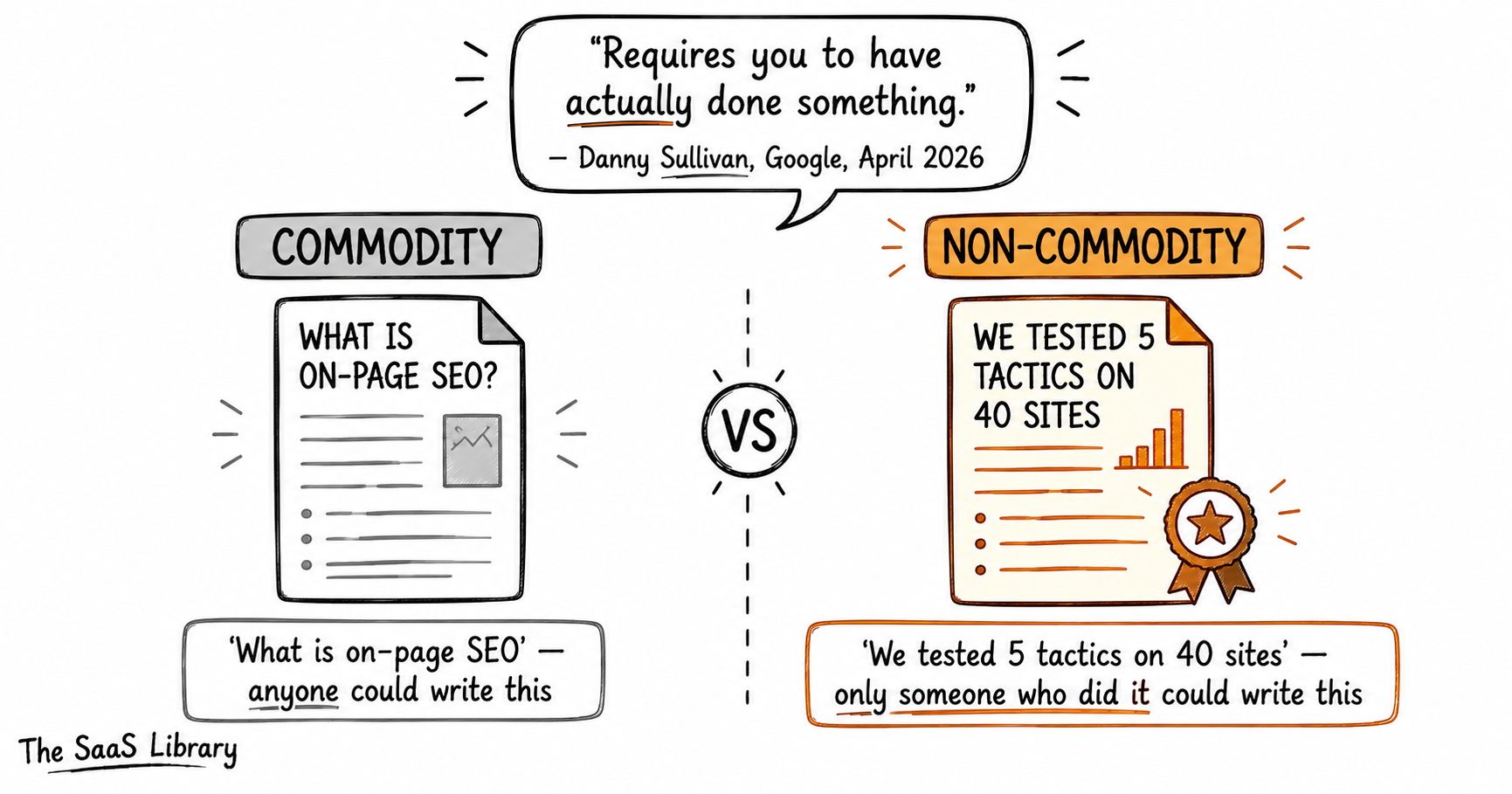
Why this matters more in the AI era: AI makes commodity information cheap to produce at unlimited volume. That’s exactly why original information and genuine expertise become more valuable differentiators, not less — everyone can generate the generic version now, so the generic version is worth less than it used to be.
This maps directly onto the framework in the next section: commodity content fails the Value question by definition. Non-commodity content passes it, regardless of whether AI helped write it.
How Do You Know If Your AI Content Crosses the Line?
Google doesn’t call this a Scale-Value Test. We do. It’s a practical way to translate Google’s published policies into a simple editorial decision framework — reduced to two questions you can run against any page before you publish it.
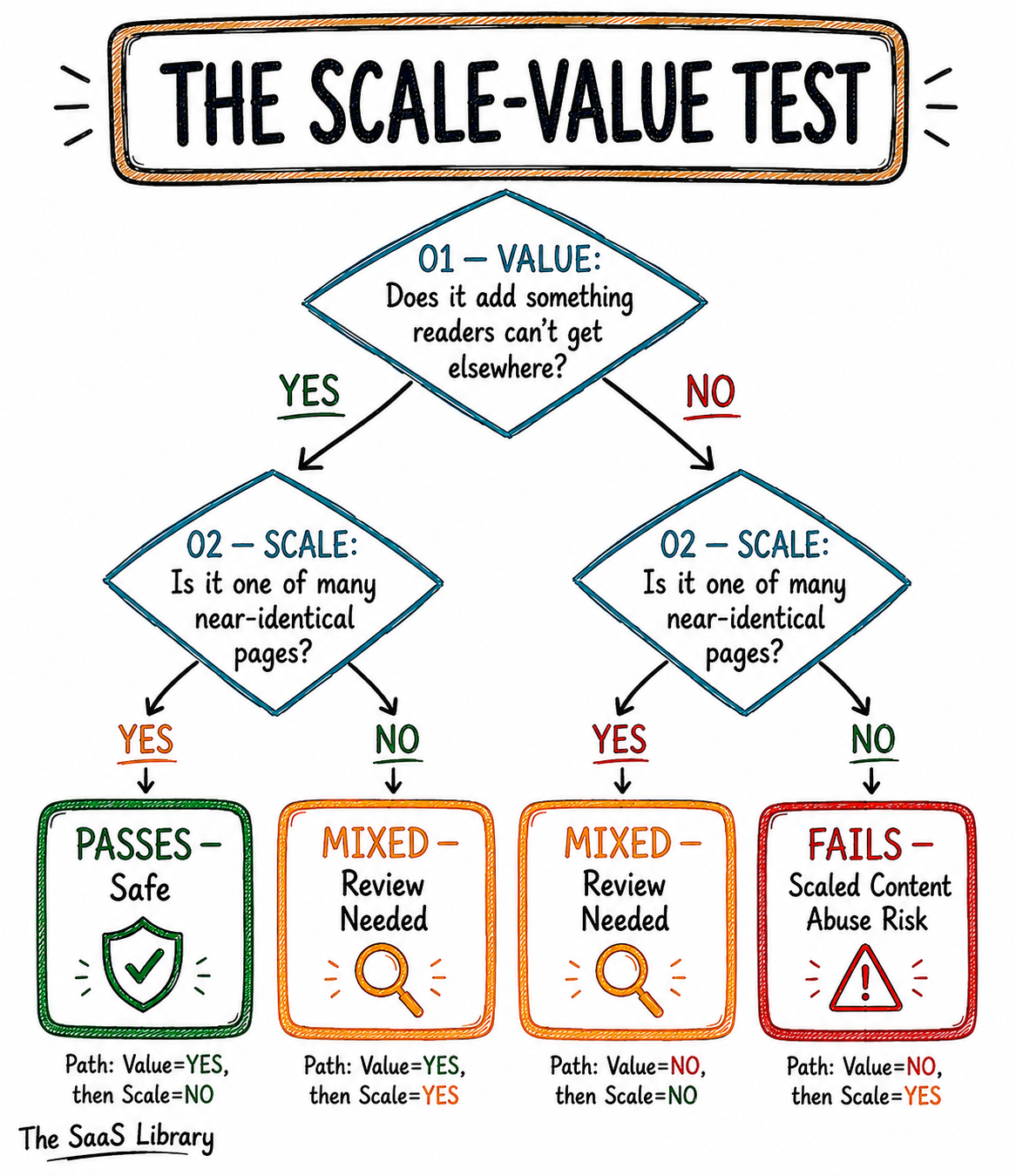
Put the two questions together and four outcomes emerge:
| Low Scale | High Scale | |
|---|---|---|
| High Value | Strongest position | Mixed — review whether the pages are genuinely differentiated |
| Low Value | Weak content, but not necessarily scaled abuse | Highest-risk pattern |
A page that fails both questions is exactly what Google’s Scaled Content Abuse policy targets. A page that uses AI but passes both is not — regardless of how much of it AI helped write. If you want to run this test across an entire existing site rather than one page at a time, our content audit framework walks through that process in more depth.
How Do You Measure AI-Search Performance?
You measure AI-search performance using Google Search Console’s Generative AI performance report, launched June 3, 2026, which tracks impressions inside AI Overviews and AI Mode separately from standard organic results.
Before this report existed, AI Overview and AI Mode impressions were folded invisibly into your regular Search Console numbers — you had no way to isolate them. That changed with a dedicated report covering five dimensions: impressions, pages, countries, devices, and dates. Source: Google Search Central
| What It Shows | What It Doesn’t (Yet) |
|---|---|
| Impressions inside AI Overviews and AI Mode | Click data or CTR |
| Which specific pages get cited | Query-level detail |
| Country and device breakdown | Position ranking within AI answers |
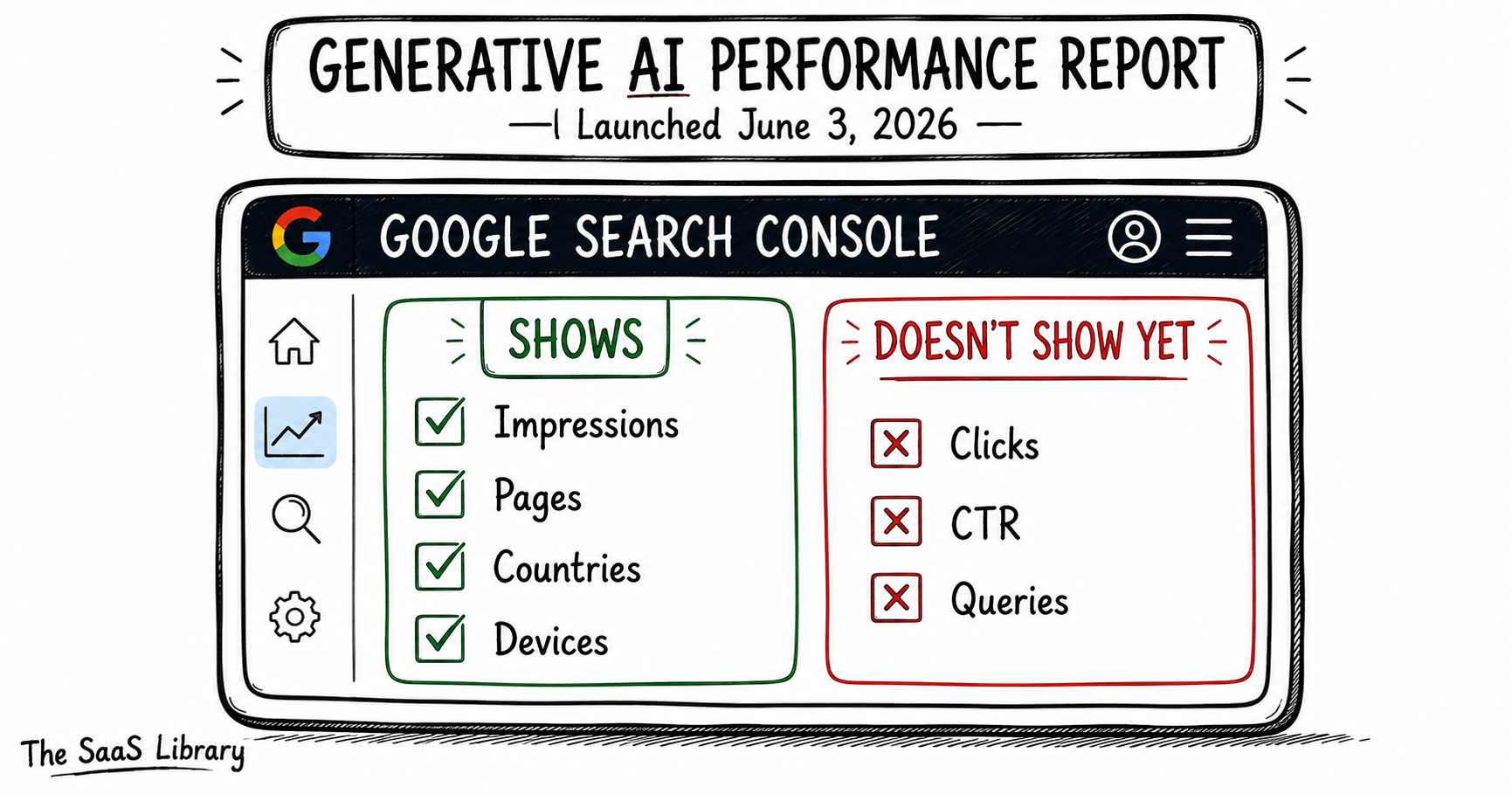
The rollout started with UK properties first, so it may not appear on every Search Console account yet. Source: Google Search Central If you don’t see it, that’s a rollout gap, not a sign your site is excluded from AI features. Beyond this report, watching impressions, traffic, and engagement differences between traditional Search and AI features is the most reliable way to track how your content performs across both surfaces right now.
Frequently Asked Questions
Does Google penalize AI-generated content?
Google does not penalize content for being AI-generated. Google’s spam policies target scaled content abuse — mass-produced, low-value pages — regardless of whether a human, an AI, or a mix of both created them.
What is scaled content abuse?
Scaled content abuse is Google’s spam policy against publishing many pages primarily to manipulate search rankings rather than help users. It covers AI-generated pages, scraped content, and human-written thin content equally.
Can AI content rank number one on Google?
Yes, AI content can rank number one on Google. Ahrefs’ 2025 study found fully AI-generated pages occupying top positions, though a separate Semrush study found human content 8x more likely to rank first.
Does the August 2026 spam update target AI content?
Google has not confirmed the August 2026 spam update specifically targets AI content. Google described it only as a normal spam update enforcing existing policies, with no new categories announced.
How does Google detect AI content?
Google has not published a specific AI-content detection methodology. Google’s SpamBrain system identifies patterns of scaled, low-value publishing rather than flagging AI authorship as a standalone signal.
Can I use AI to write my blog posts?
Yes, you can use AI to write blog posts without violating Google’s policies. The requirement is genuine editorial value — human fact-checking, original insight, and content that helps a specific reader rather than just targeting a keyword.
Is AI-generated content against Google’s guidelines?
AI-generated content is not against Google’s guidelines on its own. Google’s February 2023 guidance states directly that using AI is not a violation unless the primary purpose is manipulating search rankings.
What happened in Google’s March 2024 core update?
Google’s March 2024 core update introduced the scaled content abuse policy and triggered manual actions against roughly 1,446 sites, many built on unedited AI content, according to Originality.AI’s analysis of the deindexing wave.
How do I avoid a Google penalty when using AI content?
You avoid a Google penalty when using AI content by keeping a human editor in the process, verifying every fact, adding original value the internet doesn’t already have, and never publishing unreviewed AI output at scale.
Does using AI content lower my search rankings?
Using AI content does not inherently lower search rankings. Ahrefs found a 0.011 correlation between AI-content percentage and ranking position across 600,000 pages — negligible, though other studies show more mixed results.
What is Google’s Pure Spam manual action?
Pure Spam is a Google Search Console manual action category for sites using aggressive spam techniques, such as auto-generated gibberish or scraped content, which can catch both human and AI-produced content since production method isn’t a factor.
How often does Google release spam updates?
Google released three spam updates in 2026 — March, June, and August — each described as normal enforcement of existing policies rather than introducing new rules.
Is AI-assisted content different from AI-scaled content?
Yes. AI-assisted content keeps a human directing topic choice, editing, and final publishing decisions; AI-scaled content automates most or all of that process across many pages at once.
Does Google penalize AI Overviews manipulation?
Google’s spam policies, clarified in May 2026, apply to attempts to manipulate generative AI responses the same way they apply to traditional ranking manipulation.
Can AI content rank today but lose rankings later?
Yes. A 16-month experiment found unedited AI content on new domains got indexed quickly but only 3% remained in the top 100 after three months, showing ranking today doesn’t guarantee sustained visibility.
How can I measure AI-search visibility?
You can measure AI-search visibility using Google Search Console’s Generative AI performance report, launched June 3, 2026, which tracks impressions inside AI Overviews and AI Mode.
If you use AI to: brainstorm, research, structure, draft, rewrite, or analyze — that’s not inherently a Google spam violation.
If you use AI to: mass-produce near-identical pages, publish without meaningful review, create commodity content purely for search demand, manipulate AI-generated responses, or scale pages primarily to capture rankings — that’s a high-risk pattern, potentially within Google’s spam policies depending on execution.
This article does not claim that AI content always ranks, that AI content never performs worse, that Google cannot identify patterns associated with AI-generated publishing, that the August 2026 update had zero AI-related impact, or that every AI-assisted workflow is safe. The narrower claim: Google has not established AI authorship itself as a standalone spam violation. The documented risk is low-value, manipulative, scaled publishing — regardless of what produced it.
Conclusion
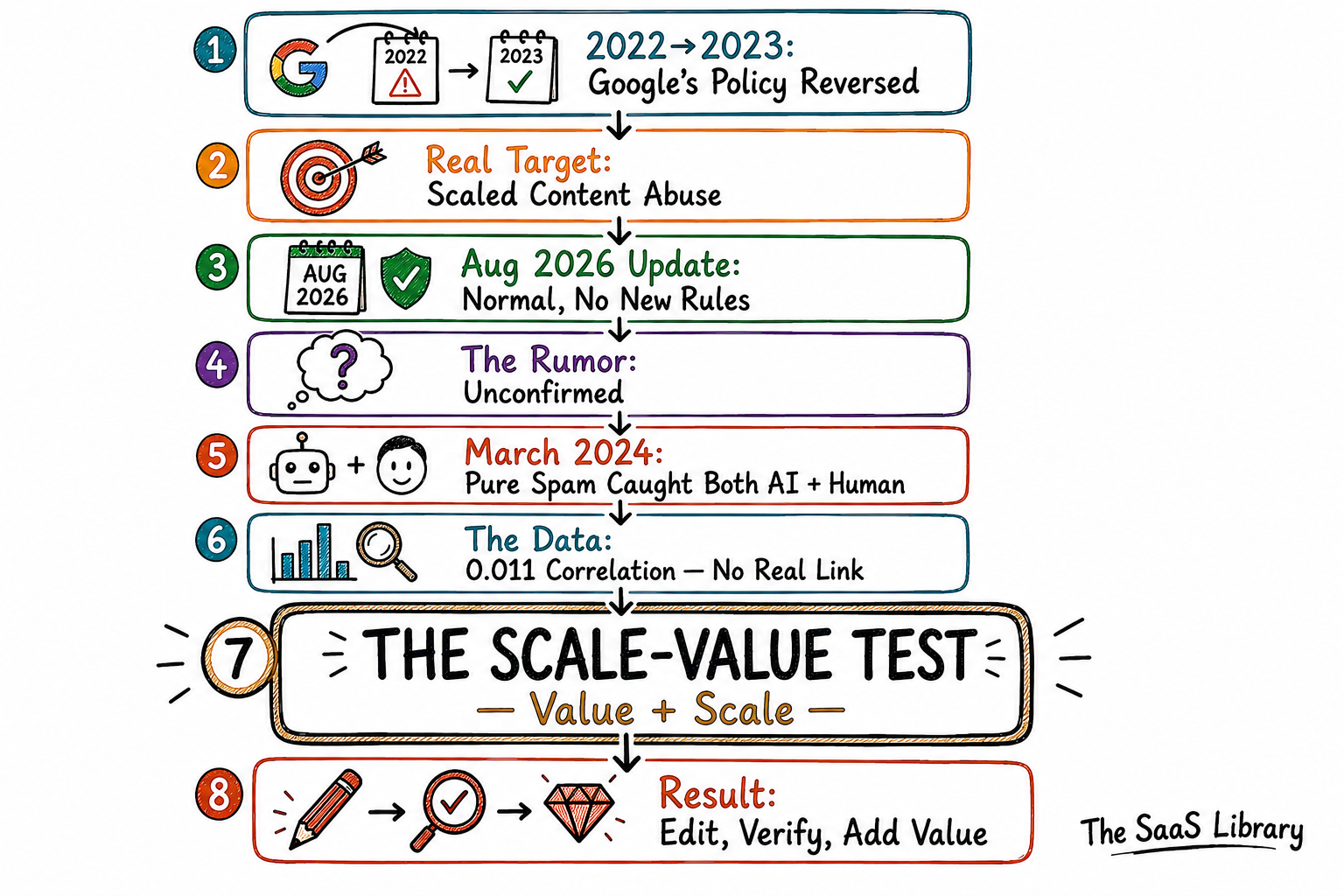
The SaaS Library Scale-Value Test cuts through all of it: does a page add something a reader can’t get elsewhere, and is it one of many near-identical pages published just to capture rankings? Google’s actual policy has never been more complicated than that.
Google does not treat AI authorship itself as the core problem. The meaningful distinction is between using AI as part of a human-led editorial process and using AI to mass-produce low-value, commodity, or manipulative content at scale. Google’s 2026 AI-search developments reinforce the same principle: optimize for useful, original information rather than manufacturing content specifically to manipulate rankings or AI-generated answers.
If you’re still deciding which AI tool to actually build that process around, our head-to-head comparison of the best AI writing tools is the natural next read.
Primary — Google
- Google Search Central — “Google Search’s guidance about AI-generated content,” Feb 8, 2023
- Google Search Central — Spam Policies for Google Web Search
- Google Search Central — “What web creators should know about our March 2024 core update and new spam policies”
- Google Search Status Dashboard — August 2026 spam update
- Google Search Central — “Introducing Search Generative AI performance reports in Search Console,” June 3, 2026
- Google Search Central — “AI features and your website”
- Google Search Console Help — Manual Actions report
First-Party Research
- Ahrefs — “AI-Generated Content Does Not Hurt Your Google Rankings,” 2025 (Si Quan Ong, 600K pages)
- Ahrefs — “Google Doesn’t Punish AI Content; It Punishes Bad Content,” 2026 (Ryan Law, 331K/1M pages)
- Semrush — “Does AI content rank well in search?” via Search Engine Land, April 2026 (224 professionals surveyed, 42K pages)
Independent Industry Reporting
- Search Engine Land — “Google releases August 2026 spam update”
- Search Engine Land — “How AI-generated content performs in Google Search: A 16-month experiment,” SE Ranking
- Search Engine Roundtable — “Google August 2026 Spam Update Is Done Rolling Out”
- Search Engine Journal — “Google’s March 2024 Core Update Impact: Hundreds Of Websites Deindexed”
- Entireweb — “Google’s August 2026 Spam Update Is Now Complete”
- Justia — “Google’s August 2026 Spam Update Is Now Rolling Out”
- Digitally Next — commodity vs. non-commodity content, reporting Danny Sullivan’s April 2026 remarks
Secondary / Industry Research