Everyone’s arguing about whether the house is on fire. Nobody’s checking which room.
Yann LeCun didn’t just criticize LLMs — he quit Meta and raised $1.03 billion to bet against them. That’s not hype, that’s money. The LLM boom is not a dead end. But the specific claim that scaling alone gets you to AGI? That’s already dead — 76% of surveyed AI researchers say so. This piece separates what’s verified from what’s vibes, one claim at a time.
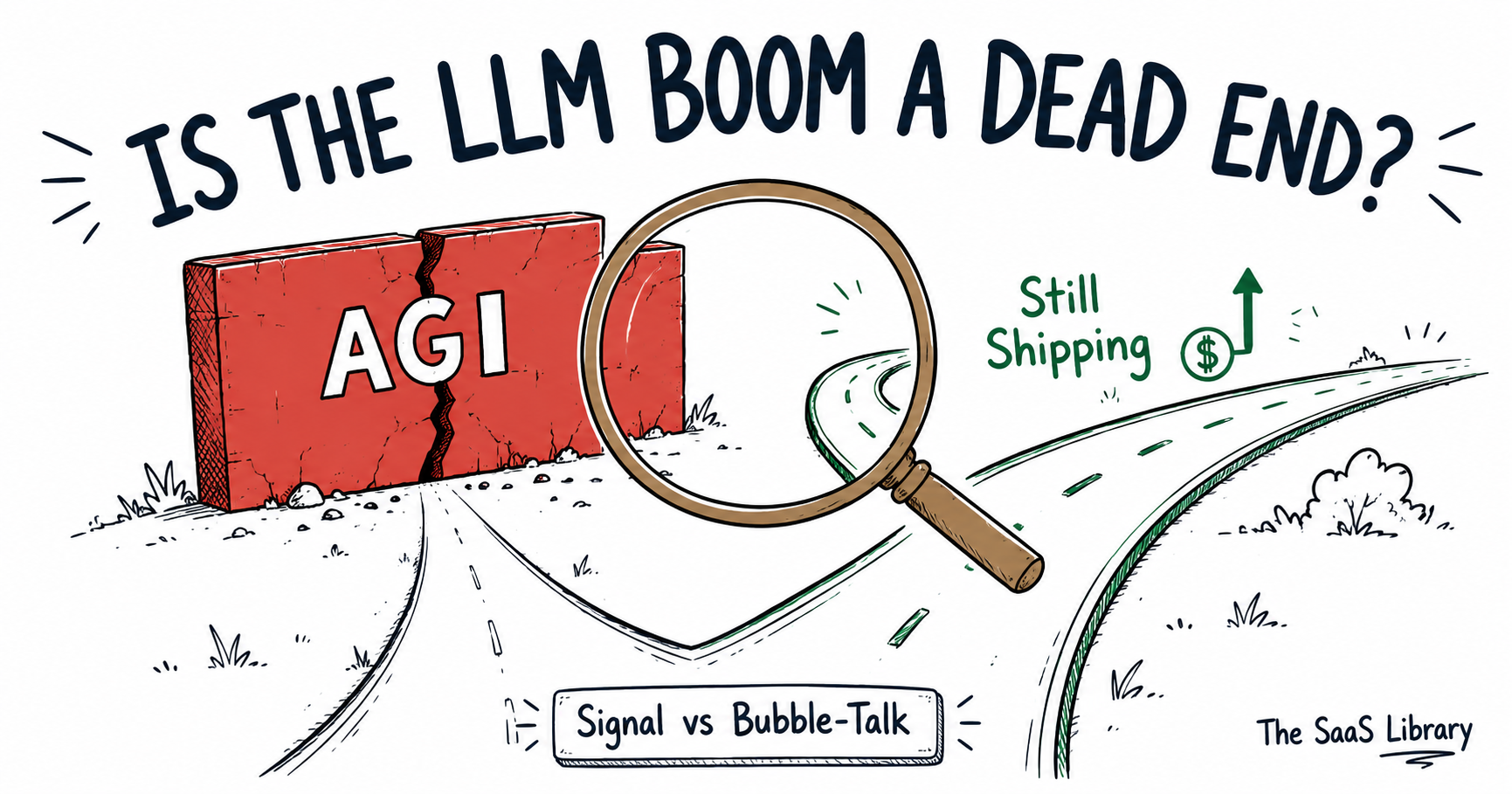
No. LLMs aren’t dying — they’re shipping, earning, improving. What’s dead is one specific bet: that scaling text-prediction alone gets you to AGI (artificial general intelligence). Three out of four AI researchers now say that bet is dead. Confuse those two claims and you’ve just bought into bubble-talk.
What does “LLM dead end” actually mean?
“LLM dead end” doesn’t mean AI is fake. It doesn’t mean ChatGPT stops working next week. It means one narrow thing: pile on more data, more GPUs, more billions — you still won’t get a machine that thinks like a human. Scaling hits a wall before AGI. That’s the whole claim.
It does not mean:
- AI is fake
- ChatGPT stops working next week
- Every LLM company is about to collapse
Here’s who’s saying it, and why it’s not a fringe take:
- Yann LeCun — Turing Award winner, ran Meta’s entire AI division for over a decade
- May 2026, Bloomberg’s “The Close”: LLMs are “not the path to real intelligence. They’re a detour.”
- Then he quit Meta
- Then he raised $1.03 billion to prove it — AMI Labs, a $3.5 billion bet on “world models” instead of next-token prediction
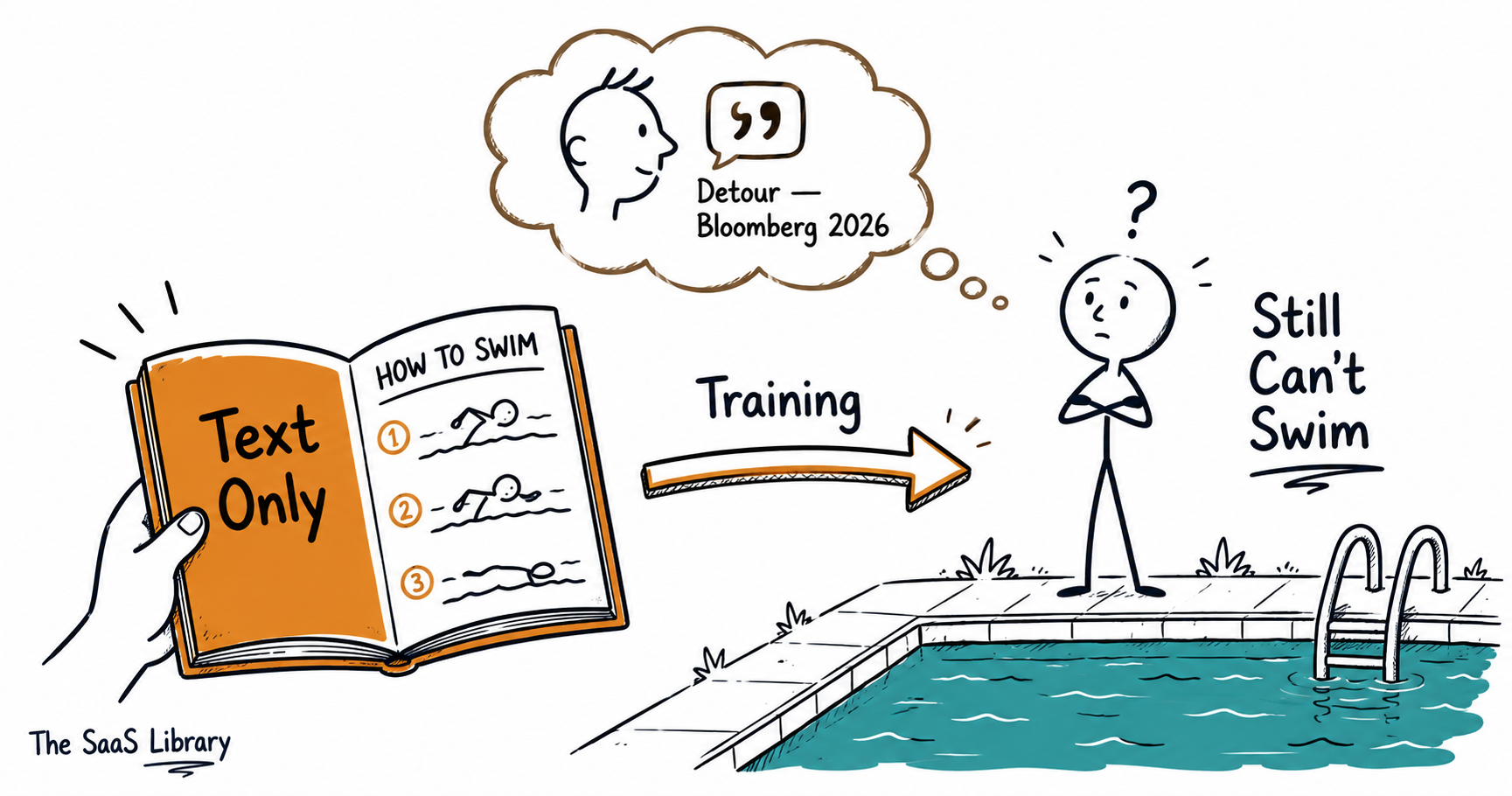
His logic, no jargon: language is a thin slice of reality. Train a model on text alone and you’re teaching it to swim from a manual. It memorizes every stroke. Throw it in water, it drowns.
| Who | What They Found | Source |
|---|---|---|
| AAAI Presidential Panel (2025) | 76% of 475 surveyed AI researchers say scaling won’t reach AGI | TechPolicy.Press |
Three out of four. That’s not a fringe opinion. That’s the room.
So: the scaling-only path to AGI is basically closed. LLMs themselves? Not even close to dead.
Why do AI researchers disagree so sharply on scaling?
AI researchers disagree so sharply on scaling because they’re not actually debating the same thing. One side points at capability. The other points at architecture. Both are right, and both are talking past each other.
Here’s the capability half — the receipts:
| Source | Finding |
|---|---|
| Apple ML Research, “The Illusion of Thinking” (2025) | Reasoning models don’t fail gracefully on hard puzzles. They collapse completely past a moderate complexity threshold. |
| Gary Marcus, ACM commentary (June 2025) | Calls the collapse a knockout blow — models are “super expensive pattern matchers that break as soon as we step outside their training distribution.” |
| Lawsen & Opus, “The Illusion of the Illusion of Thinking” (arXiv:2506.09250, 2025) | Rebuttal: much of that “collapse” is models hitting their output token limit, not losing the ability to reason. |
Real weakness. Overstated proof. Both true at once.
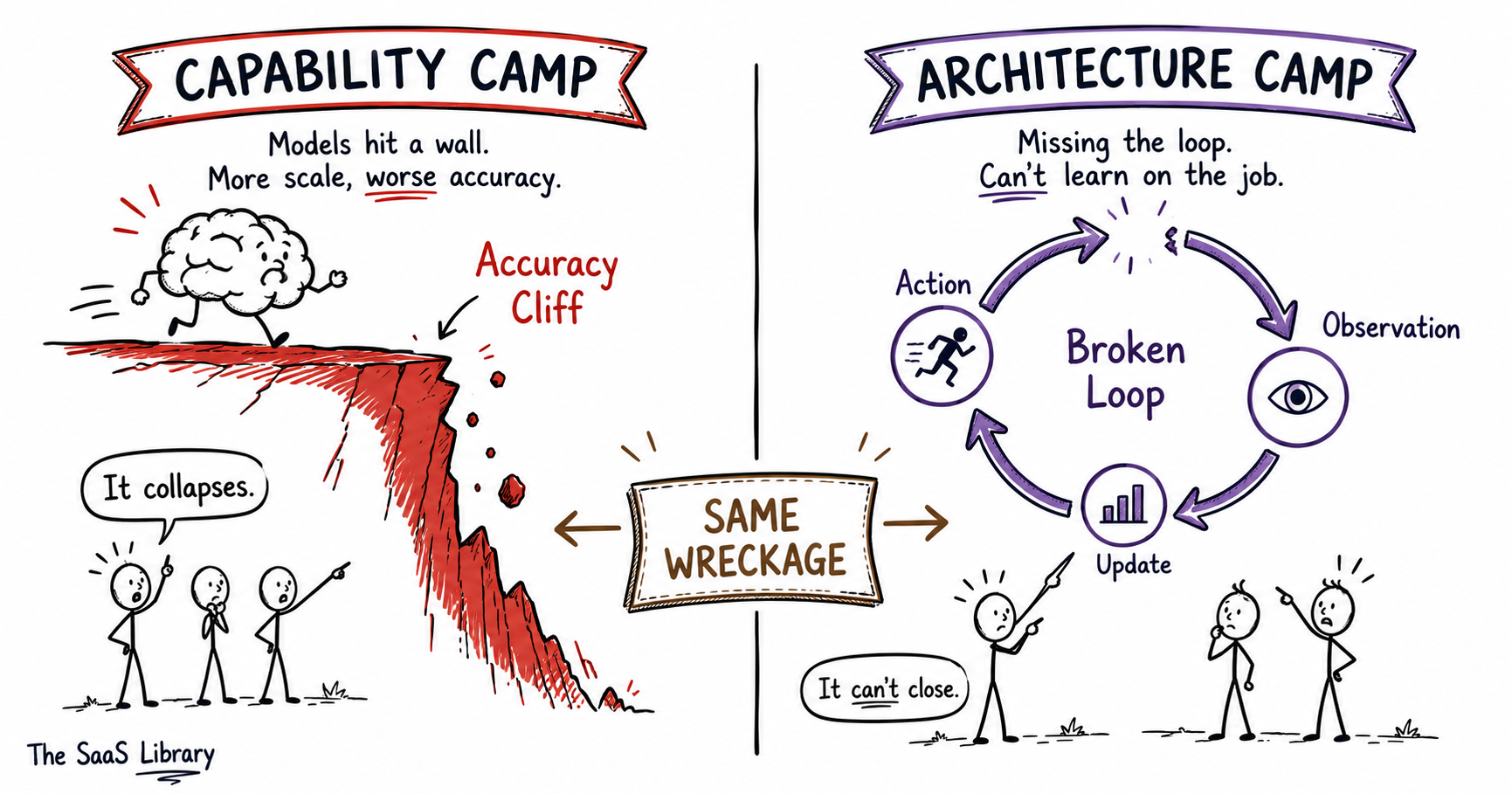
Then there’s the architecture half — the heavyweights:
- Richard Sutton — 2024 Turing Award winner, wrote “The Bitter Lesson,” the essay that basically justified the entire scale-everything era. He comes out of the reinforcement-learning lineage that treats learning-from-experience as the real prize, not pattern-matching text. On the Dwarkesh Podcast, he said the quiet part: LLMs learn to predict what a human would say. Not what happens in the world. They can’t learn on the job. No amount of scale fixes that.
- Ilya Sutskever — OpenAI’s own former chief scientist. On the Dwarkesh Podcast (Nov 25, 2025), verbatim: “We’re moving from the age of scaling to the age of research.” That’s not an outsider. That’s a founder.
This is also why the open-weights side of this architecture debate matters — LeCun’s AMI Labs isn’t just a new company, it’s a bet on an entirely different training philosophy, not a bigger version of the same one.
Now the real-world exhibit, because talk is cheap and this isn’t:
- xAI posted a $2.47 billion operating loss in Q1 2026 — on $818 million revenue, per SpaceX’s S-1 IPO filing
- All 11 of 11 original xAI co-founders have walked, confirmed by TechCrunch/The Next Web
- Musk’s own words, on the rebuild: xAI “was not built right the first time around“
The counter-punch — because this debate has one, and it’s not weak: Thomas Hazel (Forbes Technology Council) argues the plateau isn’t the architecture failing — it’s models frozen the second they ship. They can’t learn from their own mistakes in production. Fix that closed loop, he says, and the ceiling moves. Sutton’s “can’t learn on the job” critique and Hazel’s “frozen post-deployment” critique are describing the same gap. They just disagree on whether it’s fixable.
Curious why even the same model can’t reason the same way twice?
Read: Why ChatGPT Gives Different Answers →What does the enterprise ROI data actually show?
The enterprise ROI data shows two things that sound contradictory and aren’t: AI is everywhere, and it’s barely moving the needle where it counts. Both true. At the same time.
Here’s the adoption side — going up, fast:
- 88% of companies use AI in at least one function as of 2025, per McKinsey — up from 78% in 2024
- 72% of business leaders track structured gen AI ROI metrics, and 75% report positive returns, per Wharton/GBK Collective
- 82% of leaders use gen AI weekly — this isn’t a pilot anymore, it’s daily infrastructure
Here’s the payoff side — barely moving:
- Only 39% of companies can point to any enterprise-wide EBIT impact from AI, per McKinsey — and most of those say it’s under 5% of total EBIT
- 56% of CEOs report zero measurable revenue or cost benefit from AI in the past 12 months, per PwC’s 29th Global CEO Survey (January 2026, 4,454 CEOs)
- Gartner predicts over 40% of agentic AI projects specifically will be canceled by end of 2027 — not because the models are bad, but because of escalating costs and unclear business value
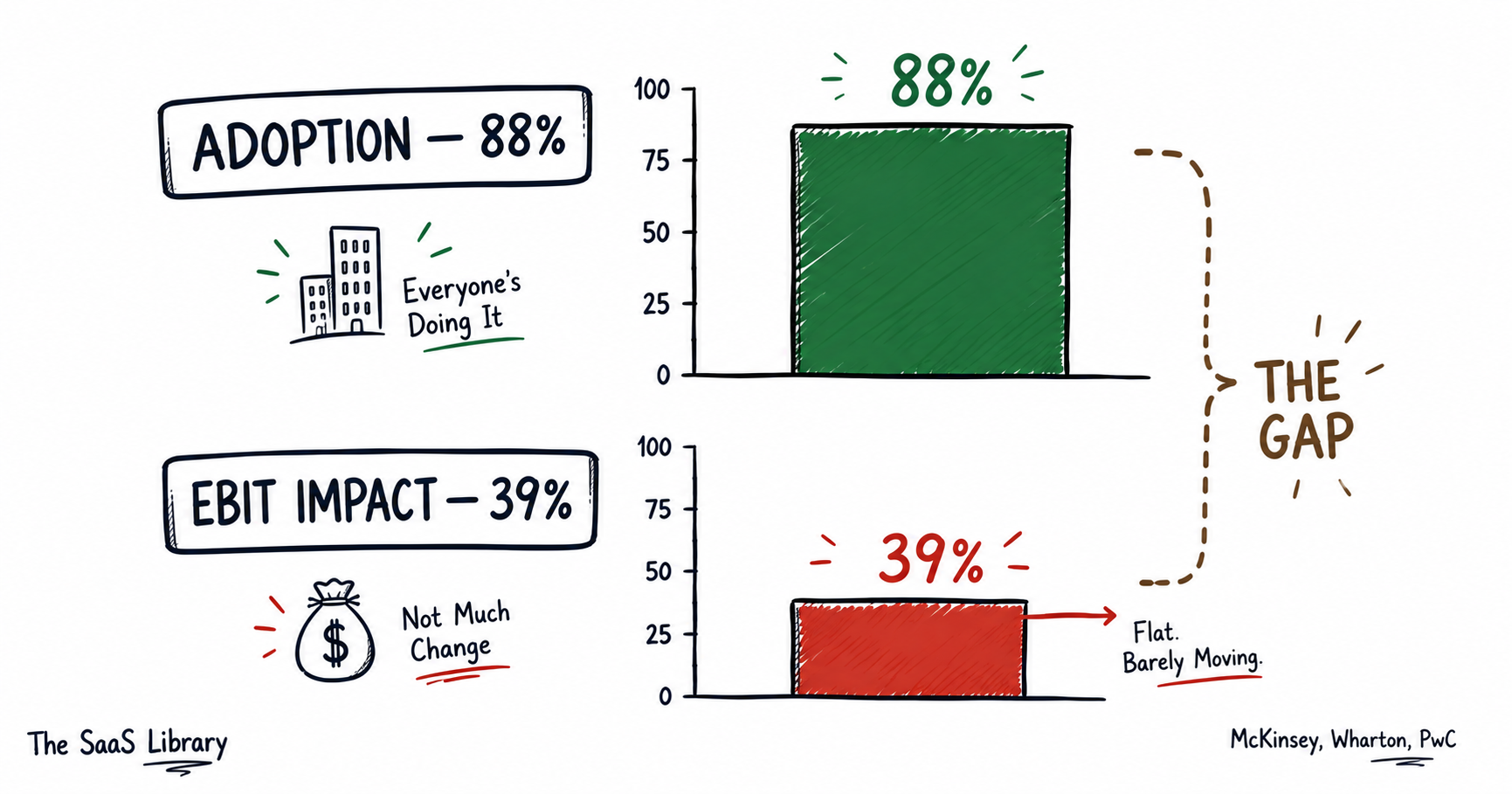
Notice none of these numbers actually contradict each other. They’re measuring three different altitudes:
| Question | Who Answers It | Result |
|---|---|---|
| Are people using it? | McKinsey (adoption) | 88% yes |
| Do they feel it’s paying off? | Wharton (perceived returns) | 75% yes |
| Does it show up in the P&L? | McKinsey (EBIT), PwC (CEO-reported) | 39% and 44%, respectively |
That gap — wide adoption, narrow financial proof — is the same gap we’ve written about in agentic AI cost planning: teams roll it out fast, and the ROI math catches up months later, if it catches up at all. It’s also why 96% of companies running AI agents still can’t govern them — adoption speed and control speed aren’t the same speed. That’s the governance side of this same gap: companies deployed first and are building the guardrails after the fact.
The consequence isn’t hypothetical. Teams that rushed AI layoffs are already walking them back — the same overconfidence that inflated adoption stats also inflated headcount cuts nobody could actually back up with output.
So no, the ROI data doesn’t say “bubble.” It says: real value, real hype, both stacked on top of each other, and most companies haven’t separated the two yet.
So far: the science says scaling alone won’t reach AGI, and the money says almost nobody’s proven ROI at enterprise scale. Next: what OpenAI’s own books actually show, and where this debate gets settled for good.
Is OpenAI’s financial picture a warning sign?
OpenAI’s financial picture is a warning sign on cost, but not on the revenue headline everyone’s fighting about. Here’s the split.
The audited numbers — verified by the Financial Times, from leaked documents obtained by Ed Zitron:
| Metric | 2024 | 2025 |
|---|---|---|
| Revenue (booked, full year) | $3.7B | $13.07B |
| Total costs | $12.48B | $34B |
| Operating loss | $8.78B | $20.92B |
| Net loss (after conversion charges) | $5.09B | ~$38.5B |
That $38.5B isn’t even pure operating pain — a chunk of it (~$41.55B) is a one-time non-cash charge from OpenAI’s nonprofit-to-for-profit conversion. Strip that out and the operating loss is $20.92B. Still brutal. Just less apocalyptic than the headline number alone suggests.
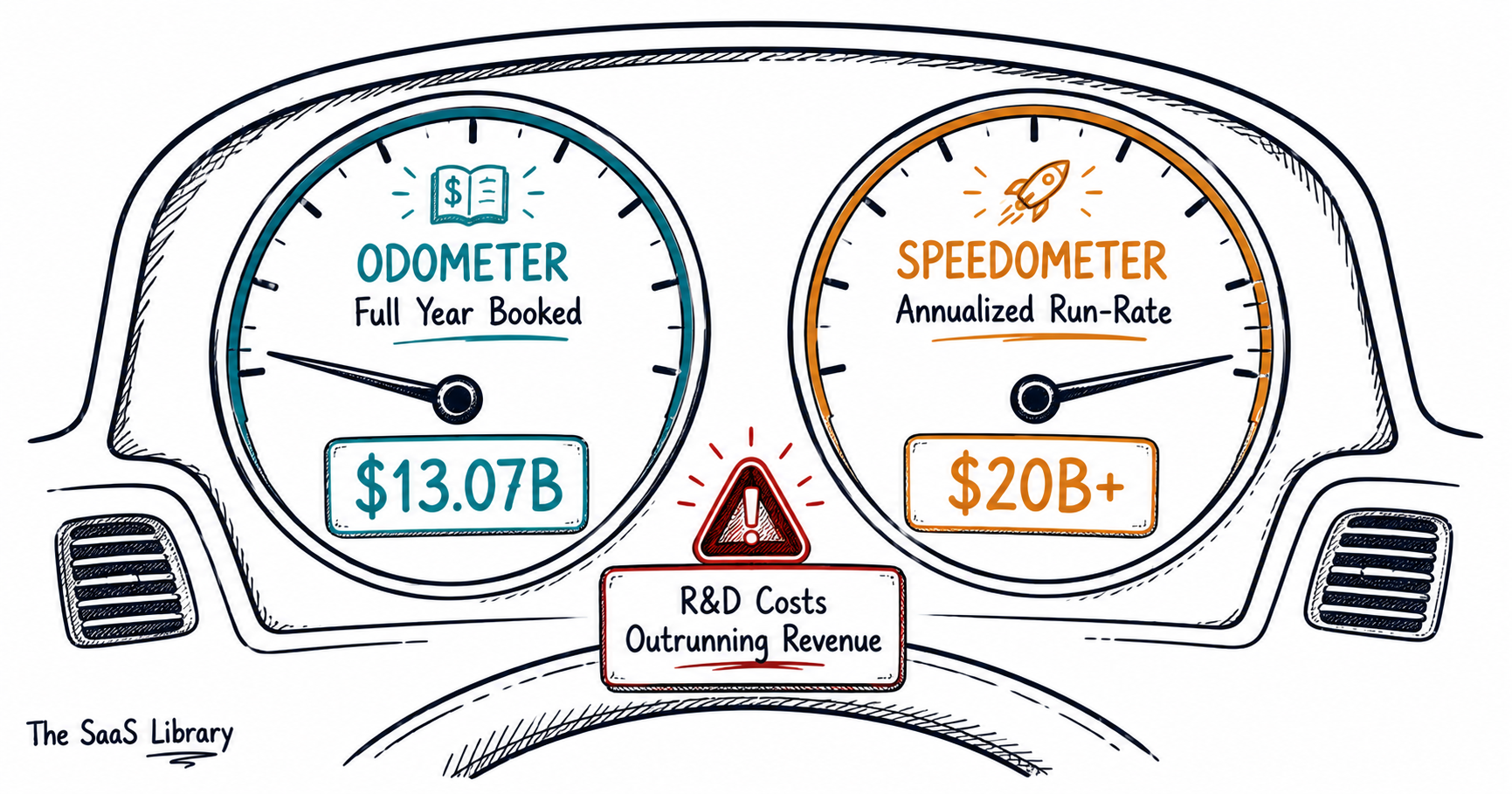
Here’s where the confusion actually starts. CFO Sarah Friar said something different, and it’s true too: annualized revenue run-rate crossed $20 billion by end of 2025. Her exact words: “Revenue followed the same curve growing 3X year over year, or 10X from 2023 to 2025: $2B ARR in 2023, $6B in 2024, and $20B+ in 2025.”
- $13.07B = what OpenAI actually booked across all 12 months of 2025 (audited, trailing)
- $20B+ = what OpenAI was making right now, annualized, by the end of 2025 (a snapshot, forward-looking)
Both numbers are real. They’re measuring different things — one’s a speedometer reading, one’s the odometer for the whole year. Most coverage swaps them without saying so, which is exactly how a real company’s real growth gets turned into “OpenAI lied about its revenue.”
The actual warning sign isn’t the top line at all. R&D alone hit $19.18B in 2025 — costs are still scaling faster than revenue, and there’s no visible point where that flips. It’s worth understanding how AI companies actually price these losses back to customers before assuming the bill stops at OpenAI’s balance sheet — and how AI FinOps teams are already budgeting for this rather than waiting to be surprised by it.
What would a real “dead end” look like vs. a normal maturity curve?
A real dead end would look like LLMs stalling — flat performance, no new capabilities, revenue cratering while costs stay the same. A normal maturity curve looks like exactly what’s happening now: costs outrunning revenue while the tech keeps improving. Those are not the same shape, and right now, we’re only seeing the second one.
Here’s the tell — watch these three signals, not the headlines:
| Signal | Dead End Looks Like | Maturity Curve Looks Like | Where We Are Now |
|---|---|---|---|
| Non-LLM architecture ships a product | JEPA/world-models beat LLMs at a real commercial task before ~2028 | World-models stay research-only, LLMs keep improving in parallel | Too early — AMI Labs has $1.03B and zero shipped products |
| Enterprise EBIT impact | Stays flat or drops below 39% | Climbs materially past 39%, per McKinsey | Still 39% — watch this number, not adoption rate |
| Agentic AI cancellations | Cancellation rate blows past Gartner’s 40% prediction | Cancellation rate lands near or under 40%, survivors show real ROI | Too early — 2027 is the checkpoint |
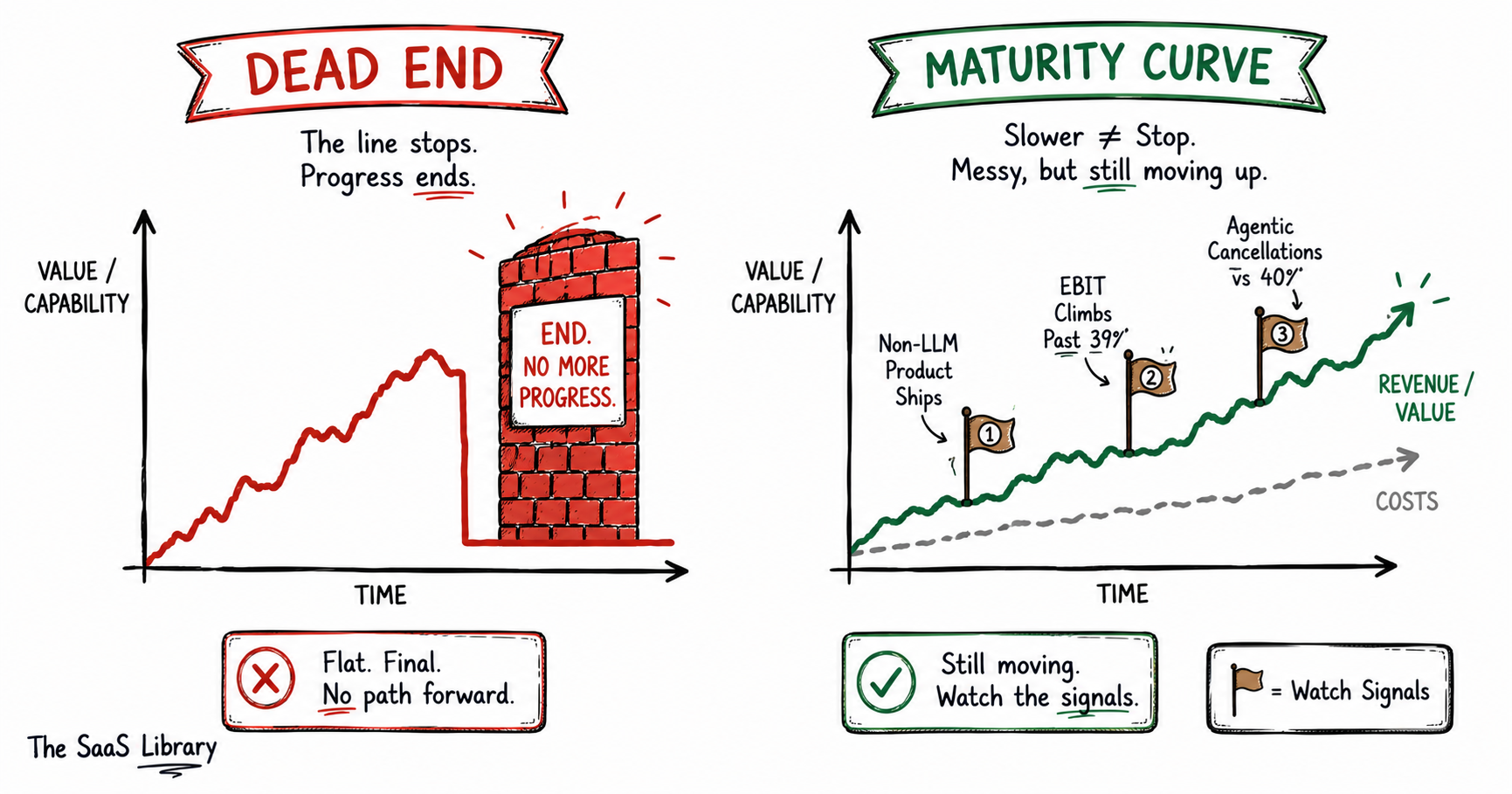
Right now every piece of hard evidence — LLMs still shipping, still earning, still improving on real tasks — points to maturity curve, not dead end. The “dead end” language only fits one narrow claim: scaling-only-to-AGI. Everything else circulating is bubble-talk borrowing a stronger word than the evidence supports.
What should SaaS teams do while the debate is unresolved?
SaaS teams should stop waiting for the debate to resolve and start filtering the claims themselves — this is the same dashboard-to-agent tension we mapped in Is SaaS Dead? — because it won’t resolve on anyone’s timeline, and every week you wait is a week a competitor didn’t.
Here’s the filter we built for this exact article. Call it the CLEAR framework — five questions, run against any AI claim before you let it change a roadmap or a budget.
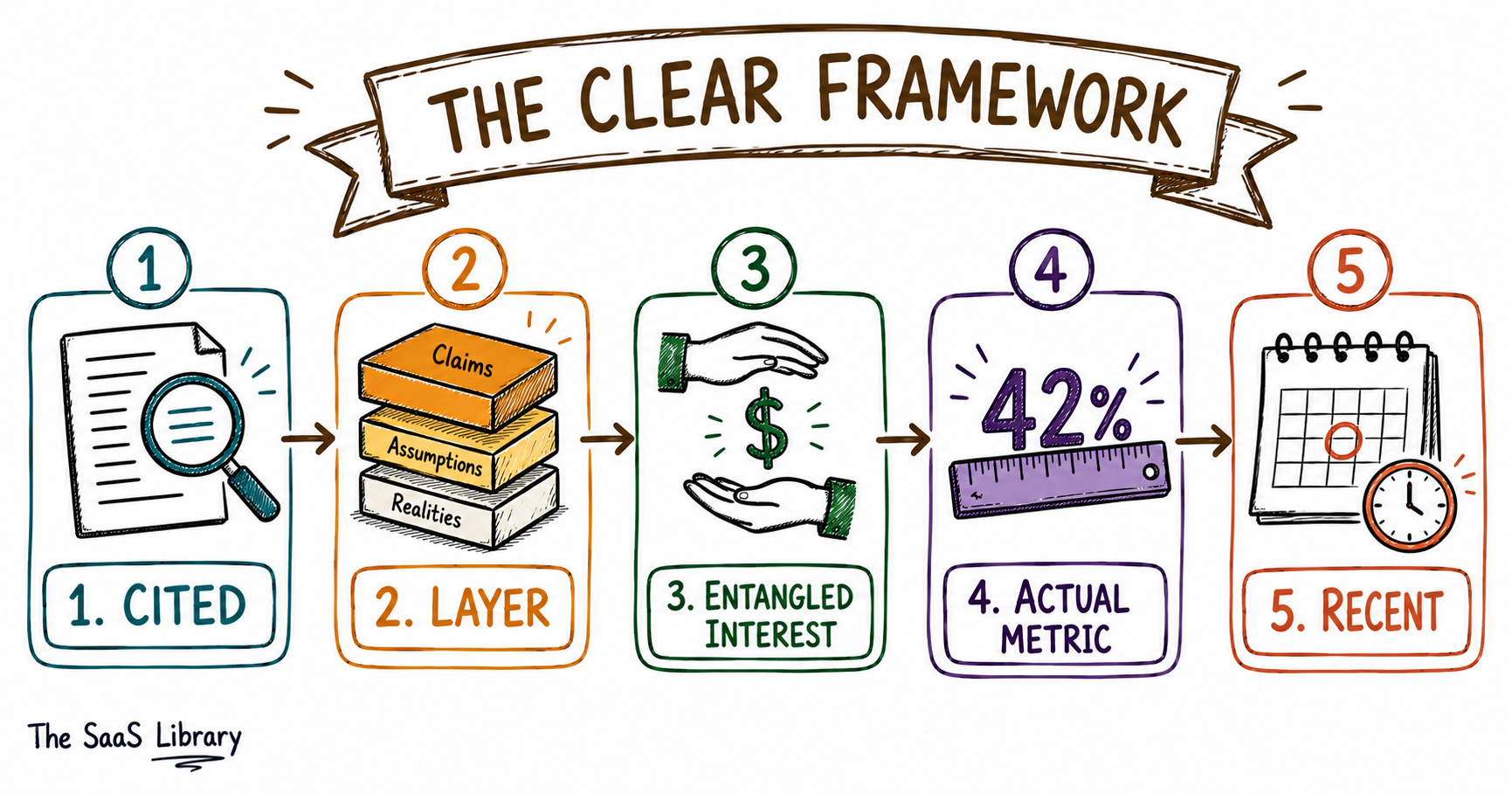
Run any headline through CLEAR before it changes what you build or buy. “92% of Fortune 500 use ChatGPT” — cited (loosely, by OpenAI itself), but check the layer (adoption ≠ revenue impact) and the metric (what counts as “use”?). It survives as directionally true, not as rigorous proof. This is the same pattern we found auditing “too dangerous to release” claims — a real fact, stretched past what it can actually prove.
Three things worth doing right now, not waiting on: track your own EBIT number instead of industry adoption stats, budget for Gartner’s 40% agentic-AI cancellation rate before you launch a pilot, and watch whether a real JEPA/world-model product ships — not the headlines about it.
Only 39% of companies can attribute any enterprise-wide EBIT impact to AI, and most of those say it’s under 5% — McKinsey, 2025.
The boom isn’t dead. But acting like every claim about it is equally true is how teams waste a budget cycle chasing a narrative instead of a number.
Frequently Asked Questions
Is the LLM boom actually a dead end?
The LLM boom is not a dead end. LLMs are still shipping products, generating billions in revenue, and improving at real tasks. What’s dead is the narrower claim that scaling text-prediction alone will reach AGI — a view 76% of surveyed AI researchers now share.
Did Yann LeCun really say LLMs are a dead end?
Yann LeCun did say this, on Bloomberg’s “The Close” in May 2026, calling LLMs “not the path to real intelligence… a detour.” He backed the claim by leaving Meta and raising $1.03 billion for AMI Labs, a bet on non-LLM “world models.”
Is AI a financial bubble?
AI is not one clean bubble. It shows real bubble characteristics at the frontier-lab level (xAI lost $2.47B in one quarter, OpenAI lost $38.5B in a year) alongside genuine enterprise adoption (88% of companies using AI in some function, per McKinsey). It’s a mixed picture, not a yes-or-no.
What percentage of AI researchers think LLMs can’t reach AGI?
76% of AI researchers think scaling current LLM approaches is “unlikely” or “very unlikely” to produce AGI, based on a 2025 AAAI Presidential Panel survey of 475 experts.
How much money did xAI lose in 2026?
xAI lost $2.47 billion in operating losses in Q1 2026 alone, on $818 million in revenue, according to SpaceX’s S-1 IPO filing. All 11 of its original co-founders have since left the company.
Did OpenAI really lose $38 billion?
OpenAI’s net loss for 2025 was approximately $38.5 billion, per audited financials verified by the Financial Times. About $41.55 billion of that came from a one-time accounting charge tied to its nonprofit-to-for-profit conversion — the underlying operating loss was $20.92 billion.
Is OpenAI’s revenue $13 billion or $20 billion?
OpenAI’s revenue is both, depending on the metric: $13.07 billion is its audited, full-year booked revenue for 2025. $20 billion+ is CFO Sarah Friar’s stated annualized run-rate as of late 2025 — a forward-looking snapshot, not the same 12-month total.
Is it true that 92% of Fortune 500 companies use ChatGPT?
It is true, directionally, that most Fortune 500 companies use ChatGPT or OpenAI’s tools in some capacity — though the specific 92% figure comes from OpenAI’s own enterprise data rather than independent audit, and “use” is loosely defined.
Will most agentic AI projects fail?
Most agentic AI projects are on track to fail by Gartner’s own numbers: the firm predicts over 40% will be canceled by the end of 2027, citing escalating costs, unclear business value, and inadequate risk controls — not model failure.
What are world models and why do they matter for this debate?
World models are AI systems trained on physical/sensory data instead of text, designed to understand cause-and-effect the way LLMs understand language patterns. They matter because Yann LeCun’s entire “dead end” thesis rests on world models eventually replacing LLMs for reaching AGI.
Should SaaS companies stop investing in LLMs?
SaaS companies should not stop investing in LLMs. The evidence shows LLMs improving and generating real enterprise value — the CLEAR framework in this article helps filter which specific claims about AI are verified before they change a roadmap or budget.
When will we know for sure if LLMs are a dead end?
We’ll have a clearer answer once a non-LLM architecture ships a commercially competitive product (watch AMI Labs and JEPA through 2028) or enterprise EBIT impact moves materially past McKinsey’s current 39% — until then, the debate stays open.
Conclusion
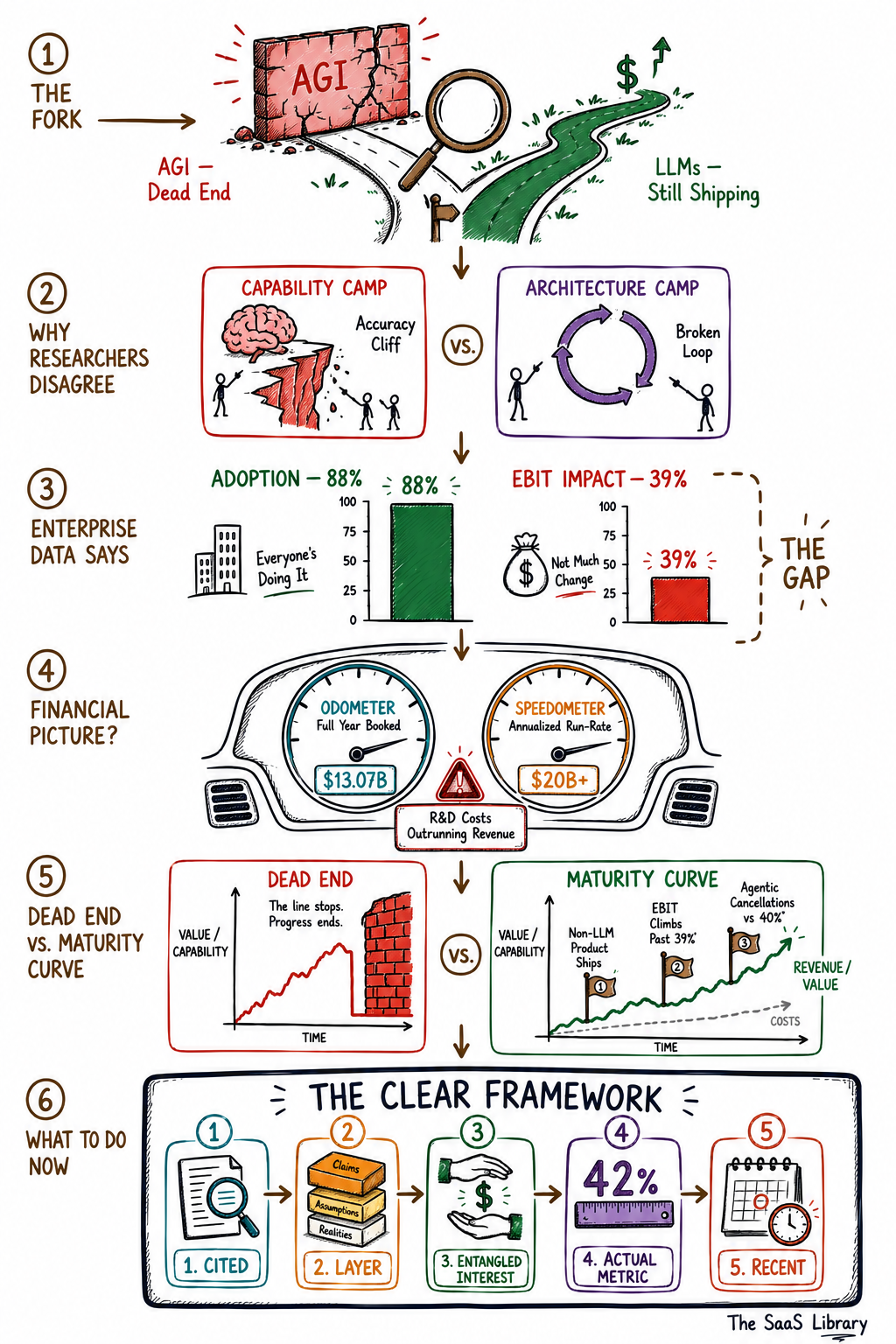
Run every AI claim through CLEAR before it changes your roadmap: is it Cited, which Layer is it actually about, who’s Entangled in the outcome, is there an Actual metric, and is it Recent.
The LLM boom isn’t dead — scaling-only-to-AGI is. Most of what you’re reading right now confuses those two things on purpose or by accident.
Don’t let a budget decision ride on the confusion. For a next step on turning this into an actual AI roadmap decision, see Agentic AI Optimization.
- Bloomberg / Crypto Briefing — Yann LeCun, “The Close,” 2026
- Futurum Group — AMI Labs $1.03B Seed Round, 2026
- AAAI Presidential Panel on the Future of AI Research, via TechPolicy.Press, 2025
- Apple ML Research — “The Illusion of Thinking,” 2025
- Lawsen & Opus — “The Illusion of the Illusion of Thinking,” arXiv:2506.09250, 2025
- Dwarkesh Podcast — Richard Sutton Interview, 2025
- Dwarkesh Podcast — Ilya Sutskever Interview, 2025
- Yahoo Finance / SpaceX S-1 — xAI Q1 2026 Financials
- The Next Web — xAI Co-Founder Exodus, 2026
- Forbes Technology Council — Thomas Hazel, 2026
- Where’s Your Ed At / FT-Verified — OpenAI 2025 Financials
- Yahoo Finance — OpenAI CFO Sarah Friar, 2026
- CFO Dive — Wharton/GBK Collective ROI Survey, 2025
- McKinsey — State of AI, 2025
- PwC — 29th Global CEO Survey, 2026
- Gartner — Agentic AI Project Cancellations, 2025