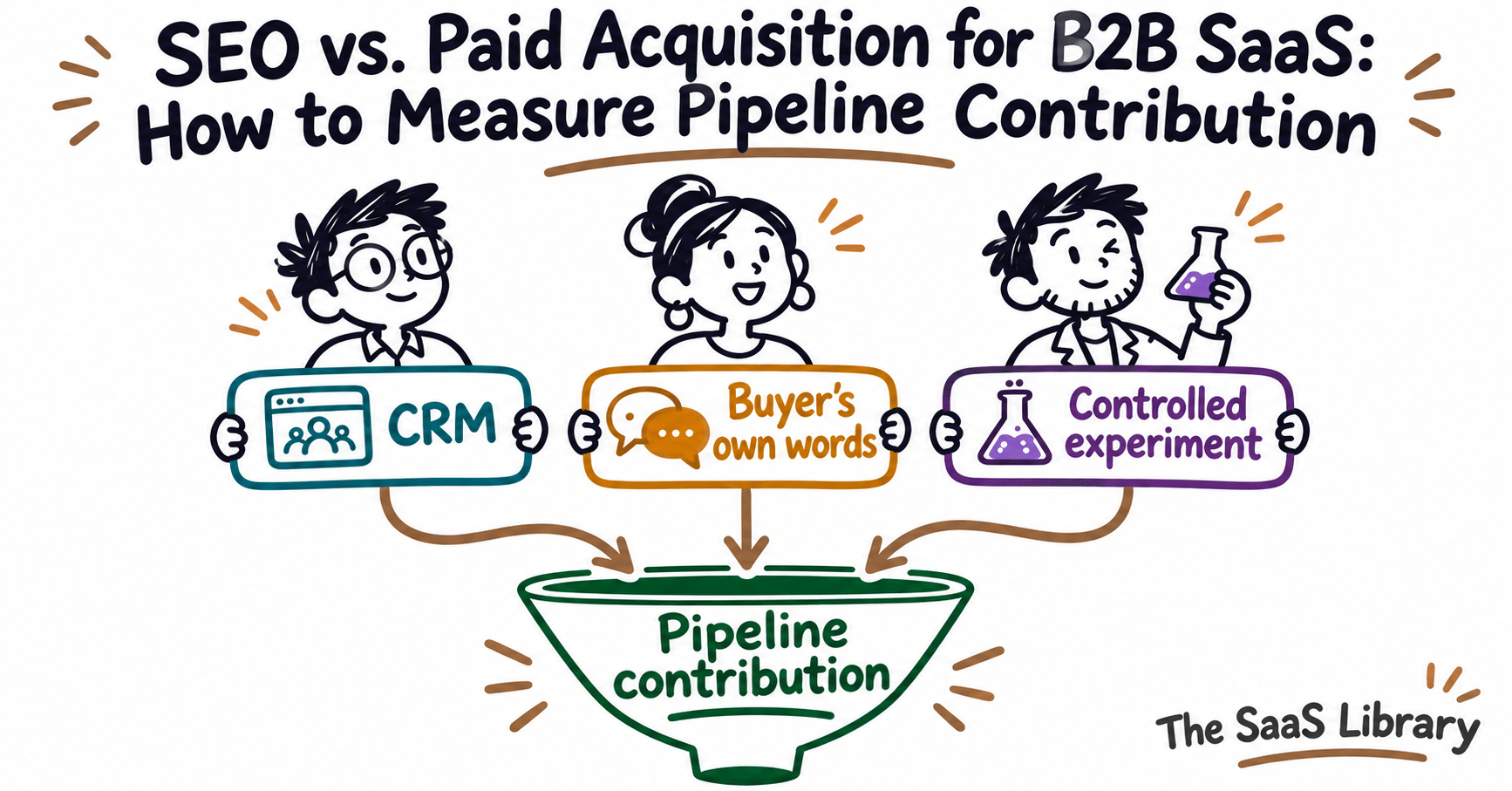
Teams comparing SEO and paid acquisition often argue about the wrong numbers, because clicks, cost per lead and last-click credit can make one channel look like the winner. The deal that closed may have started months earlier, so this guide shows how to measure SEO vs paid acquisition for B2B SaaS by pipeline contribution.
How Do SEO and Paid Search Work Differently in B2B SaaS?
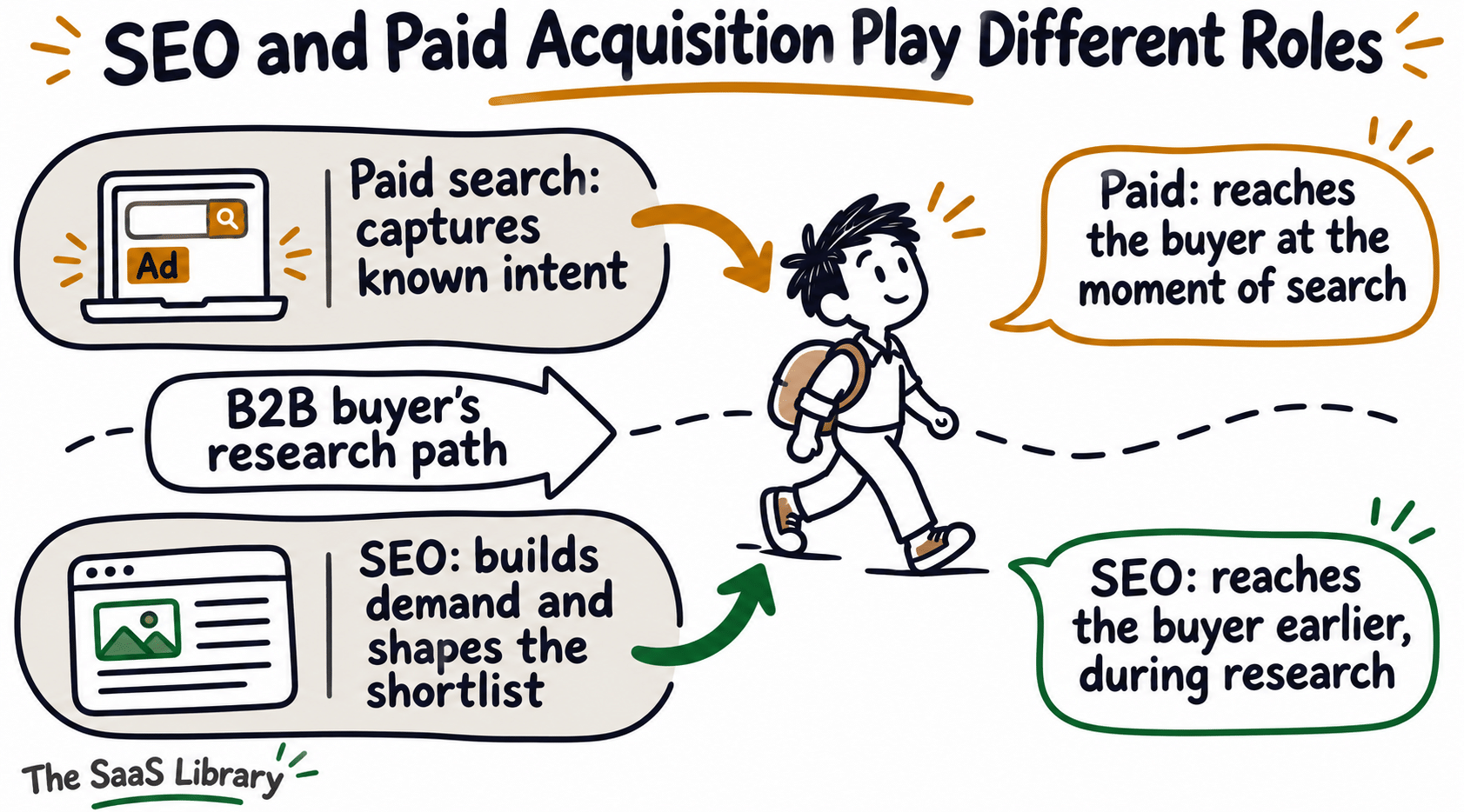
SEO earns organic visibility through content, technical quality and authority, and its visits carry no per-click charge. Paid search buys ad placement, so every visit has a price and stops when the budget does. In B2B SaaS the channels also differ in timing: SEO compounds over months, while paid search delivers visits as soon as spend starts.
Both channels put a company in front of buyers during research, but they work through different mechanics. Organic rankings reflect how well a page answers a query and how trusted the site is. Paid placements come from bidding in an auction, so reach rises and falls with spend.
The difference matters most for measurement. A paid click has a cost you can trace to a campaign on the day it happens. An organic visit has no direct cost, so its value shows up later, when the visitor returns, engages or enters a deal.
Why Does Last-Click Attribution Mislead B2B SaaS Pipeline Reports?
Last-click attribution gives all the credit for a conversion to the final tracked touchpoint. In B2B SaaS that touchpoint is often a branded search or a direct visit made after months of other activity, so the model overstates the channel that closed the loop and undercounts the channels that created the demand.
Consider a hypothetical account. A buying committee reads two organic guides in March, clicks a LinkedIn ad in May, attends a webinar in July, and then types the company name into Google in October before requesting a demo. Last-click gives the whole credit to the branded search, and the report shows search as the growth engine.
Search Engine Land argues that giving all the credit to the final touchpoint, often branded search or retargeting, produces a distorted view of what happened. Search Engine Land
Pedowitz Group adds that the last observable click may not be the last real influence. Cookie and device gaps hide earlier touches, and offline interactions such as sales calls rarely register as clicks. Pedowitz Group
Whether SEO still pays off for B2B SaaS depends on the CAC data, and our earlier analysis works through it.
Read the real CAC data →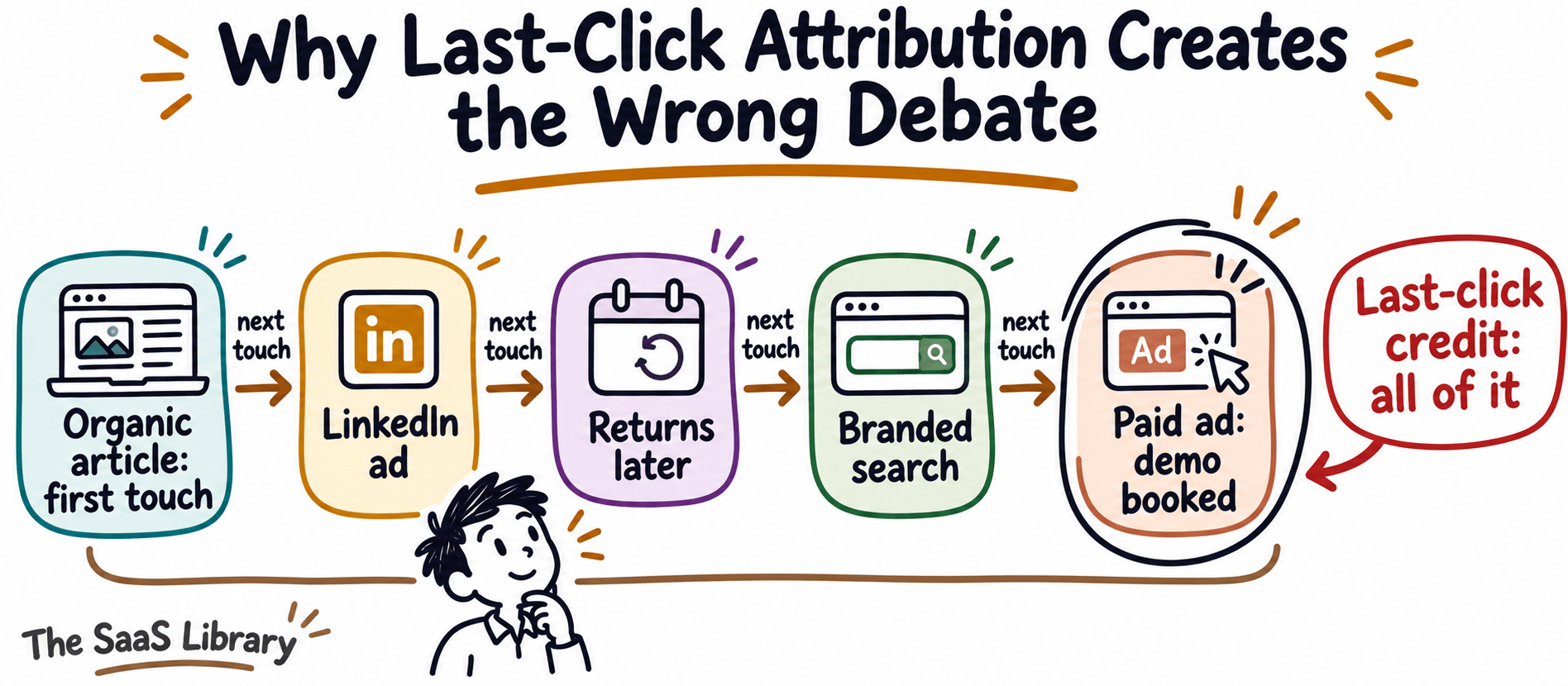
How Does a Sourced Opportunity Reach Closed-Won?
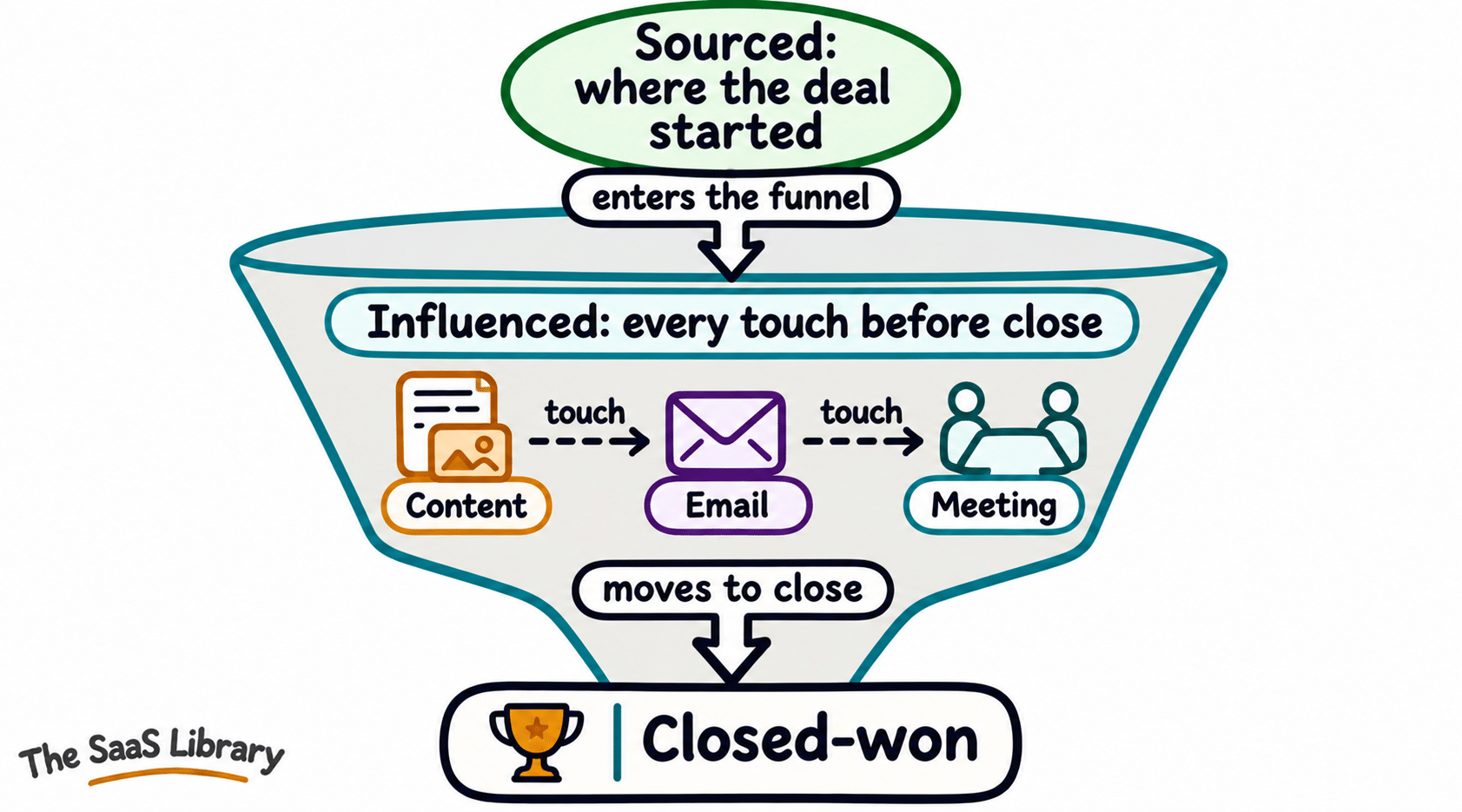
A sourced opportunity begins when a marketing touch is recorded as the origin of a deal, then moves through stages the sales team logs in the CRM until it closes as won or lost. Pipeline reporting works only when the origin and every later stage stay on the same record, so sourced revenue can be separated from influenced revenue.
Sourced means marketing created the opportunity, while influenced means a marketing touch appeared somewhere along the path. A report that mixes the two overstates the first and blurs the second.
- Origin: the first marketing touch that created the opportunity, recorded once on the opportunity.
- Stages: each move from opportunity to closed-won or closed-lost, logged by the sales team in the CRM.
- Contacts: the people involved, linked to the deal through contact roles.
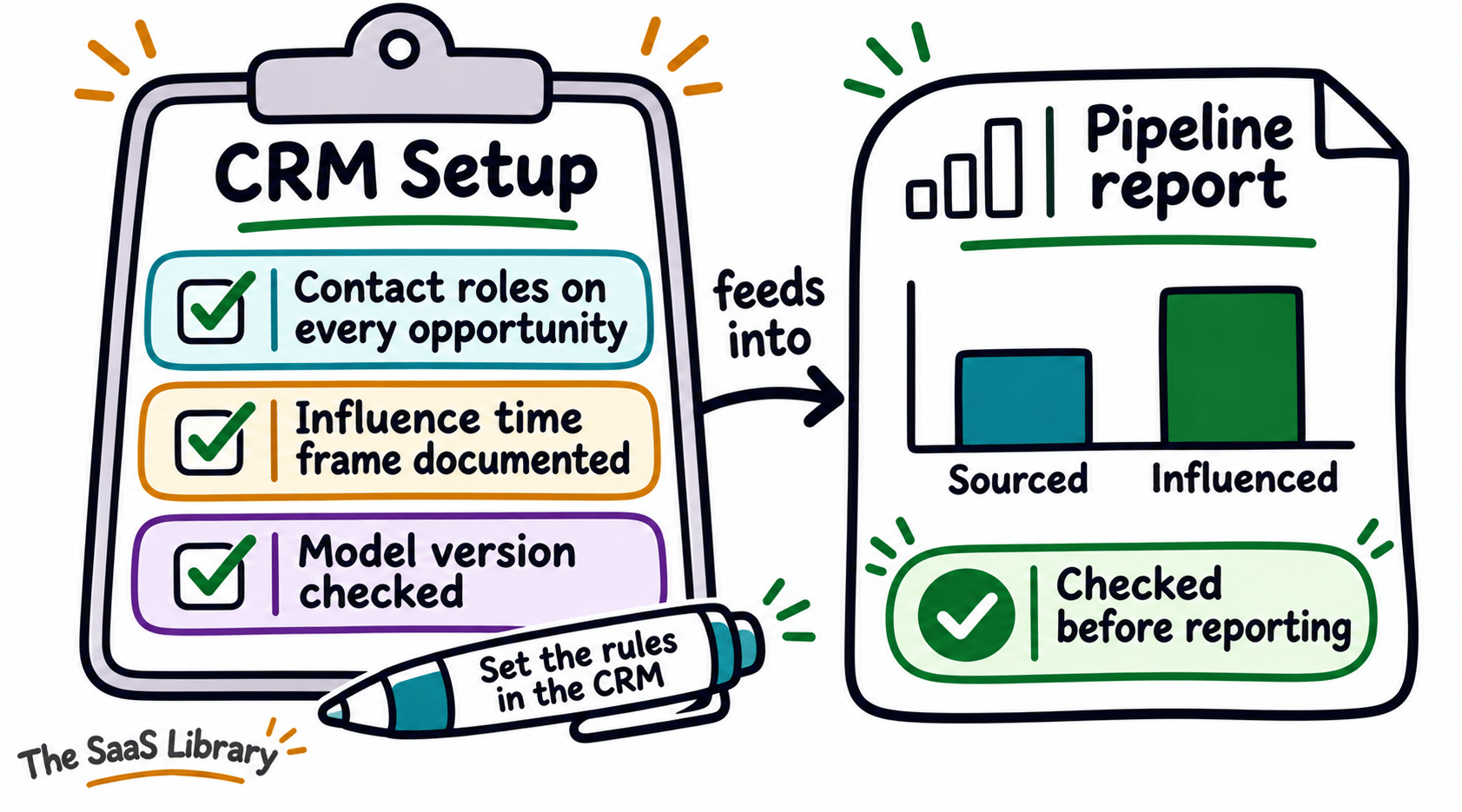
The contact is the link that makes the record traceable. Salesforce only picks up a contact’s involvement in a deal when that contact is added as a Contact Role on the opportunity. Salesforce Ben
A sourced label should only be applied when marketing created the opportunity; a later touch on an existing deal is influence.
What CRM Setup Does Pipeline Reporting Need?
Pipeline reporting needs three things in the CRM: a campaign record for each program, campaign members who are real contacts, and an opportunity contact role that links those contacts to the deal. Without the contact role, the CRM cannot connect a campaign to an opportunity, so the report shows no pipeline for that campaign.
Salesforce’s CampaignInfluence object represents the association between a campaign and an opportunity in Customizable Campaign Influence. Salesforce Developers
The influence model scans active campaigns for members who are also contact roles on an open opportunity, then creates the influence record from that match. Nebula Consulting
Salesforce’s developer pages list several API versions, and the Lightning behaviour of Campaign Influence 1.0 is described differently across the sources we checked. Confirm the setting in your own org before relying on it. Teams still choosing a CRM can compare options in HubSpot vs Salesforce for B2B SaaS.
Why Is Traffic the Wrong Measure of SEO Pipeline?
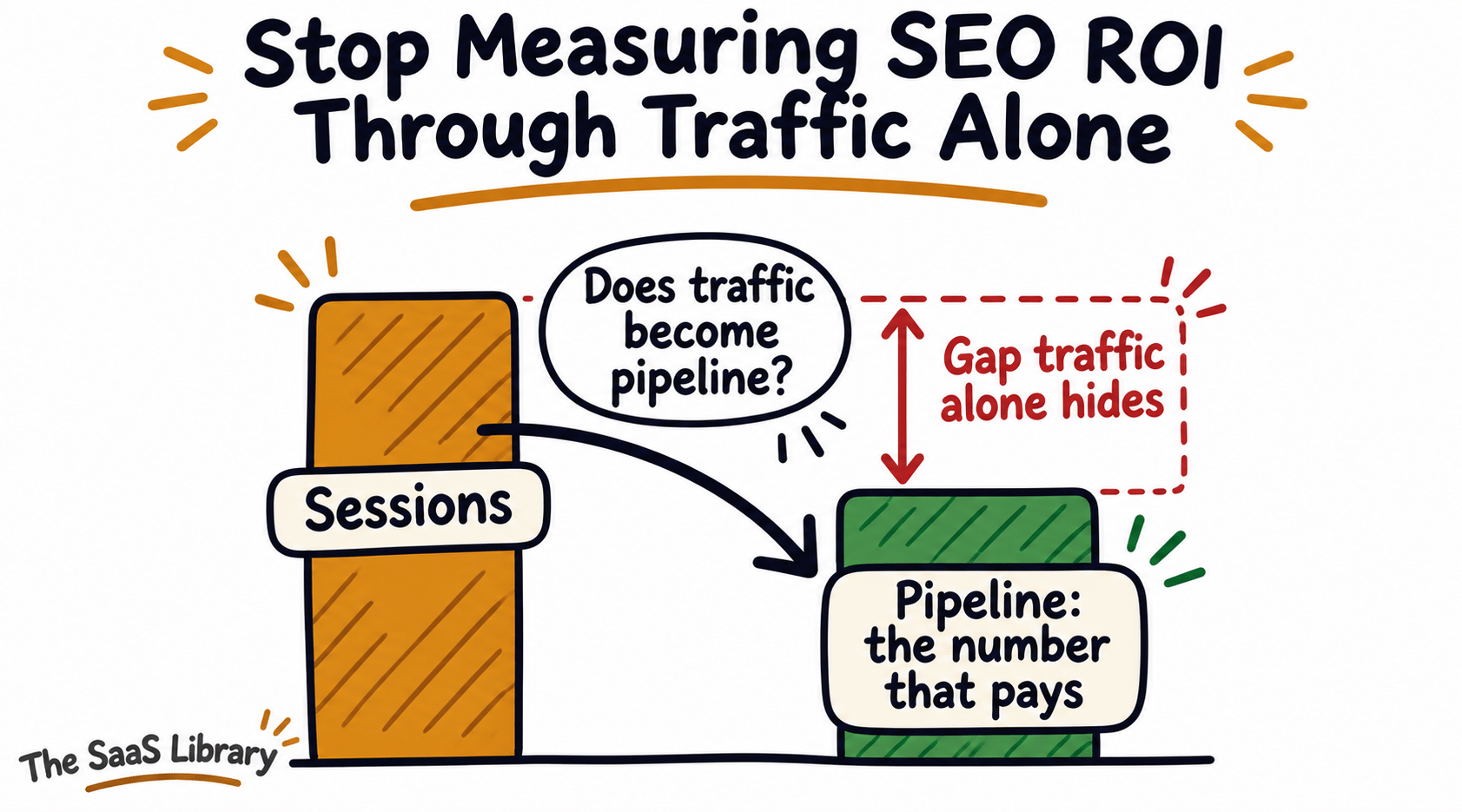
Traffic shows how many people visited a page, not whether they were the right buyers, engaged with the product or moved toward a deal. SEO reporting should follow organic visits into account engagement, opportunities and revenue, because a page with few visits can influence more pipeline than a page with many.
Pedowitz Group argues that most SEO programmes fail to produce revenue because they are measured as traffic programmes rather than revenue programmes. Pedowitz Group
Its reports often celebrate visits without showing audience fit or conversion potential, so teams cannot tell good traffic from poor traffic. The practical fix is to group organic sessions by intent, such as informational, comparison or commercial, and track each group separately.
Pedowitz also suggests reviewing operational SEO metrics monthly and business-impact metrics quarterly. Pedowitz Group For a comparison of the data sources teams use for SEO reporting, see Google Search Console and SEMrush compared.
Connecting search performance to CRM data is the step that turns rankings into pipeline. Teams that want outside help with this can review the approach of an organic visibility strategy provider before engaging one.
Pedowitz is an agency that sells SEO and revenue-marketing services, so treat its framing as a practitioner view rather than independent research.
How Does an AI Citation Connect to Analytics?
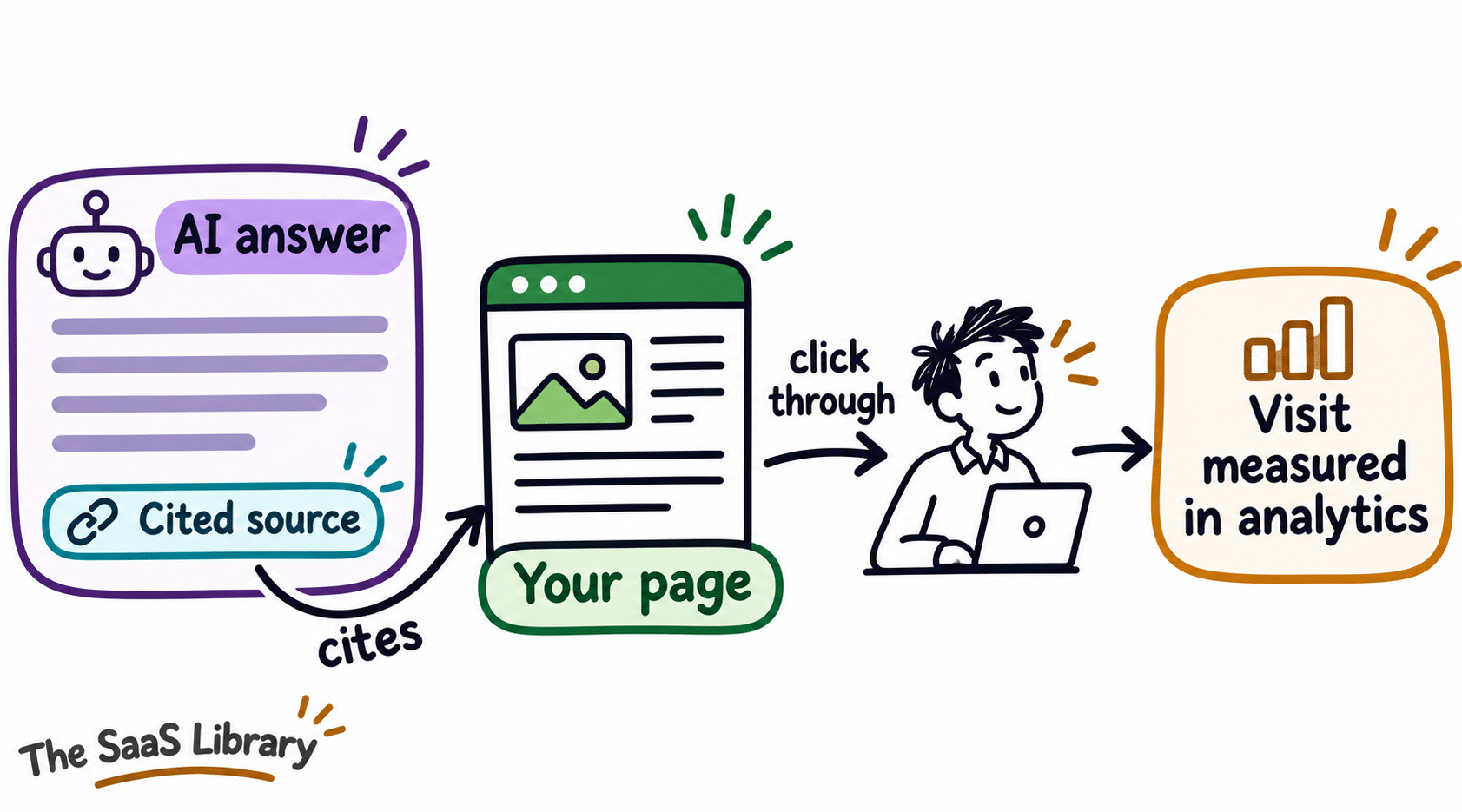
An AI citation connects to analytics when a buyer’s chatbot session produces a visit or mention that can be tagged and tracked to a signup or opportunity. Measure whether these visitors convert, and report AI referrals as their own source rather than folding them into organic traffic, so the channel’s contribution stays visible.
G2’s survey also found that 61% use AI search alongside Google, so the two channels overlap rather than replace each other. G2
Buyers who start in a chatbot arrive with a different starting point than buyers who start with a search engine, so the analytics question is whether those visits move through the funnel, not only how many arrive.
Our recommendation is to set up a separate source for AI referrals in your analytics, then compare its signup and opportunity rates with organic search over the same period. This is a TSL recommendation, not a sourced benchmark. For how the tools that report AI visibility collect their data, see how SEO, AEO and GEO tools collect data.
How Should Paid Acquisition Be Measured for Revenue?
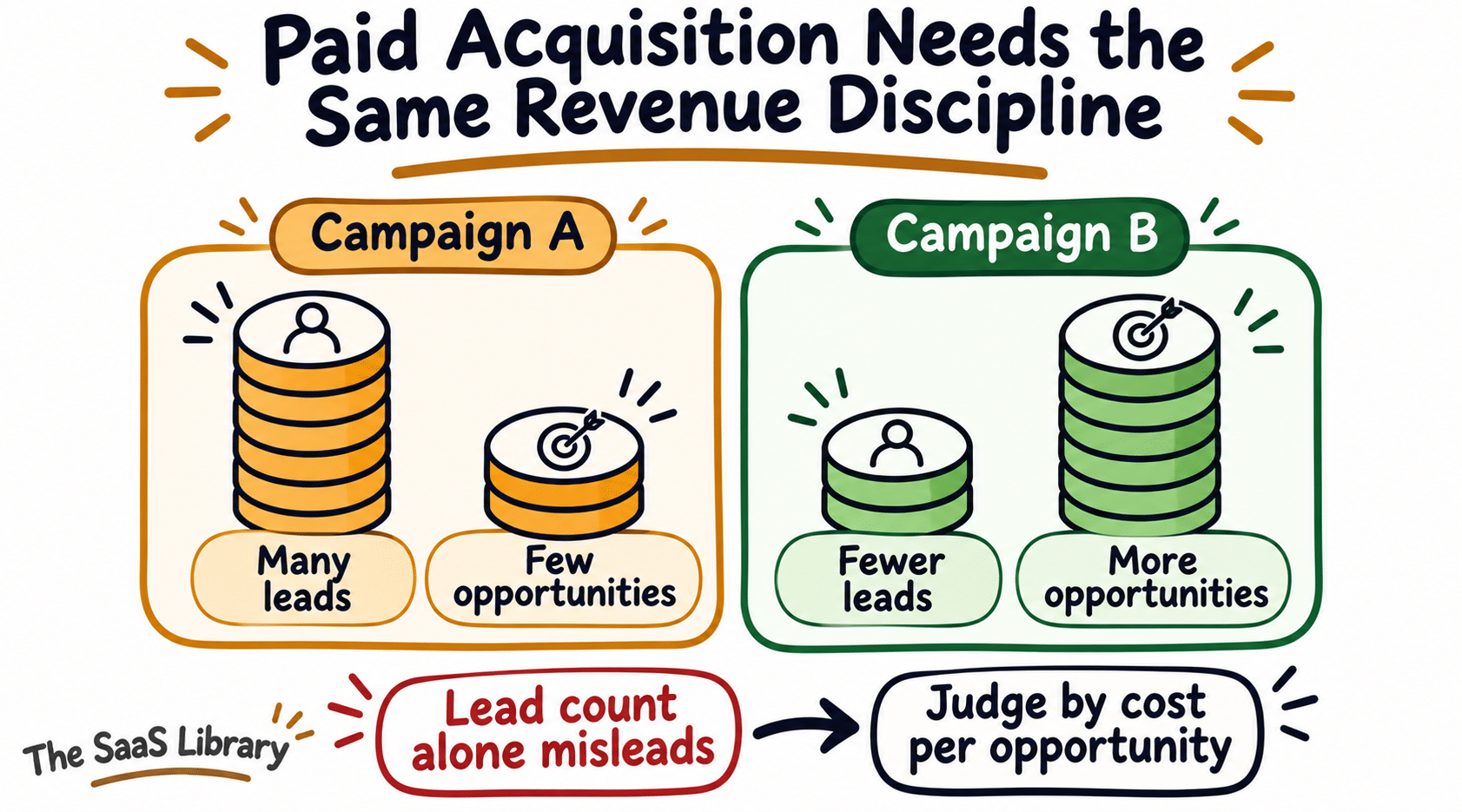
Paid acquisition should be measured by the revenue it sources or influences across the full deal cycle, not by cost per click or click-through rate alone. The attribution window must be longer than the typical sales cycle, and offline outcomes such as closed-won deals must be sent back to the ad platform through Google’s current route.
Click metrics are diagnostics, not outcomes. Dreamdata reports that average cost per click for B2B non-branded Google Search rose about 29% to $5.34, while click-through rate fell about 26% to 4.04%. Dreamdata
A short window hides most of the path. Dreamdata’s practitioners note that a 30-day attribution window measures only a fragment of the journey when a deal takes most of a year. DemandGenReport
Offline conversion import, which sends closed-won data from a CRM back to Google Ads, has changed. Since 15 June 2026, the Google Ads API no longer accepts new adopters of offline imports, and Google says the feature is moving to the Data Manager API. Google Ads API
Google describes standard offline import as a legacy feature, so teams setting up new imports should use the Data Manager API route. Google Ads Help Google’s help page says offline conversion imports and enhanced conversions for leads move to the Data Manager API starting June 15, 2026, and that the Data Manager API is the path for current and future offline conversions. Google Ads Help
Optimising paid campaigns beyond click-through rates and platform-reported conversions is the other half of this. Teams that hire a provider for performance marketing should ask how it measures revenue, not just clicks.
That covers how the channels differ, why last-click misleads, how pipeline is sourced and how paid acquisition is measured. The rest covers comparing ROI on one timeline, the next-dollar question, the Three-Witness Test, reading reports, common mistakes, shared metrics and a 90-day test.
How Do You Compare SEO and Paid ROI on the Same Timeline?
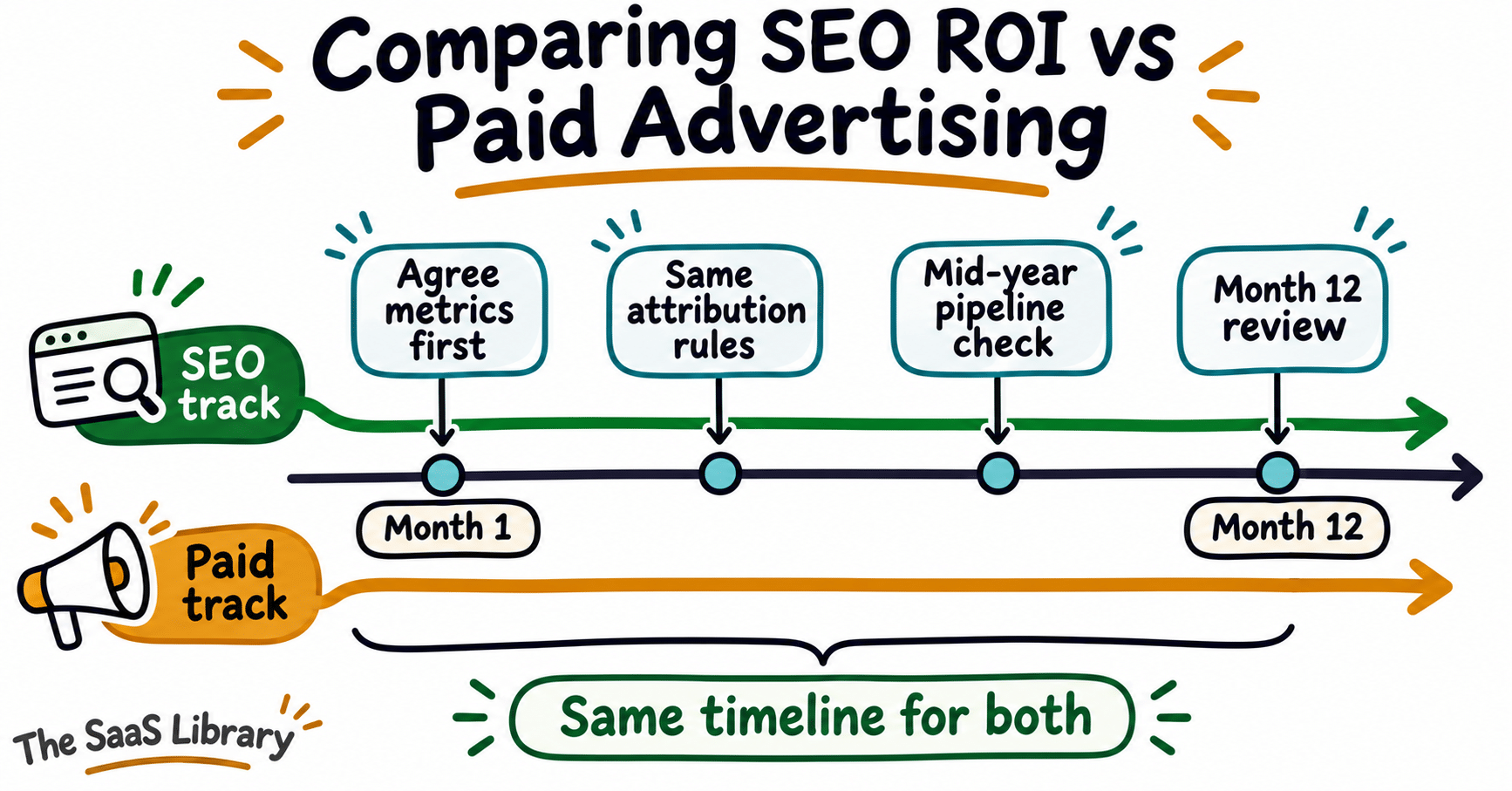
Compare SEO and paid ROI on one timeline by giving both channels the same window, the full deal cycle, and reporting sourced and influenced revenue at the same intervals. SEO builds slowly while paid search responds quickly, so a fair comparison adds a lag for SEO and reads cumulative results over at least twelve months.
The timeline needs to be long. Dreamdata reports that buyers spend about 220 days, roughly seven months, forming their decisions through content before a sales pipeline begins. TechIntelPro (syndicated PR Newswire)
Pedowitz Group recommends monthly reviews of operational SEO metrics, quarterly reviews of business impact, and longer views of revenue influence to account for delayed pipeline effects. Pedowitz Group For the pipeline side of this question, see B2B SaaS pipeline in 2026.
The twelve-month cumulative method in this section is a TSL recommendation, not a sourced standard. Dreamdata’s figures are vendor research and are cited as such.
What Is the Next-Dollar Question for Budget Allocation?
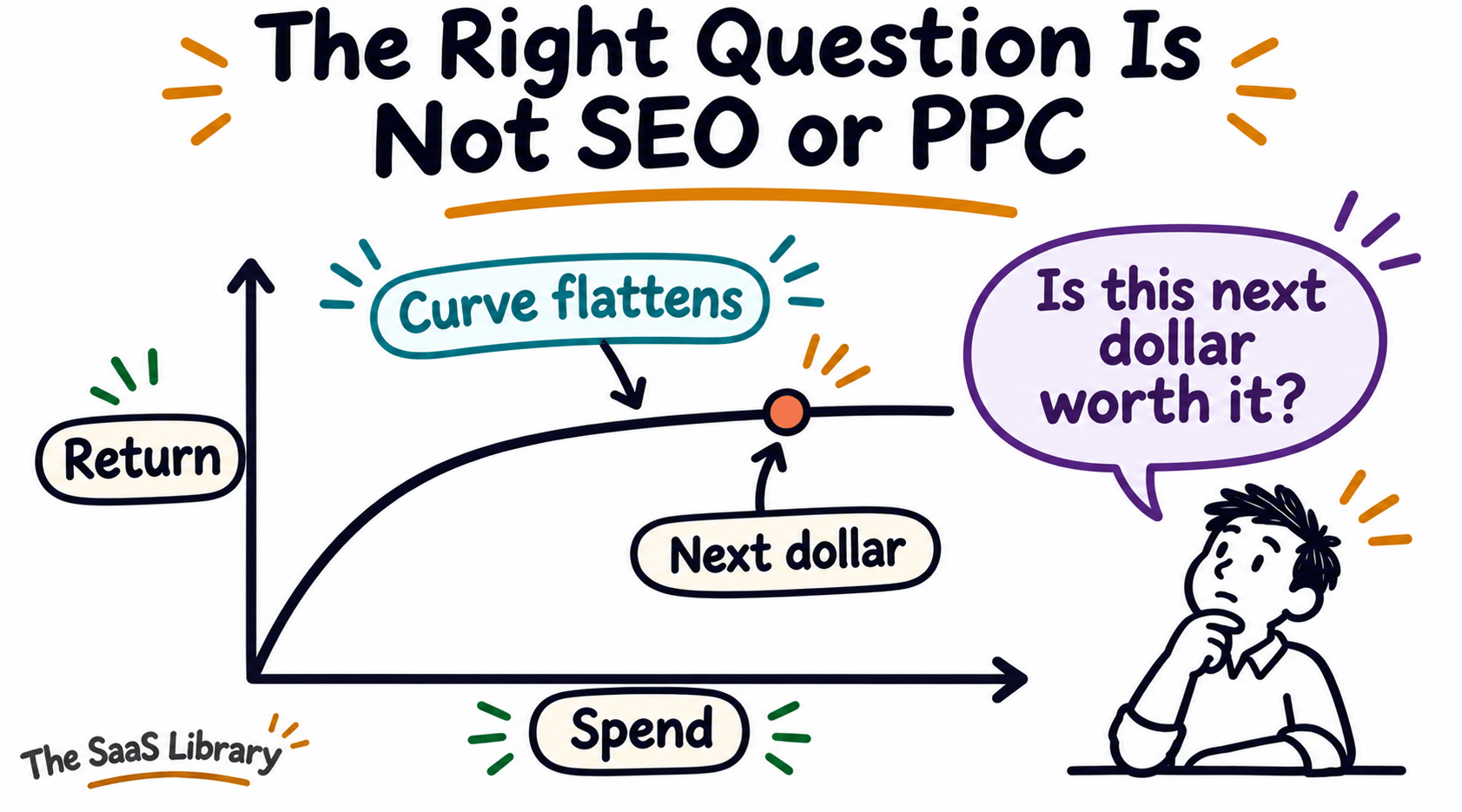
The next-dollar question asks where one more unit of budget would produce the most additional pipeline, not which channel had the best average result. It moves the decision from past performance to marginal return, so teams compare what one more dollar in SEO content would add against what one more dollar in paid search would add.
Average return can mislead. A channel with a strong average may already be saturated, so its next dollar buys little, while a weaker channel may still have room to grow.
Answering the question requires evidence about change, not just totals. A controlled test that varies spend in some markets and holds it in others is the usual way to estimate the difference, which Section 10 covers.
What Is the Three-Witness Test?
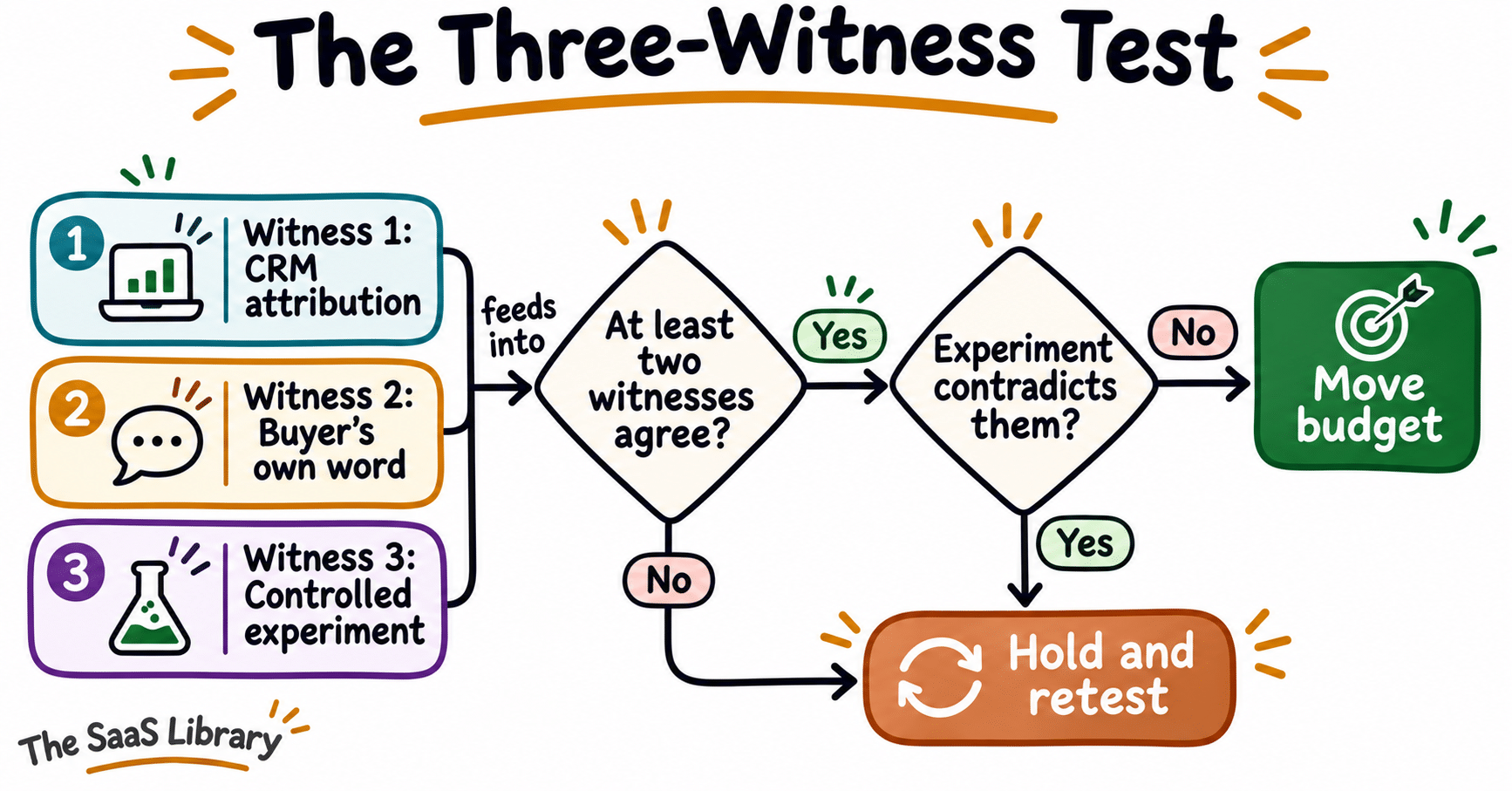
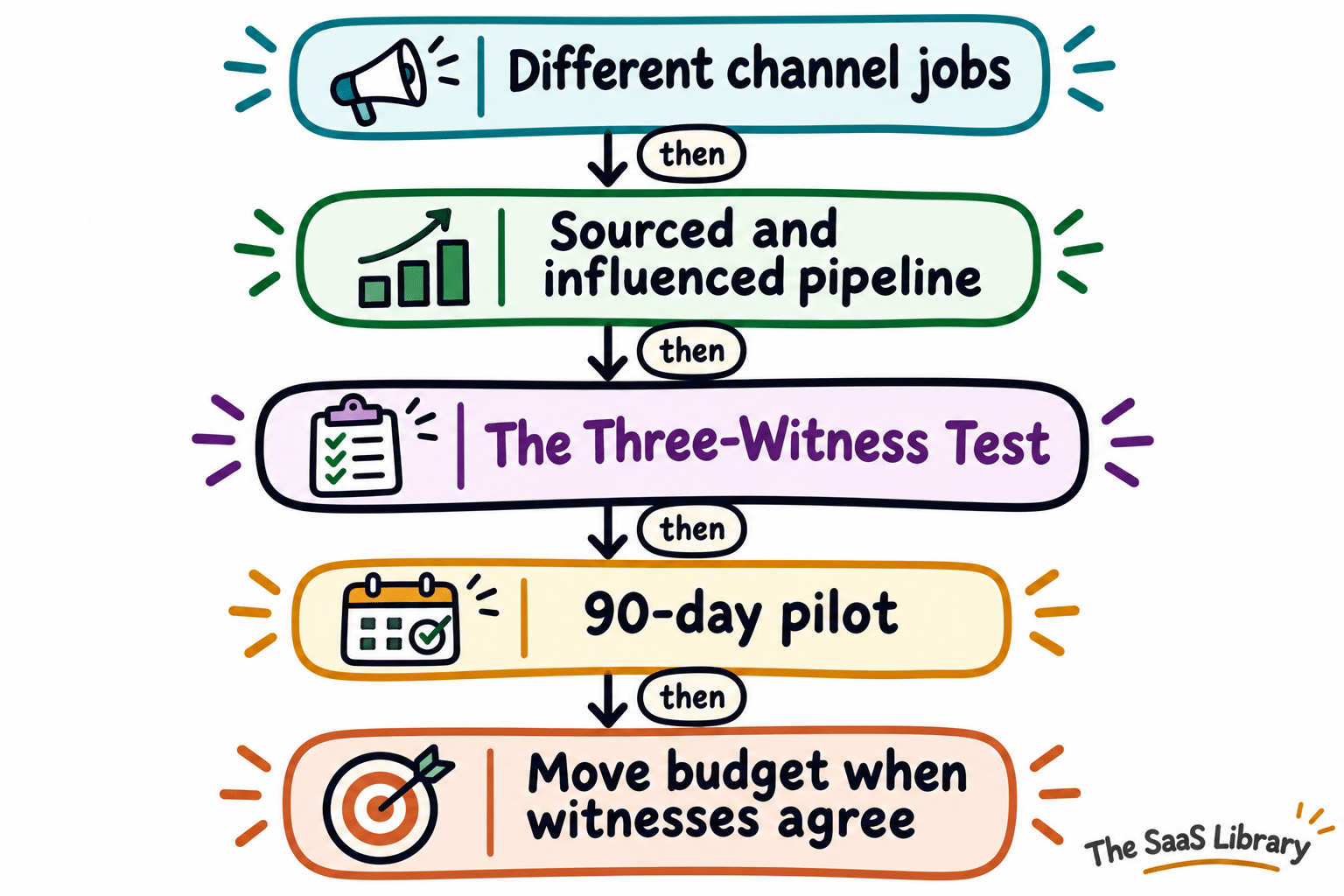
The Three-Witness Test is a TSL rule that a channel’s claimed pipeline needs three independent sources before budget moves: the CRM record, the platform’s own data, and an incrementality check such as a geo holdout. When the three disagree, the claim counts as unproven until the gap is explained.
A geo holdout is a practical way to supply the third witness. Google’s Meridian GeoX documentation describes the design as a blueprint that assigns geographic units to treatment or control groups. Google Meridian GeoX
The default design in Google’s API uses a single cell, and multi-cell designs are available when one control group must be compared with several treatments. Google Meridian GeoX
The design step also projects the budget and the minimum detectable effect the experiment needs. Google Meridian GeoX
A claim that only one witness supports is a hypothesis. Budget should move when the CRM, the platform and the test agree.
How Should a Channel Measurement Report Be Read?
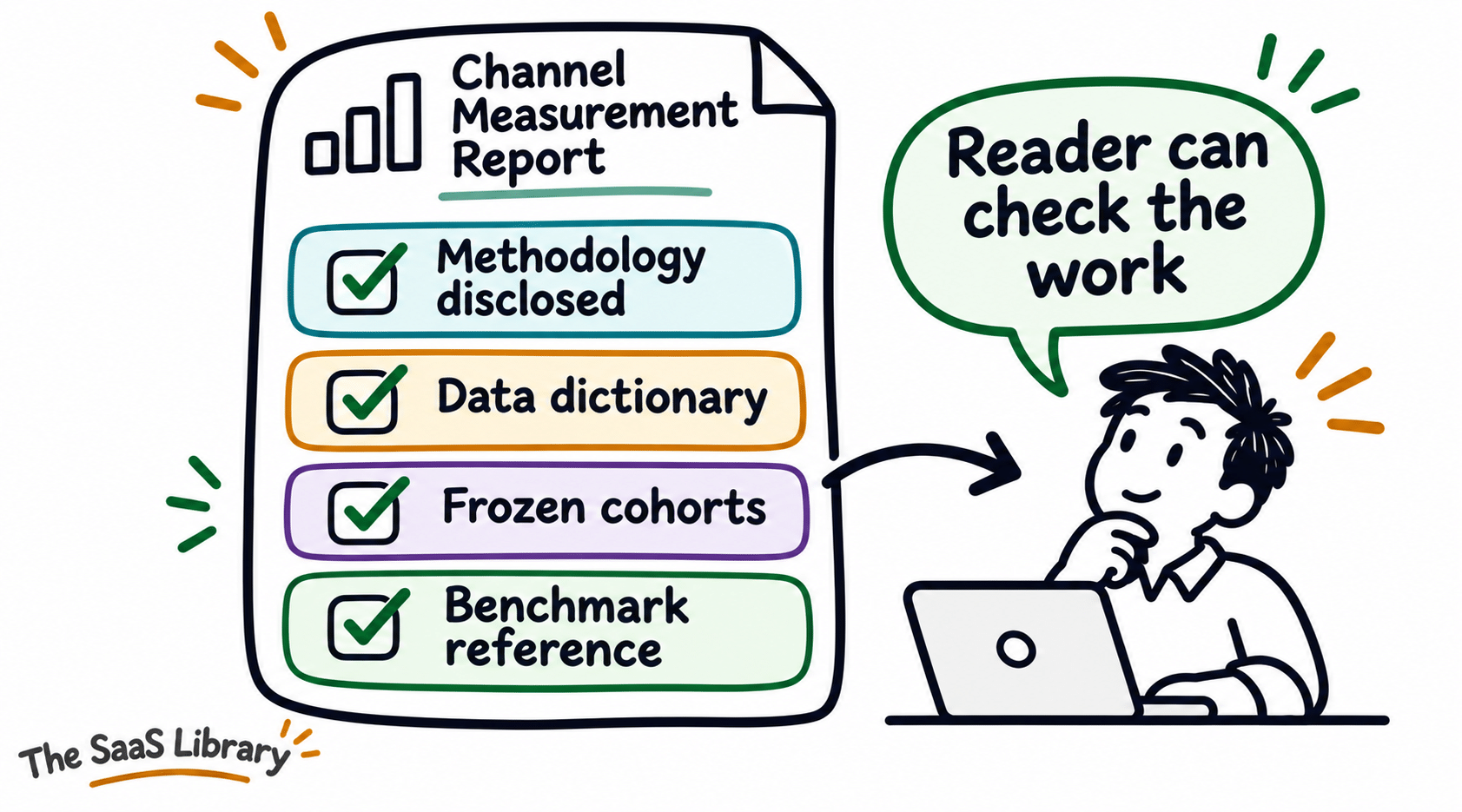
Read a channel measurement report by checking five things in order: the attribution model and window, whether pipeline is sourced or influenced, CRM coverage of contact roles, the review cadence, and whether an independent test supports the claim. A report that skips any of these overstates what the channel did.
| Check | What to look for | Why it matters |
|---|---|---|
| Attribution model | Last-click, multi-touch or data-driven, and the window length | Last-click credits the final touch, which overstates branded search and direct |
| Window | Length compared with the average deal cycle | A 30-day window misses most of a long B2B journey |
| Sourced vs influenced | Labels kept separate | Mixing them inflates the channel’s role |
| CRM coverage | Share of opportunities with a contact role | Without contact roles, campaign influence cannot be recorded |
| Cadence | Monthly operational view, quarterly impact view | Delayed pipeline needs a longer review |
| Independent test | A holdout or other incrementality check | Shows whether the channel causes the outcome |
The table draws on the sources in Sections 2, 4, 5 and 8.
What Mistakes Do Teams Make When Measuring SEO and Paid Pipeline?
The most common mistakes are judging SEO by cost per lead too early, reporting traffic as success, crediting only the last click, using a 30-day window, leaving campaigns untagged, missing contact roles, merging sourced and influenced pipeline, and skipping an independent test. Each one makes one channel look better or worse than it is.
- Judging SEO by cost per lead in the first months. Search Engine Land argues that SEO and content can lower cost per lead, but over a longer horizon. Search Engine Land
- Reporting traffic as the result. Pedowitz Group says most SEO programmes fail to produce revenue because they are measured as traffic programmes. Pedowitz Group
- Giving all the credit to the last click. Search Engine Land describes full credit to the final touchpoint as a distorted view of what happened. Search Engine Land
- Using a short attribution window. Dreamdata’s practitioners note that a 30-day window captures only a fragment of a deal that takes most of a year. DemandGenReport
- Leaving campaigns untagged or inconsistently named. When campaign links lack UTM parameters or contain manual entry errors, that spend shows up as direct traffic and effectively disappears from reporting. Claravine
- Missing contact roles in the CRM. Salesforce only picks up a contact’s involvement when that contact is added as a Contact Role on the opportunity. Salesforce Ben
- Merging sourced and influenced pipeline into one number. This is a TSL rule rather than a sourced finding: the two claims must be reported separately.
- Chasing precise attribution over decision quality. The Starr Conspiracy argues that more granular attribution often reduces executive confidence rather than increasing it. The Starr Conspiracy
- Skipping an independent test. Without incrementality measurement, budget decisions can rest on metrics that do not reflect real demand creation. The Starr Conspiracy
The Search Engine Land page for item 1 did not load in full. The cited sentence is the only part we verified.
How Do Marketing and Finance Align on Pipeline Metrics?
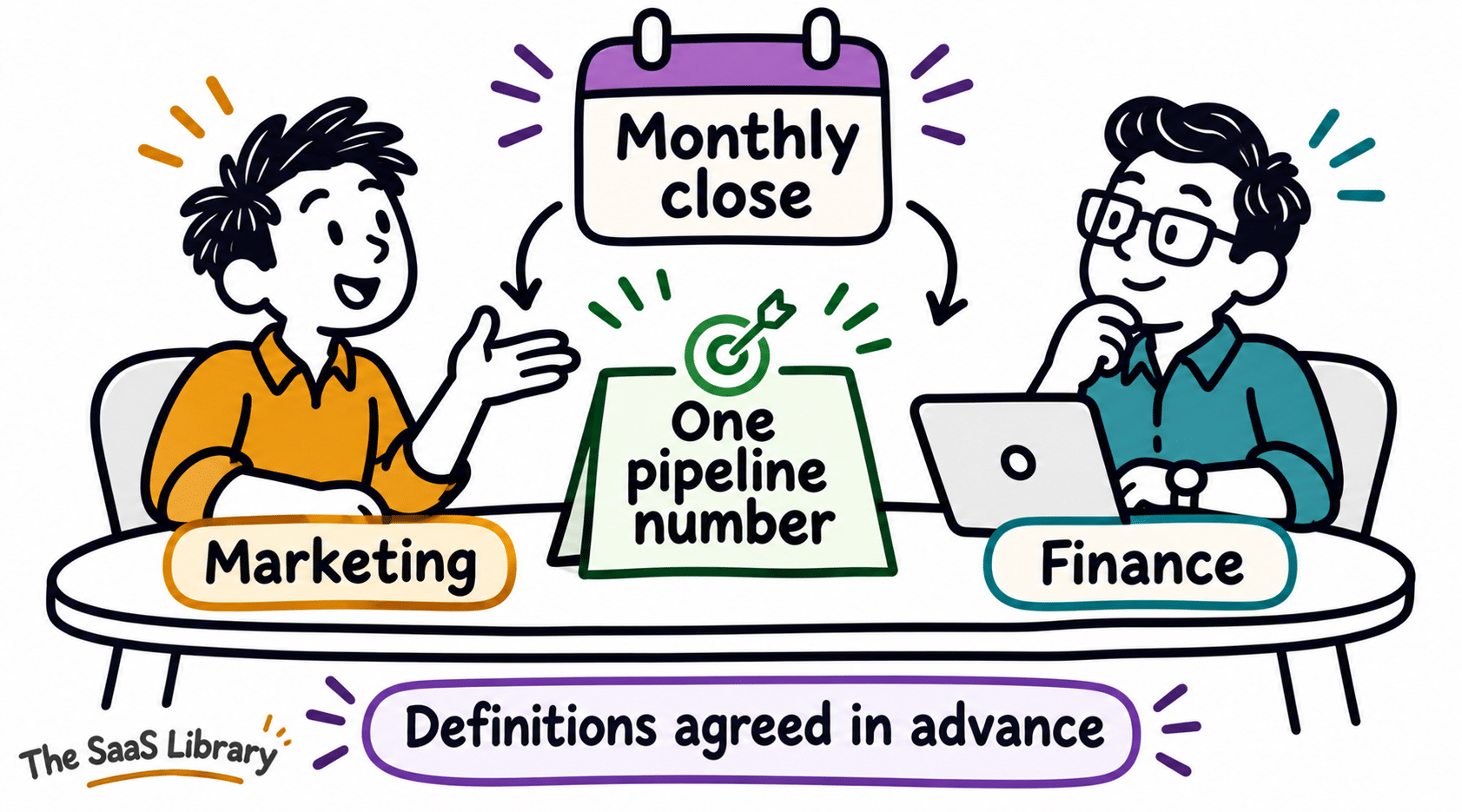
Marketing and finance align on pipeline metrics by agreeing one definition of sourced pipeline, one attribution window and one CAC payback calculation before budgets are debated. The 2026 Aleph and Benchmarkit report puts the median B2B SaaS CAC payback at 16 months for full-year 2025 actuals, which gives both teams a shared reference point.
The Aleph and Benchmarkit report, published 1 June 2026, is based on full-year 2025 actuals from 342 B2B SaaS and AI-native companies. Its top-quartile companies recover CAC in under six months. Aleph × Benchmarkit
Only 198 of those companies reported a payback figure, and bottom-quartile companies take 24 months or more. Read the benchmark as a range, not a target. SaaSHero
Alignment means both teams use the same inputs. Finance needs to agree which spend counts toward CAC, and marketing needs to agree which revenue counts toward payback. Without that, each side can produce a correct-looking number that does not match the other’s.
Other SaaS metrics are covered in SaaS metrics 2026 benchmarks.
The primary Benchmarkit report was not retrieved. These figures come from Aleph’s co-published summary and a secondary compilation. Check the primary report before publishing.
How Do You Test Pipeline Contribution in 90 Days?
A 90-day test defines the decision and its threshold first, audits the CRM and tagging, runs one geo holdout on the paid channel, and then reads the results against the threshold. Because the average SQL-to-closed-won stage runs longer than 90 days, the test reads leading indicators and pipeline movement rather than final revenue.
Phase 1, define (days 1–14): Write down the budget decision and the smallest effect that would change it. Power analysis depends on that threshold. Amsive
Phase 2, audit the CRM (days 15–30): Check that campaigns carry consistent UTM naming and that opportunities have contact roles. Claravine Salesforce Ben
Phase 3, run one geo holdout (days 31–75): Meridian GeoX designs start from historical geo-level time series for response and spend. Google Meridian GeoX A six- or eight-week test rather than four can lower the minimum detectable effect. Google Meridian GeoX
Phase 4, read and decide (days 76–90): Compare the result with the threshold from phase 1. Dreamdata’s 2024 benchmark puts SQL-to-closed-won at 95 days, so closed-won revenue will often still be in flight. Dreamdata
The four-phase split and its day counts are a TSL recommendation, not a sourced standard.
Frequently Asked Questions
How do you measure SEO vs paid acquisition for B2B SaaS?
Measure both channels by the sourced and influenced pipeline they produce over the full deal cycle, using the same attribution window. Treat cost per click and click-through rate as diagnostics, not outcomes. Confirm the paid result with an independent test, such as a geo holdout, before moving budget.
What is the difference between sourced and influenced pipeline?
Sourced pipeline is an opportunity that a marketing touch created. Influenced pipeline is an opportunity where a marketing touch appeared somewhere along the path. Report them separately, because merging them overstates the channel that created the deal and blurs the one that supported it.
Why is last-click attribution misleading for B2B SaaS?
Last-click gives all credit to the final tracked touchpoint, often a branded search or direct visit made after months of other activity. It overstates the channel that closed the deal and undercounts the channels that created demand. Multi-touch or incrementality checks give a fuller picture.
What is a Contact Role in Salesforce and why does it matter?
A Contact Role links a contact to an opportunity. Salesforce only counts a contact’s involvement in a deal when that contact is added as a Contact Role. Without this link, campaign influence cannot be recorded, so pipeline from those campaigns appears as zero.
How long is a typical B2B SaaS sales cycle?
Benchmarks vary by deal size and year. Dreamdata’s 2024 benchmark puts the average time from SQL to closed-won at 95 days. Its 2026 report puts the average full buyer journey at 272 days, including content research before sales engagement. Use the figures for your own deal size.
What is a three-witness test in marketing measurement?
It is a TSL rule that a channel’s claimed pipeline needs three independent sources before budget moves: CRM records, the platform’s own data and an incrementality check such as a geo holdout. If the three disagree, the claim is treated as unproven until the gap is explained.
Can you measure SEO ROI using traffic alone?
No. Traffic shows how many people visited, not whether they fit the target audience, engaged with the product or moved toward a deal. Pedowitz Group recommends grouping organic sessions by intent and tracking engagement, opportunities and revenue alongside them.
How do you test pipeline contribution in 90 days?
Use four phases: define the budget decision and threshold, audit CRM tagging and contact roles, run one geo holdout for about six weeks, then compare the result with the threshold. Expect leading indicators rather than final closed-won revenue, because many deals take longer than 90 days.
What is a geo holdout test?
A geo holdout compares markets where a channel runs with matched markets where it is switched off. The difference in outcomes estimates the channel’s incremental effect. Google’s Meridian GeoX documentation describes this as a design that assigns geographic units to treatment or control groups.
Did Google change offline conversion imports in 2026?
Yes. Since 15 June 2026, the Google Ads API no longer accepts new offline import adopters, and Google says the feature is moving to the Data Manager API. Google describes standard offline import as a legacy feature, so teams setting up new imports should use the Data Manager API route.
Conclusion
Measuring SEO vs paid acquisition for B2B SaaS by pipeline contribution works when the CRM records campaigns and contact roles, sourced and influenced revenue are reported separately, and at least one claim is checked by an independent test. The Three-Witness Test brings those three checks together: CRM record, platform data and a geo holdout.
When all three agree, the budget conversation about SEO vs paid acquisition for B2B SaaS can rest on evidence. Start with a 90-day test on one paid channel and use the result to decide where the next dollar goes.
- Google Ads Help, About offline conversion imports
- Salesforce Developers, CampaignInfluence object reference
- Salesforce Ben, Pardot campaign attribution update
- Nebula Consulting, Salesforce Campaign Influence
- Search Engine Land, The end of easy PPC attribution
- Search Engine Land, 3 common B2B SEO mistakes sabotaging cost per lead
- Pedowitz Group, Why do most SEO programs fail to produce revenue outcomes
- Pedowitz Group, Limitations of last-click attribution
- Pedowitz Group, How should organizations measure the business impact of SEO
- G2, The Answer Economy: How AI Search Is Rewiring B2B Software Buying (2026)
- Dreamdata, B2B Google Search non-branded ads benchmark
- DemandGenReport, Dreamdata Q&A on LinkedIn and attribution windows
- TechIntelPro (syndicated PR Newswire), Dreamdata 2026 LinkedIn Ads Benchmarks Report
- Dreamdata, B2B GTM Benchmarks 2024
- Google Ads API, Changes to offline click conversion import support (May 2026)
- Google Ads Help, Upgrade offline conversion import to enhanced conversion for leads
- Google Meridian GeoX, Intro to design
- Google Meridian GeoX, API reference
- Google Meridian GeoX, FAQs
- Amsive, Designing defensible geo holdout tests (May 2026)
- Claravine, Why your marketing data has an integrity problem
- The Starr Conspiracy, B2B marketing ROI measurement perspective
- The Starr Conspiracy, Your ROAS looks great, but is it actually working?
- Aleph × Benchmarkit, CAC payback period benchmark (2026)
- SaaSHero, B2B SaaS CAC benchmarks 2026