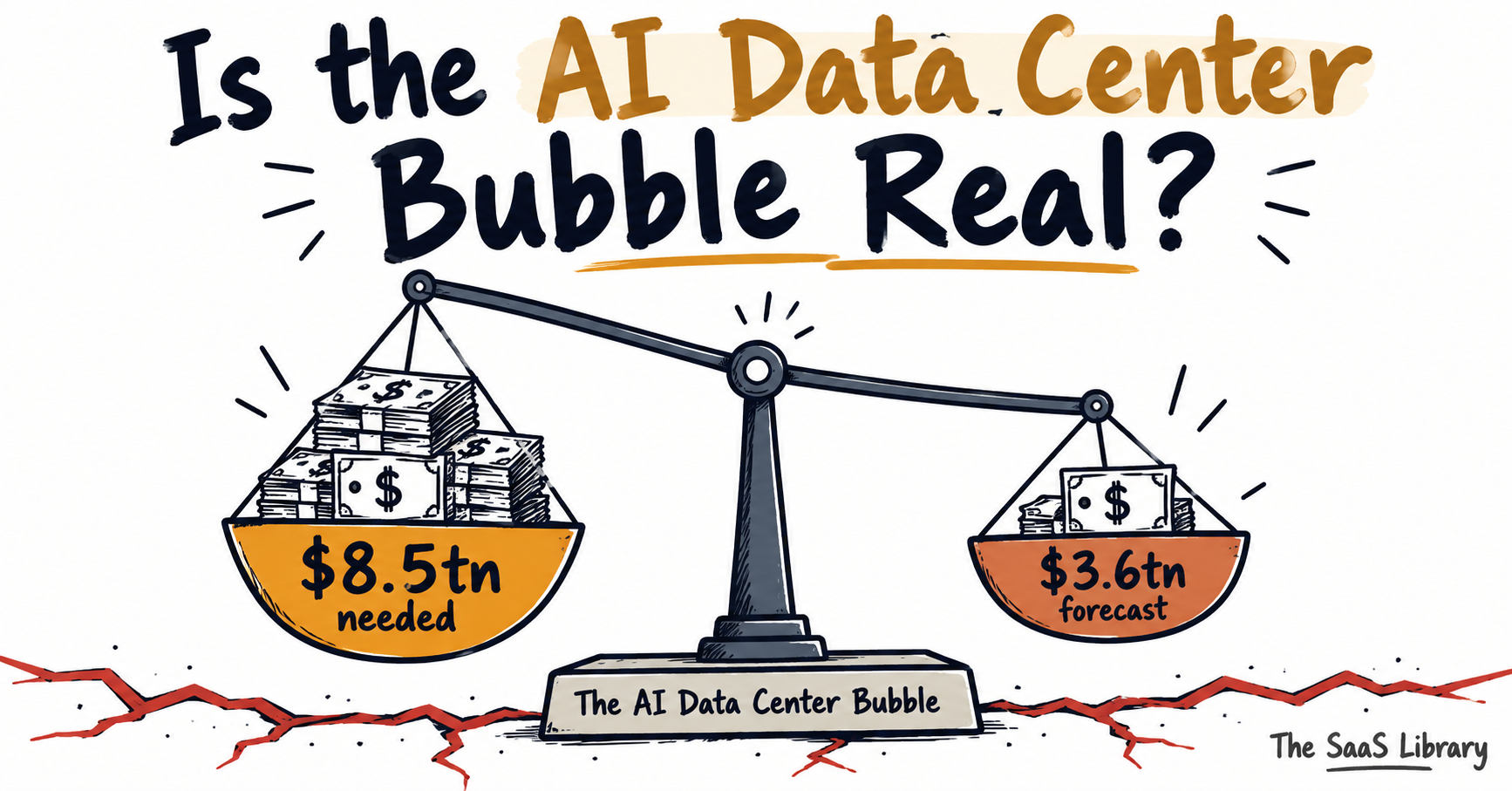
Microsoft just walked away from a data center that was supposed to hold 23,040 Nvidia chips. Gartner says AI infrastructure owners need $8.5 trillion in revenue by 2030 — and will get less than half that.
What Is the AI Data Center Bubble?
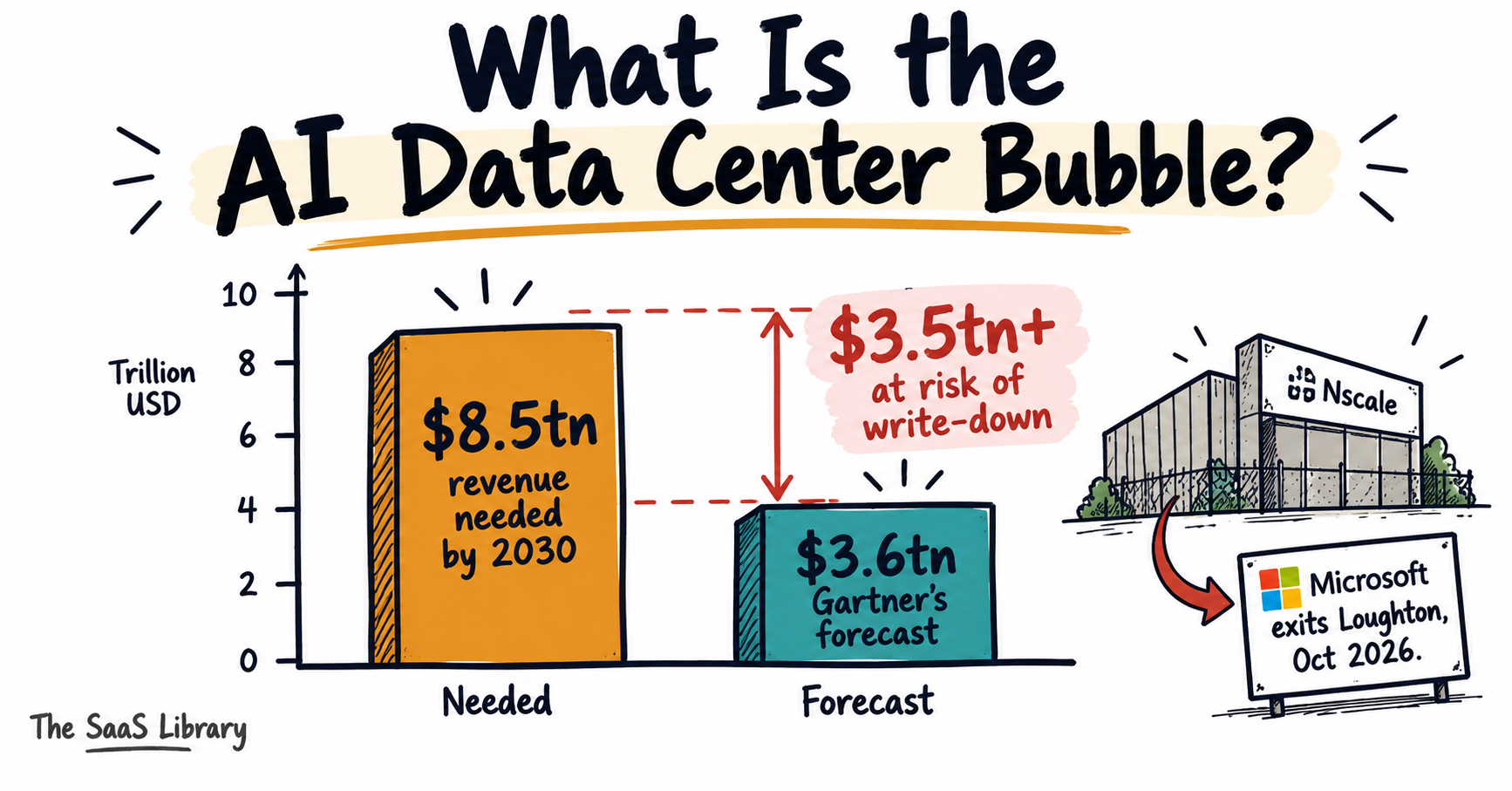
The AI data center bubble is the growing gap between what AI companies are spending on infrastructure and what that infrastructure can realistically earn back. Gartner calculates the industry needs $8.5 trillion in revenue through 2030 — but will earn at most $3.6 trillion, leaving over $3.5 trillion exposed to write-downs.
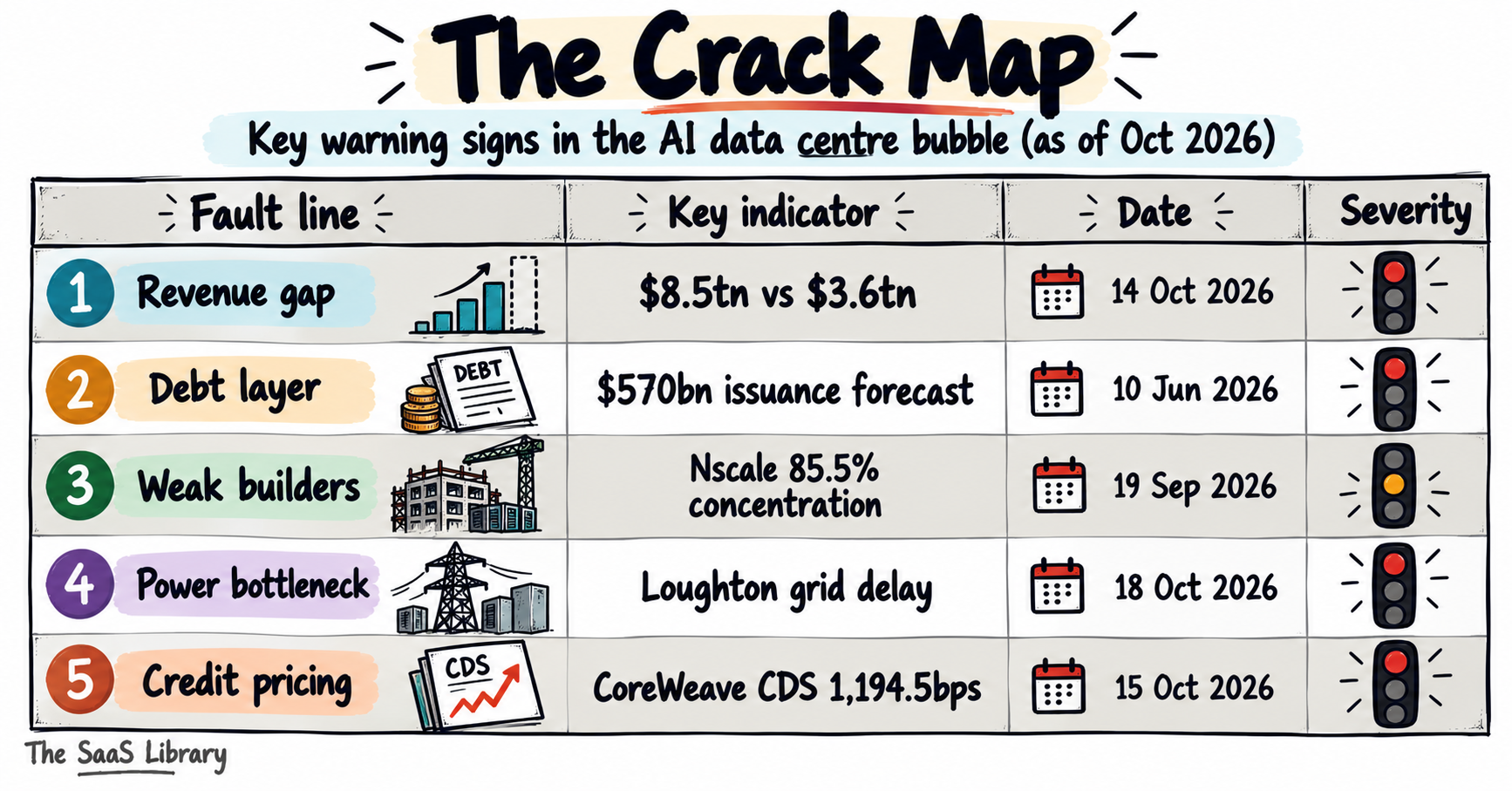
This isn’t a hunch, it’s arithmetic — and Gartner published the numbers on 14 October 2026. AI providers will spend nearly $1 trillion in 2026 alone, plus another $6 trillion between 2027 and 2030. To cover that spending, the financing costs on it, and a 12% return on invested capital, the industry needs $8.5 trillion in revenue. Gartner forecasts it will get no more than $3.6 trillion. (Gartner, 14 Oct 2026)
That shortfall doesn’t stay abstract for long. Four days after Gartner published it, Microsoft terminated its agreement for Nscale’s planned data center in Loughton, Essex — one of the two largest customers walking away from a company that had just filed for a US IPO citing more than $103 billion in total contracted value. Nscale said national grid officials had told it the site would not get a power supply until the 2030s. (Reuters, 18 Oct 2026)
A neocloud — a company that rents out GPU capacity instead of building its own AI products — borrows $1 billion to build a data center, betting customers will rent enough compute to pay it back with interest. If the tenant walks away before the loan is repaid, the lender is left holding a half-built site and a write-down. That is the mechanism behind every figure in this article.
Three things are true at once, and the rest of this article keeps them separate: AI demand is real, hyperscalers can mostly absorb the gap, and the weakest builders — neoclouds, single-tenant project-finance vehicles, and anyone who borrowed to build before securing a committed, creditworthy tenant — cannot. Gartner expects more than 80% of neoclouds to stop operating independently by 2030. Hyperscalers are not on that list.
Why Are Tech Companies Building So Many AI Data Centers?
Tech companies are overbuilding AI data centers because real compute demand is currently outpacing supply, and because no hyperscaler wants to be the one that pulled back right before AI adoption paid off. Jefferies estimates global data center demand reached 21.1 gigawatts in 2025 against only 8.9 gigawatts of capacity actually delivered — a 12-gigawatt shortfall.
Two forces are pushing in the same direction at once. The first is genuine scarcity: only 8.9 gigawatts of capacity became operational in 2025 while demand reached nearly 21.1 gigawatts, a deficit that has been widening since 2021. (Tribune India/ANI, Jun 2026)
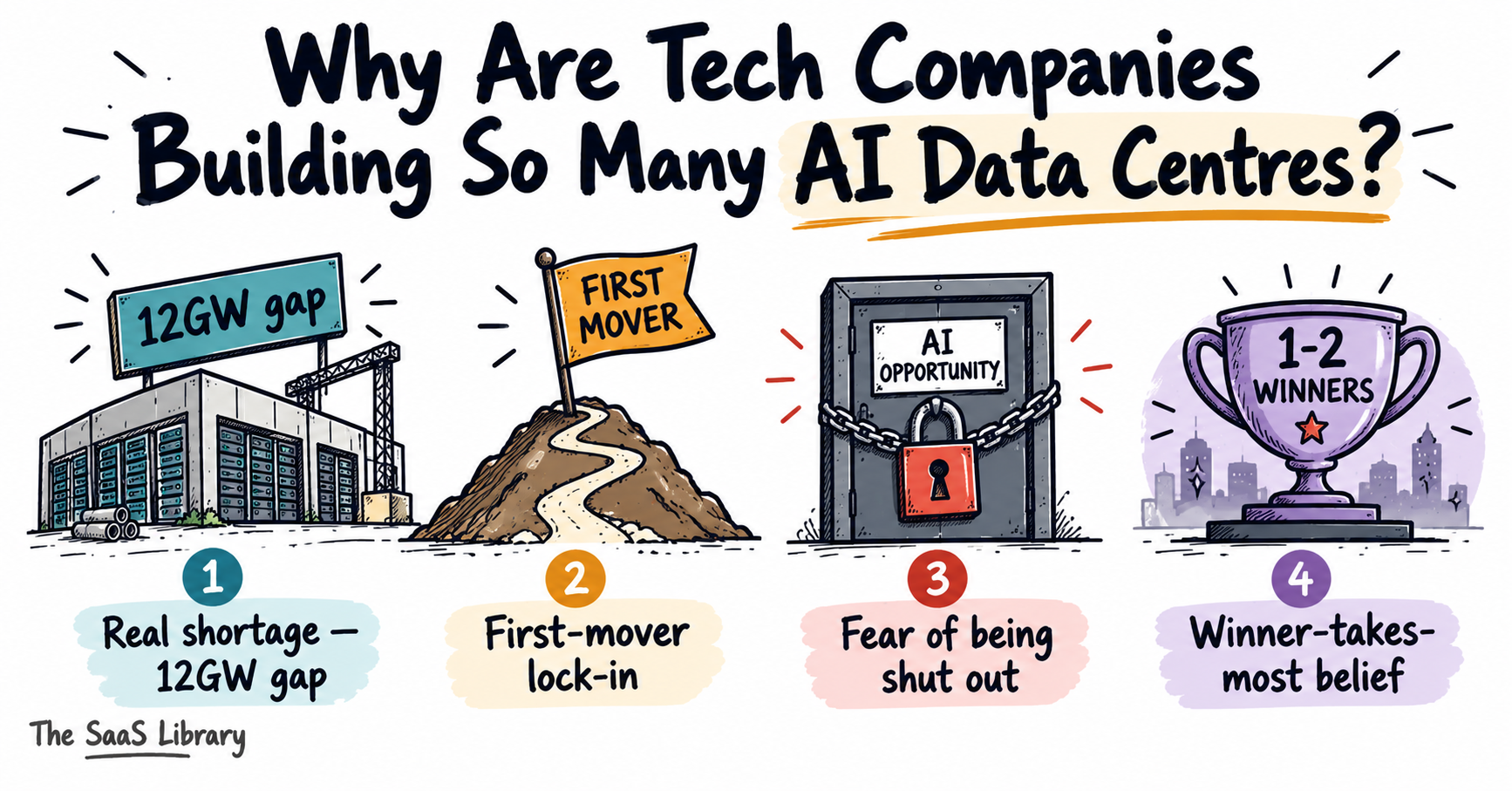
The shortage is real today — which is also why GPU rental prices rose through 2026 instead of falling. But a decision made to avoid losing a race is not the same as a decision made because the economics already work.
How Much Is Actually Being Spent on AI Data Centers?
The big four hyperscalers alone are spending over $650 billion in 2026, and Gartner puts the full industry total — including Oracle, neoclouds, and sovereign AI projects — at nearly $1 trillion for the year, rising to roughly $7 trillion cumulatively through 2030.
The headline numbers keep moving upward, not downward, through 2026. By the second-quarter earnings season, three of the big four had already raised their guidance from where they started the year.
| Company | 2026 Capex Guidance | Raised From |
|---|---|---|
| Alphabet | $195–205 billion | $180–190 billion |
| Amazon | $220 billion | $200 billion |
| Meta | $130–145 billion | $125–140 billion |
| Microsoft | $115.9 billion (FY26 actual) | — |
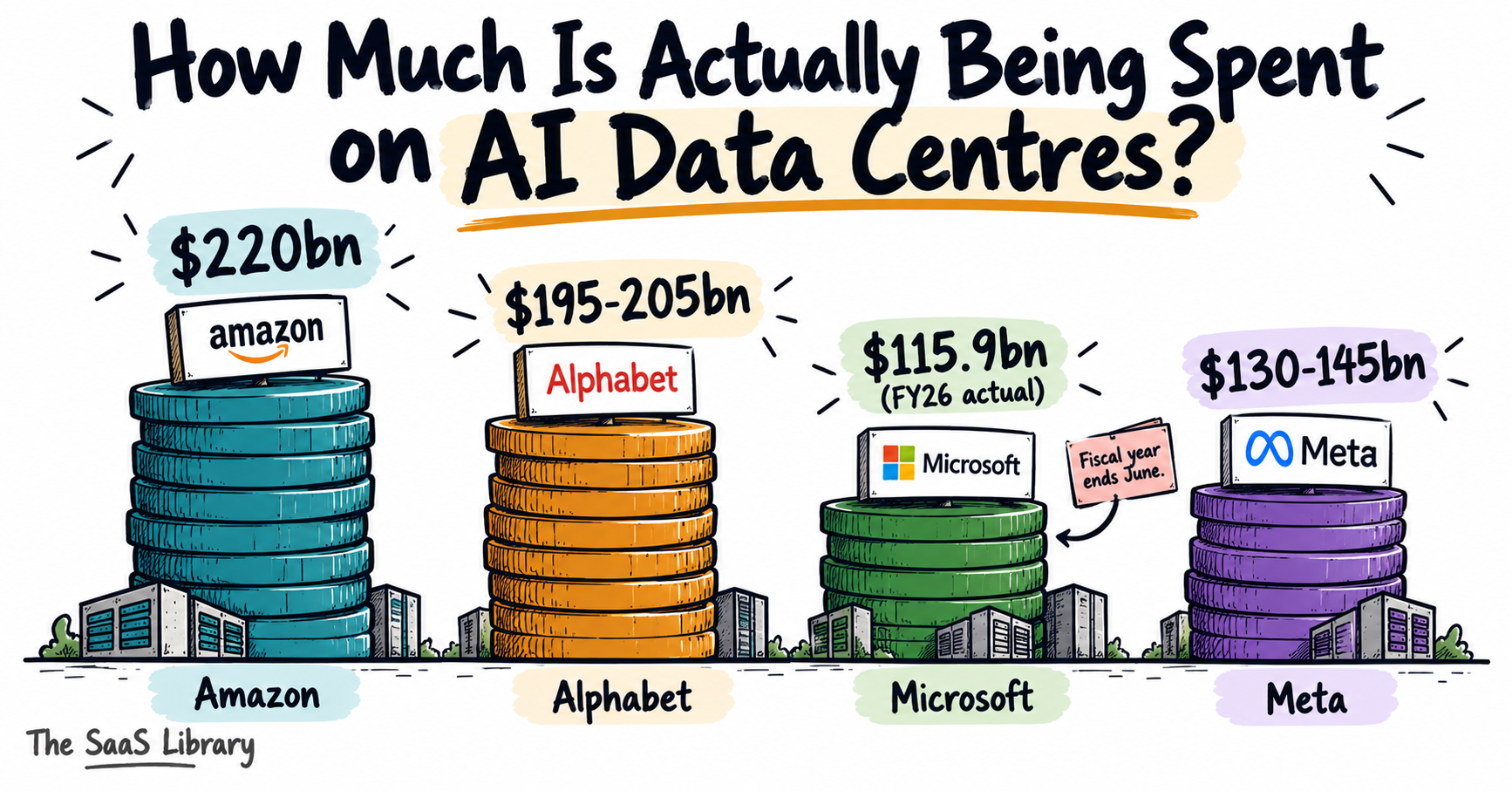
Alphabet CFO Anat Ashkenazi told analysts the company now forecasts capex of $195–205 billion, up from $180–190 billion, after Q2 2026 capex alone reached $44.9 billion. (Reuters, via Nasdaq) Microsoft runs on a fiscal year ending 30 June, which is why its $115.9 billion actual doesn’t sit cleanly next to the other three; its guidance for the year ahead has already moved to $255–260 billion. (Beancount, 2026)
Gartner’s “nearly $1 trillion in 2026” is not the same measurement as the big four’s combined guidance above — it covers all AI infrastructure providers, including Oracle and neoclouds, not just the four hyperscalers.
If four companies alone are spending over half a trillion dollars in a single year, and the full industry figure is nearly double that, the other half is coming from companies that don’t have Alphabet’s advertising revenue or Microsoft’s Office subscriptions to fall back on if the bet doesn’t pay off.
Who Is Paying for All of It?
AI data centers are being funded by a mix of four sources: hyperscaler operating cash flow (still the largest share), investment-grade corporate bonds, equity raises, and project-level or private credit secured against individual data centers or customer contracts. The share coming from debt has risen from about 9% of capex in 2024 to roughly a third by 2027, according to Goldman Sachs.
Goldman Sachs forecasts hyperscaler AI capex will surge 54% to $1.2 trillion in 2027, with roughly $400 billion of that coming from investment-grade bond issuance. (Goldman Sachs, via ROIC.ai, 25 Sep 2026) Incremental hyperscaler debt rose from about 9% of capex in 2024 to roughly 32% by mid-2026. (AI2.work, 2026)
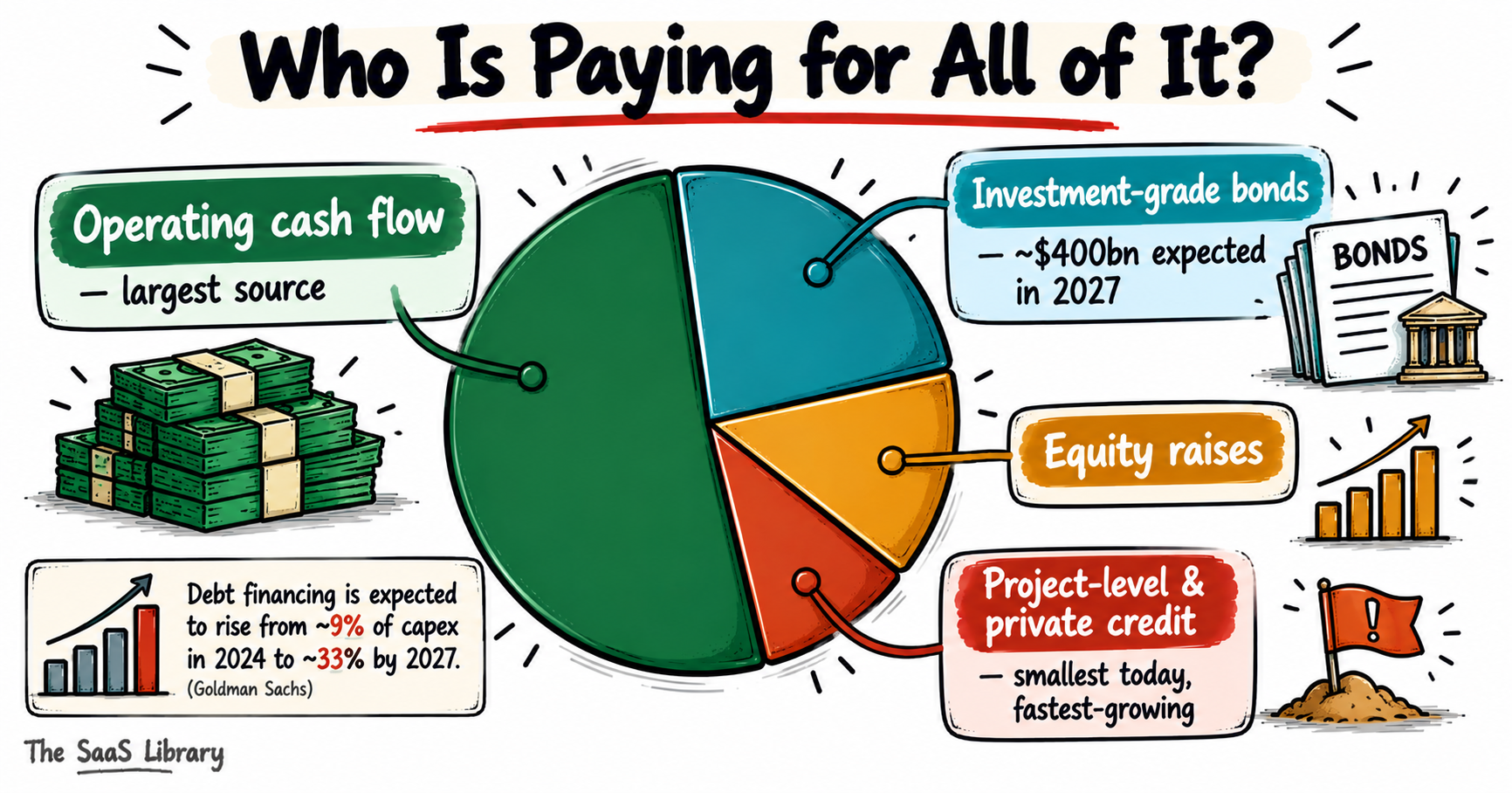
- Operating cash flow — existing profitable businesses subsidising AI build-out, still the largest single source.
- Investment-grade bonds — public debt markets, ~$400bn expected in 2027 alone.
- Equity raises — companies selling new shares specifically to fund AI capex.
- Project-level and private debt — loans tied to a single data center or customer contract, rather than the parent company’s balance sheet.
Want to see how AI companies price their own products amid this funding pressure?
Read how AI pricing works →Can AI Revenue Ever Catch Up With the Spending?
For the industry as a whole, not on the current trajectory. Anthropic, the clearest bull-case example, grew revenue 45% quarter-on-quarter to $16.8 billion in Q3 2026 and turned cash-flow positive, generating $1.70 in revenue for every dollar spent on compute.
Anthropic told prospective investors on 14 October 2026 that its revenue reached $16.8 billion in Q3, up from $11.6 billion in Q2 and $4.7 billion in Q1. (Reuters, via Devdiscourse) That follows a loss-making 2025, when revenue reached nearly $4.6 billion against an operating loss of more than $8 billion.
| Quarter (2026) | Anthropic Revenue | QoQ Growth |
|---|---|---|
| Q1 | $4.7 billion | — |
| Q2 | $11.6 billion | +147% |
| Q3 | $16.8 billion | +45% |
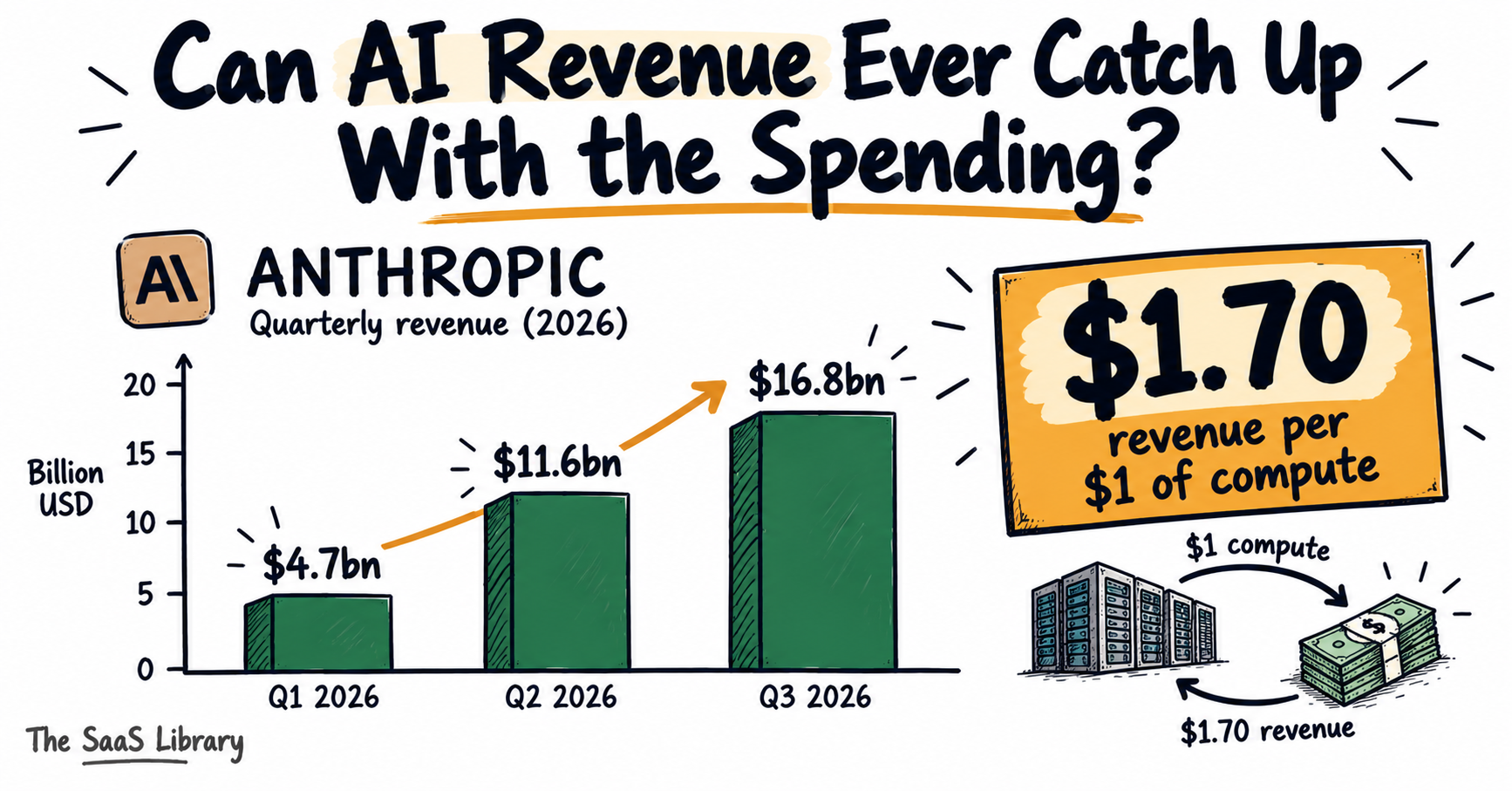
$1.70 of revenue per $1 of compute spend is the opposite of the industry-wide problem Gartner describes. It shows the shortfall isn’t evenly distributed — not that it’s resolved.
Why Does GPU Depreciation Make the Maths Worse?
GPU depreciation matters because it determines how many years a company has to earn back what it spent on a chip before that chip is replaced by a faster one. Nvidia releases a new generation roughly every year, but most GPU-cloud companies still depreciate hardware over five to six years.
CoreWeave depreciates its GPU fleet over six years, extended from five effective January 2023. Nebius moved to a five-year useful life in 2026, up from four. Both changes raise reported profitability without any cash changing hands. (io-fund.com, 2026)
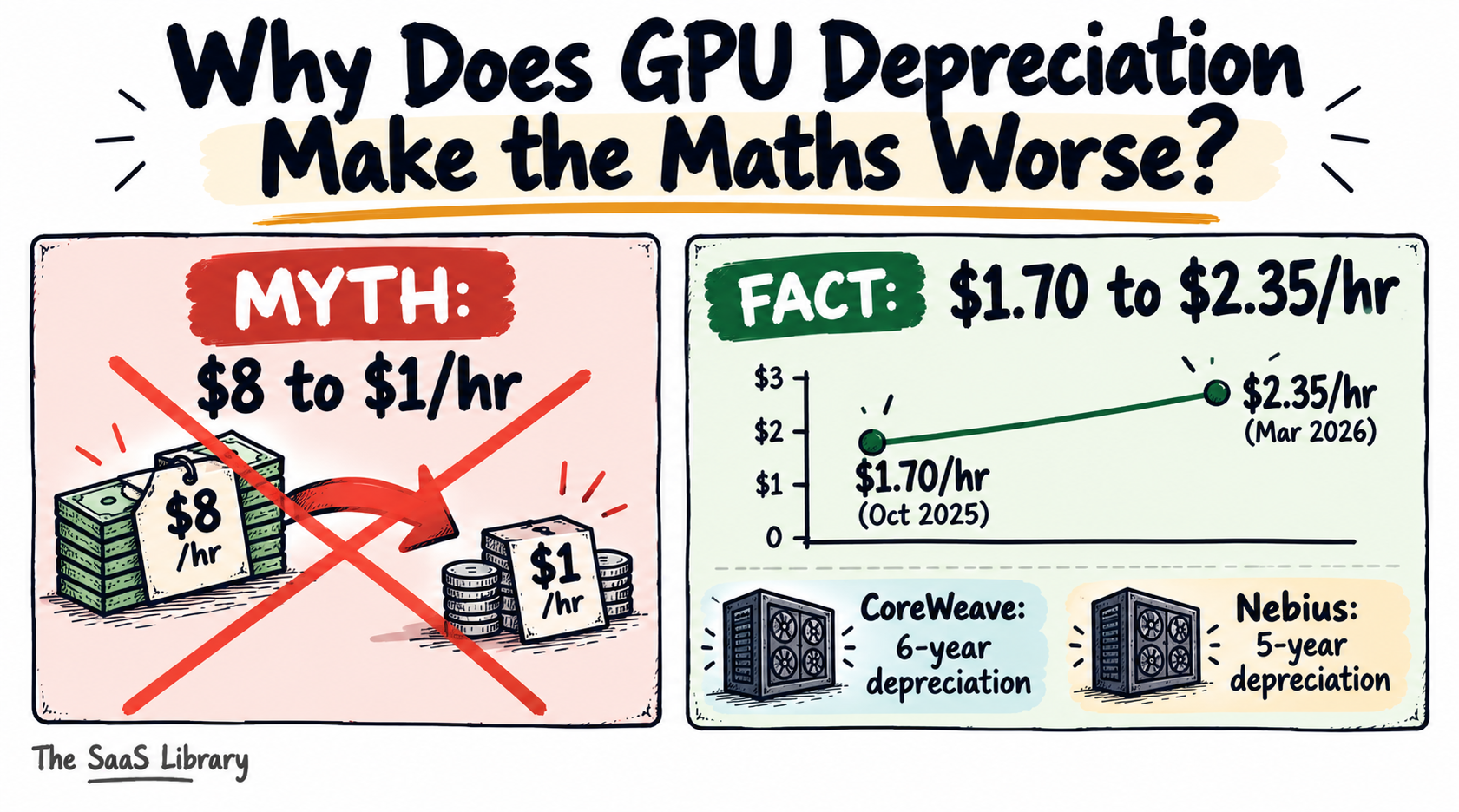
GPU rental prices didn’t collapse in 2026 — they rose. One-year H100 contract pricing climbed almost 40%, from $1.70/GPU-hour in October 2025 to $2.35 by March 2026. (Akash Network, citing SemiAnalysis, 2026)
| Fact | What’s Actually True |
|---|---|
| “GPU rental crashed to $1/hr” | False — rose from $1.70 to $2.35/hr, Oct 2025–Mar 2026 |
| CoreWeave’s schedule | 6 years (extended from 5, Jan 2023) |
| Nebius’s schedule | 5 years (extended from 4, 2026) |
Is This a Stock Bubble or a Debt Bubble?
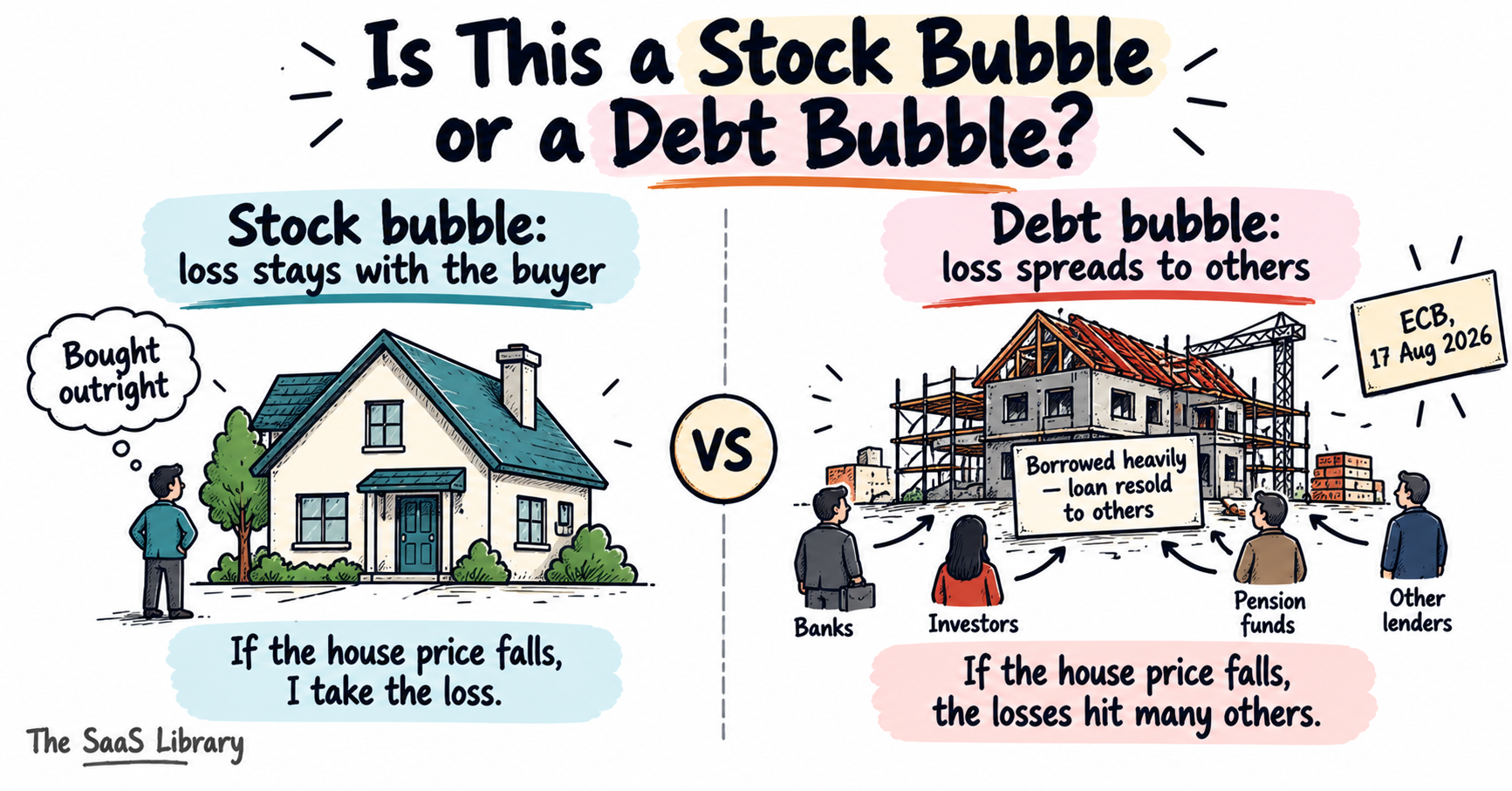
It’s both, but they carry very different risks. A stock correction mainly affects investors who chose to buy AI shares. A debt bubble affects lenders, pension funds, and insurers who may not have realised how much AI-linked risk they were holding.
The European Central Bank’s own research team addressed this directly in a blog post published 17 August 2026. Their conclusion: “A US AI fallout would not remain a US problem.” (European Central Bank, 17 Aug 2026)
| Stock Bubble | Debt Bubble | |
|---|---|---|
| What’s overvalued | Share prices vs earnings | Loans against revenue that may not arrive |
| Who loses first | Shareholders who bought in | Lenders and anyone holding that debt indirectly |
Why Are Lenders Suddenly Worried About AI Data Center Debt?
Lenders are worried because the cost of insuring against an AI company defaulting spiked sharply in October 2026 — CoreWeave’s five-year credit default swap hit a record 1,194.5 basis points, implying close to a 63% probability of default within five years, up from around 30% a year earlier.
Morgan Stanley forecast in June 2026 that global AI-related debt issuance would more than double to nearly $570 billion for the year. (Reuters, 10 Jun 2026) By mid-October, CoreWeave’s CDS surged past 1,000bps, hitting an intraday record of 1,194.5bps on 15 October. Oracle’s five-year CDS reached 288bps the same day. (Reuters, via ARY News, 15 Oct 2026)
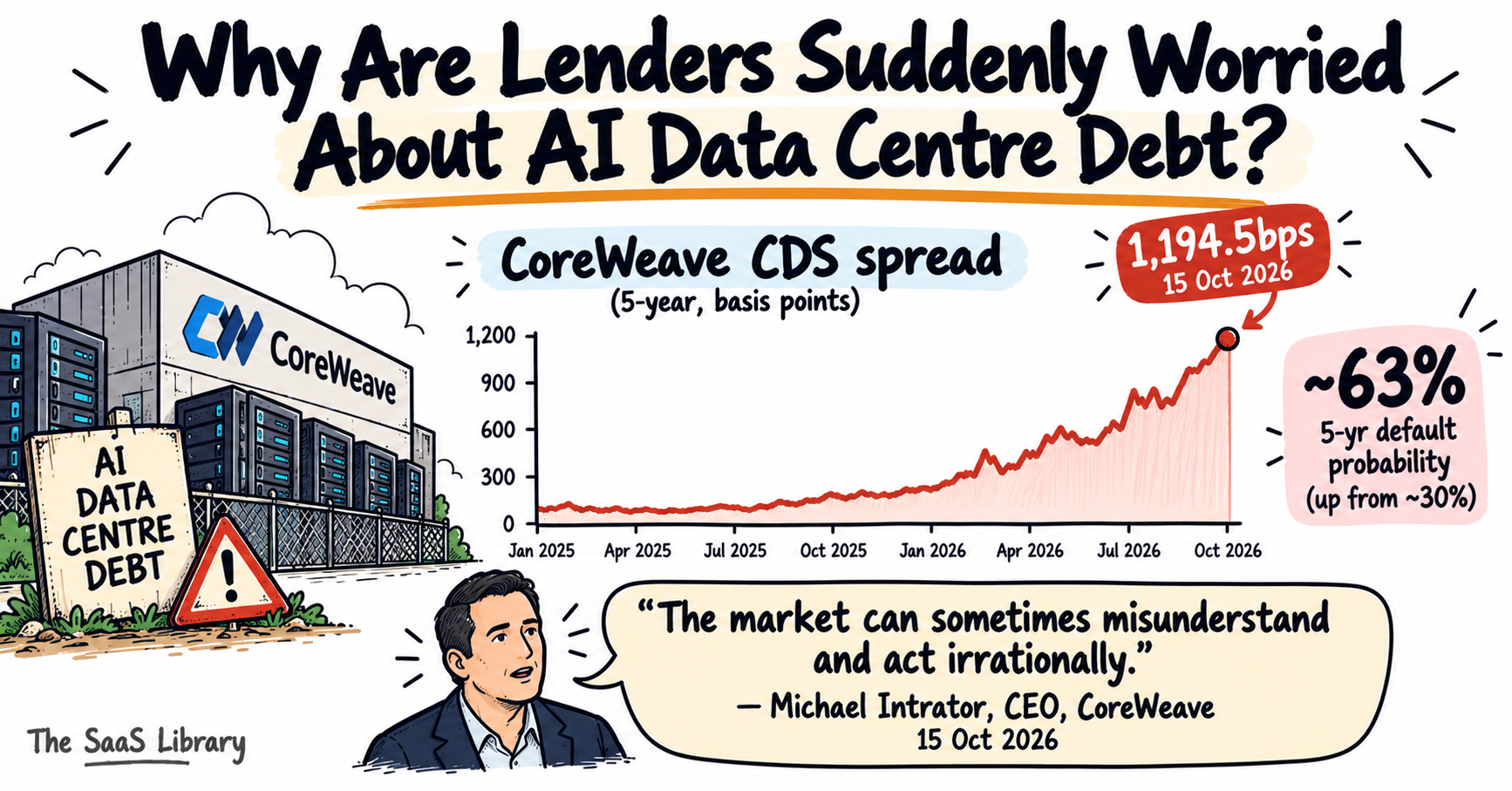
A wider CDS spread signals rising concern, not a confirmed default — CoreWeave has made every payment it owes. But the speed of the move is itself the signal: credit markets moved from pricing routine risk to pricing distress within days.
What Happened With Microsoft and Nscale’s Loughton Data Center?
Microsoft terminated its agreement for Nscale’s Loughton data center in October 2026 after grid officials said power wouldn’t arrive until the 2030s — just weeks after Nscale’s IPO filing revealed Microsoft and Anthropic together account for 85.5% of its entire $103.4 billion contract book, with one of those two deals not yet financed.
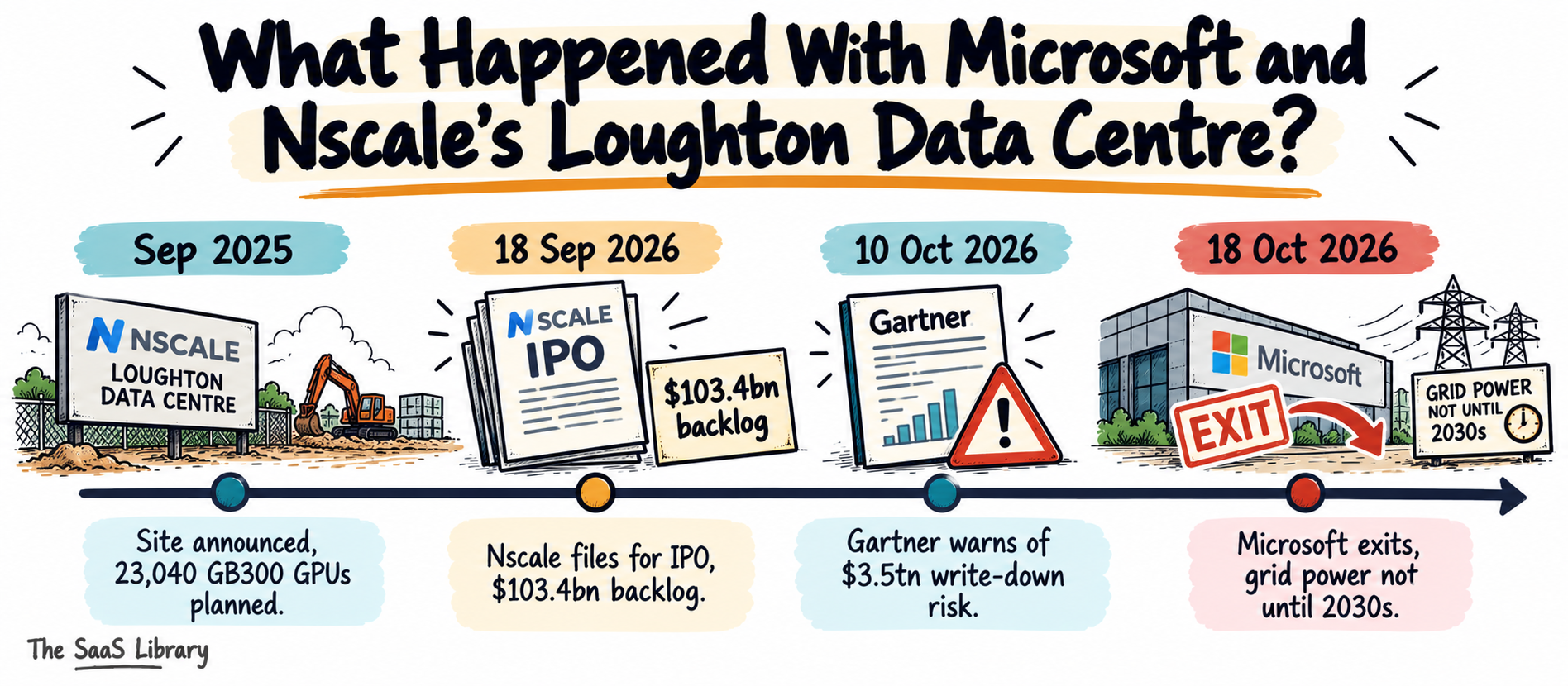
Nscale’s prospectus shows $103.4 billion in active and contracted total contract value as of 31 August 2026. Microsoft’s statements of work account for up to $43.8 billion (42.4%), and Anthropic’s agreements for up to $44.6 billion (43.1%) — together 85.5% of the book. (ProgressiveRobot, Nscale S-1 analysis, 2026)
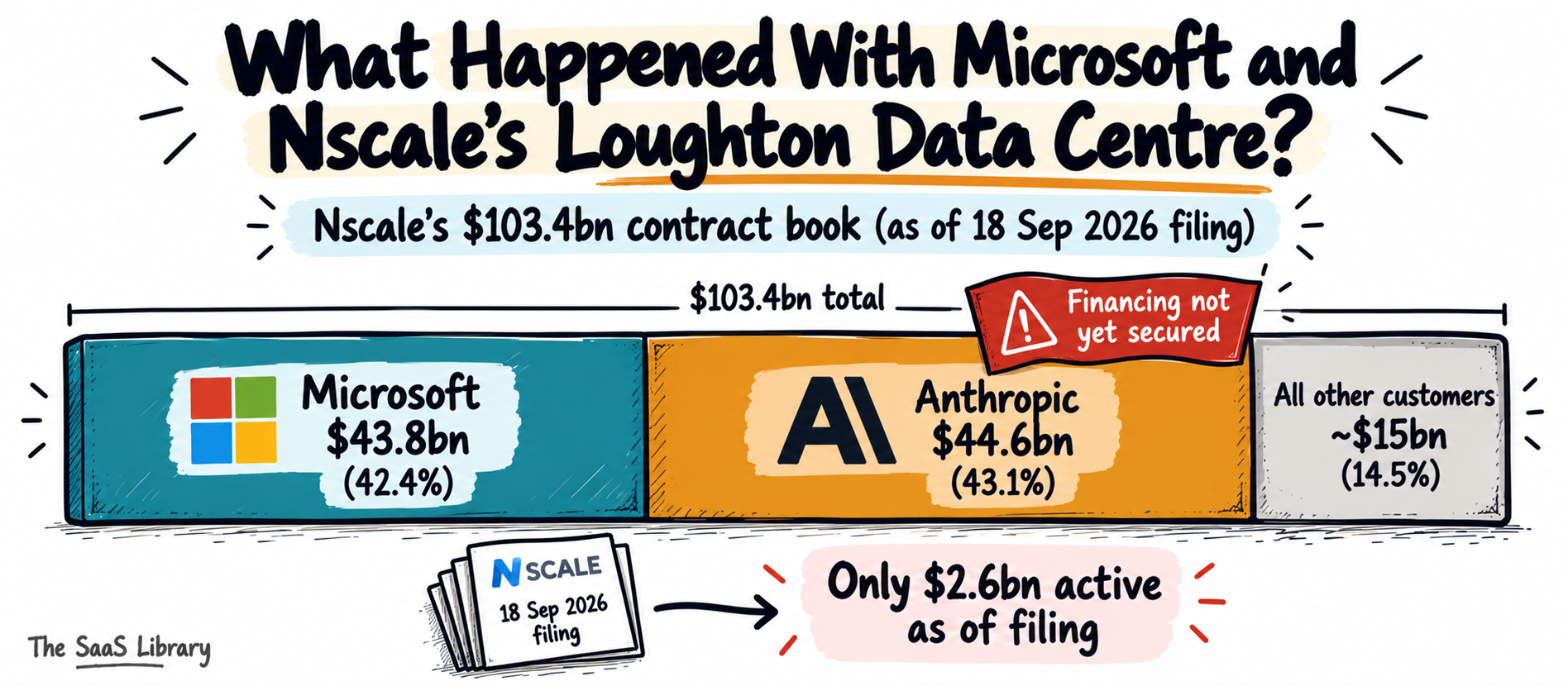
The Anthropic agreement is not yet financed. The prospectus states: “As of the date of this prospectus, we have not obtained binding commitments” for the required financing.
| Customer | Contract Value | Share | Status |
|---|---|---|---|
| Microsoft | Up to $43.8bn | 42.4% | Partially withdrawn |
| Anthropic | Up to $44.6bn | 43.1% | Financing not yet secured |
| All others | ~$15bn | 14.5% | — |
What Are the Warning Signs That the Bubble Is Cracking? (The Crack Map)
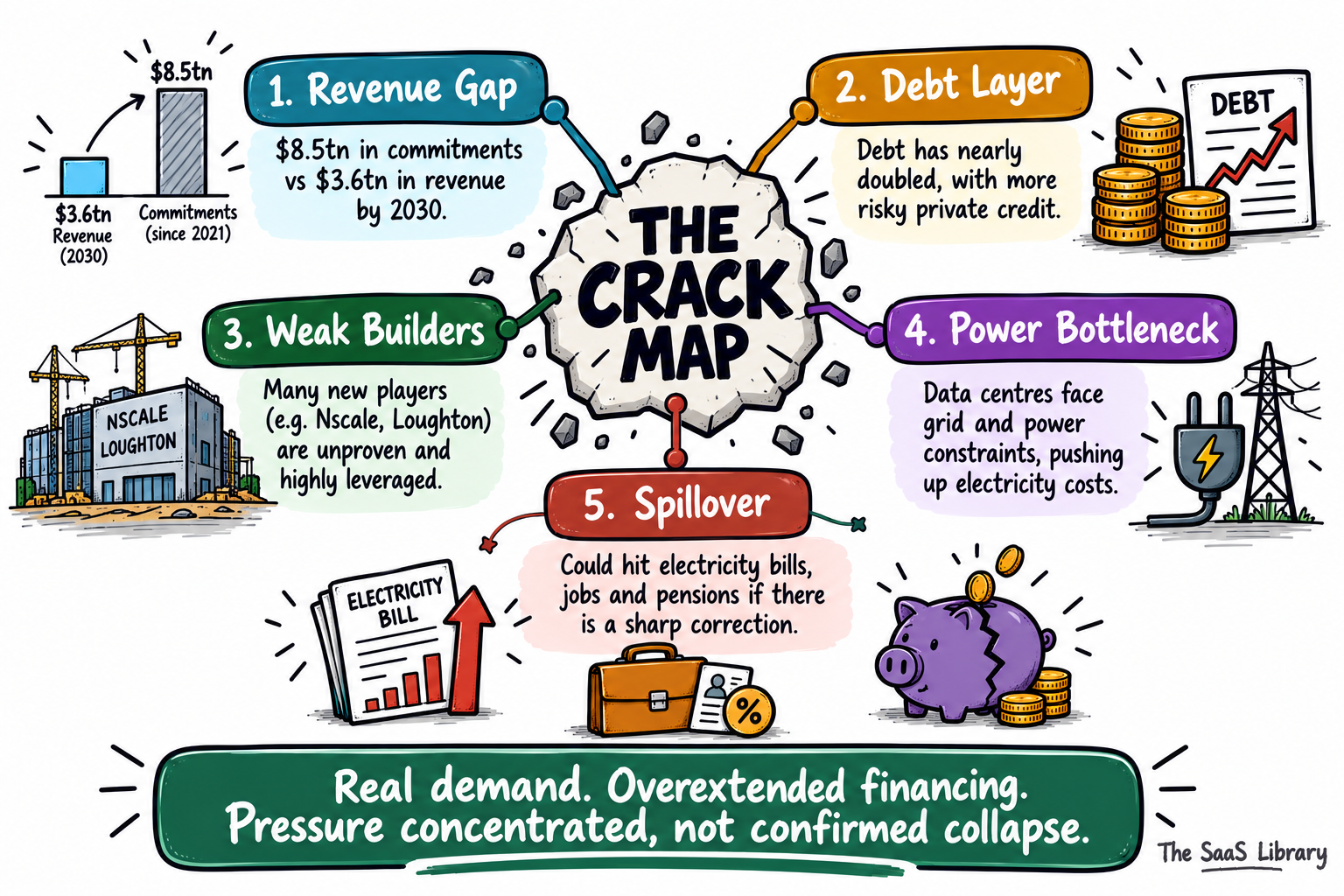
The pressure isn’t showing up everywhere at once — it’s concentrated along five specific fault lines, and every one has a dated, verifiable data point from the past six weeks. This is The Crack Map: a scorecard of where the AI data center bubble is actually showing stress right now.
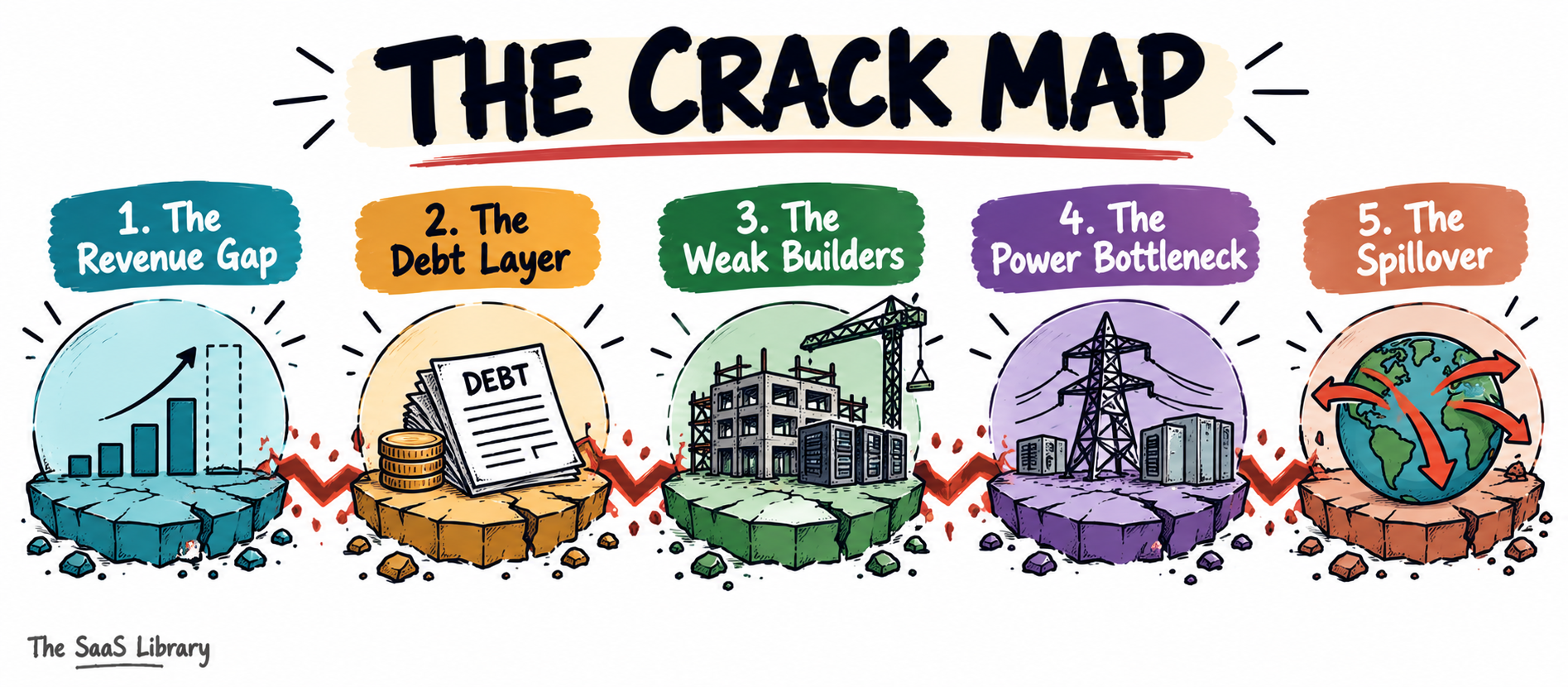
Five fault lines showing stress in the same six-week window isn’t proof the whole structure is failing — it’s proof the structure isn’t evenly built, and the places under the most load are debt-funded, customer-concentrated, power-dependent projects, not hyperscalers’ core businesses.
What Could Make the AI Data Center Bubble Burst?
The single most concrete, named trigger already on the table is Oracle falling into junk status — S&P has it one notch above that line, and a credit analyst has publicly named the exact leverage threshold (4.5 times) that would prompt a further downgrade.
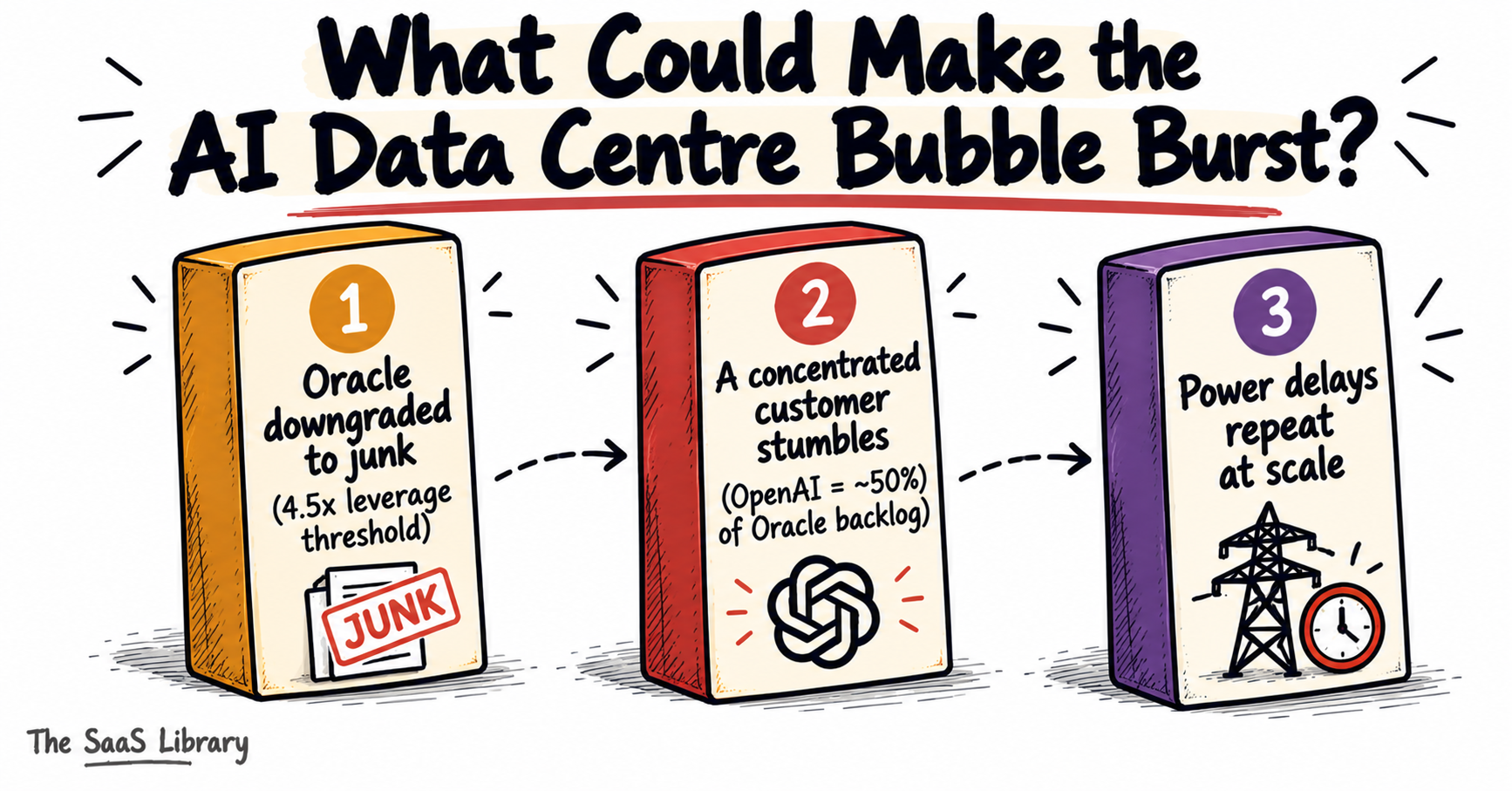
S&P downgraded Oracle to BBB- on 9 July 2026. Moody’s analyst Andrew Chang named the threshold: “We could downgrade Oracle if leverage exceeds 4.5 times.” (Reuters, via Mezha.net, 4 Aug 2026) S&P also named OpenAI as a “central credit risk,” accounting for roughly half of Oracle’s $638 billion backlog. (Traeai.com, 2026)
None of the three triggers named here has actually fired yet. The pressure is visible and measurable, but the specific event that would turn pressure into a cascading correction hasn’t occurred as of this writing.
How Does This Compare to Railway Mania and the Dotcom Crash?
The Bank for International Settlements directly compared the AI investment boom to four historical episodes in its Annual Economic Report 2026: canal mania (1830s), British railway mania (1840s), the electrification boom (1920s), and the dotcom bubble (late 1990s). Its conclusion: all four “ended with an eventual reversal in investment, inducing economy-wide recessions.”
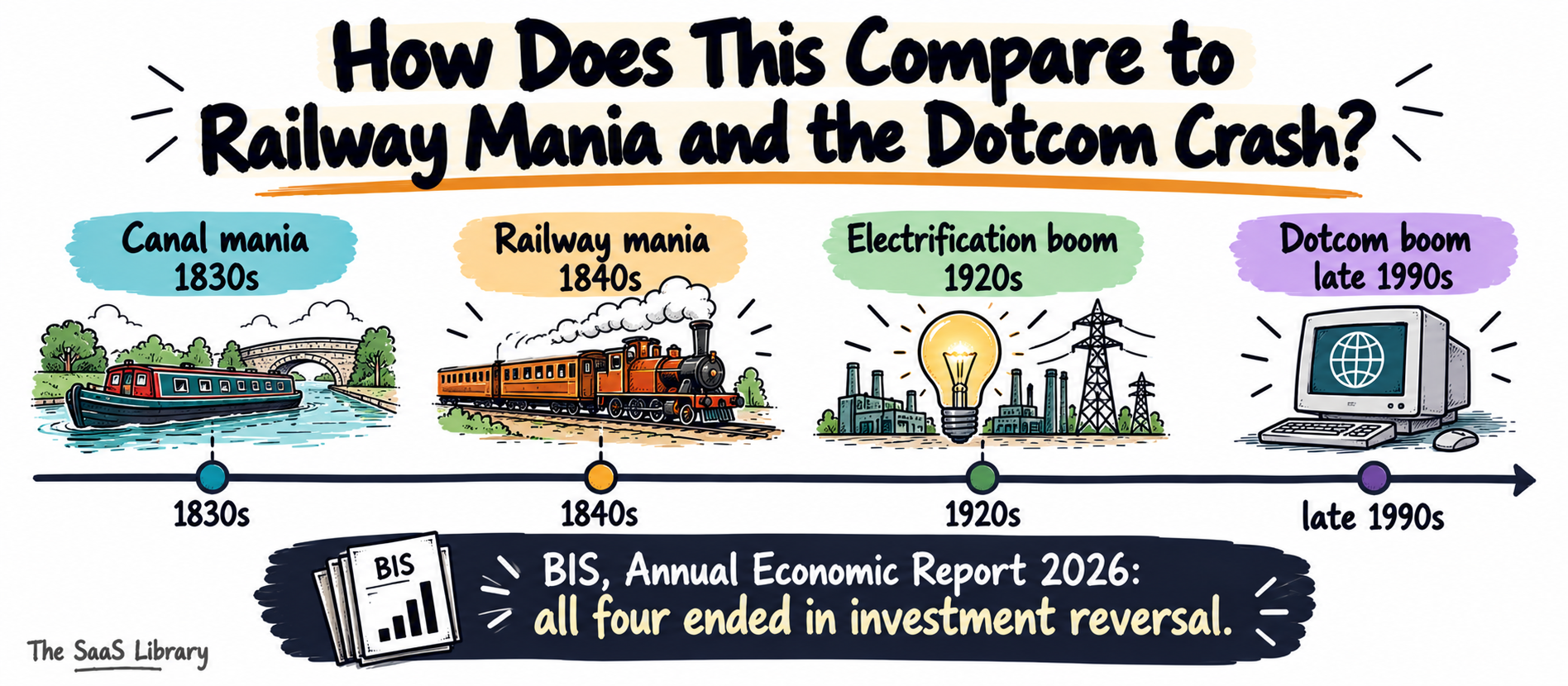
The BIS stopped short of calling the AI boom a bubble outright — its framing is risk and resemblance, not a prediction. (The Asset, citing BIS, 2026)
Who Gets Hurt If the AI Data Center Bubble Bursts?
Not evenly, and not mainly the companies building the data centers. The ECB modeled pension funds losing 5–6% of total assets and insurers around 4% in a stress scenario, while bank losses stay contained at no more than 1.3% of equity.
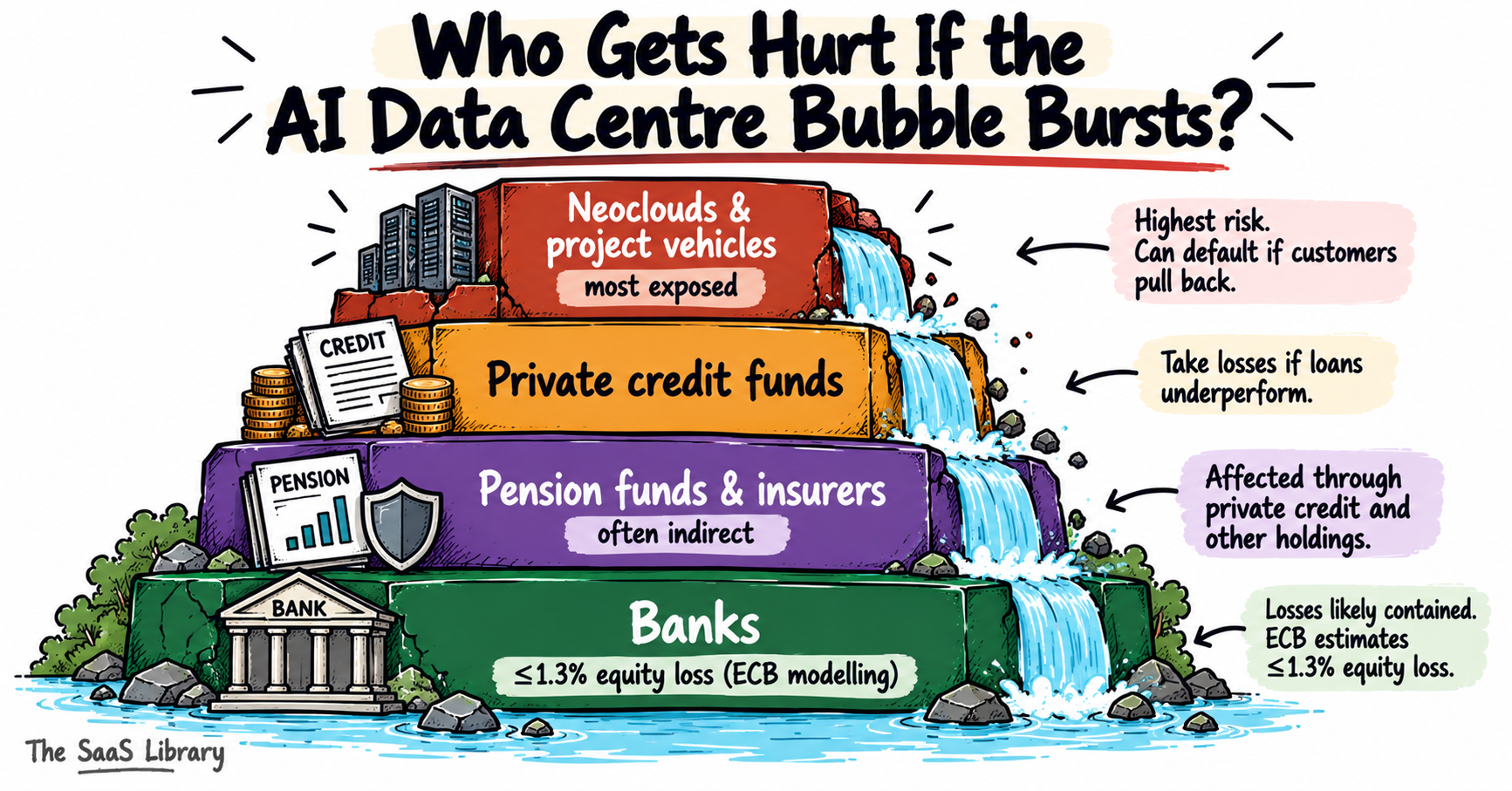
Bloomberg estimates more than $500 billion in outstanding AI data center debt, with roughly $200 billion held by private credit funds. (TechRadar Pro, 2026) CalPERS, the $615bn pension system, allocates roughly 4% of assets to private debt including $3bn to Blackstone Real Estate Debt Strategies. (PE Insights, 2 Mar 2026)
| Who | Exposure |
|---|---|
| Neoclouds / project vehicles | Direct borrower — defaults first |
| Private credit funds | Direct lenders to data center projects |
| Pension funds & insurers | Indirect, via private credit allocations |
| Banks | Mostly protected — ≤1.3% equity loss (ECB) |
What Happens to the Buildings, Power and GPUs if It Pops?
The buildings, land, and grid connections are likely to survive a correction and get bought cheaply, the way dark fibre from the dotcom bust became the backbone of the internet. The GPUs inside are a different story — they lose commercial value with each new chip generation.
More than 60 telecom companies failed between 2001 and 2003. By 2002, roughly 97.5% of installed long-haul fibre sat dark. (TechFinitive, 2026) That fibre didn’t stay dark — it became the cheap backbone of modern cloud computing.
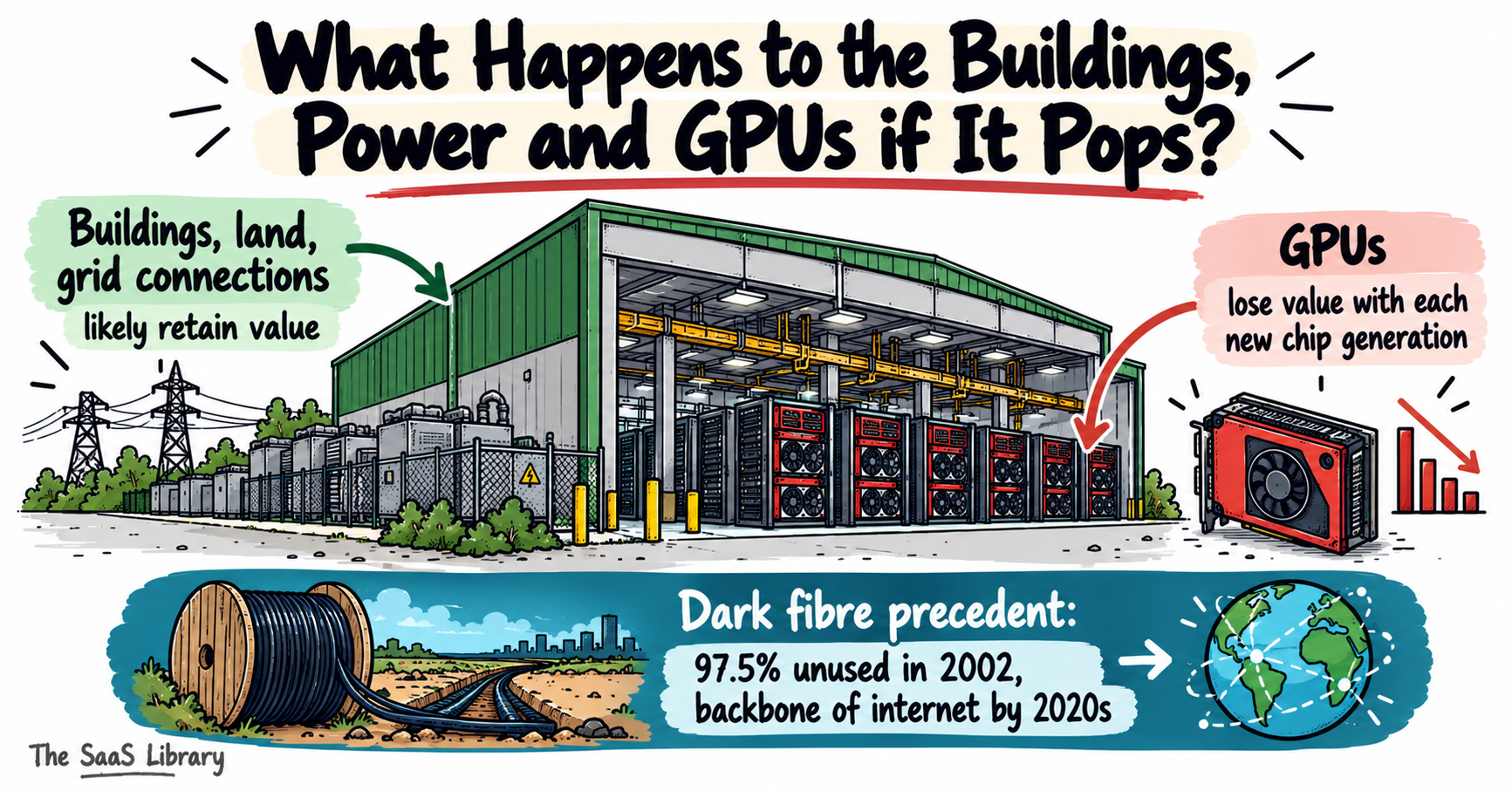
A strand of fibre-optic cable doesn’t functionally degrade sitting unused for a decade. A GPU does — Nvidia ships a new generation roughly every year, which is why the “GPUs are just the new dark fibre” comparison doesn’t fully hold.
What Does This Mean for B2B SaaS Companies?
Two things at once: most enterprises still can’t show AI is paying off internally — MIT found 95% of generative AI pilots deliver no measurable P&L impact — while the companies they rely on for AI infrastructure carry real counterparty risk most SaaS buyers have never had to think about before.
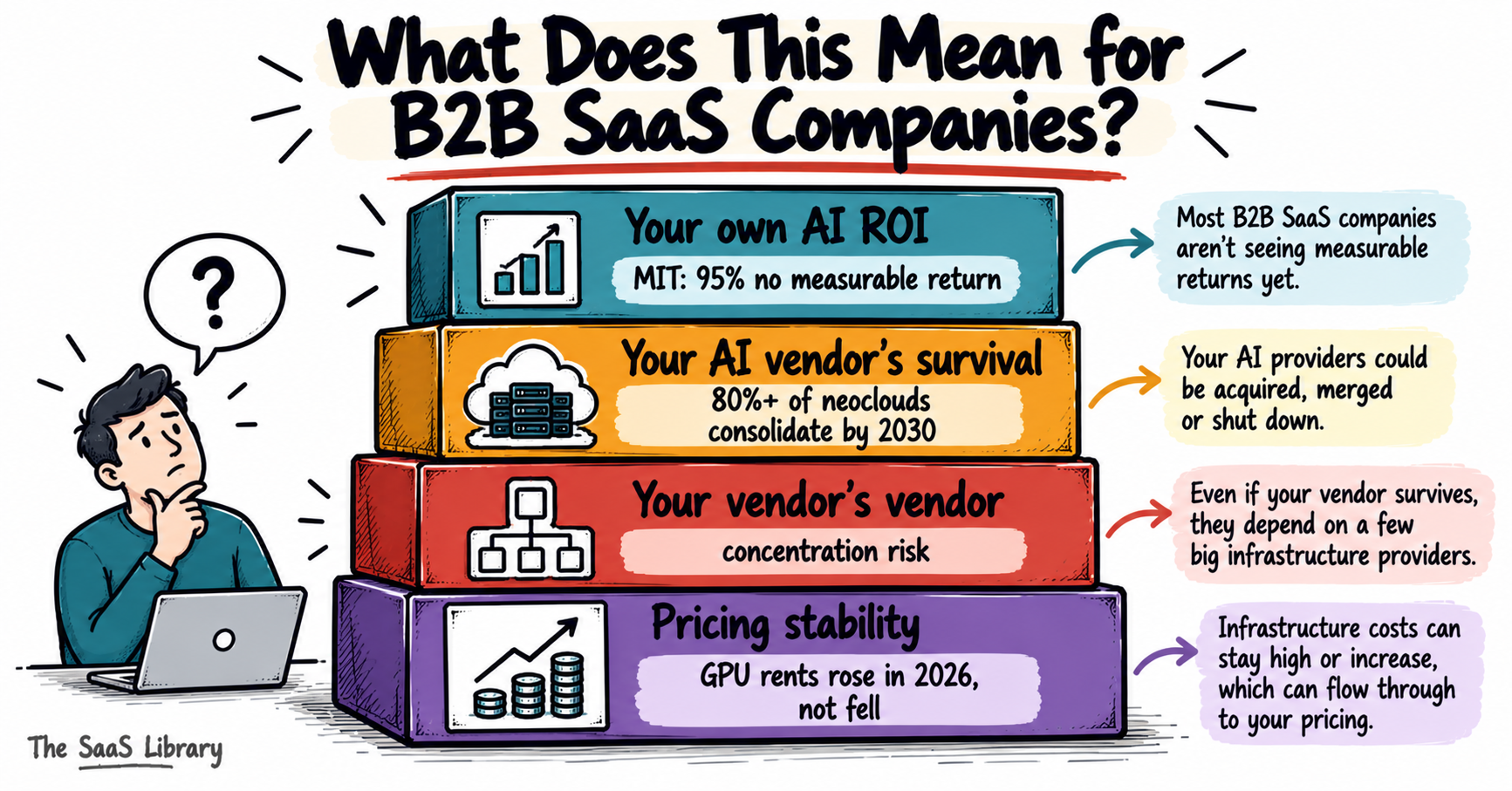
MIT Media Lab’s Project NANDA found 95% of organisations saw no measurable return from generative AI pilots. (Computing.co.uk, 2025) NBER’s survey of nearly 6,000 executives found more than 90% report no employment effect from AI at their own firm. (NBER Working Paper 34836)
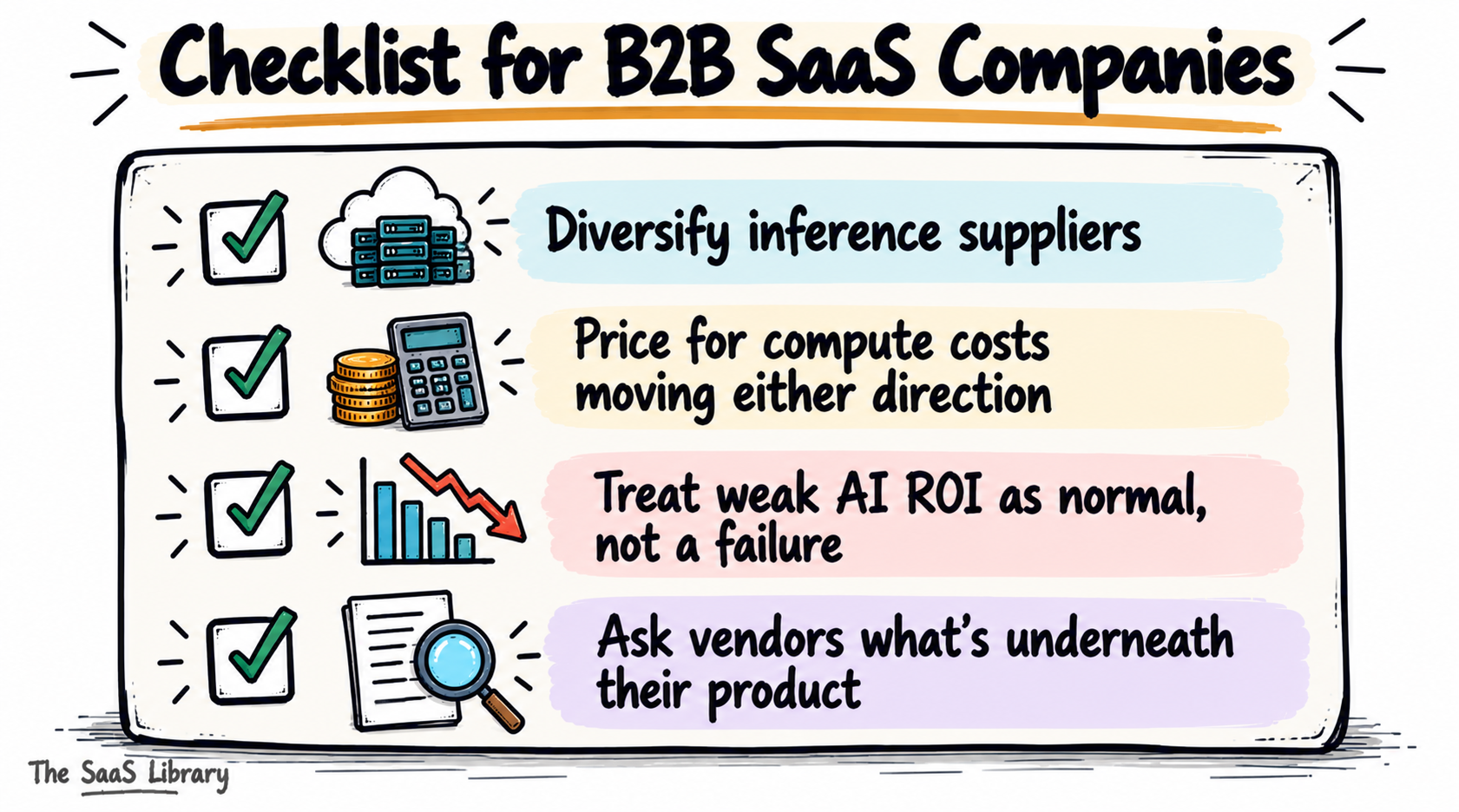
- Don’t build critical dependencies on a single neocloud without checking its customer concentration.
- Price AI features assuming compute costs could move in either direction.
- Treat weak AI ROI as the normal case, not a failure specific to your team.
- Ask vendors which cloud and model providers sit underneath their product.
Want to understand how to track and control your own AI infrastructure spend?
Read our guide to AI FinOps →How Could an AI Bubble Affect Ordinary People?
Two ways, regardless of whether anyone personally invests in AI stocks: electricity bills in areas near data centers are already rising, and anyone with a pension or index fund likely has indirect exposure they didn’t choose.
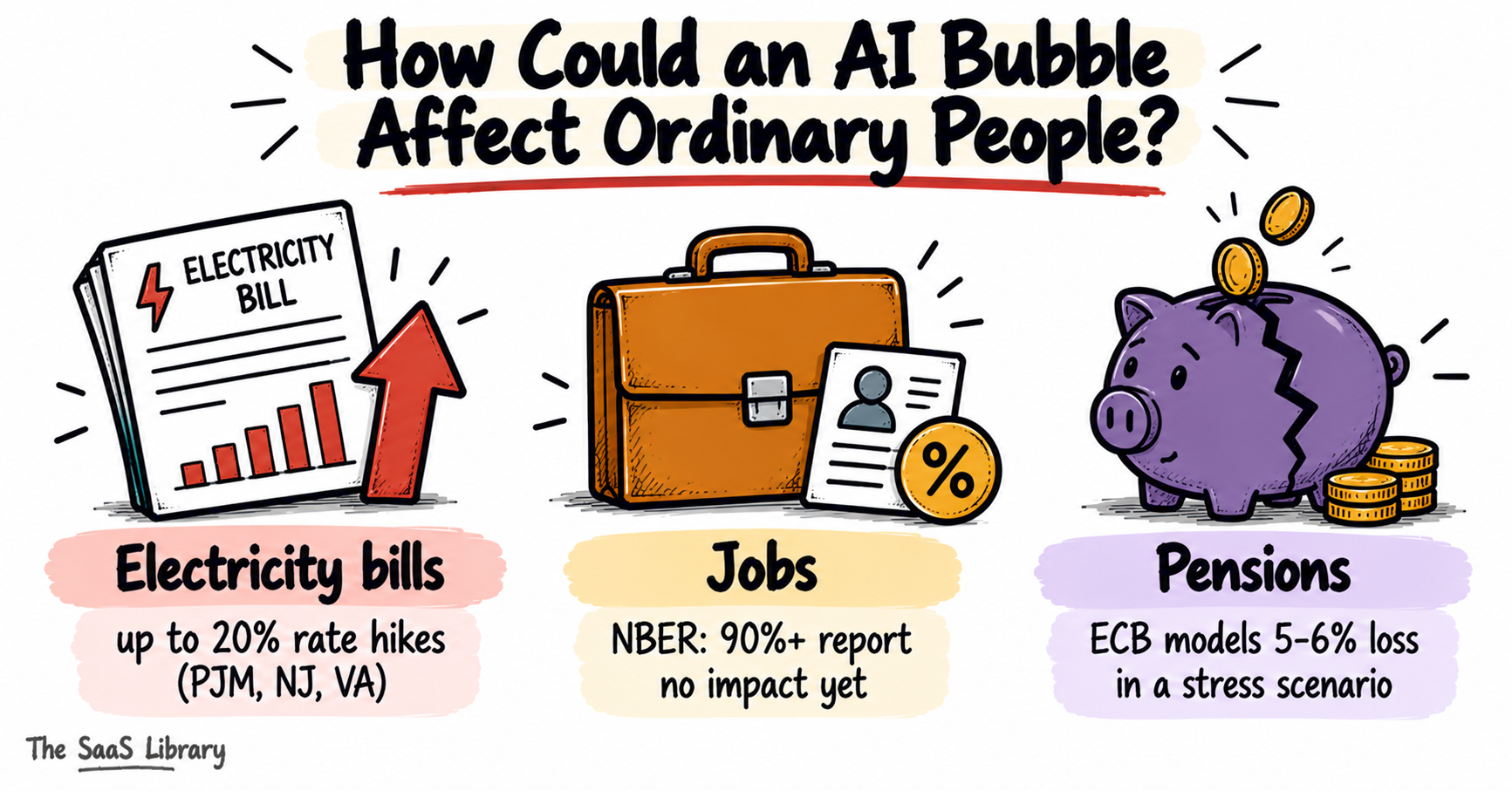
PJM electricity rates rose up to 20%, partially reflecting data center demand. Dominion Energy proposed an $8.51 a month hike and floated a “new rate class for high energy users, including data centers.” (CBS News, 2026) A March 2026 Gallup survey found 7 in 10 Americans oppose data center construction in their own communities. (Consumer Reports, 2026)
Is India’s Data Center Boom at Risk Too?
Yes — the gap between money committed and capacity actually built is unusually wide in India. CBRE recorded $173 billion in cumulative commitments since 2021 against only about 1.75 gigawatts of capacity actually operational by mid-2026.
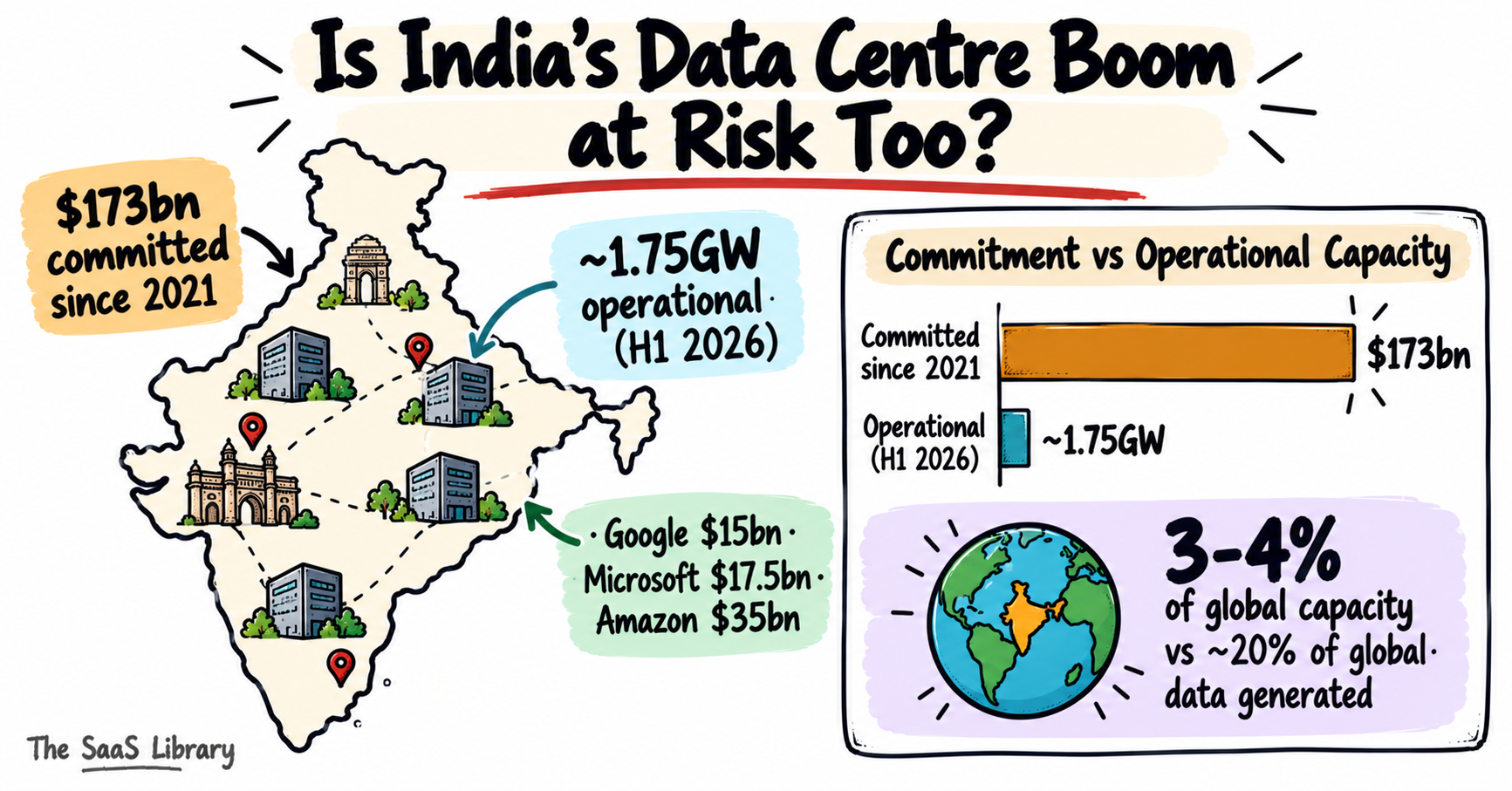
Google has committed $15 billion to an AI hub in Andhra Pradesh, Microsoft $17.5 billion through 2029, and Amazon $35 billion by 2030. (CBRE, H1 2026) This ties into the environmental risks already covered in our piece on the data center environmental impact.
What Should You Watch Over the Next 12 Months?
Five concrete, dated events: the hyperscalers’ next earnings (expected 27–28 Oct 2026), Anthropic’s and Nscale’s IPO outcomes, Oracle’s next credit rating action, whether GPU rental prices keep rising, and whether AI debt issuance rebounds.
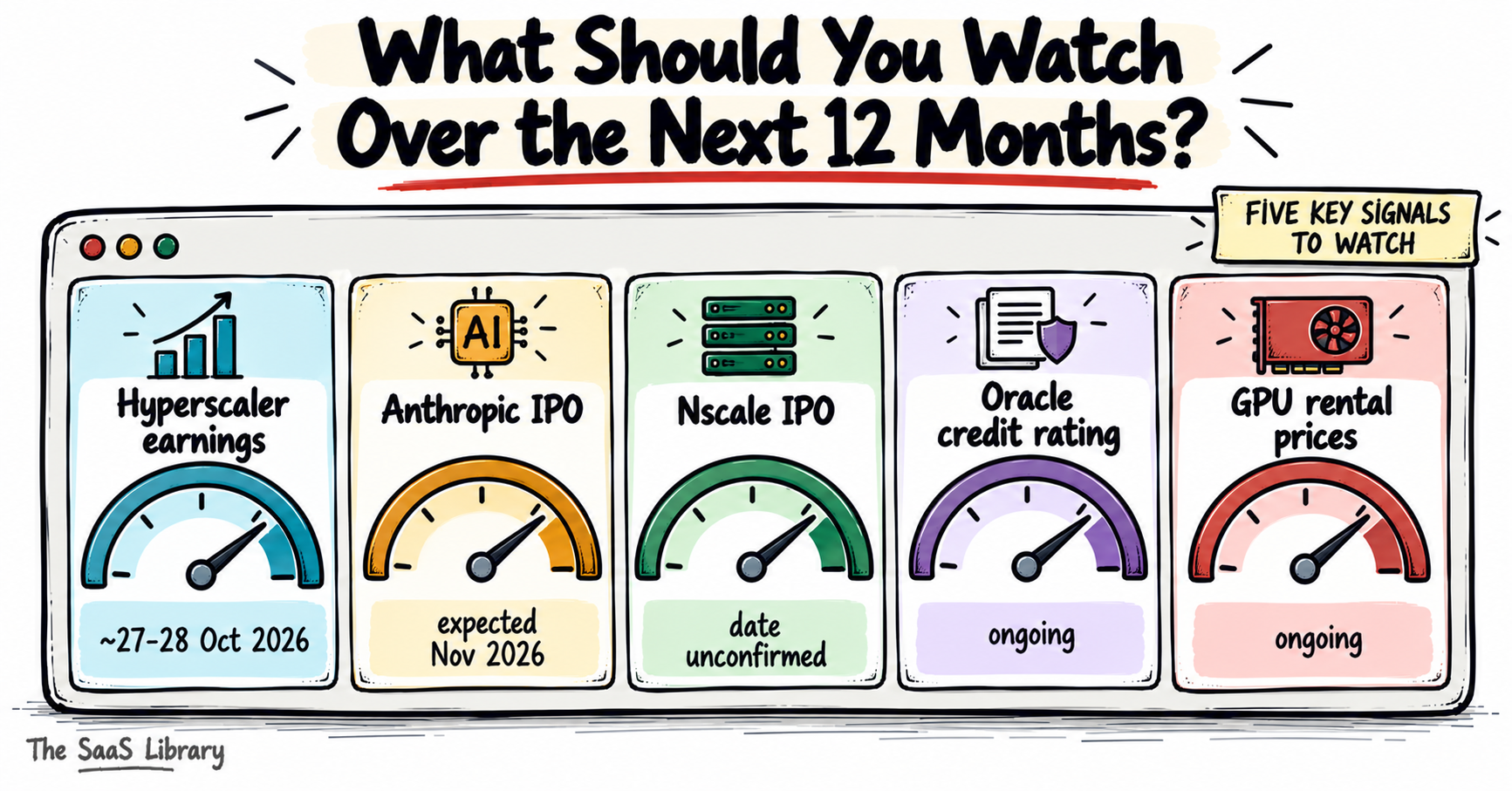
| Signal | Timing |
|---|---|
| Hyperscaler earnings | ~27–28 Oct 2026 |
| Anthropic IPO | Expected Nov 2026 |
| Nscale IPO | Date unconfirmed |
| Oracle credit rating | Ongoing |
| GPU rental prices | Ongoing |
So Is the AI Data Center Boom a Bubble or Not?
Yes and no, depending on which layer you’re looking at. Demand for AI compute is real and outpaces supply. The financing built on top of it has grown faster than the revenue available to support it, and that stress is now visible, dated, and measurable — concentrated in specific companies, not spread evenly across the industry.
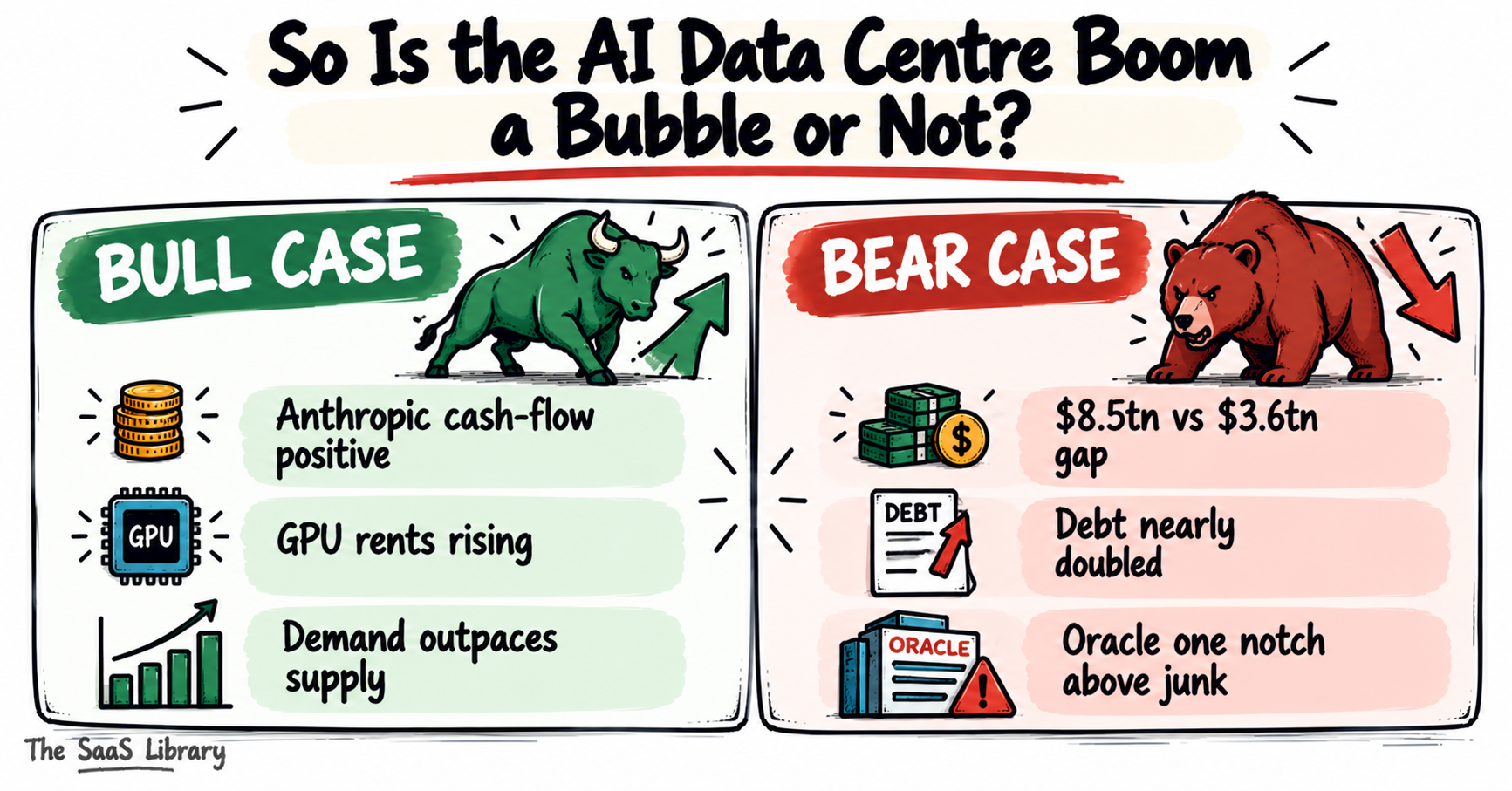
| Bull Case | Bear Case |
|---|---|
| Anthropic cash-flow positive | Gartner’s $8.5tn vs $3.6tn gap |
| GPU rents rising, not falling | AI debt nearly doubled in 2026 |
| Demand outpaces supply by 12GW | Oracle one notch above junk |
A reader asking “should I worry about AI?” and a reader asking “should I worry about data center debt?” are asking two different questions — and the evidence here supports two different answers: cautious optimism for the first, real and escalating caution for the second.
Frequently Asked Questions
Is the AI data center bubble a bubble?
Partly — and in a specific place. AI demand is real: Jefferies found a 12-gigawatt gap between data center demand and delivered capacity in 2025 alone, and GPU rental prices rose through 2026 rather than fell. The financing built on top of that demand is the actual bubble risk — Gartner forecasts the industry needs $8.5 trillion in revenue through 2030 but will earn no more than $3.6 trillion.
Why are investors worried about AI data center debt?
Investors are worried because the debt has grown very fast and the market has started pricing in real risk. AI-related global debt issuance was forecast to nearly double to $570 billion in 2026, roughly four times the prior year’s pace. By mid-October 2026, CoreWeave’s credit default swap spread tripled in about a week to a record 1,194.5 basis points, and about $18 billion of Oracle’s Project Jupiter loans were trading at 89–91 cents on the dollar.
Can the AI data center boom pay for itself?
Not in aggregate, on current numbers. Gartner’s own calculation is that AI data center owners need $8.5 trillion in cumulative revenue through 2030 to cover spending, financing costs, and a 12% return — against a forecast of no more than $3.6 trillion. Individual companies can beat that trend: Anthropic reported $16.8 billion in Q3 2026 revenue and turned cash-flow positive, generating $1.70 in revenue for every dollar spent on compute.
Will AI data centers cause a financial crash?
No confirmed trigger has fired as of October 2026. Three realistic triggers exist — Oracle falling into junk-rated debt, a major concentrated customer stumbling, or grid power delays repeating at scale — but none has happened yet. What has happened is a sharp repricing of risk in credit markets, a measurable warning sign rather than a confirmed crash.
Who is funding AI data centers?
AI data centers are being funded by a mix of four sources: hyperscaler operating cash flow (still the largest share), investment-grade corporate bonds, equity raises, and project-level or private credit secured against individual data centers or customer contracts. The share coming from debt has risen from about 9% of hyperscaler capex in 2024 to roughly a third by 2027, according to Goldman Sachs.
What happens to data centers if the AI bubble bursts?
If the AI bubble bursts, the buildings, land, and grid connections likely retain value, while the GPUs inside largely don’t. Dark fibre from the dotcom-era telecom bust became the backbone of the modern internet two decades later, and data center buildings and power connections are likely to follow the same pattern. GPUs are different: unlike fibre-optic cable, chips lose commercial value with each new Nvidia generation, so a stranded fleet may not get the same multi-decade second life.
What is a neocloud?
A neocloud is a specialist company that rents out GPU computing capacity for AI training and inference, rather than building its own AI products — examples include CoreWeave, Nebius, Nscale, and Firmus. Unlike hyperscalers such as Microsoft or Amazon, neoclouds usually have no other diversified revenue to fall back on. Gartner expects more than 80% of neoclouds to stop operating independently by 2030.
What is a credit default swap, and why does it matter here?
A credit default swap works like an insurance premium on a company’s debt — its price rises when the market believes there’s a greater chance that debt won’t be repaid. CoreWeave’s five-year CDS spread tripling in roughly a week in October 2026 meant the market’s own pricing shifted from treating a default as unlikely to treating it as a real possibility worth insuring heavily against.
Why did Microsoft pull out of Nscale’s Loughton data center?
Microsoft pulled out because national grid officials told Nscale the Essex site wouldn’t get a power supply until the 2030s. Microsoft terminated its agreement for the site in October 2026, just weeks after Nscale’s IPO filing showed Microsoft and Anthropic together account for 85.5% of its entire $103.4 billion contract book.
Is GPU rental actually getting cheaper?
No, not currently. A commonly repeated claim that H100 rental prices crashed from $8 to $1 an hour doesn’t match the data: one-year H100 contract pricing rose almost 40% between October 2025 and March 2026, from $1.70 to $2.35 per GPU-hour, as available capacity sold out.
Could India’s data center boom be at risk too?
Yes, in the same structural way as elsewhere, but more pronounced. CBRE recorded $173 billion in cumulative data center investment commitments in India since 2021, including $38 billion in the first half of 2026 alone, against only about 1.75 gigawatts of capacity actually operational by that point.
What should I watch to know if this is getting worse?
Five dated signals are worth watching: the hyperscalers’ next earnings calls (expected late October 2026), whether Anthropic’s and Nscale’s IPOs price well or get repriced sharply, any further Oracle credit rating action, whether GPU rental prices keep rising or start falling, and whether AI debt issuance rebounds or keeps shrinking.
Conclusion
The Crack Map isn’t a prediction of collapse — it’s a record of where AI data center bubble pressure is measurably visible today: the revenue gap, the debt layer, the weak builders, the power bottleneck, and the spillover to SaaS vendors, pensions, and ordinary people.
Demand for AI compute is real and currently outpaces supply. The financing built to meet that demand has grown faster than the revenue available to support it, and that gap is now showing up in dated, measurable ways — not evenly across the industry, but concentrated in the companies and structures least able to absorb it.
For a closer look at the environmental side of this same boom, read our companion piece on the data center environmental impact.
- Gartner — AI Infrastructure Impairment Warning, 14 Oct 2026
- Reuters, via The Star — Microsoft/Nscale, 18 Oct 2026
- IBTimes Singapore — Loughton GPU Count, Oct 2026
- Tribune India/ANI — Jefferies Capacity Gap, Jun 2026
- Mobile World Live — Spending Spree, 2026
- Nasdaq, citing Reuters — Alphabet Capex, Jul 2026
- Platformonomics — Q2 2026 Capex Scoreboard
- Beancount — Microsoft FY2026 Earnings
- ROIC.ai, citing Goldman Sachs — AI Capex 2027, 25 Sep 2026
- AI2.work — Capex Math, 2026
- Reuters, via Devdiscourse — Anthropic Q3 Revenue, 15 Oct 2026
- io-fund.com — Nebius vs CoreWeave, 2026
- Akash Network, citing SemiAnalysis — H100 Pricing, 2026
- European Central Bank — AI Boom Research Blog, 17 Aug 2026
- European Central Bank — Stress-Test Modelling, May 2026
- ProgressiveRobot — Nscale S-1 Analysis, Sep 2026
- The AI Insider — Nscale IPO, 23 Sep 2026
- Reuters, via ARY News — CDS Spike, 15 Oct 2026
- ROIC.ai — CoreWeave Shares, 15 Oct 2026
- BusinessDay, citing Reuters — Credit Fears, 15 Oct 2026
- The Asset, citing BIS — Annual Economic Report 2026
- Mezha.net, citing Reuters — Oracle Near Junk, 4 Aug 2026
- Traeai.com — S&P Oracle Rating Summary, 2026
- New Straits Times — Firmus IPO Withdrawn, 9 Oct 2026
- TechFinitive — Dark Fibre Precedent, 2026
- TechRadar Pro — Subprime Data Center Crisis, 2026
- Alternative Credit Investor — Private Credit Exposure, 21 Nov 2025
- PE Insights — CalPERS, 2 Mar 2026
- Computing.co.uk — MIT GenAI Report, 2025
- NBER — Firm Data on AI, Working Paper 34836
- CBS News — Electricity Bills, 2026
- Consumer Reports — Affordability Crisis, 2026
- CBRE — India Data Centre Market Monitor H1 2026
- CxOToday, citing Rubix Data Sciences — India Capacity, 2026