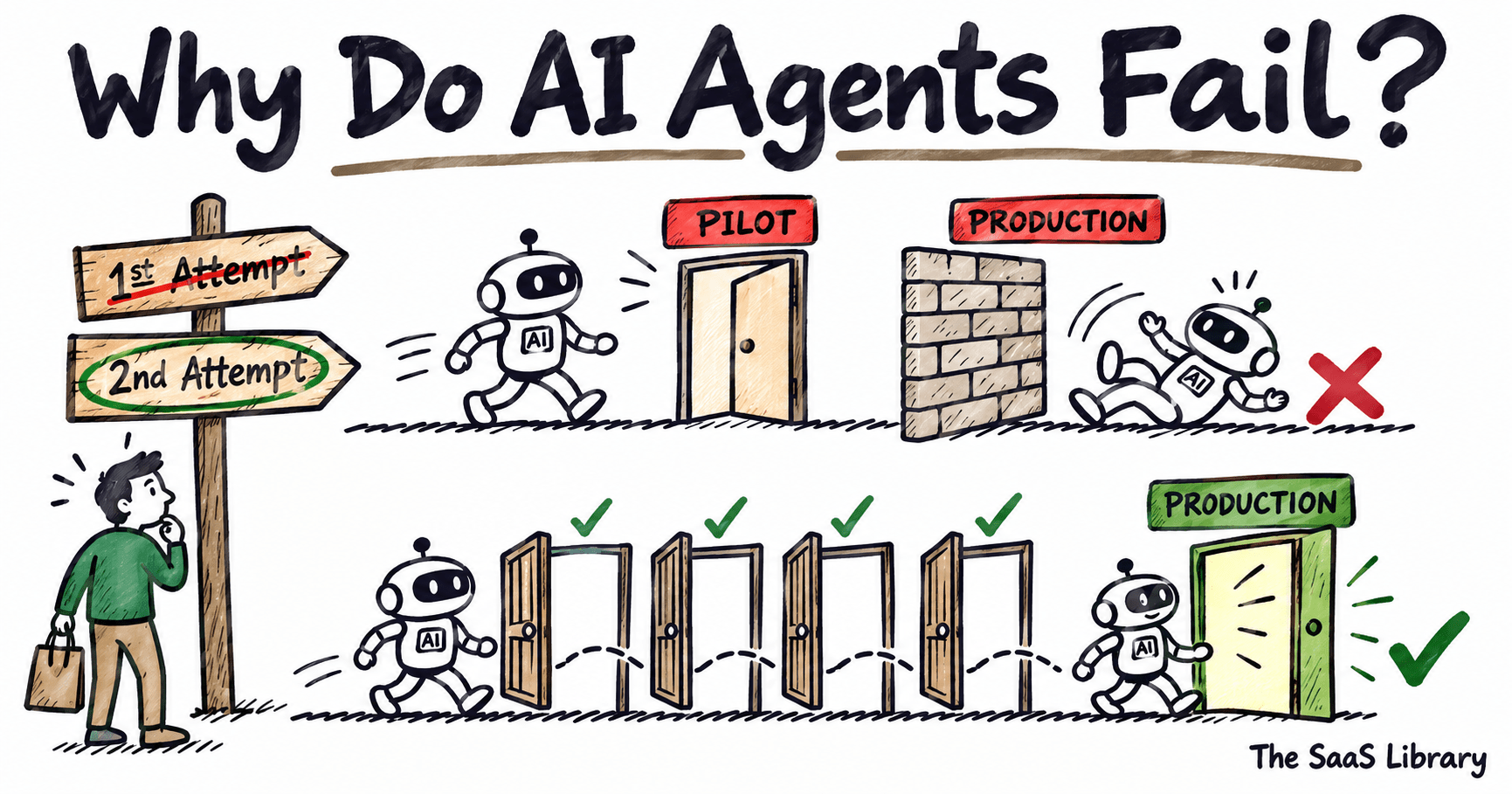
A large share of companies arriving at AI development agencies to buy AI have already tried and failed once. The data says it plainly: adoption is outrunning retention, and nobody’s talking about it.
AI agents fail more often than most buyers expect, and it’s usually organizational, not just technical. In 2025, roughly 88% of AI proofs-of-concept did not reach production; newer IDC/Lenovo data puts the 2026 figure at 46% reaching production. Meanwhile, 65.9% of buyers arriving at AI development agencies are already on their second or third attempt. This piece walks through why, using data from Gartner, IDC, McKinsey, and ChartMogul.
What Percentage of AI Buyers Are on Their Second Attempt?
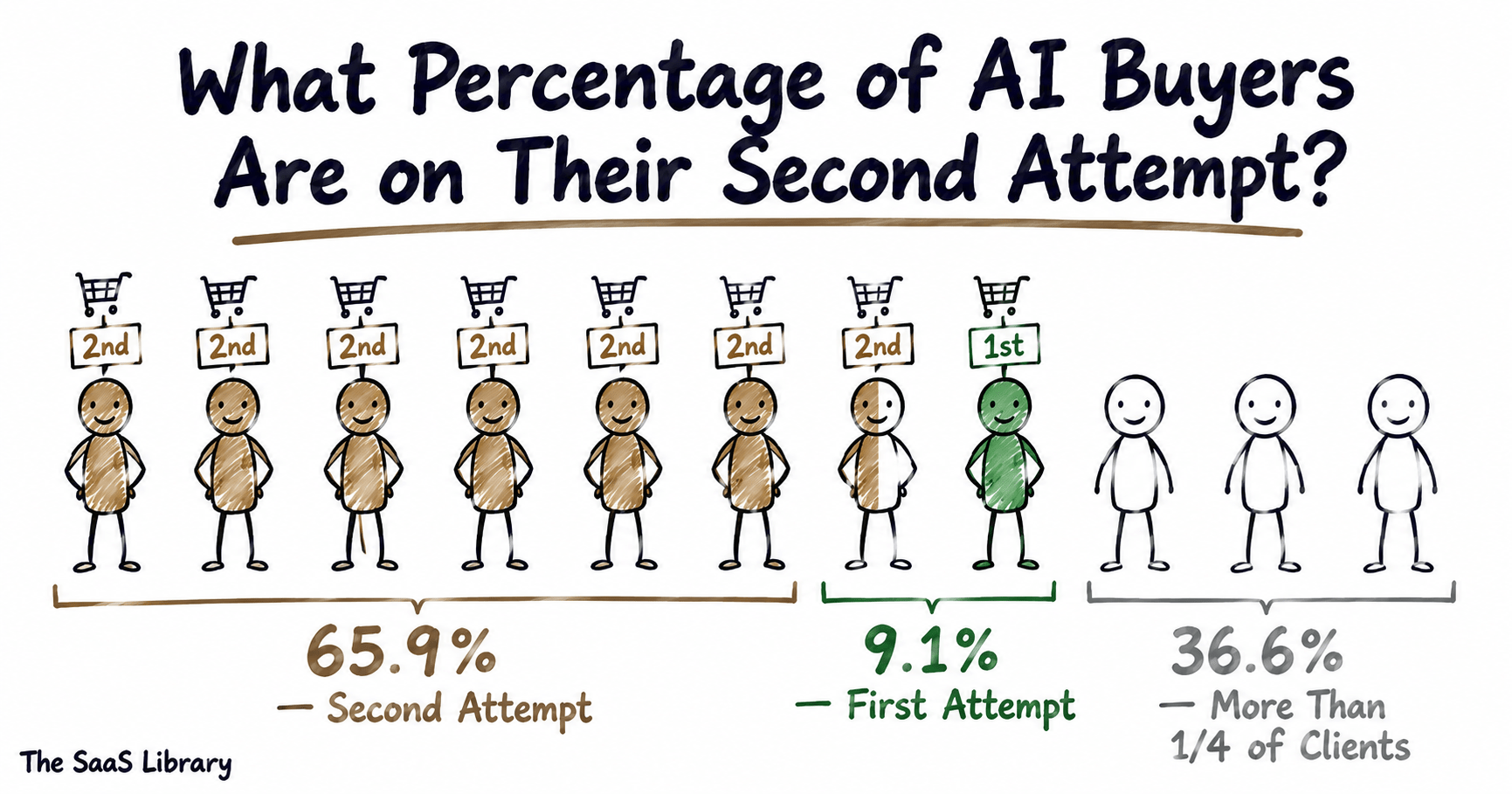
65.9% of buyers arriving at AI development agencies had already tried and abandoned a prior AI solution, internal build, vendor, or development partner, according to GoodFirms’ 2026 survey. Only 9.1% of that same agency-referred population were making a first-time AI investment.
65.9% of buyers arriving at AI development agencies are already on their second attempt. That’s the finding from GoodFirms’ 2026 survey of AI development agencies — a specific, agency-referred population, not a claim about every AI buyer globally — and it still complicates the “AI adoption boom” narrative most coverage repeats.
Here’s what that split actually looks like:
- 9.1% are making their first AI investment
- 65.9% have already tried and abandoned at least one prior attempt — an off-the-shelf tool, an internal build, or a different development partner
- 36.6% of agencies say more than a quarter of their entire client base arrived this way — through a failed prior project, not a fresh idea
So what does this mean for you?
If you’re evaluating an AI agent right now, you’re not early to this market. You’re standing in a room mostly full of people on their second try.
That raises an obvious question: if this many companies are trying twice, how many are actually succeeding the first time?
How Many AI Agent Pilots Actually Reach Production?
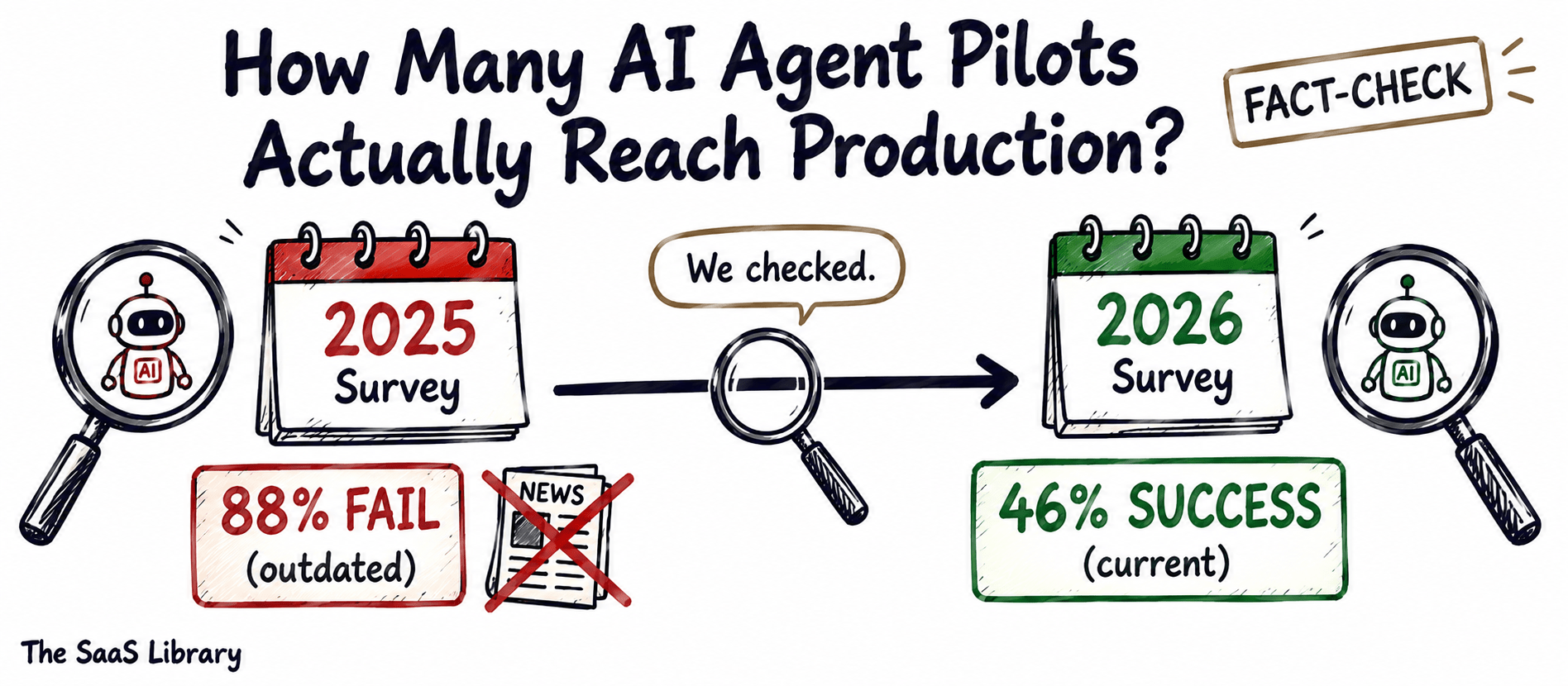
46% of AI proofs-of-concept reached production in IDC/Lenovo’s 2026 CIO Playbook, up sharply from roughly 10% a year earlier. The widely cited 88% failure figure comes from the 2025 edition and should be treated as a historical benchmark, not the current rate.
The chronology here matters more than any single number.
2025 (historical): IDC/Lenovo’s original research found just 4 of every 33 AI proofs-of-concept reached production — approximately 12%. That means roughly 88% did not reach production that year. Gartner separately projects over 40% of agentic AI projects will be canceled by the end of 2027.
2026 (current): IDC/Lenovo’s newer CIO Playbook found 46% of AI proofs-of-concept had progressed into production — a major improvement in a single year. The 88% figure should not be read as the current 2026 failure rate; it describes 2025 conditions that have since changed substantially.
The Research, Side by Side
Here’s how the underlying research stacks up, firm by firm:
| Research Firm | What They Measured | Finding | Year |
|---|---|---|---|
| Gartner | Agentic AI project cancellations | 40%+ canceled by end of 2027 | 2025 |
| IDC (International Data Corporation) / Lenovo | POC-to-production conversion | ~88% of POCs never reached production | 2025 |
| MIT NANDA | Pilots delivering measurable P&L impact | 95% show no measurable P&L impact | 2025 |
These three numbers aren’t interchangeable. Gartner is measuring project cancellations. IDC is measuring whether a proof-of-concept ever ships. MIT is measuring whether a live pilot actually moves the bottom line. Different filters, same conclusion: agent projects died at almost every stage of the pipeline, not just one.
Why the Gap Exists
Why does this keep happening? Gartner’s own reasoning centers on unclear return on investment (ROI). Senior Director Analyst Anushree Verma pointed to a specific gap, not a general one:
So what’s actually causing this gap between pilot and production?
It isn’t a mystery. IDC (International Data Corporation) Group VP Ashish Nadkarni named the real bottleneck directly: “The high number of AI POCs but low conversion to production indicates the low level of organizational readiness in terms of data, processes and IT infrastructure.”
That’s worth repeating. The problem isn’t the model failing to think well enough. It’s the company failing to give the model the data, process, and infrastructure it needs to work at all.
Nearly every “why AI agents fail” article circulating right now — including several ranking on page one for this exact search — still cites IDC’s 88% failure figure as current. We checked. It isn’t anymore.
That 88% figure comes from the CIO Playbook 2025, IDC’s research conducted with Lenovo. IDC and Lenovo have since published a fourth edition — the CIO Playbook 2026, surveying 800 IT and business decision-makers between September 16 and October 17, 2025 — and the number has moved sharply: 46% of AI proofs-of-concept have now progressed into production.
IDC’s own researcher named the scale of that shift directly: “We see that almost half of proof-of-concepts transition into production. And you may think half is not that impressive. I can tell you, a year ago, it was 10%.” — Ewa Zborowska, IDC Researcher, quoted in TechFinitive, January 2026.
So which number should you actually trust — 88% failure, or 46% success?
Both were true. They’re just true a year apart. The same pipeline that failed roughly 90% of the time in the 2025 survey is now succeeding nearly half the time in the 2026 survey — a real improvement that most competing coverage hasn’t caught up to yet.
Once an agent does reach production, keeping it under control is a separate fight entirely.
See the AI Agent Governance Gap →A canceled pilot is one kind of failure. But what happens when companies don’t just cancel — they actively give up and walk away?
Why Do Enterprises Abandon AI Agent Projects Instead of Fixing Them?
Enterprises abandon AI agent projects instead of fixing them because the cost, data, and infrastructure gaps surface late — after budget and headcount are already committed — making a full walk-away cheaper than a rebuild. S&P Global Market Intelligence’s 2025 survey found 42% of enterprises abandoned most of their AI initiatives, up from 17% the year before.
Enterprises abandon AI agent projects instead of fixing them because by the time the real problems surface, starting over looks cheaper than repairing what’s already built. That’s the finding from S&P Global Market Intelligence’s 2025 survey of more than 1,000 enterprises across North America and Europe — and the jump in one year is the real story here.
Here’s the shift, year over year:
- 17% of enterprises abandoned most of their AI initiatives in 2024
- 42% abandoned most of their AI initiatives in 2025 — nearly two and a half times higher in twelve months
- 46% is the average share of AI proofs-of-concept a company scraps before reaching production, per the same survey
So why walk away instead of fixing it?
Cost is the leading reason enterprises gave, followed closely by data privacy and security concerns — not a stalled model, and not a lack of ambition.
An abandoned project isn’t a neutral reset. It’s the moment that creates a second-attempt buyer — the exact pattern from Section 1, playing out at the enterprise level, one failed pilot at a time.
The pilot-to-production numbers explain how common failure is. The abandonment jump explains why failure turns into repeat buying instead of getting fixed. But neither number says anything yet about what happens to the company’s retention and revenue once the agent is actually paid for and running.
Do AI-Native SaaS Companies Retain Customers as Well as Traditional SaaS?
No, AI-native SaaS companies retain customers far worse than traditional SaaS. ChartMogul’s analysis of 3,500 software companies found AI-native products have a median net revenue retention (NRR) of just 48%, compared to 82% for traditional B2B SaaS in the same dataset.
No, AI-native SaaS companies retain customers far worse than traditional SaaS. ChartMogul’s Analyst-in-Residence Kyle Poyar pulled retention data across roughly 2,700 B2B SaaS companies, 600 B2C SaaS companies, and 200 AI-native companies to answer exactly this question — and the gap is not close.
Here’s the comparison, straight from the same dataset:
- 48% median NRR (net revenue retention) for AI-native SaaS companies
- 82% median NRR for traditional B2B SaaS companies
- 40% median gross revenue retention (GRR) for AI-native companies — meaning the typical AI-native company is losing more than half its revenue base every year before any expansion revenue is counted
That’s not a small gap. It’s the difference between a business model that compounds and one that leaks.
The Price-Tier Breakdown
But the number that matters even more is what happens when you slice by price.
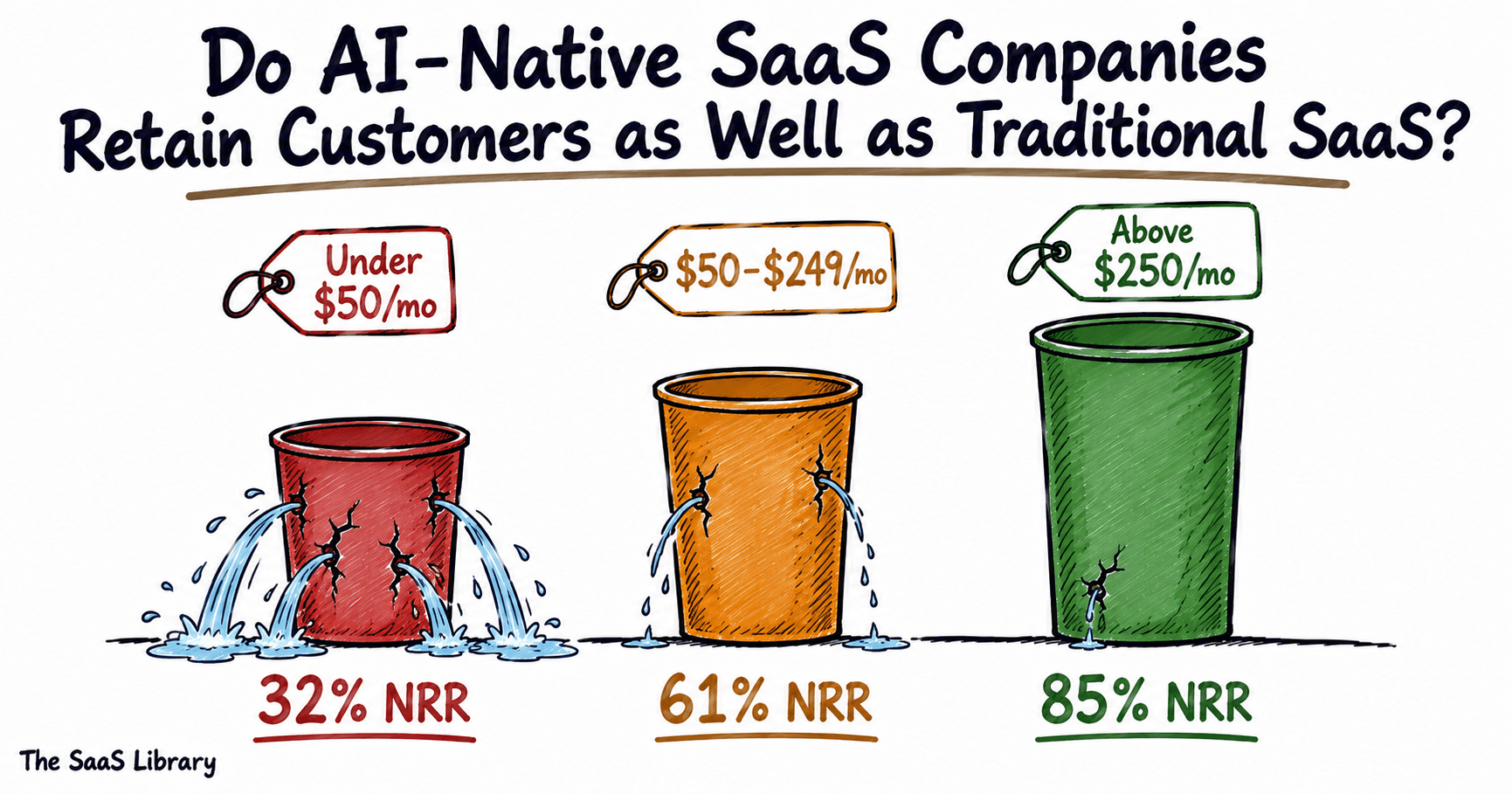
| AI-Native Price Tier | GRR | NRR |
|---|---|---|
| Under $50/month | 23% | 32% |
| $50–$249/month | 45% | 61% |
| Above $250/month | 70% | 85% |
So what does this price split actually reveal?
It shows the failure isn’t really about AI as a category — it’s concentrated almost entirely at the cheap end. AI-native products priced above $250/month retain at 85% NRR, which is essentially indistinguishable from healthy B2B SaaS. As ChartMogul’s Kyle Poyar put it, “The downside of being easy to buy is being easy to cancel.”
That’s the mechanism behind Section 1’s second-attempt number. A cheap AI tool gets bought on impulse, tried for a few weeks, and dropped the moment it doesn’t earn its place — and the person who canceled it becomes exactly the kind of buyer GoodFirms found evaluating a second tool six months later.
There’s a recovery signal worth naming too: AI-native median GRR climbed from 27% in January 2025 to 40% by September 2025, as the earliest wave of curious, low-commitment users churned out and left behind a smaller group actually using the product for real work.
The retention data proves the second-attempt pattern is real and measurable, not anecdotal. But knowing the size of the problem doesn’t yet explain the mechanism — why does a well-funded, well-staffed AI agent project still fail once it reaches deployment?
Why Do AI Agents Fail — Is It the Model or the Organization?
Most enterprise AI-agent failures aren’t caused by model capability alone. They happen when ROI, data readiness, ownership, or scope aren’t properly controlled — the exact root causes Gartner, IDC, and S&P Global each independently identified.
Most enterprise AI-agent failures aren’t caused by model capability alone. AI-agent failures are usually organizational as much as technical: every root cause named across Gartner, IDC, and S&P Global’s research — data readiness, integration complexity, governance gaps, unclear ownership — points primarily at the company, and none of them named the model as the primary cause.
Look at what each firm actually blamed:
- Gartner: escalating costs, unclear business value, inadequate risk controls
- IDC: low organizational readiness across data, process, and IT infrastructure
- S&P Global: cost, data privacy, and security risk — not model performance
Three separate studies, three separate methodologies, zero mentions of “the model wasn’t smart enough.”
So does that mean agents never fail at a technical level once they’re actually running?
No — but even those failures trace back to organizational choices, not model limits. OWASP (Open Worldwide Application Security Project)’s Top 10 for LLM Applications names this pattern directly as “Excessive Agency,” and breaks it into three causes a company controls before an agent ever runs a single task:
| Cause | What It Means |
|---|---|
| Excessive functionality | The agent has access to tools it doesn’t need for its job |
| Excessive permissions | The agent can modify or delete data it should only read |
| Excessive autonomy | The agent executes irreversible actions with no human checkpoint |
None of those three are model problems. They’re scoping decisions — made by a person, before deployment, about what the agent is allowed to touch.
Early academic testing found a real capability gap too: a 2024 benchmark called WebArena found the best GPT-4-based agent completed only 14.41% of web tasks end-to-end, against 78.24% for a human doing the same tasks. That gap has narrowed substantially since — newer agent harnesses have pushed the same benchmark above 70% — but the original finding still matters for one reason: the researchers traced the failure to a lack of active exploration and failure recovery, not raw intelligence.
The organizations succeeding with AI agents aren’t the ones with access to a smarter model. They’re the ones that scoped functionality, permissions, and autonomy before deployment — the exact three gaps OWASP names.
That distinction matters for a reason most coverage skips entirely: a failed pilot isn’t free. It costs real money, real time, and real trust — and almost nobody quantifies exactly what gets lost.
What Does a Failed AI Agent Project Actually Cost a Company?
A failed AI agent project costs a company between $5 million and $20 million in direct deployment spend alone, according to Gartner. That figure doesn’t include the engineering time already spent, the governance work rebuilt after a production incident, or the inference costs that keep climbing even after an agent launches successfully.
A failed AI agent project costs a company between $5 million and $20 million in direct deployment spend alone. That’s Gartner’s own estimate for organization-wide generative AI initiatives — and it’s just the starting number, not the full bill.
Where the Real Cost Compounds
Here’s where the real cost compounds, in three places most companies don’t budget for:
- Rising inference costs after launch. Gartner forecasts that inference costs per agentic workflow will increase more than fivefold through 2028, even as raw token prices keep falling — what Gartner analyst Will Sommer calls the “Inference Paradox.”
- Governance rebuilt after the fact, not before. Gartner separately predicts that 40% of enterprises will demote or decommission their autonomous agents by 2027 — not because the agent failed a demo, but because of governance gaps that only surfaced after a production incident.
- Abandoned proof-of-concept spend. From Section 3, the average enterprise scraps 46% of its AI proofs-of-concept before they ever reach production — money and engineering time spent on something that never shipped.
That “Inference Paradox” phrase deserves a closer look:
Why This Keeps Happening
So why does this keep catching companies off guard?
Because the failure mode isn’t a single bad decision — it’s a pattern. Gartner Senior Director Analyst Shiva Varma named the root cause plainly, in the context of the governance-driven shutdowns: “Enterprises are treating AI agent governance as binary, either locked down or fully trusted, and that is the root cause of failure.”
That single sentence explains why the cost of failure keeps compounding after the fact. A company that treats governance as all-or-nothing doesn’t find the gap during the pilot — it finds it during a live incident, months after the money’s already spent.
This is precisely why catching the warning signs early matters more than fixing them after the fact.
So far, this piece has covered how common AI agent failure is and what it costs. What’s left is the harder part: catching it early, and knowing what actually separates the agents that survive from the ones that don’t.
How Do You Know Your AI Agent Pilot Is Heading Toward Failure?
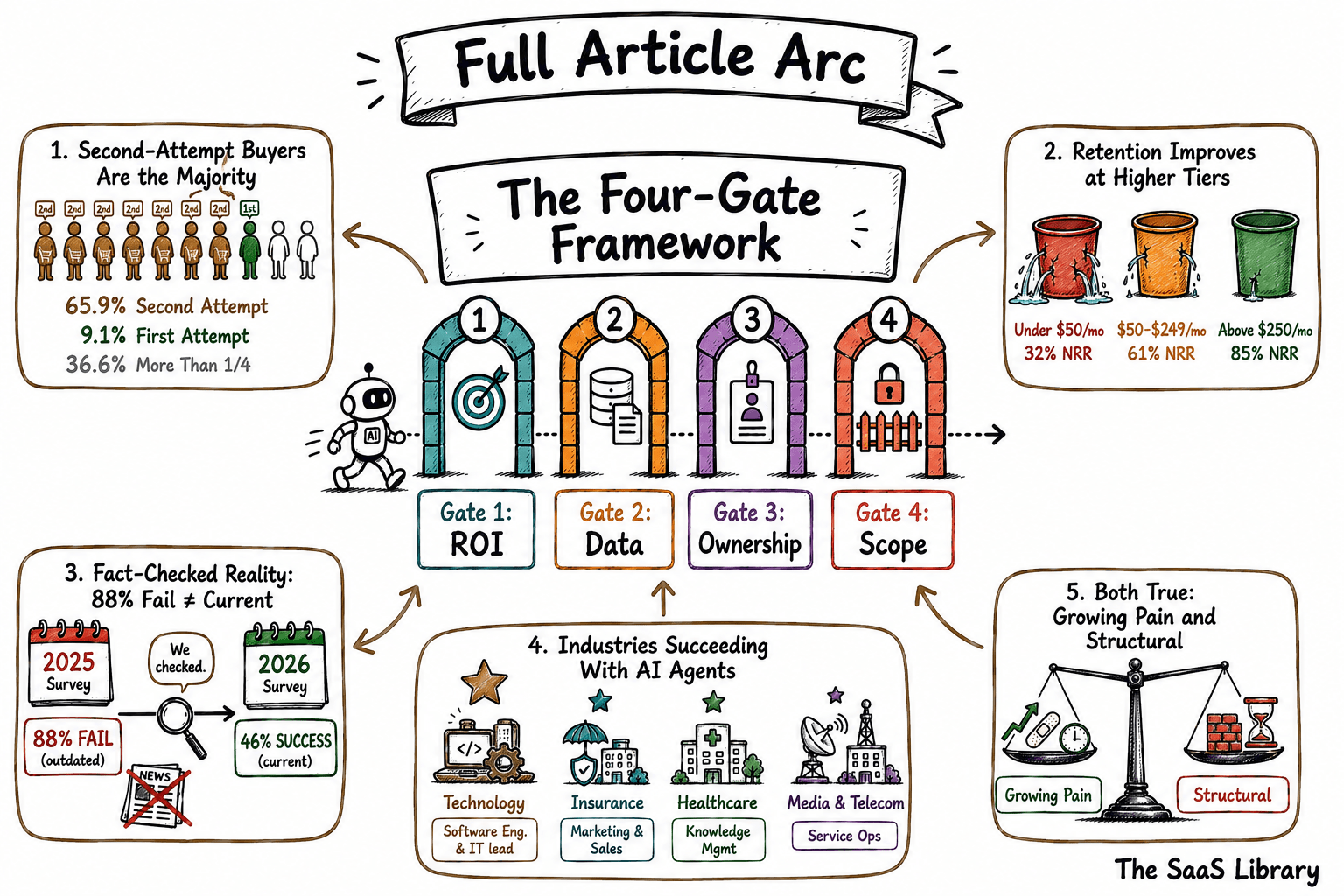
You know your AI agent pilot is heading toward failure when it’s missing any of four gates before launch: ROI, Data, Ownership, or Scope. Every root cause named in this piece so far traces back to one of these four gaps — together, they form the Four-Gate Framework.
You know your AI agent pilot is heading toward failure when it’s missing any of four specific gates — and all four are checkable before you spend a single dollar on deployment.
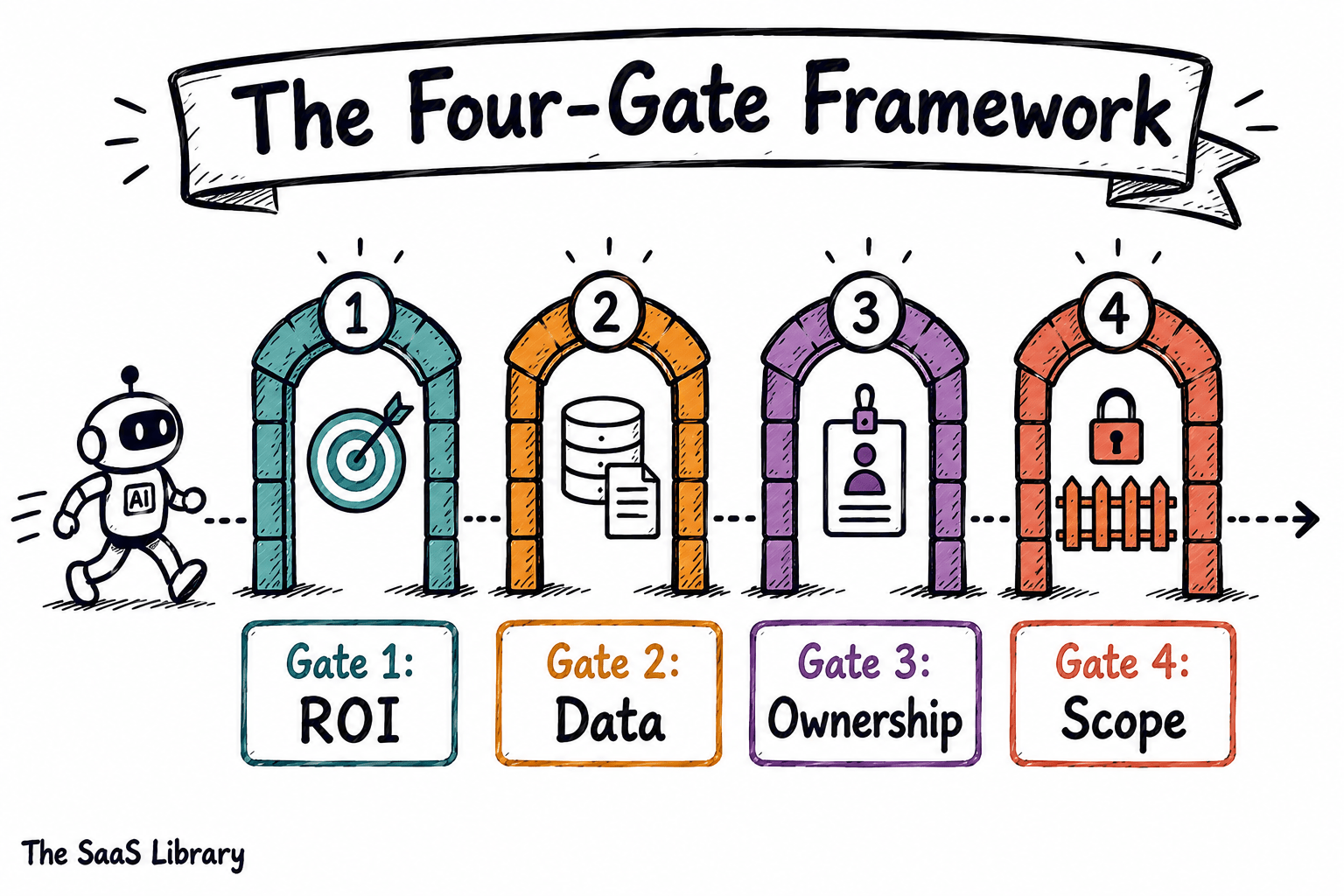
Applying the Four-Gate Framework to your own pilot takes minutes, not weeks — and it catches the exact gaps that turned into the failure statistics covered earlier in this piece.
So which gate is the earliest warning sign to catch?
The Scope Gate, by a wide margin. It’s the one that erodes gradually, during the pilot itself, while the other three are usually decided — or skipped — before the project even starts.
If your pilot has already expanded past its original scope and nobody flagged it, that’s not a minor deviation. It’s the exact pattern Gartner traces to governance failures discovered only after a production incident — not before one.
The Four-Gate Framework works whether you’re piloting your first agent or your third. But if you’ve already lived through a failed attempt, the fix isn’t running this same checklist again — it’s asking a different question entirely.
Which Industries Are Succeeding With AI Agents in Production?
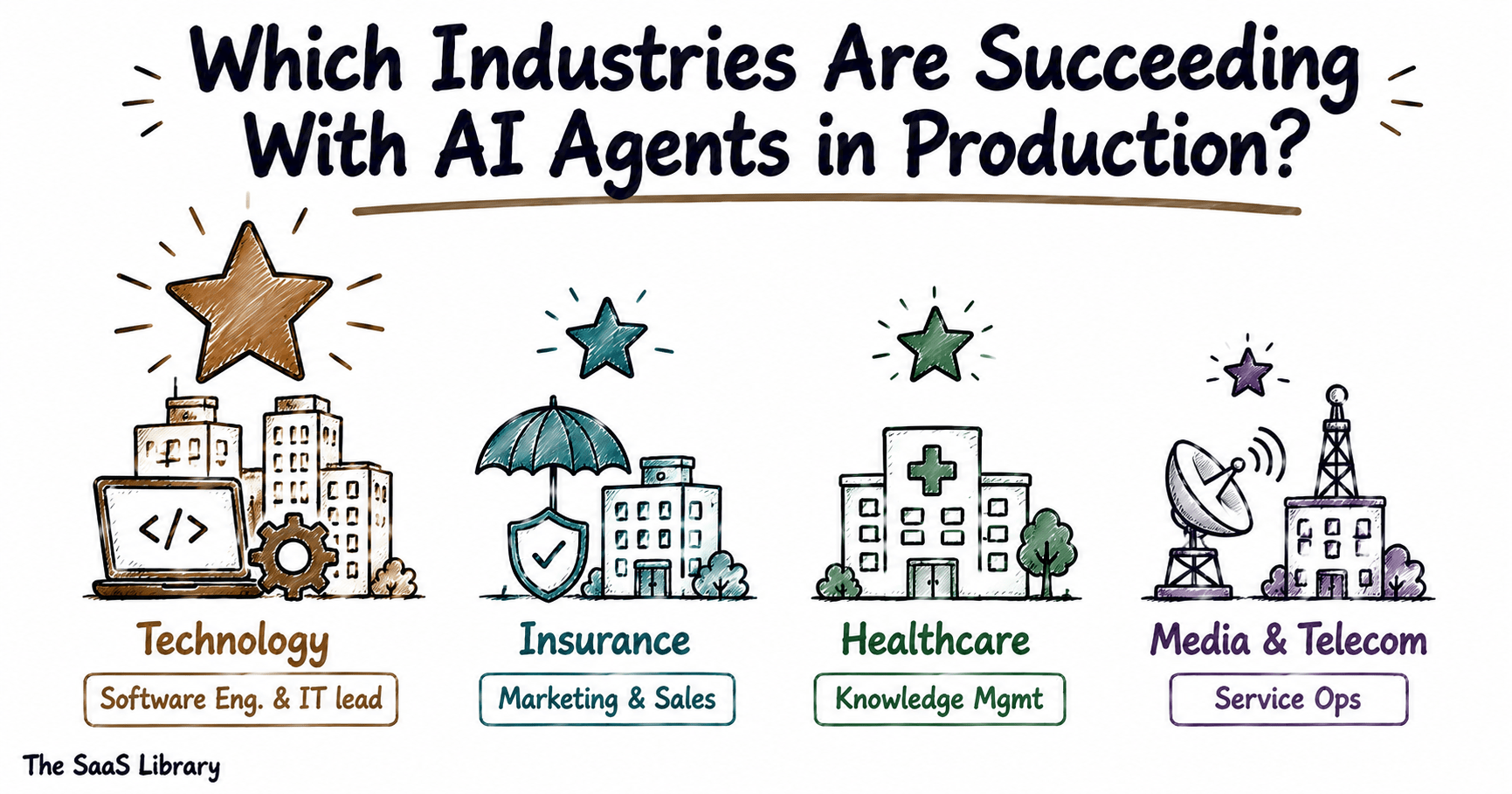
Technology-sector functions are succeeding with AI agents in production more than any other industry, with software engineering and IT reporting the highest scaled agent use. That’s according to McKinsey’s November 2025 survey of 1,993 respondents across 105 countries.
Technology-sector functions are succeeding with AI agents in production more than any other industry. McKinsey’s survey found software engineering and IT reporting the highest levels of scaled agent use of any function measured, in any sector.
But the pattern isn’t uniform across every function within an industry. Different sectors are actually leading in different specific use cases:
- Technology: software engineering and IT lead in scaled agent use overall
- Insurance: leads specifically in agents used for marketing and sales
- Healthcare: shows strong uptake in knowledge management and IT, despite lagging elsewhere
- Media and telecom: reports notable scaled use in service operations
So does that mean most companies are actually succeeding?
No — the overall picture is far more sobering than any single sector’s win column suggests. Almost 90% of companies have deployed AI in at least one business function, according to McKinsey. But only 39% report any enterprise-level EBIT (Earnings Before Interest and Taxes) impact, and just 7% say AI has been fully scaled across their organization.
88% of organizations use AI somewhere in the business. Only 7% have scaled it across the whole organization. That gap is the entire story of this piece, playing out at the industry level.
That gap between “using it somewhere” and “scaled everywhere” is exactly why Section 5’s finding — that failures are usually organizational as much as technical — holds up at the industry level too. Technology companies aren’t succeeding because they have access to a better model than insurance or healthcare. They’re succeeding because software engineering and IT are functions built around structured, well-defined processes an agent can actually be scoped against.
That’s the same lesson from a different angle — which raises the natural next question: what exactly are the companies that succeed doing differently, step by step?
What Do Companies That Succeed With AI Agents Do Differently?
Companies that succeed with AI agents scope every deployment narrowly, govern it before launch, and buy from a specialized vendor rather than building in-house. MIT NANDA’s research found vendor and partnership approaches succeed roughly 67% of the time, versus about a third as often for internal builds.
Companies that succeed with AI agents scope every deployment narrowly, govern it before launch, and buy from a specialized vendor rather than building in-house. That’s not a preference — it’s a measurable pattern, and each part of it traces back to a gap already named in this piece.
The Success Pattern
Here’s what the successful pattern actually looks like, point by point:
- Narrow scope, not broad ambition. Gartner’s 2026 Hype Cycle for Agentic AI found that most current deployments remain narrowly scoped by design, and that fully autonomous agents aren’t ready for the majority of enterprise use cases yet.
- Governance before launch, not after an incident. This directly reverses Section 6’s failure pattern — governance built in from day one instead of rebuilt after a production incident forces the question.
- Buy or partner, don’t build alone. MIT NANDA found purchasing from specialized vendors and building partnerships succeeded roughly 67% of the time, while internal builds succeeded only about a third as often.
So why does narrow scope specifically make such a difference?
Because a narrowly scoped agent is one an organization can actually govern. Gartner’s own guidance is direct on this point — the firm recommends starting with well-defined, high-volume tasks where execution is scoped, validated, and audited by default, before ever expanding further.
Every failure pattern in this piece — unclear ROI, missing data readiness, no accountable owner, scope creep — has the same fix: narrow the scope until it’s small enough to actually govern, then expand only once it’s proven stable. That’s the Four-Gate Framework, working in the opposite direction from Gartner’s 40% cancellation statistic.
If you’re evaluating your first AI agent, that pattern is your starting checklist. But if you’ve already lived through a failed attempt, the checklist looks different — because the mistake you’re protecting against isn’t the same one.
What Should You Do Before Piloting Your First AI Agent?
Before piloting your first AI agent, define a specific ROI metric, run a data-readiness audit, name one accountable owner, and lock the scope to a single well-defined task. Every one of these four steps directly counters a failure cause named earlier in this piece.
Before piloting your first AI agent, four things need to happen in order — and none of them involve picking a model.
Here’s the checklist, in the order it should actually happen:
- Define the ROI metric first. Name the specific number the agent needs to move, before writing a single prompt. Gartner named “unclear business value” as one of three drivers behind its 40%+ cancellation forecast — this step exists to remove that ambiguity entirely.
- Run a data-readiness audit. Confirm the data, process, and IT infrastructure the agent needs actually exists and is accessible. IDC traced the original 88% POC failure rate directly to organizations skipping this step.
- Name one accountable owner. Decide, in writing, who owns the agent’s outcomes and who has authority to shut it down. Gartner’s Shiva Varma linked ungoverned agents directly to shutdowns discovered only after a production incident.
- Lock the scope to one task. Pick the single most well-defined, high-volume task available, not the most ambitious one. Gartner’s own 2026 guidance recommends exactly this: starting with a task where execution can be scoped, validated, and audited by default.
So which of these four steps should happen before the other three?
The ROI metric, without question. Every other step depends on knowing what “success” actually means — a data audit, an owner, and a scope all need a target to be judged against.
How to Pick Your First AI Agent Workflow walks through exactly how to choose that single, well-scoped starting task once you’ve defined the metric. If you’re ready to go from choosing a workflow to actually shipping it, How to Build an AI Agent Step by Step covers the build itself.
That four-step checklist assumes you haven’t been through this before. But if your last AI agent already failed, running this same checklist again misses the actual problem.
You’re Already a Second-Attempt Buyer — What Should You Do Differently This Time?
If you’re already a second-attempt buyer, you should audit exactly why the first attempt failed before evaluating a new tool. Section 1 showed 65.9% of agency-referred AI buyers are in this exact position — the mistake most of them make next is repeating the same buying process with a different vendor.
If you’re already a second-attempt buyer, you should audit exactly why the first attempt failed before evaluating a new tool. That’s the step most people skip, and it’s the difference between fixing the actual problem and just switching logos.
Here’s the audit, matched directly to the Four-Gate Framework already covered in this piece:
- Was there ever a defined ROI metric? If nobody could say what success looked like the first time, a new vendor won’t fix that — the ROI Gate still applies, retroactively.
- Was the data actually ready? IDC’s research says most POC failures trace to data, process, and infrastructure gaps, not the tool itself. A new agent running on the same unready data will fail the Data Gate the same way.
- Was there one accountable owner? If the first attempt had no single owner, that’s a governance gap, not a vendor gap — switching tools without closing the Ownership Gate just delays the same shutdown.
- Did the scope stay locked, or did it creep? OWASP’s “Excessive Agency” pattern from Section 5 is the single most common way the Scope Gate fails.
So what’s actually different about a second attempt done right?
The tool almost never needs to change. What needs to change is which gate got skipped the first time — because that’s the one thing a new vendor can’t fix for you.
A failed first attempt isn’t proof that AI agents don’t work for your business. It’s data. Section 4 showed AI-native tools above $250/month retain at 85% NRR — nearly identical to healthy B2B SaaS. The products that survive are more likely to have the conditions the Four-Gate Framework is designed to test: clear value, ready data, accountable ownership, and controlled scope.
If the honest answer is “the tool itself genuinely wasn’t capable enough,” AI Agents in SaaS: 8 Use Cases You Can Deploy Right Now is a useful next stop for matching capability to task before committing again.
That audit tells you what went wrong. It doesn’t yet answer the bigger question hanging over this entire piece: is agent failure a temporary growing pain, or something structural that isn’t going away?
Is This a Temporary Growing Pain, or a Structural Problem With AI Agents?
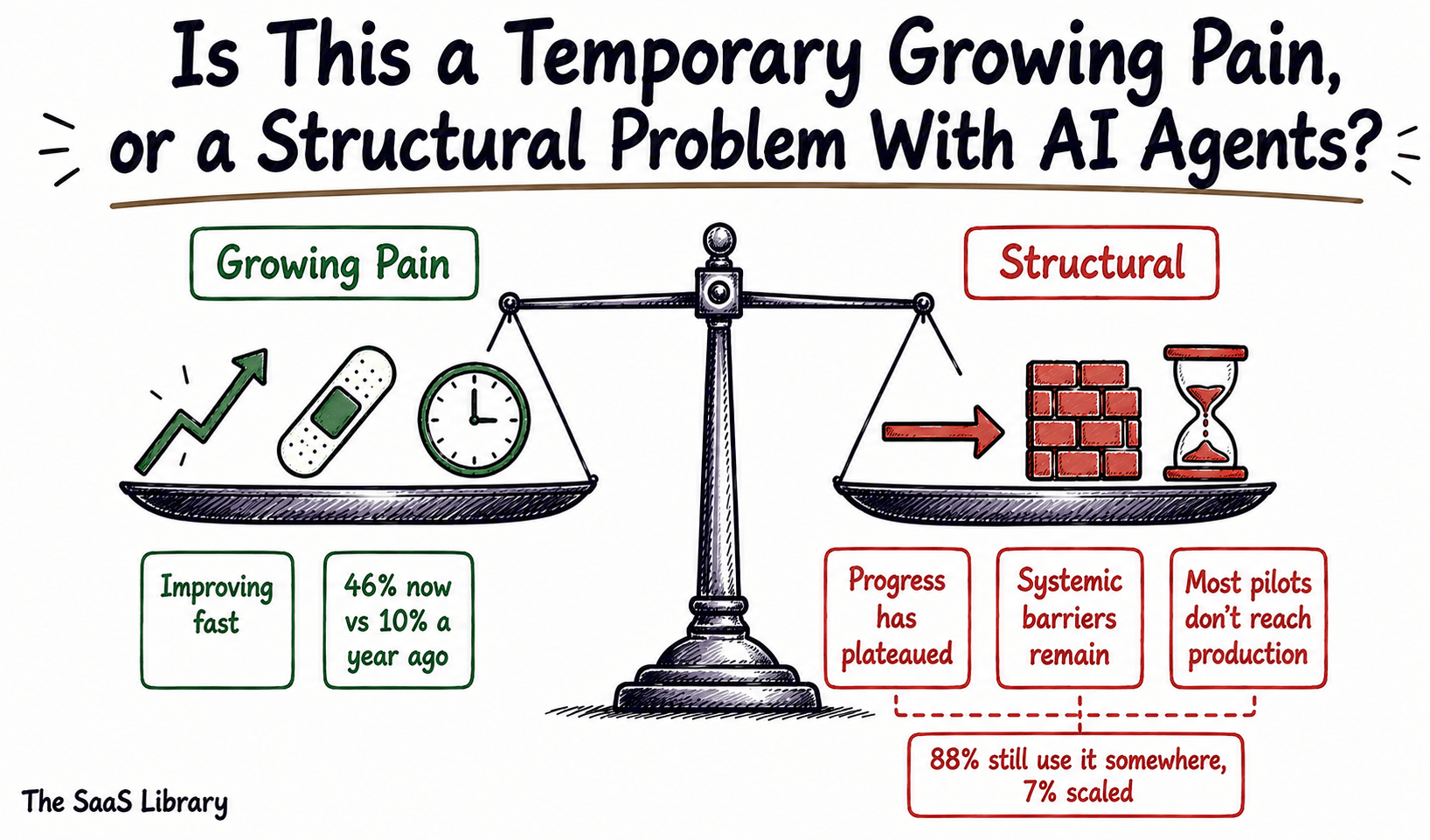
The evidence supports both interpretations: AI-agent failure is partly a temporary growing pain as the technology matures, but some failure patterns remain structural because organizational readiness, governance, data, and scaling problems persist.
The evidence supports both a growing-pain interpretation and a structural-problem interpretation. The technology is clearly improving, but organizational and deployment problems remain.
The case for “growing pain”:
- Gartner’s own 2026 Hype Cycle places agentic AI at the “Peak of Inflated Expectations” — a named stage in a well-established pattern every major technology has passed through before maturing, not a dead end.
- ChartMogul’s data from Section 4 already shows recovery in progress: AI-native median GRR climbed from 27% in January 2025 to 40% by September 2025, as low-commitment “tourist” users churned out and left a more durable customer base behind.
- IDC’s own tracking of pilot-to-production conversion already shows the improvement in progress — from roughly 10% success a year ago to 46% now, per its newest CIO Playbook.
The case for “structural”:
- Almost 90% of companies have deployed AI in some form, per McKinsey’s Section 8 data — yet only 7% report it fully scaled across the organization. That gap hasn’t closed with time; it’s what the entire market looks like right now.
- 65.9% of agency-referred AI buyers are already repeat buyers, per Section 1. If the problem were purely early-technology teething trouble, that number should be shrinking as the technology matures — not sitting at nearly two-thirds of the market.
So which read actually wins?
Neither one, cleanly — and that’s the honest answer. The technology-maturity case explains why the raw capability gap is closing. The adoption-data case explains why closing that gap hasn’t yet translated into most companies succeeding. Both are true at the same time, because they’re answering different questions: one is about what the model can do, the other is about what the organization does with it.
That’s exactly the distinction Section 5 already drew — and it’s the one piece of this puzzle that doesn’t shift no matter how much the models improve.
Frequently Asked Questions
Why do AI agents fail?
AI agents fail primarily because of organizational gaps — unclear ROI, unready data, no accountable owner, and scope creep — not because of model capability, according to research from Gartner, IDC, and S&P Global.
What percentage of AI agent pilots fail?
Roughly 46% of AI proofs-of-concept now reach production, per IDC’s newest 2026 research with Lenovo — a sharp improvement from the 88% failure rate reported in IDC’s prior-year edition of the same survey. Gartner separately projects over 40% of agentic AI projects will be canceled by 2027, since it measures a different stage of the pipeline.
What is NRR and why does it matter for AI companies?
NRR is Net Revenue Retention, the share of recurring revenue a company keeps and grows from existing customers. It matters for AI companies because AI-native SaaS shows a median NRR of just 48%, compared to 82% for traditional B2B SaaS.
Is it normal for a company’s first AI agent project to fail?
Yes, it is common for a company’s first AI agent project to fail — 65.9% of buyers surveyed by GoodFirms had already attempted AI before, according to GoodFirms’ 2026 survey of AI development agencies.
Which industries have the highest AI agent success rate?
Technology-sector functions, specifically software engineering and IT, report the highest scaled AI agent use of any industry, according to McKinsey’s November 2025 survey of 1,993 respondents.
What causes most AI agent projects to fail?
Most AI agent projects fail due to escalating costs, unclear business value, inadequate risk controls, and poor data readiness — root causes named consistently by Gartner, IDC, and S&P Global across separate studies.
How much does a failed AI agent project cost?
A failed AI agent project can cost between $5 million and $20 million in direct deployment spend alone, according to Gartner, before counting ongoing inference costs and abandoned engineering time.
Should I buy an AI agent from a vendor or build one internally?
Buying from a specialized vendor or building a partnership succeeds more often than building internally — MIT NANDA found vendor and partnership approaches succeed roughly 67% of the time, versus about a third as often for internal builds.
What is the OWASP Excessive Agency risk in AI agents?
OWASP’s Excessive Agency risk describes an AI agent with more functionality, permissions, or autonomy than its task requires, making it more likely to take unintended or irreversible actions.
How do I know if my AI agent pilot is failing?
An AI agent pilot is likely failing if it lacks a defined ROI metric, a completed data-readiness audit, one accountable owner, or a locked scope — the same four checks in this piece’s Four-Gate Framework.
Is AI agent failure a temporary problem or a long-term issue?
AI agent failure looks like a temporary growing pain for companies that close the four organizational gaps named in this piece, but shows no sign of resolving on its own for companies that don’t.
Conclusion
Most enterprise AI-agent failures aren’t caused by model capability alone. They happen when organizations skip one of four gates — ROI, Data, Ownership, or Scope. That gap is exactly why 65.9% of agency-referred AI buyers are already on a second attempt: they’re switching vendors instead of closing the gate that actually failed them.
The Four-Gate Framework in this piece is the practical test for avoiding the organizational failures behind many unsuccessful pilots. Separately, ChartMogul’s data shows that AI-native products above $250/month can reach 85% NRR, nearly identical to healthy B2B SaaS.
Before you evaluate your next agent, run SaaS Buyer Skepticism and the Trust Gap against all four gates first.
- Gartner — Over 40% of Agentic AI Projects Will Be Canceled by End of 2027, 2025
- CIO.com — IDC/Lenovo CIO Playbook 2025, 2025
- TechFinitive — Lenovo/IDC CIO Playbook 2026, 2026
- MIT NANDA — The GenAI Divide: State of AI in Business 2025, 2025
- S&P Global Market Intelligence — Generative AI Shows Rapid Growth but Yields Mixed Results, 2025
- ChartMogul — The SaaS Retention Report: The AI Churn Wave, 2025
- GoodFirms — AI SaaS Trends & Statistics 2026, 2026
- McKinsey — The State of AI, November 2025
- OWASP — Top 10 for LLM Applications
- WebArena Benchmark, arXiv, 2024
- Gartner — Hype Cycle for Agentic AI, 2026