Anthropic now embeds an invisible watermark in outputs from supported Claude models — including text you wrote yourself and only asked Claude to edit. Most of the backlash is exaggerated or flat wrong, but a handful of complaints are completely legitimate.
What Is Anthropic’s Claude Watermark, and How Does It Work?
Anthropic’s Claude watermark is an invisible, machine-readable signal woven into every response a supported Claude model generates, plus signed C2PA metadata on generated image files. It applies worldwide, on every plan, with no opt-out, and can survive copying and light editing — but heavy rewriting, paraphrasing, or translation can remove it.
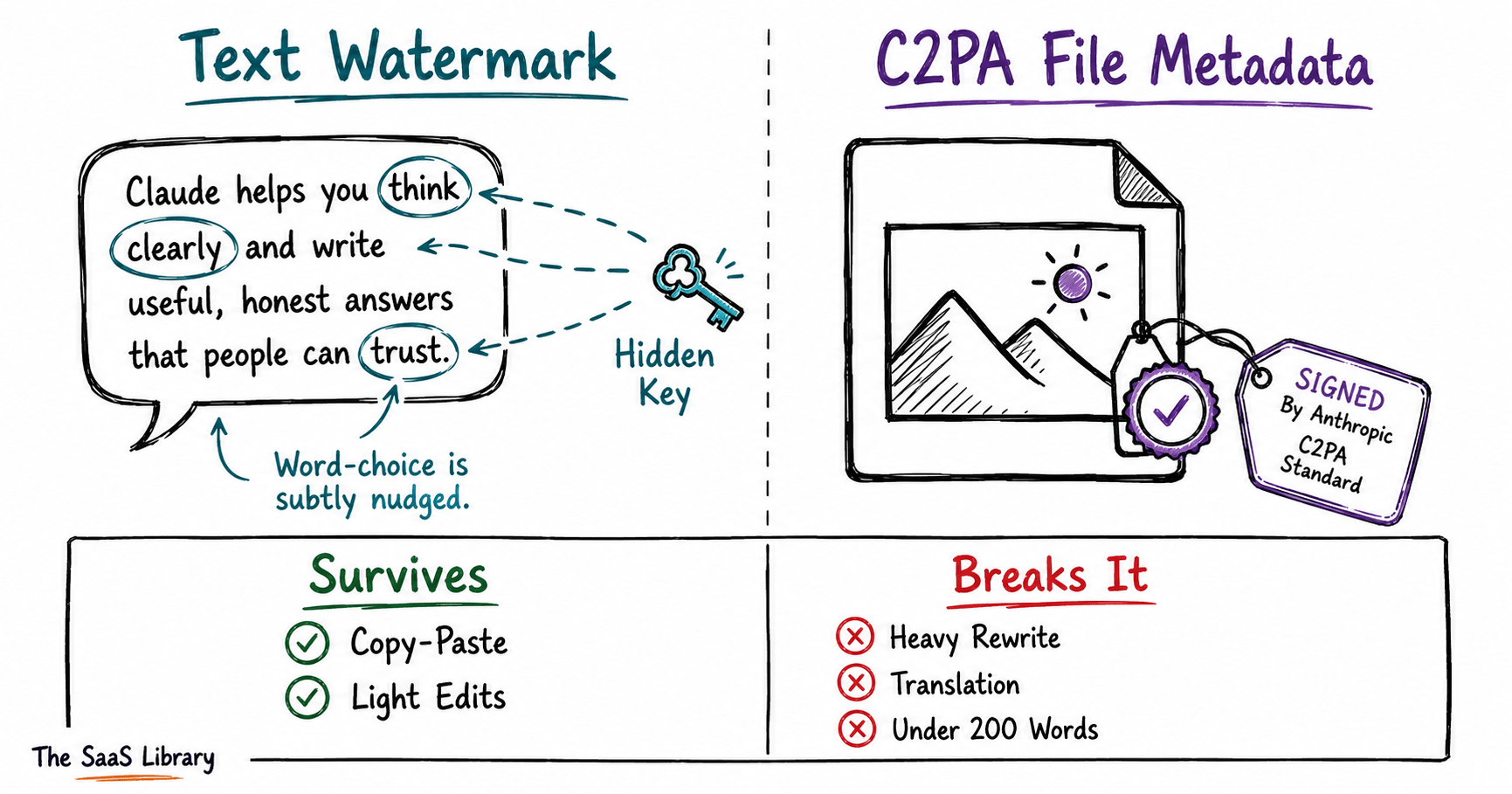
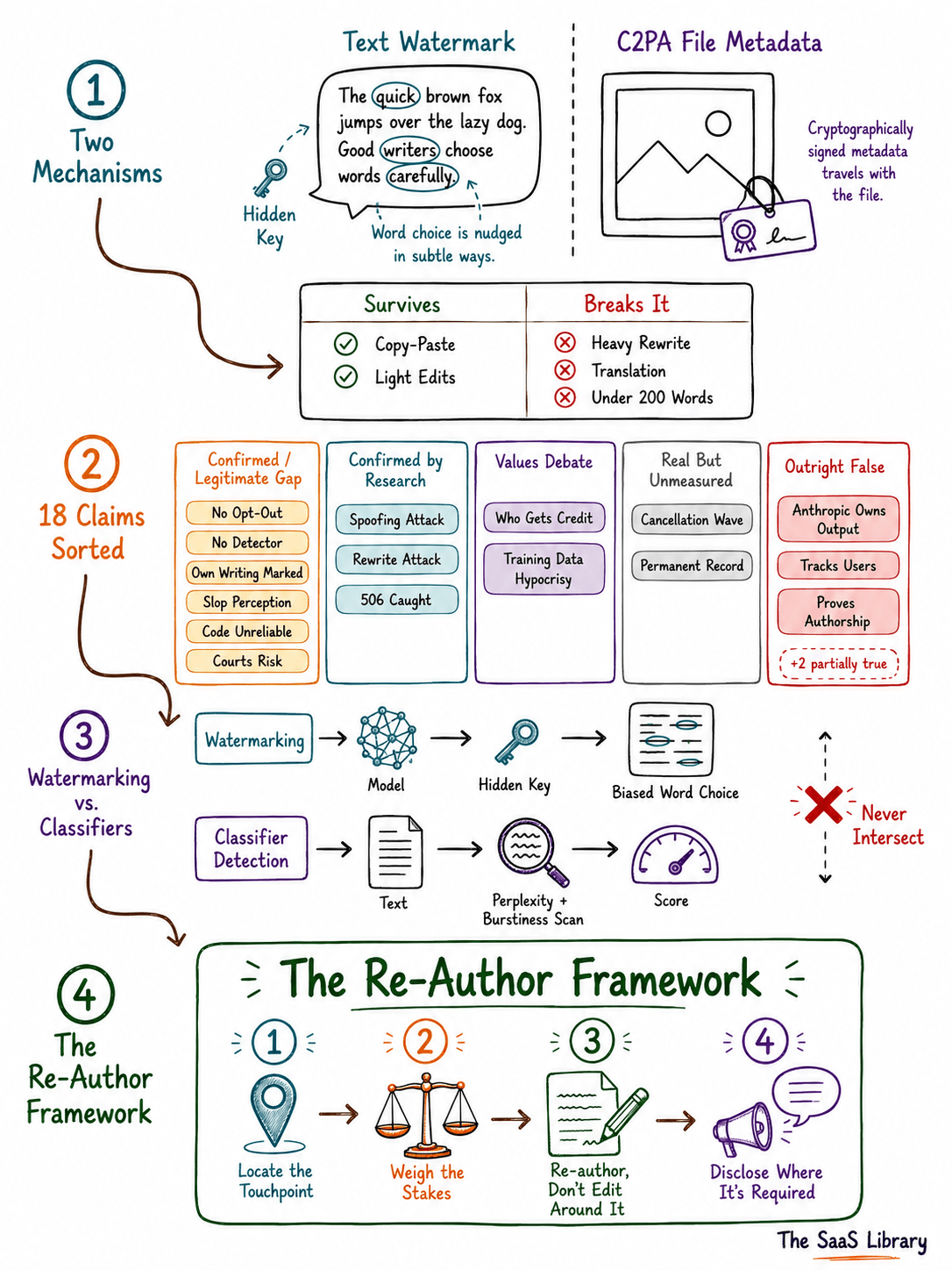
Anthropic’s Claude watermark is two separate mechanisms wearing one name, and most coverage collapses them into one. The first is an invisible statistical signal woven into generated text — it changes nothing about what you read, but it’s detectable by Anthropic’s own tools. The second is signed C2PA provenance metadata attached to generated image files (.svg, .png, .jpg), an entirely different system that behaves differently and breaks differently.
The text watermark works by nudging word choice. At almost every point in a sentence, a model like Claude has several statistically similar words it could pick next — Anthropic’s watermarking scheme biases that selection according to a hidden pattern, which accumulates into a detectable signal over enough text. This is the same general family of technique as Google’s SynthID, though Anthropic hasn’t published its specific implementation.
Anthropic states plainly that the mark “doesn’t change the meaning, quality, or readability of Claude’s response,” and that “because the watermark is part of the text, it will travel with the text when it’s copied and pasted elsewhere, and may persist through some editing” (Anthropic Help Center, Aug 2026). What breaks it and what doesn’t:
| Survives the Watermark | Breaks the Watermark |
|---|---|
| Copy-paste | Heavy rewriting |
| Reformatting | Paraphrasing |
| Light proofreading edits | Translation |
| — | Text under roughly 200 tokens (EU Code of Practice glossary, 2026) |
Coverage is broad by product, narrow by model age: marking applies across Claude, the Claude API, Claude Code, Claude Cowork, and Claude Tag, worldwide — not just for EU users — but only for models launched on or after August 2, 2026. Older models are being retrofitted during the law’s transition period, with no completion date given (Anthropic Help Center, Aug 2026). If you’re comparing how this plays out across Anthropic’s own lineup, every current Claude model is broken down here.
None of this tells you what a detected mark actually proves — and that gap is where almost every accusation in this piece starts.
Why Did Anthropic Add This Watermark to Claude?
Anthropic introduced the watermark as part of its compliance with the EU AI Act and its broader approach to AI-output transparency — specifically Article 50(2), which took effect August 2, 2026, and requires providers of generative AI systems to mark synthetic content in a machine-readable, detectable way (EU AI Act, Article 50). The company signed the EU’s voluntary Code of Practice on Transparency of AI-Generated Content, one of roughly 190 organizations to do so, alongside Google, OpenAI, Meta, Microsoft, and Mistral (European Commission, 2026).
Here’s the part that actually explains the size of the backlash: Anthropic didn’t have to apply this everywhere by strict legal necessity. Article 50(2) creates transparency obligations for covered AI-system providers and deployers under the Act; it does not, by itself, require Anthropic to watermark every Claude output worldwide — the Act’s actual jurisdictional reach is more nuanced than a simple “EU user versus non-EU user” line, since it can also turn on where a provider places a system on the market, not just where a given response is read. Anthropic chose to apply the watermark globally anyway, on every Claude surface, for every user, rather than building a narrower EU-only path (Anthropic Help Center, Aug 2026).
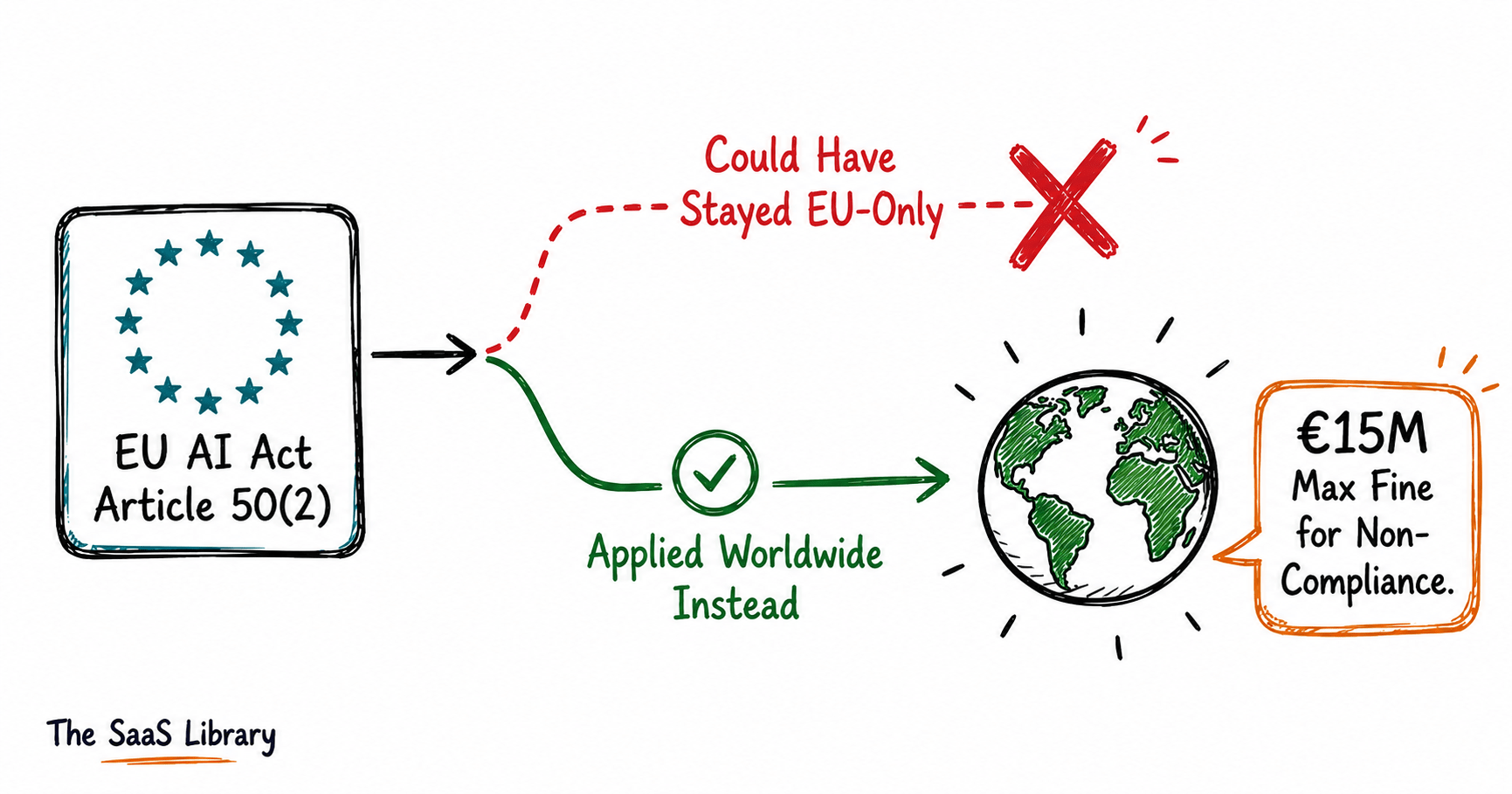
That single decision — global rollout instead of EU-only — is the reason a Reddit user in the US or a writer in India is dealing with this at all. It’s also the decision most of the accusations ahead are really a reaction to.
Wondering how Claude stacks up against the model that hasn’t released a comparable public detector yet?
Compare ChatGPT vs. Claude →Why Are Claude Users Angry About the Watermark?
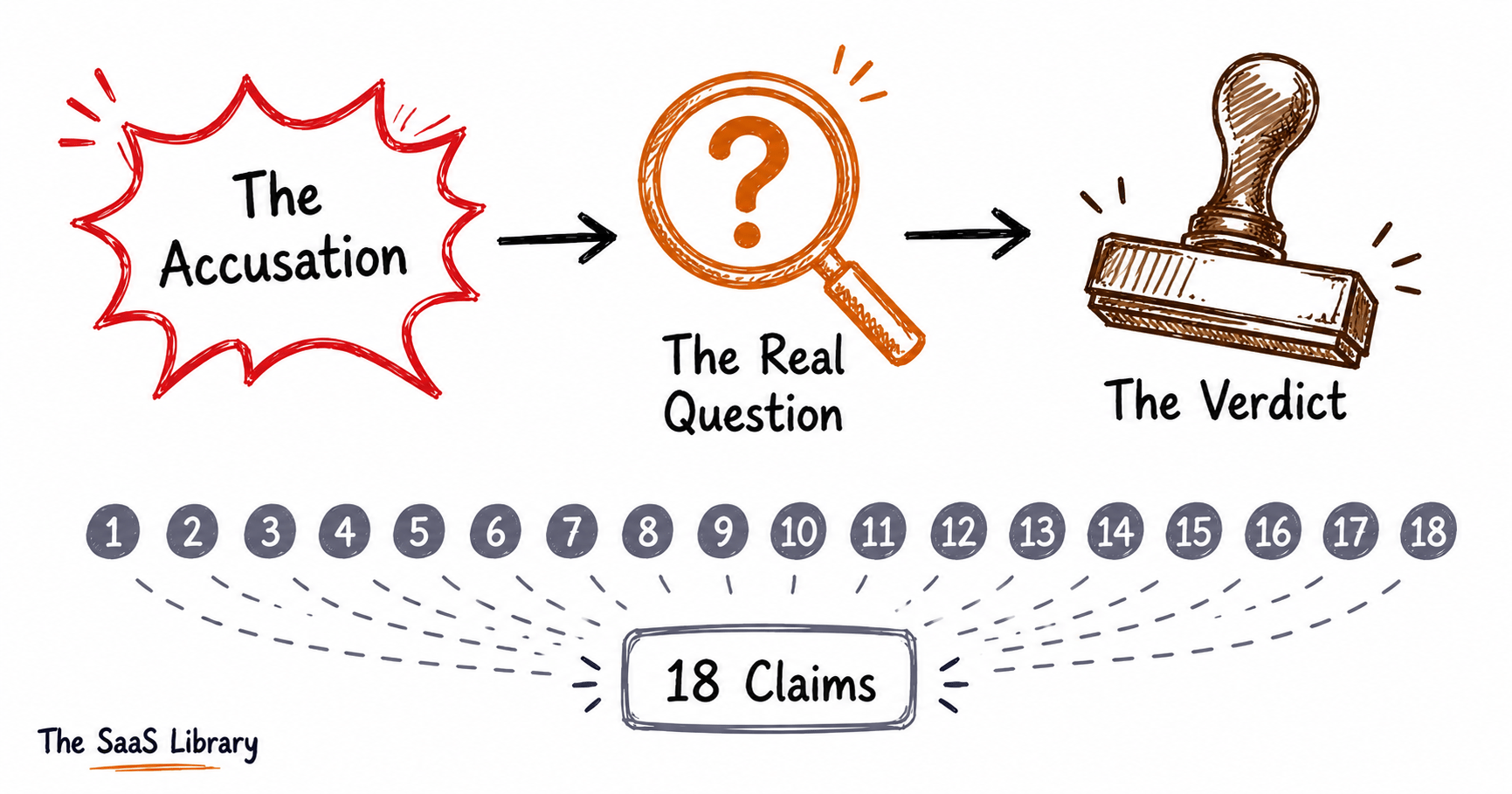
Claude users are angry about the watermark for reasons that split cleanly into two piles: legitimate design gaps, and pure panic — and almost nobody online is sorting one from the other. This piece checks all 18 of the loudest complaints against what Anthropic has actually published.
Claude users are angry about the watermark for reasons that split cleanly into two piles: legitimate design gaps, and pure panic — and almost nobody online is sorting one from the other. Scroll through Reddit or X and the reaction is loud, fast, and mostly negative. So we pulled every reason we could find, checked each one against what Anthropic has actually published, and sorted out what’s real.
Does Anthropic’s Claude Watermark Have an Opt-Out?
No — Anthropic’s Claude watermark has no opt-out. It applies to every Claude model launched on or after August 2, 2026, on every plan, with no setting to turn it off. It’s built into the model itself, not offered as a feature toggle, so no paid tier removes it (Anthropic Help Center, Aug 2026).
Has Anthropic Published a Detector, Accuracy Data, or a Dispute Process for the Claude Watermark?
Anthropic has not published a detector, accuracy data, or a dispute process, as of rollout. No public detector shipped at launch, no accuracy or false-positive statistics have been released, and there’s no formal way to contest a result. An Anthropic engineer confirmed on X that a self-serve detection API is coming, with no date or numbers given (Thariq Shihipar, @trq212, X, Aug 12, 2026). This is the single most defensible complaint in the entire backlash.
Does Claude Watermark Your Own Writing If You Only Use It to Proofread?
Claude does watermark your own writing when you use it only to proofread, according to Anthropic’s own documentation, which admits that proofreading, translating, or summarizing human-written text can leave a mark, even when Claude didn’t write a word of the original idea.
This is the sharpest complaint in the whole backlash — a real design gap, not a misunderstanding.
Can Heavily Edited AI-Assisted Writing Still Get Dismissed as “AI Slop”?
Heavily edited AI-assisted writing can still get dismissed as AI slop, and that’s a legitimate risk, not an overreaction.
A mark carries no information about how much human effort went in, so genuinely original, heavily edited work can be misjudged by anyone who treats a watermark hit as a quality signal. This concern runs alongside a broader shift in how thought leadership itself is judged in an AI-saturated feed.
Does the Claude Watermark Degrade or Break Generated Code?
The Claude watermark does not meaningfully degrade or break generated code. Source code has very little room for a statistical watermark to begin with — there’s often only one correct way to write a working line — so the signal is weak from the start, and standard formatters typically rewrite it away anyway. The real issue isn’t degraded code; it’s that the watermark was never reliable for code in the first place, which undercuts Anthropic’s own suggestion that it could help verify whether a pull request came from Claude Code (Anthropic Help Center, Aug 2026).
Who Deserves Credit for AI-Generated Work — the User or the Model?
Who deserves credit for AI-generated work has no settled factual answer — it’s a values debate, not something a source can resolve.
Anthropic has said the mark isn’t about claiming credit, just flagging that a model processed the text — and other Reddit users pushed back directly: “It’s not claiming credit though. It’s about being able to detect AI generated outputs because of the risks AI generated outputs can cause in various situations.” (Reddit user, quoted by TechCrunch, Aug 12, 2026). Reasonable people land on different sides of this one.
Is It Hypocritical for Claude to Watermark Output When Its Training Data Wasn’t Credited?
Whether Claude’s watermark is hypocritical given its own training-data provenance is a values argument, not a factual claim to verify.
It’s a real sentiment driving a meaningful share of the anger, and an unresolved tension worth sitting with rather than resolving.
Will the Claude Watermark Help Catch Students or Employees Cheating With AI?
The Claude watermark will help catch some cheating, but the concern about false positives cuts just as hard the other way.
There’s real evidence on the “it works” side too: when the International Conference on Machine Learning added a watermark to papers distributed for peer review in July 2026, organizers caught 506 reviewers who violated a no-AI policy (Nature, Aug 13, 2026). Carnegie Mellon computer scientist Nihar Shah, who ran that watermarking process, put it plainly:
A watermark hit is still a weak, non-conclusive signal — exactly the kind of thing that shouldn’t carry disciplinary weight on its own, and there’s currently no dispute process if a university or employer treats it as proof.
Can People Avoid the Claude Watermark by Paraphrasing or Using Another AI Tool?
People can partially avoid the Claude watermark by paraphrasing or heavily rewriting text — Anthropic confirms this directly. But “partially” undersells how bad the evasion problem actually is: researchers presented a Self-Information Rewrite Attack at ICML 2025 that identifies and selectively rewrites a text’s highest-signal words, stripping most of the watermark while keeping the meaning fully intact (Cloud Security Alliance research note, citing ICML 2025). So evasion is real and more sophisticated than casual paraphrasing — but “easy to evade for someone who knows how” isn’t the same as “worthless.” It still catches unedited copy-paste, which is most of what it’s actually aimed at.
Why Did Anthropic Add a Watermark to Claude Before OpenAI or xAI Did the Same for Their Models?
Anthropic added the watermark first because it chose to disclose and apply it globally, not because its legal obligation is any different from OpenAI’s or Google’s — both signed the same EU Code of Practice, in the same provider section, and carry the identical Article 50 obligation. OpenAI has reportedly had a working text detector for roughly two years and hasn’t released it, citing evasion risk and concern about disproportionately flagging non-native English writers (Wall Street Journal, Aug 2024). xAI signed only the safety chapter of the EU code, not the full transparency framework (Reuters, 2026). The resentment is understandable — it’s largely about Anthropic moving first and more transparently, not about Anthropic being uniquely wrong.
Could Courts Reject Legal Filings Just Because They Carry a Claude Watermark?
Courts could reject legal filings over a Claude watermark alone — that’s a real, emerging risk some attorneys are flagging, not a settled fact yet.
This sits alongside separate, unrelated legal exposure: a February 2026 federal ruling, United States v. Heppner, already found that Claude conversations aren’t protected by attorney-client privilege — for reasons that have nothing to do with the watermark (S.D.N.Y., Feb. 2026). The watermark itself carries no prompt content or privileged material, but it does make AI involvement in a filing easier to detect after the fact.
Does Anthropic Now Own Everything Claude Writes Because of the Watermark?
Anthropic does not own everything Claude writes because of the watermark. Output rights remain with the person using Claude under Anthropic’s own terms. The watermark is a provenance signal, not a licensing or ownership mechanism — it says a model touched the text, nothing about who owns it.
Can the Claude Watermark Identify or Track Individual Users?
Anthropic’s published documentation does not describe the watermark as identifying individual users, and we found no evidence that it does. Based on the available evidence, the mark should not be treated as a user-identification mechanism. As published, Anthropic describes it as identifying the model, not the account that used it.
Does a Detected Claude Watermark Prove AI Wrote Something or Affect Copyright?
A detected Claude watermark does not prove AI wrote something, and the watermark itself does not determine copyright ownership or copyright status. Anthropic says directly that a detected mark is a signal content “may have been processed” by Claude — not proof of authorship (Anthropic Help Center, Aug 2026). Provenance evidence and copyright ownership are two separate questions, and nothing in Anthropic’s documentation addresses the second one at all.
Are People Cancelling Their Claude Subscriptions Over the Watermark?
Some people are cancelling their Claude subscriptions over the watermark, but there’s no measured wave behind the claim.
Genuine individual cancellations exist, but there’s no survey, churn data, or analytics confirming a trend — just anecdotes amplified by engagement.
Does the Claude Watermark Create a Permanent Record That AI Touched a Document?
The Claude watermark could create a durable, detectable record that AI touched a document — that’s a legitimate concern, though it remains unconfirmed as an actual real-world harm so far. Separate from the false-attribution issue above, this is about confidentiality: a signal any time Claude touched an internal legal, journalistic, or competitive document, even ones never meant to reveal AI involvement. If you’re weighing what any AI tool actually does with your data more broadly, TSL has a full breakdown here.
Is Switching to an Open-Weight AI Model the Only Way to Avoid a Watermark?
Switching to an open-weight model is the conclusion some critics are drawing, not a verified necessity. Since you can’t be watermarked by a system you run yourself, some argue open-weight models are the only genuine escape. Worth understanding the actual distinction between open-weight and open-source AI before treating this as a real solution rather than a reaction.
Can Claude’s Watermark Be Faked Onto Text a Human Actually Wrote?
Claude’s watermark can be faked onto text a human actually wrote — yes, and this is demonstrated by named academic research, not speculation. Researchers from ETH Zurich’s SRI Lab, presented at ICML 2024, showed that querying a watermarked model’s public API enough times lets an attacker reverse-engineer the scheme well enough to forge it onto entirely human-written text — over 80% success, for under $50 in query costs, against schemes previously considered secure (Cloud Security Alliance research note, citing ICML 2024). This is a sharper problem than the proofreading false-attribution issue above — it’s not an accidental side effect of editing your own work, it’s a demonstrated attack that can make genuine human writing test positive as AI-generated on purpose.
18 accusations, sorted — but sorted isn’t the same as resolved. The next section weighs which of these actually change how you should treat a watermark hit.
Which of These Complaints Actually Hold Up?
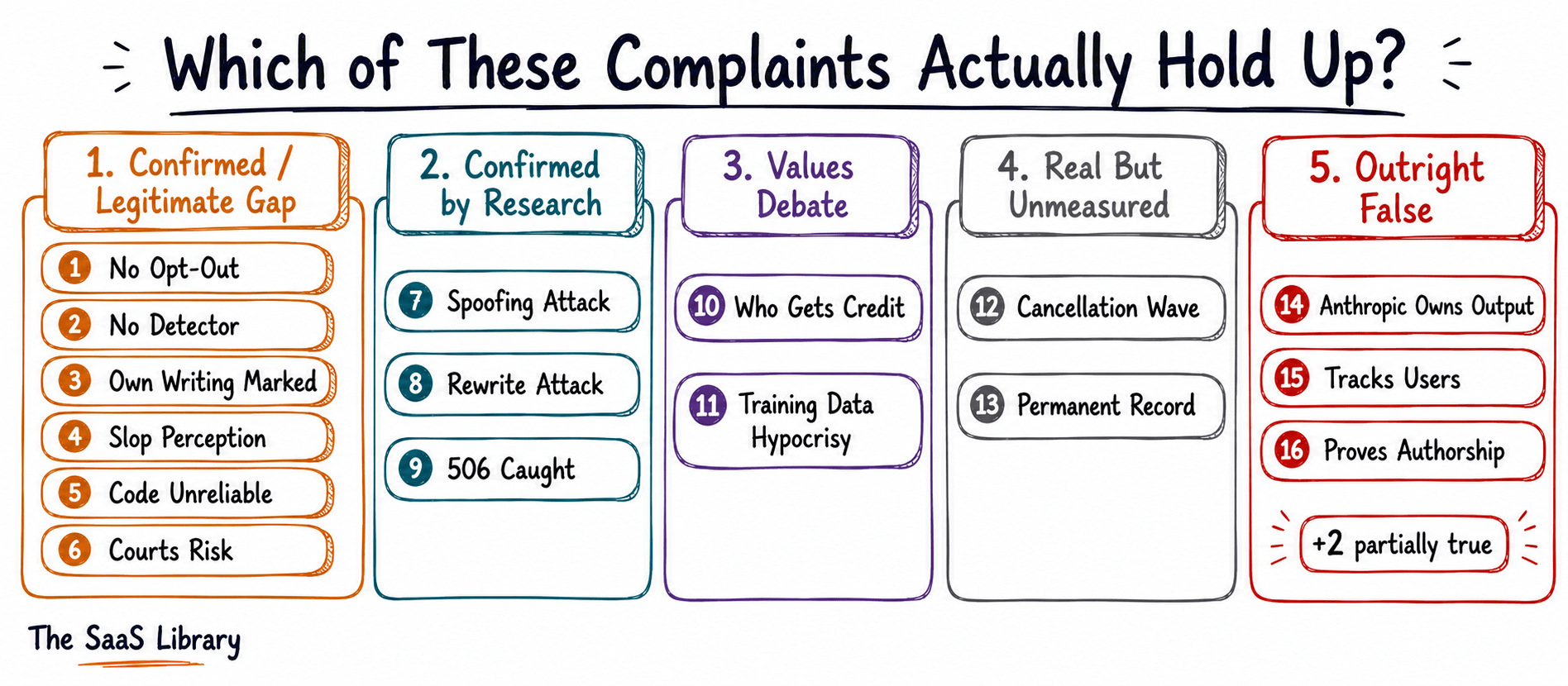
Six of the 18 accusations hold up completely, three are demonstrated by named research rather than backlash quotes, and the rest split between values debates, unmeasured anecdotes, and outright myths.
Six of the 18 accusations hold up completely, three are confirmed by named research rather than backlash quotes, and the rest split between values debates, unmeasured anecdotes, and outright myths. Here’s the sorted version, at a glance:
| Verdict | Accusations |
|---|---|
| Confirmed / legitimate gap | No opt-out; no detector/accuracy data/dispute process; your own proofread writing gets marked; edited work still risks being called “slop”; watermark unreliable for code |
| Confirmed by research, not just anecdote | Watermark can be forged onto human-written text (ETH Zurich, ICML 2024); paraphrase attacks strip most of the signal (ICML 2025); watermarking does catch real violations (506 reviewers, ICML 2026) |
| Values debate, not a fact to check | Who deserves credit; hypocrisy over training-data provenance |
| Real reaction, not measured data | Mass cancellation wave; permanent traceable record as a realized harm; courts rejecting filings over the mark alone — an emerging risk some attorneys are flagging, not yet a settled or observed outcome |
| Outright false | Anthropic owns your output; a detected mark proves authorship or determines copyright status |
| Unsupported / not evidenced | The watermark tracks individual users — not described in Anthropic’s documentation and no evidence found, but not something the available sources rule out with certainty either |
| Partially true, more nuanced than it sounds | “Only careless people get caught” undersells how sophisticated evasion research already is; “Anthropic is uniquely bad” ignores that OpenAI and Google carry the identical legal obligation |
The complaints grounded in Anthropic’s own documentation hold up almost perfectly. The complaints grounded in assumption — ownership, tracking, proof of authorship — don’t survive contact with the source. That’s not a coincidence. It’s the same failure mode driving most AI-policy panic: reacting to what a feature sounds like it does, instead of what its own documentation says it does.
That gap — between assumption and documentation — is also exactly what determines whether your content is even at risk. Which is the next question worth answering properly.
How Does AI Text Detection Actually Work?
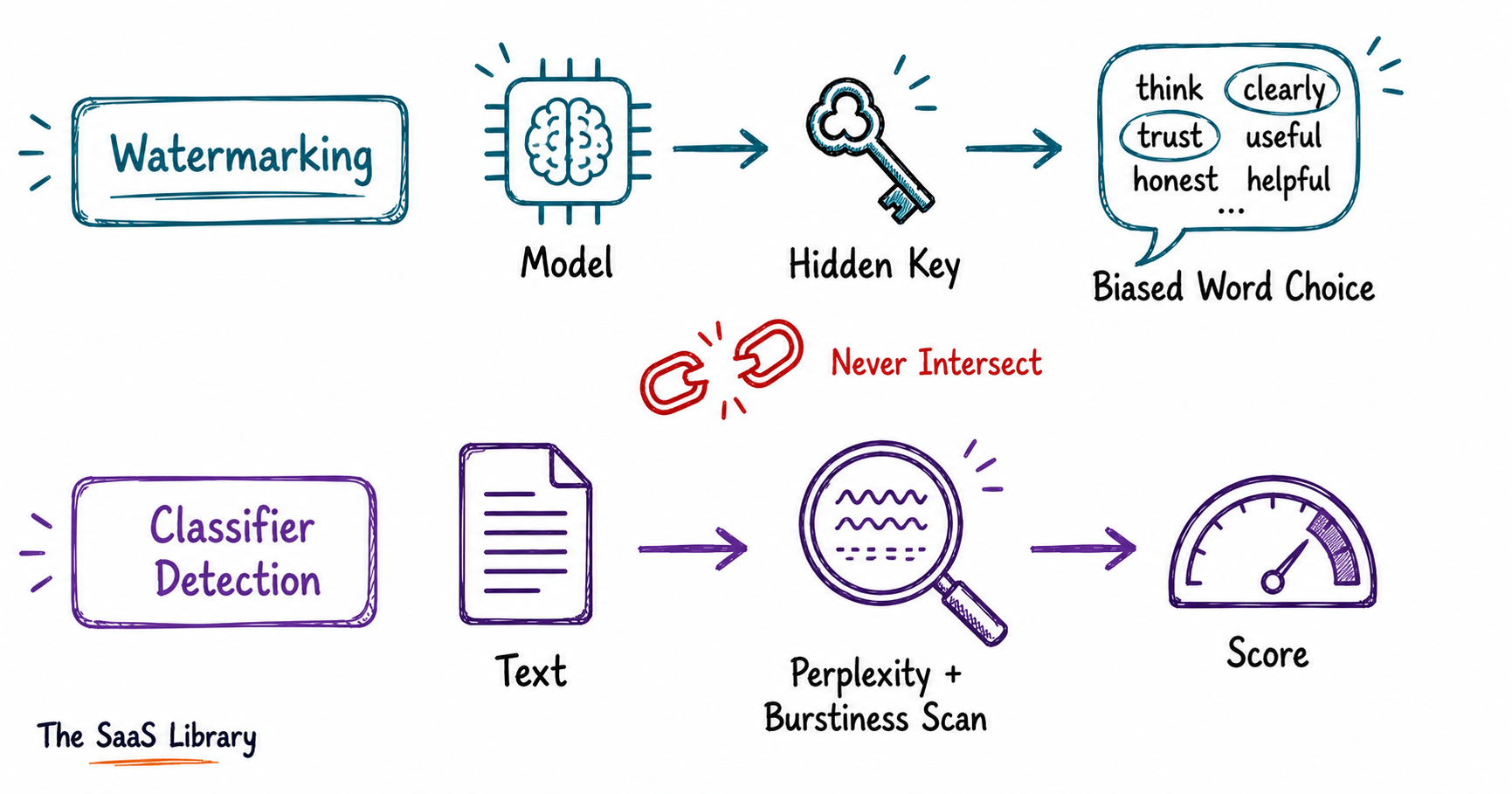
AI text detection works through two separate systems: model-level watermarking, which biases word choice during generation and requires a secret key to detect, and classifier-based detection, which scores text on statistical patterns like perplexity and burstiness after the fact.
AI text detection actually works through two completely separate systems that most coverage treats as one thing. The first is model-level watermarking — what Claude does. The second is classifier-based detection — what tools like Turnitin, GPTZero, and Originality.ai do. They don’t talk to each other, and understanding the difference explains almost every detection myth in this piece.
Watermarking doesn’t scan text after the fact — it’s baked in during generation. At each word, a model has several near-equivalent choices; the watermark biases which one it picks according to a hidden key. Detection requires that same key, which is why only Anthropic’s own tools can read Claude’s mark. Google’s SynthID works the same way for its own models (Google DeepMind, “SynthID,” ai.google.dev, 2026).
Classifier-based detectors never see a watermark at all — they never could, since they weren’t built by the model’s own creator. Instead, they score text on two statistical patterns:
- Perplexity — how predictable each word choice is. AI text tends toward the statistically likely next word; human writing is less predictable.
- Burstiness — how much sentence length and rhythm vary. Humans swing between short and long sentences; AI tends toward more uniform structure.
Example: What “AI-Sounding” Actually Looks Like on the Page
AI-typical sentence:
What a detector flags in it:
- Low burstiness — three clauses, almost identical length and rhythm (“enhance productivity, streamline operations, drive sustainable growth”)
- High predictability — every phrase is the statistically obvious next choice: “cutting-edge technology,” “competitive landscape,” “sustainable growth”
- No specific detail — no named company, no number, no lived example
Rewritten to remove those markers:
This is illustrative of the patterns detectors are built to catch, not a live result from running either sentence through a specific tool — accuracy and false-positive rates vary by detector, as the table below shows, so no single before/after pair proves a universal outcome.
Here’s where the false-positive problem gets serious, and it’s not a minor footnote. A Stanford study published in the journal Patterns ran seven AI detectors against essays written by non-native English speakers and found that the detectors “classified more than half of TOEFL essays (61.22%) written by non-native English students as AI-generated” (Liang, Yuksekgonul, Mao, Wu & Zou, Stanford HAI, May 2023). That’s not a rare misfire — that’s the majority of a genuinely human-written test set flagged wrong.
Accuracy varies sharply by vendor too:
| Detector | Accuracy Claim | Independent Finding |
|---|---|---|
| Turnitin | ~98% (vendor claim) | ~90–95% on unedited text; 5–12% false positives on non-native or heavily edited writing |
| Originality.ai | ~98–100% (vendor claim) | ~85% overall on the independent RAID benchmark; ~4.79–5.7% real-world false-positive rate |
| Pangram | Not separately marketed | ~0.01% false positives, 96.7% accuracy even against paraphrasing attacks (University of Chicago Booth, 2025) |
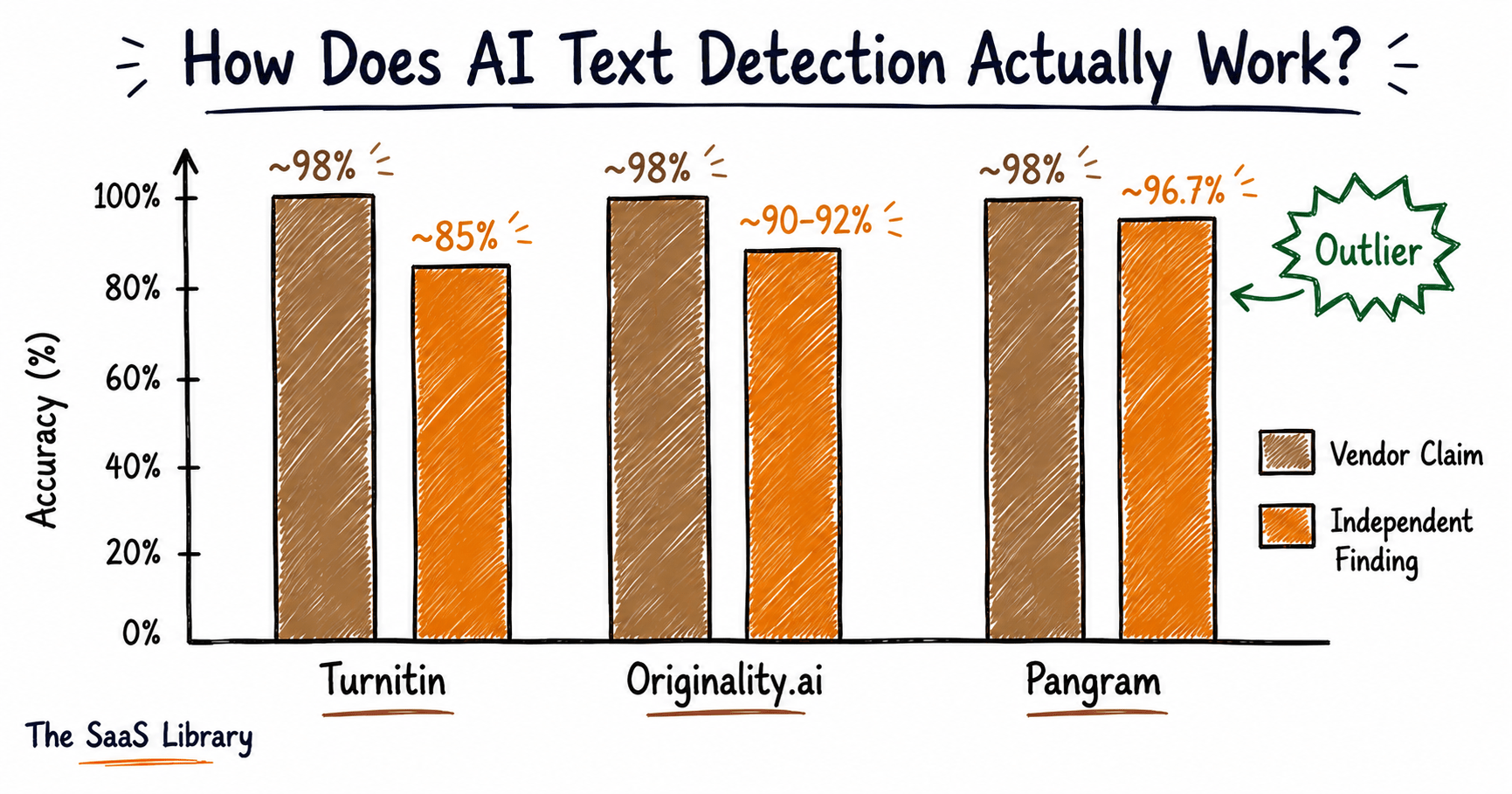
That last row matters more than it looks. Most detectors “plummeted from over 90% to below 50%” in accuracy once tested against text run through a paraphrasing tool — Pangram was the exception (Forbes, Oct 2025). Which raises the obvious next question: if paraphrasing breaks most detectors this badly, can you write your way around a false flag on purpose — and is that even the right move?
Can You Write Content That Avoids False AI-Detection Flags?
You can write content that avoids false AI-detection flags, and the fix is the same writing craft that makes writing good in the first place — varying sentence rhythm, adding specific detail, and rewriting substantively rather than relying on a humanizer tool.
You can write content that avoids false AI-detection flags — and the fix turns out to be the same thing that makes writing good in the first place, not a separate trick. This matters more than it sounds, because the demand for a “detection workaround” is really two different problems wearing the same complaint, and they need different answers.
Problem One:
Your own genuinely human writing keeps getting flagged.
This is the false-positive risk from earlier in this piece — a Stanford study found detectors flagged over 61% of TOEFL essays from non-native English speakers as AI-generated, when every one of those essays was human-written (Liang et al., Stanford HAI, May 2023). If this is your situation, the fix isn’t evasion — there’s nothing to evade, since you didn’t use AI. The fix is the same writing craft shown in the example above: vary sentence rhythm, add specific and slightly odd detail, break formulaic structure. That’s not gaming a detector. That’s just writing like a person who has something specific to say.
Problem Two:
You used AI and want the output to read as fully human.
This is a different question, and it deserves a straight answer rather than a workaround. “AI humanizer” tools exist and do mechanically change detection scores — but the research on whether they’re actually a good idea is not encouraging:
- A Google Research paper found that paraphrasing tools cut one leading detector’s accuracy from 70.3% down to 4.6% (Krishna et al., “DIPPER,” 2023) — so evasion is technically real.
- A study in Transactions on Machine Learning Research found humanizer output often scores lower on human-rated readability than the original — evasion trades away quality to lower a detection score (2024).
- Pangram’s own research on 19 different humanizer tools found that while many detectors do get fooled, a properly built detector can still catch humanized text at a low false-positive rate (“DAMAGE,” 2025) — so the workaround isn’t even reliably permanent.
That’s the honest shape of it: humanizer tools can lower a detection score, at the cost of making the writing worse, against detectors that are actively being built to catch exactly that. For something you’re publishing under your own name, that’s a bad trade — you’re degrading your own work to fool a system that may already be updated against the method you used.
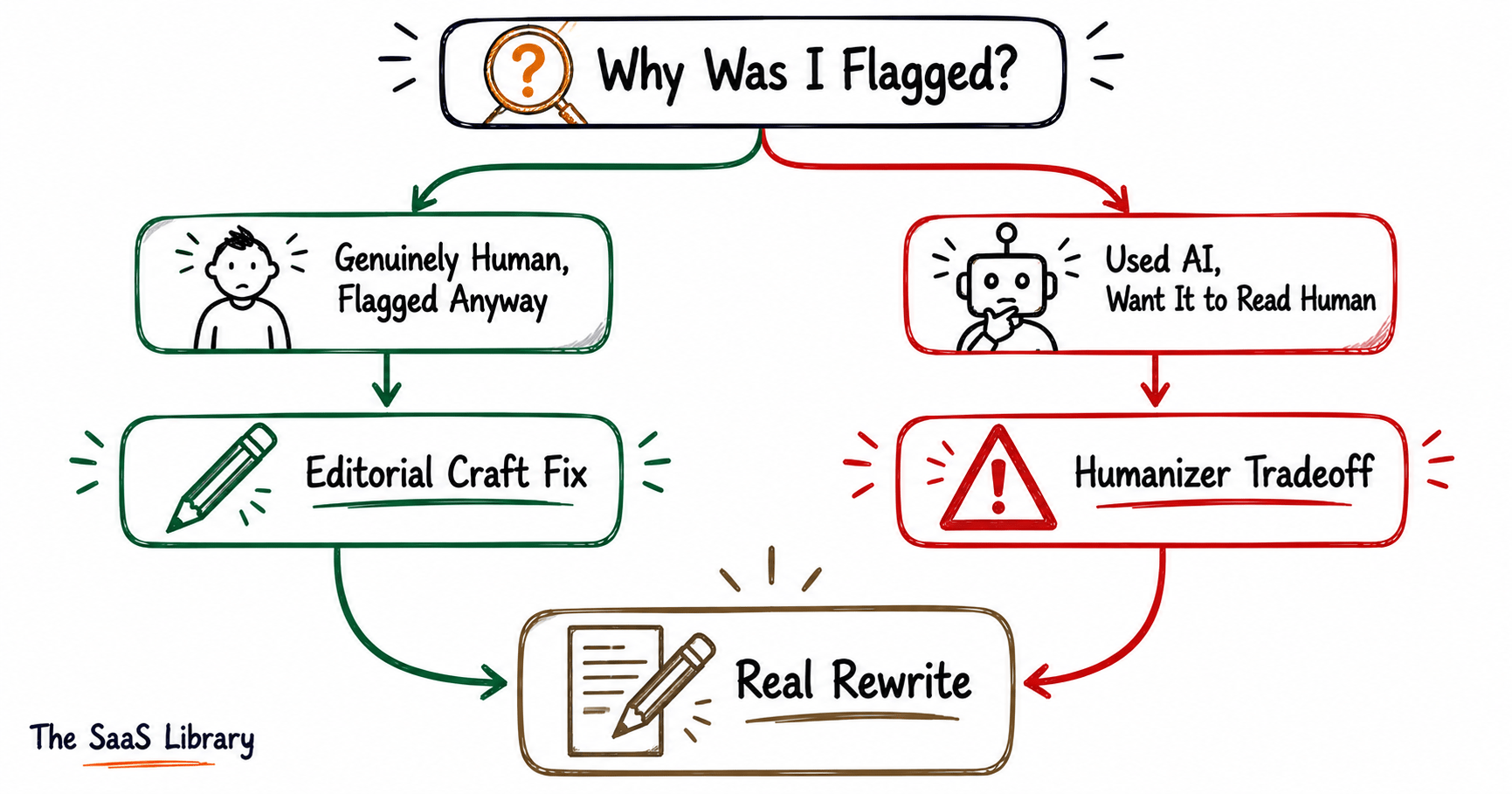
The actual fix, for both problems, is the same:
A real editorial rewrite. Restructure the argument in your own words, add your own specific detail or sourcing, cut anything you’re keeping close to verbatim. This is also the one thing Anthropic itself confirms reduces its watermark — not because a tool targeted it, but because the text has genuinely, substantively changed. Write like that from the start, and there’s nothing left for a detector — or a watermark — to catch you on.
What Should SaaS Publishers and SEO Teams Actually Do About This?
SaaS publishers and SEO teams should update their AI-disclosure and editorial workflow, not their SEO strategy — Google’s ranking systems don’t read Anthropic’s watermark, so the real work is auditing AI touchpoints and writing a disclosure policy in advance.
SaaS publishers and SEO teams should update their AI-disclosure and editorial workflow, not their SEO strategy — because nothing about this watermark touches Google’s ranking systems. That distinction matters enough to state plainly before anything else: Google evaluates content on quality and helpfulness, not on how it was produced, and its ranking systems don’t read Anthropic’s watermark at all.
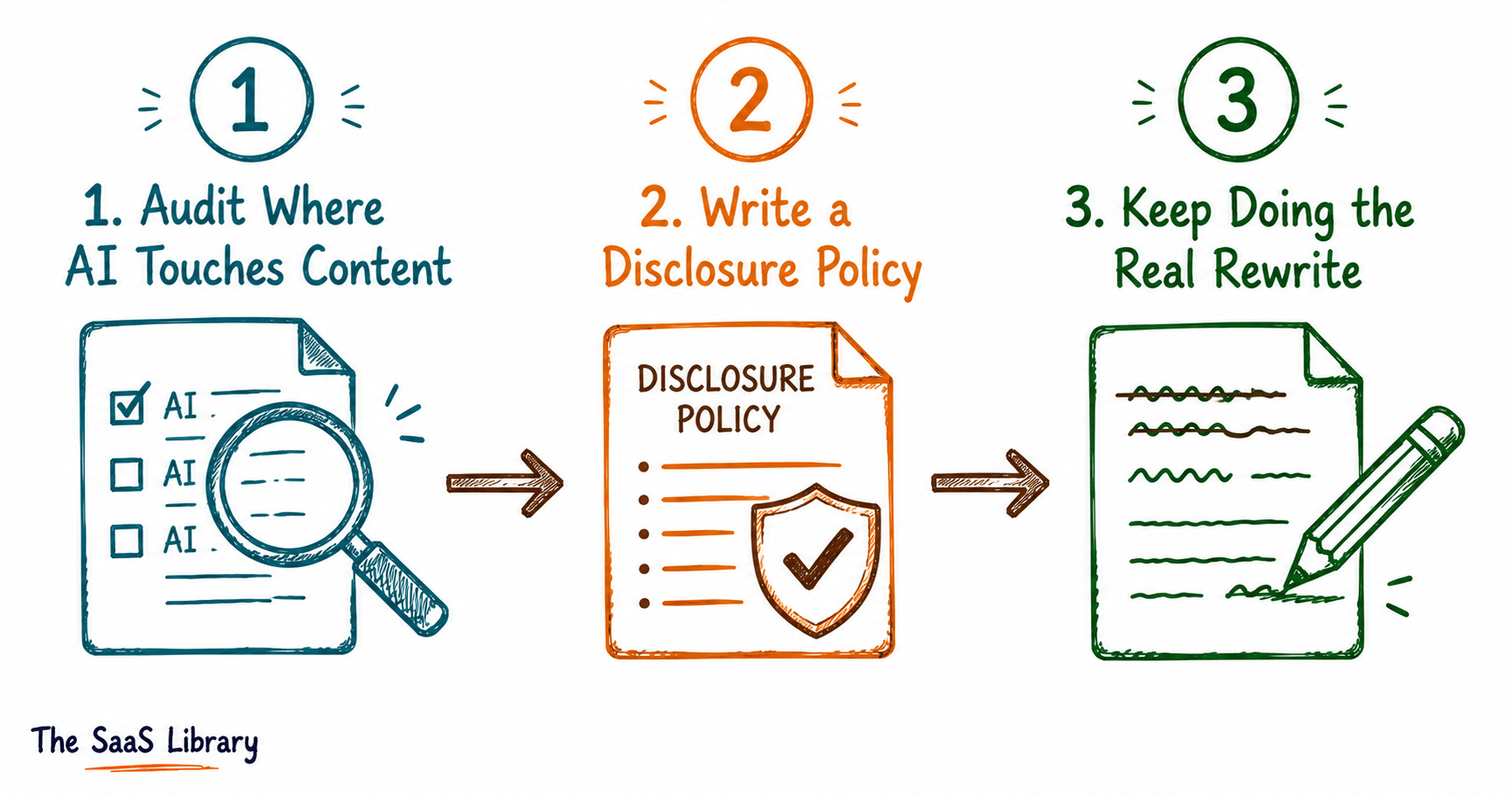
Three concrete moves worth making now:
- Audit where AI touches your published content. If your team uses Claude for drafting, editing, or proofreading, every piece of that output can now carry a mark — including work you’d call entirely your own. Know where those touchpoints are before a client, editor, or reader asks.
- Write an AI-disclosure policy before you need one. Decide now what “processed by Claude” means for your byline standards — not in the middle of a dispute. A mark is a weak, non-conclusive signal; treating it as proof of anything is a mistake your policy should rule out in advance.
- Keep doing the editorial rewrite you should already be doing. The Re-Author Framework below isn’t a new burden — it’s the same substantive editing that protects your content from both false-attribution risk and the actual thing Google does penalize: thin, unoriginal, low-value output at scale.
That third point is worth its own full breakdown, because “edit it properly” isn’t specific enough to actually follow.
What Is the Re-Author Framework?
The Re-Author Framework is a four-step method — Locate the Touchpoint, Weigh the Stakes, Re-author Don’t Edit Around It, Disclose Where It’s Required — for reducing false-attribution risk on AI-assisted writing, built on the same principle Anthropic confirms reduces its own watermark.
The Re-Author Framework is a four-step method for anyone worried their genuinely human writing could get falsely flagged as AI-generated — designed to fix the actual problem instead of gaming a detector. It’s built from the same principle Anthropic’s own documentation confirms: substantive rewriting is what reduces a watermark, not because a tool targets it, but because the text has genuinely changed.
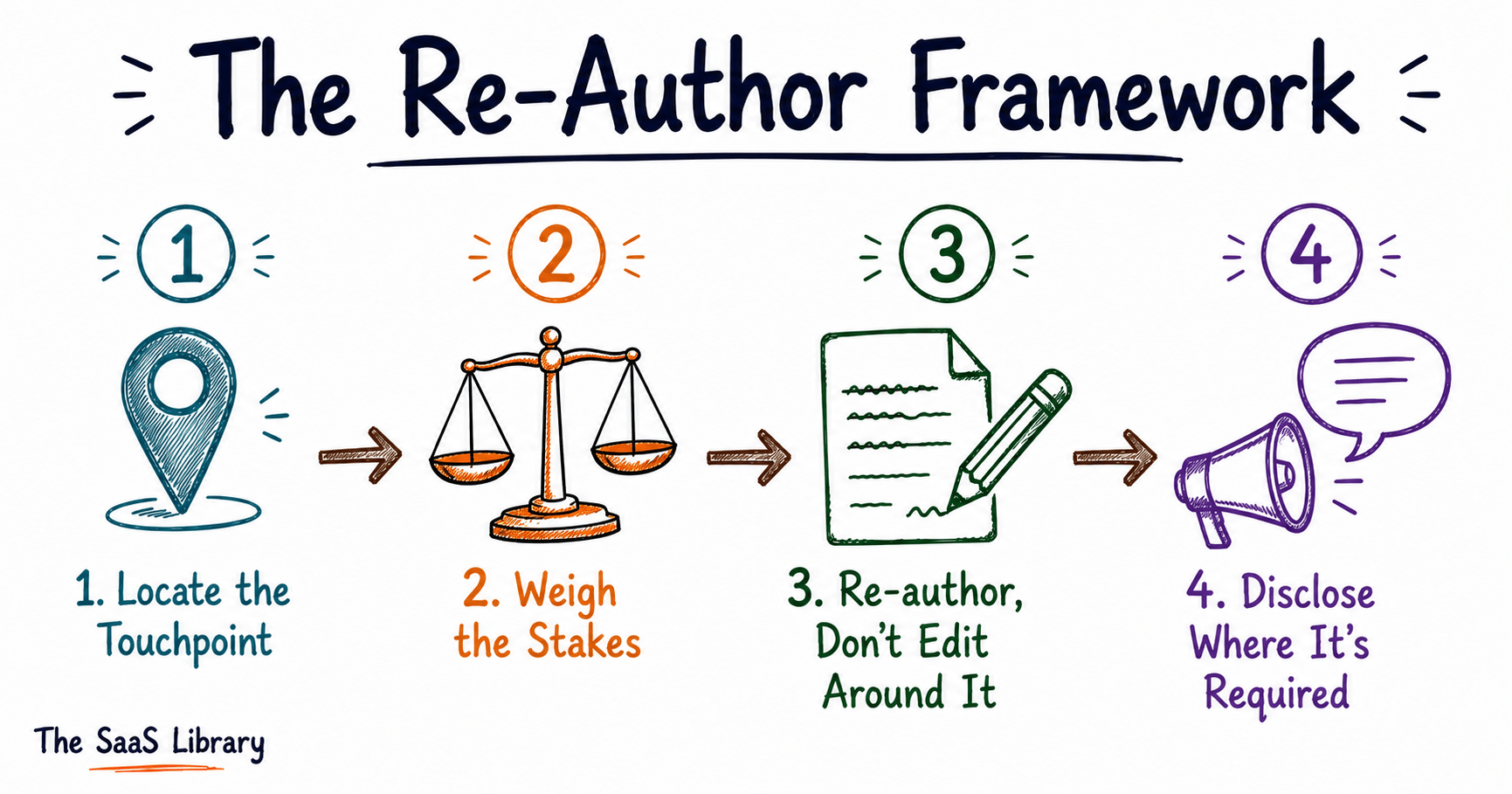
Run any piece of AI-touched writing through these four steps before it goes out under your name, and the false-attribution risk that opened this entire piece stops being a threat you’re exposed to.
Frequently Asked Questions
Does Anthropic’s Claude watermark have an opt-out?
No. The watermark applies to every Claude model launched on or after August 2, 2026, on every plan, with no setting to turn it off. It’s built into the model itself, not offered as a feature toggle.
Does Claude watermark your own writing if you only use it to proofread?
Yes. Anthropic’s own documentation admits proofreading, translating, or summarizing human-written text can leave a mark, even when Claude didn’t write a word of the original idea.
Can Claude’s watermark be faked onto text a human actually wrote?
Yes. Researchers from ETH Zurich’s SRI Lab, presented at ICML 2024, demonstrated forging Claude’s watermark onto entirely human-written text with over 80% success, for under $50 in query costs.
Does the Claude AI watermark affect Google rankings?
No. Google evaluates content on quality and helpfulness, not on how it was produced, and its ranking systems don’t read Anthropic’s watermark at all.
Can Turnitin or GPTZero detect Claude’s watermark?
No. Turnitin and GPTZero use separate statistical detection methods based on perplexity and burstiness — they cannot read Anthropic’s watermark, since detecting it requires a key only Anthropic holds.
Does Anthropic now own everything Claude writes because of the watermark?
No. Output rights remain with the person using Claude under Anthropic’s own terms. The watermark is a provenance signal, not a licensing or ownership mechanism.
Can the Claude watermark identify or track individual users?
There’s no evidence that it does. Anthropic’s documentation doesn’t describe the watermark as identifying individual users, and no reporting has surfaced evidence of one — that’s an absence of evidence, not proof it’s impossible.
Does a detected Claude watermark prove AI wrote something?
No. Anthropic states directly that a detected mark signals content “may have been processed” by Claude, not that Claude authored it.
Can people avoid the Claude watermark by paraphrasing text?
Partially. Heavy paraphrasing or rewriting does break the watermark, by Anthropic’s own account, and a 2025 ICML paper demonstrated an even more targeted rewrite attack — but the watermark still catches unedited copy-paste, which is most of what it’s aimed at.
Are people cancelling their Claude subscriptions over the watermark?
Some are, but there’s no measured wave. Individual cancellations exist publicly, but no survey or churn data confirms a broader trend.
Has Anthropic published a detector or dispute process for the watermark?
Not yet, as of rollout. No public detector, accuracy statistics, or formal dispute process has been published; an Anthropic engineer confirmed a self-serve detection API is coming, with no date given.
What is the Re-Author Framework?
The Re-Author Framework is a four-step method — Locate the Touchpoint, Weigh the Stakes, Re-author Don’t Edit Around It, Disclose Where It’s Required — for reducing false-attribution risk on AI-assisted writing.
Conclusion
Most of the panic around Claude’s watermark doesn’t survive contact with what Anthropic actually published — but the complaints that do survive are serious, and dismissing the whole backlash as overreaction would be its own kind of misinformation. Run any AI-touched writing through the Re-Author Framework before it goes out under your name, and the false-attribution risk this piece opened with stops being something you’re exposed to. The real fix was never a detection workaround — it was always just better, more substantively rewritten writing, which happens to be the same thing that protects you from Google’s actual content-quality standards too.
If your team publishes AI-assisted content regularly, the questions here don’t stop at one article — The SaaS Library covers exactly this kind of shift as it happens.
- Anthropic — “How Claude Marks AI-Generated Content,” Claude Help Center, Aug 2026
- European Commission — “Strong Backing for the Code of Practice on Transparency of AI-Generated Content,” 2026
- EU AI Act — Article 50
- TechCrunch — “Some Claude Users Are Mad…,” Aug 12, 2026
- Forbes — “Claude Users Can’t Opt Out Of New Watermarks,” Aug 11, 2026
- Nature — “Can Anthropic’s Invisible Watermarks Curb ‘AI Slop’?,” Aug 13, 2026
- UNU Campus Computing Centre — “Provenance, Not Proof,” Aug 12, 2026
- Search Engine Land — “Anthropic Adds AI Text Watermarking to Claude Models Worldwide,” Aug 11, 2026
- Google DeepMind — “SynthID”
- Google Search Central — “Google Search’s Guidance About AI-Generated Content,” Feb 2023
- Stanford HAI / Patterns — Liang, Yuksekgonul, Mao, Wu & Zou, May 2023
- University of Chicago Booth — Jabarian & Imas, “Pangram” Study, 2025
- Techmeme — Aggregated X reactions, Aug 11, 2026