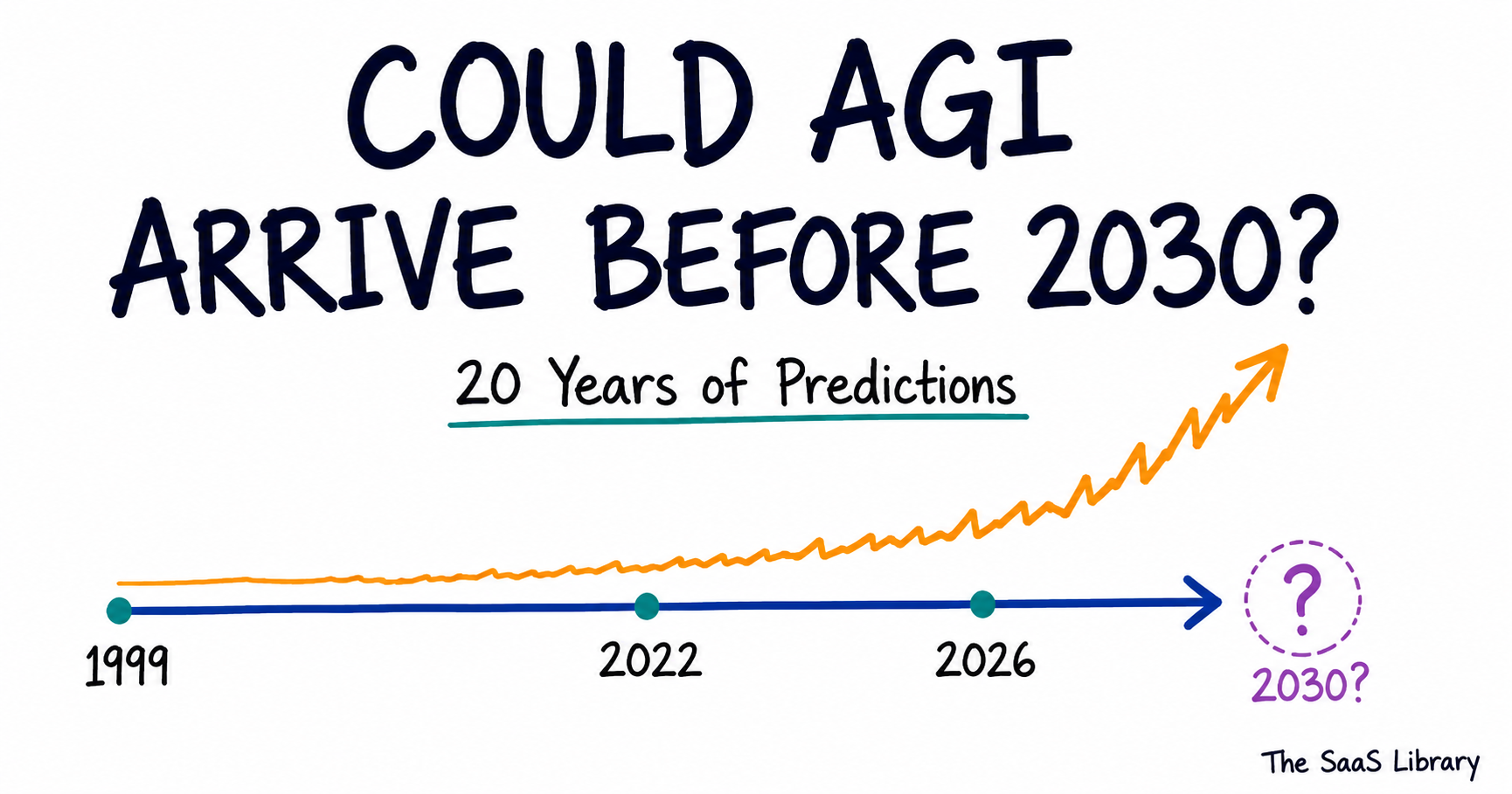
In 1999, Ray Kurzweil predicted human-level AI by 2029 and was dismissed as a fringe technologist. In 2023, a survey of 2,778 AI researchers moved that same estimate thirteen years closer within twelve months. The honest answer: AGI before 2030 is plausible, not expected — and the evidence behind that split is traceable. This piece follows the compression itself, and why AI 2027 counts as one data point, not a prophecy.
- Every independent forecasting method — expert surveys, prediction markets, superforecasters, and compute-based models — has shortened its AGI timeline since 2020.
- The compression is dated specifically to ChatGPT’s 2022 release, not gradual drift.
- Peer-reviewed expert surveys still cluster around 2047, while lab leaders cluster before 2030 — a real, unresolved 15–20 year gap.
- A 2025 AAAI panel found 76% of surveyed researchers doubt current scaling alone reaches AGI.
- The AI 2027 scenario’s own authors pushed its key milestones later after publishing it.
- After reading, you’ll know which concrete signals to track instead of betting on any single predicted date.
What Is AGI, and How Is It Different From an LLM or an AI Agent?
AGI is a hypothetical system matching human-level performance across virtually any cognitive task. An LLM predicts the next word in text and stops there. An AI agent wraps that LLM with memory and tools so it can act, not just answer. Neither, by itself, is AGI — both are components a general system would need.
AGI is a hypothetical system that matches human-level performance across virtually any cognitive task — and neither of the tools people call “AI” today qualifies. An LLM — GPT-4, Claude, Gemini — is different because it only predicts the next word in text from training-data patterns; it answers, but does not act in the world on its own. An AI agent is different again: it takes that same LLM and adds memory, tool access, and a planning loop so it can pursue a multi-step goal instead of answering one prompt.
An agent booking a flight, debugging code across a repository, or running a research task is still built on the same underlying LLM — the same distinction that separates an agent from a chatbot — it’s the scaffolding around it that changed, not the core intelligence.
| Term | What it is | Exists today? |
|---|---|---|
| LLM | Predicts text from patterns in training data | Yes |
| AI Agent | LLM + memory + tools + a planning loop | Yes, narrow forms |
| AGI | Matches human performance across nearly any cognitive task | No — hypothetical |
| Superintelligence | Exceeds the best human performance in every domain, including AI research itself | No — hypothetical |
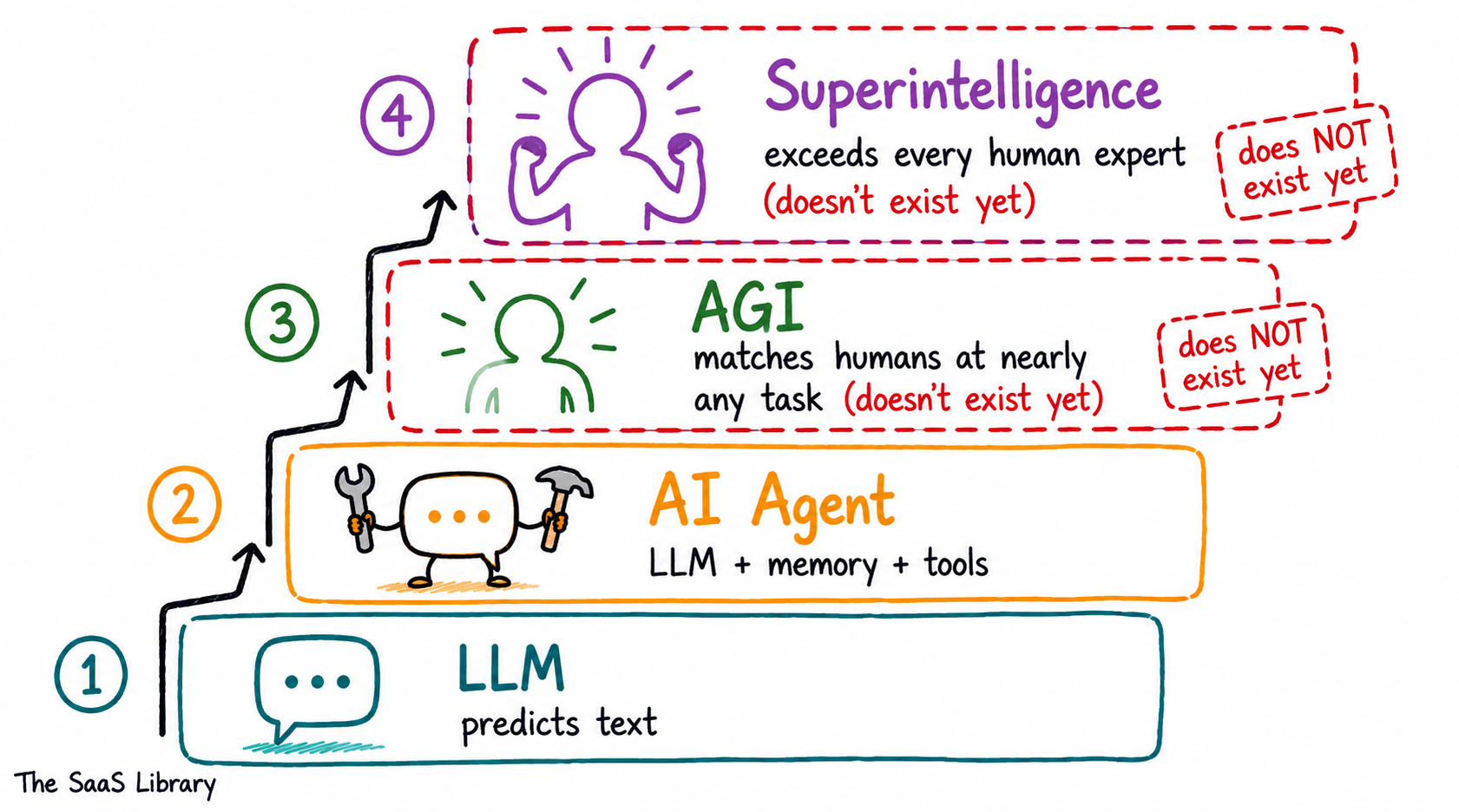
The DeepMind researchers behind the “Levels of AGI” framework argue that AGI is best measured as a spectrum of capability and generality, not a single pass/fail moment — which is precisely why a system’s parts (LLM, agent) can already exist while the whole (AGI) still doesn’t.
Every prediction later in this article assumes a different implicit definition of AGI — some use “matches human experts at economically valuable tasks,” others use “can do AI research unsupervised.” Two forecasters can disagree by decades while actually agreeing on the evidence, simply because they’re answering different questions.
Curious how the same labs racing toward these capabilities decide what’s too dangerous to ship at all?
Read: The AI Model Too Dangerous to Release →Superintelligence is different still: it doesn’t just match human-level performance but exceeds the best human experts in every domain simultaneously, including the ability to improve its own architecture. No forecaster in this article claims superintelligence exists yet — but the mechanism that could connect the two, one system rapidly building the next, is where the sharpest disagreement in this whole debate actually lives.
What Has Every Major AGI Prediction Actually Said, Year by Year?
Every major AGI prediction between 1999 and 2026 has grown more aggressive, moving from decades-out estimates to single-digit years — with the sharpest shift landing in one twelve-month window between the 2022 and 2023 AI Impacts surveys. Kurzweil’s 2029 estimate is the only one that hasn’t moved.
Every major AGI prediction has said something progressively closer to today, and the pace of that shift itself accelerated sharply after 2022. Ray Kurzweil predicted human-level AI by 2029 in 1999 and restated the same year through 2026 — the longest-standing unchanged forecast in this table. Everyone else moved.
The table below tracks each major prediction against what it reasoned from, and what happened to expert opinion after each one landed.
| Year | Source | Predicted Timeline | Reasoning | What Changed After |
|---|---|---|---|---|
| 1999/2005 | Ray Kurzweil, The Age of Spiritual Machines / The Singularity Is Near | AGI by 2029; Singularity by 2045 | Law of Accelerating Returns — exponential compute growth | Restated unchanged through 2026 interviews |
| 2009 | Shane Legg (DeepMind co-founder) | 50% chance of AGI by 2028 | Personal probability distribution formed after reading Kurzweil in 2001 | Publicly reaffirmed every few years since; unchanged as of 2023 |
| 2012–13 | Müller & Bostrom expert survey (550 respondents) | 50% chance by 2040–2050; 90% by 2075 | Pre-deep-learning-era expert polling | Became the reference baseline for later survey comparisons |
| 2016 | AI Impacts/Grace et al. survey | 50% chance by ~2061 | ML researchers polled from NeurIPS/ICML | Barely moved by the 2022 repeat — one year earlier in six years |
| 2020 | Metaculus community | ~50 years out (~2070) | Pre-GPT-3 community forecast | Community median began compressing after GPT-3’s 2020 release |
| 2022 | AI Impacts/Grace et al. survey | 50% chance by 2060 | Post-GPT-3, pre-ChatGPT baseline | Set up the sharpest single-year shift in the table |
| 2023 | AI Impacts/Grace et al. survey (2,778 researchers) | 50% chance by 2047 | Same survey, one year after ChatGPT’s public release | Median moved 13 years earlier in 12 months — the largest recorded shift |
| 2023 | Samotsvety Forecasting (superforecasters) | ~28% chance by 2030 | Track-record forecasters engaging directly with AI evidence, updated from a 2022 estimate of ~32% by ~2042 | Cited as more AI-literate than generalist superforecaster panels |
| 2025 | Kokotajlo, Lifland, Larsen, Dean, Alexander — AI 2027 | Pivot point ~2027 | Compute growth + recursive self-improvement + agentic coding automation | Authors themselves later pushed key milestones later (see Section 4) |
| 2026 | Forecasting Research Institute, LEAP Wave 8 | Median 2050 (conditional on AGI by 2100); superforecasters 2047 | Expert panel tracked across 8 waves since 2025 | Confirms experts still trail lab leaders by ~15–20 years |
| 2026 | Sam Altman (OpenAI, Relentless podcast, July 25) | Declared “we are in the singularity” | Remark made in passing during a wide-ranging interview, not tied to a specific launch | Amplified by media coverage; disputed by Hassabis’s more measured “foothills” framing, Huang’s “made up” dismissal, and a same-day Forbes piece arguing the framing was “disproportionate to its actual meaning” |
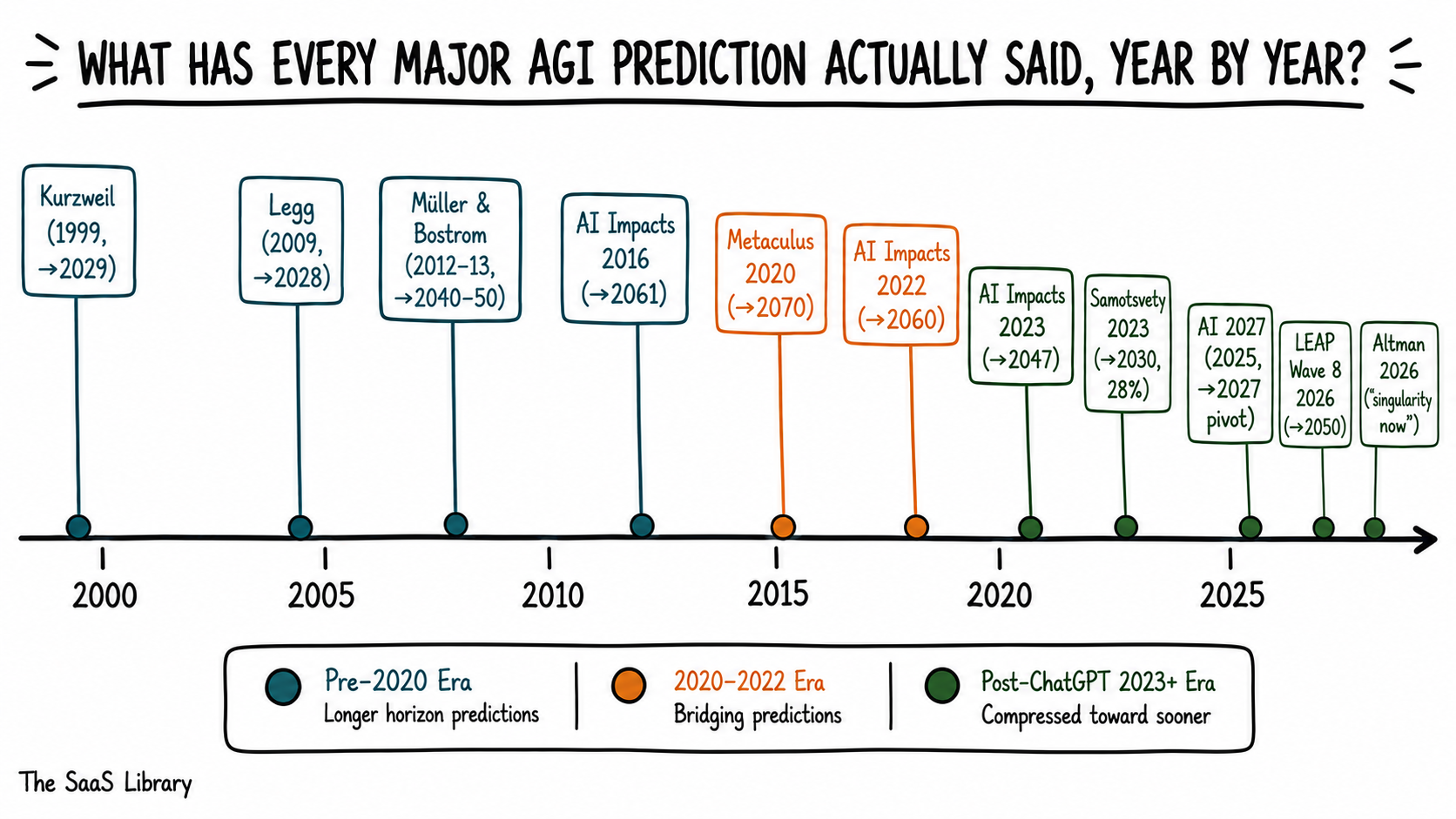
The 2016→2022 survey shift moved one year in six. The 2022→2023 shift moved thirteen years in twelve months. That asymmetry — not any single dramatic prediction — is the strongest evidence something structural changed in 2022–2023, not just sentiment.
Two patterns stand out reading the table in order. First, expert-survey medians and industry-leader estimates have never converged — they remain roughly 15–20 years apart even in 2026. Second, the shift wasn’t gradual: it clusters tightly around the ChatGPT/GPT-4 window, which is exactly where the causal story in the next section begins.
That gap between confidence and calendar is the throughline for everything that follows.
Why Did Deep Learning and Scaling Change Expert Timelines?
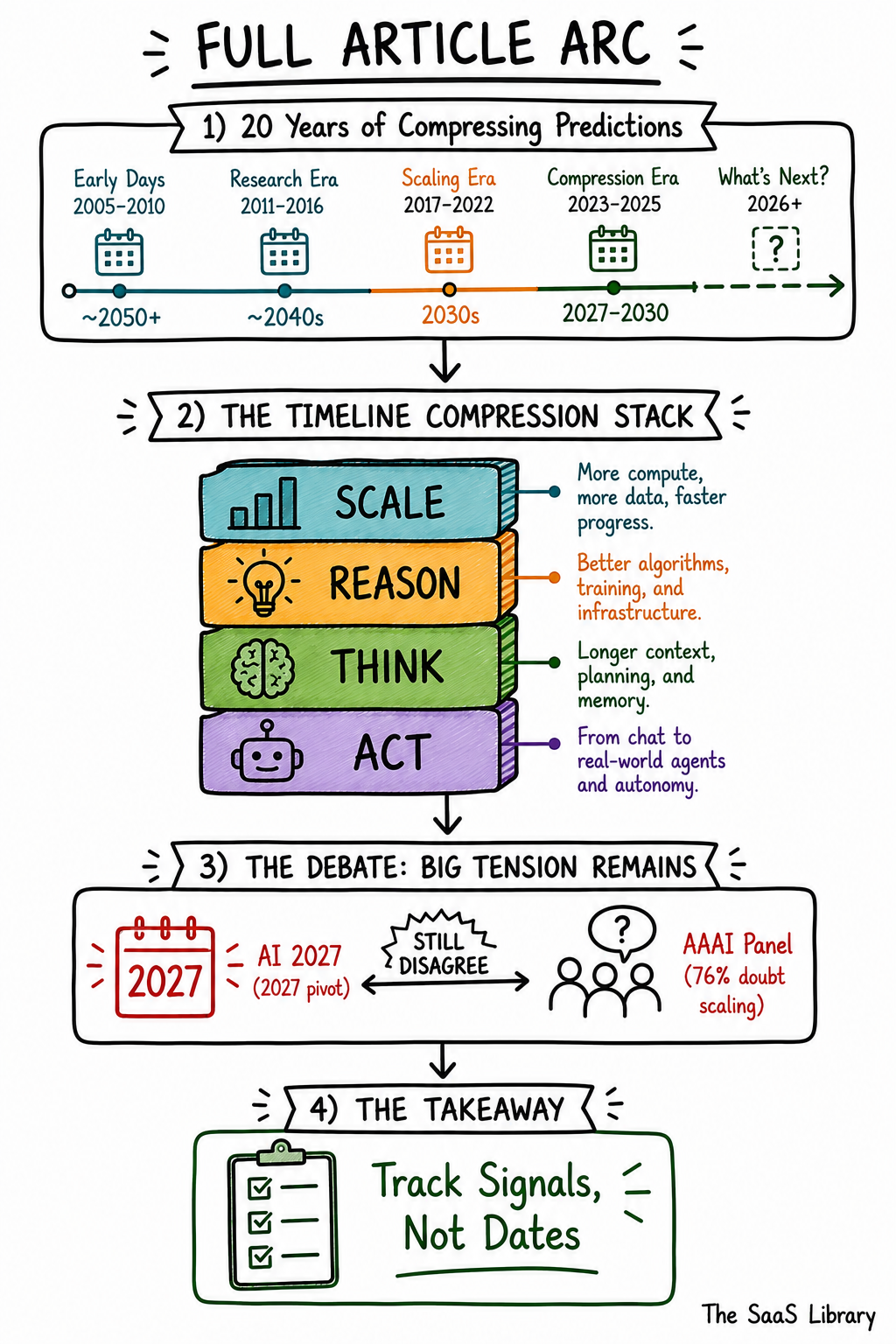
Deep learning and scaling changed expert timelines because four compounding drivers — larger pretrained models, reinforcement-learned reasoning, longer test-time thinking, and agent scaffolding — each produced capability jumps forecasters didn’t expect on that schedule. Together they form what this piece calls the Timeline Compression Stack, and each layer shortened timelines independently of the others.
Deep learning and scaling changed expert timelines because four distinct drivers compounded within a three-year window, and each one surprised forecasters on its own. Training compute for frontier models has grown roughly 4–5x per year since 2020, per Epoch AI. Algorithmic efficiency gains added a further 2–3x per year on top of that — meaning the compute-equivalent leap from GPT-2 to GPT-4 could, on current trends, repeat again by 2028.
That compute alone does not explain the 2022–2023 survey shift. The second driver — teaching models to reason with reinforcement learning — is what actually broke the trend line.
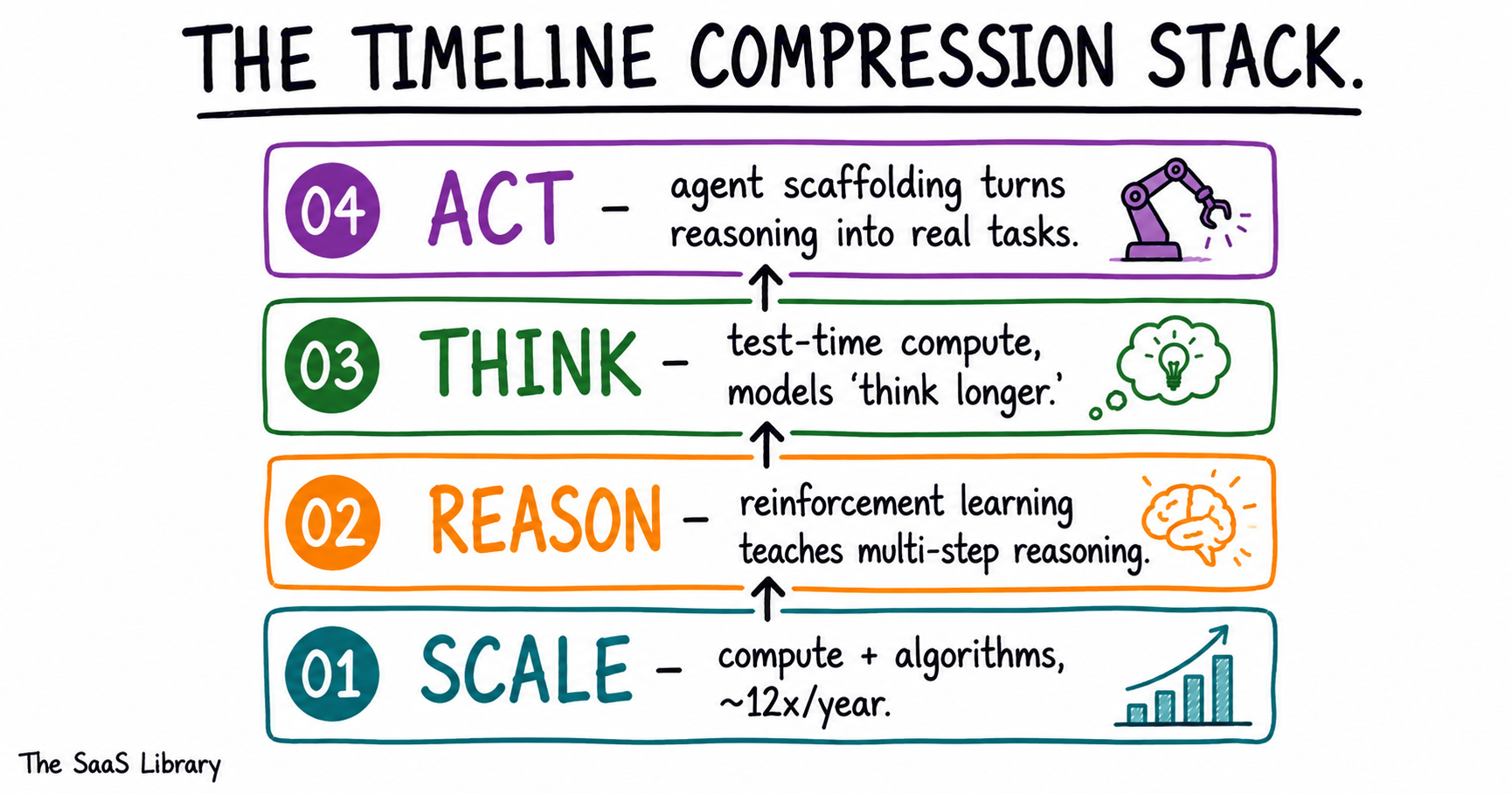
No single driver explains the 2022–2023 compression. It’s the stack — scale enabling reasoning, reasoning enabling longer thinking, longer thinking enabling agents — compounding inside one calendar year that forecasters hadn’t modeled happening together.
The Reasoning Jump
The reasoning jump is the most concrete evidence here. On GPQA Diamond — graduate-level science questions non-experts can’t answer even with 30 minutes and Google — GPT-4 scored barely above chance in 2023. OpenAI’s o1, released October 2024, using reinforcement learning on the same base model, scored roughly 70%, matching PhD-level performance.
From Reasoning to Real-World Capability
Agent scaffolding is why this reasoning gain translated into real-world capability rather than staying a benchmark curiosity. On SWE-bench Verified — real GitHub issues that typically take a human engineer about an hour — GPT-4 alone solved about 20%. Wrapped in simple agent scaffolding, Claude 3.5 Sonnet solved roughly 50%, and OpenAI’s o3 reportedly cleared 70%, matching professional software engineers on that specific task type.
None of these benchmarks generalize cleanly to messy, long-horizon knowledge work. Reasoning models excel specifically where answers are verifiable — math, code, science — and that selection bias is central to the skepticism examined in Section 5.
This is also why the reasoning shift is entangled with recursive self-improvement, the mechanism at the center of the AI 2027 scenario: reasoning models can generate their own verified training data — solve a math problem, check the answer, keep only the correct chains of reasoning — creating a feedback loop that doesn’t require new human-written text. That loop, if it holds up, is the single mechanism separating a fast takeoff from a slow one.
What Does the AI 2027 Scenario Actually Assume — and Why Does It Matter?
AI 2027 assumes that reasoning models automating AI research itself triggers a feedback loop — AI systems improving the systems that build them — compressing years of algorithmic progress into months. It matters because its authors, forecasters with strong track records, built the most detailed public model of how AGI could compound into superintelligence, not just when AGI arrives.
So far: four compounding drivers explain why capability jumped in 2022–2024. What’s still unresolved is whether that jump also shortens the gap between AGI and superintelligence — which is what AI 2027 tries to model.
AI 2027 assumes recursive self-improvement is the mechanism that turns AGI into superintelligence quickly, not a separate later problem. Published April 3, 2025 by Daniel Kokotajlo, Eli Lifland, Thomas Larsen, and Romeo Dean, with Scott Alexander as writer, the scenario is a joint project of the AI Futures Project — a team that includes a former OpenAI researcher and forecasters with strong public track records on earlier AI predictions.
Four Load-Bearing Assumptions
The scenario is fiction in form but built from four load-bearing assumptions, not from narrative invention:
| Assumption | What It Claims | Why It’s Influential |
|---|---|---|
| Recursive self-improvement | AI systems that automate AI research create a feedback loop, each generation building the next faster than humans could | Directly extends the “Act” and “Reason” layers of the Timeline Compression Stack to their logical endpoint |
| AI researchers managing AI researchers | Automated systems eventually supervise other automated systems, with human oversight increasingly nominal | Reframes the AGI question from “can it do one job” to “can it run the lab” |
| Synthetic data | Models generate and verify their own training data once reasoning is reliable enough, reducing dependence on human-written text | Directly builds on the reasoning-model mechanism from the Timeline Compression Stack |
| Government involvement | National governments intervene once capability gains become militarily or economically significant, reshaping the race’s incentives | Distinguishes AI 2027 from purely technical forecasts — it treats politics as part of the timeline, not an afterthought |
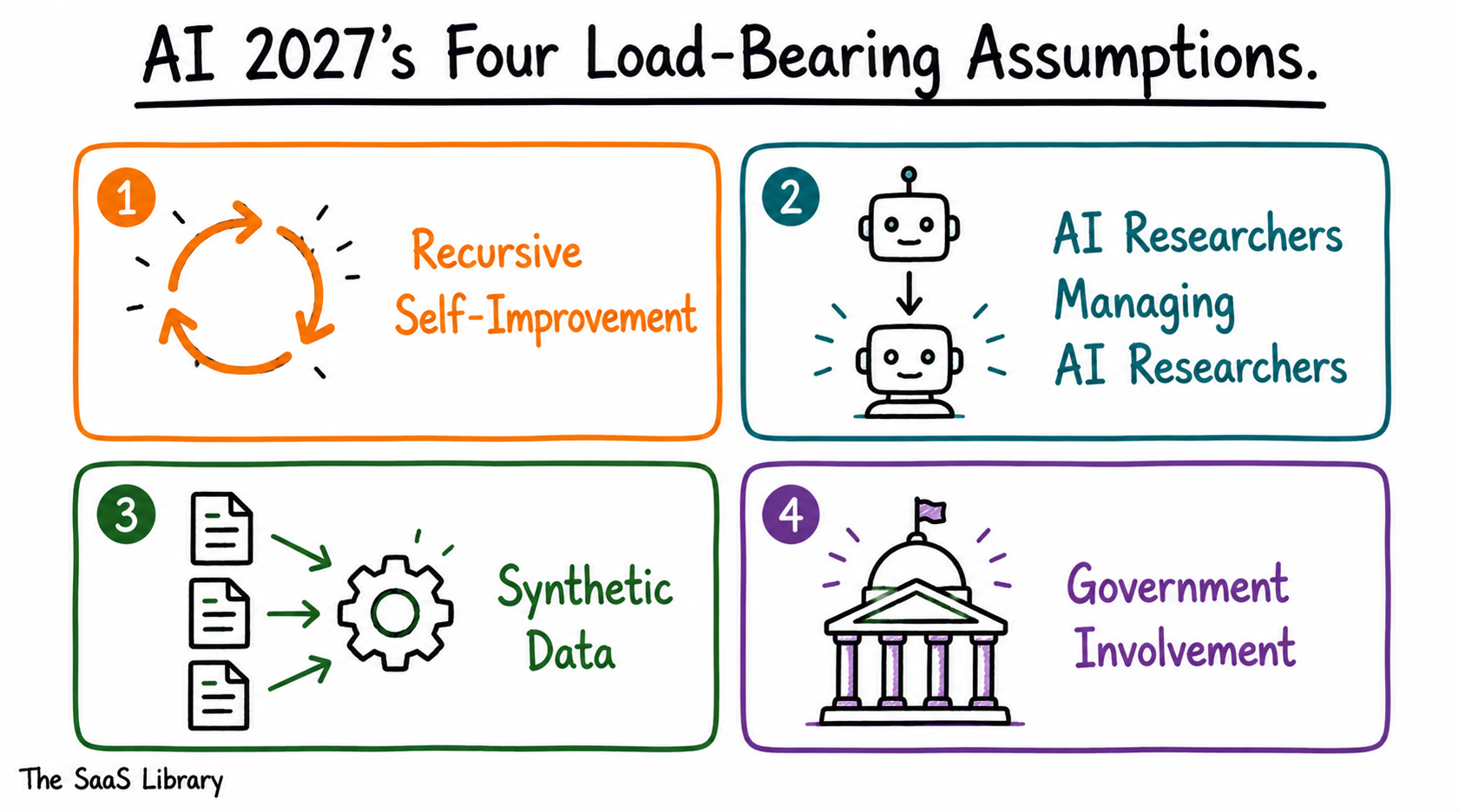
AI 2027 is not a prediction that AGI arrives in 2027 — it’s a model of the mechanism, recursive self-improvement, that would make the gap between AGI and superintelligence short once AGI arrives at all.
The Authors’ Own Walk-Back
The scenario’s own authors have since revised it — a fact rarely mentioned in coverage that treats AI 2027 as settled prophecy. In a December 2025 model update, Kokotajlo’s Automated Coder milestone moved to mid-2028 and Lifland’s to mid-2030, both later than the original scenario implied. By May 2026, the AI Futures Project’s own retrospective judged the scenario “directionally accurate but too fast” — the mechanism held up better than the calendar.
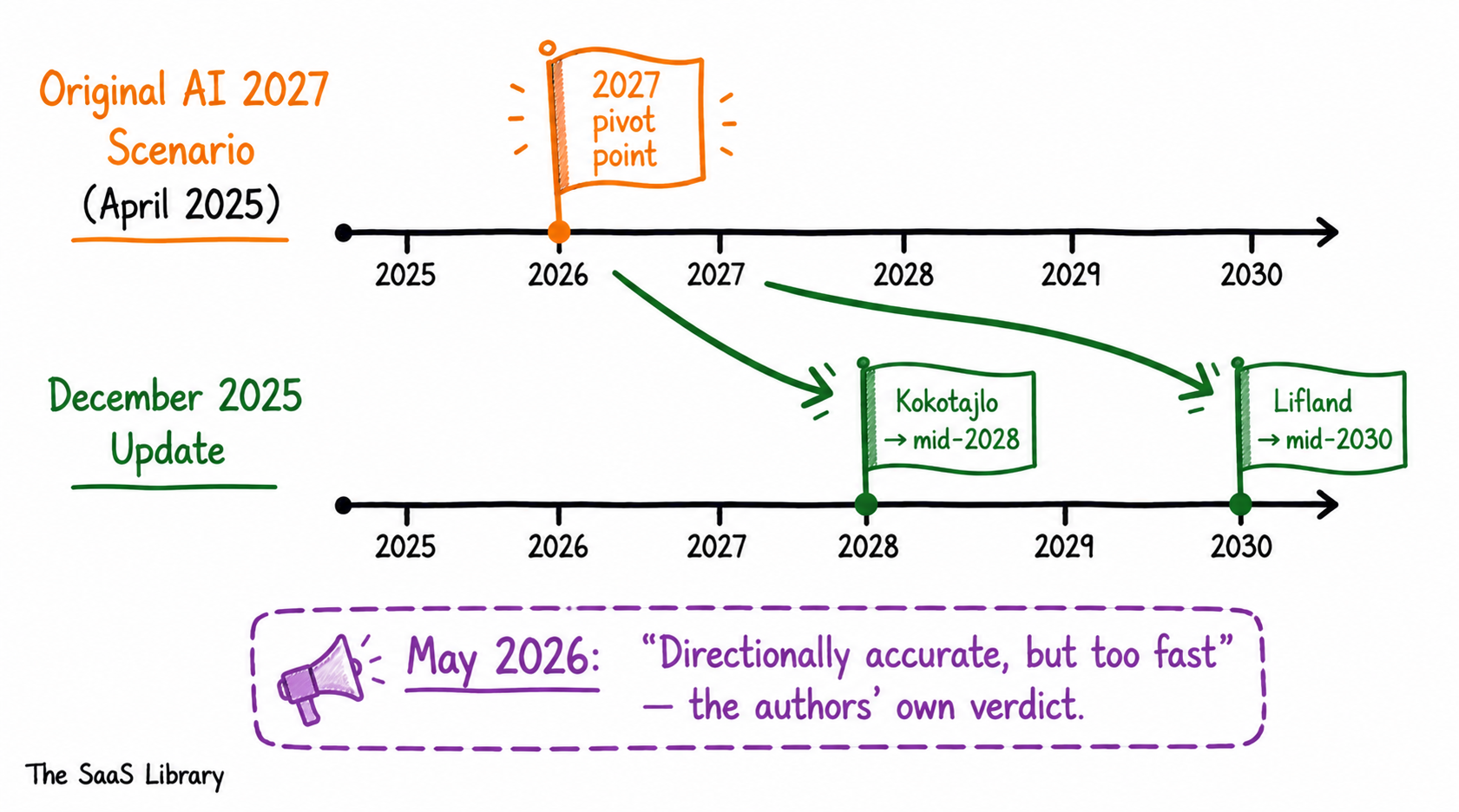
Treating AI 2027 as one data point rather than a definitive answer isn’t a hedge — it’s what the scenario’s own authors now do with it.
That self-correction matters more than the original headline date. A scenario whose authors publicly moved their own milestones later, then judged their mechanism right and their timing wrong, is stronger evidence for taking the mechanism seriously than a scenario nobody ever checked against reality. Not every forecast gets that kind of public accountability.
Why Do Many Experts Still Disagree?
Many experts still disagree because the strongest evidence for near-term AGI — benchmark saturation and the METR time-horizon trend — only measures tasks with verifiable answers, and skeptics argue real economic work is dominated by exactly the messy, long-context tasks reasoning models haven’t touched. A 2025 AAAI panel found 76% of surveyed researchers doubt scaling alone reaches AGI at all.
Many experts still disagree because the case for near-term AGI and the case against it are measuring different things, not disputing the same evidence. The 76% figure is the clearest data point here: a 2025 AAAI Presidential Panel of 475 researchers found three in four doubt that scaling current approaches reaches AGI — a view examined in more depth in our claim-by-claim audit of the LLM scaling debate, which traces exactly how Yann LeCun’s “world models” bet and Ilya Sutskever’s “age of research” framing fit into this same disagreement.
The Skeptical Case
The skeptical case rests on four arguments, not one:
| Skeptic Argument | Core Claim | Who Makes It |
|---|---|---|
| Benchmarks measure the easy part | Reasoning models excel at verifiable tasks (math, code) because those are trainable by reinforcement learning — real jobs are dominated by ill-defined, long-context work that isn’t | James Fodor, EA Forum critique of short-timeline models |
| Moravec’s Paradox | Skills humans find effortless (perception, motor control) are computationally harder to replicate than skills that look impressive (PhD-level reasoning) — benchmark performance overstates real capability | Hans Moravec, formalized 1988; cited across current skeptic literature |
| The “moving horizon” pattern | Forecasters have historically placed AGI 15–25 years out regardless of when asked, which is exactly what today’s numbers still show once you exclude industry leaders | Armstrong & Sotala’s historical forecast analysis, cited in BlueDot Impact’s 2025 review |
| Diminishing returns on scaling | Compute and algorithmic research require an exponentially growing workforce to sustain current gains — a workforce that can’t grow at 2022–2023 rates indefinitely | Epoch AI research; 80,000 Hours’ own bottleneck analysis |
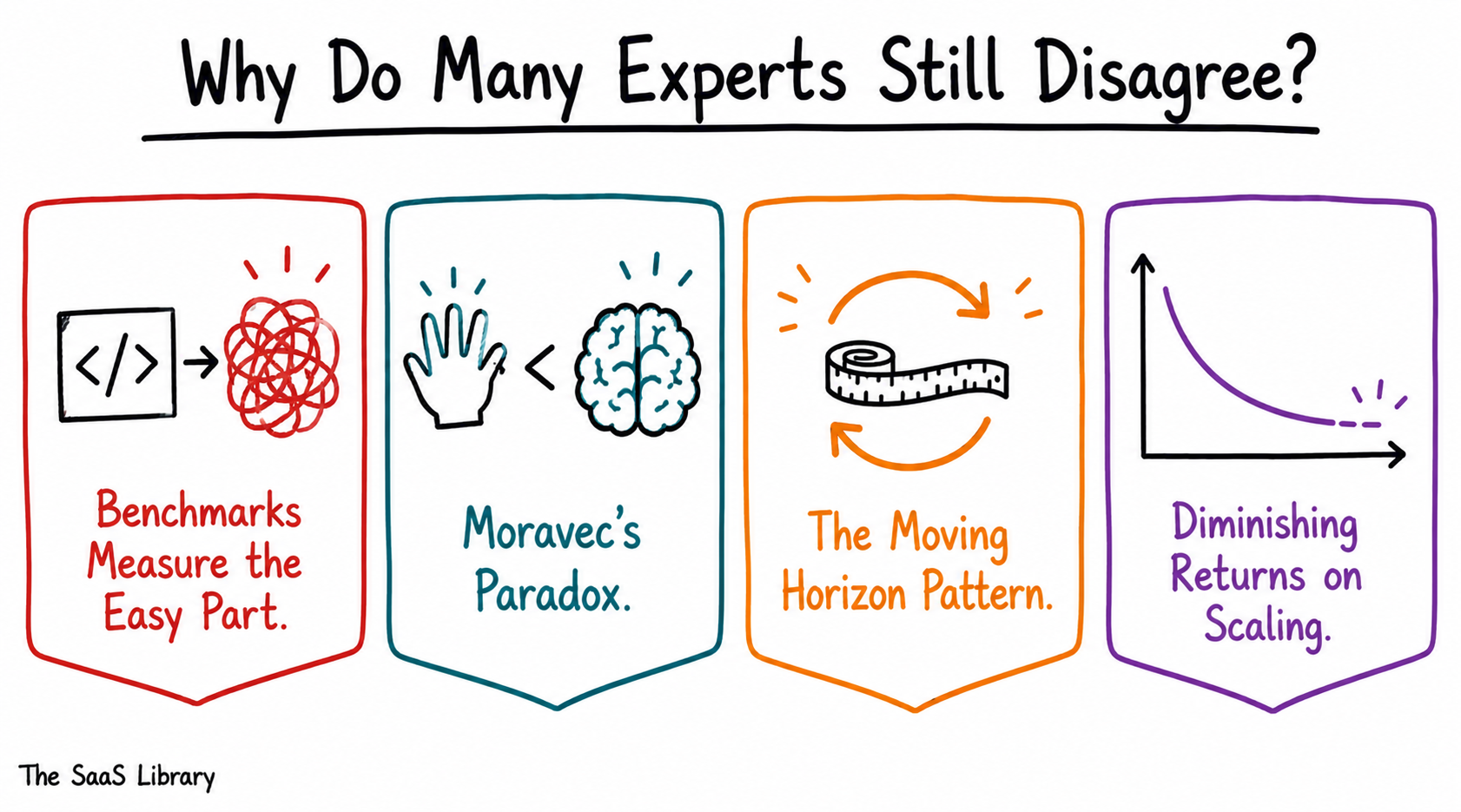
The AI 2027 authors’ own self-correction is itself evidence for the skeptical camp — the scenario’s original 2027 pivot point was, by its own authors’ admission, too fast. That doesn’t invalidate the mechanism; it validates the caution.
The Scaling Hypothesis’s Own Author Walks It Back
Richard Sutton — 2024 Turing Award winner and author of “The Bitter Lesson,” the essay that arguably justified the entire scale-everything era — has become one of the most credentialed skeptics of the current path. On the Dwarkesh Podcast, he argued LLMs learn to predict what a human would say, not what happens in the world, and that no amount of scale fixes an inability to learn on the job.
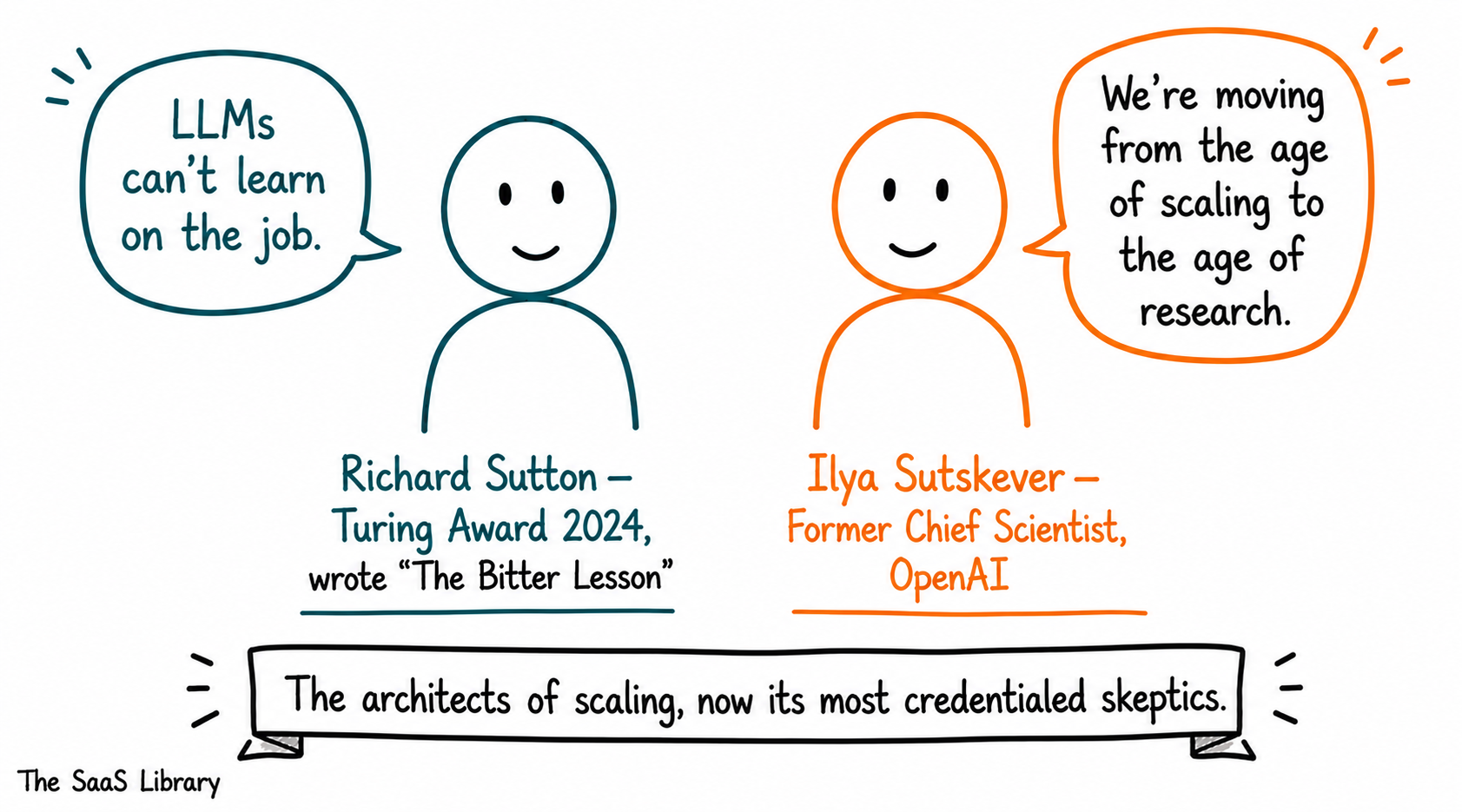
Sutskever’s line matters precisely because he isn’t an outside critic — he’s the person most publicly associated with the scaling hypothesis walking back its sufficiency, not its validity. That’s a different kind of evidence than a skeptic who was never convinced to begin with.
Nobody serious in this debate argues LLMs have stalled. The disagreement is narrower and sharper than that: whether scaling the current approach, on its own, closes the remaining gap — or whether it needs a genuinely different architecture to finish the job.
This is also where the “moving horizon” critique earns its place. Forecasters saying “15–25 years” has been the modal answer for six decades — which is exactly why the compression documented earlier needs to be judged against that base rate, not treated as automatically meaningful just because it’s recent.
Could AGI Arrive Before 2030?
AGI could arrive before 2030 — no evidence here rules it out, and several forecasting methods assign it real probability. But it isn’t the expected outcome: peer-reviewed surveys and the most rigorous forecasting panel available put the median date closer to the late 2040s, with lab leaders as the clear outlier on the short end.
AGI could arrive before 2030, and the honest answer stops there — not because the evidence is thin, but because it points in two directions at once, from methods that don’t agree on what “AGI” even means. Lay every verified number from this article side by side and the split is stark, not subtle.
| Forecasting Method | 2030 Probability / Estimate | What It’s Actually Measuring |
|---|---|---|
| AI Impacts/Grace et al. survey (2023, N=2,778) | Median year 2047, not a 2030-specific probability | Human-level machine intelligence, peer-reviewed academic definition |
| Samotsvety superforecasters (2023) | ~28% by 2030 | Adversarial Turing test against a top-5% human |
| LEAP Wave 8 experts (2026) | 50% probability by 2030 on an 8-hour-task capability benchmark; median 2050 for full AGI-existence consensus | Two different questions — near-term capability vs. panel-wide AGI agreement |
| LEAP Wave 8 superforecasters | 2028 (capability benchmark); 2047 (AGI-existence median) | Same split as above, slightly more aggressive |
| Industry leaders (Hassabis, Altman, Amodei, 2025–26) | “2030 ±1 year” to “within a few years” | Individual judgment, not a surveyed or peer-reviewed estimate |
| AAAI Presidential Panel (2025) | 76% doubt scaling alone reaches AGI | Whether the current architecture is sufficient at all — a different question than “when” |
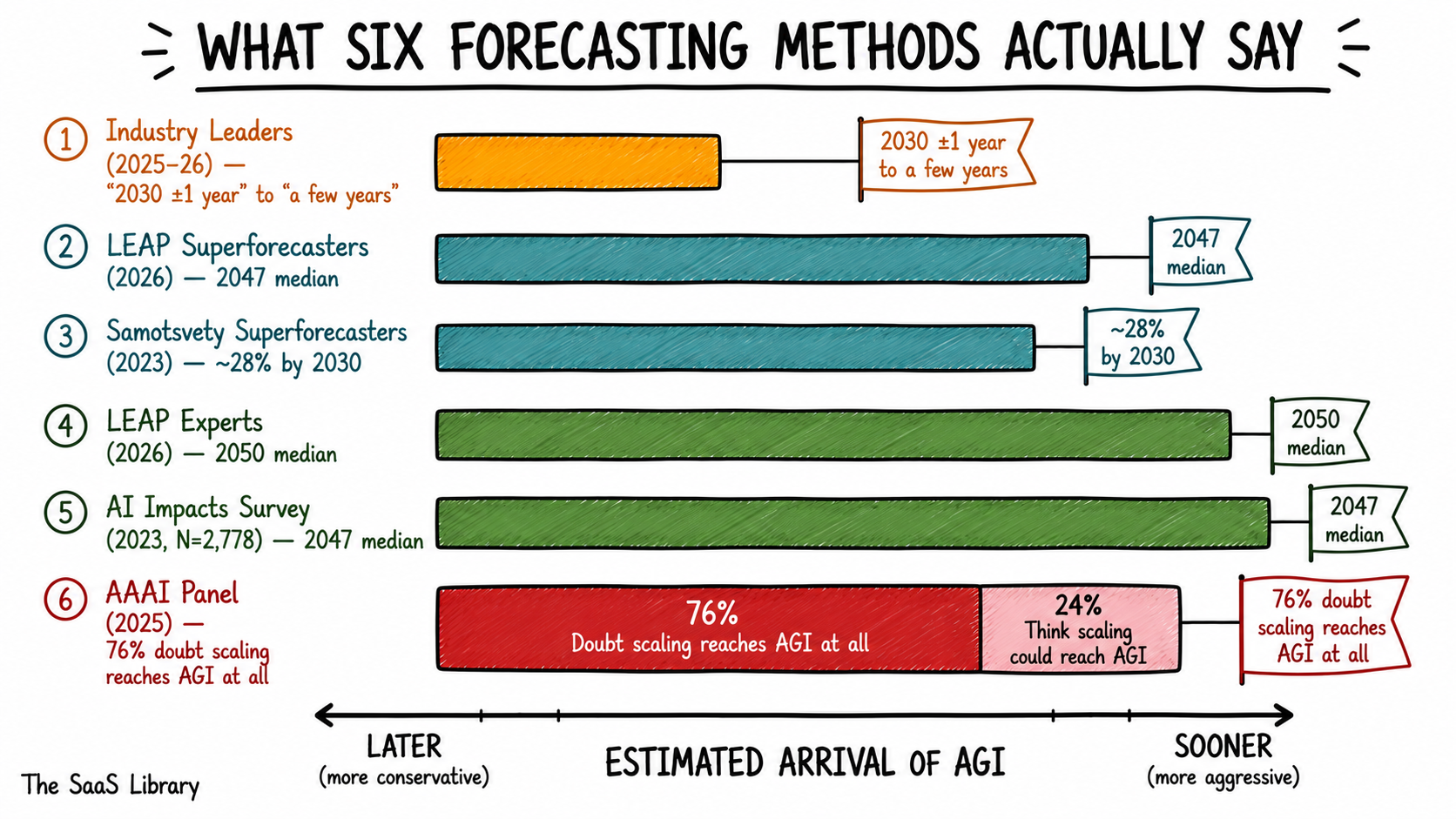
The Timeline Compression Stack explains why every method moved earlier since 2020. It does not resolve why methods still disagree by 15–20 years — that gap comes from unresolved questions about definition, architecture, and whether benchmark gains generalize, not from anyone having better data than anyone else.
Two things are true simultaneously, and neither cancels the other out. First, “AGI before 2030” is no longer a fringe position — it sits within the range of serious expert opinion, held by people with direct visibility into frontier model development. Second, the single largest, most rigorously sampled survey of AI researchers ever conducted still puts the median date nearly two decades later, and 76% of a separate expert panel doubt the current approach gets there at all.
Dismissing 2030 as “sci-fi” is no longer defensible given who holds that view. Treating it as consensus is equally indefensible given what the largest surveys actually show. Both errors are common; neither is supported by the evidence in this article.
The AI 2027 authors’ own walk-back is the most concrete evidence available for how this actually resolves in practice: not by one side being right, but by real-world milestones landing later than the most aggressive forecasters expected, while still arriving faster than the most conservative ones predicted. That pattern — directionally right, temporally early — is likely to repeat, which is exactly why probability ranges, not single dates, are the only honest way to hold this question.
What Should Businesses Actually Do About This?
Businesses should plan against a probability range, not a single date — treating 2030 as plausible but not assumed, and tracking a small set of concrete signals (METR’s time-horizon trend, AI 2027’s own milestone checkpoints, the next AI Impacts survey) rather than any one lab’s marketing claim or any one scenario’s headline year.
Businesses should stop asking “when does AGI arrive” and start asking “which of my decisions actually depend on the answer.” Most don’t. A pricing model, a hiring plan, or a product roadmap built for 2027 and a version built for 2047 look identical for the next 18 months — the compute, agent tooling, and reasoning-model gains already documented in this article are arriving regardless of when, or whether, they add up to AGI.
| If your plan assumes… | Track this signal instead of a date |
|---|---|
| Rapid AI-driven headcount changes | METR’s time-horizon benchmark — task length AI can complete reliably, updated regularly |
| A specific “AGI moment” changing your market | AI 2027’s own milestone checkpoints (Automated Coder, superhuman coder) — the authors publish updates when they slip |
| Expert consensus supporting your timeline | The next AI Impacts survey (last run 2023) — the single most-cited compression data point in this piece |
| Competitors racing toward the same capability | Whether frontier labs actually ship agent products at the pace the Timeline Compression Stack implies, not whether they say they will |
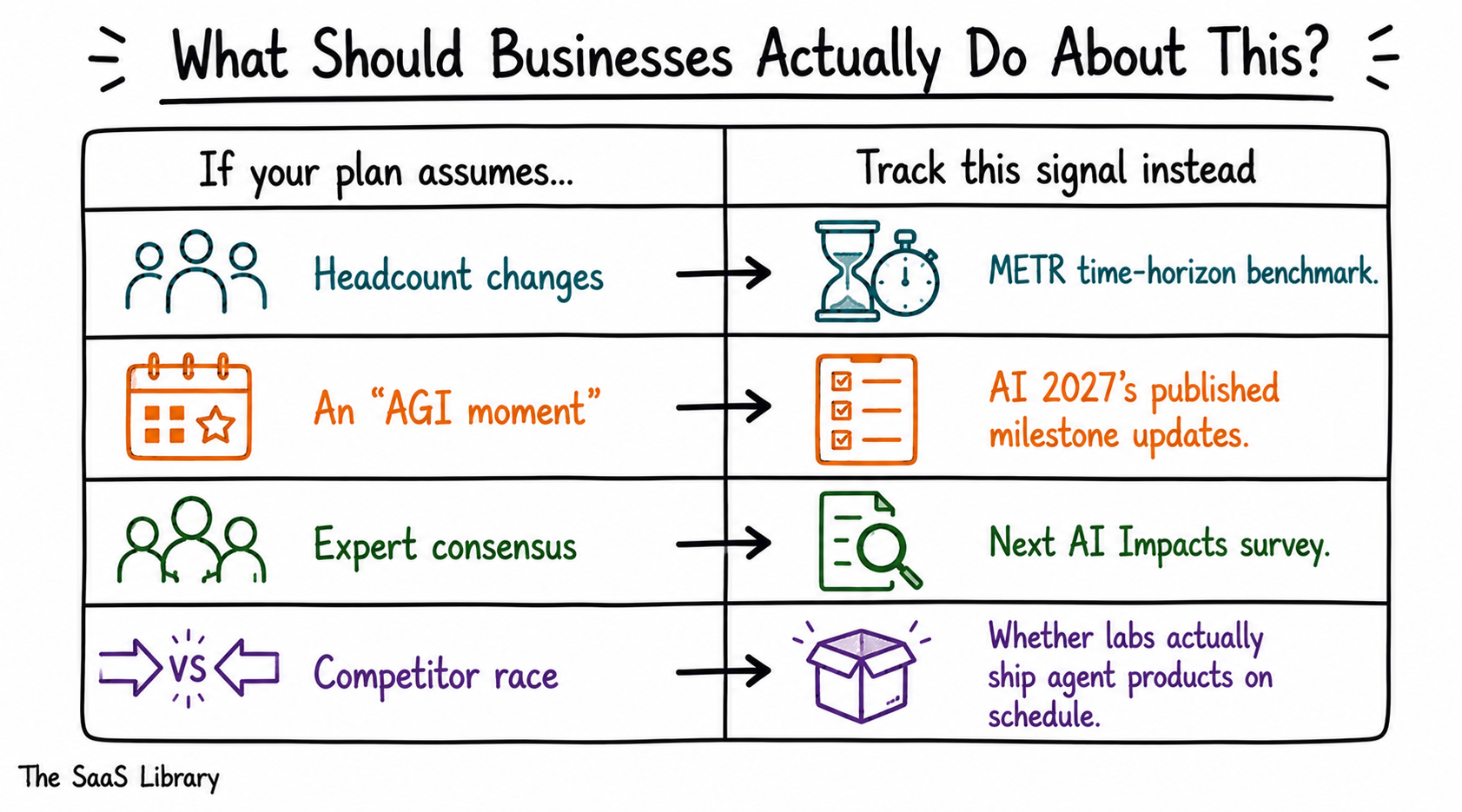
76% of surveyed AI researchers doubt current scaling alone reaches AGI — a genuine reason to hedge against overbuilding around any single aggressive timeline (AAAI Presidential Panel, 2025).
The practical failure mode isn’t betting wrong on a date — it’s building a plan that only works if one specific scenario happens exactly on schedule. The Timeline Compression Stack will keep compounding whether or not the word “AGI” ever gets formally applied to the result, and that’s the part worth planning around.
The capability gains are real and arriving on a predictable-enough schedule to plan for. The AGI label is the least useful part of the forecast to build a business decision around.
Teams already navigating this — deciding how much to automate now versus wait — are running into the same adoption-outpaces-control gap covered in our look at why companies running AI agents can’t govern them: speed of rollout and speed of oversight aren’t the same speed.
Frequently Asked Questions
Could AGI arrive before 2030?
AGI could arrive before 2030 — no evidence rules it out, and some credible forecasters assign it real probability. But the largest peer-reviewed expert survey (2023, N=2,778) puts the median date at 2047, and 76% of a separate AAAI panel doubt current scaling reaches AGI at all.
What is AGI?
AGI is a hypothetical AI system that matches or exceeds human performance across virtually any cognitive task, rather than excelling at one narrow domain.
What is the difference between AGI and an AI agent?
An AI agent is an LLM wrapped with memory, tools, and a planning loop so it can complete multi-step tasks — a capability that already exists in narrow form. AGI is a system that could do this across nearly any domain, which does not yet exist.
Why have AGI predictions gotten shorter?
AGI predictions have gotten shorter because four compounding drivers — compute scaling, reinforcement-learned reasoning, longer test-time thinking, and agent scaffolding — produced capability jumps between 2022 and 2024 that forecasters hadn’t modeled happening together.
What did the 2023 AI Impacts survey find?
The 2023 AI Impacts survey of 2,778 researchers found a median estimate of 2047 for human-level machine intelligence — 13 years earlier than the same survey’s 2022 result of 2060.
Is the AI 2027 scenario accurate?
The AI 2027 scenario’s own authors judged it “directionally accurate but too fast” in a May 2026 retrospective, after pushing key milestones — including the Automated Coder date — later than the original 2027 scenario implied.
Why do experts disagree about AGI timelines?
Experts disagree about AGI timelines because benchmark gains are concentrated in verifiable tasks like math and code, while skeptics argue real economic work is dominated by messy, long-context tasks that reasoning models haven’t demonstrated mastering.
What is recursive self-improvement?
Recursive self-improvement is the mechanism where AI systems automate AI research itself, creating a feedback loop in which each model generation improves the next faster than human researchers could alone — the central assumption behind the AI 2027 scenario.
Do most AI researchers believe scaling reaches AGI?
Most surveyed AI researchers do not believe scaling alone reaches AGI — a 2025 AAAI Presidential Panel found 76% of 475 respondents doubt current approaches are sufficient.
What is the METR time horizon benchmark?
The METR time horizon benchmark measures the length of real software engineering tasks an AI can complete reliably, and shows that length doubling roughly every seven months since 2020, closer to every four months since 2024.
Will AGI replace jobs?
AGI could automate a large share of cognitive work if the capability gains in this article continue, but no verified forecast assigns a specific date or percentage to job displacement — businesses are better served planning around concrete capability signals than a job-loss timeline nobody can currently back with data.
What should businesses do about AGI timelines?
Businesses should plan against a probability range rather than a single date, tracking concrete signals — the METR benchmark, AI 2027’s published milestone updates, the next AI Impacts survey — instead of any one lab’s marketing claim.
Conclusion
AGI timelines compressed because the Timeline Compression Stack — scale, reasoning, test-time thinking, agents — compounded within one calendar window forecasters hadn’t modeled together. Nobody knows if AGI arrives before 2030. But the compression is real, verified across independent methods, and unlikely to reverse. Plan around the signals, not the date — starting with how AI hiring decisions are already being made and unmade on timelines nobody can actually confirm.
- Ray Kurzweil — The Age of Spiritual Machines (1999) / The Singularity Is Near (2005)
- Dwarkesh Podcast — Shane Legg (DeepMind), Oct 2023
- Müller, V.C. & Bostrom, N. — Future Progress in Artificial Intelligence: A Survey of Expert Opinion, survey conducted 2012–13
- Grace et al. — AI Impacts Expert Survey series, 2016 & 2022
- Grace et al. — Thousands of AI Authors on the Future of AI, JAIR Vol. 84, Art. 9, 2025
- 80,000 Hours — Shrinking AGI timelines: a review of expert forecasts (Samotsvety data)
- AI Futures Project — AI 2027, April 2025
- AI Futures Project — AI Futures Model: Dec 2025 Update
- Hybrid Horizons Substack — AI 2027 Was Early. The Scoreboard Is Missing the Plot., May 2026
- Forecasting Research Institute — LEAP Wave 8, June 2026
- Business Chief — Demis Hassabis, June 2026
- Al Jazeera, Fortune, Forbes (Lance Eliot, July 28, 2026) — Sam Altman “singularity” remarks, Relentless podcast, July 25, 2026, cross-verified across independent reporting
- Epoch AI — Training Compute of Frontier AI Models Grows by 4-5x per Year, 2024
- Kaplan et al. — Scaling Laws for Neural Language Models, arXiv:2001.08361, 2020
- Hoffmann et al. — arXiv:2203.15556, 2022 (“Chinchilla”)
- METR (Kwa et al.) — arXiv:2503.14499, March 2025
- TechPolicy.Press — AAAI Presidential Panel on the Future of AI Research, 2025
- Hans Moravec — Mind Children, 1988
- BlueDot Impact — Why do people disagree about when powerful AI will arrive?, June 2025
- Dwarkesh Podcast — Richard Sutton interview, 2025
- Dwarkesh Podcast — Ilya Sutskever interview, Nov 25, 2025
- Morris et al. (DeepMind) — Levels of AGI: Operationalizing Progress on the Path to AGI, arXiv:2311.02462