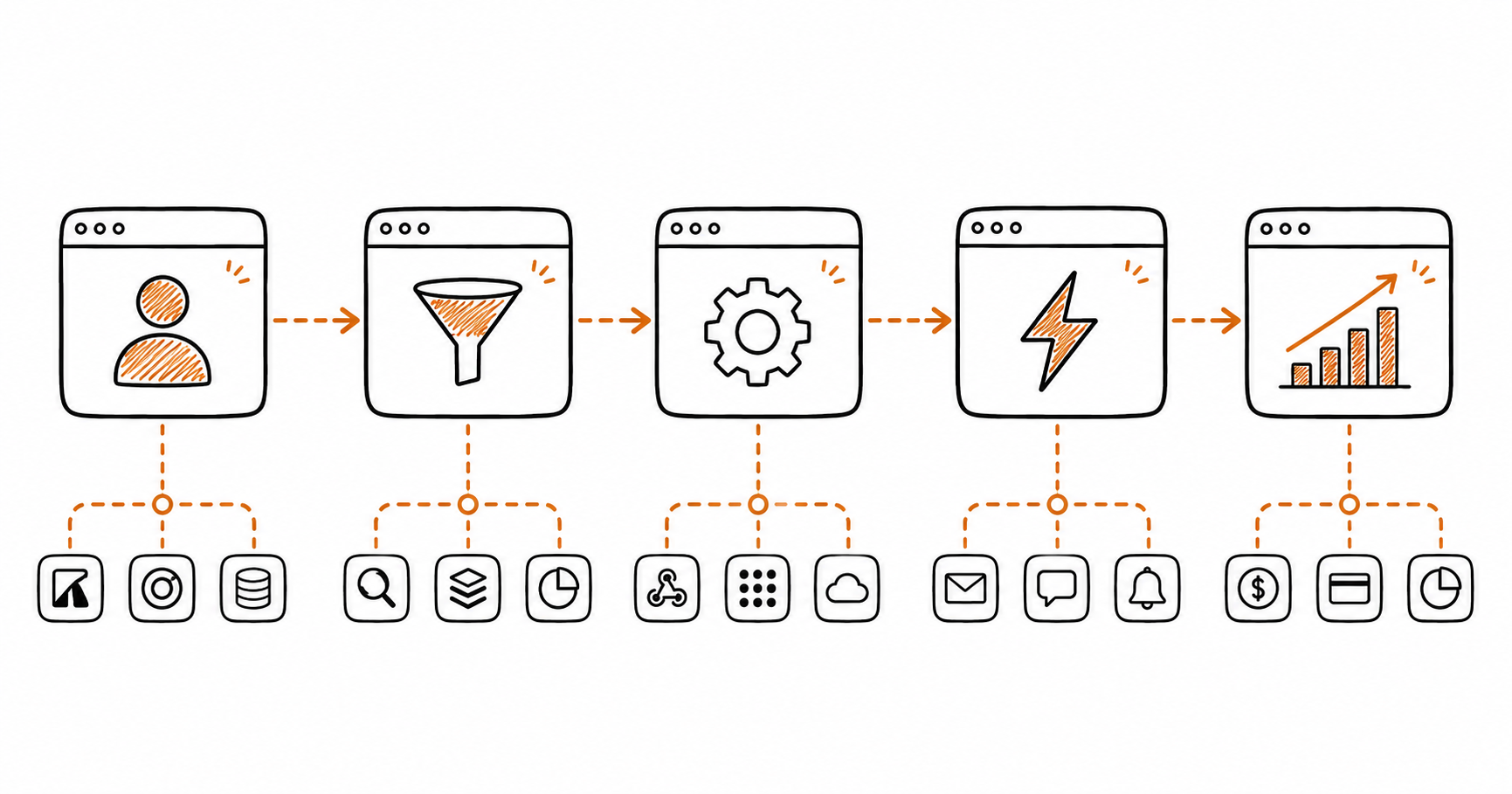
Every “best automation tools” list gives you the same ten names. None of them tell you which one to buy first, what to pair it with, or what happens when it breaks. That gap is where most automation budgets go to die.
The best automation tools for businesses in 2026 are not individual platforms — they are coordinated stacks of two or three tools, each with a defined role, working together toward a specific business goal. Whether you are trying to stop leads going cold, convert more trials without manual follow-up, or run a full GTM motion on autopilot, the answer is almost never one tool. It is a stack. If you are already thinking about how AI feeds your lead scoring system, you are asking the right question — and the stack you build around it determines whether that investment pays off.
This article organises the best business automation tools by goal, not by category. Each section names a specific operational problem, identifies the stack that solves it, and gives each tool a defined role so you know exactly what you are buying and why. To help you find your starting point, we built a framework called the Automation Stack Decision Map — and an interactive tool at the bottom of this page that maps your biggest pain point to the right stack for your stage.
The Automation Stack Decision Map is a prioritisation framework developed by The SaaS Library that helps B2B SaaS operators identify which automation goal to address first and which specific tool stack achieves it, based on their business stage, team size, and technical capacity.
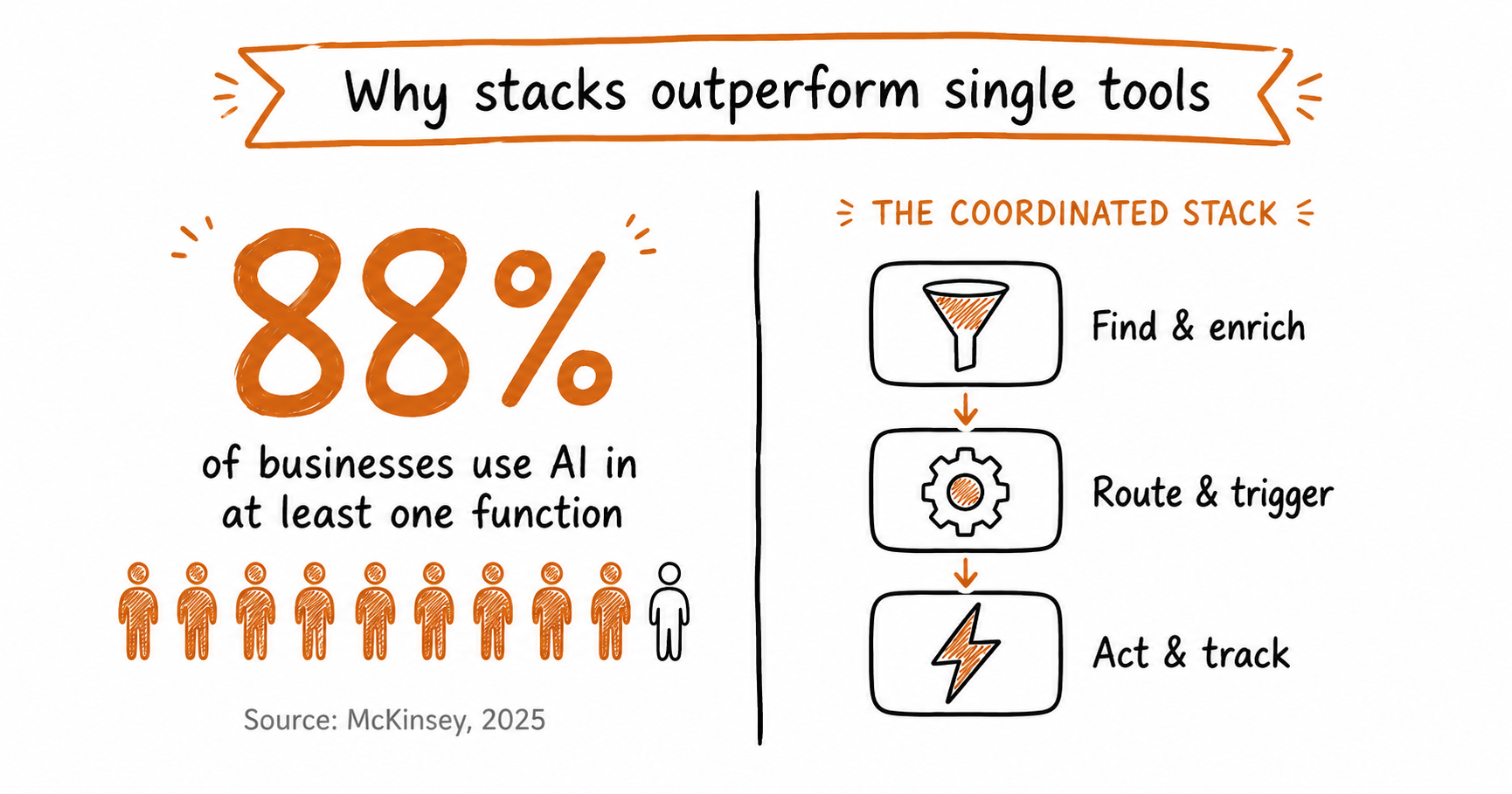
88% of organisations now use AI in at least one business function — but coordinated, goal-based stacks remain the exception. Source: McKinsey State of AI, 2025.
The best automation tools for businesses in 2026 are not individual platforms — they are stacks. This article maps eight common operational goals to the two or three tools that solve each one, with a clear role for every tool and a deploy signal so you know when you are ready to build it.
Click or tap any node to jump to that stack. Stacks in the top-left quadrant — high urgency, lower complexity — are your best starting point.
The Stack That Catches Leads Before They Go Cold
Most B2B SaaS teams are losing leads they already paid to acquire. A form gets submitted, it sits in an inbox, someone responds the next morning — and the lead has already booked a demo with a competitor. The window is minutes, not hours.
This stack closes that window automatically. Apollo.io identifies and surfaces the inbound lead with full contact and company context. Zapier fires the routing trigger the moment the form submission lands — no human required. HubSpot creates the contact, assigns ownership, logs the interaction, and launches the first follow-up sequence before your team has opened their laptop. The human steps in when there is a reply — not before.
Stack: Apollo.io · HubSpot · Zapier — also see 15 Best AI Tools for Business Automation in 2026
The Stack That Converts Trials Without a Single Manual Follow-Up
The median B2B SaaS trial-to-paid conversion rate is 18.5% — which means more than 80% of trial users vanish without ever paying. Most of those losses happen because the follow-up sequence fires on a calendar, not on behaviour. A user who has not logged in for four days gets the same email as one who just completed onboarding.
Customer.io fires behaviour-triggered sequences based on what users actually do inside the product — login events, feature usage, milestone completions. Intercom handles real-time in-app nudges and chat when a user is active but stuck. HubSpot tracks trial progression as a deal stage and flags high-intent users for a human touchpoint when data says they are close, not when the calendar says it is day seven.
Stack: Customer.io · Intercom · HubSpot
The Stack That Builds Your Outbound List While You Sleep
SDRs spend more than a third of their time building lists and researching prospects instead of selling. The data going into those lists is often stale, incomplete, or misaligned with the ICP — which means the outreach that follows is destined to underperform before it starts.
Clay pulls from 50+ data sources to build, enrich, and continuously update an ICP-matched prospect list — firmographic data, technographic signals, hiring patterns, intent signals — without a human touching a spreadsheet. Apollo.io validates contact data and surfaces buying signals in real time. Lemlist runs personalised, multi-channel outreach sequences at scale using the enriched data Clay produces — so every email references something specific and true about the recipient, not a mail-merged first name.
Stack: Clay · Apollo.io · Lemlist — also see How to Build an AI Lead Scoring System for B2B SaaS
Don’t learn AI. Pick an agent, pick the simplest possible use case, deploy it yourself, train it, QA it, test it. If you do that, you’ll be ahead of 90% of the world.
The Stack That Eliminates the Manual Work Nobody Wants to Do
Every SaaS ops team has a graveyard of manual tasks that should have been automated two years ago — copying data between tools, updating records that should update themselves, chasing people for inputs that a system should capture automatically. These tasks are not complex. They are just unfinished.
Zapier handles the simple if-this-then-that triggers across your existing tools. Make manages the workflows that need conditional logic, multi-step branching, or data transformation. Notion acts as the connected ops layer — the place where outputs land, tasks get assigned, and the team can see what the automation has done without digging into logs.
Stack: Zapier · Make · Notion — comparing both? See Zapier vs Make (2026)
The Stack That Qualifies and Responds to Inbound Without an SDR
More than half of all inbound leads arrive outside standard business hours. If your qualification process depends on a human SDR being available to respond, you are losing those leads to whoever responds first — and in competitive SaaS markets, that window is not days, it is minutes.
Lindy acts as an AI agent that qualifies inbound leads via email and chat in real time — asking the right questions, filtering out low-intent traffic, and routing high-intent prospects forward without a human in the loop. Intercom handles multi-channel response across website chat, email, and in-app so no inbound touchpoint goes dark. HubSpot captures the qualified lead, creates the contact, assigns ownership, and triggers the sequence for the human follow-up at the point where judgement is actually required.
Stack: Lindy · Intercom · HubSpot — evaluating CRM options? See HubSpot vs Salesforce (2026)
The most automated companies aren’t running the most tools. They’re running the fewest tools with the clearest handoffs.
The Stack That Turns Product Signals Into Revenue Before Users Churn
Between 40% and 60% of free users in a typical PLG funnel never reach the activation milestone. They sign up, poke around, and disappear — and most SaaS companies have no automated system that catches them before they leave. The signal that a user is about to churn, or ready to expand, is sitting in your product data and nobody is acting on it.
Customer.io monitors in-product behaviour and fires signals the moment a user hits or misses a key activation milestone — not after a week of inactivity, but in real time. Clay enriches the flagged user with firmographic and intent data — company size, growth signals, recent funding — so your team knows whether to prioritise a save or an expansion play. HubSpot triggers the right action based on the enriched signal: an automated win-back sequence, a CSM alert, or an upsell workflow.
Stack: Customer.io · Clay · HubSpot — for PLG benchmarks, see OpenView 2023 Product Benchmarks
The Stack That Runs Complex AI Workflows Without an Engineer
Most SaaS teams have identified workflows that cross three or more tools and currently require a human to manage every handoff. The data comes in from one place, needs to be processed, transformed, or reasoned about, and then sent somewhere else — and the only thing holding it together is a person copying and pasting. That is not a workflow. That is a bottleneck with a job title.
n8n serves as the AI-native orchestration backbone — connecting tools, running conditional logic, and executing multi-step workflows with LLM reasoning built in, including native MCP support so AI agents can trigger and manage workflows directly. Relay.app adds human-in-the-loop approval steps for decisions that still need a human sign-off before automation proceeds. Make handles the simpler cross-tool triggers that do not need AI reasoning, keeping costs down and complexity manageable.
Stack: n8n · Relay.app · Make — start with n8n’s official documentation. Also see AI Workflow Automation: How It Works
The Stack That Powers Your Entire GTM Motion on Autopilot
This is not a beginner stack. It is what a team at $1M–$10M ARR builds when they are ready to stop duct-taping point solutions together and start running a coordinated GTM system — one where the intelligence layer, the orchestration layer, and the system of record are talking to each other continuously without anyone manually managing the handoffs.
Clay is the intelligence layer — building, enriching, and continuously updating your ICP list from 50+ data sources. n8n is the orchestration layer — handling all trigger logic, routing decisions, and AI reasoning that connects Clay’s output to HubSpot’s actions. HubSpot is the system of record — CRM records, deal stages, sequences, and reporting all live here.
How the workflow runs — step by step:
- Clay identifies a new account matching your ICP and enriches it with firmographic, technographic, and intent data — automatically, continuously.
- n8n fires a trigger and routes the account to the right outreach sequence based on ICP tier, company size, and buying signals.
- HubSpot creates the contact, assigns the owner, launches the sequence, and tracks engagement across every touchpoint.
- When a positive signal fires — email reply, demo request, product signup — n8n triggers a handoff to a human rep in HubSpot with full context already loaded.
- The human steps in at deal qualification. Everything before that point runs without manual intervention.
Stack: Clay · n8n · HubSpot — see McKinsey State of AI 2025. Also see AI Agents in SaaS: 8 Use Cases You Can Deploy Right Now
The SaaS teams pulling ahead in 2026 are not the ones with the biggest tool budgets. They are the ones who stopped buying tools and started building stacks — two or three platforms with a clear goal, a defined handoff, and one person responsible for the whole thing. The difference between a stack and a collection of subscriptions is ownership. For a practical starting point, see 15 Best AI Tools for Business Automation in 2026.
The Automation Stack Decision Map is a prioritisation framework developed by The SaaS Library that helps B2B SaaS operators identify which automation goal to address first and which specific tool stack achieves it, based on their business stage, team size, and technical capacity. Use the interactive Matcher below to find your starting stack. If you are building AI agent workflows into your stack, AI Agents in SaaS: 8 Use Cases You Can Deploy Right Now is the right next read.
Where Do You Go From Here?
The companies pulling away from their competitors in 2026 are not the ones with more tools — they are the ones with cleaner handoffs, tighter stacks, and one person who owns the whole thing. The next step is picking your stack and deploying one part of it this week, not researching the perfect configuration for the next month.
Frequently Asked Questions
The best automation tools for businesses in 2026 are not single platforms but coordinated stacks. The most effective combinations include Apollo.io, HubSpot, and Zapier for lead response; Customer.io, Intercom, and HubSpot for trial conversion; Clay, Apollo.io, and Lemlist for outbound; and Clay, n8n, and HubSpot for full GTM automation. The right stack depends on your biggest operational pain point and business stage.
Build a stack, but start with one tool. No single platform handles every part of a business automation workflow well. The most effective approach is to pick the goal — lead response, trial conversion, outbound — identify the two or three tools that cover it, and deploy one tool first. Once it is working, add the next. Trying to build the full stack at once is where most automation projects stall.
For most B2B SaaS companies, the lead response stack — Apollo.io, HubSpot, and Zapier — delivers the fastest return because it addresses a problem that is actively costing revenue every day. If trial conversion is the bigger gap, start with Customer.io, Intercom, and HubSpot instead. The right starting stack is the one that addresses your most urgent revenue leak, not the most sophisticated option available.
A basic automation stack — Zapier plus HubSpot Starter — can be built for under $100 per month. A mid-tier stack including Clay, Apollo.io, and Lemlist typically runs $300 to $700 per month depending on usage. A full GTM stack with Clay, n8n, and HubSpot Professional ranges from $800 to $2,000 per month. Most stacks pay back within one to three months when deployed against a real revenue problem.
The Automation Stack Decision Map is a prioritisation framework developed by The SaaS Library that helps B2B SaaS operators identify which automation goal to address first and which specific tool stack achieves it, based on their business stage, team size, and technical capacity. It plots eight common operational goals across two axes — goal urgency and technical complexity — so operators can identify their best starting point without evaluating every tool on the market.